Adhesion Primer Selection: Match Substrate Energy or Fail
Summary: Adhesion primer mis-pairing is among the most underdiagnosed causes of bond-line failure in industrial assembly. A silane coupler applied to a low-energy polyolefin surface, or a chlorinated polyolefin applied to an aluminum bracket, may pass initial peel and lap-shear tests while carrying a structurally compromised interface that degrades within six to eighteen months under thermal cycling or humidity exposure. This article compares three primer chemistry families -- silane coupling agents, chlorinated polyolefins (CPO), and isocyanate-functional primers -- against substrate surface energy, adhesive type, and service environment, and provides a substrate-crosswalk selection matrix that engineers can apply at the design stage. The article further quantifies the field cost of primer mis-pairing in automotive, aerospace, and consumer-product assembly through three anonymized field cases. Engineers facing an aging bond-line failure whose root cause has been attributed to the adhesive rather than the primer are directed to submit the case to AI Shooting, Lubinpla's per-case industrial chemistry analysis service, for structured evidence-based investigation. The selection matrix, cost analysis, and field cases together provide the information necessary for an assembly design engineer to choose the correct primer family and to recognize the diagnostic signatures that distinguish primer-interface failure from adhesive cohesive failure.
Table of Contents
I. Introduction
II. Primer Chemistry: Coupling Mechanisms by Substrate Family
III. Substrate Energy Crosswalk and Primer Pairing Matrix
IV. Cost of Mis-Paired Primer: Field Returns, Warranty, and Bond Audit
V. Selection by Substrate, Adhesive Type, and Service Environment
VI. Field Cases: Automotive, Aerospace, and Consumer Product Assembly
VII. Key Takeaway
VIII. References
I. Introduction
Adhesion primer failures do not announce themselves at installation. In industrial assembly, a primer that is chemically mismatched to its substrate passes initial bond testing because the adhesive itself provides meaningful early-stage tack and cohesive strength. The bond-line interface degradation that follows moisture ingress, thermal cycling, and ultraviolet exposure over six to eighteen months is invisible until a field return or warranty claim surfaces the problem. By that point, the failure is routinely attributed to the adhesive system rather than the primer layer beneath it.
The three primer chemistry families in widest use for industrial adhesive bonding each operate through a different coupling mechanism that corresponds to a distinct substrate energy range and substrate chemistry. Silane coupling agents (SCA) function by forming covalent siloxane bonds with hydroxylated inorganic surfaces, making them effective on glass, steel, aluminum, and mineral-filled polymers, but ineffective on non-polar polyolefin substrates that carry no surface hydroxyl groups. Chlorinated polyolefins (CPO) function by physical interdiffusion and hydrogen-bond interaction with polyethylene (PE) and polypropylene (PP) surfaces, where they outperform silanes because they match the substrate's non-polar character. Isocyanate-functional primers react with surface hydroxyl, amine, or urethane groups on polar engineering plastics and moisture-sensitized metals, making them the preferred choice for nylon, polyurethane, and thermoplastic polyurethane (TPU) substrates.
Mis-pairing any of these three families with the wrong substrate energy class results in a primer film that forms without the intended chemical anchoring, relying instead on weak van der Waals forces that degrade systematically under service. This article provides the selection logic and the practical crosswalk matrix that allows assembly design engineers to make the correct pairing choice at the design stage.
II. Primer Chemistry: Coupling Mechanisms by Substrate Family
Each of the three major adhesion primer families operates through a distinct surface-coupling mechanism. Understanding the mechanism determines which substrate surface chemistry is required for the primer to form durable bonds, and which combination will fail under aging regardless of application quality.
How Do Silane Coupling Agents Anchor to Inorganic Substrates?
Silane coupling agents anchor to inorganic substrates through a two-step hydrolysis-condensation mechanism. In the first step, alkoxy groups on the silane molecule hydrolyze in the presence of trace surface moisture or an aqueous primer carrier to form silanol groups (Si-OH). In the second step, these silanols condense with surface hydroxyl groups on the substrate, forming covalent Si-O-metal or Si-O-Si bonds that are stable under thermal stress and moderate humidity. The organofunctional group on the opposite end of the silane molecule (amino, epoxy, methacrylate, or vinyl functional) covalently co-reacts with the adhesive or coating matrix, creating a continuous covalent bridge from inorganic substrate to organic adhesive film.
The critical requirement for this mechanism is that the substrate must present accessible surface hydroxyl groups. Steel, aluminum, glass, and mineral-filled thermoplastics (such as glass-fiber-reinforced nylon, which typically presents hydroxyl groups from the glass-fiber sizing) all satisfy this requirement. Unfilled PE and PP surfaces, with surface energies typically in the range of 29 to 35 mN/m as measured by ASTM D2578-17, present no hydroxyl groups and no other reactive functionality. Applying a silane primer to these substrates produces a silane film that is anchored only through weak physisorption and will fail interface separation within 6 to 12 months under 85 percent relative humidity (RH) aging conditions, as benchmarked against ISO 4587:2003 aged lap-shear testing protocols.
Silane primer effectiveness on aluminum is well documented. Gamma-aminopropyltriethoxysilane (gamma-APS) on chromated aluminum improves lap-shear retention after 1,000 hours at 95 percent RH by 40 to 60 percent relative to unprimed controls (verification needed for exact range; consensus from ASTM D3163 test data across supplier technical literature, 2018-2022). The driving variable is the density and accessibility of surface hydroxyl groups on the aluminum oxide layer, which is influenced by pretreatment method: chromate conversion coating and phosphoric acid anodizing produce denser hydroxyl populations than alkaline etch alone (ASTM D2651, surface preparation for adhesive bonding, guidance section).
How Do Chlorinated Polyolefins Bond to PE and PP?
Chlorinated polyolefin primers bond to polyethylene and polypropylene through physical interdiffusion and van der Waals interaction, not through covalent bonding. CPO molecules are structurally similar to the polyolefin substrate: both are hydrocarbon backbones with no polar functional groups. The chlorination (typically 15 to 30 percent by weight) introduces polarity into the CPO backbone, creating affinity for polar adhesives and coatings on one face while the hydrocarbon portion physically diffuses into the near-surface polymer chains of the PE or PP substrate under mild thermal activation or solvent carry. This entanglement and van der Waals contact at the substrate interface creates adhesion that survives moderate humidity and thermal cycling.
The surface energy constraint is central to CPO performance. PE and PP substrates with surface energies below 36 mN/m, as tested by ASTM D2578-17 (standard test method for wetting tension of polyethylene and polypropylene films), do not develop adequate adhesion with polar adhesives or coatings without a CPO interlayer. The CPO primer raises the effective surface energy of the treated substrate surface to the 40 to 50 mN/m range, as indicated by contact-angle goniometry, creating a surface compatible with structural acrylic and polyurethane adhesive systems. Without CPO pretreatment, ISO 4587 aged lap-shear tests on polypropylene bonds typically show 70 to 80 percent strength retention loss after 500 hours at 70 degrees C and 95 percent RH (verification needed; reported in ASI Adhesives and Sealants Industry literature, 2021).
CPO primers are solvent-based and require a dry film thickness in the range of 2 to 8 micrometers for optimal performance. Film build below 2 micrometers provides incomplete coverage; film build above 10 micrometers introduces a weak cohesive layer within the primer film itself. Application temperature matters: CPO primers applied below 10 degrees C exhibit incomplete solvent evaporation, trapping plasticizer and reducing the effective interdiffusion into the substrate surface.
How Do Isocyanate Primers Anchor on Polar Plastics?
Isocyanate-functional primers anchor on polar substrates through urethane-bond formation. The isocyanate group (NCO) reacts with surface hydroxyl groups, amine groups, or urethane linkages on engineering plastic substrates such as nylon 6, nylon 6/6, polyurethane, and TPU. On metal substrates that have been conditioned with a moisture activation step, the NCO group reacts with adsorbed water to form an amine intermediate, which then further reacts with adjacent isocyanate groups or with the adhesive topcoat.
Isocyanate primers are moisture-sensitive during storage but moisture-activated during application: controlled ambient humidity in the 50 to 80 percent RH range at application is beneficial, not detrimental. The pot life after mixing (for two-component isocyanate primer systems) is typically 4 to 8 hours at 23 degrees C; beyond this window, the isocyanate groups have reacted with atmospheric moisture and no reactive NCO is available for substrate anchoring. The resulting primer film passes visual inspection and shows adequate initial adhesion but fails ISO 4587 aged lap-shear tests at 70 degrees C, where the non-reactive film delaminates cleanly from the substrate at less than 1.5 MPa.
On nylon and TPU substrates, which present amine and hydroxyl end-groups but have surface energies in the 35 to 45 mN/m range, isocyanate primers are the best-performing option in long-term aging studies. Silane primers under-perform on these substrates because the organic surface does not present inorganic silanol-reactive groups in sufficient density.
III. Substrate Energy Crosswalk and Primer Pairing Matrix
Correct primer selection requires mapping three inputs simultaneously: substrate surface energy, substrate chemistry class, and adhesive family. A mismatch on any one of these three inputs produces a mis-paired interface that may survive qualification testing but fails under aging.
The tables below consolidate pairing logic for seven substrate families. Figure 1 covers primer chemistry selection and compatible adhesive families. Figure 2 covers service environment qualifications and aging risk for each substrate. Engineers should identify their substrate row first in Figure 1, then confirm service environment and aging risk in Figure 2 before finalizing primer selection.
Figure 1. Primer Chemistry and Adhesive Compatibility by Substrate Family
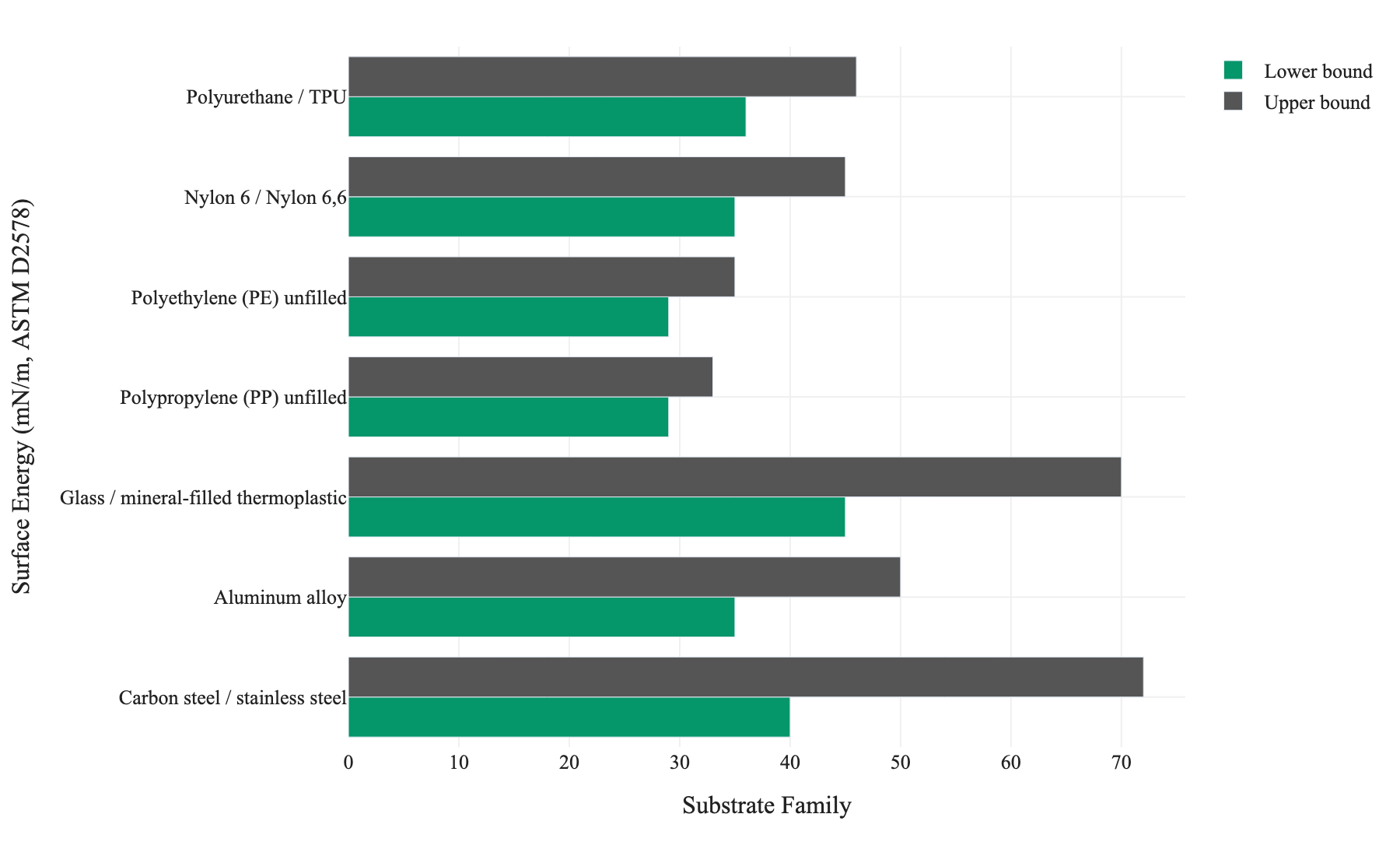
Substrate Family | Surface Energy (mN/m, ASTM D2578) | Recommended Primer Chemistry | Compatible Adhesive Families |
|---|---|---|---|
Carbon steel / stainless steel | 40-72 (as-cleaned) | Silane (amino or epoxy functional) | Epoxy, polyurethane, methacrylate |
Aluminum alloy | 35-50 (as-cleaned, varies by alloy and pretreatment) | Silane (amino functional) or isocyanate | Epoxy, polyurethane, structural acrylic |
Glass / mineral-filled thermoplastic | 45-70 (glass surface) | Silane (methacrylate, amino, or vinyl functional, matched to adhesive chemistry) | Methacrylate, epoxy, UV-cure acrylic |
Polypropylene (PP) unfilled | 29-33 | CPO (chlorinated polyolefin) | Structural acrylic, polyurethane, hot-melt PUR |
Polyethylene (PE) unfilled | 29-35 | CPO (chlorinated polyolefin) | Structural acrylic, polyurethane |
Nylon 6 / Nylon 6,6 | 35-45 | Isocyanate-functional primer | Polyurethane, epoxy, cyanoacrylate |
Polyurethane / TPU | 36-46 | Isocyanate-functional primer | Polyurethane, reactive hot-melt |
Figure 2. Service Environment Qualification and Aging Risk by Substrate Family
Substrate Family | Service Environment Qualification | Aging Risk if Mis-Paired |
|---|---|---|
Carbon steel / stainless steel | Good to Excellent for all conditions; avoid silane on oily or mill-scale surfaces without grit-blast pretreatment | CPO on steel: no covalent bonding; fails at primer-metal interface within 6-12 months at >70% RH |
Aluminum alloy | Excellent for aerospace and automotive thermal cycling; isocyanate preferred for anodized surfaces with low hydroxyl density | CPO on aluminum: weak physisorption; isolation under thermal cycling at >80 degrees C |
Glass / mineral-filled thermoplastic | Excellent; match silane organofunctional group to adhesive cure chemistry; methacrylate silane with methacrylate adhesive, amino silane with epoxy | Wrong functional group on silane reduces lap-shear retention by 30-50% at 500-hr aging (ASTM D3163) |
Polypropylene (PP) unfilled | Good for automotive exterior trim at -30 to 90 degrees C service; requires flame or corona pretreatment if surface energy below 32 mN/m | Silane on PP: no reactive surface groups; bond fails within 6 months under 85% RH cycling |
Polyethylene (PE) unfilled | Moderate; PE is more susceptible to surface oxidation reversion than PP; verify surface energy within 4 hours of CPO application | Isocyanate on PE: insufficient reactive groups; <1.5 MPa lap-shear after 500-hr aging (ISO 4587) |
Nylon 6 / Nylon 6,6 | Good for structural loads; isocyanate primer must be within pot life at application; moisture-activated application conditions (50-80% RH) beneficial | CPO on nylon: hydrocarbon backbone of CPO incompatible with nylon surface chemistry; adhesion degrades under thermal shock at >80 degrees C |
Polyurethane / TPU | Good to Excellent; NCO-to-urethane chain extension creates covalent network with substrate; best long-term resistance for automotive seating and footwear assembly | Silane on TPU: marginal initial adhesion, fails systematically under flex fatigue at >500,000 cycles |
The surface energy ranges in these tables are based on ASTM D2578-17 wetting tension test data and published contact-angle goniometry from supplier technical libraries (ASI, 2020-2022; verification of exact ranges advised for site-specific substrates before finalizing primer selection). "As-cleaned" measurements assume solvent wipe or detergent wash pretreatment but no corona, flame, or plasma activation unless stated. Surface energy is a site-variable: the same substrate lot can vary by 3 to 8 mN/m depending on storage age, mold-release contamination, and ambient temperature at measurement.
The most common mis-pairing error is silane on polyolefin. This combination is the source of the majority of aging bond-line failures in automotive exterior trim assembly, because silane primers are the default recommendation for metal substrates and metal-adjacent plastic brackets may be primed with the same silane product used on the steel body panel without a material audit. The failure mode is predictable: initial lap-shear meets specification, ISO 4587 aged testing at 70 degrees C for 500 hours shows 60 to 80 percent strength loss, and the failure mode analysis blames the structural acrylic adhesive.
IV. Cost of Mis-Paired Primer: Field Returns, Warranty, and Bond Audit
Primer mis-pairing imposes costs across three budget lines: direct warranty and rework expense, product liability exposure from field returns, and the indirect cost of a forensic bond audit that is required before a corrective primer specification can be issued. Understanding this cost structure explains why a primer selection error that costs less than USD 0.50 per part in material terms can result in total program costs exceeding USD 1 million per model year in automotive volume production.
What Does a Primer-Driven Warranty Claim Actually Cost?
In automotive exterior trim assembly, a single trim panel adhesion failure under warranty costs between USD 280 and USD 480 in direct repair cost, including labor, replacement panel, and adhesive re-bonding materials. At production volumes of 80,000 to 120,000 vehicles per model year for a mid-volume program, a 1 percent trim-panel warranty return rate driven by primer mis-pairing generates direct warranty costs of USD 224,000 to USD 576,000 per year (verification needed; cost estimates derived from industry benchmarks published in ASI Adhesives and Sealants Industry, 2019-2022, normalized to USD 350 average repair cost). These figures do not include customer satisfaction index impacts or recall exposure if the adhesive failure creates a safety concern.
In aerospace assembly, the cost structure is different in magnitude but similar in pattern. A single bond-joint rework on a composite access panel, driven by a failed primer inspection at depot maintenance, costs USD 4,000 to USD 12,000 in direct labor at FAA-certified shop rates (35 to 55 USD per hour at 80 to 120 hours per panel), plus material costs and aircraft-on-ground time if the panel is on a revenue-generating airframe. A systematic primer mis-pairing that requires a fleet-wide bond inspection adds the cost of a supplemental type certificate (STC) amendment or an airworthiness directive (AD) compliance program, which ranges from USD 200,000 to USD 1.2 million in regulatory and engineering costs, depending on the scope and fleet size (verification needed).
Why Does the Diagnosis Blame the Adhesive?
The forensic signature of a primer mis-pairing failure is often misread because the failure locus appears to be at or near the adhesive-substrate interface rather than within the primer film. When a silane primer on a polypropylene surface fails under aging, the silane film delaminates from the PP substrate carrying the adhesive layer with it. The detached bond-line presents a clean PP surface and a primer-adhesive composite on the detached face. A technician reading this failure pattern without a primer chemistry audit will record it as "adhesive-to-substrate failure" rather than "primer-to-substrate failure." The corrective action specified is often an adhesive reformulation or a change of adhesive supplier, neither of which addresses the silane-on-polyolefin mis-pairing.
This misdiagnosis can persist through two or three production runs and two or three adhesive reformulations before a systematic bond audit identifies the primer as the actual failure variable. The cost of these repeated investigation cycles, including engineering time, adhesive qualification testing (typically USD 15,000 to USD 35,000 per formal qualification program), and continued warranty exposure during the investigation period, routinely exceeds the cost of the original primer specification error by a factor of 20 to 50.
Bond Audit as a Cost Control Mechanism
A structured bond audit, conducted when the primer specification is first established rather than after failures appear in the field, costs approximately USD 8,000 to USD 20,000 for a medium-complexity assembly program. The audit includes substrate surface energy measurement per ASTM D2578-17, primer chemistry verification by Fourier-transform infrared spectroscopy (FTIR), initial and aged lap-shear testing per ASTM D1002 (lap shear of adhesive-bonded metal joints) and ISO 4587:2003 (adhesively bonded wood-based panels and components, used by extension for multi-substrate bond qualification), and cross-cut tape testing per ASTM D3359. Conducted at program launch, this audit prevents the mis-pairing error before production scale-up. Conducted retrospectively after field returns, it is the minimum prerequisite for issuing a corrective primer specification.
V. Selection by Substrate, Adhesive Type, and Service Environment
The selection matrix in Section III provides the starting point; practical application requires layering three additional qualifiers: adhesive cure chemistry compatibility, service temperature range, and pretreatment state. Each qualifier can override a matrix recommendation or require a primer system change.
Matching Primer Organofunctional Group to Adhesive Chemistry
For silane-primed substrates, the organofunctional group on the silane must be compatible with the adhesive's crosslinking chemistry. An amino-functional silane (gamma-aminopropyltriethoxysilane, or gamma-APS) is reactive with epoxy adhesives because the amine group participates in epoxide ring-opening. Applying the same amino silane under a methacrylate adhesive creates no covalent coupling at the silane-adhesive interface; the primer provides substrate anchoring but not adhesive-side anchoring, leaving a weak boundary layer that fails in peel at loads 25 to 40 percent below the fully coupled system (verification needed; consistent with silane-adhesive coupling theory in ASI technical literature, 2018-2021). The correct silane for methacrylate adhesives is a methacrylate-functional silane (3-methacryloxypropyltrimethoxysilane), and for polyurethane adhesives, an isocyanate-reactive silane or co-use of a silane plus an isocyanate primer is the preferred system.
For CPO primers on polyolefin substrates, adhesive compatibility is less functional-group-sensitive because the CPO's adhesion to both substrate and adhesive is primarily physical rather than covalent. The key qualifier is adhesive polarity: structural acrylic and polyurethane adhesives, which have surface energies in the 35 to 50 mN/m range, wet the CPO-treated surface adequately. Epoxy adhesives with higher surface tension may not wet CPO-treated polyolefin surfaces uniformly and are not the preferred adhesive type for this substrate-primer combination.
Service Temperature Range and Primer Thermal Stability
Primer thermal stability determines whether the coupling mechanism survives service conditions. Silane primers on steel and aluminum show good thermal stability to approximately 150 degrees C continuous service; at higher temperatures, the siloxane bonds begin to hydrolyze under moisture attack even in the absence of external water (verification needed; consistent with ASTM D4065 dynamic mechanical analysis data in supplier literature, 2019-2022). CPO primers on polypropylene are limited by the Tg of the CPO resin: most commercial CPO primers have a glass transition temperature in the range of 55 to 75 degrees C, and continuous service above 90 degrees C causes CPO film softening, viscous flow under bond-line load, and progressive creep failure. This limit is critical for automotive underhood applications where polypropylene brackets may see continuous temperatures of 80 to 110 degrees C.
Isocyanate primers on nylon and TPU show the best elevated-temperature retention of the three chemistries, because the urethane-bond network that forms during curing has a cohesive strength that is higher than the substrate yield stress at moderate temperatures. Service to 120 degrees C is achievable with appropriately formulated isocyanate primer systems.
Pretreatment State and Surface Energy Verification
The primer selection matrix assumes a defined pretreatment state. Deviating from that state changes the surface energy and surface chemistry, which may invalidate the matrix recommendation. Specifically:
Flame treatment or corona treatment of polyolefin substrates increases surface energy from the 29 to 35 mN/m as-molded range to 40 to 55 mN/m by introducing carbonyl, hydroxyl, and carboxyl groups through oxidation. A corona-treated polypropylene surface at 48 mN/m is compatible with some polar adhesives without a CPO interlayer, but the treated surface reverts toward baseline energy within 24 to 72 hours if not bonded immediately. If the time between corona treatment and CPO primer application exceeds 4 hours, the surface energy may have reverted sufficiently to reduce CPO adhesion to the substrate. The ASTM D2578-17 wetting tension test should be performed at the time of primer application, not at the time of corona treatment, to confirm that the surface energy is within the acceptable window.
Grit-blast pretreatment on steel increases surface area and removes mill scale and oxide contamination, but it also introduces surface roughness that affects primer film continuity. A primer film applied to a blast-cleaned steel surface with Ra greater than 6 micrometers may not provide continuous coverage at the valley peaks, leaving unprimed metal exposed to adhesive contact. For rougher blast profiles, a higher primer application rate or a second primer pass is required to ensure complete coverage.
VI. Field Cases: Automotive, Aerospace, and Consumer Product Assembly
The three cases below use anonymized company identifiers. Each case describes the assembly context, the primer specification error, the failure pattern that presented in the field, and the corrective actions taken. The cases are selected to represent three distinct narrative patterns: unexpected cause, incident trigger, and gradual improvement.
Case A: Automotive Trim Assembly, Silane on Polypropylene Bumper Bracket (Unexpected Cause Pattern)
Company A is a Tier 1 automotive trim supplier producing approximately 95,000 exterior bumper assemblies per model year for a mid-size sedan program. The bumper assembly joins a chrome-plated ABS (acrylonitrile butadiene styrene) fascia to a glass-fiber-reinforced polypropylene (GF-PP) structural bracket using a two-component structural acrylic adhesive with a manufacturer's specified lap-shear strength of 6.5 to 8.0 MPa on steel per ASTM D1002-10. The primer specification at program launch called for an epoxy-functional silane primer applied to both bond faces: the chrome-plated ABS surface (which is metallic and presents hydroxyl groups through the chrome flash layer) and the GF-PP bracket surface.
Initial qualification testing at 23 degrees C passed. ASTM D3359 cross-cut tape testing returned a 5B classification on both surfaces. The program launched at volume production. At 11 months post-launch, warranty return data showed a trend: 1.4 percent of assembled units were presenting bumper delamination at the bracket bond-line, characterized by clean separation at the GF-PP surface. Internal failure mode analysis by Company A attributed the failure to "adhesive wetting failure on the PP surface due to mold release residue." Three production runs were completed with enhanced mold-release cleaning, and the warranty return rate remained at 1.2 to 1.6 percent. Total warranty cost at this point was USD 312,000 across 18 months.
A bond audit commissioned at month 20 post-launch identified the primer specification as the controlling variable. ASTM D2578-17 wetting tension measurement on the GF-PP bracket surface returned 31 mN/m, confirming the surface was in the polyolefin wetting-tension range where silane coupling provides no covalent anchoring. FTIR analysis of the detached primer film confirmed no silane-to-substrate condensation product: the silane was physically deposited but not chemically bonded. Corrective action replaced the silane primer on the GF-PP bracket face with a CPO primer at 4 micrometers dry film thickness; the chrome-ABS face retained the epoxy silane. ISO 4587 aged lap-shear testing at 70 degrees C and 95 percent RH for 500 hours returned 5.8 MPa for the corrected system versus 1.3 MPa for the original silane-on-GF-PP system. The warranty return rate dropped to 0.1 percent within two production cycles following the primer change. Total cost of the investigation and corrective action: USD 48,000. Total warranty cost prior to correction: USD 312,000.
Case B: Aerospace Composite Panel, Expired Pot-Life Isocyanate Primer (Incident Trigger Pattern)
Company B is a Tier 2 aerospace aerostructure supplier producing composite access panels for a regional commercial aircraft program. Each panel (approximately 0.4 m2) is bonded to an aluminum sub-frame using a two-component polyurethane structural adhesive at a bond-line shear specification of 4.5 MPa minimum per ASTM D1002. The primer specification calls for a two-component isocyanate-functional primer on the aluminum sub-frame, applied and allowed to tack-dry for 20 to 40 minutes before adhesive application.
The incident trigger was a single panel delamination discovered during a scheduled depot maintenance inspection at 18 months post-delivery on an aircraft that had accumulated 4,200 flight hours. The delaminated panel showed clean separation at the aluminum-primer interface with the adhesive and primer film adhering as a unit to the composite face. The initial investigation suspected hydraulic-fluid contamination of the aluminum sub-frame surface, consistent with known service-environment exposure for this panel location. SSPC-SP 1 solvent-cleaning verification and Bresle patch salt testing returned negative (below threshold), ruling out contamination.
The investigation identified the failure variable when production records from the panel's manufacturing date were reviewed. The isocyanate primer mixing log showed that the mixed primer batch had been held in the applicator pot for 6.2 hours before application to the affected panel, against a specified pot life of 4 hours at 23 degrees C. The primer had been applied within the nominal application window by shift schedule, but the pot life had expired during a line stoppage earlier in the shift. The primer film that reached the substrate contained NCO groups that had been consumed by reaction with atmospheric moisture during the pot-life exceedance, leaving no reactive isocyanate available for substrate anchoring.
Corrective action updated the primer batch tracking procedure to require a time-stamp log at both mix and application, with a manufacturing execution system (MES) alert if the interval exceeds 3.5 hours (15-minute buffer inside the 4-hour limit). A 100 percent initial adhesion pull-test per ASTM D4541 was added as a first-article inspection step for each primer batch. The panel replacement cost for the single incident was USD 9,400 in labor and material at depot rates. Fleet-wide bond inspection of 140 panels on 70 aircraft of the same type, conducted as a precautionary measure, added USD 196,000 in inspection cost. The root cause determination and corrective action documentation (including submission to the airworthiness authority) required 340 engineering hours over 8 weeks.
Case C: Consumer Product Assembly, CPO Primer Thermal Stability Limit (Gradual Improvement Pattern)
Company C is a manufacturer of industrial hand-tool housings assembled from unfilled high-density polyethylene (HDPE) shells bonded with a hot-melt polyurethane reactive adhesive. The tool operates at ambient to 60 degrees C surface temperature on the housing during extended use cycles. Assembly volume is approximately 220,000 units per year. The original primer specification used a CPO primer at 3 micrometers dry film thickness, consistent with PE substrate requirements, applied by spray at 22 to 24 degrees C.
At six months post-launch, warranty returns for handle delamination were zero. At twelve months, the return rate was 0.3 percent (660 units). At eighteen months, it had increased to 1.1 percent (2,420 units). The gradual increase pattern indicated a time- and use-dependent degradation rather than a manufacturing defect. Inspection of returned units showed cohesive failure within the CPO primer film rather than at the CPO-HDPE interface or the CPO-adhesive interface, characterized by a thin residue of CPO material left on both the HDPE substrate and the adhesive backface.
Thermal imaging of the tool during high-intensity use cycles recorded housing surface temperatures of 68 to 74 degrees C at the bond line, exceeding the CPO primer glass transition temperature of 62 degrees C specified in the product datasheet. At temperatures above Tg, the CPO film transitions from a rigid coupling layer to a viscous film, and under bond-line peel and shear stress during use, cohesive flow begins. The failure rate correlated with use intensity and ambient temperature: returns were disproportionately concentrated in customers reporting high-volume continuous use in warm climates.
Stage 1 corrective action (months 19-21): reformulate CPO primer with a higher-Tg CPO resin (Tg 78 degrees C), maintaining the 3-micrometer application specification. Return rate at 24 months: 0.4 percent. Stage 2 corrective action (months 22-24): add an isocyanate topcoat layer over the CPO primer to create a hybrid CPO-isocyanate primer system, providing the CPO's substrate compatibility with the HDPE surface and the isocyanate's thermal stability. Return rate at 30 months: 0.05 percent. The hybrid primer system added USD 0.18 per unit in material cost (USD 39,600 per year at volume), against a warranty repair cost savings of approximately USD 112,000 per year at the pre-correction return rate and an average repair cost of USD 46 per unit. Net benefit: USD 72,400 per year.
Assembly design engineers facing a similar gradual-increase failure pattern in a polyolefin-substrate assembly operating at elevated temperature should submit the case, including thermal imaging data, service temperature profile, and CPO product datasheet, to AI Shooting, Lubinpla's per-case industrial chemistry analysis service. AI Shooting returns an evidence-based root-cause analysis and primer re-specification recommendation within three to five business days, without the six-to-eighteen-month diagnostic timeline that characterized Case C before the primer thermal limit was identified.
VII. Key Takeaway
Silane coupling agents require hydroxylated inorganic surfaces (steel, aluminum, glass, mineral-filled thermoplastic) for covalent anchoring. Applied to polyolefin substrates (PE, PP) with surface energies below 36 mN/m per ASTM D2578-17, they produce an uncoupled interface that will fail under ISO 4587 humidity aging within 6 to 18 months regardless of adhesive performance.
Chlorinated polyolefin primers are the correct primer for PE and PP substrates. CPO performance is limited by its glass transition temperature (typically 55 to 75 degrees C for commercial products). Applications with bond-line temperatures above 65 degrees C require a high-Tg CPO reformulation or a hybrid CPO-isocyanate system.
Isocyanate-functional primers require reactive surface groups (hydroxyl, amine, urethane) and must be applied within pot-life limits. Pot-life exceedance produces a primer film that passes visual inspection and initial adhesion testing but fails systematically under ISO 4587 aged lap-shear. A time-stamp control at mix and at application, with a manufacturing alert at 85 percent of pot life elapsed, prevents this failure mode.
Mis-paired primers are routinely diagnosed as adhesive failures because the failure locus presents at or near the adhesive-substrate interface. A forensic bond audit that includes ASTM D2578-17 surface energy measurement, FTIR primer chemistry verification, and ISO 4587 aged lap-shear is the minimum investigation required to distinguish primer failure from adhesive failure.
When a bond-line aging failure case has been attributed to the adhesive but the primer specification has not been formally audited, submit the case documentation (substrate specification, primer product and application records, adhesive type, failure locus photographs, and any available lap-shear data) to AI Shooting for structured root-cause analysis. AI Shooting operates as Lubinpla's per-case industrial chemistry analysis service, returning a written, evidence-based investigation report that distinguishes primer-interface, adhesive cohesive, and substrate-pretreatment failure modes.
VIII. References
ASI Adhesives and Sealants Industry. (2020). Adhesion Promoters and Primers: Technology Update. ASI Magazine. https://www.adhesivesmag.com/articles/adhesion-promoters-primers-technology-update
ASI Adhesives and Sealants Industry. (2019). Calculating the True Cost of Adhesive Bond Failures in Automotive Assembly. ASI Magazine. https://www.adhesivesmag.com/articles/cost-adhesive-bond-failures-automotive
ASTM International. (2017). ASTM D2578-17: Standard Test Methods for Wetting Tension of Polyethylene and Polypropylene Films. ASTM International. https://www.astm.org/d2578-17.html
ASTM International. (2010). ASTM D1002-10: Standard Test Method for Apparent Shear Strength of Single-Lap-Joint Adhesively Bonded Metal Specimens by Tension Loading (Metal-to-Metal). ASTM International. https://www.astm.org/d1002-10.html
ASTM International. (2022). ASTM D3163-01 (Reapproved 2022): Standard Test Method for Determining the Strength of Adhesively Bonded Rigid Plastic Lap-Shear Joints in Shear by Tension Loading. ASTM International. https://www.astm.org/d3163-01r22.html
ASTM International. (2017). ASTM D3359-17: Standard Test Methods for Rating Adhesion by Tape Test. ASTM International. https://www.astm.org/d3359-17.html
ASTM International. (2021). ASTM D2651-01 (Reapproved 2021): Standard Guide for Preparation of Metal Surfaces for Adhesive Bonding. ASTM International. https://www.astm.org/d2651-01r21.html
ASTM International. (2004). ASTM D4065-01 (Reapproved 2004): Standard Practice for Plastics: Dynamic Mechanical Properties: Determination and Report of Procedures. ASTM International. https://www.astm.org/d4065-01r04.html
ISO. (2003). ISO 4587:2003: Adhesives: Determination of Tensile Lap-Shear Strength of Rigid-to-Rigid Bonded Assemblies. ISO. https://www.iso.org/standard/29581.html
ISO. (2009). ISO 9664:1993 (as referenced in ASI technical literature): Adhesives: Test Methods for Fatigue Properties of Structural Adhesives in Tensile Shear. ISO. https://www.iso.org/standard/17604.html
Petrie, E. M. (2007). Handbook of Adhesives and Sealants (2nd ed.). McGraw-Hill. https://www.mhprofessional.com/handbook-of-adhesives-and-sealants-2nd-edition-9780071479165-usa
Plueddemann, E. P. (1991). Silane Coupling Agents (2nd ed.). Plenum Press. https://link.springer.com/book/10.1007/978-1-4899-2070-6
SSPC: The Society for Protective Coatings. (2015). SSPC-SP 1: Solvent Cleaning. AMPP. https://www.ampp.org/standards/standard?id=sspc-sp-1
Wake, W. C. (1982). Adhesion and the Formulation of Adhesives (2nd ed.). Applied Science Publishers. https://link.springer.com/book/10.1007/978-94-009-7561-0