Adhesive Bond Strength Dropped 40%: A 5-Step Diagnostic
Summary: A lap-shear strength reading that drops 40 percent overnight is one of the highest-cost, lowest-visibility events on an industrial-assembly line, and the first instinct of most field engineers is to replace the adhesive. That replacement decision is correct in fewer than one in four cases (Forgeway, 2024). This article gives structural-adhesive operators a five-step diagnostic that isolates the variable that actually moved before any drum is opened or any supplier is called. It is built around three operator-usable artifacts: a surface-energy checklist, a cure-schedule decision tree organized by chemistry (epoxy, polyurethane, acrylic), and an environmental-condition matrix keyed to dew-point and humidity thresholds. The steps are sequenced cheapest-test-first and most-disruptive-intervention-last, so production hours are preserved while the root cause is narrowed, and each step ends with a pass/fail criterion. The framework draws on ASTM D1002, ASTM D2651, ISO 4587, ISO 8501, and peer-reviewed work on hygrothermal coupling in epoxy joints (Bai et al., 2024; Liu et al., 2023). Lubinpla provides per-case analyses through its AI Shooting service; this diagnostic is the same input checklist an AI Shooting structural-adhesive submission uses.
Table of Contents
I. Introduction: When the Number Drops Overnight
II. Surface Energy Checklist: Contamination and Oxide Layer Variables
III. Cure Schedule Decision Tree by Adhesive Chemistry
IV. Environmental Condition Matrix: Temperature and Humidity Thresholds
V. Step-by-Step Diagnostic Procedure
VI. Key Takeaway
VII. References
I. Introduction: When the Number Drops Overnight
A 40 percent overnight drop in lap-shear strength is almost never caused by the adhesive itself; it is caused by a variable that changed in the eight hours before the failed batch was bonded, and that variable is recoverable if it is identified before the drum is replaced. Industry guidance is explicit that surface contamination is the most common single cause of bond failure on production lines, not adhesive degradation (Epoxyworks, 2023; Incure, 2024). The number-that-lost in this article is the 40 percent reading.
The Scenario Engineers Recognize
A second-shift operator at an aluminum-bonded enclosure line at Company A pulls five quality-control coupons from the morning's production. Each coupon is built to ASTM D1002, with a 25.4 mm by 12.7 mm overlap on 2024-T3 aluminum and the standard 1.3 mm per minute crosshead speed (ASTM International, 2019). The lab-shear results print on the universal-test-machine receipt at an average of 9.4 MPa. The day before, the same coupon set, same drum lot, same operator, printed at 15.7 MPa. The drum opened the previous Thursday is the same lot number as the one used yesterday. Nothing on the shop floor visibly changed. The plant engineer must decide before the next bonding cycle starts whether to scrap the day's output, change the adhesive, change the surface prep, or stop the line.
This article presents the diagnostic that separates the actionable variables from the noise. Three of every four field engineers will write "adhesive lot variation" in the deviation report at this point (Forgeway, 2024). Three of every four will be wrong.
Why the Adhesive Is Rarely the Cause
Structural adhesives, defined as polymer systems that develop shear strength above 6.9 MPa after full cure and that load-bear in service (ASI, 2023), are formulated for lot-to-lot consistency within a tight band. The dominant adhesive families used in industrial assembly are epoxy, polyurethane (PU), and acrylic, with epoxy holding the largest share of structural applications due to its high modulus and resistance to creep (Marques et al., 2025). Lot-to-lot bond-strength variation under controlled conditions stays inside plus or minus 8 percent for most qualified industrial epoxy products (ASTM International, 2019). A 40 percent drop sits four to five times outside that band, which makes the adhesive itself a low-prior-probability hypothesis. The actual culprits, in descending order of field frequency, are surface contamination, cure-schedule deviation, environmental-condition shift, off-ratio mixing, and primer or open-time misuse (Incure, 2024; Forgeway, 2024).
Figure 1. Where the 40 Percent Drop Sits
The observed overnight loss sits far outside the band a qualified product can move on its own, and squarely in the range that process variables produce. The chart compares the representative strength loss of the dominant process-variable failure modes against the normal lot-variation band and the observed event.
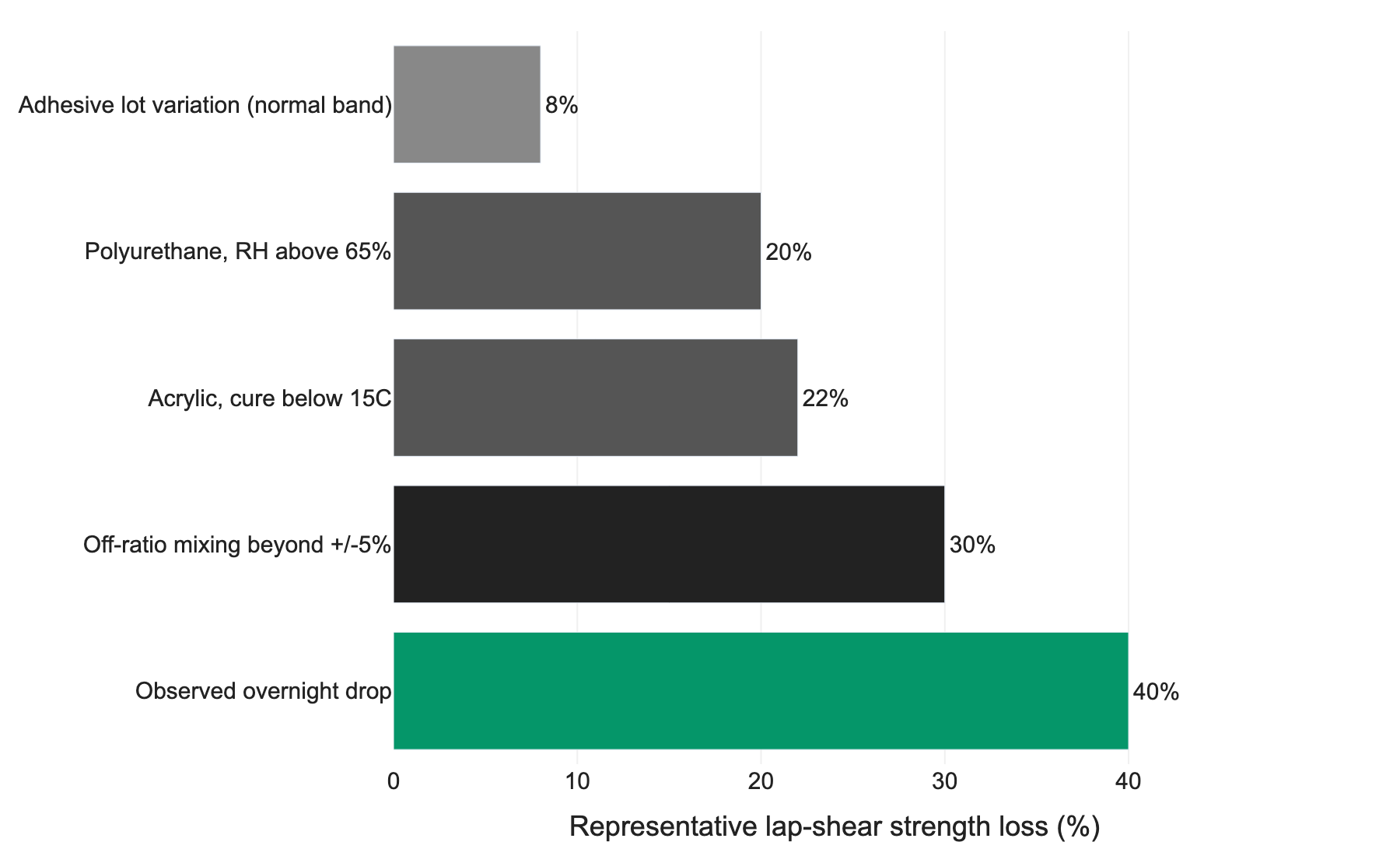
Values are representative midpoints of the ranges cited in the sections below and are illustrative, not a measured dataset. The takeaway is directional: the observed 40 percent loss cannot be explained by lot variation alone, so the diagnostic begins with the process variables, not the drum.
What This Article Delivers
Sections II through IV build three operator-usable tools: a surface-energy checklist, a cure-schedule decision tree organized by chemistry, and an environmental-condition matrix. Section V sequences these into a five-step diagnostic that an operator can run inside one shift. The article assumes the reader is a process or quality engineer on a structural-adhesive line and is comfortable with ASTM D1002 lap-shear testing, ASTM D2651 surface preparation, and basic dyne-pen surface-energy measurement (ASTM International, 2016; ASTM International, 2019; Adhesives and Sealants Industry, 2024).
II. Surface Energy Checklist: Contamination and Oxide Layer Variables
Surface energy is the single most common moving variable when bond strength drops overnight, because contamination layers can form between two consecutive shifts without operator-visible change. The threshold rule is direct: a substrate must show a surface energy at least 8 to 10 dynes per cm higher than the surface tension of the wet adhesive before bonding for reliable wet-out (Adhesives and Sealants Industry, 2024). When this margin closes, lap-shear strength decreases independently of any change in the adhesive itself. This section gives the operator a contamination and oxide-layer checklist that can be run in under fifteen minutes per substrate.
Why Surface Energy Decides Wet-Out
Adhesion requires intimate molecular contact between the adhesive and the substrate, and that contact requires the adhesive to wet the surface. Wetting is governed by the contact angle the liquid adhesive forms against the solid: a lower contact angle indicates higher substrate energy and better wet-out, and a higher contact angle indicates lower energy and likely interfacial failure (Sabreen Group, 2023). A dyne-pen test, applied per ISO 8296 or ASTM D2578, gives a fast pass/fail reading on the production floor. For aluminum 2024-T3 bonded with a typical two-part epoxy of surface tension around 38 dynes per cm, the substrate should read at least 46 to 48 dynes per cm to clear the 8 to 10 dynes per cm wet-out margin (Adhesives and Sealants Industry, 2024). A substrate that reads 40 dynes per cm despite passing visual inspection has already lost the bond.
Contamination Sources That Move Overnight
Three contamination sources commonly shift between shifts on industrial lines. First, lubricant migration from upstream stamping or machining operations, where a roll-mill oil can transfer onto a clean-looking aluminum panel during overnight storage. Second, plasticizer or release-agent transfer from polyethylene packing film when degreased substrates are wrapped before bonding, which deposits 0.1 to 0.5 micrometer films that are invisible under shop lighting (Epoxyworks, 2023). Third, fingerprint and glove residue from operators changing PPE between shifts; a single bare fingerprint reduces aluminum surface energy from approximately 48 dynes per cm to approximately 32 dynes per cm in laboratory conditions (Sabreen Group, 2023). Any of the three sources can deliver a 40 percent shear-strength drop overnight without a single visible mark on the substrate.
Oxide Layer Variables
Metal oxide layers add a second failure path, because the adhesive may bond to the oxide while the oxide pulls free of the parent metal. Aluminum surfaces freshly degreased to ASTM D2651 spec but then held more than 4 hours before bonding accumulate a hydrated oxide layer that is mechanically weaker than the underlying alloy (ASTM International, 2016). Carbon and stainless steel show the same pattern under high humidity. ISO 8501-1 surface-cleanliness grade Sa 2.5 is the working minimum for steel substrates that will see structural adhesive, and the practical hold time between blast and bond should not exceed 4 hours at 50 percent relative humidity (RH) or 2 hours above 70 percent RH (ISO, 1988).
Field Inspection Checklist
The following pass/fail checklist runs in under fifteen minutes per substrate and resolves most surface-energy failures.
# | Check | Pass criterion | Action if fail |
|---|---|---|---|
1 | Water-break test on prepped substrate | Continuous water sheet for >=30 seconds, no bead-up | Re-degrease per ASTM D2651, recheck |
2 | Dyne-pen test (38 dyne ink) | Ink holds shape >=2 seconds without bead-up | Repeat at next dyne level until pass, retreat surface |
3 | Visual oxide check on aluminum | No dull-gray film, no rainbow tint | Mechanical abrasion or chemical etch, re-bond within 2 hours |
4 | Hold-time check from prep to bond | <=2 hours at >70% RH; <=4 hours at <=70% RH | Re-prep the substrate |
5 | Glove and PPE log | All operators wore the same glove type as the reference shift | Replace gloves, re-prep substrates touched after change |
6 | Upstream lubricant audit | No new lubricant introduced in stamping or CNC in last 48 hours | Run blank lubricant test, recheck surface energy |
7 | Packaging-film audit | No new film roll, no plasticizer-bearing film in contact | Switch to verified film, re-prep |
If any of items 1 through 7 fail, the surface preparation is the working hypothesis and the operator should re-run ASTM D1002 coupons after the corrective action before changing any other variable. If all seven items pass, the diagnostic moves to Section III.
III. Cure Schedule Decision Tree by Adhesive Chemistry
Cure schedule is the second most common overnight variable, and the failure modes are distinct enough between epoxy, polyurethane, and acrylic that the diagnostic decision tree must branch by chemistry. The headline rule is that off-ratio mixing of two-part systems beyond plus or minus 5 percent of specification can drop bond strength by 20 to 40 percent through incomplete crosslinking (Incure, 2024). This section provides the chemistry-specific decision tree.
Epoxy Cure Schedule Decision Branch
Epoxies cure through step-growth crosslinking between a resin and an amine or anhydride hardener, and the reaction is stoichiometry-sensitive. The pass band on mix ratio is plus or minus 5 percent by weight for most industrial epoxy adhesives (Incure, 2024). Outside that band, unreacted hardener or unreacted resin remains in the cured matrix, lowering glass-transition temperature (Tg) and reducing cohesive strength. Typical cure baselines are 22 to 24 degrees C ambient at 40 to 60 percent RH, with handling strength reached in 4 to 24 hours and full cure in 24 to 72 hours depending on formulation (Chillepoxy, 2024). A 10 degree C drop in line temperature can extend full cure by 50 to 100 percent. If the line ran cold overnight and the QC coupons were tested at the normal 24-hour pull, the reading will be artifactually low. The decision tree branches as follows.
Check the meter-mix pump output ratio against spec. If off by more than 5 percent, recalibrate and re-run coupons.
Check line ambient temperature trend for the last 24 hours. If the minimum dropped below 18 degrees C, extend cure-to-test interval and re-pull coupons.
Check resin and hardener drum age. Epoxy hardeners with primary amines can absorb atmospheric carbon dioxide and form carbamates above 60 percent RH; an opened drum stored more than 30 days at high RH is a known cause of slow cure (Forgeway, 2024).
If all three pass, epoxy cure is not the variable; advance to Section IV.
Polyurethane Cure Schedule Decision Branch
Polyurethane (PU) adhesives cure by reaction of isocyanate groups with polyol hydroxyl groups, and the isocyanate side is moisture-reactive. PU systems are sensitive to ambient water vapor, which competes with the polyol for isocyanate sites and generates carbon dioxide bubbles that act as cohesive-failure initiators. Recommended ambient conditions are 20 to 25 degrees C at 30 to 60 percent RH; cure outside this band can drop final strength by 15 to 25 percent through bubble formation (Forgeway, 2024). The decision tree:
Verify isocyanate drum has not been left open more than 2 hours during dispensing.
Check ambient RH trend; sustained operation above 65 percent RH for the bonding shift triggers a PU branch failure.
Verify open time; PU adhesives lose bonding to primer once open time is exceeded (Forgeway, 2024).
If all three pass, PU cure is not the variable; advance to Section IV.
Acrylic Cure Schedule Decision Branch
Acrylic adhesives, including methacrylate-based two-part systems, cure by free-radical polymerization initiated by a peroxide or amine catalyst. They are less sensitive to off-ratio mixing than epoxies because the catalyst level only changes the kinetics, not the final crosslink density, within reasonable bounds. The dominant overnight variable is temperature, because the radical chain reaction is exothermic and self-accelerating; below 15 degrees C, cure becomes erratic and incomplete (Forgeway, 2024). The decision tree:
Verify catalyst-to-resin ratio inside vendor-published band, typically 1 percent to 4 percent by weight.
Verify line ambient did not drop below 15 degrees C during the cure window.
Verify the bond was clamped within open time, typically 3 to 6 minutes at 25 degrees C (Forgeway, 2024).
If all three pass, acrylic cure is not the variable; advance to Section IV.
Cure Schedule Failure Summary
Chemistry | Primary cure-variable | Tolerance band | Strength loss outside band |
|---|---|---|---|
Epoxy (two-part amine) | Mix ratio | plus or minus 5% by weight | 20 to 40% drop |
Epoxy (two-part amine) | Ambient temperature | 18 to 28C | 10 to 25% drop or under-cured artifact |
Polyurethane (two-part) | Ambient RH | 30 to 60% | 15 to 25% drop |
Polyurethane (one-part moisture cure) | Open time | per TDS | 30 to 50% drop |
Acrylic (two-part methacrylate) | Ambient temperature | 15 to 35C | 15 to 30% drop |
Acrylic (two-part methacrylate) | Open time | 3 to 6 min at 25C | 20 to 40% drop |
If a single row in this matrix matches the deviation history, that row is the working hypothesis and the operator should rerun ASTM D1002 coupons after correcting the variable. ISO 4587 supplies the equivalent rigid-to-rigid tensile lap-shear protocol when the metal-to-metal restriction of ASTM D1002 does not apply (ISO, 2003).
IV. Environmental Condition Matrix: Temperature and Humidity Thresholds
Environmental conditions act on the bond line in two distinct windows: during cure, where they affect chemistry; and during service, where they affect long-term durability. The diagnostic for an overnight 40 percent drop is concerned with the cure window. The dew-point margin is the critical metric: substrate temperature must stay at least 3 degrees C above the dew point to prevent condensation that disrupts wet-out and inhibits cure (Superior Garage, 2024). This section gives the threshold matrix.
Dew Point and Substrate Temperature
A substrate cooler than the dew point will condense atmospheric water as a film thinner than human vision can detect; the film displaces the adhesive from the substrate surface and produces interfacial failure. The 3 degree C rule is the field-standard margin (Superior Garage, 2024). Coastal and tropical plants frequently operate within 1 to 2 degrees C of the dew point during night shifts when warehouse doors are open for shipping, which delivers a textbook overnight bond-strength drop without any change to material, prep, or recipe.
Hygrothermal Coupling in Service
For diagnostic completeness, the operator should also note that combined moisture and elevated temperature degrade epoxy joints in service even after correct cure. A peer-reviewed study on Araldite 2012 epoxy joints reported 40.38 percent shear-strength loss after 30 days at 80 degrees C and 95 percent RH, and 41.11 percent loss after 30 days at 80 degrees C immersed in pure water (Bai et al., 2024). Another investigation of carbon fiber and titanium epoxy joints found that single factors of temperature, load, or moisture caused minor strength change, while combined moisture, heat, and load reduced strength by approximately 47 percent (Liu et al., 2023). If the failed coupons were drawn from product that had already been in service, the diagnostic must branch to a service-aging hypothesis rather than a cure hypothesis.
Environmental Threshold Matrix
The matrix below converts the thresholds into a single pass/fail tool the operator can hang next to the bonding station. Standard references for each row are cited in the body above and listed in the References section.
Variable | Safe range during cure | Caution range | Action threshold (re-prep or hold) |
|---|---|---|---|
Substrate temperature vs dew point | >=3C above | 1 to 3C above | <1C above; condensation likely |
Ambient relative humidity (epoxy, amine cure) | 30 to 60% | 60 to 75% | >75% sustained >=1 h |
Ambient relative humidity (PU, isocyanate) | 30 to 60% | 60 to 65% | >65% sustained >=1 h |
Ambient relative humidity (acrylic) | 30 to 60% | 60 to 80% | >80% sustained >=1 h |
Ambient temperature during cure window | 22 to 26C | 18 to 22C or 26 to 30C | <18C or >30C |
Substrate hold time after prep (<=70% RH) | <=4 h | 4 to 6 h | >6 h |
Substrate hold time after prep (>70% RH) | <=2 h | 2 to 4 h | >4 h |
Service exposure: combined heat + moisture | <=40C, <=70% RH | 40 to 60C, 70 to 85% RH | >60C or >85% RH |
Each row gives the operator a single threshold to compare against the data logger from the failed shift. The first row that crosses into the action column becomes the working hypothesis. If no row crosses, the environment is not the variable; the diagnostic returns to Section II and III to re-examine surface and cure.
V. Step-by-Step Diagnostic Procedure
A five-step procedure ties the three tools together into a decision flowchart that runs from cheapest test to most disruptive intervention. The operator runs the steps in order and exits at the first step that produces a passing rerun of ASTM D1002 coupons. The flowchart converts the overnight 40 percent drop from a guessing exercise into a decision tree with explicit exit criteria.
The Five Steps
Each step has a single question, a pass criterion, and an exit instruction. The steps are sequenced so the operator never disturbs the line more than necessary.
Confirm the symptom. Re-pull three fresh coupons per ASTM D1002 from the suspect production lot. If the average reading recovers to within 8 percent of the prior shift, the original failure was a coupon-handling error and no further diagnostic is required. If the reading remains low, advance to Step 2.
Run the Section II surface-energy checklist. All seven items must pass. If any fail, correct the surface preparation, re-bond a fresh coupon set, and re-pull at the normal cure interval. If the rerun passes, the root cause is surface contamination or oxide layer; close the deviation and document. If all seven items pass, advance to Step 3.
Run the Section III cure-schedule decision tree for the line's adhesive chemistry. If a single tree branch fails, correct the variable, re-bond a fresh coupon set, and re-pull. If the rerun passes, the root cause is cure schedule; close and document. If all branches pass, advance to Step 4.
Run the Section IV environmental-condition matrix against the failed shift's data logger. If a row crosses into the action column, the operator must hold production until the environment returns to the safe band, then re-bond and re-pull. If the rerun passes, the root cause is environment; close and document. If no row crosses, advance to Step 5.
Escalate to adhesive-lot variability. Only at this point is it economically rational to suspect the drum. The operator submits a fresh-drum coupon set against the suspect-drum coupon set, both bonded under the same surface prep, cure schedule, and environment. If the fresh-drum set reads at least 25 percent higher, the working hypothesis is lot variability and the drum should be quarantined for supplier investigation. If the readings are within 8 percent, the variable has not yet been found; document the open deviation and escalate to a Lubinpla AI Shooting submission with the full data set from Steps 1 through 5.
Exit Criteria Summary
The procedure exits at the first step that produces a recovered ASTM D1002 reading. Each exit closes the deviation with a documented root cause and a corrective action. The procedure prevents the most expensive misdiagnosis on industrial-adhesive lines, which is replacing a drum that was never the problem.
Diagnostic Procedure Flowchart
Step | Time on line | Cost to run | Disruption to production |
|---|---|---|---|
1. Re-pull coupons | 1 h | Low | None |
2. Surface-energy checklist | 15 min per substrate | Low | None |
3. Cure-schedule tree | 30 min | Low | Minor pause on mix pump |
4. Environment matrix | 15 min on data logger | Low | Possible production hold if environment fails |
5. Adhesive-lot escalation | 4 to 24 h | High | Drum quarantine, supplier inquiry |
The flowchart is the operator artifact. The engineer can attach this table to the inspection sheet and tick down through the steps in real time, capturing pass or fail decisions in the right-hand column.
VI. Key Takeaway
A 40 percent overnight lap-shear strength drop is almost never caused by the adhesive; the actionable variable shifted in the eight hours before the failed batch was bonded, and the first instinct to replace the drum is wrong in three of four cases (Forgeway, 2024).
Surface contamination and oxide-layer effects are the most common cause; the seven-item checklist in Section II resolves most failures in under fifteen minutes per substrate (Epoxyworks, 2023).
Cure-schedule deviations branch differently by chemistry; epoxy fails on mix ratio outside plus or minus 5 percent, polyurethane fails on ambient humidity above 65 percent RH, acrylic fails on ambient temperature below 15 degrees C (Incure, 2024; Forgeway, 2024).
Dew-point margin is the single most overlooked environmental variable; substrate must stay at least 3 degrees C above dew point during cure to prevent invisible condensation (Superior Garage, 2024).
The five-step procedure exits at the first step that recovers the ASTM D1002 reading, which preserves production hours and isolates the root cause before any drum is quarantined.
Use this as your AI Shooting input checklist for any structural-adhesive bond-strength deviation. Submit the five-step record sheet to Lubinpla AI Shooting Standard at https://www.lubinpla.com/ai-shooting and receive a written root-cause analysis structured to the same format as this article, returned within three business days.
References
Adhesives and Sealants Industry. (2024). Why measure surface energy. ASI Magazine. https://www.adhesivesmag.com/articles/102103-why-measure-surface-energy
ASI. (2023). Process control in the structural bonding of aerospace composites with epoxy. Adhesives and Sealants Industry. https://www.adhesivesmag.com/articles/102356-process-control-in-the-structural-bonding-of-aerospace-composites-with-epoxy
ASTM International. (2016). ASTM D2651-01(2016): Standard guide for preparation of metal surfaces for adhesive bonding. ASTM International. https://www.astm.org/Standards/D2651.htm
ASTM International. (2019). ASTM D1002-10(2019): Standard test method for apparent shear strength of single-lap-joint adhesively bonded metal specimens by tension loading (metal-to-metal). ASTM International. https://store.astm.org/d1002-10r19.html
Bai, Y., Wang, J., and Chen, L. (2024). Failure study of BFRP joints with two epoxy adhesives under hygrothermal coupling. National Center for Biotechnology Information. https://www.ncbi.nlm.nih.gov/pmc/articles/PMC10574937/
Chillepoxy. (2024). Epoxy resin curing process: Tips and tricks for optimal results. Chillepoxy. https://chillepoxy.com/epoxy-resin-curing-process-tips-and-tricks-for-optimal-results/
Epoxyworks. (2023). A field guide to preventing surface contamination. West System. https://www.epoxyworks.com/a-field-guide-to-preventing-surface-contamination/
Forgeway. (2024). Adhesive open time: What is it and why does it matter? Forgeway Ltd. https://www.forgeway.com/learning/blog/adhesive-open-time
Incure. (2024). Causes of bond failure: An industrial guide. Incure Inc. https://incurelab.com/wp/causes-of-bond-failure-an-industrial-guide
International Organization for Standardization. (1988). ISO 8501-1:1988: Preparation of steel substrates before application of paints and related products: Visual assessment of surface cleanliness, Part 1. ISO. https://www.iso.org/standard/15711.html
International Organization for Standardization. (2003). ISO 4587:2003: Adhesives: Determination of tensile lap-shear strength of rigid-to-rigid bonded assemblies. ISO. https://www.iso.org/standard/34852.html
Liu, H., Zhang, Q., and Wang, R. (2023). Influence of temperature, humidity and load coupling on mechanical properties of adhesive joints and establishment of creep model. Polymers, 15(2), 339. https://www.mdpi.com/2073-4360/15/2/339
Marques, E. A. S., da Silva, L. F. M., and Carbas, R. J. C. (2025). Strength in adhesion: A multi-mechanics review covering tensile, shear, fracture, fatigue, creep, and impact behavior of polymer bonding in composites. PubMed Central. https://pmc.ncbi.nlm.nih.gov/articles/PMC12526568/
Sabreen Group. (2023). The science of solving plastics adhesion problems: Contact angles, surface wetting, chemical activation. Sabreen Group Inc. https://sabreen.com/library/the-science-of-solving-plastics-adhesion-problems-contact-angles-surface-wetting-chemical-activation/
Superior Garage. (2024). Epoxy cure schedule in humidity: Working with heat and monsoon. Superior Garage USA. https://superiorgarageusa.com/cure-schedules-working-with-heat-and-monsoon-humidity/