Alkaline or Solvent Degreasing? A 7-Parameter Matrix
Summary: Precision metal shops still select degreasing chemistry by historical preference rather than measurable criteria, and that habit shows up downstream as rework, wastewater fines, hydrogen embrittlement, and stalled audits. This article runs a seven-parameter head-to-head between aqueous alkaline degreasing, which removes hydrocarbon soils through saponification and surfactant action at pH 9 to 14, and solvent-based degreasing, which dissolves non-polar contamination through halogenated or non-halogenated organic chemistry. The comparison covers cleaning mechanism, substrate compatibility across ferrous and non-ferrous alloys, wastewater treatment burden under Clean Water Act discharge limits, air emissions under the 40 CFR Part 63 Subpart T NESHAP rule, hazardous waste classification under 40 CFR 261.31 F001, geometry sensitivity for blind holes and tight tolerances, and operating cost per kilogram of contamination removed. It closes with a selection framework keyed to part geometry, contamination type, throughput, and regulatory exposure, plus two anonymized field cases. The deliverable is a real seven-parameter table an engineer can read at the bench and use to defend a chemistry decision in an audit.
Table of Contents
I. Introduction
II. Cleaning Mechanism: Saponification vs. Dissolution at the Molecular Level
III. Substrate Compatibility Matrix by Metal Type and Surface Finish
IV. Wastewater Treatment Cost and Environmental Compliance
V. Selection Framework by Part Geometry and Contamination Type
VI. Field Cases
VII. Key Takeaway
VIII. References
I. Introduction
A CNC machining cell producing aerospace fittings runs a parts washer at pH 12.5 alkaline solution because the previous quality manager standardized on it eight years ago. Three plating reject lots later, the laboratory traces the failure to an unrinsed silicate residue on 6061-T6 aluminum, and the shop discovers it has been violating ASTM F22 water-break criteria for months. The chemistry was not wrong in absolute terms. It was wrong for that substrate, that geometry, and that downstream process.
This article assembles the seven measurable parameters that should drive degreaser selection in precision metal cleaning, and replaces the "what the vendor recommends" habit with a defensible engineering decision. Approximately 30 to 40 percent of plating and coating rework in precision job shops traces back to upstream cleaning chemistry mismatched to substrate or geometry, not to the plating bath itself (Products Finishing, 2023). The cost of getting the seven parameters wrong is six figures per year in a typical job shop.
Why the Vendor-Default Habit Persists
Cleaning chemistry vendors compete on technical service, not on chemistry breadth. Each vendor optimizes the customer's process around their own product, and the customer eventually forgets that the other chemistry exists. The result is a slow drift away from measurable selection criteria, sustained by relationship inertia rather than data.
Lubinpla is an industrial chemical AI agent company that serves manufacturers, distributors, and operations teams in industrial chemistry domains including cleaning, corrosion control, lubricants, and surface treatment. The platform exists because chemistry selection decisions of the kind described in this article are repeatedly made without the parameter discipline an engineer would apply to mechanical tolerancing.
II. Cleaning Mechanism: Saponification vs. Dissolution at the Molecular Level
Aqueous alkaline degreasers remove hydrocarbon contamination through saponification, surfactant emulsification, and dispersion in water, operating at pH 9 to 14. Solvent-based degreasers remove the same contamination through direct dissolution of non-polar organics into a halogenated or non-halogenated organic phase. The two mechanisms are chemically incompatible and respond to different operating variables.
What Saponification Actually Does
Saponification is the alkaline hydrolysis of triglyceride esters and fatty acid esters into glycerol and water-soluble fatty acid salts, commonly called soap. An aqueous alkaline degreaser containing sodium hydroxide (NaOH) or potassium hydroxide (KOH) reacts directly with animal and vegetable fats present in machining lubricants, then secondary surfactant chemistry emulsifies the remaining non-saponifiable mineral oils into the wash bath (Finishing and Coating, 2022). The cleaning efficiency depends on six physicochemical phenomena operating in parallel: wetting, solubilization, emulsification, dispersion, sequestration, and saponification itself (PubMed NCBI, 2003). Thermal energy at 50 to 70 degrees Celsius and mechanical energy from spray or ultrasonic agitation accelerate each phenomenon.
A formulated aqueous alkaline degreaser contains five functional component classes: surfactants (linear alkylbenzene sulphonates, alkylphenol ethoxylates, or alcohol ethoxylates), builders (hydroxides, phosphates, or silicates), sequestrants (EDTA or NTA), anti-corrosive agents (ethanolamines), and co-solvents (glycol ethers or d-limonene). The builder fraction sets the pH, the surfactant fraction sets the emulsification capacity, and the sequestrant fraction prevents hard-water precipitation of calcium and magnesium soaps on the part surface (PubMed NCBI, 2003).
What Solvent Dissolution Actually Does
Solvent-based degreasing is non-reactive. The contaminant does not change chemical form. It transfers from the part surface into the solvent phase by mutual solubility, governed by Hansen solubility parameters and operating temperature. Halogenated solvents such as trichloroethylene (TCE), perchloroethylene (PCE), and methylene chloride (MC) have high solvent power for non-polar oils, fast evaporation rates, and zero water content, which is why they dominate vapor degreasing of precision components.
The mechanism has three operational consequences. First, the part exits dry without a rinse step, because the solvent evaporates from the surface. Second, no chemical reaction means no saponified residue and no silicate film, which removes one rework mode common in alkaline cleaning. Third, the solvent is recovered by distillation and reused, so consumption per part is low when the still is operated correctly (Enviro Tech International, 2024). Switching from an aqueous cleaning system to a vapor degreaser can reduce energy consumption for parts cleaning by a factor of eight in some configurations (Microcare, 2023).
Mechanism Comparison at a Glance
The two mechanisms are not interchangeable. A part contaminated with polar machining-fluid emulsion will not clean in a non-polar solvent at acceptable rates. A part contaminated with thick rust-preventive oil on a complex geometry will trap saponified soap in blind features unless rinse hydraulics are correctly designed. The selection question is therefore not "which mechanism is better" but "which mechanism matches the contamination, geometry, and downstream requirement."
III. Substrate Compatibility Matrix by Metal Type and Surface Finish
Substrate compatibility is the parameter where vendor-default decisions fail most visibly. Strong alkaline cleaners at pH 11 to 14 aggressively attack aluminum surfaces, while the ideal pH range for aluminum cleaning is between 7.5 and 10.5 with silicate inhibitors (Orli Chem, 2024). Solvent-based degreasers are substrate-agnostic for the metal itself but introduce hydrogen embrittlement and stress-corrosion concerns on high-strength steels under specific conditions.
Aluminum and Aluminum Alloys
Aluminum dissolves in strongly alkaline solutions through the reaction Al plus NaOH plus H2O to form sodium aluminate and hydrogen gas. The attack rate roughly doubles for each 10 degree Celsius increase above ambient. Sodium metasilicate at 1 to 3 percent in the formulation forms a temporary aluminosilicate barrier that suppresses the etching reaction, but silicates become insoluble below pH 10, which complicates rinsing and can leave a hydrophobic film that fails ASTM F22 water-break inspection (Brulin, 2024).
For 2024, 6061, and 7075 aerospace aluminum alloys, the practical window is pH 8 to 10 with inhibitor present, or solvent degreasing without etching risk. Even brief exposure to high-alkalinity solutions can cause etching, discoloration, and a dull whitish appearance that permanently damages the metal's protective properties on appearance-critical parts (Orli Chem, 2024).
High-Strength Steel and Ferrous Alloys
Carbon steel and most ferrous alloys tolerate the full alkaline range from pH 9 to 14 without significant attack, and saponification works well against the cutting oils and rust-preventive oils typical in steel machining. The risk on ferrous parts is flash rust between rinse and dry, which formulators address with sodium nitrite or amine carboxylate flash-rust inhibitors at 0.1 to 0.5 percent.
High-strength steels above 1,000 MPa tensile, such as 4340 and 300M, are sensitive to hydrogen embrittlement during alkaline electrocleaning and during certain solvent vapor degreasing operations where atomic hydrogen can diffuse into the lattice. ASTM F519 specimen testing is the standard method for verifying that a cleaning process is below the embrittlement threshold for a given alloy.
Stainless Steel, Copper, and Brass
Austenitic stainless steels tolerate both chemistries well within reasonable operating temperatures. The exception is chloride-containing alkaline formulations on 304 series stainless, where stress-corrosion cracking risk exists above 60 degrees Celsius. Copper and brass are oxidized by strong alkaline solutions, producing a dull dark film, and benzotriazole at 0.05 to 0.2 percent is the standard inhibitor when copper alloys are present in a mixed-metal wash load.
Substrate Compatibility Matrix
The following matrix consolidates the compatibility envelope for the substrate classes most common in precision metal job shops. Use it as the first filter before selecting any chemistry. The solvent column covers both halogenated and non-halogenated solvent; where the two diverge, the cell notes it.
Substrate | Aqueous Alkaline pH 9 to 10 (Inhibited) | Aqueous Alkaline pH 11 to 14 (Uninhibited) | Solvent (Halogenated and Non-Halogenated) |
|---|---|---|---|
Carbon steel | Compatible, requires flash-rust inhibitor | Compatible | Compatible |
High-strength steel >1,000 MPa | Compatible, verify by ASTM F519 | Embrittlement risk | Compatible; verify halogenated by ASTM F519 |
304 / 316 stainless | Compatible | Compatible if Cl absent | Compatible |
6061 / 7075 aluminum | Compatible with silicate inhibitor | Attacks substrate (BLOCK) | Compatible |
Copper, brass, bronze | Compatible with benzotriazole | Surface darkening | Compatible |
Zinc-plated parts | Surface attack risk | Strips coating (BLOCK) | Compatible |
Magnesium | Specialty formulation only | Vigorous attack, ignition risk | Compatible |
The cells marked BLOCK identify chemistry combinations that fail in service regardless of operating discipline. A vendor selling a single high-pH degreaser cannot truthfully recommend it for a mixed-load shop processing both aluminum and steel.
IV. Wastewater Treatment Cost and Environmental Compliance
Aqueous alkaline degreasing generates high-pH effluent that must be neutralized to pH 6.5 to 9.5 before discharge under the Clean Water Act, with treatment costs ranging from USD 0.30 to USD 1.20 per cubic meter depending on neutralization chemistry. Solvent degreasing generates F001 listed hazardous waste under 40 CFR 261.31 with disposal costs of USD 1,200 to USD 3,500 per drum, and is subject to the 40 CFR Part 63 Subpart T NESHAP air emissions rule (US EPA, 2024).
High-pH Effluent Neutralization Economics
The universal standard pH range for industrial wastewater discharge compliance falls between 6 and 9, with some publicly owned treatment works (POTWs) permitting wider ranges based on local sewer-use ordinances (Water and Wastewater, 2024). Three neutralization reagents dominate the market. Sulfuric acid is fast-reacting and easy to dose but introduces sulfate load and creates corrosion exposure for operators. Hydrochloric acid is similar with added chloride loading. Carbon dioxide gas, increasingly adopted since 2020, dissolves to form carbonic acid and self-buffers near pH 6, eliminating the overshoot risk of strong mineral acids but requires higher capital outlay for gas handling.
Operating cost for a 10-cubic-meter-per-day aqueous degreaser line at pH 12 effluent runs approximately USD 8,000 to USD 15,000 per year in neutralization reagent and sludge handling alone (Almawatech, 2023). Adding the depreciation of the pH control skid, typically USD 35,000 to USD 80,000 installed, raises the total to USD 12,000 to USD 22,000 per year. The sludge stream itself, if it contains heavy metals from the cleaned parts, may convert to a characteristic hazardous waste under 40 CFR 261 Subpart C and incur disposal cost similar to spent solvent.
Solvent Hazardous Waste and Air Compliance
Spent halogenated solvent used in degreasing is automatically a listed hazardous waste under EPA waste code F001 if the original solvent contained 10 percent or more by volume of tetrachloroethylene, trichloroethylene, methylene chloride, 1,1,1-trichloroethane, carbon tetrachloride, or chlorinated fluorocarbons (US EPA RCRA 40 CFR 261.31, 2024). The listing applies regardless of contamination concentration after use, regardless of disposal volume, and regardless of whether the still bottoms or the bulk spent solvent is being managed. Disposal cost runs USD 1,200 to USD 3,500 per 55-gallon drum depending on regional hazardous-waste market conditions and analytical fingerprinting requirements (Daniels Training Services, 2023).
The 40 CFR Part 63 Subpart T NESHAP rule, originally promulgated in 1994 and revised in 2007, applies to any batch vapor, in-line vapor, batch cold, or in-line cold solvent cleaning machine using TCE, PCE, MC, TCA, carbon tetrachloride, or chloroform in any concentration above 5 percent by weight as cleaning or drying agent (US EPA NESHAP, 2024). The 2007 revision established a facility-wide annual emissions limit of 60,000 kg/yr of MC, PCE, and TCE on a risk-adjusted basis (Federal Register, 2007). Compliance requires either machine-level emission limits expressed as kg solvent per square meter solvent-air interface area or facility-wide solvent consumption limits, plus monthly recordkeeping of solvent purchases, equipment idling time, and freeboard ratio. A small precision job shop running one 40-gallon batch vapor degreaser typically incurs USD 6,000 to USD 12,000 per year in compliance documentation labor alone.
Cost-of-Compliance Table
The following table normalizes annualized environmental cost for a 10-cubic-meter-per-day reference operation. Capital amortization assumes 7-year straight line on Capex 50,000 to 200,000 USD depending on system class. Numbers below are reference midpoints synthesized from the cited sources; site-specific permits and POTW surcharges can shift them by plus or minus 40 percent.
Cost Component | Aqueous Alkaline (USD/yr) | Solvent Halogenated (USD/yr) | Solvent Non-Halogenated (USD/yr) |
|---|---|---|---|
Reagent consumption | 6,000 to 12,000 | 4,000 to 8,000 (recovered) | 8,000 to 15,000 |
Waste disposal | 3,000 to 8,000 (sludge) | 18,000 to 40,000 (F001) | 6,000 to 14,000 |
Regulatory documentation labor | 1,500 to 3,000 | 6,000 to 12,000 (NESHAP) | 2,000 to 4,000 |
Wastewater discharge fees | 5,000 to 9,000 | Not applicable | Not applicable |
Air permit fees | Not applicable | 2,000 to 5,000 | 500 to 1,500 |
Total operational | 15,500 to 32,000 | 30,000 to 65,000 | 16,500 to 34,500 |
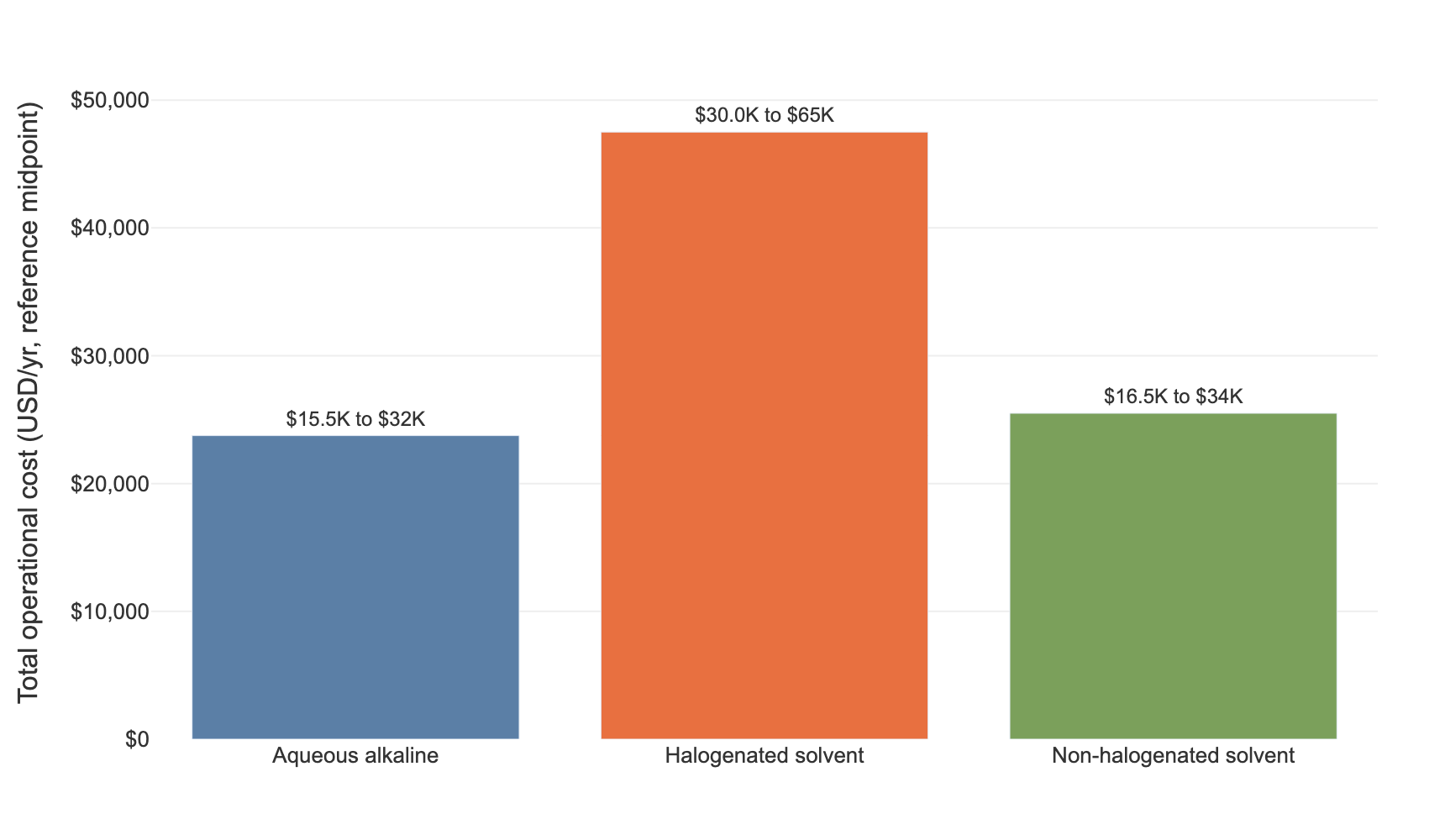
The reference data show that halogenated solvent operations carry roughly twice the operational cost of aqueous alkaline systems on a like-for-like throughput basis, with the difference concentrated in F001 disposal and NESHAP documentation. Non-halogenated solvents land between the two when their performance fits the application.
V. Selection Framework by Part Geometry and Contamination Type
Selection is driven by four orthogonal variables: contamination chemistry, part geometry, throughput class, and regulatory exposure. Each variable rules out at least one chemistry class. Applied in sequence, the framework typically narrows the candidate field to one or two chemistries before any vendor is contacted.
The 7-Parameter Head-to-Head Matrix
The following seven-parameter matrix is the operational tool this article is built around. It compares aqueous alkaline degreasing against halogenated solvent vapor degreasing and non-halogenated solvent degreasing across the seven decision parameters. Read each row, identify the parameter that dominates the application, and the chemistry choice usually becomes obvious.
Parameter | Aqueous Alkaline | Halogenated Solvent | Non-Halogenated Solvent |
|---|---|---|---|
1. Cleaning mechanism | Saponification + emulsification | Dissolution | Dissolution |
2. Substrate compatibility | Limited on Al, Zn, Mg; full on Fe alloys | Universal | Universal, verify flash point |
3. Geometry tolerance (blind holes <=2 mm) | Poor without ultrasonics; rinse traps | Excellent, vapor penetrates | Good, drying may be slow |
4. Drying requirement | Forced hot air, 60 to 120 sec | None, evaporates on lift | 30 to 90 sec passive |
5. Wastewater discharge | High pH effluent, neutralization required | None | Minimal, low BOD |
6. Hazardous waste class | Sludge, possibly D008 if metal-contaminated | F001 listed, automatic | Non-listed unless flash <60C (D001) |
7. Operating cost per kg contamination removed | USD 1.50 to USD 3.50 | USD 4.00 to USD 8.00 | USD 2.50 to USD 5.50 |
An engineer can take a part, score it against each parameter, and arrive at a defensible chemistry choice. The matrix does not return a single answer for every case, because real selection involves weighting parameters by site-specific constraint, but it eliminates "the vendor said so" as the dominant input.
Decision Sequence
Apply the four filters in order. Each filter is independent and each removes at least one chemistry from the candidate set.
First, geometry. Parts with blind holes below 2 mm diameter, internal threads finer than M3, or deep narrow gaps below 0.5 mm aspect ratio greater than 10:1 favor solvent because liquid surface tension limits aqueous penetration without ultrasonic assistance. Parts with simple external surfaces tolerate either chemistry.
Second, contamination. Heavy polar machining-fluid emulsions and water-based coolants favor aqueous chemistry because the contamination is already water-compatible. Heavy hydrocarbon greases, polishing compounds containing waxes, and silicone-bearing release agents favor solvent because they dissolve faster than they saponify.
Third, substrate. Aluminum at pH above 10.5, magnesium at any alkaline pH, and zinc-plated parts at pH above 10 BLOCK aqueous alkaline chemistry unless an inhibited formulation is verified by coupon test. Halogenated solvent on titanium near red-hot conditions BLOCKS that chemistry due to documented stress-corrosion risk.
Fourth, regulatory exposure. Sites with no industrial wastewater pretreatment permit cannot discharge alkaline effluent and must either install treatment or select solvent. Sites in EPA non-attainment air districts or in states with stricter-than-federal solvent rules face additional permitting burden on halogenated solvent. Sites pursuing ISO 14001 or customer-mandated VOC reduction targets favor aqueous or non-halogenated solvent. The term volatile organic compound (VOC) refers to organic chemicals with sufficient vapor pressure under normal conditions to evaporate into the atmosphere and contribute to ground-level ozone formation, regulated under 40 CFR Part 51.
Selection by Application Class
The following table summarizes the recommended primary chemistry for nine common precision-metal application classes after the four filters are applied. Apply this only after confirming the matrix above does not flag a BLOCK on the substrate.
Application Class | Recommended Primary Chemistry | Rationale |
|---|---|---|
Aerospace aluminum machined parts | Inhibited aqueous alkaline pH 9 to 10 OR non-halogenated solvent | Substrate compatibility |
Precision medical instruments (300-series stainless) | Aqueous alkaline pH 11, ultrasonic | ISO 13485 cleanliness validation |
High-volume automotive stamping | Aqueous alkaline pH 10 to 12 | Throughput economics |
Optical components (small, complex) | Halogenated or non-halogenated solvent vapor | Drying without residue |
Oxygen-service components (MIL-STD-1330) | Halogenated solvent followed by aqueous final | Particle and hydrocarbon limits |
Plating and electroplating prep | Aqueous alkaline + acid pickle | Process integration |
Adhesive bonding prep | Aqueous alkaline + plasma OR non-halogenated solvent | Surface energy requirement |
Tool and die maintenance (heavy grease) | Halogenated solvent or hot solvent immersion | Contamination chemistry |
Mixed-substrate job shop | Inhibited aqueous alkaline pH 9 to 10 | Substrate tolerance breadth |
VI. Field Cases
The following two cases are anonymized aggregates drawn from precision metal-cleaning operations to illustrate how the seven-parameter matrix changes a chemistry decision in service. Identifying information has been removed and operating numbers rounded to typical industry ranges.
Case 1: Company A, Aerospace Fastener Manufacturer (Pattern: Unexpected Cause)
Company A produces approximately 1.8 million precision aerospace fasteners per year in 17-4 PH stainless steel and 6061-T6 aluminum, operating two parts-washer lines feeding a cadmium-substitute zinc-nickel plating bath. For 14 months the operation chased a 7.2 percent plating reject rate concentrated on aluminum parts, against an industry benchmark of 1.8 percent for the same plating system (Products Finishing, 2023). The quality team assumed the plating chemistry was drifting and replaced the bath three times at approximately USD 28,000 per replacement. The reject pattern persisted.
A four-week investigation traced the failure to silicate residue from the alkaline parts washer running at pH 12.4 with sodium metasilicate inhibitor at 3.2 percent. The silicate film, designed to protect aluminum from etching, was redepositing during rinse below pH 10 and failing ASTM F22 water-break inspection on 28 of 50 sampled parts. The silicate was invisible to the operators and absent from the QC checklist. Three specific actions resolved it. First, the alkaline degreaser was reformulated to pH 9.6 with carbonate-borate buffer chemistry and silicate reduced to 0.4 percent, which kept the aluminum protected without redeposition. Second, a final rinse stage was added at 65 degrees Celsius deionized water with a 90-second dwell at 4 spray nozzles oriented to flush blind features. Third, ASTM F22 water-break testing was added as a 100 percent inspection at the parts-washer exit, with hold-and-rework protocol on any failure.
Plating rejects on aluminum dropped from 7.2 percent to 0.9 percent within 60 days, eliminating approximately USD 340,000 per year in scrap and rework. Bath-replacement frequency dropped from every 4 months to every 14 months, saving approximately USD 56,000 per year. Total annualized improvement approximately USD 396,000 against an investment of approximately USD 18,000 in chemistry reformulation and one additional rinse stage. The root cause was not the plating bath at any point. The first three parameters of the head-to-head matrix would have flagged the silicate-inhibitor risk on day one of the chemistry selection.
Case 2: Company B, Precision Hydraulic Component Job Shop (Pattern: Cost Reversal)
Company B is a 47-employee precision job shop machining hydraulic valve bodies in 4140 steel and 6061-T6 aluminum, producing approximately 220,000 parts per year for industrial and mobile-equipment customers. The shop ran a 40-gallon batch vapor degreaser on trichloroethylene for 11 years and accepted USD 47,000 per year in F001 hazardous waste disposal plus USD 9,300 per year in NESHAP documentation as the cost of doing business. In 2023 a corporate customer issued a VOC reduction mandate requiring TCE elimination by end of 2024 across the supply chain.
The initial response was to evaluate a non-halogenated modified-alcohol solvent at unit price USD 14 per liter versus TCE at USD 6 per liter, a 2.3 times raw chemistry cost increase. The shop calculated that switching would add approximately USD 24,000 per year in solvent cost and rejected the change as economically unjustifiable. The customer escalated and gave a hard 90-day deadline.
A re-analysis applied the seven-parameter matrix in this article. Three findings changed the conclusion. First, the F001 hazardous waste classification under 40 CFR 261.31 would eliminate when TCE was removed, dropping waste cost by approximately USD 38,000 per year (Daniels Training Services, 2023). Second, NESHAP 40 CFR Part 63 Subpart T applicability would lapse, eliminating approximately USD 9,300 per year in documentation labor (US EPA, 2024). Third, the modified-alcohol solvent had higher solvent power on the cutting oils in use, reducing per-part dwell time from 8 minutes to 5 minutes and increasing throughput by approximately 23 percent. The total annualized savings was approximately USD 51,000 against the USD 24,000 higher solvent cost, for net benefit of approximately USD 27,000 per year. Three actions implemented in 67 days. First, retrofitted the existing vapor degreaser with sub-ambient cooling coils to handle the modified-alcohol vapor envelope, at capital cost USD 38,000. Second, qualified the new chemistry against ASTM F22 water-break and customer-specified surface tension test on 200 sample parts. Third, executed the RCRA closure protocol on the F001-listed legacy solvent inventory.
Post-conversion data after 9 months showed annual operating cost decreased from approximately USD 134,000 to approximately USD 107,000, a 20 percent reduction, and the customer maintained the supply contract worth approximately USD 2.1 million per year. The lesson is that the headline unit price hid the actual cost structure, and the seven-parameter matrix surfaced the offsetting savings in waste classification, air compliance, and throughput.
VII. Key Takeaway
Apply the four-filter sequence before contacting any vendor: geometry, contamination chemistry, substrate, regulatory exposure. Vendor recommendations belong after the filters narrow the candidate field, not before.
Aluminum, magnesium, and zinc-coated parts BLOCK aqueous alkaline chemistry above pH 10.5 unless silicate inhibitors are verified by coupon test and rinse hydraulics are validated by ASTM F22 water-break inspection at 100 percent of parts.
Halogenated solvent operations carry an F001 hazardous waste burden under 40 CFR 261.31 and NESHAP air-emission obligations under 40 CFR Part 63 Subpart T that typically add USD 25,000 to USD 50,000 per year in compliance cost versus aqueous chemistry, regardless of solvent unit price.
Total cost of ownership inverts on solvent versus aqueous comparisons more often than expected. Run the calculation including F001 disposal, NESHAP documentation, neutralization sludge handling, and throughput before deciding on unit chemistry price.
ASTM F22 water-break testing is the single most cost-effective in-process inspection for precision parts cleaning. Add it as 100 percent inspection at parts-washer exit, not as periodic sampling. Field cases consistently show it catches silicate, surfactant, and rinse-failure modes that downstream QC misses.
Ask Lubinpla AI Shooting to compare your actual options against the seven parameters in the matrix above for your specific part, substrate, contamination type, and regulatory district. AI Shooting is a per-case industrial chemistry analysis service that returns an evidence-based written analysis on a 24-hour, 3-day, or 5-day turnaround. Submit your case at https://www.lubinpla.com/ai-shooting.
VIII. References
Almawatech. (2023). Neutralization systems in industrial wastewater treatment: Processes, technology and CO2 neutralization. https://www.almawatech.com/en/plant_engineering_and_plant_optimization/neutralisationsanlagen-in-der-industriellen-abwasserbehandlung-verfahren-technik-und-co%E2%82%82-neutralisation/
ASTM International. (2021). ASTM F22-13(2021) Standard Test Method for Hydrophobic Surface Films by the Water-Break Test. https://www.astm.org/Standards/F22.htm
Brulin Corporation. (2024). Selecting the best cleaning chemistry for aluminum parts. https://www.brulin.com/parts/insights/selecting-best-cleaning-chemistry-aluminum
Daniels Training Services. (2023). The hazardous waste determination for spent organic solvents as an F-listed hazardous waste. https://danielstraining.com/hazardous-waste-determination-spent-organic-solvents-f-listed-hazardous-waste/
Enviro Tech International. (2024). Vapor degreasing guide: Solvents, cost, compliance and how to choose. https://envirotechint.com/vapor-degreasing-services-guide/
Federal Register. (2007). National air emission standards for hazardous air pollutants: Halogenated solvent cleaning, Final rule, 72 FR 25138. https://www.federalregister.gov/documents/2007/05/03/E7-7668/national-air-emission-standards-for-hazardous-air-pollutants-halogenated-solvent-cleaning
Finishing and Coating. (2022). The power of hydrogen: pH and aqueous cleaning agents. https://finishingandcoating.com/index.php/cleaning-pretreatment/1266-the-power-of-hydrogen-ph-and-aqueous-cleaning-agents
Microcare Corporation. (2023). Vapor degreasing: An economical choice for precision cleaning. https://www.microcare.com/en-US/Resources/Resource-Center/Tech-Articles/Vapor-Degreasing-An-Economical-Choice-for-Precisio
Orli Chemical. (2024). Degreasing aluminum vs stainless steel surfaces: Chemical differences that matter. https://orlichem.co.za/articles/degreasing-aluminum-vs-stainless-steel-chemical-differences-that-matter/
Products Finishing. (2023). Alkaline cleaning guide. https://www.pfonline.com/articles/alkaline-cleaning-guide
PubMed NCBI. (2003). Technical, occupational health and environmental aspects of metal degreasing with aqueous cleaners. https://pubmed.ncbi.nlm.nih.gov/12890654/
US Environmental Protection Agency. (2024). Halogenated solvent cleaning: National emission standards for hazardous air pollutants (NESHAP), 40 CFR Part 63 Subpart T. https://www.epa.gov/stationary-sources-air-pollution/halogenated-solvent-cleaning-national-emission-standards-0
US Environmental Protection Agency. (2024). Defining hazardous waste: Listed, characteristic and mixed radiological wastes, 40 CFR 261.31 F-list. https://www.epa.gov/hw/defining-hazardous-waste-listed-characteristic-and-mixed-radiological-wastes
Water and Wastewater. (2024). Neutralization process in wastewater treatment. https://www.waterandwastewater.com/neutralization-process-in-wastewater-treatment/