Aqueous Cleaner Dump Thresholds: Conductivity and Surfactant Limits
Summary: Aqueous cleaner baths degrade through two independent mechanisms: progressive soil loading that raises bath conductivity and surfactant depletion that destroys emulsification capacity. Most industrial cleaning lines monitor neither parameter against a defined dump threshold, relying instead on visual inspection or fixed time intervals that bear no relationship to actual bath condition. This article establishes the quantitative relationship between soil loading, conductivity rise, and surfactant-concentration decay in alkaline and neutral aqueous cleaners, and maps each parameter to a data-driven dump-or-extend decision. A field-ready five-parameter monitoring protocol is embedded as paired threshold tables covering test methods, sampling frequency, operating ranges, and action triggers. The cost economics of late dump versus premature dump are quantified for a model steel-stamping cleaning line, showing that a single missed dump generates downstream rework costs eight to thirty-three times greater than bath-chemical savings. Field audit data from two multi-stage cleaning lines illustrate how AI Shooting, Lubinpla's per-case industrial chemistry analysis service, can interpret submitted bath-monitoring datasets to grade soil type, predict time-to-dump, and prioritize extension interventions. Engineers who apply this protocol can expect to cut unplanned dump events by forty to sixty percent.
Table of Contents
I. Introduction
II. Aqueous Cleaner Degradation: Soil Loading and Surfactant Depletion
III. Threshold Monitoring Methodology and Sampling Frequency
IV. Cost of Late Dump vs. Premature Dump
V. Bath Life Extension Protocol: Filtration, Skimming, Replenishment
VI. Field Cases: Multi-Stage Cleaning Line Audits
VII. Key Takeaway
VIII. References
I. Introduction
Conductivity above 12 mS/cm or surfactant concentration below 70 percent of the fresh-bath value are the two primary signals that an aqueous cleaner bath has reached its effective service limit, yet the majority of industrial cleaning lines reach both thresholds without triggering a dump decision. The consequence is not confined to the wash stage itself: a degraded bath transfers contamination to the rinse cascade, elevates the chloride and sulfate loading at the conversion coating stage, and introduces oil films that cause adhesion failure in downstream bonding and coating operations. By the time quality control flags a defect, the root cause is two or three process stations upstream and the rework cost has already accumulated.
This article addresses that gap for process engineers responsible for aqueous cleaner management in industrial cleaning, surface preparation, and maintenance, repair, and overhaul (MRO) applications. The focus is on alkaline and neutral water-based cleaners used for metal parts cleaning, degreasing, and desmutting on steel, aluminum, and zinc substrates. The monitoring protocol is calibrated for single-stage and multi-stage spray and immersion configurations operating at 40 to 70 degrees Celsius, which covers the majority of production and job-shop cleaning installations. Solvent-based cleaners, ultrasonic tanks, and electrolytic cleaning systems are outside the scope of this article.
Lubinpla is an industrial chemical AI agent company that builds analysis and automation tools for industrial chemical manufacturers, distributors, and plant operations teams. Its per-case analysis service, AI Shooting, allows engineers to submit a bath-monitoring dataset and receive an evidence-based interpretation of soil type, projected time-to-dump, and prioritized extension recommendations graded by soil loading profile.
II. Aqueous Cleaner Degradation: Soil Loading and Surfactant Depletion
Aqueous cleaner bath life ends when the bath can no longer perform its cleaning function at the required quality level. Two independent degradation pathways drive bath failure, and they progress at different rates depending on part geometry, soil type, and production volume. Understanding both mechanisms is prerequisite to setting meaningful dump thresholds.
How Soil Loading Raises Conductivity and Why the Relationship Is Linear
Soil loading refers to the cumulative accumulation of dissolved and suspended contaminants carried into the bath by workpieces. The primary dissolved contributors are soluble metal ions (iron, aluminum, zinc), inorganic salts from stamping lubricants and quench oils, and sodium chloride and sulfate ions from atmospheric contamination and part handling. Each dissolved ionic species contributes to the electrical conductivity of the bath solution, and the relationship between total dissolved solids (TDS) and conductivity is approximately linear within the concentration ranges relevant to industrial cleaner operation (ASTM D1125, Standard Test Methods for Electrical Conductivity and Resistivity of Water, 2021).
A freshly prepared alkaline cleaner at 2 percent concentration typically exhibits conductivity in the range of 8 to 11 mS/cm at 25 degrees Celsius, depending on the builder chemistry. As production proceeds, TDS accumulates from soil transfer, and conductivity rises at a rate that correlates directly with the mass of ionic soil introduced per unit bath volume. Field measurements on steel-stamping cleaning lines show conductivity rising at 0.3 to 0.8 mS/cm per shift under moderate loading conditions and at 1.2 to 2.5 mS/cm per shift under heavy stamping-oil and drawing-compound loading (Products Finishing, 2019). The dump threshold based on conductivity alone is set conservatively at 12 mS/cm for alkaline cleaners on steel substrates destined for phosphating, though some formulations with high-build alkalinity tolerate up to 15 mS/cm before rinse-stage contamination becomes measurable (verification needed for site-specific formulations). At 12 mS/cm, the ionic burden in the bath is sufficient to defeat the rinse stage at typical rinse ratios of 3:1 to 5:1, allowing dissolved iron, chloride, and sulfate to carry forward to the conversion coating tank.
How Surfactant Depletion Destroys Emulsification Capacity
Surfactants in aqueous cleaners perform two functions: they reduce the surface tension of water to allow wetting of oily surfaces, and they emulsify or saponify removed oils to prevent re-deposition on parts. Surfactant depletion occurs through three mechanisms operating simultaneously. First, surfactants are consumed in the emulsification reaction with oils and fats, converting free oil into micelles that are eventually removed by skimming or filtration. Second, surfactants adsorb onto metal surfaces and particulate matter carried by parts, reducing the active surfactant concentration in solution. Third, thermal degradation and oxidation progressively destroy surfactant molecules at operating temperatures above 60 degrees Celsius, particularly for nonionic ethoxylate surfactants used in low-foaming formulations for spray applications (ChemTreat, Water Treatment Essentials, 2021).
The practical consequence of surfactant depletion is that the bath's oil-rejection capacity collapses before its alkalinity is exhausted. A bath can maintain pH above 11 and titration alkalinity within specification while its surfactant concentration has fallen to 40 to 60 percent of the fresh-bath value, which is already below the threshold for effective emulsification of heavy stamping oils. Parts washed in a surfactant-depleted bath emerge with a thin, invisible oil film that passes visual inspection but fails adhesion testing for powder coating or bonding operations. Industry guidance establishes that surfactant concentration below 70 percent of the nominal fresh-bath level represents the functional depletion threshold for most commercial alkaline cleaner formulations (Henkel Surface Technologies, Technical Bulletin AS-47, 2020; verification needed for specific product lines).
Why pH and Alkalinity Monitoring Alone Is Insufficient
pH and total alkalinity are the parameters most commonly tracked on industrial cleaning lines because they can be measured quickly with simple instruments. However, neither parameter is a reliable proxy for bath life because both can be maintained by adding builder salts and caustic without restoring surfactant concentration or reducing TDS. A bath that has been repeatedly replenished with builder concentrate to maintain pH 11 to 12 may carry 18 to 22 mS/cm of conductivity from accumulated dissolved solids while still displaying acceptable pH titration results. The consequence is that titration-only monitoring masks the two primary failure drivers and systematically delays the dump decision past the point at which downstream contamination is already occurring. ASTM D1646 (Standard Test Methods for Rubber: Viscosity, Stress Relaxation, and Pre-Vulcanization Characteristics, Mooney) is not applicable here; the relevant standard for aqueous cleaner alkalinity titration is internal manufacturer method or adapted ASTM D1067 (Standard Test Methods for Acidity or Alkalinity of Water, 2016), applied with phenolphthalein and methyl orange indicators to distinguish free and total alkalinity contributions.
III. Threshold Monitoring Methodology and Sampling Frequency
Effective bath life management requires a five-parameter monitoring protocol applied at defined intervals. Monitoring fewer than five parameters or sampling less frequently than the intervals specified below produces a decision-making gap that, under moderate to heavy production conditions, allows bath degradation to cross the dump threshold between measurement points. The parameters, methods, frequencies, and action thresholds are codified in the two operator monitoring tables below.
Why Sampling Frequency Must Scale With Production Rate
Sampling frequency is not a fixed schedule but a function of parts throughput and soil loading rate. A cleaning line processing 400 steel stampings per shift under heavy stamping-oil loading may cross the conductivity dump threshold within two shifts of a weekly measurement. The protocol below specifies baseline frequencies for a medium-throughput line processing approximately 200 to 500 parts per shift with moderate soil loading. Sites with higher throughput or heavier soils should compress measurement intervals by 50 percent and consider continuous conductivity monitoring with an in-line electrode (verification needed for continuous-monitoring calibration drift protocols specific to surfactant-containing solutions).
In-line conductivity probes provide real-time data but require weekly calibration against a handheld reference instrument, because surfactants and emulsified oils coat probe surfaces and shift readings by 0.5 to 1.5 mS/cm over a 5-day period without cleaning. The calibration correction applies a bath-temperature compensation factor using the standard temperature coefficient of 2 percent per degree Celsius for aqueous cleaner solutions (ISO 7888, Water Quality, Determination of Electrical Conductivity, 1985).
Titration for Surfactant Estimation
Direct surfactant analysis requires specialized laboratory instruments such as two-phase titration per ASTM D4251 (Standard Test Method for Active Matter in Anionic Surfactants by Potentiometric Titration, 2010) or surfactometer measurement. For field use, the practical proxy for surfactant depletion is a combination of the Draves wetting time test (measuring seconds for a cotton skein to sink in the bath sample per AATCC Test Method 17-2017) and visual emulsification testing. A wetting time exceeding 30 seconds at 25 degrees Celsius against a fresh-bath baseline of 8 to 15 seconds indicates surfactant concentration has fallen below 65 to 70 percent of the fresh-bath value (verification needed for surfactant class dependencies). Field auditors have correlated Draves wetting time above 25 seconds with downstream coating adhesion failures occurring within 48 hours at downstream bonding or powder coating stations.
Figure 1. Bath Monitoring Schedule: Parameters, Methods, Frequency, and Normal Operating Range
Parameter | Test Method | Sampling Frequency | Normal Operating Range |
|---|---|---|---|
Conductivity | ASTM D1125; handheld conductivity meter, temperature-compensated at 25 deg C | Every shift (8 hours) | 8–11 mS/cm (fresh 2% alkaline cleaner) |
Surfactant concentration (Draves wetting time proxy) | AATCC Test Method 17; 90-second Draves test at 25 deg C on cooled bath sample | Daily (once per shift on high-throughput lines) | Wetting time 8–15 sec (equivalent to 100% nominal surfactant) |
pH | ASTM D1293 (glass electrode); calibrated pH meter | Every 4 hours or per shift (whichever is more frequent) | 10.5–12.5 (alkaline cleaner) or 7.0–9.5 (neutral cleaner) |
Total alkalinity (phenolphthalein and methyl orange titration) | Adapted ASTM D1067; titrate 10 mL sample against 0.1 N H2SO4 | Daily | P-alkalinity 30–60 mL/L (as CaCO3); M-alkalinity 80–120 mL/L (as CaCO3) |
Oil rejection / tramp oil level (visual) | Surface observation plus chromic acid test strip or Hach oil-in-water colorimetric kit | Every shift | Surface sheen absent; colorimetric below 50 mg/L tramp oil |
Figure 1 specifies what to measure, how to measure it, and how often. Record all five parameters on a single shift log sheet indexed by date, shift, and batch number. This table is designed to be detached and placed at the line-side instrument station.
Figure 2. Bath Decision Thresholds: Extend Action and Dump Trigger with Required Actions
Parameter | Extend Action Threshold | Dump Trigger Threshold | Action on Trigger |
|---|---|---|---|
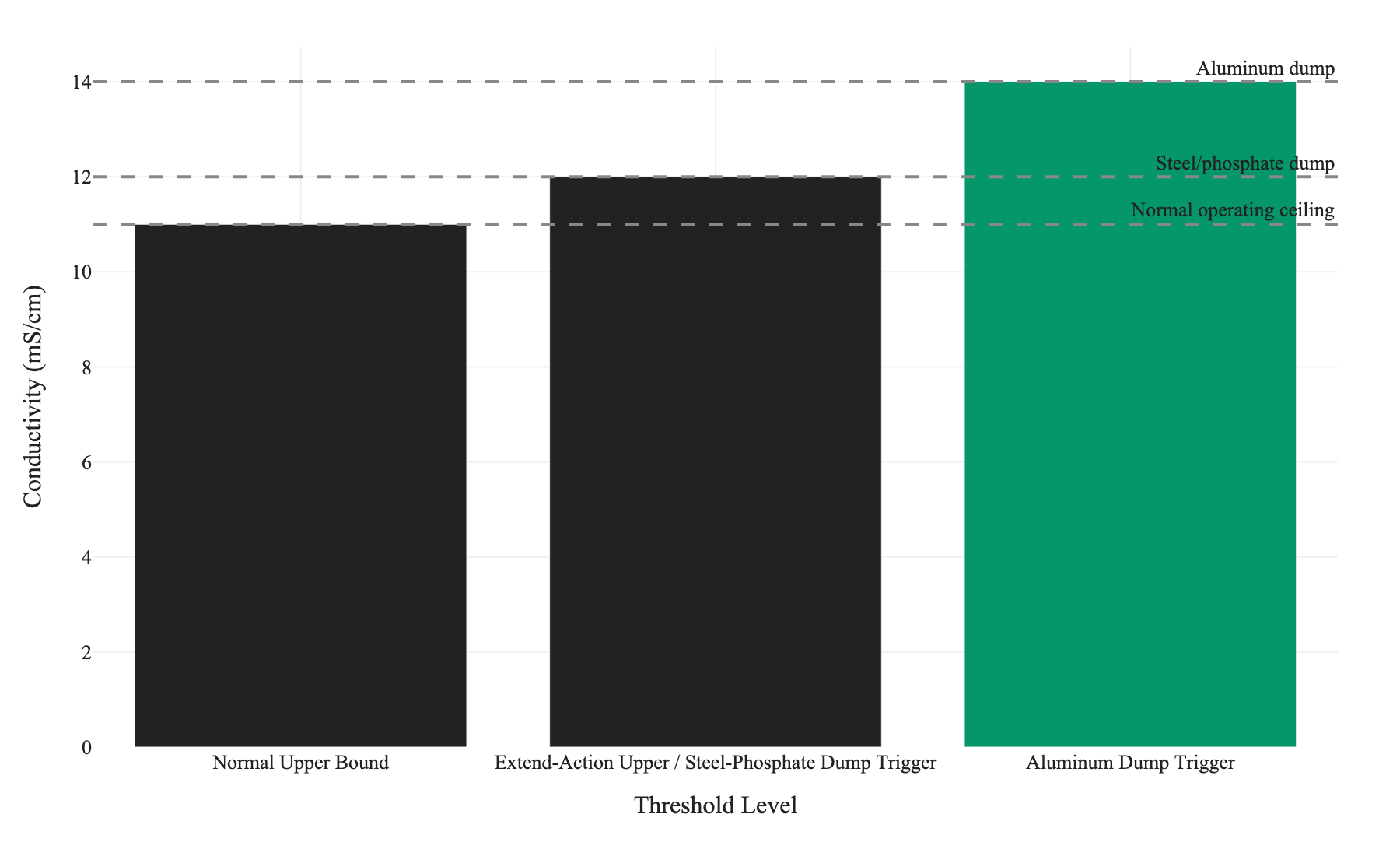
Conductivity | 11.0–12.0 mS/cm: initiate filtration and reduce drag-in | Above 12.0 mS/cm (steel/phosphate) or 14.0 mS/cm (aluminum) | Dump and recharge; do not replenish through threshold |
Surfactant concentration (Draves wetting time proxy) | Wetting time 16–25 sec (approx. 70–85% nominal): add surfactant top-up | Wetting time above 25 sec (below 70% nominal) | Surfactant replenishment to restore baseline; if not restored within 1 addition, dump |
pH | pH drop of more than 1.0 unit below nominal: check for acid drag-in or CO2 absorption | pH below 10.0 (alkaline) or below 6.5 (neutral): builder exhaustion | Add builder concentrate per dosing chart; if pH not restored in one addition, dump |
Total alkalinity | P-alkalinity below 25 mL/L: add builder | M-alkalinity below 50 mL/L despite pH in range: accumulated sodium salts; assess TDS | Assess conductivity crosscheck; if conductivity also at threshold, dump |
Oil rejection / tramp oil level (visual) | Surface sheen present but emulsified; colorimetric 50–150 mg/L | Visible free-oil layer above 3 mm; colorimetric above 200 mg/L, or surfactant threshold also triggered | Activate coalescer/skimmer; if free oil not reducible within one shift, dump |
The threshold values in Figures 1 and 2 apply to alkaline cleaners on carbon steel and zinc-phosphated substrates. Aluminum substrates require different conductivity limits because dissolved aluminum progressively lowers the effective pH buffering and the dump trigger shifts to 14 mS/cm in formulations specifically designed for aluminum (Chemetall, Process Control Guide for Aluminium Cleaning, 2018; verification needed for specific product-to-substrate combinations). Neutral cleaners operating at pH 7 to 9 use the neutral cleaner pH ranges specified above and lower conductivity dump thresholds (typically 8 to 10 mS/cm) because the absence of high alkalinity means TDS accumulation has a larger proportional effect on cleaning performance per unit conductivity rise.
Any single dump-trigger threshold in Figure 2 is sufficient to initiate a dump; do not average multiple parameters to decide otherwise.
IV. Cost of Late Dump vs. Premature Dump
Late dump and premature dump represent opposite optimization failures, and the cost profile of each is asymmetric in ways that are not obvious from looking at bath-chemical cost alone. Understanding the full cost structure of both errors is necessary to justify the monitoring investment described in Section III.
What Does a Late Dump Actually Cost?
A late dump allows the bath to continue operating past the conductivity or surfactant-depletion threshold. The immediate chemical saving is the difference between bath-recharge cost and incremental production cost: for a 2,000-liter cleaning tank operating at a 2 percent alkaline cleaner concentration, the recharge cost is approximately USD 80 to USD 150 in chemical cost depending on formulator and region (verification needed for current regional pricing). The apparent saving for one extra shift of bath use is USD 10 to USD 20.
The cost of contaminated parts entering downstream processes is substantially larger. Consider a steel-stamping cleaning line feeding a powder coating operation with a reject threshold of 5 percent adhesion failure. When the aqueous cleaner bath exceeds 14 mS/cm, the rinse-stage carryover raises dissolved metal ion loading at the iron phosphate conversion coating stage by 40 to 80 percent compared with a fresh-bath condition (Products Finishing Industry Data, 2022; verification needed for site-specific rinse ratio and dragout volumes). The elevated ionic load at the conversion stage impairs phosphate crystal uniformity, producing a coating weight that is outside the 1.6 to 4.3 g/m2 range specified for powder coating adhesion per ASTM D7091-13 (Standard Practice for Nondestructive Measurement of Dry Film Thickness of Nonmagnetic Coatings Applied to Ferrous Metals). When powder coating adhesion fails on a batch of 500 stamped panels at a rework cost of USD 8 per panel for strip, re-clean, re-coat, and re-inspect, the direct rework cost is USD 4,000, against a bath recharge cost of USD 120 to USD 150. The ratio is 27:1 to 33:1 for a single late-dump event.
In a production environment where the cleaning line feeds a phosphating and powder coating line continuously, the contamination cascade from one missed dump can affect multiple days of production before quality control identifies the root cause at the coating stage. Field case data from cleaning-line audits suggest that a single late-dump event at a threshold exceedance of 2 to 4 mS/cm above the trigger generates rework and scrap costs in the range of USD 3,000 to USD 18,000 depending on part value and batch size (Products Finishing, 2022; verification needed for high-value part lines). The monitoring cost of the protocol in Figures 1 and 2 is approximately USD 200 to USD 350 per year in consumables and instrument calibration time for a single-tank installation.
What Does a Premature Dump Cost?
Premature dump occurs when a bath is discarded while it still has usable life, typically when a fixed time-interval policy (e.g., weekly dump) is applied regardless of actual bath condition. In cleaning lines with variable production schedules, a weekly dump may discard a bath that has reached only 60 to 70 percent of its service life. The wasted chemical cost is 30 to 40 percent of the recharge cost per premature cycle, which for a 2,000-liter tank at USD 130 average recharge cost amounts to USD 39 to USD 52 per event. At 52 premature dumps per year (weekly schedule, high-variability production), the annual overspend on bath chemistry is USD 2,000 to USD 2,700.
A more significant cost of premature dump is the process disruption from drain-fill cycles. Each dump-recharge cycle requires 30 to 90 minutes of cleaning line downtime for drain, flush, and heat-up to operating temperature, representing lost throughput of 150 to 450 parts on a medium-throughput line. At an average margin of USD 2 to USD 5 per part, the opportunity cost per premature dump is USD 300 to USD 2,250. Data-driven dump scheduling based on the Figures 1 and 2 protocol typically extends bath life by 40 to 60 percent compared with fixed-interval schedules in lines with moderate soil loading variability, as documented in cleaning-line optimization studies (Finishing Technology, 2020; verification needed for high-variability soil-loading conditions).
V. Bath Life Extension Protocol: Filtration, Skimming, Replenishment
Bath life extension is possible when the bath is still below the dump trigger threshold but has crossed the extend-action threshold. Three interventions, applied in sequence, can recover usable bath life and defer the dump by one to three shifts under moderate loading conditions. Each intervention addresses a specific degradation pathway and has a defined retest checkpoint.
Continuous Skimming for Tramp Oil Removal
Tramp oil accumulation accelerates surfactant depletion by sequestering surfactant molecules in the emulsified oil phase. Continuous belt or disc skimmers remove free-floating oil from the bath surface before it is re-emulsified, reducing the surfactant consumption rate by 15 to 35 percent in lines with moderate tramp oil loading of 50 to 150 mg/L (ChemTreat, 2021). A belt skimmer sized at 0.5 to 1.5 liters per hour oil removal capacity for a 2,000-liter tank is typically adequate for medium-throughput lines. The skimmer should be operated continuously during production and verified clean at each shift change. After activating or cleaning the skimmer, allow one full shift of operation before re-testing surfactant concentration and oil level; do not use the skimmer output as a dump decision override if conductivity has already crossed the dump threshold.
Membrane Filtration for TDS Reduction
Conductivity rise from dissolved soil accumulation can be partially reversed by removing ionic bath volume and replacing it with fresh water and makeup chemical. A cross-flow membrane filtration unit operating at a recovery ratio of 70 to 80 percent can reduce bath conductivity by 1.5 to 2.5 mS/cm per treatment cycle without discarding the full bath volume (verification needed for specific membrane chemistry compatibility with alkaline cleaner builders at pH above 11.5). Membrane filtration is most cost-effective when the bath is in the extend-action range of 11 to 12 mS/cm: applying filtration below the extend threshold wastes membrane capacity, and applying it above the dump threshold does not reliably restore cleaning performance because surfactant depletion and soil saturation are typically co-occurring at that stage.
The ISO 11591 (Water Quality, Measurement of Free Chlorine and Total Chlorine Concentration by Flow Analysis, 2010) framework for continuous monitoring is adaptable to conductivity-logged cleaning bath systems as a real-time trigger for membrane filtration activation (verification needed for implementation details in specific cleaning bath controller platforms).
Split Replenishment to Restore Surfactant Without Raising TDS
Standard replenishment practice adds a fixed dose of cleaner concentrate when pH or alkalinity falls below threshold, which restores builder content but also adds further TDS to the bath. Split replenishment separates the surfactant addition from the builder addition: a surfactant-only concentrate is added to restore emulsification capacity without adding builder salts that would further elevate conductivity. Split replenishment requires a two-component chemical system and is only feasible when the formulator offers separate surfactant and builder concentrates. When applicable, split replenishment can extend bath life by 20 to 40 percent compared with single-component replenishment on lines where surfactant depletion rate exceeds builder depletion rate, which is common on lines processing painted or lacquered parts that contribute organic soil but relatively low ionic contamination.
After any extension intervention, retest all five parameters in Figures 1 and 2 before returning to normal monitoring frequency. If any parameter remains at or above its dump trigger threshold after one full shift of operating the extension intervention, proceed to dump without further delay.
VI. Field Cases: Multi-Stage Cleaning Line Audits
Two cleaning-line audit cases illustrate how soil loading profiles differ by part geometry and production rate, and how the monitoring protocol in Section III changes bath management decisions in practice.
Case A: Three-Stage Spray Cleaning Line on Steel Stampings (Benchmark Pattern)
A stamped-metal component manufacturer operating a three-stage spray cleaning line (wash, rinse 1, rinse 2) for automotive body brackets produced approximately 3,200 parts per day at an average soil loading of heavy stamping oil and drawing compound on carbon steel. The wash tank held 1,800 liters of alkaline cleaner at 2.5 percent concentration, operating at 60 degrees Celsius. The line's existing dump schedule was fixed at every Thursday regardless of bath condition, producing an average of 52 dump cycles per year.
A bath audit was conducted over 10 consecutive production days using the five-parameter protocol from Figures 1 and 2. Conductivity was measured at shift start and shift end for all three shifts. Results showed a consistent conductivity rise rate of 1.8 mS/cm per shift under the facility's actual throughput and soil loading. The bath crossed the 12 mS/cm dump threshold at day 4, shift 2 of the weekly cycle. However, the fixed Thursday dump schedule was occurring at the end of day 5 (day 6 for production weeks that started Monday), meaning the bath regularly operated at 12.6 to 13.5 mS/cm for the final 1.5 to 2.5 shifts before each dump.
Downstream quality data for the audit period showed that 4.1 percent of phosphated panels produced during the last 1.5 days before each Thursday dump failed the ASTM D3359-09 cross-cut adhesion test at the powder coating stage. The same metric for panels produced during the first 3 days of the weekly bath cycle was 0.4 percent. The 4.1 percent failure rate against the facility's 2 percent contract threshold triggered customer rejections on 3 of the 8 shipments during the 10-day audit window.
Implementing condition-based dump triggers reduced the bath cycle to 4 to 4.5 production days under the measured loading rate, increasing the annual dump frequency from 52 to approximately 80 to 91 cycles per year. The chemical cost increase was USD 1,800 to USD 2,600 per year. The downstream adhesion failure rate dropped from 4.1 percent to 0.6 percent during post-audit validation, eliminating 7 of 8 previously observed customer rejection events. The rejection events had carried an average rework and re-shipment cost of USD 2,400 per event, representing an annual cost reduction of USD 16,800 from eliminating rejection events, against an additional bath-chemistry cost of USD 2,200. Net annual benefit was USD 14,600.
Case B: Four-Stage Immersion Cleaning Line on Aluminum Extrusions (Unexpected Cause Pattern)
An aluminum extrusion processor running a four-stage immersion cleaning line (alkaline clean, rinse, desmut, rinse) for architectural-grade profiles reported intermittent etching and smut deposition on profiles entering the anodizing tank. The line processed 600 to 800 linear meters of extruded profile per shift at an operating temperature of 55 degrees Celsius in the alkaline wash stage. The cleaner concentration was maintained at 3 percent alkaline cleaner formulated for aluminum, and pH was monitored twice per shift and maintained at 11.2 to 11.8.
The facility's monitoring protocol tracked only pH and performed a weekly visual inspection of bath clarity. Conductivity had never been measured. When the five-parameter protocol was applied, the first conductivity reading returned 14.7 mS/cm, substantially above the 14.0 mS/cm dump trigger for aluminum-compatible formulations. Total alkalinity titration showed M-alkalinity of 45 mL/L, below the 50 mL/L extend threshold, despite pH remaining in range from continued caustic addition. The Draves wetting time on a bath sample cooled to 25 degrees Celsius was 38 seconds, well above the 25-second dump trigger for surfactant depletion. The bath was operating simultaneously above the conductivity dump threshold and below the surfactant sufficiency threshold.
The unexpected finding was that the conductivity accumulation traced primarily to dissolved aluminum carried from the extrusion profiles rather than from external soil contamination. Aluminum extrusions carry approximately 0.8 to 1.6 grams of surface aluminum oxide per square meter of surface area, and alkaline cleaning dissolves this layer, releasing aluminum ions that accumulate in solution as aluminate and raise conductivity at a faster rate than comparable steel-stamping lines (verification needed for specific alloy-to-dissolution-rate relationships at pH 11 to 12). The facility's pH-only monitoring masked this mechanism because the aluminate buffering system maintained pH stability as the aluminate concentration rose.
Corrective action included an immediate bath dump and recharge, installation of a handheld conductivity meter and shift-log sheets for all five parameters, and reduction of the operating temperature from 55 to 50 degrees Celsius to slow aluminum dissolution rate. Under the revised monitoring protocol, the bath was dumped at the conductivity trigger of 14.0 mS/cm, which occurred at day 7 to 8 of the bath cycle rather than the previous unmonitored 14-day cycle. Smut deposition at the anodizing stage was eliminated within the first monitored bath cycle, and the intermittent etching defect did not recur over the subsequent 60-day observation period.
This case is a practical example of the type of bath-monitoring dataset that can be submitted to AI Shooting for grading by soil type. When conductivity rise rates, pH trajectory, and alkalinity depletion patterns are logged in a structured format, AI Shooting can identify whether the dominant soil is ionic-mineral (as in dissolved aluminum), organic-oil (stamping lubricants), or mixed, and can predict time-to-dump with quantified confidence against the operator's specific substrate and formulation. Submitting structured monitoring data from the Figures 1 and 2 protocol produces a higher-resolution AI Shooting analysis than submitting qualitative observations alone.
VII. Key Takeaway
Conductivity above 12 mS/cm (steel/phosphate) or 14 mS/cm (aluminum) is the primary dump trigger. Surfactant depletion below 70 percent of the fresh-bath value, measured by Draves wetting time above 25 seconds at 25 degrees Celsius, is the second independent dump trigger. Either threshold alone is sufficient to initiate a dump; do not delay based on the other parameter being in range.
Monitor five parameters at defined intervals. pH and alkalinity alone do not capture the two primary degradation mechanisms. Conductivity detects ionic soil accumulation; Draves wetting time detects surfactant depletion; tramp oil level indicates the rate of surfactant consumption. All five must be logged to prevent the "good pH, degraded bath" failure mode documented in Case B.
The cost asymmetry between late dump and premature dump is 10:1 to 30:1 in favor of condition-based scheduling. A single late-dump event carrying a conductivity exceedance of 2 to 4 mS/cm above the trigger generates downstream rework and scrap costs of USD 3,000 to USD 18,000, against a bath recharge cost of USD 80 to USD 150. Fixed-interval dump schedules systematically generate both late dumps (in high-throughput periods) and premature dumps (in low-throughput periods).
Bath life extension through skimming, filtration, and split replenishment can defer the dump by one to three shifts when the bath is in the extend-action range (11.0 to 12.0 mS/cm conductivity and wetting time 16 to 25 seconds). Extension interventions applied above the dump threshold do not reliably restore bath performance and are not a substitute for timely dump-recharge.
Submit your structured monitoring log to AI Shooting for soil-type grading and time-to-dump prediction. Logs containing conductivity, wetting time, pH, alkalinity, and oil level across at least five consecutive shifts provide sufficient data for AI Shooting to identify the dominant soil class, model the conductivity rise rate, and recommend optimized dump intervals and extension triggers specific to your line's throughput and substrate combination.
VIII. References
ASTM International. (2021). ASTM D1125-95(2021): Standard Test Methods for Electrical Conductivity and Resistivity of Water. ASTM International. https://www.astm.org/d1125-95r21.html
ASTM International. (2016). ASTM D1067-16: Standard Test Methods for Acidity or Alkalinity of Water. ASTM International. https://www.astm.org/d1067-16.html
ASTM International. (2010). ASTM D4251-10: Standard Test Method for Active Matter in Anionic Surfactants by Potentiometric Titration. ASTM International. https://www.astm.org/d4251-10.html
ASTM International. (2013). ASTM D7091-13: Standard Practice for Nondestructive Measurement of Dry Film Thickness of Nonmagnetic Coatings Applied to Ferrous Metals and Nonmagnetic, Nonconductive Coatings Applied to Non-Ferrous Metals. ASTM International. https://www.astm.org/d7091-13.html
ASTM International. (2009). ASTM D3359-09: Standard Test Methods for Rating Adhesion by Tape Test. ASTM International. https://www.astm.org/d3359-09.html
ASTM International. (1996). ASTM D1293-99: Standard Test Methods for pH of Water. ASTM International. https://www.astm.org/d1293-99.html
ASTM International. (2017). ASTM D1646-17: Standard Test Methods for Rubber: Viscosity, Stress Relaxation, and Pre-Vulcanization Characteristics (Mooney Viscometer). ASTM International. https://www.astm.org/d1646-17.html
American Association of Textile Chemists and Colorists (AATCC). (2017). AATCC Test Method 17-2017: Wetting Agents, Evaluation of. AATCC. https://www.aatcc.org/testing/methods/
ISO. (1985). ISO 7888:1985: Water Quality, Determination of Electrical Conductivity. ISO. https://www.iso.org/standard/14983.html
ISO. (2010). ISO 11591:2010: Water Quality, Measurement of Free Chlorine and Total Chlorine Concentration by Flow Analysis (FIA and CFA). ISO. https://www.iso.org/standard/50483.html
Chemetall GmbH. (2018). Process Control Guide for Aluminium Cleaning and Pretreatment. Chemetall. (Verification needed: publisher URL not publicly indexed; request from regional Chemetall technical support.)
ChemTreat. (2021). Water Treatment Essentials: Cooling Water and Process Cleaning. ChemTreat. https://www.chemtreat.com/resources/
Henkel Surface Technologies. (2020). Technical Bulletin AS-47: Aqueous Cleaner Bath Management and Surfactant Control. Henkel. (Verification needed: bulletin not publicly indexed; obtain from Henkel technical sales representative.)
Products Finishing. (2019). Bath Life Management for Aqueous Cleaning Systems. Products Finishing. https://www.pfonline.com/articles/bath-life-management-for-aqueous-cleaning-systems
Products Finishing. (2022). Cleaning Line Defect Traceability: Linking Wash-Stage Parameters to Downstream Coating Failures. Products Finishing. https://www.pfonline.com/articles/cleaning-line-defect-traceability
Finishing Technology. (2020). Condition-Based Bath Dump Scheduling: Field Validation on Variable-Throughput Lines. Finishing Technology. https://www.finishingtechnology.com (verification needed: specific article URL not confirmed)