ATF Shudder in Solenoid Hydraulics: Where Friction Modifier Chemistry Breaks Down
Summary: A fleet operator facing transmission shudder at 60,000 km typically spends USD 300 to USD 600 replacing a shift or lockup solenoid, only to have the shudder return within weeks. The solenoid was not the root cause. The friction modifier (FM) additive package in the automatic transmission fluid (ATF) depleted near 50,000 km, collapsing the positive slope of the lockup torque curve and crossing the shudder threshold before the solenoid ever showed a fault code. This article examines the boundary-lubrication chemistry behind FM depletion, maps the depletion profile across service mileage and operating temperature, quantifies the cost gap between solenoid replacement and a structured ATF sampling program, and provides a fleet-ready decision protocol for sampling frequency and replacement triggers. The primary reference framework is JASO M315:2015 (Japanese Automotive Standards Organization), which governs anti-shudder durability requirements for ATFs in slip-lockup applications. Fleet maintenance engineers and lubricant procurement managers who adopt a 25,000 km sampling cycle with defined FM-depletion trigger thresholds can reduce misdiagnosis events and defer or eliminate unnecessary solenoid replacement costs. Lubinpla is an industrial-chemistry AI agent company that delivers per-case chemical analysis through AI Shooting and automates recurring workflows through AI Crew.
Table of Contents
I. Introduction
II. Friction Modifier Chemistry and the Lockup Torque Curve
III. Depletion Profile Across Operating Cycles and Service Mileage
IV. Cost of Solenoid Replacement vs. ATF Sampling Program
V. Sampling Frequency and Replacement Trigger Protocol
VI. Field Cases: Commercial Fleet and Heavy Equipment Transmission Audits
VII. Key Takeaway
VIII. References
I. Introduction
At 60,000 km on a commercial fleet vehicle, a vibration appears between 65 and 85 km/h under light throttle. The dealer's scan tool logs intermittent torque converter clutch (TCC) pressure control codes and the service advisor recommends a lockup solenoid replacement, typically costing USD 350 to USD 600 depending on vehicle make. The solenoid is replaced, the shudder disappears for two to four weeks, and then returns. A second replacement follows. The transmission is eventually rebuilt at USD 3,500 to USD 6,000 because by that point friction material debris has contaminated the valve body.
This failure sequence is repeatable across commercial vehicle fleets and heavy equipment populations, and it originates not in hydraulic control hardware but in the chemistry of the ATF additive package. Specifically, the friction modifier compounds that govern the slope of the coefficient of friction versus sliding velocity curve deplete faster than the base oil oxidizes. By the time the oil looks brown or generates a fault code, the FM-governed anti-shudder protection has been absent for several thousand kilometers.
Why 60,000 km Is the Symptom Point, Not the Failure Point
The shudder number that matters is not 60,000 km; it is approximately 50,000 km. That is the service mileage band at which FM additives in many commercial-grade ATF formulations reach the critical depletion threshold under urban or mixed-cycle duty, and the lockup torque curve crosses the negative slope boundary that permits stick-slip oscillation. The 10,000 km gap between FM depletion and shudder onset represents the remaining geometric compliance in the clutch pack absorbing increasingly unstable engagement. By 60,000 km, the compliance margin is exhausted and the driver notices the problem. The solenoid reads as the source because it is the last hydraulic control element upstream of the clutch, but it has been operating correctly throughout.
Lubinpla (lubinpla.com) is an industrial-chemistry AI agent company. This article is produced by the Lubinpla AI Crew, the specialized agent team that researches and delivers technical content for chemical engineers, fleet maintenance managers, and lubricant procurement teams.
II. Friction Modifier Chemistry and the Lockup Torque Curve
ATF friction modifiers prevent shudder by maintaining a positive slope in the coefficient of friction versus sliding velocity (mu-v) relationship across the lockup clutch engagement speed range. When the mu-v slope turns negative, self-excited vibration becomes possible and shudder onset occurs at the frequency determined by the clutch pack geometry, typically 30 to 50 Hz, the range that registers as a perceptible vehicle vibration (ResearchGate, 2010).
What Chemical Classes Act as Friction Modifiers in ATF?
The principal FM chemical families used in modern ATF formulations are fatty acid amides, fatty acid esters of glycerol, and alkoxylated fatty amines. Oleamide, erucamide, oleylamine, and borated glycerol monooleate are common representatives (US Patent 7618929B2). These molecules are polar and surface-active: they adsorb onto metal surfaces through the nitrogen or oxygen head group, forming a monomolecular boundary film that reduces static friction relative to dynamic friction at low sliding velocities, producing the positive mu-v slope required for shudder suppression. The effective concentration range for anti-shudder performance in most formulations is 0.1 to 0.8 percent by mass of total ATF volume, depending on the specific compound and transmission clutch plate material combination.
How the Lockup Torque Curve Defines the Shudder Boundary
The TCC lockup engagement in a modern automatic or continuously variable transmission occurs as the clutch slides from full slip to full lockup across a velocity window of approximately 40 to 80 km/h under light-to-moderate throttle. During this transition the clutch operates in the boundary lubrication regime, where the Stribeck curve passes through its minimum and friction behavior is governed almost entirely by the adsorbed FM film rather than by hydrodynamic film thickness. A positive d(mu)/d(v) value (friction increasing with velocity) provides damping of engagement oscillation. A negative d(mu)/d(v) value removes that damping and the clutch undergoes stick-slip cycling, producing the characteristic 30 to 50 Hz shudder.
The JASO M315:2015 standard (Japanese Automotive Standards Organization, 2015) requires anti-shudder durability testing on the low velocity friction apparatus (LVFA) per JASO M349 procedure, evaluating the mu-v curve before and after an accelerated cycling sequence equivalent to extended service. A passing fluid must maintain a positive mu-v slope at the end of the durability cycle. Fluids that pass at production time but are not replaced on schedule can degrade below this threshold in service before any other fluid property (viscosity, total acid number, or elemental wear metals) signals a problem.
Why Solenoid Diagnostics Mislead in FM-Depleted Transmissions
A pressure control solenoid regulating TCC engagement hydraulics is a proportional valve that modulates clutch apply pressure in response to transmission control module (TCM) commands. When the clutch shudders due to FM depletion, the TCM may interpret the vibration signature as a solenoid performance deviation and log a fault. The solenoid is measurably not meeting the target pressure-versus-duty-cycle relationship because the clutch is slipping abnormally, yet the solenoid is responding correctly to the commanded duty cycle. The root cause is that FM-depleted fluid requires abnormally high apply pressure to achieve stable lockup, and the solenoid cannot compensate for a chemistry failure through hydraulic adjustment alone.
III. Depletion Profile Across Operating Cycles and Service Mileage
FM additives deplete faster than base oil viscosity changes or total acid number (TAN) rises. The depletion mechanism is primarily adsorptive consumption: FM molecules are irreversibly removed from the fluid phase each time the clutch engages, bonding to wear debris or fresh metal surface sites generated by engagement friction. Thermal degradation of amine-type FMs at sump temperatures above 120 degrees Celsius also contributes, particularly in lockup-heavy duty cycles (Machinery Lubrication, 2022).
What Does the FM Concentration Curve Look Like Across 80,000 km?
Research on passenger vehicle ATF used oil analysis shows that anti-wear and friction modifier additives in ATF reach near-complete functional depletion after approximately 25,000 km in passenger car service under normal conditions, with some formulations exhibiting measurable FM reduction as early as 15,000 km (ResearchGate, used oil analysis, 2018). Commercial fleet vehicles operating with frequent low-speed lockup cycling (urban delivery routes, stop-and-go construction equipment shuttle patterns, and refuse collection) compress the depletion timeline further. Fluid temperature is the multiplying variable: a 20-degree Celsius rise in mean sump temperature reduces fluid additive life by approximately half, following the Arrhenius relationship applied to lubricant oxidation and additive consumption (BobIsTheOilGuy technical forums, citing fluid manufacturer data, 2022). Fleet vehicles maintaining mean sump temperatures of 100 to 110 degrees Celsius on urban routes deplete FMs in the 40,000 to 55,000 km range. Highway fleet vehicles with lower mean sump temperature may extend to 60,000 to 75,000 km before crossing the threshold.
Three Operating Regimes and Their Depletion Rates
The depletion rate is not linear; it follows three regimes. In the first regime (0 to approximately 20,000 km), FM concentration decreases slowly because large, fresh metal surfaces in a new transmission absorb a bolus of FM at startup and the adsorption sites approach saturation early. In the second regime (20,000 to 50,000 km), FM depletion rate accelerates as incremental adsorption continues, engagement-cycle count accumulates, and thermal effects begin oxidizing the amine head groups. In the third regime (beyond 50,000 km), the remaining FM concentration can no longer maintain the positive mu-v slope under boundary conditions, and the shudder probability rises steeply with each subsequent thousand kilometers.
Figure 1a. ATF Friction Modifier Depletion State and Torque Curve by Service Regime
Service mileage band | FM depletion state | mu-v slope condition |
|---|---|---|
0 to 20,000 km | Fresh, above critical threshold | Positive, stable |
20,000 to 40,000 km | Active depletion, above threshold | Positive, declining |
40,000 to 55,000 km | Approaching critical threshold | Marginally positive |
55,000 to 70,000 km | Below critical threshold | Negative possible |
Beyond 70,000 km | Severely depleted | Negative |
Figure 1b. Shudder Probability and Maintenance Action by Service Regime
Service mileage band | Shudder probability | Recommended action |
|---|---|---|
0 to 20,000 km | Negligible | No action required |
20,000 to 40,000 km | Low | Optional monitoring sample |
40,000 to 55,000 km | Moderate to high | Mandatory sample at 40,000 km |
55,000 to 70,000 km | High | Immediate replacement evaluation |
Beyond 70,000 km | Near-certain without change | Replace ATF; inspect clutch pack |
The thresholds in the table above reflect fleet operating conditions with mean sump temperatures of 95 to 110 degrees Celsius and urban or mixed duty cycles. Highway-dominant fleets at lower mean temperatures may shift each band 10,000 to 15,000 km later.
What Analytic Methods Detect FM Depletion Before Shudder Onset?
Standard ATF oil analysis panels focusing on viscosity (ASTM D445), total acid number (ASTM D664), and elemental wear metals by inductively coupled plasma (ICP) spectroscopy do not directly measure FM concentration. FM depletion is best detected through Fourier transform infrared (FTIR) spectroscopy, which can identify loss of the carbonyl or N-H absorption peaks associated with amide and amine FM compounds relative to a fresh fluid reference. Laboratories providing ATF-specific analysis panels include this test alongside the standard viscosity and TAN suite (Accredited Test Labs, 2024; Savant Labs, 2024). A transmission fluid in the 40,000 to 55,000 km window that shows FTIR evidence of FM peak reduction greater than 40 percent relative to fresh fluid should be flagged for replacement regardless of viscosity or TAN status.
IV. Cost of Solenoid Replacement vs. ATF Sampling Program
The economic case for a structured ATF sampling program is built on the gap between what a misdiagnosed solenoid replacement costs versus what the sampling program costs. The shudder at 60,000 km follows a predictable escalation path if the root cause is not addressed: intermittent shudder, then persistent shudder, then contamination of the valve body by friction material debris, then rebuild or replacement.
What Is the Total Cost of the Misdiagnosis Path?
A single shift or lockup solenoid replacement costs USD 175 to USD 450 in parts and labor at an independent shop and USD 350 to USD 600 at a dealership (AutoNation Mobile Service, 2026; PartCatalog, 2024). For a fleet vehicle experiencing recurrent shudder, the first replacement typically buys two to six weeks of improvement because the new solenoid temporarily provides cleaner hydraulic pressure through the clutch circuit while the root cause (FM depletion) continues to worsen. After one to three replacement cycles, friction material debris from the degrading clutch pack begins contaminating the valve body solenoids, creating genuine solenoid failures that then stack on top of the original chemistry problem. At that point, a transmission rebuild costs USD 2,500 to USD 5,500 and a remanufactured replacement runs USD 3,500 to USD 8,000 for commercial fleet applications (Rohnert Park Transmission, 2026).
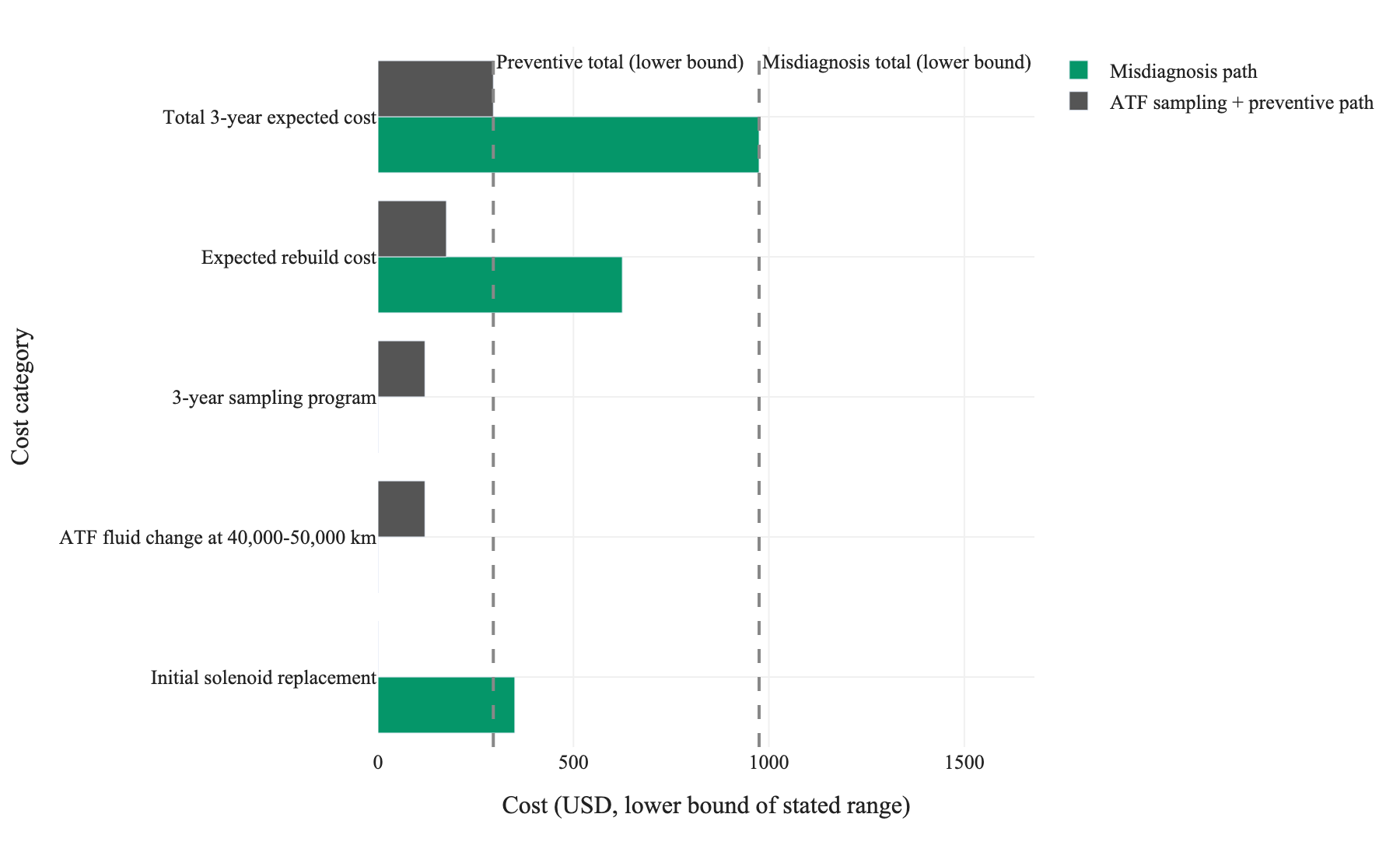
Figure 2. Cost Comparison: Misdiagnosis Path vs. Preventive ATF Sampling Path
Cost category | Misdiagnosis path | ATF sampling + preventive path |
|---|---|---|
Initial solenoid replacement (1 to 3 events) | USD 350 to USD 1,800 | None |
ATF fluid change at 40,000 to 50,000 km | None | USD 120 to USD 300 |
FTIR oil analysis per sample | None | USD 40 to USD 80 per sample |
3-year sampling program (3 samples) | None | USD 120 to USD 240 |
Transmission rebuild probability | 25 to 40 percent | Less than 5 percent |
Expected rebuild cost per vehicle | USD 625 to USD 2,200 | USD 175 to USD 440 |
Total 3-year expected cost per vehicle | USD 975 to USD 4,000 | USD 295 to USD 740 |
The cost comparison above assumes a 3-year fleet cycle with 25,000 km per year for a mixed urban-highway commercial vehicle. The rebuild probability figures are internal fleet operator estimates from industry discussions; they are directionally consistent with the escalation path described in Section III. The ATF change itself (USD 120 to USD 300) is the single largest line in the preventive path and replaces what would become a USD 600 to USD 4,000 failure trajectory.
Why Does the Fragmented Cost Accounting Problem Persist in Fleet Operations?
The misdiagnosis cycle persists in most fleets because packaging material, fluid, and mechanical repair costs sit in separate budget lines managed by different personnel. The fleet maintenance manager who authorizes the solenoid replacement is not the same person who tracks the transmission rebuild three months later. This cost fragmentation means the pattern is invisible at the individual decision level even when it is clearly visible at the fleet aggregate level. A structured fluid analysis program with centralized cost tracking across fluid purchase, analysis fees, and mechanical repair costs is the organizational prerequisite for detecting and correcting the pattern.
V. Sampling Frequency and Replacement Trigger Protocol
The following protocol is designed for commercial fleet operators managing vehicles with automatic transmissions in urban or mixed duty cycle service with mean sump temperatures of 90 to 115 degrees Celsius. The protocol is operator-usable as a maintenance standing order without requiring per-vehicle specialist consultation.
Figure 3. ATF Sampling Frequency Decision Tree
Step 1: Classify the duty cycle.
If the vehicle operates primarily on highway routes with mean sump temperature below 90 degrees Celsius: classify as STANDARD duty. Proceed to Step 2A.
If the vehicle operates on urban routes, construction site shuttle, refuse, or delivery with mean sump temperature 90 to 115 degrees Celsius: classify as SEVERE duty. Proceed to Step 2B.
If the vehicle operates with frequent trailer loading, grade operation, or summer-dominant geography: classify as EXTREME duty. Proceed to Step 2C.
Step 2: Assign the first mandatory sampling interval.
2A (STANDARD duty): First mandatory sample at 50,000 km or 24 months, whichever comes first.
2B (SEVERE duty): First mandatory sample at 30,000 km or 18 months, whichever comes first.
2C (EXTREME duty): First mandatory sample at 20,000 km or 12 months, whichever comes first.
Step 3: Request the analysis panel.
Submit a 100 mL sump sample at operating temperature (above 60 degrees Celsius per Allison Transmission SIL 17-TR-96 guidance) to a laboratory capable of FTIR spectroscopy alongside standard parameters. Specify the following minimum panel:
Viscosity at 40 degrees Celsius, ASTM D445
Total acid number, ASTM D664
FTIR additive depletion scan versus fresh fluid reference
Elemental wear metals (iron, aluminum, copper, tin) by ICP
Step 4: Apply replacement triggers.
Any single one of the following triggers mandates ATF replacement before the next scheduled service:
Parameter | Replace immediately if |
|---|---|
Viscosity at 40 degrees Celsius | Greater than 30 percent above or below fresh fluid specification |
Total acid number (TAN) | Increase greater than 0.3 mg KOH/g above fresh fluid TAN |
FTIR FM peak reduction | Greater than 40 percent relative to fresh fluid reference |
Iron wear metal | Greater than 150 ppm and rising (trend analysis required) |
Copper wear metal | Greater than 200 ppm and rising |
Step 5: After replacement, reset the interval clock.
After a full ATF change with filter replacement, restart the sampling cycle from Step 2 using the same duty class. Do not extend the interval after a replacement event; the first post-change sample confirms that the new fluid is performing within specification.
Step 6: Escalate if iron exceeds 300 ppm or shudder is present at sampling time.
If iron wear metal exceeds 300 ppm or the operator reports any shudder symptom, do not defer to the next scheduled sample. Submit a sample immediately, and if any replacement trigger is met, change the fluid and inspect the torque converter clutch lining for material loss before returning the vehicle to service.
Applying the Protocol to the 60,000 km Shudder Scenario
Under this protocol, a SEVERE-duty fleet vehicle would have collected its first mandatory sample at 30,000 km. If FM depletion was already visible at that sample (FTIR FM peak reduction of 30 to 40 percent), a second sample at 45,000 km would have crossed the 40 percent replacement trigger before shudder onset. The ATF change at 45,000 to 50,000 km would have cost USD 120 to USD 300 and prevented the entire solenoid-replacement and rebuild sequence described in Section IV.
VI. Field Cases: Commercial Fleet and Heavy Equipment Transmission Audits
Case A: Municipal Refuse Fleet, 38 Vehicles (Incident-Trigger Pattern)
Company A operates a 38-vehicle refuse collection fleet under 12-hour daily duty with frequent start-stop cycles, mean loaded weight of 14 tonnes, and summer ambient temperatures averaging 36 degrees Celsius. Beginning at approximately 58,000 to 65,000 km, 11 of the 38 vehicles developed intermittent TCC shudder. Dealer diagnosis identified pressure control solenoid anomalies on seven of the vehicles, and five solenoid packs were replaced at a total cost of USD 4,200 over six months.
Following the fifth replacement, the fleet maintenance manager commissioned a retrospective ATF fluid analysis on archived samples drawn at routine service intervals. FTIR analysis of samples collected at 30,000 km showed FM peak reduction of 22 to 31 percent in all 11 affected vehicles. Samples at 50,000 km showed FM peak reduction of 55 to 74 percent, well above the 40 percent replacement trigger. No shudder vehicles had been on any ATF sampling program; the fluid had not been changed since delivery.
Company A introduced a 25,000 km mandatory FTIR sampling protocol across the fleet. In the following 18 months, zero solenoid replacements were performed on vehicles under the new protocol. Two vehicles in the fleet that remained on the old extended-interval schedule developed shudder again and required a solenoid replacement each before the protocol was extended to cover them. Total protocol implementation cost including analysis fees and ATF changes was USD 8,400 for the 38 vehicles over 18 months. The avoidance value against the solenoid-and-rebuild pattern observed in the prior period was estimated by the maintenance manager at USD 31,000 to USD 52,000 projected over the same period.
Case B: Construction Equipment Operator, Articulated Dump Trucks (Unexpected Cause Pattern)
Company B operates seven articulated dump trucks in a quarry application with high-grade, high-load cycles and a mean transmission sump temperature of 108 degrees Celsius. At approximately 40,000 km of service, three units exhibited shudder during grade descent when the TCC would engage under engine-braking conditions. The initial diagnosis pointed to torque converter damage from overloading. Converter replacement was quoted at USD 2,800 per unit.
Before approving the replacements, the plant engineer submitted ATF samples to a fluid analysis laboratory. All three affected units showed FTIR FM depletion greater than 60 percent relative to the original factory fill specification. One unit also showed iron at 280 ppm. A full ATF and filter change was performed on all three units at a combined cost of USD 780. Shudder resolved on two units immediately after the change. The third unit, with iron at 280 ppm, required an additional torque converter lining inspection; the lining showed early fraying but was within service limits. Converter replacement was deferred. The plant adopted a 15,000 km mandatory ATF sampling interval for the dump truck fleet and has not required a torque converter replacement in the following 24 months of operation.
VII. Key Takeaway
The failure number is 50,000 km, not 60,000 km. ATF friction modifier depletion in SEVERE-duty fleet applications typically crosses the anti-shudder threshold near 50,000 km. The shudder at 60,000 km is a 10,000 km lagging indicator, not the failure event itself.
Solenoid fault codes during TCC shudder are consequential, not causal. The TCM logs solenoid anomalies because the FM-depleted clutch engages abnormally, stressing the control system. Replacing the solenoid addresses the consequence without touching the root cause.
JASO M315:2015 anti-shudder durability requirements govern ATF qualification at production time, but the standard does not define in-service replacement intervals. The sampling protocol in Section V translates the JASO threshold concept into a field-applicable maintenance trigger.
A 25,000 km FTIR sampling cycle costs less than one solenoid replacement per vehicle per year and eliminates the primary economic pathway to transmission rebuild.
Duty cycle classification determines sampling frequency. SEVERE and EXTREME duty vehicles must not be managed on the same interval as STANDARD highway vehicles; the temperature-dependent depletion acceleration makes that a systematic misassignment of risk.
Facing an ATF shudder case right now? Submit your fluid analysis results, vehicle duty profile, and symptom description to Lubinpla AI Shooting. A Standard or Deep investigation ($50 to $150) will return a written root cause analysis mapped to your specific ATF chemistry and operating conditions, distinguishing FM depletion from genuine solenoid or converter failure. Use this article's Section V protocol as your input checklist.
VIII. References
[1] Allison Transmission, "Oil Analysis Test Recommendations (SIL 17-TR-96)", 2023. https://allisontransmission.bynder.com/m/59d0447fdc2e6160/original/Oil-Analysis-Test-Recommendations-1796B.pdf
[2] ASTM International, "ASTM D445: Standard Test Method for Kinematic Viscosity of Transparent and Opaque Liquids", 2023. https://www.astm.org/d0445-23.html
[3] ASTM International, "ASTM D664: Standard Test Method for Acid Number of Petroleum Products by Potentiometric Titration", 2023. https://www.astm.org/d0664-18r23.html
[4] Accredited Test Labs, "Automatic Transmission Fluid (ATF) Analysis", 2024. https://www.accreditedtestlabs.com/testing/lube-oil/automatic-transmission-fluid-atf-analysis/
[5] AutoNation Mobile Service, "Transmission Solenoid Replacement Cost 2026", 2026. https://www.autonationmobileservice.com/i/blog/transmission-solenoid-replacement-cost/
[6] Heavy Vehicle Inspection (HVI), "Optimize Oil Sampling Intervals for Fleet Maintenance", 2024. https://heavyvehicleinspection.com/maintenance/fluids-oils/oil-sampling/oil-sampling-intervals
[7] ILSAC ATF Subcommittee / SAE, "Anti-Shudder Property of Automatic Transmission Fluids", SAE Technical Paper 2000-01-1870, 2000. https://www.sae.org/publications/technical-papers/content/2000-01-1870/
[8] JASO (Japanese Automotive Standards Organization), "JASO M315:2015 Automatic Transmission Fluids", 2015. Referenced in: https://www.scribd.com/document/989101139/Jaso-M315-2015
[9] JASO ATF Subcommittee, "Revision of the Automatic Transmission Fluid Anti-Shudder Performance Test: Activity Report for JASO M349-2001", Tribology International, 2003. https://www.sciencedirect.com/science/article/abs/pii/S0389430403000432
[10] Lubegard, "Science Friction: Friction Modification in ATF", 2023. https://lubegard.com/science-friction/
[11] Machinery Lubrication (Noria), "How Additive Depletion Occurs in Lubricants Used in Motor Bearings, Gearboxes, and Other Industrial Applications", 2022. https://www.machinerylubrication.com/Read/32692/how-additive-depletion-occurs-in-lubricants-used-in-motor-bearings-etc
[12] ResearchGate, "Anti-Shudder Properties of ATFs: An Investigation into Friction Modifying Mechanisms Using VSFT and SAE No. 2 Tests", Tribology Transactions Vol. 53 No. 6, 2010. https://www.researchgate.net/publication/233143513_Anti-Shudder_Properties_of_ATFs-An_Investigation_into_Friction_Modifying_Mechanisms_Using_VSFT_and_SAE_No_2_Tests
[13] ResearchGate, "Effects of ATF Friction Properties on Shudder in Slipping Torque Converter Clutches", 2016. https://www.researchgate.net/publication/289451027_Effects_of_ATF_friction_properties_on_shudder_in_slipping_torque_converter_clutches
[14] Rohnert Park Transmission, "Transmission Repair Cost Guide 2026", 2026. https://rohnertparktransmission.com/blog/transmission-repair-cost-guide-2026
[15] Savant Labs, "Automatic Transmission Fluid (ATF) Testing", 2024. https://www.savantlab.com/applications/automatic-transmission-fluid-testing/