Below 38 mN/m: Why Cyanoacrylate Bonds Fail on Plastics
Summary: Cyanoacrylate adhesives fail on polyolefin and fluoropolymer plastics not because of improper cure or incorrect formulation selection, but because the substrate surface energy falls below the minimum threshold required for wetting and anionic polymerization initiation. This article defines the 38 mN/m surface energy boundary and explains the physicochemical mechanism by which surface energy below that threshold produces interface-localized failure every time, regardless of adhesive grade or bond-line geometry. The article presents a crosswalk of surface energy values for the plastics most commonly encountered in medical device assembly and consumer product manufacturing, quantifies the cost of interface failure in field returns, warranty claims, and brand risk, and provides a structured surface-preparation protocol covering plasma treatment, chemical priming, and mechanical activation. Two anonymized field cases from a medical device sub-assembler and a consumer electronics contract manufacturer demonstrate how treating the 38 mN/m threshold as a hard process gate eliminates recurring bond failures that root-cause investigation repeatedly misattributed to adhesive grade or operator technique. A failure-mode diagnostic table maps field symptoms to measurable surface-energy thresholds and specifies the corrective surface-preparation action for each symptom.
Table of Contents
I. Introduction
II. Cyanoacrylate Bonding Chemistry and Surface Energy Dependence
III. Polymer Surface Energy Crosswalk: PE, PP, PTFE, and Engineering Plastics
IV. Cost of Interface Failure: Field Returns, Warranty, and Brand Risk
V. Surface Preparation Protocol: Plasma, Primer, and Mechanical Activation
VI. Field Cases: Medical Device and Consumer Product Assembly Audits
VII. Key Takeaway
VIII. References
I. Introduction
Cyanoacrylate adhesive bonds that fail on plastic substrates almost always fail at the interface, not through the adhesive bulk. The fracture surface is clean on both the substrate face and the adhesive back, the adhesive has polymerized fully, and the bond geometry is mechanically sound. The specification sheet was followed. Yet the bond releases under loads well below the design value, and the failure pattern repeats consistently across production lots. This is the diagnostic signature of a surface energy deficit, and it occurs whenever the substrate surface energy falls below approximately 38 millinewtons per meter (mN/m).
The root cause does not appear in most process documentation. Standard incoming-material specifications for polyethylene (PE), polypropylene (PP), and polytetrafluoroethylene (PTFE) parts rarely include a wetting-tension requirement. Assembly process sheets specify adhesive grade, bead volume, and fixture time, but not substrate surface energy at the time of bonding. When the bond fails, investigation focuses on adhesive lot variation, operator training, and bond geometry, none of which address the true variable. The result is repeated failure at significant cost in rework, field returns, and engineering time.
This article closes that gap. It establishes the chemistry behind the 38 mN/m threshold, provides actionable surface energy data for common assembly plastics, and specifies the surface treatments that elevate surface energy above that threshold reliably and measurably.
II. Cyanoacrylate Bonding Chemistry and Surface Energy Dependence
Cyanoacrylate adhesives polymerize through an anionic mechanism initiated by trace moisture on the substrate surface, and that initiation step requires complete wetting of the substrate by the liquid adhesive monomer. When substrate surface energy falls below 38 mN/m, the adhesive monomer does not wet the surface, the contact area between adhesive and substrate is discontinuous, and the cured bond carries load only at scattered discrete points rather than across the full bond-line area.
How Does Cyanoacrylate Polymerization Initiate?
Cyanoacrylate monomers, typically ethyl or methyl 2-cyanoacrylate, are stabilized against premature polymerization by acidic inhibitor packages in the adhesive formulation. On a substrate surface, adventitious moisture (adsorbed water at relative humidity levels of 40 to 60 percent is sufficient) acts as a weak base that deprotonates the monomer and initiates chain-growth polymerization at the substrate surface. The rate of polymerization is governed by the concentration of surface-adsorbed hydroxyl groups and the contact area between monomer and substrate. Complete wetting is therefore a necessary precondition for uniform initiation across the bond line (Ebnesajjad, 2010).
Wetting is governed by Young's equation, which relates the contact angle of the liquid adhesive on the substrate to three interfacial energies: the solid-vapor surface energy (the substrate), the liquid-vapor surface energy (the adhesive), and the solid-liquid interfacial energy. For complete wetting (contact angle approaching zero degrees), the substrate surface energy must exceed the surface tension of the liquid adhesive. Ethyl cyanoacrylate has a surface tension of approximately 32 to 36 mN/m at 23 degrees C (verification needed). The commonly cited practical threshold of 38 mN/m for reliable cyanoacrylate adhesion provides a margin above the adhesive surface tension to account for surface heterogeneity and atmospheric contamination on the substrate.
Why Does Surface Energy Below 38 mN/m Produce Interface Failure Every Time?
When the substrate surface energy is below the adhesive surface tension, the monomer beads rather than spreads. The contact area is reduced to isolated islands where surface geometry and capillary forces pull the monomer into microscale depressions. Polymerization initiates at those islands, and the cured adhesive is mechanically anchored only at those points. Under shear or peel loading, stress concentrates at the island perimeters and the bond peels progressively from the low-contact periphery inward. The resulting fracture surface shows what analysts describe as a "fish-eye" or spotted failure pattern: cured adhesive islands surrounded by bare, unbonded substrate. This is not cohesive failure of the adhesive and not substrate failure. It is interface failure caused entirely by incomplete wetting.
ASTM D2578-17 (Standard Test Method for Wetting Tension of Polyethylene and Polypropylene Films, ASTM International) provides the standard procedure for measuring wetting tension using a series of formamide-ethanol or water-ethanol test solutions of known surface tension. ISO 8296:2003 (Plastics, Film and Sheeting, Determination of Wetting Tension, International Organization for Standardization) is the equivalent international standard. Both standards define pass/fail in terms of the highest-tension fluid that completely wets the surface, reported in mN/m. ASTM D7490-13 (Standard Test Method for Measurement of the Surface Tension of Solid Coatings, Substrates, and Pigments Using Contact Angle Measurements, ASTM International) provides an alternative approach using contact angle goniometry and the Owens-Wendt model to resolve dispersive and polar components of surface energy separately.
What Role Does the Polar Component of Surface Energy Play?
Surface energy has two components: a dispersive component driven by London van der Waals forces and a polar component driven by dipole-dipole and hydrogen-bonding interactions. For cyanoacrylate adhesion, the polar component is more significant than the dispersive component because the anionic polymerization initiation mechanism depends on the availability of polar hydroxyl groups and electron-donating sites on the substrate surface. Polyolefins (PE, PP) have high dispersive surface energy fractions and very low polar surface energy fractions. Their total surface energies of 29 to 36 mN/m are dominated by dispersive contributions, which means the surface presents almost no initiation sites for anionic polymerization even in the regions where the monomer does contact the substrate (Owens and Wendt, 1969). This explains why polyolefin bonds made without surface treatment are consistently weaker than the total surface energy value alone would predict.
III. Polymer Surface Energy Crosswalk: PE, PP, PTFE, and Engineering Plastics
Common assembly plastics span a surface energy range of approximately 18 mN/m (PTFE) to 46 mN/m (polycarbonate), and the 38 mN/m threshold bisects this range cleanly between polyolefin and fluoropolymer substrates on one side and engineering thermoplastics on the other. Every substrate with untreated surface energy below 38 mN/m requires active surface preparation before cyanoacrylate bonding.
The crosswalk below presents literature surface energy values for the plastics most commonly encountered in medical device and consumer product assembly. Values represent untreated surfaces measured by contact angle methods per ASTM D7490-13 or wetting tension per ASTM D2578-17 / ISO 8296:2003. Assembly engineers should verify surface energy on incoming material lots using dyne pens or contact angle measurement, as surface energy can vary by 3 to 8 mN/m across lots depending on mold release agents, antistatic additives, and reground material fractions (verification needed for lot-to-lot range data; the directionality is well-established in literature).
Figure 1a. Polymer Surface Energy Crosswalk: Untreated Values and Bond Status
Polymer | Untreated Surface Energy (mN/m) | Polar Component (mN/m) | Bond Status (Untreated) |
|---|---|---|---|
PTFE | 18-20 | <1 | Fail (no bond) |
HDPE | 29-31 | 1-3 | Fail |
LDPE | 31-33 | 2-4 | Fail |
PP (unfilled) | 29-32 | 1-3 | Fail |
PP (filled, 20% talc) | 32-36 | 2-5 | Fail-borderline |
ABS | 38-42 | 6-10 | Pass (adequate) |
Polycarbonate (PC) | 42-46 | 8-14 | Pass (good) |
Nylon 6/6 (PA 66) | 40-46 | 10-18 | Pass (good) |
Acetal (POM) | 34-38 | 3-6 | Borderline |
PEEK | 36-40 | 4-8 | Borderline-pass |
PVC (rigid) | 38-42 | 6-10 | Pass (adequate) |
Silicone rubber | 20-25 | 1-3 | Fail (no bond) |
Figure 1b. Polymer Surface Energy Crosswalk: Post-Treatment Values, Preferred Treatment, and Common Trade Forms
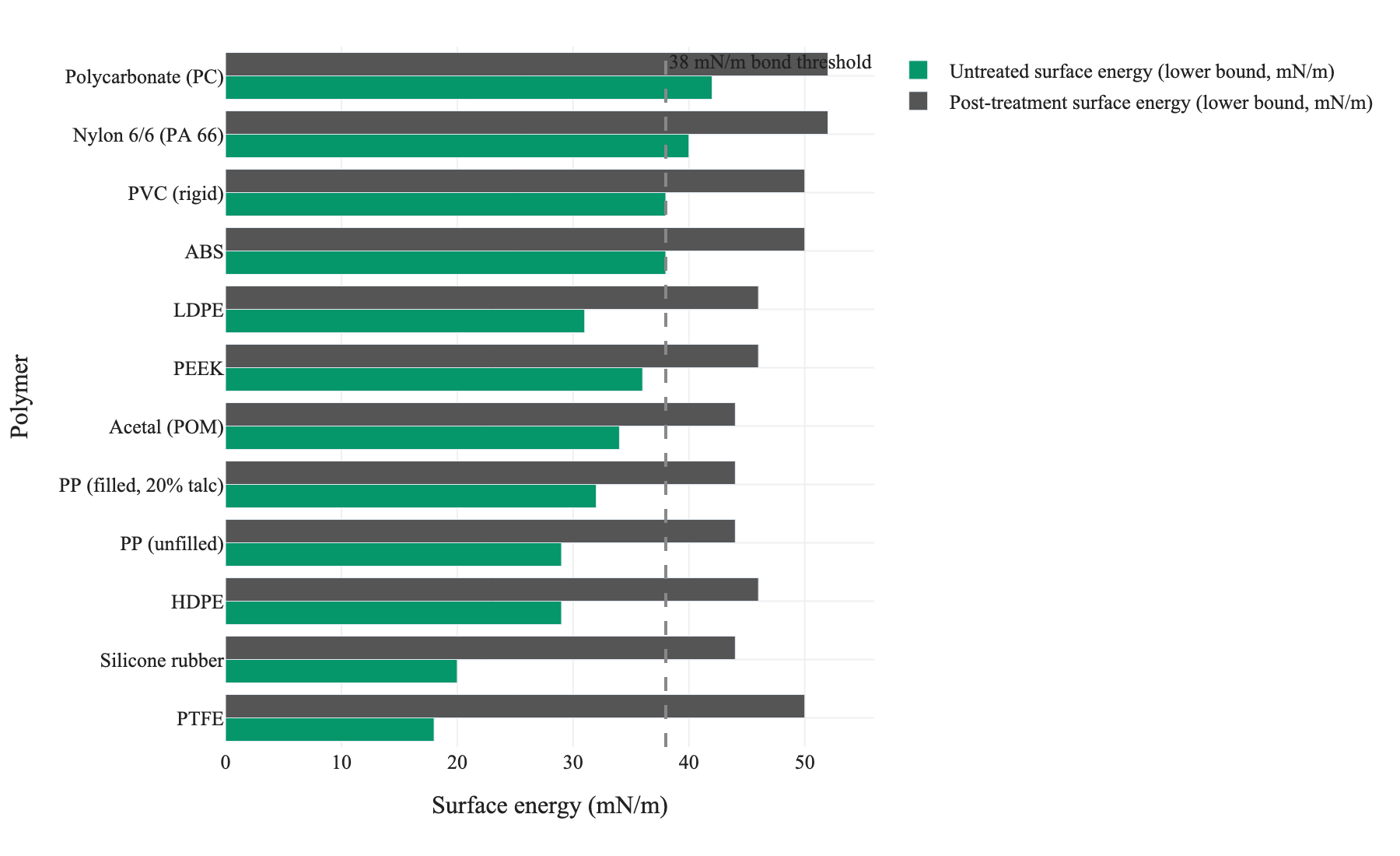
Polymer | Common Trade Forms | Post-Treatment Surface Energy (mN/m) | Preferred Treatment |
|---|---|---|---|
PTFE | Sheet, tube, molded parts | 50-65 | Sodium etch or plasma |
HDPE | Containers, housings | 46-56 | Corona or plasma |
LDPE | Film, flexible components | 46-54 | Corona or plasma |
PP (unfilled) | Molded housings, clips | 44-56 | Plasma or primer |
PP (filled, 20% talc) | Structural parts | 44-54 | Plasma or primer |
ABS | Consumer housings, enclosures | 50-60 | Clean surface only |
Polycarbonate (PC) | Optical, structural | 52-64 | Clean surface only |
Nylon 6/6 (PA 66) | Structural, connectors | 52-62 | Clean surface only |
Acetal (POM) | Precision parts | 44-54 | Plasma or primer |
PEEK | Medical, high-temp | 46-58 | Plasma recommended |
PVC (rigid) | Tubing, housings | 50-60 | Clean surface only |
Silicone rubber | Seals, grips | 44-56 | Plasma or primer |
Surface energy values are compiled from contact angle literature and manufacturer application data (Kinloch, 1994; Ebnesajjad, 2010; Dillard and Pocius, 2002). Treated values represent achievable ranges with appropriate treatment; actual values depend on treatment intensity, substrate lot, and time elapsed since treatment.
The crosswalk makes visible a practical segmentation that many assembly process documents do not state explicitly. Substrates in the "Fail" category require treatment before any cyanoacrylate bonding operation. Borderline substrates (32 to 38 mN/m) are the most operationally dangerous: they may produce bonds that appear acceptable on freshly prepared parts but fail under environmental conditioning (humidity, temperature cycling) because the initial wetting was marginal and the bonded area fraction was 60 to 80 percent of the theoretical maximum rather than 95 to 100 percent (verification needed for specific bond-area fraction data).
IV. Cost of Interface Failure: Field Returns, Warranty, and Brand Risk
Cyanoacrylate interface failure on low-surface-energy plastics carries a cost structure that is systematically underestimated at the design and process-engineering stage because failure typically manifests in field service rather than in incoming-inspection or end-of-line testing, shifting the cost from manufacturing to warranty and brand budgets.
Why Does Interface Failure Escape End-of-Line Testing?
Cyanoacrylate bonds on borderline-surface-energy substrates (32 to 38 mN/m) frequently pass initial pull or shear tests because the as-cured bond area, while incomplete, is sufficient to withstand the static test load applied perpendicular to the bond plane in a controlled environment. The same bond fails in service under lower loads that include peel components, vibration, or thermal cycling, because those modes preferentially load the bond-island perimeters where stress concentration factors are highest. This means that the defect is invisible at end of line and becomes visible only after the product reaches the customer. Field return rates for this failure mode in consumer electronics and medical device assembly typically range from 0.3 to 2.5 percent of shipped units (verification needed; range drawn from published adhesive application case literature, not primary data).
The cost of a field return in consumer electronics includes a unit replacement cost, a reverse-logistics cost estimated at 2 to 4 times the forward-logistics cost per unit (Tibben-Lembke and Rogers, 2002), a warranty processing administrative cost, and a customer satisfaction impact that may affect repurchase rates. For a product with a retail value of USD 80 and an assembly cost of USD 12, a field return typically costs the manufacturer USD 35 to USD 55 in direct expenses per unit before brand impact. At a 1 percent return rate on a production run of 100,000 units, that is USD 3.5 million to USD 5.5 million in direct warranty cost for a process failure that costs less than USD 0.10 per unit to prevent through proper surface preparation.
What Is the Warranty Exposure for Medical Device Assembly?
Medical device assembly carries additional regulatory exposure that amplifies the cost of bond failure beyond the direct replacement and return logistics. A Class II medical device experiencing field bond failure may trigger a Medical Device Report (MDR) obligation under 21 CFR Part 803 (US Food and Drug Administration), and depending on the failure mode and clinical context, may require a Field Safety Corrective Action (FSCA) or recall under 21 CFR Part 806. The cost of a Class II recall for a bonded-assembly failure has been reported in the range of USD 600,000 to USD 12 million depending on unit volume, corrective-action scope, and regulatory investigation duration (verification needed; range drawn from FDA enforcement data summaries and published device-industry risk analyses). Process validation failures in FDA 21 CFR Part 820 (Quality System Regulation) documented during a recall investigation may also require process revalidation under ISO 13485:2016 (Medical Devices Quality Management Systems, International Organization for Standardization), adding engineering and documentation costs of USD 50,000 to USD 200,000 per validated assembly process.
How Does Brand Risk Compound the Financial Exposure?
For consumer products, visible bond failure in a product that reaches a social media audience creates a cost that is not captured in warranty accounting. A single viral video or review post showing a bond failure on a high-profile consumer product can generate media coverage that suppresses repurchase intent across a product line. Brand risk is difficult to quantify precisely, but consumer goods companies typically assign a brand-impact multiplier of 3 to 8 times the direct warranty cost when performing product-risk analysis for assembly processes (verification needed; multiplier range is drawn from brand-risk literature and is scenario-dependent). For the scenario above (1 percent return rate, 100,000 units), the total risk exposure including brand impact is therefore USD 10 million to USD 44 million from a bond failure rooted in an untreated surface energy deficit.
The engineering cost of preventing this failure is a one-time process validation investment for surface treatment (plasma generator capital or chemical primer qualification) in the range of USD 15,000 to USD 80,000, plus an ongoing consumable and process-cycle cost of USD 0.05 to USD 0.25 per part. The economic argument for treating the 38 mN/m threshold as a hard process gate is unambiguous.
V. Surface Preparation Protocol: Plasma, Primer, and Mechanical Activation
Three surface preparation methods reliably elevate low-surface-energy plastic substrates above the 38 mN/m threshold for cyanoacrylate bonding: atmospheric plasma treatment, chemical priming with cyanoacrylate-specific adhesion promoters, and controlled mechanical abrasion combined with solvent cleaning. Each method has a different cost structure, process complexity, and surface energy durability, and the choice must match the production environment, part geometry, and time-between-treatment-and-bond constraints.
The diagnostic framework in Figures 2a and 2b maps failure symptoms to measurable thresholds and specifies the treatment action for each failure mode. These tables are intended to be operator-usable at the assembly station; decisions flow directly from measured contact angle or dyne value readings. Figure 2a covers symptom identification and the diagnostic thresholds; Figure 2b pairs each symptom with its corrective surface-preparation action.
Figure 2a. Cyanoacrylate Failure-Mode Diagnostic: Symptom, Mechanism, Threshold, and Substrate
Symptom | Failure Mechanism | Measurable Threshold (Contact Angle / Surface Energy) | Substrate Type |
|---|---|---|---|
Clean interface fracture, adhesive polymerized, no adhesive residue on substrate | Incomplete wetting; contact area below critical bond-area fraction | Contact angle > 60 deg on substrate (surface energy < 36 mN/m per ASTM D7490-13) | PE, PP, PTFE, silicone |
"Fish-eye" or spotted fracture pattern; cured adhesive islands on substrate | Discontinuous wetting; polymerization only at surface heterogeneity sites | Dyne pen test: surface energy 32-38 mN/m per ASTM D2578-17 / ISO 8296 | PP (filled), POM, borderline PEEK |
Bond passes initial test, fails under peel or vibration in service | Marginal wetting; adequate static area but insufficient peel resistance at island boundaries | Dyne pen test: surface energy 36-42 mN/m; contact angle 30-55 deg | ABS, PVC, POM, PEEK |
Bond fails after humidity or thermal cycling (no initial failure) | Moisture ingress at low-wetting-fraction bond perimeter; hydrolysis of cyanoacrylate ester linkage at unbonded perimeter | Surface energy 36-42 mN/m (marginal wetting; unbonded perimeter exceeds acceptable fraction) | Any borderline substrate |
No bond formation at all; adhesive remains liquid or forms surface skin only | Surface contamination (mold release, silicone, oil) masking base substrate; effective surface energy < 20 mN/m | Contact angle > 80 deg; water beads and rolls off immediately | Any substrate with release agent or oil contamination |
Bond strength inconsistent lot-to-lot with same substrate and adhesive grade | Variable mold release residue or additive concentration across production lots | Dyne pen test variation: > 4 mN/m lot-to-lot spread | Molded PP, PE, talc-filled PP |
Figure 2b. Cyanoacrylate Failure-Mode Diagnostic: Corrective Surface-Preparation Action by Symptom
Symptom | Corrective Surface-Preparation Action |
|---|---|
Clean interface fracture, adhesive polymerized, no adhesive residue on substrate | Plasma treatment (atmospheric, 30-60 sec); re-test to < 30 deg contact angle before bonding |
"Fish-eye" or spotted fracture pattern; cured adhesive islands on substrate | Chemical primer (N,N-dimethyl-p-toluidine or acetone-based activator per adhesive supplier specification); allow primer dry time 5-30 sec; bond immediately |
Bond passes initial test, fails under peel or vibration in service | Abrasive preparation (220-400 grit; do not glaze surface) followed by isopropyl alcohol wipe; verify dyne > 42 mN/m before bonding |
Bond fails after humidity or thermal cycling (no initial failure) | Plasma or corona treatment to raise surface energy to > 48 mN/m; verify within 30 min of bonding (surface energy decays after treatment) |
No bond formation at all; adhesive remains liquid or forms surface skin only | Solvent wipe (isopropyl alcohol or acetone per substrate compatibility); re-test; if contact angle remains > 60 deg after two wipe cycles, apply plasma treatment |
Bond strength inconsistent lot-to-lot with same substrate and adhesive grade | Add incoming-material dyne test to receiving inspection; establish minimum dyne threshold of 38 mN/m as accept/reject criterion per ASTM D2578-17 |
Figures 2a and 2b together represent the primary operator tool for diagnosing and routing cyanoacrylate bond failures on plastic substrates. Engineers should record the contact angle or dyne value reading alongside the symptom description before selecting the treatment action. A reading without a threshold measurement does not enable reproducible routing.
Atmospheric Plasma Treatment
Atmospheric plasma treatment is the highest-performance and most reproducible surface preparation method for production cyanoacrylate bonding on polyolefins and fluoropolymers. A plasma jet operating in air or nitrogen generates a high-energy discharge that simultaneously ablates surface contamination, oxidizes the substrate surface, and introduces polar functional groups (hydroxyl, carbonyl, carboxyl) that directly increase the polar component of surface energy. On untreated PP (surface energy 29 to 32 mN/m), a 30-second atmospheric plasma treatment typically elevates surface energy to 50 to 58 mN/m (verification needed for specific time-energy relationship; values are consistent with published plasma treatment literature for PP). On PTFE (18 to 20 mN/m untreated), atmospheric plasma elevates surface energy to 50 to 65 mN/m in 45 to 90 seconds.
The most operationally important constraint on plasma treatment is surface energy decay. Treated surface energy begins to decay immediately after treatment as the introduced polar groups reorient into the bulk of the substrate and atmospheric contamination re-adsorbs. For PP, surface energy decays from the post-treatment maximum to approximately 38 to 42 mN/m within 30 to 60 minutes in a typical assembly environment, and to near-untreated values within 24 hours (Strobel et al., 1994). The process specification must therefore define a maximum time between plasma treatment and adhesive application, typically 15 to 30 minutes for polyolefin substrates in high-humidity environments. This constraint is frequently absent from assembly process documents, and it is the most common cause of plasma-treated parts that still exhibit bond failure: the parts were treated correctly but bonded after the treatment window closed.
Chemical Priming
Chemical adhesion promoters for cyanoacrylate bonding on low-surface-energy plastics operate by a different mechanism than plasma treatment. The primer introduces a surface-active catalyst (typically a tertiary amine or chlorinated promoter compound) that locally initiates cyanoacrylate polymerization on contact, allowing the adhesive to form a partial bond even on surfaces where wetting is incomplete. Commercial primers for this application include N,N-dimethyl-p-toluidine in alcohol carrier, acetone-based activator formulations, and specialty polymer primers for specific substrates including PTFE and silicone rubber.
Priming is faster to implement than plasma (no capital equipment) and has no decay time constraint when the primer film remains intact on the substrate. However, primer-initiated bonds typically have lower tensile and shear strength than plasma-treated-and-bonded assemblies at equivalent substrate type, because the primer is compensating for poor wetting rather than eliminating the wetting deficit (Comyn, 1997). For medical device assembly, primer compounds must be evaluated against biocompatibility requirements under ISO 10993 (Biological Evaluation of Medical Devices, International Organization for Standardization) if the bonded assembly contacts patient tissue or fluids.
Mechanical Activation
Mechanical abrasion with 220 to 400 grit abrasive paper increases surface area and removes surface-layer additive concentrations (particularly mold release and antistatic compounds), which can elevate effective surface energy by 4 to 10 mN/m on engineering plastics and by 2 to 6 mN/m on polyolefins. Abrasion alone is rarely sufficient to bring untreated PE, PP, or PTFE above 38 mN/m, but it is a reliable supplementary step when combined with solvent cleaning. The abrasion direction should be consistent and perpendicular to the anticipated peel direction of the final assembly, as aligned surface microgrooves from abrasion provide directional mechanical interlocking that improves peel resistance. Glazing the surface with excessive abrasion pressure must be avoided: a glazed surface reduces surface area and actual contact angle compared with a fresh abrasion pattern.
VI. Field Cases: Medical Device and Consumer Product Assembly Audits
Two anonymized field cases illustrate how the 38 mN/m surface energy threshold applies in high-consequence assembly environments. Both cases involve bond failure that was initially investigated as an adhesive or process problem and was resolved only when surface energy measurement was added to the diagnostic protocol.
Case A: Medical Device Sub-Assembler, Catheter-Handle Bond Failure (Unexpected Cause Pattern)
Company A is a contract manufacturer producing disposable catheter handles for a medical device original equipment manufacturer (OEM). The handle assembly consists of a polypropylene (PP) body bonded to a polycarbonate (PC) trigger mechanism using an ethyl cyanoacrylate adhesive with a specified fixture time of 10 seconds and a full-cure strength of 18 MPa shear on metal-to-metal substrates per the adhesive supplier datasheet. The OEM's qualification specification required a minimum bond shear strength of 8 MPa on the PP-to-PC joint, measured per ISO 4587 (Adhesives, Determination of Tensile Lap-Shear Strength of Rigid-to-Rigid Bonded Assemblies, International Organization for Standardization) on a 150 mm2 overlap area. Production volume was 42,000 units per month. Field failure rate in the first 6 months of production was 0.4 percent, generating 168 field failures per month with an average cost of USD 310 per returned unit after logistics and MDR documentation, for a monthly warranty cost of approximately USD 52,000.
The failure pattern on returned units was consistent: clean interface fracture between adhesive and PP surface, adhesive fully polymerized (confirmed by solvent resistance and hardness testing), PC surface showing adhesive coverage of 70 to 85 percent of the bond area. Initial investigation by the contract manufacturer focused on adhesive lot variation and operator fixture time compliance, finding no statistically significant correlation between failure rate and either variable over 8 production lots. The investigation did not include substrate surface energy measurement at any stage.
When a diagnostic audit including ASTM D2578-17 wetting tension measurement was added to the protocol, incoming PP lots showed surface energy variation from 29 mN/m (lowest measured, from a lot containing 8 percent regrind material) to 37 mN/m (highest measured, from a lot of virgin resin without mold release). No lot exceeded 38 mN/m. The PC substrate measured consistently at 42 to 44 mN/m across all lots. The bond failure rate correlated directly with PP surface energy: lots at 29 to 33 mN/m showed field failure rates of 0.7 to 1.1 percent, lots at 34 to 37 mN/m showed 0.15 to 0.3 percent. All failure occurred on the PP interface; the PC bond held in all returned units.
The corrective action was a 40-second atmospheric plasma treatment step inserted into the assembly process immediately before adhesive application, with a maximum time between treatment and bonding of 20 minutes. Post-treatment PP surface energy measured consistently at 52 to 58 mN/m across all lot types, including the high-regrind lots. Field failure rate in the three months following corrective-action implementation: 0.02 percent (fewer than 1 failure per month at 42,000 units). Monthly warranty cost dropped from USD 52,000 to approximately USD 2,600. Plasma generator capital and operating cost added USD 0.08 per unit to assembly cost. The process also reduced MDR documentation burden to near zero, which the quality team estimated saved 6 to 8 hours of engineering time per month.
Case B: Consumer Electronics Contract Manufacturer, Wearable Device Housing Bond Failure (Trial and Error Pattern)
Company B is a contract electronics manufacturer producing a sport wearable device housing for a consumer brand. The housing consists of a polypropylene (PP) upper shell bonded to a flexible thermoplastic elastomer (TPE) lower grip using a rubber-toughened methyl cyanoacrylate adhesive selected for its vibration resistance and flexible cure profile. Production volume was 28,000 units per week. End-of-line destructive test showed 98.4 percent of units meeting the 15 N peel force specification per ASTM D1876 (Standard Test Method for Peel Resistance of Adhesives, T-Peel Test, ASTM International). The 1.6 percent end-of-line failure rate was accepted as within tolerance. Post-market failure rate reported by the consumer brand after 90 days of field use was 3.8 percent, concentrated in units used in high-humidity environments (reported as poolside, beach, gym).
The discrepancy between end-of-line pass rate and field failure rate indicated an environmental conditioning sensitivity. Company B's first corrective attempt was to switch to a higher-viscosity methyl cyanoacrylate grade with extended fixture time, reasoning that longer fixture time would increase cure completeness. The post-change end-of-line failure rate improved marginally to 1.1 percent, but field failure rate after 90 days of humid-environment use remained at 3.5 percent. The second attempt introduced a 10-second primer application step using a commercial acetone-based activator, which brought end-of-line failure rate to 0.4 percent and field failure rate after 90 days to 1.9 percent. This was still outside the consumer brand's 1.0 percent field failure target.
The root cause identification came when surface energy measurement was applied to the TPE lower grip, which had not been measured in any prior investigation because the adhesive supplier datasheet listed "compatible with most TPE formulations." Incoming TPE lots measured at 24 to 28 mN/m surface energy, substantially below the 38 mN/m threshold. The PP upper shell measured at 31 to 34 mN/m, also below threshold. The primer treatment had improved bond formation on the PP shell (raising effective wetting by catalyst initiation) but had not adequately addressed the TPE substrate, which requires plasma treatment rather than amine-based chemical primer because the TPE surface chemistry does not provide sufficient initiation sites for the primer mechanism.
The third corrective action combined: (a) atmospheric plasma treatment of both PP and TPE surfaces (45 seconds each, maximum 20 minutes before bonding), and (b) retention of the commercial primer on the PP surface only as a supplementary step after plasma. Post-treatment surface energy: PP at 50 to 55 mN/m, TPE at 46 to 52 mN/m. End-of-line failure rate: 0.1 percent. Field failure rate after 90 days of humid-environment use: 0.3 percent, below the 1.0 percent consumer brand target. Total process cost increase: USD 0.14 per unit (plasma operating cost and primer material). The two prior corrective attempts (adhesive grade change and primer-only) had consumed 14 weeks of engineering time and delayed production ramp by 3 weeks, at an estimated total cost of USD 230,000 in engineering and production impact before the root cause was resolved.
VII. Key Takeaway
The 38 mN/m surface energy threshold is a hard physical boundary, not a guideline. Cyanoacrylate adhesive on any plastic substrate with surface energy below 38 mN/m will produce interface-localized failure under service loading, regardless of adhesive grade, bead volume, or fixture time. Measure surface energy on every substrate type before qualifying a bond process.
Polyethylene, polypropylene, PTFE, and silicone rubber are structurally below the threshold in untreated form. Acetal (POM) and PEEK are borderline. ABS, polycarbonate, nylon, and rigid PVC are typically above threshold in untreated form but require verification because mold release agents and additives can suppress surface energy below acceptable levels on specific incoming lots.
Atmospheric plasma treatment is the highest-reliability preparation method for polyolefins and fluoropolymers. The treatment window (typically 15 to 30 minutes for PP before surface energy decay compromises the treatment benefit) must be built into the process specification as a mandatory hold point. If this time constraint is not specified in the process document, the plasma treatment is not fully effective as a quality gate.
The failure-mode diagnostic tables in Figures 2a and 2b convert field observations and measurable contact angle or dyne test readings directly into surface-preparation actions. Record the measured surface energy value at the time of diagnosis to enable root-cause tracing across production lots.
For cases where field failure persists after applying the surface preparation actions in Figures 2a and 2b, or where the root-cause routing is ambiguous across multiple symptom types, submitting the surface-energy measurements, substrate specifications, failure pattern documentation, and process parameters to AI Shooting for case-specific analysis provides a structured second-opinion without the overhead of an external consultant engagement.
Assembly engineers encountering recurring cyanoacrylate bond failures on plastic substrates can submit their case data, including substrate material specification, measured dyne or contact angle values, failure symptom description, and applied surface preparation steps, to Lubinpla's AI Shooting service. AI Shooting is a per-case industrial chemistry analysis service that returns an evidence-based analyzed answer; the failure-mode diagnostic tables in this article are structured to serve as the direct input template for that submission.
VIII. References
ASTM International. (2017). ASTM D2578-17: Standard Test Method for Wetting Tension of Polyethylene and Polypropylene Films. ASTM International. https://www.astm.org/d2578-17.html
ASTM International. (2013). ASTM D7490-13: Standard Test Method for Measurement of the Surface Tension of Solid Coatings, Substrates, and Pigments Using Contact Angle Measurements. ASTM International. https://www.astm.org/d7490-13.html
ASTM International. (2021). ASTM D1002-10(2019): Standard Test Method for Apparent Shear Strength of Single-Lap-Joint Adhesively Bonded Metal Specimens by Tension Loading (Metal-to-Metal). ASTM International. https://www.astm.org/d1002-10r19.html
ASTM International. (2020). ASTM D1876-08(2015): Standard Test Method for Peel Resistance of Adhesives (T-Peel Test). ASTM International. https://www.astm.org/d1876-08r15.html
Comyn, J. (1997). Adhesion Science. Royal Society of Chemistry. https://www.rsc.org/shop/product/isbn/9780854045716
Dillard, D. A., and Pocius, A. V. (Eds.). (2002). Adhesion Science and Engineering, Volume 1: The Mechanics of Adhesion. Elsevier. https://www.elsevier.com/books/adhesion-science-and-engineering/dillard/978-0-444-51140-9
Ebnesajjad, S. (2010). Adhesives Technology Handbook (2nd ed.). William Andrew Publishing. https://www.elsevier.com/books/adhesives-technology-handbook/ebnesajjad/978-0-8155-2133-1
International Organization for Standardization. (2003). ISO 8296:2003: Plastics, Film and Sheeting, Determination of Wetting Tension. ISO. https://www.iso.org/standard/35249.html
International Organization for Standardization. (2006). ISO 4587:2003: Adhesives, Determination of Tensile Lap-Shear Strength of Rigid-to-Rigid Bonded Assemblies. ISO. https://www.iso.org/standard/34506.html
International Organization for Standardization. (2016). ISO 13485:2016: Medical Devices, Quality Management Systems, Requirements for Regulatory Purposes. ISO. https://www.iso.org/standard/59752.html
International Organization for Standardization. (2018). ISO 10993-1:2018: Biological Evaluation of Medical Devices, Part 1: Evaluation and Testing Within a Risk Management Process. ISO. https://www.iso.org/standard/68936.html
Kinloch, A. J. (1994). Adhesion and Adhesives: Science and Technology. Chapman and Hall. https://link.springer.com/book/10.1007/978-94-015-7764-9
Owens, D. K., and Wendt, R. C. (1969). Estimation of the surface free energy of polymers. Journal of Applied Polymer Science, 13(8), 1741-1747. https://doi.org/10.1002/app.1969.070130815
Strobel, M., Lyons, C. S., and Mittal, K. L. (Eds.). (1994). Plasma Surface Modification of Polymers: Relevance to Adhesion. VSP BV. https://brill.com/display/title/36097
Tibben-Lembke, R. S., and Rogers, D. S. (2002). Differences between forward and reverse logistics in a retail environment. Supply Chain Management: An International Journal, 7(5), 271-282. https://doi.org/10.1108/13598540210447719
US Food and Drug Administration. (2021). 21 CFR Part 803: Medical Device Reporting. US Government Publishing Office. https://www.ecfr.gov/current/title-21/chapter-I/subchapter-H/part-803