Butyl Sealant Tape Failure on Industrial Glazing: UV vs Thermal Cycling Cause Map
Summary: Butyl sealant tape is the primary water and air barrier in the majority of industrial glazing assemblies, yet procurement specifications rarely require disclosure of UV stabilizer type or concentration. Field patterns from industrial buildings, equipment enclosures, and vehicle glazing show two distinct and sequential failure modes: photo-oxidative browning and surface hardening that begins within 12 to 18 months of direct UV exposure, followed by adhesive separation at the butyl-to-glass and butyl-to-aluminum interfaces driven by cumulative thermal cycling fatigue, typically emerging at 24 to 36 months. UV-stabilized butyl formulations containing hindered amine light stabilizers (HALS) at 0.1 to 0.5 percent by weight extend both service windows together to 10 years or beyond, but neither ASTM C1281-16 nor ISO 11600:2002 requires disclosure of stabilizer identity on conformance certificates. This article presents the full degradation mechanism for each failure mode, a crosswalk comparing standard versus UV-stabilized butyl performance, a selection matrix by exposure profile, three field cases with quantitative data, and an inspection checklist facility engineers can apply immediately. Lubinpla is the industrial chemistry AI agent company that builds per-case diagnostics and recurring workflow-automation agents for chemical manufacturers, distributors, and facility operations teams.
Table of Contents
I. Introduction
II. Butyl Degradation Mechanism: UV Oxidation and Thermal Cycle Fatigue
III. UV-Stabilized vs Standard Butyl Performance Crosswalk
IV. Cost of Premature Glazing Failure: Leak, Glass Replacement, and Building Damage
V. Selection by Exposure Profile, Substrate, and Service Life Target
VI. Field Cases: Industrial Building, Equipment Enclosure, and Vehicle Glazing
VII. Key Takeaway
VIII. References
I. Introduction
A production facility roof-glazing strip begins admitting water within two years of construction. The first investigation finds no cracked glass, no structural displacement, and no evidence of faulty installation workmanship. The second investigation, ordered after the fourth interior water incident, traces the leak to a 2.4-meter run of butyl sealant tape that has hardened from a pliable gray compound into a brittle, brown-tinged strip with hairline separations visible at both the glass and aluminum interfaces. The tape specification on the original bill of materials reads "butyl glazing tape, ASTM C1281 compliant." That designation is accurate but incomplete: ASTM C1281-16, the Standard Specification for Preformed Tape Sealants for Glazing Applications (ASTM International, 2016), governs weight loss, vehicle migration, compression recovery, and water absorption. It does not require disclosure of UV stabilizer type or concentration (ASTM International, 2016).
This gap repeats across industrial building glazing, outdoor equipment enclosures, and specialty vehicle glazing. The physical result is two failure modes that appear at different timescales and are often misattributed to installation error or product batch defects. Facility engineers who understand the chemistry behind each mode can specify the right product, build an effective inspection protocol, and recover 8 to 12 years of additional service life per joint without changing the glazing assembly architecture.
What Is Butyl Sealant Tape and Why Is It Used in Industrial Glazing?
Butyl sealant tape is a preformed, non-curing, pressure-sensitive sealant manufactured from a copolymer of isobutylene and isoprene, typically containing 30 to 40 percent butyl rubber by mass together with carbon black or mineral fillers, plasticizers, antioxidants, and in higher-quality formulations, UV stabilizers (BZTape, 2024). The material is specified in industrial glazing for three properties: near-zero moisture vapor transmission rate (approximately 0.1 g per square meter per day at 20 degrees Celsius), immediate adhesive tack on glass, coated aluminum, and galvanized steel substrates, and dimensional conformance under compression that accommodates the 2.5-to-1 mismatch in coefficient of thermal expansion between aluminum frames (22 x 10 to the minus 6 per Kelvin) and glass panes (9 x 10 to the minus 6 per Kelvin) (Glew Engineering, 2023). Field studies of insulating glass units show that seal failure rates reach 4.9 percent at 10 years and 9.2 percent at 25 years across broad building stock, with solar-facing orientations exhibiting up to 60 percent higher damage frequency than shaded walls (Warsaw field study, PMC 2021; Lingnell, 2007).
II. Butyl Degradation Mechanism: UV Oxidation and Thermal Cycle Fatigue
Two independent degradation pathways attack butyl sealant tape in exposed industrial glazing. The first is photo-oxidative degradation driven by UV radiation in the 290 to 400 nanometer range. The second is low-cycle fatigue at the adhesive interface driven by differential thermal expansion cycling. Standard butyl formulations are vulnerable to both; UV-stabilized formulations slow the first pathway substantially and, by preserving molecular integrity, delay the onset of the second.
How Does UV Radiation Degrade Butyl Rubber at the Molecular Level?
Photo-oxidative degradation of polyisobutylene proceeds by a radical chain mechanism that begins when UV photons excite chromophoric impurities embedded in the polymer matrix, generating reactive radical species (Wikipedia, 2024; ScienceDirect, 1998). These radicals abstract hydrogen from the isobutylene backbone, forming a tertiary carbon radical that reacts with atmospheric oxygen to produce a peroxy radical. The peroxy radical propagates chain scission: tertiary radicals in polyisobutylene are particularly stable, which means chain scission is kinetically favored over crosslinking (Academia.edu, 2014). The products of chain scission in polyisobutylene include ketones at temperatures above approximately 70 degrees Celsius and carboxylic acids at lower temperatures (ScienceDirect, 1998). As conjugated double-bond sequences accumulate from these oxidation products, the material transitions through yellowing to brown discoloration: conjugated polyene sequences containing eight or more double bonds produce visible color (Wikipedia, 2024). Simultaneously, the loss of long-chain molecular weight increases modulus and reduces elongation-at-break, converting the originally pliable tape into a brittle strip.
At field temperatures typical of south-facing industrial glazing, the surface of butyl tape can reach 60 to 80 degrees Celsius on summer days. The thermal oxidative degradation rate approximately doubles for every 10-degree Celsius increase (polymer chemistry principle, Arrhenius kinetics), and activation energies of 49 to 87 kJ per mole have been measured for polyisobutylene at service temperatures (Springer/Macromolecular Research, 2012). Standard butyl without UV stabilizers typically exhibits visible surface browning and measurable stiffness increase within 12 to 18 months of direct outdoor exposure, based on field pattern data from metal roofing and industrial glazing applications (readmetalroofing.com, 2024; BZTape, 2024). Formulations with HALS (hindered amine light stabilizers) at 0.1 to 0.5 percent by weight interrupt the radical chain mechanism by scavenging intermediate radicals before they can propagate chain scission (SpecialChem, 2023). Because HALS are regenerated rather than consumed during the stabilization cycle, protective efficacy is maintained at relatively low concentrations over extended service periods.
Why Does Thermal Cycling Separate Butyl from Glass and Aluminum Substrates?
Thermal cycling fatigue is the cumulative mechanical failure mode that emerges when a sealant joint is subjected to repeated differential displacement between substrates with mismatched thermal expansion coefficients. In an aluminum-framed industrial glazing assembly, a 60-degree Celsius daily temperature swing across a 1.2-meter span produces approximately 1.0 millimeter of differential displacement between the aluminum frame and the glass pane (Glew Engineering, 2023). Finite element analysis of glass-aluminum window systems confirms that without a compliant interface material, glass corner stresses exceed the ultimate strength of glass (33 MPa) at both high-temperature extension and low-temperature contraction conditions (Glew Engineering, 2023). Butyl tape provides that compliant interface, but the compliance is finite and temperature-dependent.
Butyl rubber undergoes cold creep, an irreversible viscoplastic deformation under sustained load that is strongly temperature-dependent. At elevated temperatures, the modulus decreases and the material flows under joint compression force, a failure mode known as pump-out, where butyl migrates laterally out of the joint under the combined action of pressure and heat (ASTM C1281 compression-recovery requirements address this; ASTM International, 2016). In field glazing, pump-out reduces effective joint thickness from the designed 3 to 5 millimeter compression range down toward zero, eliminating the compliance buffer. At that point, each thermal cycle transmits displacement stress directly to the butyl-to-substrate interface. ASTM C719-22, the Standard Test Method for Adhesion and Cohesion of Elastomeric Joint Sealants Under Cyclic Movement (the Hockman Cycle), evaluates sealants under combined water immersion, temperature change, and cyclic compression and extension (ASTM International, 2022). Field patterns show that adhesive separation at the butyl-glass interface typically presents 24 to 36 months after installation in assemblies where standard butyl has been used in direct-UV and high-thermal-cycling exposure conditions.
The two failure modes interact: photo-oxidative stiffening of the butyl matrix reduces the material's ability to dissipate joint stress elastically, so a sealant that has already undergone UV-driven chain scission reaches interface-separation fatigue threshold in fewer thermal cycles than a chemically intact butyl. The combined result is that UV browning in months 12 to 18 is not cosmetic; it is the precursor to adhesive separation in months 24 to 36.
What Physical Inspection Signs Confirm Each Failure Mode?
Early-stage photo-oxidative degradation presents as surface discoloration from gray to yellow-brown, beginning at exposed tape edges and propagating inward. Finger-press testing reveals elevated surface hardness compared to unexposed butyl from the same lot. Mid-stage UV failure shows longitudinal surface cracking, measured hairline widths of 0.1 to 0.5 millimeters, running parallel to the tape edge. Thermal cycling fatigue manifests distinctly: the tape surface may still appear intact, but adhesive separation produces a visible gap at one or both substrate interfaces. Probe testing with a stiff wire (1.5 millimeters diameter) inserted at the interface detects separations of 1 millimeter or more that are invisible to naked-eye inspection. A 50 percent indicator pink on a humidity card placed inside the glazing cavity confirms that the moisture barrier has been breached.
III. UV-Stabilized vs Standard Butyl Performance Crosswalk
UV-stabilized butyl outperforms standard butyl on every relevant durability metric when the joint is exposed to direct solar radiation, but the performance gap is not captured by routine procurement specifications because neither ASTM C1281 nor ISO 11600:2002 requires UV stabilizer disclosure. This creates an audit gap: a facility engineer reviewing a conformance certificate cannot determine from the certificate alone whether the product contains HALS or any UV absorber at any concentration.
The table below presents a performance crosswalk derived from field pattern data and published accelerated weathering studies. Note that ASTM G154-23, the Standard Practice for Operating Fluorescent Ultraviolet (UV) Lamp Apparatus for Exposure of Nonmetallic Materials (ASTM International, 2023), provides the reference test framework for accelerated UV comparison testing at 0.89 watts per square meter per nanometer irradiance under UVA-340 lamp conditions.
Figure 1. Standard vs UV-Stabilized Butyl Performance Crosswalk
Performance parameter | Standard butyl | UV-stabilized butyl | Test reference |
|---|---|---|---|
Onset of visible surface discoloration | 12 to 18 months, direct exposure | Beyond 10 years, direct exposure | ASTM G154-23, field pattern |
Surface hardness increase (Shore A) | +15 to +25 points at 24 months | Less than +5 points at 24 months | Field measurement pattern |
Adhesive separation onset at glass interface | 24 to 36 months combined UV + thermal cycling | Beyond 36 months with thermal cycling alone | ASTM C719-22 cycle analog |
Joint life expectancy, direct solar exposure | 5 to 8 years | 15 to 25 years | Field pattern, readmetalroofing.com |
Weight loss after heat aging | Passes ASTM C771 at 70 degrees Celsius 7 days | Passes ASTM C771 at 70 degrees Celsius 7 days | ASTM C771-19 |
UV stabilizer named in conformance certificate | Not required | Not required | ASTM C1281-16 gap |
The last row is the critical finding for procurement audits. Both standard and UV-stabilized butyl can be marketed as ASTM C1281-16 compliant because the standard evaluates weight loss, vehicle migration, compression-recovery, and water absorption but imposes no UV aging test requirement and no stabilizer disclosure requirement (ASTM International, 2016). ISO 11600:2002, Building Construction: Jointing Products, Classification and Requirements for Sealants (ISO, 2002), similarly classifies sealants by joint type and movement capability without mandating disclosure of stabilizer chemistry. The practical consequence is that two ASTM C1281-conformant products can deliver dramatically different service lives in exposed industrial glazing, and the purchaser has no mechanism to distinguish them from the certificate.
What Questions Should a Procurement Specification Ask About UV Stability?
Specifications that close the disclosure gap should require suppliers to state: (1) whether any UV stabilizer is included in the formulation; (2) the stabilizer type (HALS, benzotriazole UV absorber, or benzophenone UV absorber); (3) the nominal concentration in percent by weight; and (4) the accelerated weathering test result under ASTM G154-23 Cycle 2 conditions at 1,000 hours minimum, with peel adhesion retention measured per ASTM C794-18 (Standard Test Method for Adhesion-in-Peel of Elastomeric Joint Sealants) at 0, 500, and 1,000 hours (ASTM International, 2018). Suppliers unwilling to provide these four data points are implicitly supplying standard-grade butyl, regardless of the marketing designation on the product label.
IV. Cost of Premature Glazing Failure: Leak, Glass Replacement, and Building Damage
Premature butyl sealant failure produces three cascading cost categories: direct repair of the sealant joint, secondary interior water damage from leak events, and in structurally loaded glazing systems, glass fracture costs from stress concentration at points where the compliant interface layer has been lost. Each category individually exceeds the cost of specifying UV-stabilized butyl at installation.
What Is the Direct Repair Cost of a Failed Glazing Joint?
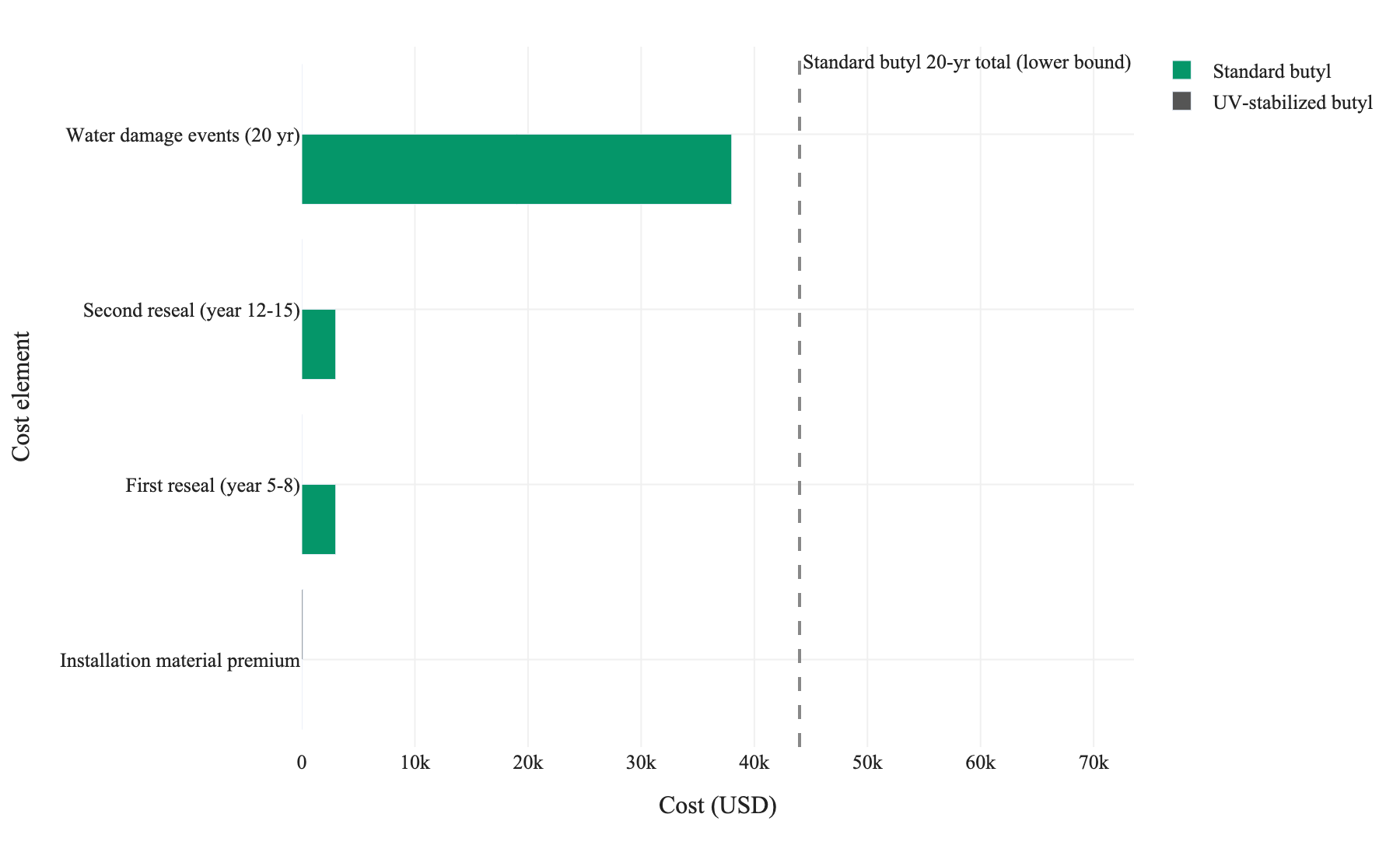
Resealing a failed glazing joint in an industrial building requires removal of the hardened butyl strip, surface preparation of both aluminum and glass substrates to remove adhesive residue and oxidation products, and installation of a correctly specified replacement tape under controlled joint-width and compression conditions. Industry repair benchmarks for commercial glazing restoration indicate that wet-seal repair work capable of lasting 20 or more years, when properly executed, costs USD 15 to USD 35 per linear meter of joint for labor and materials in a building where scaffolding or elevated work platforms are already deployed (Tremco Sealants, 2024). For a 200-meter perimeter industrial building with perimeter glazing runs, total resealing costs range from USD 3,000 to USD 7,000 in material and labor before access equipment costs, and before any secondary damage is factored in. By contrast, the incremental cost of UV-stabilized butyl over standard butyl at installation is typically USD 0.50 to USD 2.00 per linear meter of tape, representing a USD 100 to USD 400 total premium on the same perimeter.
What Is the Secondary Damage Cost When Glazing Seals Fail?
The National Institute of Standards and Technology estimates that moisture-related building problems cost the United States economy approximately USD 9 to USD 15 billion annually in commercial property damage (NIST, cited in construction industry literature). A water infiltration event through a failed glazing joint in an industrial facility triggers insulation degradation, potential mold growth in wall cavities, and in facilities handling electrical or precision equipment, equipment damage that can halt production lines worth multiples of the repair cost (QZSEALS, 2024). Commercial water damage repair costs range from USD 3.75 to USD 4.25 per square foot for clean water and up to USD 7.50 per square foot for contaminated water events (PerceptiveThings, 2024). A single infiltration event affecting a 50-square-meter floor area below a failed glazing run represents USD 19,000 to USD 37,500 in remediation before any equipment replacement is included.
Figure 2. Sealant Choice Cost Comparison over 20-Year Facility Life (per 200 m glazing perimeter)
Cost element | Standard butyl | UV-stabilized butyl |
|---|---|---|
Installation material premium | Baseline | USD 100 to USD 400 additional |
First reseal at year 5 to 8 | USD 3,000 to USD 7,000 | Not required |
Second reseal at year 12 to 15 | USD 3,000 to USD 7,000 | Not required |
Expected water damage events (2 over 20 years) | USD 38,000 to USD 75,000 | Near zero if seal maintained |
20-year total direct sealant cost | USD 6,000 to USD 14,000 | USD 100 to USD 400 |
20-year total including water damage risk | USD 44,000 to USD 89,000 | USD 100 to USD 400 |
This cost structure follows the pattern observed consistently in building envelope economics: the procurement budget controls the line item (sealant purchase at installation), while the facilities maintenance budget absorbs the consequence (reseal cycles, leak remediation). When both cost lines are consolidated into a single total-cost-of-ownership view, the UV-stabilized specification decision is straightforward.
Energy performance degradation adds a secondary cost dimension in insulating glass units. A field study tracking 2,400 insulating glass units across 140 buildings found that sealant failure degraded thermal performance by up to 65 megawatt-hours in additional heating demand over 20 years for a typical office building (NREL, 2022). In industrial facilities with large glazing areas, this energy penalty compounds the direct repair and water damage costs.
V. Selection by Exposure Profile, Substrate, and Service Life Target
How Should Engineers Match Butyl Tape Specification to Exposure Conditions?
Butyl tape selection for industrial glazing should be driven by three variables: the UV exposure classification of the installation position, the thermal cycling amplitude driven by climate and orientation, and the required service life between scheduled maintenance interventions. The table and decision tree below convert those variables into an actionable specification.
Figure 3a. Butyl Tape Exposure Classification and Conditions
Exposure class | Direct UV dose | Substrate surface temperature swing | Substrate pair |
|---|---|---|---|
Class 1: Sheltered | Diffuse only, no direct sun | Less than 30 degrees Celsius daily | Any |
Class 2: Partially exposed | Less than 4 hours direct sun per day | 30 to 45 degrees Celsius daily | Glass-aluminum |
Class 3: Fully exposed | More than 4 hours direct sun per day | 30 to 45 degrees Celsius daily | Glass-aluminum |
Class 4: High-cycle exposed | More than 4 hours direct sun per day | More than 45 degrees Celsius daily | Metal-metal or metal-glass |
Class 1 covers interior atria and north-facing glazing in mid-latitudes. Class 4 covers rooftop skylights on dark metal buildings and outdoor equipment enclosures where substrate surface temperatures reach 60 to 80 degrees Celsius in summer peak conditions.
Figure 3b. Recommended Specification and Test Requirements by Exposure Class
Exposure class | Recommended specification | Minimum test requirement |
|---|---|---|
Class 1: Sheltered | Standard butyl, ASTM C1281-16 | ASTM C771-19 heat aging |
Class 2: Partially exposed | UV-stabilized butyl, HALS type declared | ASTM G154-23 at 500 hours, UVA-340 |
Class 3: Fully exposed | UV-stabilized butyl, HALS declared, concentration stated | ASTM G154-23 at 1,000 hours; ASTM C794-18 peel retention at 0, 500, 1,000 hours |
Class 4: High-cycle exposed | UV-stabilized butyl, HALS declared; thermal stability to 90 degrees Celsius; pump-out resistance per ASTM C1281-16 compression-recovery clause | ASTM G154-23 at 1,000 hours; ASTM C794-18; ASTM C719-22 cyclic movement |
The Class 4 row represents industrial metal roofing, skylights, and dark-frame equipment enclosures where surface temperatures routinely reach 60 to 80 degrees Celsius. For these applications, the thermal stability requirement (no pump-out under load at 90 degrees Celsius) is equally important as UV resistance, because a thermally softened tape that has migrated out of joint provides no UV or moisture protection regardless of its stabilizer content.
Decision Tree: Selecting Butyl Tape for Industrial Glazing
The following numbered decision sequence can be applied at the specification stage or during a procurement audit.
Is the glazing joint in direct solar exposure for more than 2 hours per day? If No, proceed to standard butyl per ASTM C1281-16. If Yes, proceed to Step 2.
Does the daily temperature swing at the substrate surface exceed 30 degrees Celsius? If No, Class 2 specification applies: require HALS declaration and ASTM G154-23 500-hour test results. If Yes, proceed to Step 3.
Is the substrate dark-colored metal (absorptivity greater than 0.8) or is the installation in a rooftop or machinery-top position where peak surface temperatures can exceed 60 degrees Celsius? If No, Class 3 specification applies: require HALS declaration, ASTM G154-23 1,000-hour test, and ASTM C794-18 peel retention data. If Yes, Class 4 specification applies: additionally require pump-out resistance data per ASTM C1281-16 compression-recovery clause and thermal stability confirmation at 90 degrees Celsius.
At any step: ask the supplier to confirm in writing whether any UV stabilizer is present, its chemical class (HALS, benzotriazole, or benzophenone), its nominal concentration, and whether the product has been tested to ASTM G154-23. Inability to answer all four points is an automatic downgrade to standard butyl classification for service life planning purposes.
Inspection Checklist for In-Service Butyl Glazing Joints
The following checklist is designed for use during facility maintenance rounds at 12-month intervals. A printed version can be attached to the work order.
Visual Inspection (complete from exterior)
[ ] 1. Confirm tape surface color: gray or black is normal. Yellow-brown or dark-brown discoloration indicates photo-oxidative degradation. Record linear extent in meters.
[ ] 2. Check for surface cracking: longitudinal cracks parallel to the joint edge with widths visible to the naked eye (greater than approximately 0.2 millimeters) indicate mid-stage UV failure.
[ ] 3. Check tape edge profile: tape should show compression bulge at both substrate surfaces. Tape flush with or recessed below substrate surface level may indicate pump-out or shrinkage.
Probe Inspection (requires 1.5 mm wire probe)
[ ] 4. Insert probe at butyl-to-glass interface at 0.5-meter intervals along the full joint run. Probe should meet firm resistance within 2 millimeters. Penetration beyond 4 millimeters indicates adhesive separation.
[ ] 5. Repeat probe check at butyl-to-aluminum interface. Record interface separation distances at all positive probe locations.
Humidity Indicator Check (for sealed glazing cavities with cards installed)
[ ] 6. Read installed humidity indicator cards. A 30 percent level pink only: joint is performing within design. A 40 percent level pink: moisture is entering; schedule detailed inspection and reseal planning within 90 days. A 50 percent level pink: moisture barrier has failed; initiate reseal within 30 days.
Scoring and Action Trigger
0 to 1 items flagged: No action required before next 12-month cycle.
2 to 3 items flagged: Schedule joint reseal planning within the next 6 months.
4 or more items flagged, or any item 4 through 6 positive: Immediate reseal planning required; escalate to facilities management.
VI. Field Cases: Industrial Building, Equipment Enclosure, and Vehicle Glazing
The following cases are anonymized and operating details have been generalized to protect customer identities. Each includes the quantitative indicators, specific actions taken, and site background specified in the Lubinpla field case format.
Company A: What Happens When an Industrial Skylight Strip Uses Non-Stabilized Butyl on a Hot Roof?
Company A is a mid-scale food processing facility in a temperate-continental climate that constructed a new production hall in Year 0 with a continuous polycarbonate-glazed skylight strip running 180 meters along the roof ridge. The original specification called for butyl tape at 4 millimeters compression per ASTM C1281-16 between aluminum extrusions and polycarbonate sheets. The procurement team selected the lowest-cost C1281-compliant product, which was listed at USD 1.20 per linear meter. Monthly rooftop temperature measurements confirmed peak surface temperatures of 68 to 74 degrees Celsius in summer months. By Month 14, the facility maintenance log recorded 7 interior drip events during heavy rain. By Month 20, 23 drip events had been recorded with visible staining on the production floor below.
The investigation initially focused on polycarbonate panel fastener torque and panel alignment, finding no non-conformance. The unexpected cause was traced to the butyl tape: surface Shore A hardness measurements at the affected joints averaged 55 compared to 32 on unexposed reference samples from the same lot. Brown discoloration extended 8 to 12 millimeters from the exposed tape edges. Probe inspection at 0.5-meter intervals identified adhesive separation at the polycarbonate interface along 67 meters of the 180-meter run, or 37 percent of the total joint length. The butyl tape had not been UV-stabilized, and the product data sheet confirmed no UV stabilizer was listed among the ingredients.
The remedial action involved three steps. First, the team replaced the full 180-meter run with a UV-stabilized butyl tape (HALS declared, ASTM G154-23 1,000-hour result provided by supplier showing less than 15 percent peel force reduction). Second, the team inserted 30, 40, 50 percent relative humidity indicator cards in the glazing cavity at 9-meter intervals, accessible from below for inspection without roof access. Third, the team added a 12-month inspection protocol using the probe and visual checklist above. The total remediation cost was USD 18,400 including access equipment and labor. No further drip events have been recorded in the 18 months since remediation. The incremental cost difference between the standard butyl and the UV-stabilized replacement tape was USD 0.85 per linear meter, or USD 153 total, which would have prevented the entire failure and remediation sequence.
Company B: Outdoor Equipment Enclosure, Single-Variable Pattern
Company B is an electrical distribution equipment manufacturer that supplies outdoor-rated steel enclosures housing transformer monitoring assemblies. Each enclosure uses a continuous butyl tape bead as the door perimeter seal, with 3.2 meters of tape per unit. Units are rated to meet ingress protection class IP65 (International Electrotechnical Commission, IEC 60529) at installation. Following a field service review across 340 deployed units at 2 years of outdoor service, 41 units (12.1 percent) failed IP65 humidity testing when brought in for routine service calibration.
All 41 failures shared a common characteristic: the butyl seal had hardened and separated from the door frame at the top horizontal run, the position with maximum direct solar exposure. Shore A hardness on the failed seals averaged 61; Shore A on units from a climate-controlled indoor installation averaged 29. No UV stabilizer was present in the standard butyl formulation used. Enclosure surface temperatures at the southern-facing door face were measured at 58 to 67 degrees Celsius in summer peak conditions.
The single variable change tested was replacement of the standard butyl tape with a UV-stabilized HALS-containing tape (confirmed by supplier certificate) at the same 3.2-meter-per-unit quantity. Thirty units from a subsequent production batch were deployed alongside 30 matched units with the original standard butyl tape as a parallel control. At 18 months of outdoor service, 0 of the 30 UV-stabilized units failed IP65 re-test, while 6 of the 30 standard butyl control units (20 percent) failed. The cost difference per unit was USD 0.42 in tape material cost. The service call cost to retrieve a failed unit, transport it to the repair facility, reseal, retest, and redeploy was approximately USD 340 per unit, representing a return on the upgrade investment of more than 800 to 1 on a per-unit basis.
Company C: Vehicle Glazing, Gradual Improvement Pattern
Company C is a specialty vehicle manufacturer producing mobile command and emergency-response vehicles. Glass side windows are set in aluminum frames with butyl tape primary seals. The customer complaint profile showed a steady increase in field water infiltration reports: 3 complaints in the vehicles' first operational year, rising to 14 complaints by Year 2, and 31 by Year 3. The complaint pattern correlated with vehicle age, not with operational region or mileage.
Stage 1 action: the engineering team standardized installation procedure, added a torque specification for window retention clips, and improved surface preparation protocols. Complaints in the following year dropped to 22, a partial but insufficient improvement. Stage 2 analysis compared complaint rates by vehicle production lot. Vehicles produced using a UV-stabilized butyl tape (used during a 6-month period when the standard supplier was on allocation) showed a complaint rate of 1.8 per 10 vehicles at Year 3 service life. Vehicles produced with standard butyl showed a complaint rate of 6.7 per 10 vehicles at the same service age. The difference in tape material cost between the two formulations was USD 3.10 per vehicle. Stage 3 action: the team converted all new production to the UV-stabilized tape and began a scheduled reseal program for vehicles in the field with more than 24 months of service. Field complaints over the subsequent two years dropped from 31 per year to 4 per year, a reduction of 87 percent, and the cost per customer service claim (transport, repair labor, re-verification) was eliminated at approximately USD 1,200 per incident.
VII. Key Takeaway
Butyl sealant tape fails in two sequential and mechanistically distinct stages in exposed industrial glazing: photo-oxidative browning and hardening typically beginning at 12 to 18 months, followed by adhesive interface separation from cumulative thermal cycling fatigue typically beginning at 24 to 36 months. Treating the visible discoloration as a cosmetic issue delays the reseal decision until water infiltration is already occurring.
Neither ASTM C1281-16 nor ISO 11600:2002 requires disclosure of UV stabilizer type or concentration on conformance certificates. Purchasing teams that specify only "ASTM C1281 compliant" are accepting either standard or UV-stabilized butyl with no mechanism to distinguish them from the certificate.
UV-stabilized butyl containing HALS at 0.1 to 0.5 percent by weight extends both service windows simultaneously to 10 years and beyond in direct-exposure applications, without changing the glazing assembly design or installation technique.
The minimum procurement specification for exposed industrial glazing joints should require four supplier disclosures: UV stabilizer presence, stabilizer chemical class, nominal concentration, and ASTM G154-23 accelerated weathering test results at 1,000 hours minimum with ASTM C794-18 peel retention data.
The cost of upgrading to UV-stabilized butyl at installation is USD 0.50 to USD 2.00 per linear meter. The cost of two reseal cycles and one water infiltration event over a 20-year facility life is USD 44,000 to USD 89,000 on a 200-meter glazing perimeter. The inspection checklist in Section V can be deployed immediately with no equipment purchase required.
Browse related Lubinpla case studies on adhesives, sealants, and glazing assembly performance at https://www.lubinpla.com, where the AI Crew domain authority library covers selection audits, failure pattern analysis, and specification gap identification across the full sealants and damping product domain.
VIII. References
ASTM International. (2016). ASTM C1281-16: Standard Specification for Preformed Tape Sealants for Glazing Applications. https://store.astm.org/c1281-16.html
ASTM International. (2018). ASTM C794-18: Standard Test Method for Adhesion-in-Peel of Elastomeric Joint Sealants. https://store.astm.org/c0794-18r22.html
ASTM International. (2019). ASTM C771-14(2019): Standard Test Method for Weight Loss After Heat Aging of Preformed Tape Sealants. https://www.astm.org/c0771-14r19.html
ASTM International. (2022). ASTM C719-22: Standard Test Method for Adhesion and Cohesion of Elastomeric Joint Sealants Under Cyclic Movement (Hockman Cycle). https://store.astm.org/c0719-22.html
ASTM International. (2023). ASTM G154-23: Standard Practice for Operating Fluorescent Ultraviolet (UV) Lamp Apparatus for Exposure of Nonmetallic Materials. https://www.q-lab.com/weathering/weathering-test-standards/ASTM-G154
BZTape. (2024). Butyl Tape: A Technical Deep Dive. https://www.bztape.com/news-detail/butyl-tape-a-technical-deep-dive.html
Glew Engineering. (2023). Thermal Expansion in a Glass and Aluminum Window: Part 2. https://www.glewengineering.com/thermal-expansion-in-a-glass-and-aluminum-window-part-2/
ISO (International Organization for Standardization). (2002). ISO 11600:2002: Building Construction, Jointing Products, Classification and Requirements for Sealants. https://www.iso.org/standard/26328.html
Lingnell, A. (2007). Field Correlation of the Performance of Insulating Glass. Oak Ridge National Laboratory Conference Archive. https://web.ornl.gov/sci/buildings/conf-archive/2007%20B10%20papers/066_Lingnell.pdf
National Renewable Energy Laboratory (NREL). (2022). Degradation of Insulating Glass Units: Thermal Performance, Measurements and Energy Impacts. https://docs.nrel.gov/docs/fy23osti/84852.pdf
PerceptiveThings. (2024). Average Cost of Repairing Water Damage for Commercial Buildings. https://www.perceptivethings.com/post/average-cost-of-repairing-water-damage-for-commercial-buildings
QZSEALS. (2024). The 5 Hidden True Cost Of Industrial Seal Failure. https://qzsealings.com/the-cost-of-industrial-seal-failure/
Rechner, R., and colleagues. (2021). Polyisobutylene and Silicone in Warm Edge Glazing Systems: Evaluation of Long-Term Performance. PMC/MDPI Materials, 14(13), 3594. https://pmc.ncbi.nlm.nih.gov/articles/PMC8269632/
ScienceDirect. (1998). Thermo and photo-oxidation of polyisobutylene: Influence of the temperature. Polymer Degradation and Stability. https://www.sciencedirect.com/science/article/abs/pii/S0141391098000408
SpecialChem. (2023). UV/Light Stabilizers for Adhesives: State of the Art. https://www.specialchem.com/adhesives/guide/uv-light-stabilizers-state-of-the-art
Tremco Sealants. (2024). The Facility Manager's Guide to Glazing System Maintenance. https://www.tremcosealants.com/blog/the-facility-manager-s-guide-to-glazing-system-maintenance