Catch Cooling Water Scale 90 Days Before Shutdown
Summary: Cooling water scale rarely surprises a plant on the day the heat exchanger fails. The chemical conditions that drive calcium carbonate precipitation, declining approach temperature, drifting cycles of concentration, and rising specific conductivity leave a measurable signature in plant historian data weeks to months before the unit is forced offline for emergency descaling. This guide examines the saturation chemistry that governs cooling water scaling, identifies the sensor patterns that precede critical fouling events, and quantifies the economic delta between planned chemical treatment and emergency descaling, which trade publications report as roughly 3 to 5 times more costly per event. It then provides a step-by-step procedure for building a basic scale prediction model from existing historian tags, including a threshold table for operators, a sampling routine aligned with ASTM D1126 hardness testing, and a Langelier Saturation Index based escalation matrix. The objective is operational: convert historian data already being collected and ignored into a 90-day lead-time warning system, so descaling becomes a scheduled outage rather than an unplanned shutdown. Lubinpla helps process plants interpret this multi-signal cooling water data through AI Shooting, a per-case analysis service that returns an evidence-based written report on submitted operating data.
Table of Contents
I. Introduction
II. Scaling Mechanisms: Calcium Carbonate Saturation Index and Temperature Dependency
III. Sensor Data Patterns That Precede Critical Fouling Events
IV. Predictive Maintenance Economics: Planned Treatment vs. Emergency Descaling
V. Building a Predictive Model from Existing Plant Historian Data
VI. Key Takeaway
VII. References
I. Introduction
Cooling water scale prediction is the use of routinely logged chemistry and thermal data to forecast calcium carbonate deposition on heat transfer surfaces before the deposit causes a measurable capacity loss. In a typical recirculating system the relevant data already exists in the historian, with conductivity, pH, makeup flow, and approach temperature sampled at one minute or less. The opportunity is to read it 90 days earlier, not to install new sensors.
At a midsize specialty chemicals plant the sequence often plays out the same way. The operator notices that the reactor jacket cooling cannot pull product temperature down to the setpoint, the heat exchanger duty curve is reviewed, the unit is taken offline, and a contractor is mobilized for mechanical or acid cleaning. The chemistry that produced the scale, however, was visible months earlier. Cooling water hardness drift and pH movement above the saturation pH had already pushed the Langelier Saturation Index (LSI) into positive territory, and conductivity at the basin had climbed past the cycles of concentration setpoint without the blowdown valve responding.
This Predictive Insight focuses on the chain from chemistry to historian signature to outage decision. It is written for process engineers, reliability engineers, and water treatment specialists who own a cooling water system and have access to a plant historian but have not yet operationalized predictive descaling.
Why 90 Days Is the Right Lead Time
Ninety days corresponds to the practical scheduling horizon for a planned shutdown in most process plants. Procurement of descaling chemistry, contractor mobilization, production rescheduling, and inventory pre-build all fit inside a 90 day window. By contrast, two to four weeks of warning, which is what plants typically experience with fouling factor monitoring alone, leaves time only for emergency response, not for a properly costed outage. Recent work on data-driven fouling detection in refinery preheat trains has shown that machine learning models trained on baseline operational data can detect fouling resistance trends weeks earlier than threshold-based alarms (Tarcanu et al., 2024).
II. Scaling Mechanisms: Calcium Carbonate Saturation Index and Temperature Dependency
Calcium carbonate scale forms when the cooling water reaches local supersaturation at the hot tube wall, releases dissolved carbon dioxide, and precipitates calcite (CaCO3) onto the heat transfer surface. The dominant predictive index is the Langelier Saturation Index (LSI), defined as the difference between the measured pH and the saturation pH (LSI = pH minus pHs) at the same temperature, total dissolved solids (TDS), calcium hardness, and alkalinity (Corrosion Doctors, 2024). A positive LSI indicates that the water tends to deposit calcium carbonate; a negative LSI indicates that the water tends to dissolve it.
How Does Temperature Shift the Saturation Point?
Saturation pH falls as temperature rises, which is why scale forms preferentially on the hot side of a heat exchanger rather than in the cooling tower basin. The bulk water can sit at LSI close to zero in the basin and reach LSI of plus 0.5 to plus 1.0 at the hot tube wall, which is far above the widely accepted equilibrium range of minus 0.30 to plus 0.30 (Corrosion Doctors, 2024). Scale-forming species, primarily calcium ions paired with carbonate or bicarbonate, are concentrated further as evaporation drives the cycles of concentration upward in the recirculating loop.
The Ryznar Stability Index (RSI), defined as RSI = 2 pHs minus pH, complements LSI by quantifying how thick the predicted deposit is likely to be in service. Values below 6 generally indicate scaling potential, values above 7 indicate that calcium carbonate is unlikely to form a protective film, and values above 8 indicate aggressive corrosion conditions (Water Treatment Basics, 2023). RSI is the better field index when the question is "how fast is scale accumulating," while LSI is the better thermodynamic index for "will it scale at all."
What Drives Calcium Carbonate Supersaturation in a Real Plant?
Three drivers dominate. First, the cycles of concentration: cooling tower systems typically run at 3 to 7 cycles, and going from 3 to 6 cycles reduces makeup water by 20 percent but doubles the concentration of every scale-forming species (Dober, 2024). Second, makeup water chemistry: hard makeup with calcium hardness above 150 mg/L as CaCO3 and alkalinity above 100 mg/L as CaCO3 reaches LSI = 0 at a much lower pH than soft makeup. Third, treatment chemical drift: a 10 percent underdose of phosphonate or polymer scale inhibitor effectively raises the local saturation index by an amount comparable to a 0.5 unit pH increase, in field practice.
Figure 1. Scale-Forming Drivers and Their Historian Equivalents
Chemical driver | What changes | Historian tag that reflects it |
|---|---|---|
Cycles of concentration rising | TDS and Ca hardness multiply | Basin conductivity (uS/cm), makeup flow, blowdown flow |
Makeup water hardness drift | Inlet Ca and alkalinity climb | Makeup conductivity, periodic Ca titration log |
pH drift upward | Saturation pH gap closes | Basin pH probe, acid feed runtime |
Inhibitor underdose | Local supersaturation tolerated higher | Inhibitor pump strokes, day tank level |
Tube wall temperature rise | Local pHs falls, LSI rises | Hot side outlet T, approach T, duty calculation |
Each row in the table maps a chemistry mechanism to a tag already present in most plant historians. Building a prediction model is therefore a matter of reading what is already collected, not adding new instrumentation.
III. Sensor Data Patterns That Precede Critical Fouling Events
The detectable pattern in historian data is a coordinated drift across four signals: rising basin conductivity, narrowing approach temperature, falling overall heat transfer coefficient (U), and increasing inhibitor pump duty without corresponding chemistry improvement. Each signal in isolation is noisy; the four moving together for more than two weeks is the predictive pattern that precedes most critical fouling events in process cooling water service.
Which Historian Tags Carry the Signal?
Approach temperature, the difference between the cold-side outlet temperature and the wet bulb temperature, is the cleanest single tag. A trend of 0.05 to 0.10 degrees C per week of widening approach over a steady-load period is the classic fouling signature (NeonEET, 2025). Conductivity at the basin is the next tag: if conductivity is climbing while makeup conductivity stays constant, the cycles of concentration are creeping up and scale risk is following. Specific conductance moves before LSI does, because conductivity rises continuously while pH and alkalinity sometimes get titrated back by the dosing controller, masking the chemistry shift.
The fouling factor itself, calculated from inlet temperature, outlet temperature, flow, and process side duty, is the most direct measurement but is the most expensive to compute correctly in a noisy plant. Refinery applications have demonstrated that LSTM neural networks and gradient boosting models can predict heat exchanger outlet temperatures with R2 values above 0.96, which is sufficient to detect fouling resistance trends well before threshold-based alarms (Tarcanu et al., 2024).
What Does a Real Pre-Fouling Trace Look Like?
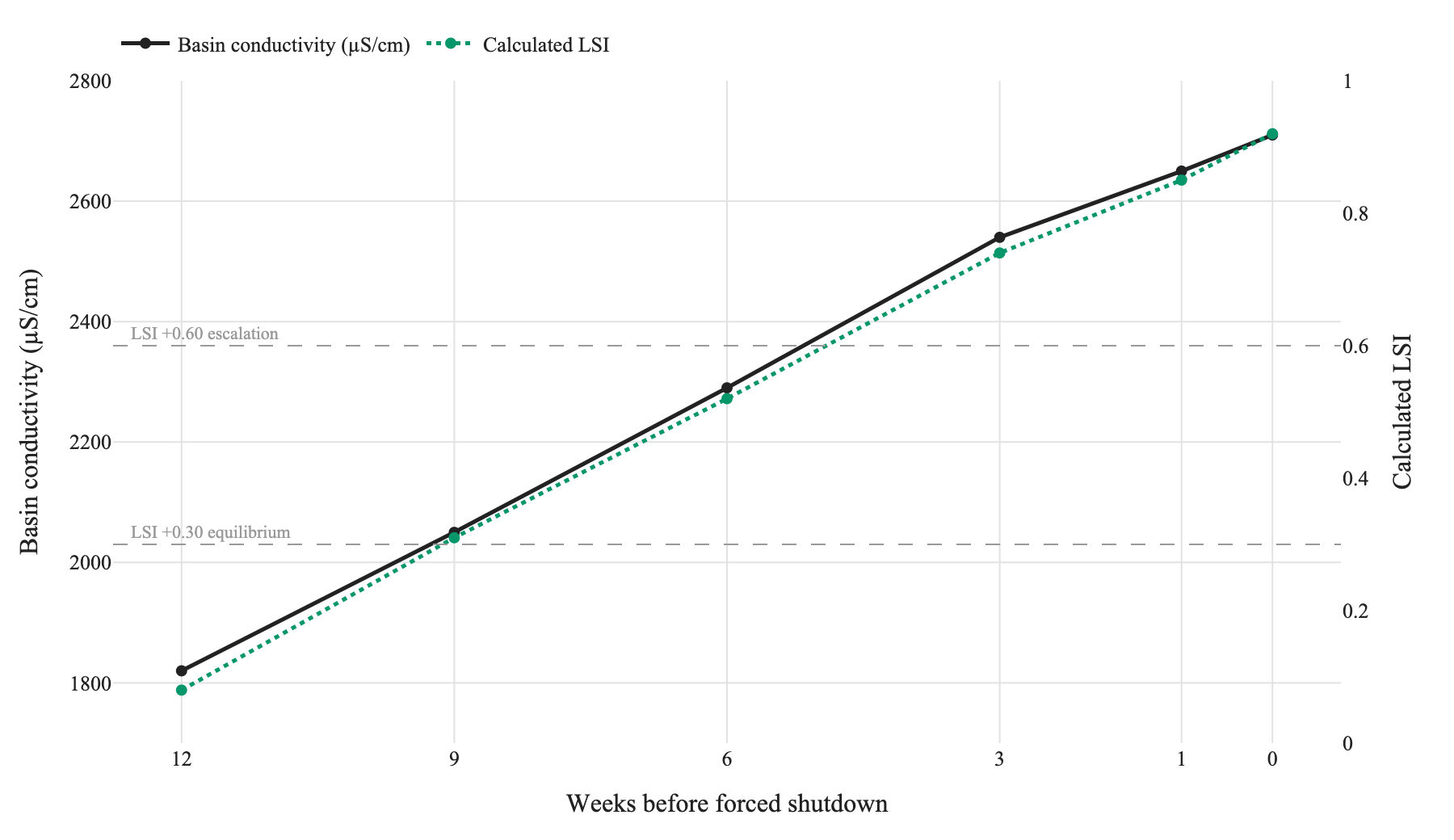
Company A, a midsize fine chemicals plant operating an open recirculating cooling tower (cooling duty approximately 8 MW, 12,000 m3/h circulating, makeup hardness 180 mg/L as CaCO3), experienced a forced shutdown of a critical reactor cooling loop. The descale invoice and lost production combined came to approximately USD 240,000 for that single event. Looking back at the historian, four signals had been moving in unison for 11 weeks before the shutdown: basin conductivity climbed from 1,800 to 2,650 uS/cm, approach temperature widened from 4.2 to 6.8 degrees C, inhibitor pump duty rose from 18 to 27 percent, and calculated LSI moved from plus 0.10 to plus 0.85. The pattern was a textbook scale onset trajectory. No alarm fired because each individual tag stayed inside its single-tag deadband.
This case is the heart of the predictive opportunity. The data was complete, the chemistry was unambiguous, and the lead time was 11 weeks. What was missing was a model that read the four signals together against the LSI baseline.
Figure 2. Approach Temperature and Conductivity Pattern Before a Forced Shutdown
Week before shutdown | Basin conductivity (uS/cm) | Approach temperature (degrees C) | Calculated LSI |
|---|---|---|---|
12 | 1,820 | 4.1 | +0.08 |
9 | 2,050 | 4.6 | +0.31 |
6 | 2,290 | 5.2 | +0.52 |
3 | 2,540 | 6.1 | +0.74 |
1 | 2,650 | 6.8 | +0.85 |
0 (shutdown) | 2,710 | 7.4 | +0.92 |
The pattern shows monotonic drift on all three indicators for 12 weeks before the shutdown. Note that absolute LSI value at week 12 was already above the plus 0.30 equilibrium threshold but had not triggered the single-tag pH alarm. The combination of three tags moving in the same direction, against a stable load profile, is what makes the pattern predictive rather than coincidental.
IV. Predictive Maintenance Economics: Planned Treatment vs. Emergency Descaling
Predictive descaling saves roughly 3 to 5 times the direct cost of an emergency event, and a larger multiple once production losses are included. ARC Advisory Group has estimated that unplanned downtime in process industries costs approximately 10 times as much as planned downtime per equivalent outage hour, and reliability research places unplanned shutdowns at about 5 percent of total process industry output (ARC Advisory Group, 2024; Industry USA, 2024).
Why Is Emergency Descaling 3 to 5 Times More Expensive?
The headline cost driver is mobilization rather than the chemistry. Contractor emergency mobilization, off-hours premium labor, expedited chemical procurement, and tooling rental together account for 40 to 60 percent of the emergency invoice premium. Production losses are separate and usually larger than the descale invoice itself. In the Company A case above, the descale invoice was approximately USD 70,000 and lost product margin was approximately USD 170,000. A planned outage would have inverted that ratio, with descale chemistry slightly higher than emergency baseline but lost production effectively zero because the outage coincides with another planned activity.
A second driver is asset damage. Emergency descaling is often more aggressive (higher concentration acid, longer dwell, higher temperature) because the deposit is harder and thicker than it would have been if treated at the 90 day mark. This raises the risk of attack on tube metallurgy, gasket damage, and accelerated under-deposit corrosion (NACE SP0189, 2013). NACE SP0189 specifically addresses online monitoring of cooling water systems to detect both fouling and corrosion before they reach a damaging level, and the standard's existence reflects how routinely this dual mode failure occurs.
Figure 3. Cost Worksheet: Emergency vs. Planned Descale, 8 MW Cooling Loop
Line item | Emergency (USD) | Planned (USD) | Assumption |
|---|---|---|---|
Descale chemistry | 18,000 | 22,000 | Planned uses milder citric/EDTA blend, longer dwell |
Contractor labor | 32,000 | 14,000 | Emergency 1.7x rate, off-hours premium |
Production loss | 170,000 | 8,000 | Emergency 5 days unplanned vs 1 day inside planned outage |
Asset damage allowance | 20,000 | 2,000 | Harder deposit and higher acid concentration in emergency |
Total | 240,000 | 46,000 | Net delta approximately USD 194,000 per event |
The worksheet assumes a single forced event per year is converted to a single planned event. For plants running two to three forced descales per year, the delta scales linearly. Capital cost of the predictive model itself is in the low five figures USD when built on the existing historian, and payback is typically inside one prevented event.
What Are the Compliance and Standards Implications?
Three standards are directly relevant. ASTM D1126-17 specifies the hardness titration method used to verify calcium and magnesium concentrations in cooling water samples, and is the foundational reference for any plant operating a chemical treatment program (ASTM International, 2017). NACE SP0189-2013 defines online monitoring practices for fouling and corrosion in cooling water systems, including the heat transfer monitoring devices that translate historian data into fouling factor estimates (NACE International, 2013). AWWA standards on water analysis methods support the laboratory verification of routine grab samples drawn from the system. A plant operating predictive descaling without referencing at least these three documents is leaving its program open to audit findings.
V. Building a Predictive Model from Existing Plant Historian Data
A predictive scale model can be built in three months with existing historian tags, a recurring sampling routine, and a threshold table that the day shift can act on without further interpretation. The model does not require deep machine learning to deliver 90 day lead time. A multivariable index combining LSI, basin conductivity slope, and approach temperature slope, evaluated weekly, is enough for the first generation.
What Tags Should the Model Read?
The minimum tag set is six: basin conductivity, makeup conductivity, basin pH, basin temperature, cold side outlet temperature, and hot side outlet temperature. Add inhibitor pump duty and blowdown valve position if available. Calcium hardness and alkalinity come from grab samples (twice per week is sufficient at the start; daily once the model is operational). With these inputs the LSI can be computed continuously and the cycles of concentration can be computed continuously from the conductivity ratio (Lakewood Instruments, 2024).
How Should Operators Act on the Output?
The model output is most useful when expressed as a four band threshold table that maps to specific operator actions. The table below is the recommended starting framework for an 8 MW recirculating system on moderately hard makeup; sites with softer or harder makeup should tune the numeric thresholds while preserving the band structure.
Figure 4. Threshold Table for Predictive Scale Response
Variable | Safe range | Action threshold | Escalation threshold |
|---|---|---|---|
LSI (computed weekly average) | minus 0.30 to plus 0.30 | plus 0.30 to plus 0.60 | above plus 0.60 |
Basin conductivity slope | less than 30 uS/cm per week | 30 to 80 uS/cm per week | above 80 uS/cm per week |
Approach temperature slope | less than 0.05 deg C per week | 0.05 to 0.10 deg C per week | above 0.10 deg C per week |
Cycles of concentration | 4 to 6 | 6 to 7 | above 7 |
Inhibitor pump duty | less than 22% | 22% to 30% | above 30% |
Operator action | Log only | Increase grab sampling, verify dose | Notify reliability, schedule descale within 90 days |
Each row in the table is independently observable in the historian, and the cross-row pattern (two or more variables in the action band for two consecutive weeks) is what triggers escalation. This pattern based rule is materially less noisy than any single-tag threshold and is the same logic used by published fouling prediction models in refinery preheat trains.
What Is the Sampling Procedure?
A formal sampling routine is required to ground the model in chemistry, not just in instrument drift. The routine below references ASTM D1126 for hardness and is the minimum acceptable cadence for a plant running predictive descaling.
Equipment: clean 1 L polyethylene sample bottle, calibrated pH meter (within 30 days), conductivity probe (within 7 days), EDTA titration kit per ASTM D1126-17, alkalinity titration kit. Pre-rinse all glassware with sample water.
Frequency: basin and makeup grab samples twice per week minimum. Daily during action or escalation band conditions. Maintain consistent sampling time of day to control for diurnal load variation.
Sampling points: basin (representative recirculating composition), makeup line (raw water entering the system), blowdown line (concentrated discharge for mass balance check). Skip return line; it gives noisy results that confuse new operators.
Tests per sample: pH, conductivity, calcium hardness (ASTM D1126-17), total alkalinity, free chlorine (if biocide is in use), phosphonate residual (if applicable to inhibitor program). Record temperature at sampling point.
Success criteria: pH within 0.05 of inline probe, conductivity within 3 percent of inline probe, calcium hardness back-calculated cycles of concentration within 0.5 cycle of the conductivity-based estimate. Discrepancies outside these bands indicate instrument drift, not chemistry change.
Record retention: log all results in the historian or LIMS within 24 hours. Retain hard copy bench sheets for 12 months minimum (longer if facility audit cycle requires).
The sampling routine is what converts the prediction model from an interesting calculation into a defensible operating procedure. Without verified grab samples the LSI calculation is only as good as the inline probes, which drift over weeks unless calibrated against titration.
What About the Lubinpla AI Shooting Pathway?
For plants that have the historian data and the grab sample log but do not yet have an internal data science capacity to build the multivariable model, the same dataset can be submitted to AI Shooting, which is Lubinpla's per-case industrial chemistry analysis service. AI Shooting returns a written report on the submitted readings with the LSI and RSI calculated, the pattern relative to scale onset trajectories from comparable systems, and a 90 day forward projection. The deliverable is the analysis, not a tool or a subscription. This is the natural entry point for a plant that wants the predictive output before investing in an in-house model.
VI. Key Takeaway
Calcium carbonate scale formation is predictable from historian data already collected in most process cooling systems, with practical 90 day lead time available when LSI, conductivity slope, and approach temperature slope are read together.
The Langelier Saturation Index plus 0.30 to plus 0.60 band is the action zone; above plus 0.60 a descale should be scheduled inside 90 days regardless of whether the heat exchanger duty has yet degraded.
Emergency descaling typically costs 3 to 5 times the planned alternative on direct invoice basis and 5 to 10 times when production losses are included, per ARC Advisory Group benchmarks on process industry unplanned downtime.
Reference ASTM D1126-17 for hardness verification and NACE SP0189-2013 for online monitoring design; a program that omits both is exposed at audit and at insurance review.
Submit your readings to AI Shooting for interpretation if the in-house dataset is ready but the modeling capacity is not yet built. Per-case analysis is available at https://www.lubinpla.com/ai-shooting
References
ARC Advisory Group. (2024). Process industry downtime and key performance metrics. https://www.arcweb.com/blog/process-industry-downtime-and-key-performance-metrics
ASTM International. (2017). ASTM D1126-17 standard test method for hardness in water. https://www.astm.org/Standards/D1126.htm
Corrosion Doctors. (2024). Langelier Saturation Index (LSI) for cooling water towers. https://www.corrosion-doctors.org/Cooling-Water-Towers/Index-Langelier.htm
Corrosion Doctors. (2024). Scaling indices for corrosion by water. https://corrosion-doctors.org/Corrosion-by-Water/Scaling-indices.htm
Dober. (2024). Cooling tower cycles of concentration (COC): what you need to know. https://www.dober.com/smart-release/resources/cooling-tower-cycles-of-concentration
EAI Water. (2024). Cycles of concentration in cooling towers. https://eaiwater.com/cycles-of-concentration/
EPCLand. (2026). Heat exchanger fouling factor: significance, calculation, and 2026 standards. https://epcland.com/heat-exchanger-fouling-factor/
Industry USA. (2024). The cost of unplanned downtime due to inefficient maintenance practices. https://magazine-industry-usa.com/market-overview/96259-the-cost-of-unplanned-downtime-due-to-inefficient-maintenance-practices
Infinite Cooling. (2024). Understanding the role of AI in predictive cooling tower maintenance. https://www.infinite-cooling.com/post/understanding-the-role-of-ai-in-predictive-cooling-tower-maintenance
Lakewood Instruments. (2024). Cycles of concentration control for boilers and cooling towers. https://lakewoodinstruments.com/blog-cycles-of-concentration-control/
Mantech. (2024). Cooling water scaling potential: Langlier Saturation Index. https://mantech-inc.com/blog/cooling-water-scaling-potential-langlier-saturation-index-lsi/
NACE International. (2013). NACE SP0189-2013 online monitoring of cooling water systems. AMPP Store. https://store.ampp.org/sp0189-2013-2
NeonEET. (2025). How fouling degrades shell and jacket heat exchangers and how to make maintenance decisions. https://neoneeet.com/en/cooling-water-fouling-heat-exchanger-maintenance-2/
Oxmaint. (2024). Predictive maintenance for cooling tower: AI detection of scale buildup. https://oxmaint.com/industries/facility-management/predictive-maintenance-for-cooling-tower-ai-detection-of-scale-buildup
Tarcanu, A., et al. (2025). Data-driven fouling detection in refinery preheat train heat exchangers using neural networks and gradient boosting. Sensors, 25(16), 4936. https://www.mdpi.com/1424-8220/25/16/4936
Water Treatment Basics. (2023). Ryznar Stability Index (RSI) calculation for cooling water treatment. https://watertreatmentbasics.com/ryznar-stability-index-calculation/