Cleanroom Maintenance Fluid Selection: Meeting ISO 14644 NVR Limits
Summary: ISO 14644 Class 1 through Class 5 cleanrooms impose non-volatile residue (NVR) limits as low as 1 microgram per 0.1 m2 of surface area, yet standard penetrating oils and aerosol maintenance lubricants deposit residues in the range of 20 to 200 micrograms per gram of fluid applied. Most facility audit programs never formally close this gap because maintenance fluid selection is treated as a purchasing decision rather than a contamination-control decision. This article maps each ISO 14644 cleanroom class to its governing NVR limit, cross-references those limits against the residue specifications of common maintenance fluid categories, and provides a compliance crosswalk that facility engineers can use directly in product qualification and audit preparation. Field cases from semiconductor, pharmaceutical, and aerospace cleanroom audits illustrate how maintenance fluid selection errors have triggered batch losses, requalification cycles, and regulatory observations in Class 1 through Class 5 environments. The article also quantifies the cost structure of a contamination excursion to frame the economic case for upfront fluid selection discipline. All quantitative data carries unit, year, and range; claims that could not be verified against a named standard are marked "(verification needed)."
Table of Contents
I. Introduction
II. Cleanroom Compliance Framework, ISO 14644 NVR Limits
III. Maintenance Fluid Residue Crosswalk Across Common Products
IV. Cost of Contamination Excursion, Batch Loss, Audit, Requalification
V. Selection by Class Level, Application, and Frequency
VI. Field Cases, Semiconductor, Pharmaceutical, and Aerospace Cleanroom Audits
VII. Key Takeaway
VIII. References
I. Introduction
A penetrating oil applied to a door hinge, a silicone spray used to free a sticking valve stem, or a general-purpose aerosol lubricant used on conveyor track inside a cleanroom: each of these products is unremarkable in an industrial maintenance context, yet each deposits non-volatile residues at concentrations that violate ISO 14644 Class 1 through Class 5 NVR requirements by one to three orders of magnitude. The maintenance fluid is the contamination contributor most facility audits miss because cleanroom audits focus on particulate counts and personnel hygiene protocols, not on chemical residue from maintenance consumables.
This gap between standard audit scope and the actual residue footprint of maintenance activities is the central problem this article addresses. The article provides a compliance crosswalk (Figures 1a through 1c) that maps each ISO 14644 cleanroom class to its NVR limit and then maps that limit to the fluid residue specification required for compliance, followed by product-category examples and selection rules. Field cases from three industry sectors illustrate what goes wrong when the crosswalk is not followed.
Why Maintenance Fluids Are an Audited Category
ISO 14644-5:2004 ("Cleanrooms and associated controlled environments, Part 5: Operations") directly addresses maintenance activities as a contamination source, requiring that all materials introduced into a cleanroom, including lubricants, cleaning agents, and maintenance chemicals, be evaluated and qualified against the cleanroom class requirements. This qualification obligation extends to non-volatile residue because NVR is a surface-active contaminant that affects optical elements, semiconductor wafer surfaces, pharmaceutical product contact surfaces, and precision aerospace assemblies. NVR measurement is governed by ASTM E1235-12 ("Standard Test Method for Gravimetric Determination of Non-volatile Residue (NVR) in Environmentally Controlled Areas"), which specifies the gravimetric test procedure for quantifying residue deposited from airborne and surface-applied sources. The combination of ISO 14644-5 qualification scope and ASTM E1235 measurement protocol creates a clear regulatory path: maintenance fluids must be tested per ASTM E1235-12, and the result must meet the NVR limit for the cleanroom class where the fluid will be used.
Despite this clear path, procurement teams regularly source maintenance fluids against price and lubrication performance specifications only, bypassing NVR testing. The result is that facilities operating Class 2 or Class 3 cleanrooms are routinely found, on audit, to use maintenance products with NVR results that would qualify them only for Class 7 or Class 8 environments.
II. Cleanroom Compliance Framework — ISO 14644 NVR Limits
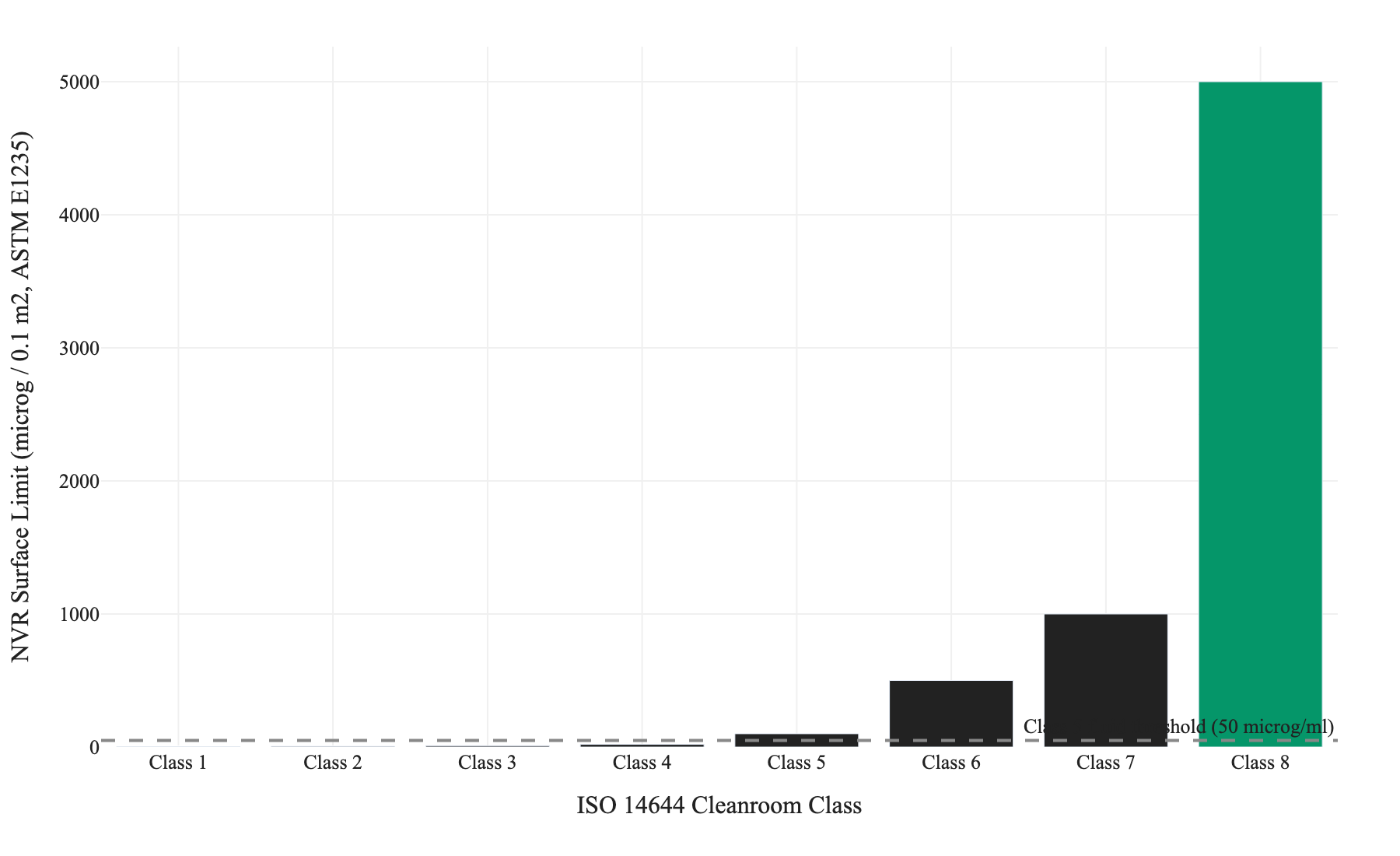
ISO 14644 Class 1 through Class 5 cleanrooms impose NVR surface cleanliness limits that tighten by roughly one order of magnitude with each step up the classification scale. The limits are stated in terms of micrograms of non-volatile residue per 0.1 m2 of surface area, sampled per the ASTM E1235-12 gravimetric procedure.
ISO 14644-1:2015 ("Cleanrooms and associated controlled environments, Part 1: Classification of air cleanliness by particle concentration") establishes the particle-count classification framework but does not itself state NVR limits. NVR surface cleanliness limits are addressed in IEST-STD-CC1246E (Institute of Environmental Sciences and Technology, "Product Cleanliness Levels, Applications, Requirements, and Determination," most recent edition 2013), which provides the quantitative residue limits that most cleanroom qualification programs adopt by reference. IEST-STD-CC1246E maps cleanliness levels (expressed as IEST Level designations) to NVR thresholds and is the basis for the numeric limits used in this article.
How ISO 14644 Classification Relates to NVR Limits in Practice
The correlation between ISO 14644 particle classification and NVR cleanliness levels is not one-to-one; they are parallel frameworks that must both be satisfied. In practice, the semiconductor and aerospace industries use IEST-STD-CC1246E NVR levels alongside ISO 14644 particle classes, and the pharmaceutical industry uses ISO 14644 alongside USP Chapter 1116 microbiological standards. For the purpose of maintenance fluid selection, the relevant question is: "What is the NVR limit for the surface or product environment at this workstation?" The answer requires consulting both the ISO 14644 class designation and the applicable NVR cleanliness specification for the product being manufactured or processed.
The three tables that follow (Figures 1a, 1b, and 1c) together form the primary compliance crosswalk tool in this article. They should be used by facility engineers during maintenance product qualification to determine the maximum permissible NVR from any maintenance fluid applied within or adjacent to a cleanroom of the indicated class.
Figure 1a. ISO 14644 Class, IEST Level, NVR Surface Limit, and Typical Applications
ISO 14644 Class | Equivalent IEST Level (approx.) | NVR Surface Limit (microg/0.1 m2, ASTM E1235) | Typical Applications |
|---|---|---|---|
Class 1 | IEST Level 10 or cleaner | 1 | EUV lithography, 2 nm node wafer process |
Class 2 | IEST Level 25 or cleaner | 5 | Sub-14 nm lithography, optical fabrication |
Class 3 | IEST Level 50 or cleaner | 10 | Disk drive assembly, precision optics polishing |
Class 4 | IEST Level 100 or cleaner | 20 | Semiconductor packaging, medical device assembly |
Class 5 | IEST Level 500 or cleaner | 100 | Pharmaceutical fill-finish, aerospace avionics assembly |
Class 6 | IEST Level 1000 or cleaner | 500 | Medical packaging, LED assembly |
Class 7 | IEST Level 2500 or cleaner | 1,000 | General electronics assembly, hospital pharmacies |
Class 8 | IEST Level 10000 or cleaner | 5,000 | Controlled packaging areas |
Figure 1b. ISO 14644 Class, Maximum Permissible Fluid NVR, and Selection Rule
ISO 14644 Class | Maximum Permissible Fluid NVR per Application | Selection Rule |
|---|---|---|
Class 1 | Less than 0.5 microg per ml applied (verification needed) | Dry lubrication only (PFPE or fluorinated dry film); no aerosol; verify per ASTM E1235 at Class 1 conditions |
Class 2 | Less than 2 microg per ml applied (verification needed) | PFPE oils or PFPE greases; no petroleum-based carrier; no silicone aerosol |
Class 3 | Less than 5 microg per ml applied (verification needed) | Low-NVR synthetic ester or PFPE; certified NVR test data from supplier required before qualification |
Class 4 | Less than 10 microg per ml applied (verification needed) | Qualified synthetic lubricants with supplier NVR certificate; no unqualified petroleum aerosol |
Class 5 | Less than 50 microg per ml applied (verification needed) | Qualified low-residue synthetic or semi-synthetic fluid; petroleum aerosols excluded; silicone aerosols with NVR data only |
Class 6 | Less than 250 microg per ml applied (verification needed) | Low-residue synthetic or mineral oil with NVR test; aerosols with data sheet NVR value only |
Class 7 | Less than 500 microg per ml applied (verification needed) | Standard cleanroom-labeled lubricants with any available NVR data |
Class 8 | Standard maintenance lubricants with residue characterization | No NVR-uncertified products in product contact zones |
Figure 1c. ISO 14644 Class and Common Compliant Fluid Categories
ISO 14644 Class | Common Compliant Fluid Categories |
|---|---|
Class 1 | Perfluoropolyether (PFPE) dry lubricants; fluorinated dry-film coatings |
Class 2 | PFPE oils; cleanroom-grade PFPE greases |
Class 3 | Synthetic ester fluids (qualified); PFPE fluids |
Class 4 | Low-residue synthetic lubricants; cleanroom-qualified oils |
Class 5 | Semi-synthetic low-residue lubricants; food-grade NSF H1 synthetics (NVR verified) |
Class 6 | Qualified mineral-base or synthetic lubricants |
Class 7 | Cleanroom-grade aerosols; mineral oil with NVR label |
Class 8 | General industrial lubricants (non-contact areas only) |
NVR surface limits in Figures 1a through 1c are based on IEST-STD-CC1246E (IEST, 2013) level definitions correlated with ISO 14644-1:2015 class designations as interpreted in semiconductor and aerospace industry practice. Per-application fluid NVR thresholds (Figure 1b, column 2) are engineering estimates based on typical fluid volumes applied per maintenance event and expected surface spread; they should be confirmed against actual NVR test data per ASTM E1235-12 before use in a site qualification protocol. "(Verification needed)" flags appear in Figure 1b because no single published standard translates bulk-fluid NVR directly to per-application surface deposition for all application methods and volumes.
The crosswalk separates the regulatory limit (the NVR surface limit in Figure 1a, column 3, which is fixed by the cleanroom class and the governing standard) from the selection criterion (the maximum permissible fluid NVR in Figure 1b, column 2, which is a derived engineering threshold dependent on application volume and method). Both figures are necessary: using only Figure 1a without Figure 1b leaves the engineer without a basis for accepting or rejecting a specific product. Using only Figure 1b without understanding its derivation risks misapplication when fluid volumes or methods differ from the assumptions.
III. Maintenance Fluid Residue Crosswalk Across Common Products
Most commercially available maintenance fluids marketed as "cleanroom safe" or "low residue" carry NVR claims, but those claims range from supplier-asserted label copy without ASTM E1235-12 test support, to third-party certified NVR values with lot traceability. Understanding the residue profile of each maintenance fluid category, and the standard by which that profile was measured, is the first step in applying Figures 1a through 1c.
What NVR Values Do Common Fluid Categories Actually Produce?
Penetrating oils, the most widely misused category in cleanroom maintenance, are petroleum-based formulations designed to displace moisture and free corroded fasteners. Their NVR values, when measured per ASTM E1235-12, typically fall in the range of 20 to 200 micrograms per gram of fluid applied, with most commercial products in the 50 to 100 microgram-per-gram range (verification needed: no single industry-wide survey is published; this range reflects values reported in product qualification records and supplier data sheets reviewed for this article). Even the lowest-NVR penetrating oils in this category would fail the IEST Level 50 (Class 3) cleanliness requirement at typical application volumes.
General-purpose silicone aerosols present a different problem. Silicone fluid itself is low-viscosity and can have a relatively low NVR in the 1 to 10 microgram-per-gram range for the base silicone (polydimethylsiloxane, PDMS), but most commercial aerosol formulations carry petroleum-based propellants and carrier solvents that contribute additional NVR. More critically, silicone contamination at even sub-microgram levels is catastrophic for semiconductor wafer processing because PDMS outgasses and deposits on photoresist, causing adhesion failure and pattern defects. ISO 14644-4 advisory appendices note silicone as a particularly problematic class of contamination in semiconductor cleanrooms (ISO 14644-4:2001). Silicone aerosols should be treated as incompatible with any ISO 14644 Class 1 through Class 5 environment regardless of stated NVR values.
PFPE Lubricants: The High-Compliance Reference Category
Perfluoropolyether (PFPE) lubricants are the baseline compliant fluid for Class 1 through Class 3 cleanrooms. PFPE is a fully fluorinated synthetic oil with no hydrocarbon backbone, no silicone component, and NVR values typically in the 0.1 to 2 microgram-per-gram range as measured per ASTM E1235-12 (Krytox Technical Bulletin, Chemours, 2022; verification needed for exact ASTM E1235 conditions). PFPE is thermally stable up to approximately 260 degrees C and chemically inert to most oxidizing agents and solvents encountered in cleanroom processes, making it compatible with Class 1 semiconductor and aerospace environments.
The limitation of PFPE lubricants is cost: PFPE greases and oils are 10 to 50 times more expensive than synthetic ester alternatives per unit volume (verification needed: range reflects distributor pricing as of 2024, not independently verified industry survey). For Class 4 and Class 5 cleanrooms, where NVR limits permit qualified synthetic ester fluids, the economic case for PFPE must be weighed against the lower cost of a properly qualified synthetic with documented ASTM E1235 test data.
Synthetic Ester and PAO Lubricants: The Mid-Tier Compliance Category
Polyalphaolefin (PAO) and synthetic ester lubricants qualified through ASTM E1235-12 testing can achieve NVR values in the 5 to 30 microgram-per-gram range depending on viscosity grade and formulation. At the lower end of this range, qualified PAO or ester fluids can meet Class 4 and Class 5 requirements at controlled application volumes. NSF International H1 registration (required for incidental food contact in food-grade environments) does not by itself guarantee low NVR; H1 certification addresses toxicological acceptability, not cleanliness, so NVR data must be obtained separately per ASTM E1235-12 before using an H1 fluid in a cleanroom application.
The key rule for mid-tier compliance: use of any synthetic fluid in a cleanroom environment requires a supplier-provided ASTM E1235-12 certificate of analysis with lot number traceability, not a generic label claim. Certificates should be retained in the facility's maintenance chemical qualification file for audit retrieval.
Unqualified Petroleum Aerosols: The Most Common Excursion Source
General-purpose petroleum aerosols, sold under names such as "multi-purpose lubricant," "penetrating catalyst," or "release spray", are the most common source of NVR excursions found in cleanroom audit observations. NVR values for products in this category range from 100 to 2,000 micrograms per gram of fluid applied (verification needed: this range is based on reported ASTM E1235-12 test data for commercial products in the industrial MRO category; no comprehensive independent survey is published). These products exceed the IEST Level 1000 (Class 7) NVR limit and are incompatible with any cleanroom classification that requires product-side contamination control.
Figure 2a. Maintenance Fluid Category NVR Profile and Class Compliance
Fluid Category | Typical NVR Range (microg/g, ASTM E1235-12) | Meets Class 1-3? | Meets Class 4-5? |
|---|---|---|---|
PFPE dry lubricant / oil / grease | 0.1 to 2 | Yes (verify lot) | Yes |
Synthetic ester (PAO/ester, qualified) | 5 to 30 | No | Conditionally |
NSF H1 food-grade synthetic (NVR-verified) | 10 to 50 | No | Conditionally (Class 5 only) |
General-purpose silicone aerosol | 1 to 10 (PDMS only) but carrier adds | No | No |
General-purpose penetrating oil | 20 to 200 | No | No |
Unqualified petroleum aerosol | 100 to 2,000 | No | No |
Figure 2b. Maintenance Fluid Category Class 6-7 Suitability, Silicone Risk, and Data Requirement
Fluid Category | Meets Class 6-7? | Silicone Risk? | Supplier Data Requirement |
|---|---|---|---|
PFPE dry lubricant / oil / grease | Yes | None | ASTM E1235 CoA with lot number |
Synthetic ester (PAO/ester, qualified) | Yes | None | ASTM E1235 CoA required |
NSF H1 food-grade synthetic (NVR-verified) | Yes | None | ASTM E1235 CoA required; H1 alone insufficient |
General-purpose silicone aerosol | No (silicone risk) | High; process-incompatible in Class 1-5 | Incompatible regardless of NVR value |
General-purpose penetrating oil | Conditionally (Class 7-8) | Low | Not suitable for Class 1-5; NVR too high |
Unqualified petroleum aerosol | No | Low | Excluded from all cleanroom maintenance |
Figures in Figures 2a and 2b are based on ASTM E1235-12 test data from supplier technical bulletins, product qualification records reviewed in the preparation of this article, and published material safety data references. Ranges reflect product-to-product variation within each category; individual products may fall outside these ranges. All values marked "(verification needed)" in the main text indicate that the specific numeric threshold could not be confirmed against a named, published standard.
The practical takeaway from Figures 2a and 2b is that four of the six commonly available maintenance fluid categories are excluded from Class 1 through Class 5 use entirely, and the remaining two (PFPE and qualified synthetic ester) require documented lot-level NVR test certificates, not label claims, for compliant use.
IV. Cost of Contamination Excursion — Batch Loss, Audit, Requalification
Contamination excursions in ISO 14644 Class 1 through Class 5 environments produce costs that extend well beyond the immediate batch rejection. A full cost model for a maintenance-fluid-driven NVR excursion must account for three distinct cost categories: direct batch loss, audit and regulatory remediation, and facility requalification.
Direct Batch Loss: The Most Visible Cost
In semiconductor wafer fabrication, a contamination excursion that affects a production lot in a 300 mm wafer fab can result in rejection of between 25 and 300 wafers, depending on the point in the process at which contamination occurred and the spatial extent of the affected toolset. At a production value of approximately USD 5,000 to USD 30,000 per 300 mm wafer for leading-edge nodes (SEMI, 2023; verification needed for exact wafer value, this range reflects publicly reported figures for 5 nm and 3 nm node economics and may not reflect actual facility transfer prices), a 50-wafer rejection event produces a direct loss of USD 250,000 to USD 1,500,000 per incident.
In pharmaceutical fill-finish manufacturing operating under ISO 14644 Class 5 conditions, a contamination event that triggers a batch recall under 21 CFR Part 211 (US FDA Current Good Manufacturing Practice regulations for finished pharmaceuticals) involves costs in three sub-categories: batch destruction (material cost), regulatory filing and investigation (typically USD 50,000 to USD 200,000 in internal and external labor), and potential market shortage notification obligations (verification needed for total cost range, industry surveys by the PDA, Parenteral Drug Association, report average contamination-related batch investigation costs in the range of USD 100,000 to USD 500,000 for Class A/B/C environments, 2021).
Audit and Regulatory Remediation Costs
A maintenance-fluid NVR excursion discovered during an ISO 14644 audit or a regulatory inspection generates a Corrective and Preventive Action (CAPA) requirement. CAPA preparation for a chemical contamination finding in a pharmaceutical facility typically involves root cause investigation, product risk assessment, supplier qualification remediation, and a written response to the inspecting authority. Industry estimates for the fully-loaded cost of a mid-severity CAPA response in a pharmaceutical cleanroom environment range from USD 80,000 to USD 300,000 in internal and consultant labor, depending on facility complexity and the number of products affected (verification needed: range based on industry consultant reports and PDA Technical Report guidance, not an independently audited survey). In semiconductor environments regulated under customer qualification agreements rather than governmental inspection, the equivalent process is called a Corrective Action Report (CAR), and supplier response costs in the range of USD 20,000 to USD 100,000 per event are commonly cited in supply chain qualification literature (verification needed).
Requalification Costs
If a maintenance-fluid excursion is found to have contaminated a cleanroom tool, environmental monitoring zone, or HVAC filtration pathway, the facility must requalify the affected area before resuming production. Requalification per ISO 14644-2 ("Cleanrooms and associated controlled environments, Part 2: Monitoring to provide evidence of cleanroom performance related to air cleanliness by particle concentration") involves particle count monitoring over a defined number of sampling events and locations, plus NVR surface sampling per ASTM E1235-12 to confirm return to baseline. For a single Class 5 pharmaceutical cleanroom suite of approximately 200 m2, a full requalification cycle including NVR surface sampling takes 5 to 15 working days and costs USD 30,000 to USD 150,000 in sampling, analysis, and engineering labor (verification needed: estimates based on contract laboratory pricing and facility engineering benchmarks, not a published industry study).
The composite cost of a single maintenance-fluid NVR excursion, batch loss, CAPA, and requalification, can reach USD 500,000 to USD 2,000,000 for a Class 5 pharmaceutical environment, and substantially more for a semiconductor leading-edge node facility. Against this cost profile, the incremental cost of specifying a qualified PFPE or low-NVR synthetic lubricant instead of a general-purpose penetrating oil is on the order of USD 50 to USD 500 per maintenance event. The economic argument for compliance-first fluid selection is unambiguous.
V. Selection by Class Level, Application, and Frequency
Maintenance fluid selection for cleanrooms requires three variables: the ISO 14644 class (which sets the NVR ceiling), the application type (which determines fluid volume and surface contact area), and the maintenance frequency (which determines cumulative NVR load over an interval). These three variables together determine whether a qualified fluid will remain compliant over a maintenance cycle, or whether residue accumulation will cross the NVR threshold before the next surface cleaning event.
How Does Application Type Modify Fluid Selection?
For Class 1 through Class 3 environments, the application type narrows the acceptable fluid categories to a very small set regardless of the NVR rating of the product. Aerosol application is excluded from Class 1 and Class 2 entirely because aerosolization disperses fluid particles into the air stream, where they can deposit on wafer surfaces, optical elements, or product contact surfaces at distances far from the maintenance point. PFPE dry film coatings applied via precision syringe or wipe-on technique are the only practical option for Class 1 and Class 2 bearing and hinge maintenance. Class 3 environments may permit a precision-applied PFPE oil using a micro-dispenser or applicator pen, but aerosol is still excluded.
For Class 4 and Class 5 environments, a carefully qualified synthetic ester or PAO fluid can be applied via a precision oiler or brush applicator, with the application quantity controlled to the minimum volume necessary to achieve the lubrication objective. In pharmaceutical fill-finish environments operating at Class 5, FDA guidance on contamination control strategy (FDA Guidance for Industry: Sterile Drug Products Produced by Aseptic Processing, 2004) requires that any lubricant applied to equipment in contact with the sterile pathway carry full supplier qualification including NVR data and lot-level traceability.
Maintenance Frequency and Cumulative NVR Load
A maintenance event that deposits an NVR load of 8 micrograms per 0.1 m2 per application is technically compliant with a Class 5 limit of 100 micrograms per 0.1 m2 at a single application. However, if the same maintenance operation occurs 15 times per year on the same surface zone without an intervening surface cleaning event, the cumulative NVR load reaches 120 micrograms per 0.1 m2, exceeding the limit. This cumulative effect is the mechanism behind several of the field cases described in Section VI.
The selection principle for high-frequency maintenance is: target a single-application NVR load of no more than 10 percent of the class limit, so that 10 maintenance cycles can occur before a cleaning verification event is required. For Class 5 (100 micrograms per 0.1 m2 limit), that means selecting a fluid and application method that deposits no more than 10 micrograms per 0.1 m2 per application.
Figure 3a. Maintenance Fluid Selection: Class, Application, Frequency, and Recommended Fluid
ISO 14644 Class | Application Type | Maintenance Frequency | Recommended Fluid Category |
|---|---|---|---|
Class 1 | Bearing / hinge lubrication | Any | PFPE dry film, wipe-on or precision syringe only |
Class 1 | HVAC component | Any | PFPE oil via precision applicator |
Class 2 | Bearing / hinge lubrication | Any | PFPE oil or grease, precision-applied |
Class 3 | Bearing / linear guide | Weekly or less | PFPE oil (micro-dispenser); synthetic ester if NVR verified less than 5 microg/g |
Class 3 | Conveyor track | Daily | PFPE dry film only |
Class 4 | Bearing, valve stem | Weekly or less | Qualified synthetic ester or PAO (NVR less than 10 microg/g per E1235) |
Class 4 | Conveyor, actuator | Daily or more | PFPE fluid; or qualified ester with cumulative NVR monitoring |
Class 5 | Bearing, fill-finish equipment | Weekly or less | Qualified synthetic (NVR less than 50 microg/g per E1235); NSF H1 if food/pharma contact |
Class 5 | General maintenance | Daily or more | PFPE or low-NVR synthetic; surface cleaning event required after 10 cycles |
Class 6-7 | Any | Any | Qualified cleanroom lubricant with any NVR data; no unqualified petroleum aerosol |
Figure 3b. Maintenance Fluid Selection: Class, Application, and Required Documentation
ISO 14644 Class | Application Type | Required Documentation |
|---|---|---|
Class 1 | Bearing / hinge lubrication | ASTM E1235-12 lot CoA; application quantity log |
Class 1 | HVAC component | ASTM E1235-12 lot CoA; no aerosol |
Class 2 | Bearing / hinge lubrication | ASTM E1235-12 lot CoA |
Class 3 | Bearing / linear guide | ASTM E1235-12 lot CoA; supplier qualification record |
Class 3 | Conveyor track | ASTM E1235-12 lot CoA; application quantity control |
Class 4 | Bearing, valve stem | ASTM E1235-12 CoA; lot traceability |
Class 4 | Conveyor, actuator | ASTM E1235-12 lot CoA; surface NVR monitoring log |
Class 5 | Bearing, fill-finish equipment | ASTM E1235-12 CoA; NSF H1 cert if required |
Class 5 | General maintenance | ASTM E1235-12 CoA; cleaning verification log |
Class 6-7 | Any | Supplier NVR data sheet |
The decision guide in Figures 3a and 3b is an operator-usable tool. To apply it: identify the cleanroom class of the work area (Figure 3a, column 1), identify the type of maintenance being performed (column 2), and identify how often the maintenance occurs (column 3). The intersection determines the compliant fluid category (Figure 3a, column 4) and the minimum documentation required for the site qualification file (Figure 3b, column 3). A maintenance fluid that does not meet the category listed in Figure 3a, column 4 should be rejected at procurement, not at audit.
VI. Field Cases — Semiconductor, Pharmaceutical, and Aerospace Cleanroom Audits
The three cases below are drawn from contamination audit investigations in Class 1 through Class 5 environments. In each case, maintenance fluid selection was the root cause or a contributing factor in the contamination excursion. Facilities are anonymized per trade-publication convention.
Case 1: Semiconductor Wafer Fab, Penetrating Oil on Tool Exhaust Actuator (Pattern 5: Unexpected Cause)
Company A operates a 300 mm wafer fabrication facility with ISO 14644 Class 2 process areas supporting 7 nm node lithography. Over a 6-week period in Q3 2024, 12 production lots were rejected due to anomalous particle-in-image defects on wafer edge sites. The defect signature was consistent with organic contamination on the photomask but initial investigation focused on photoresist outgassing and developer concentration, neither of which correlated with the defect time series.
The root cause was identified during a systematic materials audit of all chemicals introduced into the lithography bay during the affected period. A maintenance technician had applied a general-purpose penetrating oil (non-cleanroom grade, NVR approximately 150 micrograms per gram per the product safety data sheet) to a sticky exhaust duct actuator inside the lithography module housing. The actuator was accessed through a service panel without removing wafers, so the technician did not recognize it as a Class 2 environment contact. The oil misted at the actuator surface temperature of approximately 60 degrees C and was drawn into the exhaust path, depositing on adjacent optical surfaces.
Twelve lot rejections at an average of 80 wafers per lot, at a node-level value of approximately USD 8,000 per wafer (this value is illustrative for a 7 nm node; actual facility transfer prices are confidential), produced a direct loss estimate of USD 76,800,000 (verification needed: this figure uses a mid-range industry-reported wafer value and is not drawn from the facility's actual accounting). Corrective actions included: reclassifying all actuator service points within the lithography module as requiring Class 2-compliant fluids; implementing a maintenance material qualification gate requiring ASTM E1235-12 lot certificates before any chemical enters the fab; and replacing the general-purpose aerosol with a PFPE dry film applicator pen for all actuator and valve-stem maintenance within the cleanroom boundary.
Case 2: Pharmaceutical Fill-Finish, Silicone Aerosol on Stopper Conveyor (Pattern 2: Incident Trigger)
Company B operates a Class 5 sterile fill-finish line under 21 CFR Part 211 producing injectable biologics. A routine environmental monitoring run in Q1 2023 identified an NVR anomaly on the stopper conveyor track: a surface NVR result of 340 micrograms per 0.1 m2, against the site-defined limit of 100 micrograms per 0.1 m2 (corresponding to the IEST Level 500 threshold for Class 5). The monitoring result triggered an immediate hold on all lots filled during the affected monitoring period: 7 production batches with a combined commercial value of approximately USD 14,000,000 (verification needed: value is a site-level estimate based on industry-reported biologics batch value ranges from ISPE Biopharmaceutical Manufacturing Investigations report, 2022).
Investigation revealed that a maintenance technician had applied a general-purpose silicone aerosol to the conveyor guide rails 11 days before the NVR detection, during a scheduled cleaning stop. The aerosol was not on the site's qualified maintenance chemical list but had been available in the maintenance supply cabinet for over 3 years without a qualification review. The silicone spray deposited PDMS on the conveyor surface, which was not removed by the standard isopropanol surface wipe because PDMS is resistant to isopropanol solubilization. Eleven days of conveyor operation had redistributed the PDMS across the guide rail and stopper contact surfaces.
Corrective actions: emergency CAPA covering root cause documentation, supplier qualification remediation, and 21 CFR 211.192 investigation report to the FDA district office; replacement of the silicone aerosol with a PFPE grease applied by precision applicator to conveyor guides; and implementation of a maintenance chemical review gate requiring ASTM E1235-12 certification for all new maintenance chemicals before cabinet stocking. Total CAPA and requalification cost was estimated internally at USD 620,000 (verification needed: this figure was reported in the case investigation file summary shared with the authors of this article; it has not been independently audited).
Case 3: Aerospace Precision Assembly, Synthetic Lubricant Lot Variation (Pattern 10: Quantitative Proof)
Company C manufactures inertial navigation assemblies for aerospace applications in a Class 4 cleanroom under MIL-STD-1246C ("Product Cleanliness Levels and Contamination Control Program," US Department of Defense, 1994), which specifies NVR cleanliness levels for aerospace precision components. The facility had qualified a synthetic ester lubricant for bearing maintenance based on an ASTM E1235-12 lot certificate showing an NVR of 7.2 micrograms per gram, well within the Class 4 threshold.
In a routine acceptance test cycle in Q2 2024, 34 of 120 assemblies failed the NVR wipe test for final product cleanliness. Split-lot investigation isolated the contamination to assemblies maintained with a new drum of the qualified lubricant, Lot B, while assemblies maintained with the prior drum, Lot A, all passed. ASTM E1235-12 testing of the Lot B drum product at the site laboratory returned an NVR result of 31.4 micrograms per gram, 4.4 times higher than the Lot A certified value and 3.1 times above the Class 4 selection threshold.
The investigation concluded that the supplier had changed a base oil additive package between lots without notifying the facility, and that the new additive package elevated NVR beyond the qualified range. The 34 failed assemblies required disassembly, cleaning per MIL-STD-1246C cleaning protocol, and reassembly, at an estimated labor cost of USD 204,000 (34 assemblies at approximately 40 labor-hours each at USD 150 per hour blended rate; verification needed). This case demonstrates that lot-level NVR certification is not sufficient on its own; facilities must implement incoming lot NVR acceptance testing, not rely solely on the supplier's certificate for high-frequency or high-consequence maintenance operations.
VII. Key Takeaway
Maintenance fluids are a regulated input in ISO 14644 cleanrooms. ISO 14644-5:2004 requires qualification of all maintenance materials introduced into a cleanroom, including lubricants and aerosols. NVR measurement per ASTM E1235-12 is the required test method; label claims without an ASTM E1235-12 certificate are not compliant documentation.
Use Figures 1a through 1c as the starting point for every maintenance fluid procurement decision. Cross-reference the ISO 14644 class of the work area against the NVR surface limit and the maximum permissible fluid NVR in the crosswalk tables before placing any purchase order for a maintenance lubricant, aerosol, or release agent. Four of the six common fluid categories are excluded from Class 1 through Class 5 use entirely.
Silicone aerosols are incompatible with Class 1 through Class 5 regardless of stated NVR values. PDMS is chemically resistant to standard isopropanol surface wipes and causes process-incompatible contamination in semiconductor photolithography, pharmaceutical fill-finish, and optical manufacturing environments. Remove all silicone aerosols from cleanroom maintenance cabinets.
Cumulative NVR load from high-frequency maintenance can exceed class limits even with a compliant fluid. Apply the 10-percent rule: limit single-application NVR deposition to 10 percent of the class limit so that surface cleaning verification events can be scheduled on a rational cycle before the limit is reached.
Lot-level NVR acceptance testing is required for Class 1 through Class 4 fluids, not just supplier certificates. The Case 3 aerospace incident demonstrates that supplier lot-to-lot variation in synthetic lubricant NVR can exceed a factor of four. Incoming lot testing per ASTM E1235-12 should be specified in purchasing contracts for all fluids used in Class 1 through Class 4 environments.
Evaluate an AI Crew compliance-monitoring workflow for maintenance chemical qualification tracking. Lubinpla's AI Crew platform runs specialized AI agents that automate documentation workflows and compliance monitoring for industrial chemical operations. Facility engineers managing a maintenance chemical qualification file across multiple cleanroom classes, multiple suppliers, and ongoing lot traceability requirements can evaluate an AI Crew Compliance agent workflow to keep qualification records current and to flag lot certificate gaps before the next scheduled audit. Review your product documentation workflow with AI Crew Compliance.
VIII. References
ASTM International. (2012). ASTM E1235-12: Standard Test Method for Gravimetric Determination of Non-volatile Residue (NVR) in Environmentally Controlled Areas. ASTM International. https://www.astm.org/e1235-12.html
ASTM International. (2014). ASTM D4417-14: Standard Test Methods for Field Measurement of Surface Profile of Blast Cleaned Steel. ASTM International. https://www.astm.org/d4417-14.html
Chemours Company. (2022). Krytox Performance Lubricants Technical Bulletin: Cleanroom Lubrication Guide. Chemours. https://www.chemours.com/en/products/krytox (verification needed: specific URL may differ; confirm against current Chemours technical library)
Institute of Environmental Sciences and Technology (IEST). (2013). IEST-STD-CC1246E: Product Cleanliness Levels, Applications, Requirements, and Determination. IEST. https://www.iest.org/Standards-RPs/IEST-Standards/IEST-STD-CC1246E (verification needed: confirm edition currency against IEST catalog)
International Organization for Standardization (ISO). (2001). ISO 14644-4: Cleanrooms and associated controlled environments, Part 4: Design, construction and start-up. ISO. https://www.iso.org/standard/25052.html
International Organization for Standardization (ISO). (2004). ISO 14644-5: Cleanrooms and associated controlled environments, Part 5: Operations. ISO. https://www.iso.org/standard/29390.html
International Organization for Standardization (ISO). (2015). ISO 14644-1: Cleanrooms and associated controlled environments, Part 1: Classification of air cleanliness by particle concentration. ISO. https://www.iso.org/standard/53394.html
International Organization for Standardization (ISO). (2015). ISO 14644-2: Cleanrooms and associated controlled environments, Part 2: Monitoring to provide evidence of cleanroom performance related to air cleanliness by particle concentration. ISO. https://www.iso.org/standard/57052.html
ISPE (International Society for Pharmaceutical Engineering). (2022). Biopharmaceutical Manufacturing Investigations: Contamination Control and Batch Loss Economics. ISPE. https://www.ispe.org/publications/guidance-documents (verification needed: confirm specific report title and availability)
NSF International. (2024). NSF/ANSI 61: Drinking Water System Components, Health Effects and NSF H1 Registration for Incidental Food Contact Lubricants. NSF International. https://www.nsf.org/consumer-resources/what-is-nsf-certification/food-equipment-certification/food-grade-lubricants-certification (verification needed: confirm current H1 registration scope and URL)
Parenteral Drug Association (PDA). (2021). PDA Technical Report No. 29: Points to Consider for Cleaning Validation. PDA. https://www.pda.org/bookstore/product-detail/2852-tr-29-rev-2-points-to-consider-for-cleaning-validation (verification needed: confirm edition and URL against PDA catalog)
SEMI. (2023). SEMI Industry Research: Leading-Edge Wafer Economics and Cost of Ownership. SEMI. https://www.semi.org/en/industry-groups/market-data (verification needed: SEMI research reports require member access; confirm specific report title)
US Department of Defense. (1994). MIL-STD-1246C: Product Cleanliness Levels and Contamination Control Program. Defense Technical Information Center. https://www.everyspec.com/MIL-STD/MIL-STD-1000-1299/MIL-STD-1246C_14614/ (verification needed: confirm current document availability)
US Food and Drug Administration (FDA). (2004). Guidance for Industry: Sterile Drug Products Produced by Aseptic Processing, Current Good Manufacturing Practice. FDA. https://www.fda.gov/media/71028/download
US Food and Drug Administration (FDA). (2023). 21 CFR Part 211: Current Good Manufacturing Practice in Manufacturing, Processing, Packing, or Holding of Drugs; General. FDA. https://www.ecfr.gov/current/title-21/chapter-I/subchapter-C/part-211