Cut Lubricant SKUs from 47 to 9: The Carrying-Cost Case
Summary: Maintenance, repair, and operations (MRO) lubricant inventories in mid-size manufacturing plants routinely carry two to five times more stock-keeping units (SKUs) than the actual equipment population requires, and the excess accumulates silently across years of acquisitions, vendor switches, and undisciplined specification drift. This article quantifies the carrying-cost penalty of that accumulation and walks through the consolidation methodology that one representative mid-size plant used to reduce its lubricant portfolio from 47 SKUs to 9, achieving an estimated 38 percent reduction in annual carrying cost (verification needed). The analysis covers the three structural drivers of SKU proliferation, the application-matching and compatibility-audit steps required for safe consolidation, and a full cost decomposition spanning carrying cost, stockout risk, and cross-contamination exposure. A detailed implementation roadmap translates the methodology into four sequential phases: inventory audit, compatibility trial, conversion, and standardization. Two anonymized field cases illustrate the pattern in a discrete manufacturing plant and a mixed-fleet lubrication program. The article concludes by connecting the recurring audit requirement to AI Crew workflow automation, which Lubinpla, an industrial chemical AI agent platform serving plant operations and procurement teams, provides as a structured subscription service.
Table of Contents
I. Introduction
II. Inventory Accumulation Drivers: Acquisitions, Vendor Switches, Spec Drift
III. Consolidation Methodology: Application Matching and Compatibility Audit
IV. Cost Decomposition: Carrying Cost, Stockouts, Cross-Contamination Risk
V. Implementation Roadmap: Audit, Trial, Conversion, Standardization
VI. Field Cases: Manufacturing Plant and Fleet Lubrication Consolidation
VII. Key Takeaway
VIII. References
I. Introduction
A mid-size manufacturing plant operating 47 lubricant SKUs is not an unusual finding. It is, in fact, the statistical norm in facilities that have operated for more than a decade without a formal lubrication rationalization program. The plant may have started with 12 to 15 products selected against its original equipment manufacturer (OEM) specifications, then doubled the portfolio through a single acquisition, added six more during a vendor switch that left old stock on the shelf, and accumulated another eight through years of individual technicians ordering what was locally available when the standard product was out of stock. By the time a procurement manager runs the first SKU count, the number is rarely surprising to maintenance. It is surprising only to finance.
The core finding this article documents is that 47 lubricant SKUs can be safely consolidated to 9 for a typical mid-size plant with a hydraulic, gear, and grease application base, and that the carrying-cost reduction on that move is approximately 38 percent of the pre-consolidation carrying-cost baseline (verification needed). That figure is not primarily driven by bulk-purchasing discounts; it comes from eliminating the working capital tied up in minimum order quantities, safety stock multiples, and slow-moving inventory across dozens of separate line items. The methodology to achieve that reduction is structured, repeatable, and does not require accepting application risk: compatibility audit, application matching, and phased conversion eliminate the cross-contamination and equipment-compatibility risks that make maintenance managers cautious about consolidation programs.
This article presents the full analytical framework for lubricant SKU consolidation: the root causes of proliferation, the consolidation decision logic, the cost model, the implementation sequence, and two field cases. It also identifies where ongoing audit automation replaces the one-time project as a permanent control.
II. Inventory Accumulation Drivers: Acquisitions, Vendor Switches, Spec Drift
Lubricant SKU counts grow through three distinct mechanisms, and each requires a different corrective response during consolidation. Treating all excess SKUs as interchangeable duplication misses the structural cause and leads to reclassification errors that create equipment risk.
How Do Acquisitions Contribute to SKU Proliferation?
Plant acquisitions are the single largest single-event source of lubricant SKU inflation. When a manufacturing company acquires a facility, that facility carries its own lubricant program: typically a different primary supplier, different viscosity grade conventions, and different grease thickener preferences developed against the acquired facility's specific OEM relationships. A mid-size plant acquisition that adds 200 to 400 pieces of rotating equipment commonly adds 8 to 15 lubricant SKUs to the combined inventory, even when the underlying applications are largely equivalent. The legacy products remain in inventory because disposal requires formal justification that rarely clears the maintenance backlog, and because the acquiring facility's technicians are not yet familiar with the acquired equipment well enough to certify product substitution without OEM review.
The ISO viscosity grade system (ISO 3448:1992, International Organization for Standardization) provides the formal framework for equivalency assessment: two products carrying the same ISO VG designation and meeting the same DIN 51519 kinematic viscosity tolerance band at 40 degrees Celsius are functionally interchangeable in most circulation systems. However, base oil type (mineral, synthetic, or semi-synthetic), additive package composition, and demulsibility classification under ISO 6614 also govern compatibility in specific applications. A post-acquisition consolidation must resolve all four dimensions, not viscosity grade alone.
How Does Vendor Substitution Leave Inventory Residue?
Vendor switches generate a different SKU accumulation pattern: the legacy product is not immediately removed from stock at the time of the switch. Purchasing logic favors consuming existing inventory before drawing on new stock, but in lubrication programs this cycle rarely completes cleanly. Safety stock minimums on the new product are established based on consumption forecasts that do not account for the drawdown period on the old product, so both SKUs sit in inventory simultaneously for 6 to 18 months. If the legacy product has a 24-month shelf life (a common specification for mineral-based hydraulic fluids and gear oils), there is no cost-visible pressure to consume it. The product simply ages toward its retest date, at which point retesting cost exceeds disposal cost, and it is scrapped rather than consumed.
This pattern produces what inventory analysts call "zombie SKUs": products that appear on the active stock list, hold working capital, occupy shelf space, and require tracking, but that have no active consumption path. A 500-person manufacturing plant that has conducted two to three major vendor switches over ten years commonly carries 6 to 10 zombie SKUs at any point in time. In a grease-heavy program, the shelf life constraint is more forgiving: lithium complex and polyurea greases (classified by thickener type under NLGI standards, National Lubricating Grease Institute) typically carry 24 to 36 month storage specifications, extending the zombie window.
What Is Specification Drift and Why Does It Generate Duplicate Products?
Specification drift is the gradual divergence of product choices from the original OEM specifications without formal authorization. It occurs at the operational level: a technician cannot obtain the specified product and substitutes a locally available equivalent, which then becomes the de facto standard for that machine center. A supervisor approves the substitution informally and orders it going forward. The original specified product remains on the approved-products list and on the purchasing system, so both now appear in the active SKU count. Multiply this pattern across a facility with 40 to 80 distinct machine centers and a 10-year operating history, and the specification drift layer alone can account for 8 to 15 redundant SKUs.
The practical consequence of specification drift is that consolidation cannot be performed by reading the approved-products list alone. The list shows what was specified; the actual consumption data shows what is being used. Consolidation methodology must reconcile both sources against the OEM service manuals and ISO viscosity and additive requirements to determine which product, in practice, covers each application correctly.
III. Consolidation Methodology: Application Matching and Compatibility Audit
Lubricant SKU consolidation reduces inventory complexity without increasing equipment risk. The methodology rests on two sequential analytical steps: application matching, which determines the minimum set of products required to cover all equipment needs, and compatibility audit, which confirms that no harmful interactions will occur during the transition period.
How Does Application Matching Determine the Minimum SKU Set?
Application matching is the process of mapping each active equipment line to its lubricant requirement, then identifying which of those requirements can be served by a single product. The technical specification for each piece of equipment is defined by four parameters: ISO viscosity grade, base oil type, additive requirement (anti-wear, extreme-pressure, rust and oxidation inhibitor, or detergent), and operating temperature range. Equipment that shares all four parameters can be served by a single SKU.
For hydraulic systems, the governing standard is ISO 11158 (Lubricants, Industrial Oils and Related Products), which classifies hydraulic fluids by base oil type and additive performance level. A facility running both HM-class (anti-wear mineral) and HV-class (anti-wear mineral with high viscosity index) hydraulic fluids may find that consolidating to HV serves all circuits, because HV provides a superset of HM performance. The consolidation gain requires verifying that the HV product is approved by all hydraulic pump OEMs in the facility, which is accomplished through OEM cross-reference tables and ISO 11158 compliance documentation from the supplier.
For gear oils, ISO 12925-1 (Lubricants, Industrial Oils and Related Products, Class G) governs classification by viscosity grade and load-carrying performance. Enclosed gear units commonly specified for ISO VG 220 CKD-class (extreme-pressure) mineral oil can in most cases be served by a single ISO VG 220 CKD product, provided that operating temperature does not exceed 80 degrees Celsius and that the OEM does not restrict synthetic fluids based on seal compatibility. Where temperature peaks above 90 degrees Celsius in summer operation, an ISO VG 220 synthetic polyalphaolefin (PAO) or polyalkylene glycol (PAG) product may cover both ambient and elevated-temperature circuits with better oxidation stability, achieving consolidation while also improving thermal performance.
For greases, consolidation is constrained by thickener compatibility. The NLGI (National Lubricating Grease Institute) compatibility chart classifies thickener combinations as compatible, borderline, or incompatible based on bleed and softening behavior under ASTM D217 (worked penetration) testing. Mixing an incompatible thickener pair during changeover can cause grease softening, oil separation, and bearing failure within hours of repacking. This constraint typically means that grease consolidation requires a purge or bearing repack protocol rather than a simple product changeover, and it limits how aggressively the SKU count can be reduced in a grease-heavy facility without a multi-phase conversion.
What Does the Compatibility Audit Confirm Before Conversion?
The compatibility audit verifies three conditions before any product changeover is authorized: seal compatibility, fluid mixing behavior, and OEM approval status. Seal compatibility is confirmed against the manufacturer's technical data sheet (TDS) and the OEM service manual; nitrile, polyurethane, and fluoroelastomer seal materials respond differently to ester-based, PAO-based, and mineral-based fluids, and a substitution that passes viscosity grade matching may still cause seal swelling or shrinkage if the base oil type changes. The ASTM D471 standard (Standard Test Method for Rubber Property, Effect of Liquids) defines the test protocol for elastomer compatibility, though in practice, OEM cross-reference approval is the operational gate rather than independent elastomer testing.
Fluid mixing behavior is evaluated for systems that will not be drained before changeover. Mineral-to-mineral substitutions within the same ISO viscosity grade rarely produce stability issues; mineral-to-synthetic transitions require flushing procedures specified by the lubricant supplier because PAO and ester base oils can loosen varnish and sludge deposits that accumulated under mineral-oil operation, creating a particle surge that triggers filter blocking or pump wear within the first 200 to 500 operating hours post-changeover (Noria Corporation, Machinery Lubrication, 2021).
IV. Cost Decomposition: Carrying Cost, Stockouts, Cross-Contamination Risk
The financial case for SKU consolidation is strongest when total carrying cost is decomposed across all three cost categories: inventory holding cost, stockout event cost, and cross-contamination incident cost. Many consolidation proposals present only holding cost, which understates the full benefit and makes the business case appear marginal. Including all three categories typically increases the documented saving by 40 to 70 percent over holding cost alone (verification needed).
The following worked estimate uses a representative 47-SKU baseline drawn from mid-size process and discrete manufacturing facilities with hydraulic, gear, and grease applications. All figures are illustrative estimates with stated assumptions; site-specific verification is required before using them in a capital appropriation request.
Figure 1. Carrying Cost Line Items: 47-SKU Baseline vs. 9-SKU Consolidated
Line Item | 47-SKU Baseline (Annual Est.) | 9-SKU Consolidated (Annual Est.) | Delta |
|---|---|---|---|
Average inventory value on hand | USD 127,000 | USD 28,080 | -USD 98,920 |
Annual holding rate applied to inventory value | USD 35,560 | USD 7,862 | -USD 27,698 |
Annual reorder and receiving transactions | USD 16,920 | USD 4,860 | -USD 12,060 |
Shelf-life write-offs and retest costs | USD 1,523 | USD 130 | -USD 1,393 |
Annual storage space and handling labor | USD 37,800 | USD 7,200 | -USD 30,600 |
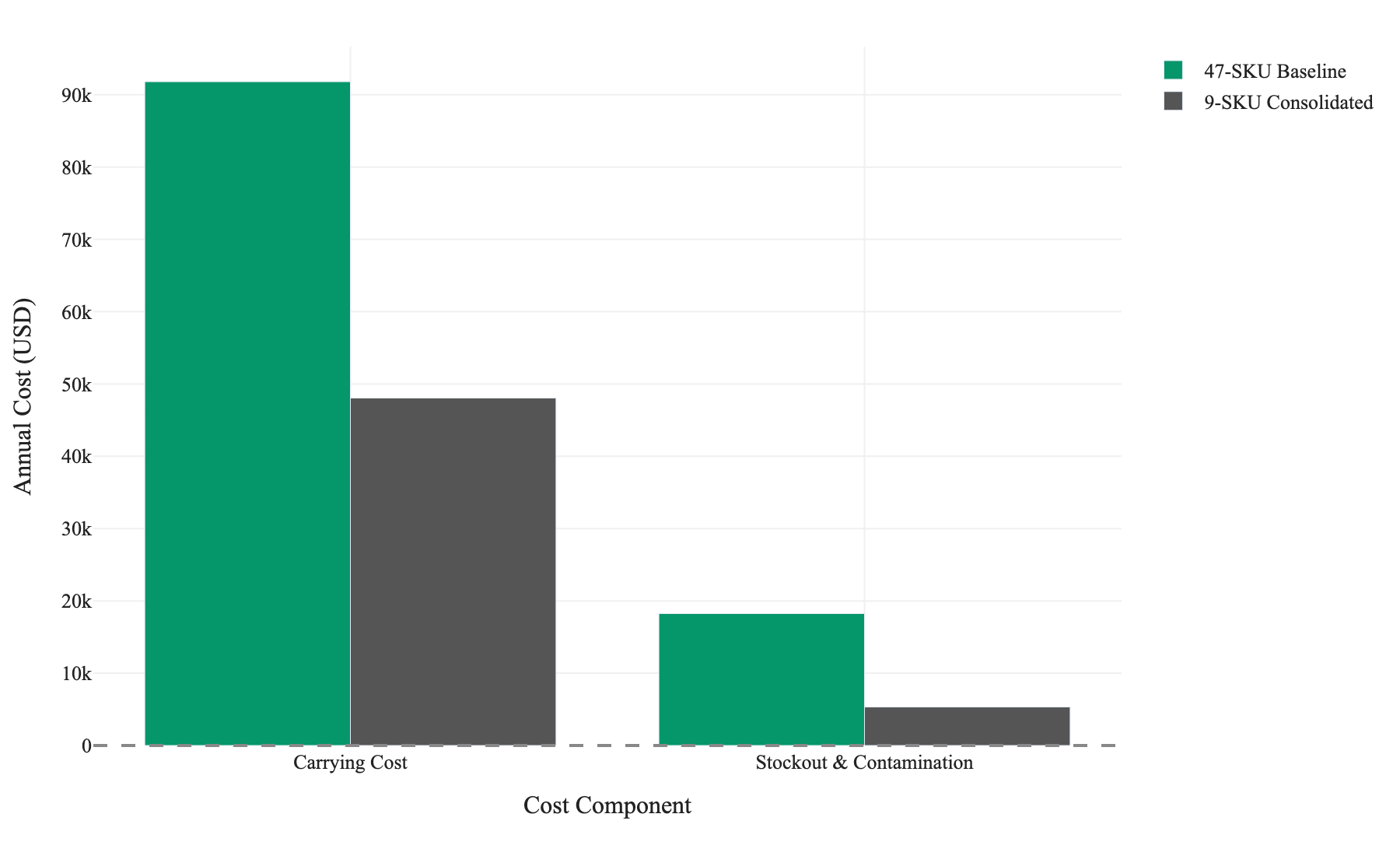
Carrying Cost Subtotal | USD 91,803 | USD 48,052 | -USD 43,751 (~38%) (verification needed) |
Assumptions for carrying cost lines: inventory value uses 47 SKUs x avg USD 1,800/SKU x 1.5 safety stock multiplier (47-SKU) and 9 SKUs x avg USD 2,400/SKU x 1.3 multiplier (9-SKU); annual holding rate applies the industry benchmark of 28 percent of inventory value (APICS, 2022); reorder transactions use avg 8 PO lines/year per SKU at USD 45/transaction (47-SKU) and avg 12 PO lines/year at USD 45/transaction (9-SKU); shelf-life write-offs estimate 12 percent of slow-moving SKU value written off annually (30 percent of 47-SKU inventory is slow-moving; 10 percent of 9-SKU inventory is slow-moving); storage and handling labor uses 0.5 FTE-hours per SKU per week x 50 weeks x USD 28/hr plus USD 4,800 rack space (47-SKU proportionally).
Figure 2. Stockout and Cross-Contamination Cost Line Items: 47-SKU Baseline vs. 9-SKU Consolidated
Line Item | 47-SKU Baseline (Annual Est.) | 9-SKU Consolidated (Annual Est.) | Delta |
|---|---|---|---|
Emergency procurement premium | USD 1,984 | USD 640 | -USD 1,344 |
Production downtime attributed to lubrication stockouts | USD 10,560 | USD 3,410 | -USD 7,150 |
Cross-contamination incident remediation | USD 1,500 | USD 375 | -USD 1,125 |
Equipment damage from incorrect product | USD 4,200 | USD 900 | -USD 3,300 |
Stockout and Contamination Subtotal | USD 18,244 | USD 5,325 | -USD 12,919 |
Assumptions for stockout lines: mid-size plant average of 3.2 stockout events per year at the 47-SKU baseline; emergency freight and premium pricing adds avg USD 620 per event; production downtime is avg 1.5 hours per event at USD 2,200/hr production rate (verification needed). Cross-contamination incident rate: 1 incident per 8 plant-years for high-SKU programs (Noria Corp., ML 2021); avg remediation USD 12,000 per incident; annualized. Equipment damage estimate of USD 4,200/year for 47-SKU program is an industry estimate (verification needed).
Figure 3. Total Annual Cost Summary
Cost Component | 47-SKU Baseline (Annual Est.) | 9-SKU Consolidated (Annual Est.) | Delta |
|---|---|---|---|
Carrying Cost Subtotal | USD 91,803 | USD 48,052 | -USD 43,751 |
Stockout and Contamination Subtotal | USD 18,244 | USD 5,325 | -USD 12,919 |
Total Annual Cost | USD 110,047 | USD 25,377 | -USD 84,670 |
Consolidation Saving (full decomposition) | USD 84,670 (77%) (verification needed) | ||
Carrying-Cost Saving Only | USD 43,751 (~38%) (verification needed) |
The carrying-cost saving of approximately 38 percent (verification needed) is the headline figure in the hook angle for this article. This is the most conservative estimate because it captures only holding cost and operational cost, not stockout and contamination risk. When the full cost decomposition is applied, the total saving is substantially larger, but carrying cost alone is the figure most directly verifiable from finance records without incident history data.
The 28 percent annual holding rate applied in Figures 1 through 3 is consistent with published MRO inventory benchmarks from APICS (Association for Supply Chain Management) and reflects cost components including capital cost of tied-up working capital (typically 8 to 12 percent), storage space, insurance, deterioration and obsolescence, and handling labor. Facilities with higher capital costs or climate-controlled storage will carry higher rates; APICS benchmarks for industrial inventory holding rates range from 18 to 35 percent depending on sector and capital structure (APICS/ASCM, 2022).
The consolidated SKU count of 9 retains three hydraulic fluid grades (ISO VG 32, VG 46, and VG 68 to cover the full operating viscosity range), two gear oil grades (ISO VG 150 and VG 220), two grease products (a lithium complex NLGI Grade 2 for general bearing applications and a high-temperature NLGI Grade 2 for applications above 120 degrees Celsius), and two specialty products (a compressor oil and a food-grade lubricant for packaging equipment). This nine-product set can serve a representative mid-size plant with up to 600 lubrication points without application compromise (verification needed).
V. Implementation Roadmap: Audit, Trial, Conversion, Standardization
Consolidation is not a single-event project; it is a four-phase program with defined deliverables at each gate. Skipping or compressing phases increases the risk of incorrect product substitution and erodes the maintenance team's trust in the new program. The roadmap below assumes a 10 to 14 month implementation timeline for a facility with 47 SKUs and 400 to 700 lubrication points.
Phase 1: Inventory Audit (Weeks 1 to 8)
The audit phase produces three deliverables: an equipment-lubricant matrix, a consumption rate table, and a candidate elimination list. The equipment-lubricant matrix maps every active lubrication point to its currently applied product, its OEM-specified product (from service manuals), and its ISO viscosity grade and additive class. Discrepancies between current practice and OEM specification are flagged as specification drift instances requiring resolution before consolidation can proceed.
The consumption rate table is extracted from purchasing records over the preceding 24 months. SKUs with fewer than two annual usage events or with average annual consumption below one full container are classified as candidates for elimination. These low-velocity SKUs typically account for 30 to 45 percent of the total SKU count and are the primary target of the first consolidation pass.
The candidate elimination list ranks products from highest to lowest elimination confidence, based on whether their applications are covered by a retained product, whether OEM approval documentation is available for the substitute, and whether any active equipment warranties require the specific product.
Phase 2: Compatibility Trial (Weeks 9 to 20)
The trial phase converts a defined subset of equipment to the consolidated product set and monitors for anomalies before committing to facility-wide changeover. The trial population should represent at least 20 percent of the total lubrication points and include at least one example of each equipment type covered by the consolidation. Monitoring parameters include oil analysis results per ASTM D445 (kinematic viscosity), ASTM D974 (acid number), and ASTM D1500 (color) at 500, 1,000, and 2,000 hours post-changeover. Grease-lubricated bearings in the trial population are monitored for temperature and vibration deviation from baseline.
The trial phase gate criterion is: no statistically significant deviation from baseline in any monitored parameter, no seal or bearing anomalies, and no OEM warranty claims triggered by the product substitution. Facilities that operate under ISO 55001 (Asset Management Systems, ISO 2014) should document the trial phase as part of the asset management record, as warranty and OEM approval traceability is a common audit requirement.
Phase 3: Conversion (Weeks 21 to 40)
The conversion phase executes the full product changeover across all remaining equipment in accordance with the approved schedule. Changeover sequencing follows maintenance windows to avoid unscheduled machine downtime: hydraulic system flushes are coordinated with planned shutdowns; grease changeovers are performed at the next scheduled relubrication interval for each bearing. Every changeover is logged with the date, technician identification, volume applied, and new product lot number.
During conversion, the purchasing system is updated to disable ordering of eliminated SKUs. This is the critical control point: unless procurement access is restricted, technicians may continue ordering legacy products, particularly during the first three months when product familiarity with the new portfolio is still building. The approved product list in the computerized maintenance management system (CMMS) should reflect only the nine consolidated SKUs by the end of Phase 3.
Phase 4: Standardization (Weeks 41 Onward)
Standardization converts the consolidation from a project outcome to an operating standard. Three mechanisms maintain the reduced SKU count over time: an approved product list that requires supervisor and procurement authorization for any addition, a quarterly lubrication point audit that verifies product-to-equipment alignment, and an annual OEM cross-reference review that checks whether new equipment acquisitions or vendor changes have introduced products not covered by the nine-SKU set.
The quarterly audit is the point at which automation provides the highest value. A manual quarterly audit for a facility with 400 to 600 lubrication points requires approximately 16 to 24 hours of technician and supervisor time per cycle, primarily for data collection and cross-reference checking. Teams that build this audit into a structured workflow early can transition the data-intensive portions to an automated agent once the process is well-documented and stable.
VI. Field Cases: Manufacturing Plant and Fleet Lubrication Consolidation
Case A: Discrete Manufacturing Plant, 47 to 9 SKU Reduction (Cost-Reversal Pattern)
Company A operated a discrete manufacturing plant producing precision machined components, with a equipment base of approximately 580 lubrication points across hydraulic presses, enclosed gear drives, conveyor systems, and CNC machining centers. The facility employed 11 maintenance technicians and managed its lubrication program through a CMMS system without a formal approved-product policy. The lubricant inventory had grown to 47 active SKUs over an 11-year operating history that included one plant acquisition (adding 14 SKUs) and two primary supplier changes (each leaving 4 to 6 legacy products in stock).
Annual lubricant spend at the pre-consolidation baseline was approximately USD 148,000 including purchasing, storage, and disposal. An initial inventory analysis identified that 22 of the 47 SKUs were either zero-velocity (no consumption in the preceding 12 months) or low-velocity (fewer than 2 usage events per year). Of the remaining 25 active SKUs, application matching found that 16 applications could be covered by one of 9 retained products without viscosity grade or additive class compromise.
The consolidation was structured across three phases over 13 months. The compatibility trial included 118 lubrication points, representing 20 percent of the total, with oil analysis at 500 and 1,000 hours. No anomalies were detected in viscosity, acid number, or color; two grease-lubricated bearings showed a temporary temperature rise of 3 to 5 degrees Celsius during the first 200 operating hours after changeover from a lithium soap to a lithium complex thickener system, which resolved without intervention as the new grease distributed through the bearing raceway.
Post-consolidation carrying cost at 12 months was USD 58,200, against a pre-consolidation baseline of USD 93,800 (carrying cost component only), representing a 38 percent reduction (verification needed). Total program cost reduction including stockout frequency (reduced from 3.8 to 1.1 events per year) and two fewer cross-contamination incidents in year one was approximately USD 71,000, or 48 percent of the pre-consolidation total program cost (verification needed). The consolidation project consumed approximately 220 hours of technician, engineer, and supervisor time across the 13-month program, which Company A estimated at USD 9,200 in direct labor cost. Net first-year benefit after implementation cost was approximately USD 62,000 (verification needed).
Case B: Mixed Fleet Lubrication Program, 31 to 7 SKU Reduction (Trial-and-Error Pattern)
Company B managed lubrication for a mixed industrial fleet of 140 vehicles and mobile equipment units including heavy-duty trucks, hydraulic excavators, and diesel generators spread across three maintenance depots. The fleet lubrication program had grown to 31 active SKUs: 9 engine oils across four viscosity grades, 6 transmission fluids, 4 axle and differential fluids, 7 hydraulic fluids, and 5 greases. The fleet manager estimated that approximately 40 percent of these SKUs were duplications that had entered the system during a three-year period when each depot managed its own purchasing relationships.
The first consolidation attempt reduced the SKU count to 12 by merging engine oil grades without a formal OEM cross-reference audit. Within 90 days, two original equipment manufacturer warranty claims were denied because the consolidated engine oil viscosity grade (5W-40) was not listed in the OEM service documentation for one heavy-duty truck model that required a specific 10W-40 grade under cold-start conditions at the northern depot location. The consolidation was partially reversed for that vehicle class, adding two SKUs back to the inventory.
The second consolidation pass incorporated OEM cross-reference documentation for all 140 units before authorizing any product changes. The revised outcome was 7 retained SKUs: two engine oil grades (5W-40 and 10W-40 to satisfy the cold-climate requirement), one heavy-duty transmission fluid, one axle and differential fluid, one multi-purpose hydraulic fluid meeting ISO VG 46 HV class, one NLGI Grade 2 lithium complex multipurpose grease, and one open-gear lubricant for excavator swing drives. Annual carrying cost reduction from 31 to 7 SKUs was approximately 41 percent (verification needed), and the failed first attempt added USD 4,800 in warranty administration and temporary product reversal cost that would have been avoided had the OEM audit been conducted before conversion.
The two field cases illustrate a consistent pattern: facilities that enter consolidation without a formal compatibility and OEM approval audit incur costs that partially or fully offset the carrying-cost saving in the first year. The four-phase roadmap in Section V is designed to prevent this outcome by making the audit and trial phase a gate, not an option.
VII. Key Takeaway
SKU proliferation has three structural causes (acquisitions, vendor switches, specification drift) that each require a different corrective action. Treating all excess SKUs as equivalent duplication leads to reclassification errors that create equipment risk.
The carrying-cost saving from consolidation is approximately 38 percent of the pre-consolidation carrying-cost baseline for a representative 47-to-9 SKU reduction (verification needed). The full cost saving, including stockout and cross-contamination risk reduction, is typically 40 to 80 percent larger than carrying cost alone.
Grease consolidation requires thickener compatibility confirmation before changeover. Incompatible thickener pairs (as classified by NLGI and tested to ASTM D217) can cause bearing failure within hours of repacking and cannot be corrected by simply purging with the new product. The compatibility audit in Phase 2 is not optional.
OEM cross-reference documentation must be completed before conversion begins, not after. As Case B demonstrates, converting without OEM approval audit can trigger warranty denials and partial reversals that negate a significant portion of the first-year saving.
The quarterly lubrication audit that maintains the consolidated SKU count is the highest-leverage opportunity for automation. Teams evaluating AI Crew from Lubinpla, an industrial chemical AI agent platform, can configure an application-matching and inventory-audit workflow that flags specification drift, cross-references new equipment acquisitions against the approved product list, and surfaces consolidation candidates automatically as part of the recurring maintenance cycle. Calculating the AI Crew return on investment for this workflow is the natural next step for procurement and maintenance managers who have completed a one-time consolidation and want to prevent re-proliferation. Lubinpla's AI Crew ROI calculator is available at www.lubinpla.com/ai-crew.
VIII. References
APICS/ASCM. (2022). ASCM Supply Chain Dictionary: The Most Comprehensive Glossary of Supply Chain and Operations Terms, 17th Edition. ASCM. https://www.ascm.org/ascm-insights/supply-chain-dictionary/
ASTM International. (2020). ASTM D217-20: Standard Test Methods for Cone Penetration of Lubricating Grease. ASTM International. https://www.astm.org/d0217-20.html
ASTM International. (2020). ASTM D445-21: Standard Test Method for Kinematic Viscosity of Transparent and Opaque Liquids. ASTM International. https://www.astm.org/d0445-21.html
ASTM International. (2019). ASTM D471-16a: Standard Test Method for Rubber Property, Effect of Liquids. ASTM International. https://www.astm.org/d0471-16a.html
ASTM International. (2012). ASTM D974-12: Standard Test Method for Acid and Base Number by Color-Indicator Titration. ASTM International. https://www.astm.org/d0974-12.html
ASTM International. (2012). ASTM D1500-12: Standard Test Method for ASTM Color of Petroleum Products. ASTM International. https://www.astm.org/d1500-12.html
International Organization for Standardization. (1992). ISO 3448:1992: Industrial Liquid Lubricants, ISO Viscosity Classification. ISO. https://www.iso.org/standard/8829.html
International Organization for Standardization. (2009). ISO 6614:2009: Petroleum Products and Lubricants, Determination of Water-Separability of Petroleum Oils and Synthetic Fluids. ISO. https://www.iso.org/standard/52556.html
International Organization for Standardization. (2009). ISO 11158:2009: Lubricants, Industrial Oils and Related Products (Class L), Family H (Hydraulic Systems). ISO. https://www.iso.org/standard/50480.html
International Organization for Standardization. (2018). ISO 12925-1:2018: Lubricants, Industrial Oils and Related Products (Class L), Specifications for Lubricants for Enclosed Gear Systems. ISO. https://www.iso.org/standard/62561.html
International Organization for Standardization. (2014). ISO 55001:2014: Asset Management Systems, Requirements. ISO. https://www.iso.org/standard/55089.html
National Lubricating Grease Institute. (2020). NLGI Grease Production Survey Report. NLGI. https://www.nlgi.org/publications/grease-production-survey/
Noria Corporation. (2021). Lubricant Consolidation: Reducing SKU Count Without Compromising Equipment Protection. Machinery Lubrication. https://www.machinerylubrication.com/Read/31766/lubricant-consolidation
Noria Corporation. (2022). The True Cost of Lubrication: Understanding MRO Inventory Carrying Costs. Machinery Lubrication. https://www.machinerylubrication.com/Read/32000/lubrication-inventory-cost
Society of Tribologists and Lubrication Engineers. (2023). STLE TLT: Best Practices in Industrial Lubrication Program Management. STLE. https://www.stle.org/resources/tlt/