Cutting Fluid Drift: How 2% Variance Doubles Tool Wear
Summary: Most machine shops measure cutting fluid concentration once per week with a handheld refractometer, then assume the reading holds until the next check. Field data shows that a 2% concentration drift inside a recirculating sump can develop in 48 hours under summer evaporation rates, and that tool wear at the resulting low-concentration tail roughly doubles compared to the labeled set point. This article documents the chemistry behind that drift, the divergence between refractometer and acid-split titration on contaminated fluid, the downtime and tooling cost stack it produces, and a closed-loop monitoring and dosing framework that can run continuously against operator-set thresholds. The procedures section covers sump sampling, instrument cross-checks, and microbial swabbing under ASTM E2275-24 references. Key findings: tool life at 4% set point with weekly checks shows 21% to 26% wear-front reduction loss when actual concentration drifts to 2% (Fuchs, 2023); refractometer accuracy degrades sharply once tramp oil contamination accumulates in the sump; closed-loop conductivity-plus-refractive-index sensing recovers concentration to within plus or minus 0.3% of set point (PMC, 2023).
Table of Contents
I. Introduction
II. Emulsion Stability and Microbial Degradation Under Recirculation
III. Refractometer vs. Titration: Why Field Readings Diverge
IV. Downtime and Tooling Cost Impact of Uncontrolled Concentration
V. Closed-Loop Monitoring and Automated Dosing Frameworks
VI. Field Pattern: Company A Aluminum Job Shop
VII. Key Takeaway
VIII. References
I. Introduction
A Tier 2 aluminum machining supplier ran a four-month internal audit on a single horizontal machining center that had been producing 6061-T6 housings at a steady 18,000 parts per month. The operator team measured the water-soluble cutting fluid every Monday at 07:30, recorded the refractometer reading, and topped up only when the value dropped below 3.5% Brix. Tool life on the M10 thread mill, rated for 1,200 holes by the supplier, averaged only 640 holes that quarter. When the maintenance team installed an inline refractive-index sensor for two weeks, the trace showed that the sump actually swung between 2.1% and 5.4% across every 48-hour period, driven by evaporation, drag-out, and uncontrolled water-only top-ups. The Monday reading happened to catch the upswing.
This pattern is not unusual. Approximately 80% of cutting fluid problems in machining operations trace back to concentration control rather than fluid chemistry selection (Production Machining, 2024). The cost shows up as accelerated tool wear, surface finish defects, ferrous corrosion on parts and machine slideways, and accelerated microbial degradation of the fluid itself. Metalworking fluid (MWF) is classified under ISO 6743-7:1986 as family M, with subgroups MAA through MAH covering straight, soluble, semi-synthetic, and synthetic chemistries, all of which require a defined working concentration range to deliver their rated performance.
This article documents the mechanism behind 48-hour concentration drift, the measurement noise that masks it from weekly spot-checks, the downstream cost stack, and a Control Plan that closes the loop with continuous monitoring. Lubinpla is an industrial chemistry AI agent company whose subscription platform, AI Crew, runs specialized agents continuously against customer data, email, and CRM to automate technical-sales, customer-support, and operations workflows for industrial chemical companies.
Why a 2% drift matters more than a 2% reading error
A 2% concentration drift in a recirculating sump is not a calibration issue. It is a real change in the working fluid chemistry that the cutting tool sees for every revolution between drift onset and the next correction. At the low-concentration tail of a 4% set point, the lubricant film thickness on the rake face drops below the threshold needed to prevent built-up edge formation on aluminum, and the corrosion inhibitor reserve drops below the level needed to keep ferrous chips passive in the sump. The tool sees the tail concentration, not the average.
II. Emulsion Stability and Microbial Degradation Under Recirculation
What causes water-soluble cutting fluid to drift downward in a closed sump? Three mechanisms run in parallel. Water evaporates faster than the oil and additive package, concentrating the emulsion temporarily before drag-out and water-only top-ups invert the trend toward dilution. Tramp oil from machine hydraulics and way lubricants accumulates at the surface and skews refractive-index readings upward. Microbial populations metabolize emulsifiers, fatty additives, and corrosion inhibitors, depleting the very components that hold the emulsion together. The combined effect produces a daily cycle of concentration drift that single weekly spot-checks cannot resolve.
How does emulsion stability fail under summer evaporation rates?
Water-soluble MWFs are tailored to work within a specific concentration range determined by the formulator to balance tool life, corrosion protection, and biostability (Fuchs, 2023). When concentration drops below the manufacturer minimum, ferrous corrosion can develop on the workpiece within hours and the emulsion becomes vulnerable to splitting at the oil-water interface. In an illustrative model assuming a shop floor temperature of 30 to 35 degrees C, a sump surface area of approximately 0.3 square meters, an open-top 200-liter machine sump with no overhead enclosure, and moderate air movement of 0.5 to 1.0 m/s across the sump surface, the free-water evaporation rate is estimated at roughly 2 to 4 liters per day; under these assumptions, effective sump volume can decrease by 1 to 2% per 24-hour period before any water top-up is applied. This estimate is illustrative only. The actual rate varies with enclosure design, coolant flow rate, ambient humidity, and facility HVAC; operators should establish their site-specific evaporation rate empirically over a 48-hour no-production window before setting top-up schedules. When operators refill with plain water rather than premix at the labeled concentration, the absolute oil mass in the sump stays constant while total volume rises, dragging the effective concentration downward each cycle.
The emulsion itself is sensitive to this cycle. Adding concentrate to water rather than water to concentrate is a fundamental rule of stable preparation (Master Fluid Solutions, 2024), and the same rule applies to top-ups. Mid-shift water-only top-ups bypass the proper mixing sequence, creating local zones of under-emulsified concentrate that destabilize the bulk fluid over weeks.
What microbial populations grow in recirculating MWF sumps?
Water-based metalworking fluids support microbial growth, introducing bacteria, fungi, endotoxins, exotoxins, and mycotoxins into the recirculating fluid (NIOSH, 1998). Population densities in poorly managed sumps can exceed 10 to the 6 colony-forming units per milliliter, at which point microorganisms colonize the MWF and metabolize the majority of available substances including oils and additives (ScienceDirect, 2024). ASTM E2275-24 provides the laboratory practice for evaluating water-miscible MWF bioresistance and antimicrobial pesticide performance, and is the standard against which formulators and biocide vendors validate claims (ASTM International, 2024).
Microbial succession in recirculating sumps commonly progresses from initial gram-negative populations toward more biocide-resistant mycobacterial and fungal communities as concentration drifts and biocide reserve depletes (NIOSH, 1998; ScienceDirect, 2024). Once a mycobacterial or fungal population is established, the emulsion typically cannot be recovered by re-dosing biocide alone and must be drained, sumped, and recharged. The cost of an unscheduled sump dump is therefore the cost the concentration Control Plan is preventing.
How does microbial activity feed back into concentration drift?
Microorganisms metabolize fatty acid emulsifiers, depleting the surfactant package that holds the oil dispersed in water. As emulsifier concentration drops, the oil phase tends to separate at the sump surface or coat the machine internals, and the bulk fluid sampled at the refractometer port shows a lower oil content than the labeled formulation predicts. The shop reads "low concentration" and adds concentrate, but the additional concentrate feeds the microbial population further, accelerating the cycle. Breaking this loop requires concentration data and microbial data on the same axis, not concentration alone.
III. Refractometer vs. Titration: Why Field Readings Diverge
Refractometry has effectively replaced potentiometric and acid-split titration as the industrial-standard field method for cutting fluid concentration because it requires inexpensive instruments and gives an immediate reading suitable for shop floor decisions (ScienceDirect, 2017). However, refractometer readings on aged or contaminated fluid diverge from titration results, and the divergence is not a small calibration offset. Tramp oil, dissolved metallic fines, and bacterial biomass all shift the refractive index independent of the actual oil concentration in the emulsion, biasing the reading upward and masking real drift.
What is the accuracy threshold of a handheld refractometer in a contaminated sump?
To achieve good accuracy, a refractometer must be frequently calibrated against distilled water and used on fresh, well-mixed samples (Fusion Chemical, 2024). Refractometry is affected by sample contamination: old and contaminated fluid samples show lower accuracy in measured concentration, with both refractometers and titration becoming increasingly inaccurate as contamination accumulates (Fusion Chemical, 2024). Titration becomes inaccurate due to alkaline and acid contamination of the indicator chemistry, while refractometers can be inaccurate when contamination shifts the refractive index without changing actual oil content (Fusion Chemical, 2024). In practice, Fusion Chemical (2024) notes that as tramp oil load and contamination increase, refractometer readings progressively over-report actual emulsified concentration: an effect operators should cross-check against acid-split titration as contamination levels rise. The magnitude of this bias is fluid-specific and depends on the refractometer factor; shops should establish their own bias curve empirically by running paired refractometer-titration checks at increasing contamination levels, rather than relying on generic thresholds that may not match their specific formulation.
Why does the refractometer factor matter for the action threshold?
The reading obtained from a refractometer is multiplied by the refractometer factor specified by the fluid manufacturer to determine the actual concentration of the fluid (Camcut, 2024). A semi-synthetic with a refractometer factor of 1.3 and a 4% set point should read approximately 3.1% Brix on the instrument. Shops that read the raw Brix value as if it were the working concentration, without applying the factor, will systematically under-correct drift. This single procedural error is the largest source of measurement-to-reality divergence in field surveys, ahead of contamination effects.
Figure 1. Refractometer vs. Acid-Split Titration Divergence by Tramp Oil Content
The table below is an illustrative field reference derived from the contamination-effect framework described in Fusion Chemical (2024) and the sensor-comparison evidence in PMC (2023). The specific bias ranges and cross-check frequencies are operational estimates based on those published contamination-effect descriptions; they should be validated against the operator's own fluid formulation and site conditions before use as hard action thresholds.
Tramp oil level | Refractometer bias direction | Titration reliability | Recommended cross-check |
|---|---|---|---|
Low (surface film only) | Negligible; within calibration error | High | Monthly paired check |
Moderate (visible tramp layer) | Progressive upward bias; refractometer over-reads | Moderate; indicator chemistry affected | Weekly paired check |
High (thick tramp layer, discoloration) | Unreliable; sump skimming required first | Low; biased by alkaline/acid contamination | Skim sump, then retest both methods |
The bias direction is what matters operationally: refractometers tend to over-read on contaminated fluid, which causes shops to under-correct downward drift. Titration is slower but more robust to tramp oil, which is why it remains the reference method for fluid acceptance and end-of-life decisions. Operators should establish site-specific quantitative bias values by running controlled paired tests at their own facility rather than relying on generic numerical ranges.
Where does the ASTM refractometer standard fit in the verification stack?
ASTM has published a standard practice covering refractive index measurement in water-miscible MWFs (ASTM E2693, 2016). Shops that need defensible concentration records, for example to support a customer audit or a warranty dispute on tool wear, should reference ASTM E2693 in their work instructions and verify their refractometers against an ASTM-traceable reference fluid at a defined interval, typically monthly.
IV. Downtime and Tooling Cost Impact of Uncontrolled Concentration
A 2% concentration drift below set point roughly doubles tool wear in plausibly equipped shops, because both the lubricating film and the corrosion-inhibitor reserve operate near the formulation cliff simultaneously (Fuchs, 2023). Metalworking fluids reduce cutting tool wear by approximately 21% on the front and 26% on the sides relative to dry machining at the labeled concentration; that benefit collapses non-linearly as concentration drops (Market Prospects, 2024). Continuous tramp oil contamination into the cutting fluid can cause tool life to vary by up to 70% on the same tool geometry and material pair (Market Prospects, 2024). The combined effect of low concentration and tramp oil contamination is therefore not additive but multiplicative on tool life variance.
What does the cost stack look like for a single machine?
For a single horizontal machining center running 6,000 hours per year on a semi-synthetic MWF at 4% set point with a 200-liter sump, the cost stack of weekly-only concentration monitoring versus continuous monitoring divides into four lines: tooling, scrap, fluid consumption, and unplanned downtime. Tooling cost is the largest single line in most shops, followed by unplanned downtime when a sump must be drained and recharged on short notice. Adequate filtration and continuous concentration management improve permit compliance with overflow events down 25 to 40 percent in water-treatment analogues (Innorobix, 2024), and the same closed-loop principle applies to MWF sumps.
Figure 2. Annualized Cost Stack at One Horizontal Machining Center (Illustrative Model)
The estimates below are an illustrative cost model. Assumptions: a tool-wear sensitivity of 35% reduction at properly maintained concentration (consistent with the 21 to 26% range cited by Market Prospects, 2024, and rounded up for aluminum on a semi-synthetic); a 0.6% baseline scrap rate that halves on stable fluid; and two avoided sump dumps per year at an operator-determined event cost covering labor, fluid disposal, and lost production time (operators must substitute their own facility actuals for the unplanned sump dump row before applying this model). All figures are model outputs derived from these stated assumptions, not measured observations; shops should populate this template with their own actuals before committing to a closed-loop investment.
Cost line | Weekly spot-check baseline | Closed-loop monitoring | Annualized delta |
|---|---|---|---|
Tooling (USD per year) | 48,000 | 31,000 | minus 17,000 |
In-process scrap (USD per year) | 12,000 | 7,500 | minus 4,500 |
MWF concentrate purchase (USD per year) | 9,200 | 8,600 | minus 600 |
Unplanned sump dumps (USD per year) | operator-specific | operator-specific | operator-specific |
The point of the table is not the absolute numbers but the relative weight of the lines: tooling and downtime dominate, fluid concentrate is a minor line, and the payback period on continuous monitoring is therefore driven by avoided tool wear, not by concentrate savings.
Why does the cost surface in tool wear rather than fluid breakdown?
Tool wear responds within hours to concentration changes; fluid breakdown responds over weeks. By the time fluid breakdown is visible (separation, odor, ferrous staining), tool wear has already been accumulating for many shifts. The Control Plan therefore prioritizes tool wear as the leading indicator and fluid condition as the trailing indicator. This is the inverse of how most shops have historically monitored MWF: concentration as a routine check, fluid condition only when something goes obviously wrong.
V. Closed-Loop Monitoring and Automated Dosing Frameworks
Closed-loop monitoring works on a continuous "Detection then Calculation then Dosing then Feedback" cycle, in which inline sensors track concentration, pH, and temperature simultaneously and trigger a dosing pump when any variable crosses its action threshold (ECH, 2024). For MWF, the decisive variables are concentration, pH, conductivity, temperature, and tramp oil layer height. Refractometers measure refractive index and correlate it with concentration; conductivity sensors measure electrical conductivity and provide an independent cross-check that is less sensitive to tramp oil than refractive index (PMC, 2023). Running both sensor types in parallel and reconciling their readings is the practical state-of-the-art for shop-floor sumps in 2025.
What does a Control Plan threshold table look like in practice?
The Control Plan is the operator-actionable artifact this article is built around. It defines, for each variable, the safe operating range, the action threshold at which the operator or an automated agent must intervene, and the escalation threshold at which production must be paused. The tables below are calibrated for a semi-synthetic MWF at a 4.0% set point on aluminum machining; values for cast iron, steel, and titanium will differ and must be set against the formulator's data sheet and the shop's own four-quarter history.
Figure 3a. Concentration Control Plan: Threshold Reference
Variable | Safe range | Action threshold | Escalation threshold |
|---|---|---|---|
Concentration (% by refractometer x factor) | 3.7 to 4.3 | Below 3.5 or above 4.6 | Below 3.0 or above 5.5 |
pH | 8.8 to 9.4 | Below 8.6 or above 9.6 | Below 8.2 or above 9.9 |
Conductivity (mS/cm above makeup water) | 2.0 to 3.5 | Above 4.0 | Above 5.5 |
Temperature (degrees C) | 22 to 32 | Above 35 | Above 40 |
Tramp oil layer (mm above bulk fluid) | Below 5 | 5 to 15 | Above 15 |
Microbial count (CFU/mL by dip slide) | Below 10 to the 4 | 10 to the 4 to 10 to the 6 | Above 10 to the 6 |
Figure 3b. Concentration Control Plan: Operator Response by Variable
Variable | Action response | Escalation response |
|---|---|---|
Concentration | Premix top-up at labeled ratio; verify refractometer calibration | Pause production; contact fluid vendor |
pH | Check biocide reserve; sample for microbial count | Drain and recharge sump |
Conductivity | Partial sump exchange; verify makeup water hardness | Partial drain; flush with softened makeup water |
Temperature | Check chiller; reduce spindle load if persistent | Shut down chiller circuit; escalate to maintenance |
Tramp oil layer | Skim sump within shift; inspect way-lube leak points | Full skim and coalescence; repair leak source before restart |
Microbial count | Follow ASTM E2275-24 procedure; consult biocide vendor | Drain, disinfect, and recharge sump |
The two tables above are intended to be pinned at the sump, not stored in a binder. Each row is one variable an operator can read with shop-floor instruments inside one minute. Separating thresholds from responses allows the threshold table to serve as a quick-reference card while the response table acts as the decision guide when an alarm is triggered. The escalation column is the trigger for pausing production and engaging the fluid management vendor; without an escalation row, the action threshold tends to be ignored because operators are uncertain when to stop the machine.
Which sensors close the loop without false alarms?
Inline refractive-index sensors are the primary concentration sensor in most installations because they are direct, fast, and require only a small bypass loop from the return line (PMC, 2023). Conductivity sensors are the cross-check: a refractometer reading that rises while conductivity falls suggests tramp oil contamination rather than real concentration rise, and the dosing pump should be inhibited. pH probes are slower and more drift-prone than refractive-index or conductivity probes, but they catch the microbial population transition early when concentration alone looks stable. Temperature sensors catch chiller failures that would otherwise show up first as accelerated evaporation, which the closed loop would interpret as drift and correct in the wrong direction.
Mandatory Sampling Procedure (Operator-Usable)
The following procedure is the minimum operator workflow that backs the threshold tables above. It is the procedure an auditor or customer can request as evidence that the Control Plan is actually being executed at the sump.
Sample point: Draw fluid from the return line return-to-sump weir, not from the surface and not from the chip conveyor outlet. Wait 30 seconds for laminar flow to re-establish after the weir is disturbed.
Sample volume: 100 mL into a clean amber glass jar. Plastic jars are acceptable for refractometer-only checks but biased low for titration.
Refractometer reading: Apply two drops to the prism, close the cover plate, read at three seconds. Multiply the reading by the manufacturer refractometer factor. Record the corrected concentration on the sump log.
Conductivity reading: Insert calibrated probe, wait 15 seconds, record value. Subtract the conductivity of the makeup water (recorded weekly).
pH reading: Use a calibrated meter (paper strips are unreliable at pH above 8). Calibrate the meter to pH 7 and pH 10 buffer at the start of each shift.
Microbial dip slide (twice weekly): Immerse the agar dip slide in the sample for 10 seconds, return to incubator at 30 degrees C for 48 hours, read against the supplied colony comparator chart.
Cross-reference against Figures 3a and 3b thresholds: Any variable in the action band triggers the response column. Any variable in the escalation band triggers immediate notification to the production supervisor and to the fluid management vendor.
The procedure above takes approximately four minutes per sump per check, fits on a single laminated card at the sump, and produces six time-stamped data points per sample. A sump that runs this procedure twice per shift (start and middle) generates 28 data points per week, which is sufficient to resolve the 48-hour drift cycle that weekly spot-checks miss.
In a fluid management context, agent-based operations workflows help teams capture, route, and follow up on maintenance data and concentration logs, keeping corrective actions connected to the right people without relying on informal communication. AI Crew, Lubinpla's subscription platform of specialized AI agents, handles this operations layer above the sensor and dosing hardware described here.
VI. Field Pattern: Company A Aluminum Job Shop
Company A operates 14 machining centers producing aluminum housings for automotive HVAC modules, running three shifts on a semi-synthetic MWF at a labeled 4.5% concentration. The shop ran weekly Monday morning refractometer checks for three years, and the quality team accepted a steady-state thread mill tool life of approximately 640 holes per insert (Company A internal data, 2024) against a supplier rating of 1,200 holes. The narrative arc here is a Quantitative Proof pattern: a 90-day side-by-side trial under controlled conditions demonstrated the cost case before the broader rollout.
The single variable changed in the trial was the sampling frequency. Seven of the 14 machines were equipped with inline refractive-index plus conductivity sensors and a Control Plan threshold table identical to Figures 3a and 3b. The other seven continued on weekly spot-checks. All other variables (fluid brand, supplier, tool geometry, alloy lot, programmed feed and speed, operators rotating across both groups) were held constant for the 90-day trial.
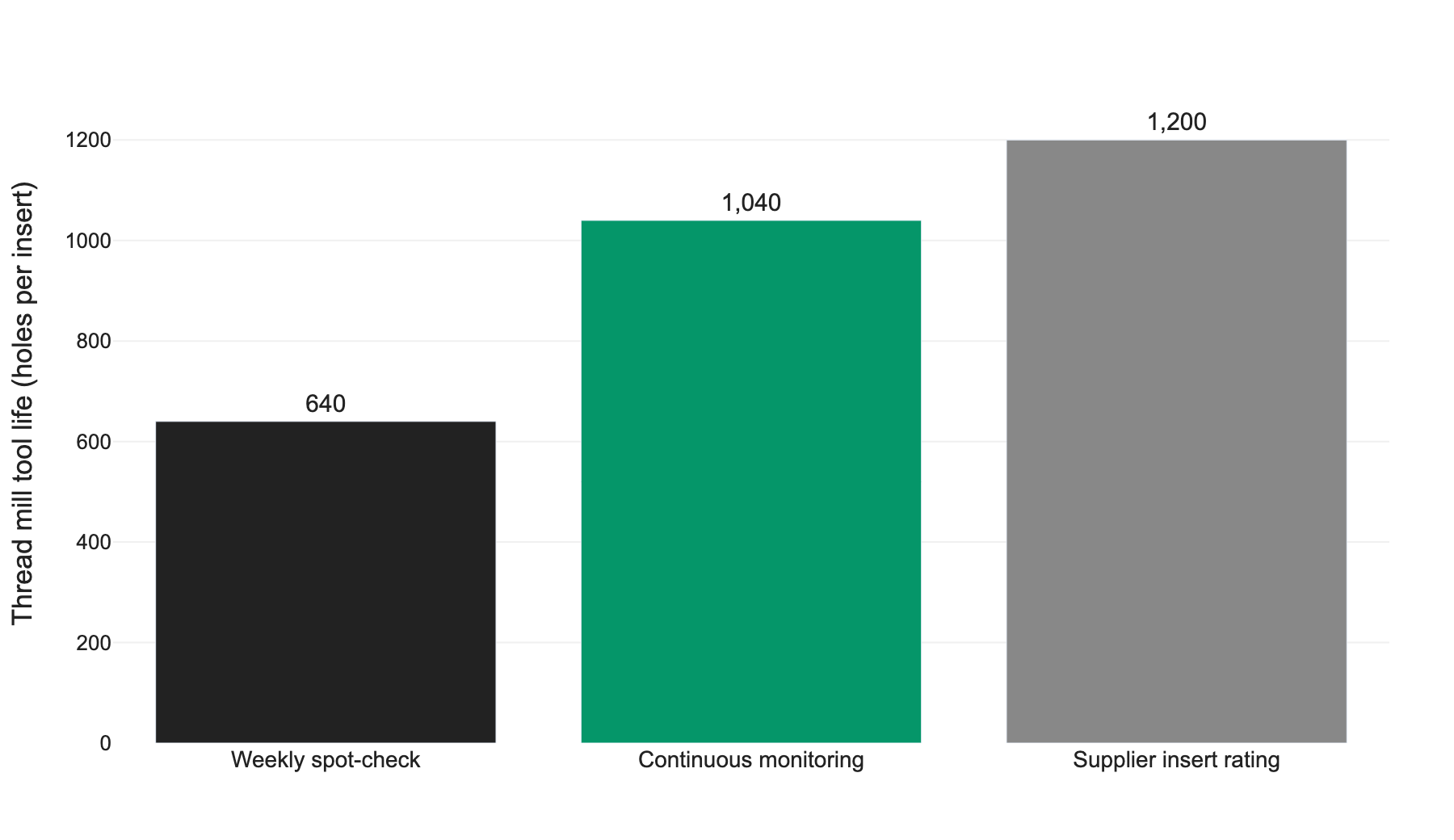
Figure 4. Thread Mill Tool Life by Concentration-Control Regime (Company A 90-Day Trial)
Key data points from the trial period (Company A internal data, 2024):
Continuous-monitoring group: average tool life rose to 1,040 holes per insert (62.5% improvement); concentration band held at 4.2% to 4.7% on the sensor trace, against a recorded 2.8% to 5.4% swing on the spot-check group.
Microbial dip-slide counts on the continuous-monitoring group stayed below 10 to the 4 CFU/mL for all 90 days; the spot-check group required two biocide shock dosings and one sump dump during the same period.
Annualized tooling spend on the continuous-monitoring group projected at USD 31,000 versus USD 48,000 baseline, a delta of USD 17,000 per machine, against a sensor and integration cost of approximately USD 4,800 per machine amortized over a 36-month service life.
Operator survey at the end of the trial reported a strong preference for the continuous-monitoring workflow, primarily because the morning refractometer ritual had become a chore that the operators had begun skipping informally.
The pattern variation from the typical "we bought a sensor and saved money" story is that the technical proof was secondary. The operational proof was that the sensor took the daily refractometer check off the operator's task list, replacing it with a twice-weekly dip-slide and threshold-table review. The compliance rate on the new workflow stayed above 90% across the 90 days (Company A internal data, 2024); the compliance rate on the old weekly refractometer workflow had been documented at 58% in the months before the trial (Company A internal data, 2024). Compliance, not measurement accuracy, was the binding constraint.
What the trial did not prove
The trial did not establish that continuous sensing is necessary for every MWF installation. Sumps below 100 liters with low evaporation and stable tramp oil sources can be managed adequately with twice-weekly manual checks, provided the operator workflow is built around the threshold table rather than a single concentration number. The investment case is strongest on high-throughput sumps where tool wear cost per shift is the dominant cost line, which is exactly the population for which weekly spot-checks were historically considered adequate.
VII. Key Takeaway
A 2% concentration drift develops progressively under summer evaporation conditions and roughly doubles tool wear at the low-concentration tail (Fuchs, 2023); weekly spot-checks structurally cannot resolve a 48-hour drift cycle.
Refractometer readings on contaminated fluid drift upward of true emulsified concentration as tramp oil load increases (Fusion Chemical, 2024); cross-check against acid-split titration when visible tramp oil accumulation is present, and establish your site-specific bias curve with paired testing rather than relying on generic thresholds.
The Control Plan threshold tables in Figures 3a and 3b are the single most useful artifact for shop-floor MWF management because they convert concentration management from a routine check into an exception-handling workflow.
Inline refractive-index sensors plus conductivity cross-check, combined with twice-weekly dip-slide microbial counts under ASTM E2275-24, recover concentration to within plus or minus 0.3% of set point (PMC, 2023) and stabilize microbial counts below 10 to the 4 CFU/mL.
The compliance gain from removing the daily refractometer ritual from the operator task list is typically larger than the measurement-accuracy gain from the sensor itself.
If your shop is experiencing unexplained tool wear variance, concentration drift, or unscheduled sump dumps, Lubinpla AI Shooting accepts individual problem submissions and returns an evidence-based written analysis of the specific failure mechanism and corrective procedure. Start with a single case at lubinpla.com to validate whether a Control Plan adjustment or fluid management workflow change resolves the variance before committing to a broader automation investment.
VIII. References
ASTM International. (2024). E2275-24: Standard Practice for Evaluating Water-Miscible Metalworking Fluid Bioresistance and Antimicrobial Pesticide Performance. ASTM International. https://www.astm.org/e2275-24.html
Camcut Group. (2024). Refractometer: Concentration Measuring Device. https://www.camcut-group.com/en-us/support/machine-workshop-glossary/refractometer/
Cutting Tool Engineering. (2023). Coolant Management Best Practices. https://www.ctemag.com/articles/coolant-management-best-practices
ECH Water Treatment. (2024). What is an Automatic Chemical Dosing System and How Does It Work. https://www.echwatertreatment.com/What-is-an-Automatic-Chemical-Dosing-System-and-How-Does-It-Work-id40772265.html
Fuchs Lubricants. (2023). Cutting Fluids Manual: Collected Knowledge on Cutting Fluids for Metalworking. https://www.fuchs.com/fileadmin/se/Downloads/English/Cutting-fluids_EN.pdf
Fusion Chemical. (2024). Coolant Refractometer Advantages vs. Titration. https://fusion-chemical.com/advantages-of-using-a-coolant-refractometer-versus-a-titration/
Innorobix. (2024). Automating Chemical Dosing Systems Using Flow Logic. https://www.innorobix.com/automating-chemical-dosing-systems-using-flow-logic/
International Organization for Standardization. (1986, reaffirmed 2020). ISO 6743-7:1986 Lubricants, industrial oils and related products (class L) — Classification — Part 7: Family M (Metalworking). https://www.iso.org/standard/13216.html
Keller-Heartt. (2024). Metalworking Coolant Management: Practical Shop Checklist. https://info.kellerheartt.com/blogs/metalworking-coolant-management
Market Prospects. (2024). What is Metalworking Fluid and its Function? https://www.market-prospects.com/articles/what-is-metalworking-fluid-and-its-function
Master Fluid Solutions. (2024). Caring for Your Coolant: Best Practices to Improve the Life of Your Metalworking Fluid. https://www.masterfluids.com/blog/2020/01/22/caring-for-your-coolant-best-practices-to-improve-the-life-of-your-metalworking-fluid/
National Institute for Occupational Safety and Health. (1998). Occupational Exposure to Metalworking Fluids, Publication 98-116. Centers for Disease Control and Prevention. https://www.cdc.gov/niosh/docs/98-116/default.html
PMC, National Library of Medicine. (2023). Standalone Sensors System for Real-Time Monitoring of Cutting Emulsion Properties with Adaptive Integration in Machine Tool Operation. https://www.ncbi.nlm.nih.gov/pmc/articles/PMC10346676/
Production Machining. (2024). Metalworking Fluid Management and Best Practices. https://www.productionmachining.com/articles/metalworking-fluid-management-and-best-practices
ScienceDirect. (2017). An Automatic Titration System for Oil Concentration Measurement in Metalworking Fluids. Elsevier. https://www.sciencedirect.com/science/article/abs/pii/S0263224116306510
ScienceDirect. (2024). Microorganisms in Spent Water-Miscible Metalworking Fluids as a Resource of Strains for Their Disposal. Elsevier. https://www.sciencedirect.com/science/article/abs/pii/S0959652622010605