DCM Paint Stripper Substitutes That Actually Work by Substrate
Summary: Methylene chloride (DCM) has been the default stripping agent in aerospace, automotive, and heavy-industrial coating programs for decades, but two converging regulatory events have made it untenable for most applications: the US EPA finalized a TSCA risk management rule restricting DCM paint and coating removal uses in 2024, and EU REACH restricted NMP in consumer and certain industrial applications. Process engineers now face a three-way substitution decision among NMP, benzyl alcohol, and dibasic ester (DBE) blends, each of which performs differently depending on substrate hardness, coating chemistry, and a site's OSHA PEL compliance profile. This article presents a chemistry crosswalk, a substrate compatibility analysis with stripping-time data, a cost and compliance comparison, and a scored selection matrix engineers can apply directly to their stripping programs. Field cases from aerospace part rework, automotive body shop de-coating, and industrial maintenance stripping illustrate how each chemistry performs under production conditions. The selection matrix serves as the structured input specification for a compliance-tracking agent configuration.
Table of Contents
I. Introduction
II. Stripper Chemistry Crosswalk: Solvent vs Caustic vs Bio-Based
III. Substrate Compatibility and Stripping Time
IV. Cost, OSHA Exposure, and Effluent Compliance
V. Selection by Coating Type, Substrate, and Compliance Profile
VI. Field Cases: Aerospace, Automotive, and Industrial Stripping Programs
VII. Key Takeaway
VIII. References
I. Introduction
Approximately 60 percent of industrial paint stripping operations that relied on methylene chloride (dichloromethane, DCM) formulations before 2020 are currently operating in regulatory transition, with some sites running legacy inventory while procurement teams finalize substitute specifications (US EPA, 2024). The failure mode in this transition is not that substitutes are unavailable; it is that engineers select a substitute based on a single variable, typically cost or availability, without accounting for the interaction between coating chemistry, substrate material, OSHA inhalation exposure limits, and wastewater treatment constraints. A benzyl alcohol blend that strips an alkyd coating from mild steel in 30 minutes may require 4 hours or produce incomplete lift on a fully cured epoxy primer over aluminum, because the dissolution kinetics depend on both the solubility parameter match to the coating and the substrate's tolerance for retained solvent.
The three primary DCM substitutes in current industrial use are NMP-based formulations, benzyl alcohol-based formulations, and dibasic ester (DBE) blends. Each occupies a distinct position in the performance-safety-cost triangle. NMP is a high-efficacy amide solvent with a solubility parameter close to DCM, but EU REACH restriction (SVHC listing, reproductive toxin category 1B) has made it a liability in European supply chains. Benzyl alcohol is a mild aromatic alcohol with good efficacy on solvent-borne alkyds and lacquers but limited penetration on cross-linked epoxy or polyurethane topcoats. DBE blends, based on dimethyl succinate, dimethyl glutarate, and dimethyl adipate mixtures, offer the best safety profile among the three but require extended contact time, elevated temperature, or mechanical agitation to achieve stripping rates competitive with DCM on thick, fully cured systems.
This article provides process engineers with a chemistry crosswalk, substrate compatibility data, cost and compliance analysis, and a scored selection matrix covering all three substitutes against the decision variables that matter in practice.
II. Stripper Chemistry Crosswalk: Solvent vs Caustic vs Bio-Based
The three DCM substitute families differ not only in chemistry but in the regulatory frameworks that govern their use, the waste streams they generate, and the coating chemistries they can effectively dissolve or penetrate.
How Does NMP Work as a DCM Substitute?
N-methyl-2-pyrrolidone (NMP) functions as a DCM substitute through two mechanisms: direct dissolution of coating polymers driven by its high solubility parameter (approximately 23.1 MPa0.5), and plasticization of crosslinked thermoset coatings that are not soluble but can be softened enough for mechanical removal. NMP's boiling point of 202 degrees C gives it low volatility, which reduces worker inhalation exposure compared to DCM (boiling point 40 degrees C) but creates a different risk: NMP penetrates skin readily and is classified as a reproductive toxin category 1B under EU CLP Regulation No 1272/2008 (ECHA, 2018). The EU REACH restriction under Annex XVII (Entry 71a) limits NMP concentration in products to 0.3 percent by weight for consumer uses and imposes exposure limits for industrial uses that require risk management measures (ECHA REACH Annex XVII, Entry 71a; verification needed for exact effective date of industrial restrictions). US OSHA has no established PEL specifically for NMP; NIOSH recommends a ceiling of 40 mg/m3 (approximately 10 ppm), and the American Conference of Governmental Industrial Hygienists (ACGIH) threshold limit value (TLV) is 10 ppm as an 8-hour time-weighted average (ACGIH TLV Documentation, 2022). NMP-based strippers are effective on virtually all coating chemistry types, which makes them a preferred single-product solution for shops that strip multiple coating types, but regulatory headwinds in the EU and California (California Code of Regulations, Title 8, Section 5155) have made long-term supply continuity uncertain.
How Does Benzyl Alcohol Work as a DCM Substitute?
Benzyl alcohol (CAS 100-51-6) is an aromatic primary alcohol with a solubility parameter of approximately 24.7 MPa0.5 and a boiling point of 205 degrees C. Its stripping mechanism is primarily dissolution of solvent-borne and thermoplastic coatings, with secondary plasticizing action on some thermosets at elevated temperature. Benzyl alcohol is not classified as a reproductive toxin and does not appear on EU REACH SVHC candidate list as of 2025. OSHA has no established PEL for benzyl alcohol; ACGIH has not issued a TLV, reflecting the chemical's relatively low acute toxicity profile. The primary occupational exposure concern is irritation at high concentrations. Benzyl alcohol biodegrades under aerobic conditions and does not persist in the environment at concentrations of concern, which simplifies effluent management relative to NMP (OECD SIDS, 2006). The critical limitation of benzyl alcohol formulations is penetration rate on high-crosslink-density coatings. On fully cured two-component epoxy systems, benzyl alcohol may require 2 to 6 hours contact time at ambient temperature compared with 20 to 45 minutes for DCM, and may not achieve complete lift on coatings thicker than 250 micrometers dry film thickness without heat or mechanical agitation (Products Finishing, 2019).
How Do Dibasic Ester Blends Work as DCM Substitutes?
Dibasic ester (DBE) blends are mixtures of dimethyl succinate (CAS 106-65-0), dimethyl glutarate (CAS 1119-40-0), and dimethyl adipate (CAS 627-93-0). Commercial DBE products typically contain all three esters in ratios optimized for the target coating chemistry. The solubility parameter of DBE blends ranges from approximately 19.5 to 21.5 MPa0.5 depending on composition, lower than NMP or benzyl alcohol and further from the DCM value of approximately 20.2 MPa0.5. DBE blends are generally recognized as safe (GRAS) in some applications, have low acute toxicity (OSHA PEL not established; ACGIH TLV not established as of 2024), and biodegrade readily under aerobic and anaerobic conditions. Their primary performance limitation is kinetics: DBE must typically be applied at 50 to 70 degrees C or combined with a penetrant activator to achieve stripping times competitive with NMP or benzyl alcohol on epoxy or polyurethane topcoats. On softer substrates such as fiberglass-reinforced plastics, thin-wall aluminum, or magnesium alloys, the gentle chemical action of DBE is an advantage because aggressive solvents can cause osmotic blistering, stress cracking, or galvanic sensitization of substrate surfaces.
What About Caustic and Alkaline Strippers?
Caustic (sodium hydroxide or potassium hydroxide) aqueous strippers operate through saponification of ester-containing coatings and hydrolysis of polyurethane linkages, rather than through solvation. They are effective on alkyd, oil-based, and some polyurethane coatings at pH above 12, but are incompatible with aluminum, zinc, and magnesium substrates (pH above 9 attacks the oxide layer and causes base metal etching). Caustic strippers are low-cost, have no inhalation vapor exposure concern under typical use, and are classified as hazardous waste based on pH rather than organic chemistry, which simplifies some waste streams. However, they produce high-volume aqueous effluent that must be neutralized before discharge, and they are ineffective on chemically resistant epoxy topcoats, powder coatings, and high-bake finishes (ASTM D7869, 2022, weathering-resistant coating test context). This article focuses on solvent-based substitutes because they are the functional replacements for DCM in the majority of stripping applications, but caustic is noted here as an economical option where the coating and substrate combination is compatible.
III. Substrate Compatibility and Stripping Time
Substrate material hardness and surface chemistry determine which stripping chemistry can be used at all, and which will achieve acceptable stripping rates within production time constraints. The substrate variable is often underdiscussed in substitute evaluations because DCM had such a wide compatibility window that substrate type rarely constrained selection.
Why Does Substrate Hardness Determine Substitute Selection?
Substrate material limits the solvent contact mechanism in two ways. First, aggressive solvents can absorb into polymer-matrix substrates (fiberglass, carbon fiber composites, Bisphenol-A epoxy laminates), causing swelling, delamination, or irreversible mechanical property loss. Second, thin metallic substrates respond to solvent penetration at grain boundaries or surface defects in ways that vary with alloy type and temper. For titanium alloys used in aerospace, NMP at elevated temperature can cause hydrogen embrittlement at stress concentrations in some heat-treated conditions, which is why aerospace prime contractors frequently specify only qualified stripping processes (MIL-PRF-83936, stripping process qualification requirements for aerospace aluminum and titanium; verification needed for specific solvent restrictions in current revision). For aluminum substrates, caustic strippers above pH 10 are categorically prohibited, and even mildly alkaline phenolic strippers can cause pitting if contact time exceeds specification.
The practical substrate hardness classification for stripping program design follows three tiers:
Tier 1 substrates are hard metals and alloys with high surface energy and high resistance to solvent absorption: low-carbon steel (e.g., ASTM A36), stainless steel (300 series), cast iron, and hard chrome plate. These substrates tolerate NMP, benzyl alcohol, DBE, and caustic strippers over the full contact-time range without substrate damage. All three solvent substitutes perform well on Tier 1, and selection is driven entirely by coating chemistry and compliance profile.
Tier 2 substrates are softer or reactive metals and alloys: 2xxx and 7xxx series aluminum alloys, magnesium alloys, copper alloys, zinc die castings, and thin-wall galvanized steel. Caustic strippers are prohibited on all Tier 2 substrates. High-concentration NMP at temperatures above 60 degrees C may require evaluation against specific alloy-temper combinations. Benzyl alcohol and DBE are generally preferred for Tier 2 because their lower aggressiveness reduces risk of intergranular attack, hydrogen uptake, or surface sensitization.
Tier 3 substrates are polymer composites, fiberglass-reinforced plastics, carbon fiber reinforced polymers (CFRP), and thermoset resin laminates. All three solvent substitutes carry some risk of matrix ingress on Tier 3. DBE is generally the preferred substitute because its larger molecular size and lower diffusion coefficient through cured thermoset matrices reduce ingress depth. NMP has documented uptake into CFRP laminates at ambient temperature, and most aerospace structural repair manuals (SRM) qualify stripping processes by chemical agent type. Contact time limits for any solvent on Tier 3 are typically 30 to 90 minutes depending on laminate construction and resin type.
Stripping Time Data by Substrate and Coating Type
Stripping time is the most operationally significant performance variable after substrate compatibility. The data below represents published and industry-reported performance ranges for common industrial coating-substrate combinations at ambient temperature (20 to 25 degrees C) and for coatings at standard dry film thickness (75 to 125 micrometers for primers, 125 to 250 micrometers for topcoats). Extended contact-time results for DBE at elevated temperature (60 degrees C) are noted separately.
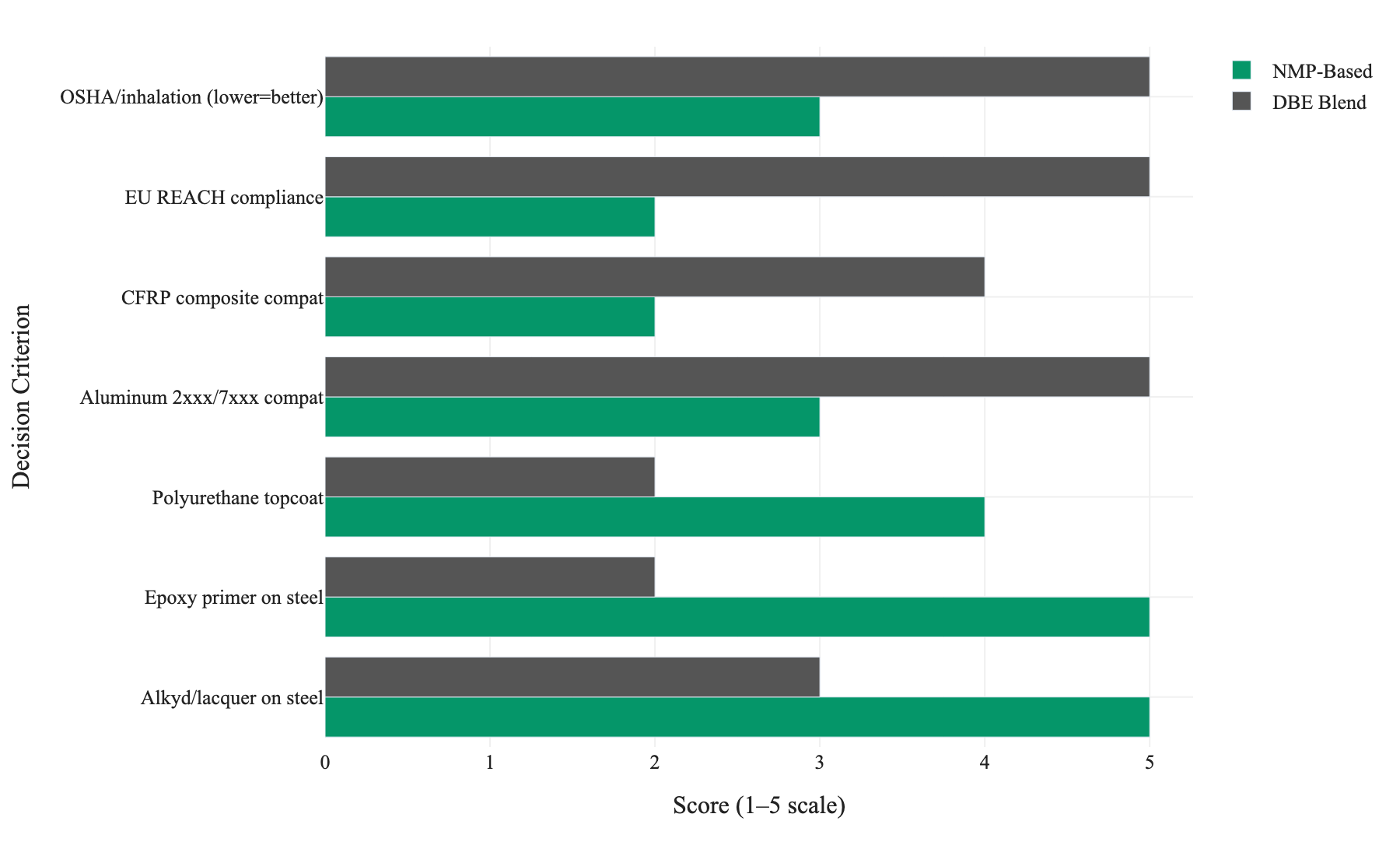
The scored selection matrix below is the primary practical tool for this article. It covers all 13 decision criteria against the three substitute chemistries plus DCM as a historical reference. Because the matrix exceeds four columns when all chemistries are shown together, it is presented in two grouped tables: Figure 1a covers stripping efficacy and substrate compatibility criteria; Figure 1b covers regulatory compliance, effluent, cost, and process speed criteria. Both tables share the same scoring key and weight scheme.
Figure 1a. Selection Matrix: Stripping Efficacy and Substrate Compatibility
Decision Criterion | NMP-Based | Benzyl Alcohol | DBE Blend |
|---|---|---|---|
Stripping efficacy: alkyd/lacquer on steel (High) | 5 | 4 | 3 |
Stripping efficacy: epoxy primer on steel (High) | 5 | 3 | 2 (3 at 60 C) |
Stripping efficacy: polyurethane topcoat (High) | 4 | 3 | 2 (3 at 60 C) |
Stripping efficacy: powder coat on steel (Medium) | 3 | 2 | 2 |
Substrate compatibility: aluminum 2xxx/7xxx (High) | 3 | 4 | 5 |
Substrate compatibility: CFRP composite (High) | 2 | 3 | 4 |
Substrate compatibility: mild steel (High) | 5 | 5 | 5 |
Scoring: 5 = best performance; 1 = worst. Weight: High = 3x, Medium = 1.5x. DCM historical reference scores (all efficacy criteria = 5; aluminum = 4; CFRP = 2; mild steel = 5) are omitted from this table because DCM is not selectable under the post-2024 EPA TSCA rule for most commercial stripping uses. Sources: US EPA TSCA Final Rule 2024; Products Finishing 2019.
Figure 1b. Selection Matrix: Regulatory Compliance, Effluent, Cost, and Process Speed
Decision Criterion | NMP-Based | Benzyl Alcohol | DBE Blend |
|---|---|---|---|
OSHA/inhalation exposure, lower = better score (High) | 3 | 4 | 5 |
EU REACH compliance, 2025 status (High) | 2 | 5 | 5 |
US EPA TSCA compliance, post-2024 rule (High) | 4 | 5 | 5 |
Effluent/wastewater treatability (Medium) | 3 | 4 | 5 |
Unit cost, lower cost = higher score (Medium) | 3 | 3 | 2 |
Stripping time, shorter = higher score (High) | 4 | 3 | 2 (3 at 60 C) |
Scoring: 5 = best compliance or performance; 1 = worst. Weight: High = 3x, Medium = 1.5x. Sources: US EPA TSCA Final Rule 2024; ECHA REACH Annex XVII; OSHA PEL tables; ACGIH TLV 2022.
Figures 1a and 1b together constitute the full scored selection matrix. Figure 1a shows that NMP-based formulations score highest on stripping efficacy but lowest among substitutes on substrate compatibility with sensitive alloys. Benzyl alcohol presents a balanced profile for shops primarily stripping alkyd and lacquer systems from steel or aluminum. DBE blends score best on substrate compatibility, particularly for aluminum 2xxx/7xxx and CFRP. Figure 1b shows that NMP scores lowest on regulatory compliance (EU REACH) while benzyl alcohol and DBE are equivalent on compliance and effluent, with DBE carrying a modest cost advantage.
Two derived aggregate scores are useful for program engineers. For a shop stripping primarily solvent-borne alkyd topcoats from mild steel with strong EU compliance requirements and standard effluent treatment capacity, benzyl alcohol scores approximately 3.7 weighted average versus NMP at 3.4 and DBE at 3.2. For a shop stripping thick epoxy primers from CFRP aerospace components with OSHA 1910.1000 Air Contaminants Standard compliance as a primary constraint, DBE at elevated temperature scores approximately 3.6 versus benzyl alcohol at 3.1 and NMP at 2.8.
IV. Cost, OSHA Exposure, and Effluent Compliance
A stripping substitute that performs well on coatings and substrates but creates unacceptable inhalation exposure, wastewater treatment cost, or regulatory reporting burden has not solved the DCM problem; it has displaced it. Cost, occupational exposure, and effluent compliance must be evaluated together as a total operating cost.
What Are the OSHA Exposure Boundaries for Each Substitute?
OSHA's current permissible exposure limit (PEL) for DCM under 29 CFR 1910.1052 is 25 parts per million (ppm) as an 8-hour time-weighted average (TWA) and 125 ppm as a 15-minute short-term exposure limit (STEL). This limit has driven the adoption of local exhaust ventilation systems and continuous air monitoring in DCM stripping operations. Exceeding the OSHA DCM PEL triggers medical surveillance requirements, exposure record-keeping for 30 years, and regulated-area designation. These administrative costs are substantial: a typical multi-station DCM stripping line with proper industrial hygiene infrastructure (continuous monitoring, annual medical exams for exposed workers, OSHA 300 log entries) adds an estimated USD 12,000 to USD 22,000 per year in compliance overhead per facility (OSHA, 29 CFR 1910.1052, regulatory text).
For NMP, OSHA has no established PEL under 29 CFR 1910.1000 Table Z-1 as of 2024, which means compliance defaults to the general duty clause and any applicable state-plan PEL. California OSHA (Cal/OSHA) has adopted an NMP PEL of 10 ppm (8-hour TWA) per the California Code of Regulations Title 8, Section 5155. NIOSH recommends 10 ppm as a ceiling. Facilities in non-California US states may technically comply with no specific NMP air monitoring requirement under federal OSHA, but this is operationally risky given NMP's reproductive toxin classification and potential future federal rulemaking. Industrial hygiene best practice recommends engineering controls targeting below 10 ppm regardless of formal PEL status.
For benzyl alcohol and DBE blends, OSHA has established no specific PEL, and ACGIH has not issued a TLV for either as of 2024. General dilution ventilation adequate for nuisance-level odor control is typically sufficient for both, representing a substantial reduction in air monitoring and industrial hygiene program cost relative to DCM or NMP operations.
How Do Substitute Chemistries Compare on Total Cost Per Stripped Area?
Chemical cost alone does not determine the economics of substitute selection. The relevant metric is total cost per square meter stripped, which includes chemical purchase price, labor time adjusted for stripping rate, ventilation and personal protective equipment (PPE) cost, and effluent disposal cost. The following ranges are based on publicly available supplier pricing, regulatory compliance cost estimates, and published stripping rate data as of 2024.
NMP-based formulations are priced at approximately USD 3.50 to USD 6.00 per kilogram for bulk industrial-grade product, comparable to benzyl alcohol at USD 2.80 to USD 5.50 per kilogram and DBE blends at USD 2.00 to USD 4.50 per kilogram. Application rates vary: DCM strippers typically apply at 0.15 to 0.25 liters per square meter, while NMP-based strippers at comparable efficacy levels may apply at 0.20 to 0.40 liters per square meter due to lower volatility and higher required film thickness.
Labor time is the largest cost variable. Because DBE requires 2 to 4 times the ambient-temperature contact of NMP for equivalent stripping of cured epoxy systems, a 10-person stripping operation running 8-hour shifts incurs 16 to 32 additional labor-hours per shift cycle if DBE is substituted for NMP without process modification. At USD 45 to USD 65 per labor-hour (including burden), this represents USD 720 to USD 2,080 per shift in additional cost before chemical savings are counted. Heated DBE application (50 to 60 degrees C bath or spray temperature) recovers a substantial portion of this gap by reducing contact time to 30 to 90 minutes on most epoxy systems.
Effluent disposal cost adds another dimension. NMP-contaminated wastewater typically requires treatment to below 10 mg/L NMP before discharge under local pretreatment standards because NMP is a potential groundwater contaminant and reproductive toxin. Treatment costs for NMP wastewater at a contract industrial waste facility run approximately USD 0.80 to USD 1.60 per liter as of 2024 estimates. Benzyl alcohol and DBE biodegrade under standard aerobic wastewater conditions and are generally acceptable at concentrations below 200 mg/L in municipal sewage systems, subject to local pretreatment authority approval, which substantially reduces disposal cost.
What Does the EPA TSCA DCM Rule Actually Require?
The EPA finalized its TSCA Section 6(a) risk management rule for DCM in 2024, prohibiting most commercial paint and coating removal uses of DCM for consumer applications immediately upon rule publication, and establishing a phased compliance schedule for industrial and commercial uses (US EPA, TSCA DCM Final Rule, 2024). Industrial workplaces must implement stringent exposure limits and engineering controls under the rule's Workplace Chemical Protection Program (WCPP) provisions, with full compliance deadlines phased over 1 to 3 years from rule publication depending on employer size. Small businesses receive extended deadlines (verification needed for exact compliance deadline dates for each employer-size tier). The practical effect for most industrial stripping operations is that DCM use will either require engineering controls equivalent to a closed-system process or it will be more economically rational to substitute than to comply.
V. Selection by Coating Type, Substrate, and Compliance Profile
The selection logic flows from three constraints applied in sequence: substrate compatibility eliminates chemistries that damage the base material, coating chemistry determines which substitutes can achieve stripping within the production time window, and the compliance profile (OSHA, REACH, EPA) applies site-specific regulatory constraints that may further narrow the choice.
How Does the Selection Decision Tree Work?
The decision follows a three-gate structure. Gate 1 is substrate class: identify the Tier (1, 2, or 3) from Section III. Tier 3 composite substrates route directly to DBE as the primary candidate unless process qualification tests under the applicable structural repair manual have cleared another agent. Tier 2 reactive metals route to benzyl alcohol or DBE and exclude caustic. Tier 1 hard metals open all three solvent substitutes for further evaluation.
Gate 2 is coating chemistry. Solvent-borne alkyd, lacquer, and vinyl coatings are solvated by all three substitutes at ambient temperature. Two-component epoxy primers and topcoats require NMP or heated DBE to achieve stripping within a standard production shift at typical dry film thicknesses above 150 micrometers. High-build polyurethane topcoats respond similarly to epoxy: NMP achieves stripping in 30 to 90 minutes, benzyl alcohol in 2 to 5 hours, and DBE at ambient temperature in 4 to 8 hours for films above 200 micrometers DFT (Products Finishing, 2019). Powder coatings (thermoset polyester, hybrid, or epoxy powder) are among the most resistant to all solvent-based strippers because the high-bake cure (160 to 200 degrees C, 15 to 25 minutes) produces a dense crosslink network. NMP at 50 to 60 degrees C with a penetrant activator is the most effective solvent substitute for powder coatings; DBE requires extended contact at elevated temperature and may still not achieve clean removal on highly crosslinked polyester powder coats.
Gate 3 is the compliance profile. EU operations facing REACH NMP restrictions route to benzyl alcohol or DBE for any new stripping programs, using remaining NMP inventory under risk management programs only where benzyl alcohol and DBE have been evaluated and found technically inadequate. US operations in California or in facilities with air emission permits that include NMP as a reportable compound face similar constraints. Facilities with no local NMP restrictions and strong effluent treatment infrastructure may retain NMP as a viable substitute where it is the only agent that achieves acceptable stripping rates on high-crosslink coatings.
The gate-logic selection guide below provides a direct recommendation for each substrate-coating-compliance combination. It is presented in two grouped tables to maintain four or fewer columns: Figure 2a covers Tier 1 (hard metals) cases; Figure 2b covers Tier 2 reactive metals and Tier 3 composite substrates. Both tables share the same column structure.
Figure 2a. Substrate-Coating-Compliance Selection Guide: Tier 1 Substrates (Mild Steel, Stainless)
Coating Type | EU REACH Restricted Site | US Non-California Site | Notes |
|---|---|---|---|
Alkyd / lacquer | Benzyl alcohol | Benzyl alcohol or NMP | Ambient temp; 30-90 min contact |
Epoxy primer (2K) | DBE at 60 C | NMP or DBE at 60 C | DBE requires bath heating; NMP preferred for US single-shift cycle |
Polyurethane topcoat (2K) | DBE at 60 C | NMP or DBE at 60 C | NMP preferred for US single-shift cycle |
Powder coat (thermoset) | DBE + activator (NMP restricted) | NMP at 50-60 C | Partial removal likely with DBE only on EU sites |
Note: "NMP restricted" in EU column means REACH Annex XVII Entry 71a restrictions apply; NMP may still be used under industrial exposure risk management provisions with documented controls (ECHA REACH Annex XVII; verification needed for current industrial use status per latest ECHA update).
Figure 2b. Substrate-Coating-Compliance Selection Guide: Tier 2 and Tier 3 Substrates
Substrate / Coating | EU REACH Restricted Site | US Non-California Site |
|---|---|---|
Aluminum 2xxx/7xxx — alkyd / lacquer | Benzyl alcohol | Benzyl alcohol |
Aluminum 2xxx/7xxx — epoxy primer (2K) | DBE at 60 C | Benzyl alcohol or DBE at 60 C |
Magnesium / zinc — any coating | DBE (ambient or heated) | DBE (ambient or heated) |
CFRP / fiberglass (Tier 3) — any aerospace coating | DBE (qualified per SRM) | DBE (qualified per SRM) |
Note: For Tier 2 and Tier 3 substrates, caustic strippers are categorically excluded regardless of compliance jurisdiction. SRM = structural repair manual.
Row-level notes: Caustic is prohibited on all Tier 2 substrates (aluminum, magnesium, zinc) regardless of coating type or jurisdiction. For aluminum 2xxx/7xxx with epoxy primer, NMP is not listed because its hydrogen uptake risk must be evaluated against the specific alloy-temper combination per the applicable structural repair manual before use is cleared. Magnesium and zinc substrates have high surface reactivity; the pH of the DBE formulation must be verified to fall within the substrate-safe window (typically pH 5 to 7) before application. For CFRP and fiberglass Tier 3 substrates, DBE must be qualified under the applicable structural repair manual; contact time is capped at 60 to 90 minutes depending on laminate construction and resin type.
Figures 2a and 2b together provide the gate-logic selection tool. The scored matrices in Figures 1a and 1b give a weighted score when multiple substitutes are technically acceptable and the engineer needs a ranked recommendation. Figures 2a and 2b give a gate-logic selection when the substrate or compliance constraint eliminates options outright. Most real stripping programs benefit from applying both tool sets: Figures 2a/2b first to eliminate non-viable options, then Figures 1a/1b to rank the remaining candidates.
VI. Field Cases: Aerospace, Automotive, and Industrial Stripping Programs
The following three cases illustrate how the three-gate selection logic of Section V plays out in practice. Company names are anonymized per standard practice.
Case A: Aerospace Component Rework Facility (Unexpected Cause Pattern)
Company A operates a rework facility processing aluminum aircraft structural components, primarily 7075-T6 and 2024-T3 alloy frame sections and skin panels. Annual throughput is approximately 1,200 components per year at an average stripped area of 2.4 m2 per component (total annual area: approximately 2,900 m2). The coatings stripped are MIL-PRF-23377 epoxy primer and MIL-PRF-85285 polyurethane topcoat, typically applied at 25 to 38 micrometers DFT for primer and 50 to 75 micrometers DFT for topcoat. The facility had used a DCM-based stripper qualified under MIL-R-81294 for 14 years.
Following the 2024 EPA TSCA rule, the facility evaluated NMP-based strippers as the first substitution candidate because NMP's efficacy on epoxy-polyurethane systems is well-established. Bench testing confirmed 25 to 40 minute stripping time on the epoxy-polyurethane stack using a qualified NMP formulation at 40 degrees C. The unexpected finding was that the 7075-T6 components showed localized surface discoloration and a measurable reduction in surface hardness (Vickers hardness reduced from 175 HV to 158 HV, approximately 9.7 percent) after a 60-minute NMP soak at 40 degrees C, consistent with hydrogen uptake or partial dissolution of the protective oxide layer. The 2024-T3 panels did not show the same effect at the same conditions.
DBE blend evaluation at 50 degrees C produced clean stripping in 70 to 90 minutes on the 7075-T6 components with no detectable hardness change (post-strip Vickers: 174 HV, within measurement uncertainty). On the 2024-T3 panels, DBE at 50 degrees C achieved stripping in 55 to 75 minutes. Both alloys passed post-strip inspection per the applicable structural repair manual criteria. The facility implemented a heated DBE bath system with temperature control at plus or minus 3 degrees C, increasing per-component energy cost by approximately USD 0.18 per component but avoiding the substrate compatibility risk of NMP on the 7075-T6 alloy. Total transition cost from DCM to the DBE system, including the heated bath installation and process qualification testing, was approximately USD 74,000. The facility projects annual compliance cost savings of approximately USD 38,000 by eliminating DCM medical surveillance, air monitoring, and regulated-area administration, recovering the transition investment in approximately 24 months.
Case B: Automotive Body Shop De-coating (Trial-and-Error Pattern)
Company B operates a high-volume automotive body shop stripping epoxy primer and waterborne basecoat-clearcoat systems from steel unibody structures for corrosion-related rework. The shop processes approximately 280 vehicles per year, with an average stripped area of 6.5 m2 per vehicle (approximately 1,820 m2 annually). The coating stack is: epoxy primer at 20 to 30 micrometers DFT, surfacer at 30 to 50 micrometers DFT, waterborne basecoat at 12 to 18 micrometers DFT, and two-component polyurethane clearcoat at 40 to 60 micrometers DFT.
The shop initially substituted a benzyl alcohol-based formulation directly for DCM, reasoning that benzyl alcohol's low regulatory risk profile (no OSHA PEL, no REACH SVHC) would simplify the compliance transition. At ambient temperature, benzyl alcohol achieved stripping of the clearcoat and basecoat layers in 35 to 55 minutes, but required 3.5 to 5 hours contact to lift the epoxy primer layer from steel. This extended contact time reduced shop throughput from 1.2 vehicles per day to 0.6 vehicles per day, a 50 percent throughput reduction that made the substitution economically non-viable.
The second trial used a heated benzyl alcohol formulation at 55 degrees C. At elevated temperature, the clearcoat and basecoat lifted in 12 to 20 minutes, and the epoxy primer lifted in 45 to 75 minutes. Throughput recovered to 1.0 to 1.1 vehicles per day (approximately 83 to 92 percent of DCM baseline). Effluent from the heated benzyl alcohol process was acceptable at the local pretreatment authority under a biochemical oxygen demand (BOD) limit test: benzyl alcohol at concentrations below 400 mg/L was confirmed biodegradable within 5-day BOD testing (ASTM D5864-11, aerobic biodegradation test). The heated bath system required a USD 18,000 capital investment for the strip tank and temperature controller. Total stripping cost per vehicle increased from approximately USD 42 (DCM process) to approximately USD 61 (heated benzyl alcohol), a 45 percent increase in per-unit chemical and energy cost, but elimination of DCM regulatory overhead reduced annual compliance program cost by approximately USD 9,500, partially offsetting the per-unit increase.
Case C: Industrial Maintenance Stripping of Structural Steel (Cost Reversal Pattern)
Company C maintains a 38,000 m2 manufacturing facility with structural steel framing painted with epoxy-phenolic primer and alkyd topcoat on a 7-year maintenance cycle. The maintenance stripping program strips approximately 4,200 m2 per year across multiple shift windows, targeting spot-blast areas and full-panel stripping zones. Prior to 2024, the contractor used DCM gel formulations applied by brush and covered with a plastic dwell sheet at 0.18 to 0.22 liters per square meter.
DBE blend at ambient temperature was evaluated as the low-risk substitute. On the alkyd topcoat layers, DBE achieved stripping in 45 to 75 minutes at ambient temperature (18 to 24 degrees C, typical of the unheated facility interior), comparable to the DCM gel process at 30 to 50 minutes. On the epoxy-phenolic primer layers, DBE at ambient temperature required 3 to 6 hours contact with one intermediate reapplication, which extended the stripping sequence to two shifts per panel. NMP gel was evaluated as an alternative for the primer phase only, achieving primer stripping in 60 to 90 minutes at ambient temperature.
The program adopted a two-product approach: DBE gel for alkyd topcoat removal (approximately 3,100 m2 per year) and a NMP gel formulation for epoxy-phenolic primer removal (approximately 1,100 m2 per year). Annual chemical cost under the two-product program is approximately USD 28,400 (DBE at USD 5.20 per m2 applied cost and NMP at USD 7.80 per m2 applied cost) compared with USD 24,600 under the DCM program. The USD 3,800 per-year increase in chemical cost is offset by elimination of DCM-related regulatory overhead: termination of the medical surveillance program (USD 6,200 per year), discontinuation of continuous air monitoring (USD 4,100 per year annualized over equipment life), and removal of the regulated-area administrative cost (USD 2,800 per year). Net annual cost reduction under the substitute program: approximately USD 9,300 per year, with the higher chemical cost more than offset by regulatory compliance savings.
VII. Key Takeaway
Substrate class determines which substitutes are physically viable before coating chemistry or cost enters the analysis. Tier 3 composite substrates (CFRP, fiberglass) route to DBE by default. Tier 2 reactive metals (aluminum 2xxx/7xxx, magnesium, zinc) exclude caustic and require caution with NMP on certain heat-treated alloys. Only Tier 1 hard metals open all three solvent substitutes for further evaluation.
NMP-based formulations offer the closest performance match to DCM on cross-linked epoxy and polyurethane systems, but EU REACH Annex XVII restrictions and the reproductive toxin classification make them a long-term liability for European operations and high-regulatory-sensitivity US facilities. Programs retaining NMP should track ECHA SVHC candidate list updates and US state-plan PEL developments quarterly.
Benzyl alcohol is the preferred substitute for solvent-borne alkyd and lacquer coatings on steel or aluminum at ambient temperature, and becomes competitive on epoxy systems when operated at 50 to 60 degrees C. Its safety profile (no established PEL, no SVHC classification, readily biodegradable) substantially reduces industrial hygiene program cost relative to both DCM and NMP.
DBE blends offer the best compliance profile of all three substitutes but require heated application (50 to 70 degrees C) or extended contact time to strip cured thermoset coatings. The capital cost of a heated strip bath (USD 12,000 to USD 25,000 for most industrial configurations) is typically recovered in under 24 months through elimination of DCM or NMP air monitoring and medical surveillance overhead.
The 2024 EPA TSCA DCM rule has transformed the compliance calculus permanently: the question for most industrial stripping programs is no longer whether to substitute but which substitute to qualify and how to manage the transition in a single regulated step rather than serially substituting from DCM to NMP to a safer alternative.
Stripping programs running multiple coating-substrate combinations benefit from a two-product or segmented approach (as illustrated in Case C), applying the scored selection matrices in Figures 1a and 1b and the substrate-compliance gate logic in Figures 2a and 2b independently for each coating-substrate pair, then rationalizing the product count against procurement and training overhead.
Process engineers managing DCM or NMP substitution across multiple product lines, coating types, and regulatory jurisdictions accumulate a significant documentation and tracking burden as regulatory limits evolve, substitute qualifications are updated, and effluent permit conditions change. Lubinpla's AI Crew platform provides specialized AI agents that automate the ongoing regulatory monitoring, substitute qualification record management, and compliance documentation workflow for stripping programs in active migration. Setting up an AI Crew compliance-tracking agent configuration using the selection criteria in this article allows the agent to flag when new ECHA SVHC additions, US state-plan PEL changes, or EPA TSCA implementation updates affect the qualified substitute inventory, reducing the manual monitoring overhead to a review-and-approve workflow rather than a full research task.
VIII. References
ACGIH. (2022). Documentation of the Threshold Limit Values and Biological Exposure Indices: N-Methyl-2-Pyrrolidone (NMP). American Conference of Governmental Industrial Hygienists. https://www.acgih.org/nmp-documentation
ASTM International. (2011). ASTM D5864-11: Standard Test Method for Determining Aerobic Aquatic Biodegradation of Lubricants or Their Components. ASTM International. https://www.astm.org/d5864-11.html
ASTM International. (2022). ASTM D7869-17(2022): Standard Practice for Xenon Arc Exposure Test with Enhanced Light and Water Exposure for Transportation Coatings. ASTM International. https://www.astm.org/d7869-17r22.html
California Department of Industrial Relations. (2023). California Code of Regulations, Title 8, Section 5155: Airborne Contaminants. Cal/OSHA. https://www.dir.ca.gov/title8/5155.html
ECHA. (2018). Annex XVII to REACH: Restrictions on the Manufacture, Placing on the Market and Use of Certain Dangerous Substances, Mixtures and Articles, Entry 71a: N-Methyl-2-pyrrolidone (NMP). European Chemicals Agency. https://echa.europa.eu/substances-restricted-under-reach
ECHA. (2025). Candidate List of Substances of Very High Concern for Authorisation. European Chemicals Agency. https://echa.europa.eu/candidate-list-table
NIOSH. (2020). Pocket Guide to Chemical Hazards: Methylene Chloride. US National Institute for Occupational Safety and Health. https://www.cdc.gov/niosh/npg/npgd0414.html
NIOSH. (2020). Pocket Guide to Chemical Hazards: N-Methyl-2-Pyrrolidone. US National Institute for Occupational Safety and Health. https://www.cdc.gov/niosh/npg/npgd0446.html
OECD. (2006). SIDS Initial Assessment Report for SIAM 22: Benzyl Alcohol. OECD Screening Information Data Set. https://hpvchemicals.oecd.org/ui/handler.axd?id=bc4c2a73-69f2-4c20-961c-b4fca7d52c28
OSHA. (1997). 29 CFR 1910.1052: Methylene Chloride Standard. US Occupational Safety and Health Administration. https://www.osha.gov/laws-regs/regulations/standardnumber/1910/1910.1052
OSHA. (2024). 29 CFR 1910.1000 Table Z-1: Air Contaminants. US Occupational Safety and Health Administration. https://www.osha.gov/laws-regs/regulations/standardnumber/1910/1910.1000TBLZ1
Products Finishing. (2019). Alternatives to Methylene Chloride Paint Strippers: Evaluating NMP, Benzyl Alcohol, and Dibasic Esters for Industrial Applications. Products Finishing. https://www.pfonline.com/articles/alternatives-to-methylene-chloride-paint-strippers
US EPA. (2024). TSCA Section 6(a) Final Rule: Risk Management for Methylene Chloride (Dichloromethane). US Environmental Protection Agency. https://www.epa.gov/assessing-and-managing-chemicals-under-tsca/risk-management-methylene-chloride
US EPA. (2024). Methylene Chloride: Overview of EPA Actions Under TSCA. US Environmental Protection Agency. https://www.epa.gov/assessing-and-managing-chemicals-under-tsca/methylene-chloride