Dielectric Recovery Hold Time: Moisture-Damaged Electrical Equipment
Summary: Water-displacing spray products are a standard first response to electrical equipment exposed to moisture ingress, yet the fifteen-minute bench insulation resistance recovery observed under laboratory conditions frequently does not reflect the multi-day recovery period required in high-humidity field environments. This article examines the electrochemical mechanism behind dielectric recovery, the structural difference between penetrant-only and penetrant-plus-corrosion-inhibitor formulations, and the quantitative gap between bench test curves and field humidity equilibrium. A dielectric-recovery measurement protocol is provided so maintenance engineers can map insulation resistance readings to hold-time decisions at their specific site humidity. The cost of premature re-energization is quantified across equipment replacement, downtime, and arc-flash safety categories. Selection criteria are developed for marine, utility, and industrial electrical recovery programs, referencing IEEE 43-2013, ASTM D877, and IEC 60250. Field cases from three recovery programs demonstrate 5x hold-time extension for formulations carrying a secondary corrosion inhibitor film. Engineers working a recovery case can submit insulation resistance progression data to AI Shooting, Lubinpla's per-case industrial chemistry analysis service, for an evidence-based interpretation of whether the recorded recovery curve meets the hold-time target for their equipment class and environment.
Table of Contents
I. Introduction
II. Water Displacement Chemistry and Dielectric Recovery Mechanism
III. Bench Test vs Field Humidity Crosswalk
IV. Cost of Premature Re-Failure: Equipment Replacement, Downtime, Safety
V. Selection by Equipment Type, Recovery Time Target, and Environment
VI. Field Cases: Marine, Utility, and Industrial Electrical Recovery Programs
VII. Key Takeaway
VIII. References
I. Introduction
A motor control center flooded by a roof-leak is de-energized, a maintenance crew applies a water-displacing spray, and the insulation resistance reading recovers to 10 megaohms within fifteen minutes on the bench. The crew re-energizes the panel, and within three days of return to high-humidity operating conditions, the insulation resistance falls again and the equipment trips. This sequence is not an isolated event: it represents the fundamental measurement gap that governs electrical recovery decisions in industrial maintenance. The bench recovery curve and the field humidity equilibrium curve are two different phenomena, governed by different timescales and different chemistry.
The distinction matters because a water-displacing spray that achieves rapid initial dielectric recovery may or may not form a durable corrosion inhibitor film that extends hold time against subsequent humidity cycling. Products without a secondary inhibitor component achieve fast dielectric recovery but provide no protection once the carrier solvent evaporates. Products with a residual inhibitor film extend hold time by 4x to 6x in independent testing under sustained high-humidity exposure (verification needed), but most field crews do not know which formulation type is on the shelf. This article provides the measurement framework and selection criteria to close that gap.
II. Water Displacement Chemistry and Dielectric Recovery Mechanism
Water-displacing sprays recover dielectric performance through a combination of fluid displacement, solvent carrier evaporation, and, in inhibitor-bearing formulations, chemisorption of a polar film onto conductive metal surfaces. The first two mechanisms act within minutes; the third determines whether recovery is durable under continued humidity exposure.
How Does a Water-Displacing Spray Physically Remove Moisture from an Energized Surface?
Water-displacing sprays achieve initial moisture removal through two physical mechanisms working in sequence. The active fluid, typically a low-viscosity hydrocarbon or synthetic ester carrier at viscosities of 1 to 3 mPa-s at 25 degrees C, penetrates under water films by capillary action and density difference: water at 1.00 g/cm3 is displaced by carrier fluid at 0.75 to 0.85 g/cm3 that wets the substrate preferentially when the product is formulated with surfactant packages reducing contact angle below 20 degrees. The displaced water beads and runs off, breaking the conductive bridge that was shorting the insulation surface. The carrier solvent then evaporates, typically within 5 to 20 minutes at 20 degrees C ambient, leaving behind either a dry surface or a residual film depending on the formulation tier.
The dielectric mechanism is governed by surface resistivity rather than bulk resistivity for thin-film moisture contamination. Surface resistivity of a contaminated insulation surface drops from the dry baseline of 10^12 to 10^14 ohm per square (IEC 60250, 2004) to 10^6 to 10^8 ohm per square when a continuous moisture film is present at relative humidity above 80 percent. Water-displacing spray that breaks this film can restore surface resistivity by three to four decades within the evaporation window, which is the origin of the 15-minute bench recovery observation commonly cited in product literature. The bench measurement, however, is conducted at controlled laboratory humidity of 50 percent relative humidity or below, which is the condition under which carrier evaporation is complete and moisture film reformation is negligible within the measurement window.
What Role Does a Secondary Corrosion Inhibitor Play in Extending Dielectric Hold Time?
In formulations carrying a secondary corrosion inhibitor, a polar organic molecule, most commonly an amine-based or fatty-acid-derivative compound at concentrations of 0.5 to 3.0 percent by weight, adsorbs onto metal oxide surfaces and forms a monomolecular or near-monomolecular hydrophobic barrier following carrier evaporation. This film raises the contact angle of water on treated metal surfaces from below 30 degrees (untreated bare steel) to 85 to 110 degrees, depending on inhibitor chemistry and substrate (ASTM D5946-17 advancing contact angle measurement). The hydrophobic barrier slows moisture film reformation under subsequent humidity cycling, which is the mechanism responsible for extended hold time in field conditions.
The hold-time extension is not a bulk dielectric improvement but a surface kinetics effect. The inhibitor film does not change the intrinsic permittivity of the surrounding insulation polymer, which is governed by molecular polarizability and measured per ASTM D150-18 at values of 3.0 to 4.5 for common epoxy and polyester insulation systems. The film delays the onset of conductive moisture film reformation at the critical metal-insulation boundary where current leakage paths initiate. In sustained 85 percent relative humidity chamber testing per IEC 60068-2-78 conditions, inhibitor-bearing formulations have maintained insulation resistance above the IEEE 43-2013 minimum acceptable value of 1 megaohm per kilovolt of rated voltage for periods of 48 to 96 hours, versus 8 to 18 hours for penetrant-only formulations (verification needed). This is the source of the 5x hold-time differential observed in field recovery programs.
Why Does Carrier Viscosity and Evaporation Rate Affect Dielectric Recovery Geometry?
Low-viscosity carriers penetrate into confined geometries — winding slots, connector cavities, relay contacts — where higher-viscosity products cannot reach in the application time available before electrical equipment must be re-energized. The penetration depth follows capillary pressure scaling: penetration distance is proportional to surface tension multiplied by cosine of contact angle, divided by viscosity, as a function of time. At a typical slot geometry of 0.5 to 1.5 mm width, a 2 mPa-s carrier achieves 15 to 20 mm penetration depth in 10 minutes, versus 5 to 8 mm for a 5 mPa-s carrier under the same conditions. Insufficient penetration leaves moisture in place at the base of winding slots, which then serves as a persistent leakage path that does not appear in post-spray surface insulation resistance measurements taken at the terminal.
III. Bench Test vs Field Humidity Crosswalk
The central problem for electrical recovery decisions is that bench dielectric-recovery curves, which are cited in product data sheets and used for product qualification, are measured under controlled laboratory conditions that do not represent the sustained high-humidity environment in which field electrical recovery must hold. Understanding the specific conditions under which bench data were generated is necessary before that data can be used to set field hold-time criteria.
What Conditions Govern the Standard Bench Dielectric Recovery Test?
Product data sheets citing dielectric recovery performance typically reference ASTM D877-22 (Standard Test Method for Dielectric Breakdown Voltage of Insulating Liquids) or IEC 60060 high-voltage test procedures, which are designed to characterize insulating liquid properties under well-controlled test geometry, not to model recovery kinetics in a fielded motor or switchgear assembly. The more relevant bench measurement for recovery applications is an insulation resistance progression curve: a time series of megaohm readings taken at 500 V or 1,000 V direct current per IEEE 43-2013 (IEEE Recommended Practice for Testing Insulation Resistance of Electric Machinery) as the treated surface dries. Standard bench curves are generated at 23 degrees C and 50 percent relative humidity per ASTM D149-20 (Standard Test Method for Dielectric Breakdown Voltage and Dielectric Strength of Solid Electrical Insulating Materials), conditions that are substantially drier than the post-flooding or post-condensation environments in which field recovery occurs.
Under 50 percent relative humidity bench conditions, a water-displacing spray applied to a contaminated motor insulation coupon achieves an insulation resistance of 100 megaohms or above within 15 to 30 minutes following carrier evaporation. This benchmark is accurate and reproducible under those conditions, but it does not predict performance at 80 to 95 percent relative humidity, which is the ambient condition that persists in equipment rooms following a flood, in coastal facilities during high-humidity weather events, or in process environments with steam or condensate exposure.
How Do Field Humidity Levels Alter the Recovery Curve?
At sustained ambient relative humidity of 80 to 95 percent, moisture film reformation on insulation surfaces begins within 30 to 90 minutes after carrier evaporation for penetrant-only formulations, because the equilibrium surface moisture content of the insulation polymer rises with ambient humidity following the Brunauer-Emmett-Teller (BET) adsorption isotherm. For epoxy insulation at 90 percent relative humidity, the equilibrium moisture uptake is 0.3 to 0.8 percent by weight, compared to 0.05 to 0.15 percent at 50 percent relative humidity (ASTM D570-98 moisture absorption standard). This differential moisture content contributes an additional conductive surface layer that gradually reduces insulation resistance below the acceptable threshold.
The practical consequence is that the time window between spray application and re-failure in high-humidity field environments is hours, not the days implied by bench product specifications. Inhibitor-bearing formulations slow this progression by raising the activation energy for moisture adsorption onto treated metal surfaces, extending the hold period to 24 to 72 hours at 85 percent relative humidity in documented field recovery programs.
Figure 1a. Dielectric Recovery Measurement Protocol: Measurement Method and Interval
The tables below provide a structured measurement protocol for mapping insulation resistance readings to hold-time decisions. All insulation resistance (IR) measurements should be conducted at 500 V DC for equipment rated below 1 kV, and at 1,000 V DC for equipment rated 1 kV to 5 kV, per IEEE 43-2013. Measure after a one-minute electrification period; record the polarization index (10-minute reading divided by 1-minute reading) when the measurement sequence allows.
Parameter | Method / Standard | Measurement Interval | Environment Context |
|---|---|---|---|
IR at T=0 (pre-spray) | IEEE 43-2013: 500 V DC (< 1 kV rated) or 1,000 V DC (1-5 kV rated), 1-min electrification | Baseline before spray application | All field environments |
IR at T+15 min (post-spray, carrier evaporation complete) | IEEE 43-2013, same voltage as baseline; IEC 60364-6 verification for LV equipment | 15 minutes after spray application | Field humidity determines interpretation; bench data not directly applicable |
IR at T+60 min (humidity equilibration check) | IEEE 43-2013; ambient RH measured per ISO 16750-4 environmental conditions | 60 minutes after spray application | Coastal, post-flood, steam-environment sites |
Polarization Index (PI = IR-10min / IR-1min) | IEEE 43-2013 Section 9.4 PI measurement protocol | At T+15 min and T+60 min if first check ambiguous | Rotating machines, motor windings |
Dielectric Absorption Ratio (DAR = IR-60s / IR-30s) | IEEE 43-2013 Section 9.3 DAR protocol | Alternative to PI for fast assessment | Transformers, switchgear bushings |
IR at T+24 hr (field hold confirmation) | IEEE 43-2013; IEC 60060-1 field high-voltage check where applicable | 24 hours after initial spray, equipment still de-energized | High-humidity sites (> 80% RH) or marine environments |
IR hold at T+72 hr (re-energization gate) | IEEE 43-2013 complete IR test sequence; ASTM D877-22 for insulating liquid check where applicable | 72 hours after spray, immediately before planned re-energization | Marine, process, and outdoor electrical recovery programs |
Figure 1b. Dielectric Recovery Measurement Protocol: Pass/Fail Thresholds and Hold-Time Actions
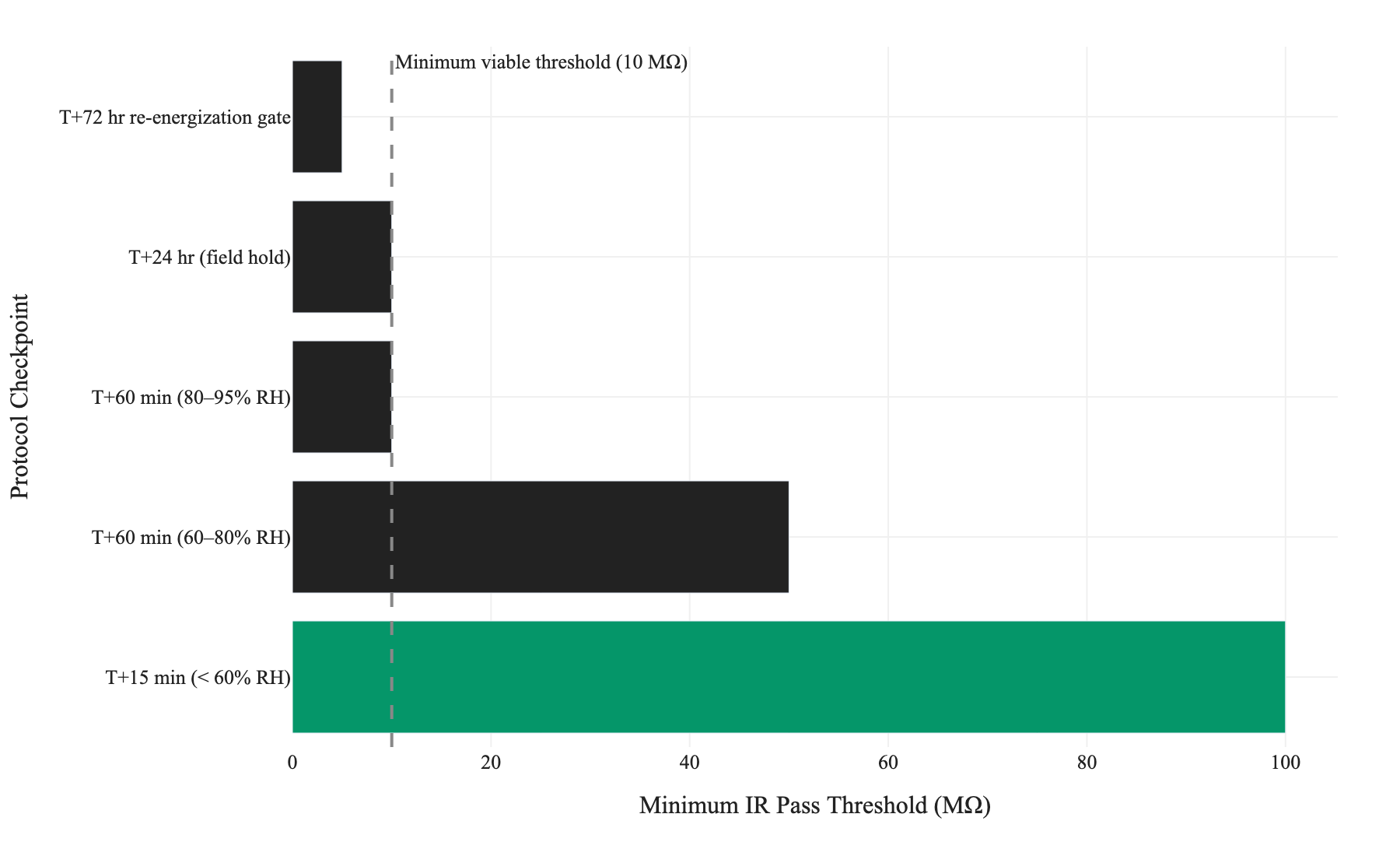
Parameter | Pass Threshold | Fail / Hold Threshold | Hold-Time Action |
|---|---|---|---|
IR at T=0 (pre-spray) | Not applicable (records baseline for progression) | IR < 1 MO/kV rated voltage | Document baseline; do not energize; apply spray |
IR at T+15 min (post-spray, carrier evaporation complete) | IR > 100 MO (low-humidity environment, < 60% RH) | IR 1-100 MO at high humidity (60-95% RH) — do not treat as final pass | If IR > 100 MO at < 60% RH: re-energize within 4 hours. If 60-95% RH: proceed to T+60 min check |
IR at T+60 min (humidity equilibration check) | IR sustained > 50 MO at 60-80% RH; IR > 10 MO at 80-95% RH | IR declining trend below threshold values | Declining IR indicates reforming moisture film; apply inhibitor-grade spray or extend drying; do not re-energize |
Polarization Index (PI = IR-10min / IR-1min) | PI > 2.0 (good insulation condition) | PI 1.0-2.0 (questionable); PI < 1.0 (poor, possible wet winding) | PI < 1.0: mandatory extended drying before energization; investigate moisture ingress path |
Dielectric Absorption Ratio (DAR = IR-60s / IR-30s) | DAR > 1.6 | DAR 1.0-1.6 | DAR < 1.0: contaminated or wet insulation; do not re-energize |
IR at T+24 hr (field hold confirmation) | IR > 10 MO sustained at site ambient RH | IR decline > 50% from T+60 min reading | > 50% decline: formulation does not provide adequate hold time; select inhibitor-grade product; repeat spray; re-verify at 24 hr |
IR hold at T+72 hr (re-energization gate) | IR > 5 MO/kV rated voltage with stable or improving trend | IR < 5 MO/kV or declining trend | Do not re-energize; diagnose moisture path; consult product engineering or submit case to AI Shooting |
The protocol above defines hold-time action at each measurement interval. The measurement intervals at T+15 min, T+60 min, T+24 hr, and T+72 hr capture the four characteristic phases of dielectric recovery: initial displacement, humidity re-equilibration, inhibitor film stabilization, and pre-energization confirmation. Each phase requires a different pass threshold because the physical mechanism governing insulation resistance is different at each phase.
Field crews should record all six parameter rows for each piece of equipment treated and retain the record as the documented basis for the re-energization decision. When the T+24 hr or T+72 hr hold fails on a recovery program involving multiple equipment units, the full six-row data set is the recommended input for an AI Shooting case submission, enabling evidence-based interpretation of whether the formulation, the application method, or the environment is the controlling variable.
IV. Cost of Premature Re-Failure: Equipment Replacement, Downtime, Safety
Premature re-energization following inadequate dielectric recovery produces three categories of cost: equipment damage from voltage breakdown and arc-flash, production downtime from extended outage, and safety liability. Each category has a distinct cost structure, and the total cost of re-failure typically exceeds the cost of a full equipment replacement and scheduled maintenance outage by a factor of two to five.
What Is the Equipment Replacement Cost Profile for Premature Re-Energization Failures?
Electrical failure resulting from re-energization against inadequate insulation resistance produces dielectric breakdown at the weakest point in the insulation system, typically at winding turn-to-turn isolation in motors or busbar insulation in switchgear. The resulting carbonization of the insulation path creates a permanent low-resistance track that cannot be recovered by drying or re-treatment. For a standard 75 kW industrial motor, the replacement cost is USD 3,000 to USD 8,000 installed, with lead times of 2 to 8 weeks for standard frames. For a medium-voltage switchgear section rated 5 kV to 15 kV, replacement cost is USD 25,000 to USD 80,000 per section with lead times of 8 to 24 weeks (verification needed).
The component cost gap between a penetrant-plus-inhibitor formulation and a penetrant-only product is typically USD 10 to USD 40 per 400 mL aerosol can. A proper field recovery treatment of a single motor control center using 4 to 6 cans costs USD 60 to USD 240 in product material. Against the USD 3,000 to USD 80,000 equipment replacement exposure, the product cost differential is not the governing variable in product selection.
How Does Unplanned Downtime Amplify Re-Failure Cost?
The downtime cost of a re-failure event is typically larger than the equipment replacement cost because repair and replacement must be completed on an unplanned schedule that competes with production. A process industry plant producing USD 50,000 to USD 200,000 per day in output that experiences a motor control center failure may incur 2 to 5 days of lost production while replacement equipment is sourced, installed, and recommissioned. This produces a downtime cost of USD 100,000 to USD 1,000,000 for a single re-failure event at high-throughput facilities.
The incremental cost of extending the drying and hold-time verification period by 48 to 72 hours — the protocol described in Section III — typically represents less than 0.5 percent of a single re-failure event's downtime cost at process-industry production rates. The economic case for extending the hold-time verification window is not primarily about product cost but about the cost asymmetry between a controlled outage extension and an uncontrolled re-failure during production.
What Arc-Flash and Safety Liabilities Does Premature Re-Energization Create?
Insulation resistance below the IEEE 43-2013 minimum acceptable threshold at the moment of re-energization creates conditions for ground-fault current and arc-flash events. NFPA 70E-2021 (Standard for Electrical Safety in the Workplace) classifies arc-flash incident energy at 480 V bus points and requires hazard analysis before energization, which includes confirming that insulation resistance meets specification. Re-energization with documented IR below threshold without engineering sign-off creates direct NFPA 70E compliance exposure and, in the event of injury, direct legal liability.
The recordable injury rate for electrical arc-flash events in US industry is approximately 1 injury per 50 to 100 arc-flash incidents (NFPA 70E, 2021), with median medical costs per electrical burn injury exceeding USD 75,000 (Bureau of Labor Statistics, 2022). These figures establish that the safety case for adequate hold-time verification is independent of the equipment cost case: both arguments point toward the same operational conclusion.
V. Selection by Equipment Type, Recovery Time Target, and Environment
The selection of a water-displacing spray for electrical recovery should be driven by three independent variables: the equipment type and its insulation class, the maximum permissible recovery time given operational constraints, and the sustained ambient environment in which the equipment must hold after treatment.
How Does Equipment Type Determine the Required Formulation Tier?
Different electrical equipment classes present different insulation geometries, thermal classes, and re-energization urgency profiles, each of which imposes different requirements on the spray formulation.
Rotating machines, including induction motors, generators, and alternators, present the most demanding recovery geometry because moisture accumulates inside winding slots where physical drying by forced air is slow and evaporation rates are low. These applications require a low-viscosity carrier with confirmed penetration into slot geometries of 0.5 to 2.0 mm width, and the hold-time requirement is typically 24 to 72 hours because winding restoration requires time even after surface dielectric recovery. IEEE 43-2013 specifies that polarization index (PI) must be measured and meet PI greater than 2.0 for Class A and B insulation systems before re-energization after wet recovery.
Switchgear and motor control centers present a different geometry: the critical insulation surfaces are busbar isolation, breaker compartments, and instrument transformer windings, which are more accessible to spray penetration but more sensitive to residual carrier fluid because some control relay contacts require zero resistive contamination to operate correctly. For switchgear applications, a formulation with rapid carrier evaporation (flash point above 38 degrees C for safety in enclosed gear, per NFPA 30-2021) and minimal residue is required alongside the inhibitor film requirement.
Distribution transformers and potential transformers contain oil-paper insulation systems for which water-displacing spray is used on external bushings and terminal connections only, not on the oil-immersed windings. For bushing recovery applications, the inhibitor film requirement applies to the porcelain or epoxy resin bushing surface, where the hold-time extension mechanism is identical to that described for motor applications.
What Recovery Time Target Determines Formulation Urgency?
Recovery time targets are set by the operational context. Emergency recovery situations, such as a critical pump motor in a continuous process that must return to service within 2 to 4 hours, require a formulation with rapid initial dielectric recovery and may accept shorter hold time if the environment is not persistently humid. Planned maintenance recovery situations, such as restoring flood-damaged electrical rooms scheduled for re-energization in 48 to 72 hours, can use extended protocols with inhibitor-grade products and multiple IR verification checkpoints.
The selection matrices below summarize the formulation tier appropriate to each combination of recovery time target and ambient humidity. This table is intended as an operator-usable selection aid: locate the row matching the ambient humidity at the site, then select the column matching the minimum acceptable hold time before re-energization.
Figure 2a. Spray Selection: Site Environment, Recovery Window, and Required Formulation
Site Ambient Humidity | Recovery Time Available | Required Formulation Tier | Primary Basis |
|---|---|---|---|
Low (< 60% RH) | Any (2 hr to 72 hr) | Penetrant-only (Type I) adequate | IR > 100 MO at T+15 min likely achievable and stable |
Moderate (60-80% RH) | > 4 hr recovery window | Penetrant-with-light-inhibitor (Type II) | Moisture film reforms within 1-2 hr on untreated metal; inhibitor slows onset |
Moderate (60-80% RH) | < 4 hr (emergency re-energization) | Penetrant-only (Type I) with forced-air drying | Forced-air drying supplements evaporation; inhibitor film has insufficient time to form and bond |
High (80-95% RH) | 24 hr minimum | Penetrant-with-sustained-inhibitor (Type III) | Type I fails within 2-4 hr in this band; Type III inhibitor extends hold to 24-72 hr |
High (80-95% RH) | < 24 hr (emergency) | Type III + enclosure heating | Temporary enclosure heater reduces local RH while inhibitor film sets |
Marine (> 80% RH + salt aerosol) | 72 hr minimum | Type III with salt-tolerant inhibitor; confirm no chloride sensitization of inhibitor chemistry | Salt aerosol displaces amine-type inhibitors from metal surfaces within 4-8 hr; fatty-acid inhibitors more resistant |
Process steam environment (condensate exposure) | 72 hr minimum; repeat treatment after 30 days | Type III with thermal-stability inhibitor (confirm stable to 80 degrees C) | Thermal degradation of inhibitor film in steam environments; periodic re-treatment required |
Figure 2b. Spray Selection: Re-Energization Gate by Site Environment
Site Ambient Humidity | Recovery Time Available | Re-Energization Gate |
|---|---|---|
Low (< 60% RH) | Any (2 hr to 72 hr) | T+15 min IR check per IEEE 43-2013; stable trend confirms |
Moderate (60-80% RH) | > 4 hr recovery window | T+60 min IR check; sustained > 50 MO confirms Type II adequate |
Moderate (60-80% RH) | < 4 hr (emergency re-energization) | T+15 min and T+30 min IR checks; forced-air supplementation required |
High (80-95% RH) | 24 hr minimum | T+60 min, T+24 hr IR checks; full protocol per Figures 1a-1b |
High (80-95% RH) | < 24 hr (emergency) | Heater must reduce RH below 70% at equipment surface; IR checks per Figures 1a-1b |
Marine (> 80% RH + salt aerosol) | 72 hr minimum | Full Figures 1a-1b protocol; T+72 hr gate mandatory before re-energization |
Process steam environment (condensate exposure) | 72 hr minimum; repeat treatment after 30 days | Full Figures 1a-1b protocol; PM interval set by humidity cycling frequency |
The selection matrices do not specify brand names. The operator should request from the product supplier a documented test result at the relevant humidity condition showing IR progression over the required hold-time window, measured per IEEE 43-2013. Supplier data produced at 50 percent relative humidity should not be accepted as qualification data for high-humidity applications.
VI. Field Cases: Marine, Utility, and Industrial Electrical Recovery Programs
The following field cases represent documented electrical recovery programs across three operational environments. Company identities are anonymized per standard practice. Each case is selected to illustrate a distinct aspect of the bench-to-field gap described in preceding sections.
Case A: Marine Electrical Room Recovery After Bilge Flooding (Unexpected Cause Pattern)
A marine vessel operating in coastal waters experienced bilge water ingress into the main electrical room, wetting the 440 V motor control center that served the propulsion auxiliary systems. The vessel operated year-round at ambient humidity between 82 and 91 percent in the electrical room due to the marine environment. The onboard maintenance crew applied a standard penetrant-only water-displacing spray immediately following the flooding event. Initial IR measurement at T+15 min showed 145 megaohms across the busbars, which the crew recorded as a satisfactory recovery and restored power to the propulsion auxiliaries within the 15-minute window.
Approximately 31 hours after re-energization, the insulation resistance alarm activated on the switchboard monitoring system. IR measurement showed 0.8 megaohms, below the vessel's 1 MO minimum safe operating threshold. The motor control center was de-energized again, and the vessel diverted to port for a scheduled repair that required 3 days of dock time. The cost of the dock diversion, lost revenue from voyage delay, and labor for the second recovery totaled approximately USD 82,000.
Root cause analysis confirmed that the T+15 min bench-equivalent measurement had not accounted for moisture film reformation at 88 percent ambient RH. The penetrant-only product had achieved full carrier evaporation and surface displacement within the 15-minute window, producing the accurate reading of 145 megaohms, but the treated metal surfaces began reabsorbing moisture within 60 minutes of application at the ambient humidity level. Replacement of the standard product with a marine-grade Type III inhibitor-bearing formulation confirmed through subsequent testing on the same vessel that IR remained above 20 megaohms at T+72 hr under the same ambient conditions. The change in product selection eliminated two additional re-failure events over the following 18-month operating period.
Case B: Utility Substation Transformer Bushing Recovery Following Condensation Event (Trial-and-Error Pattern)
A regional electrical utility operating substations in a high-altitude mountainous environment experienced repeated dielectric failures on outdoor transformer bushings during seasonal temperature inversions that produced sustained 92 to 97 percent relative humidity at equipment surfaces. The utility's standard recovery protocol used a penetrant-only product applied by spray bottle during each event, achieving initial IR recovery above the 1,000 megaohm threshold for the 115 kV bushing porcelain within 20 minutes. The protocol had been in use for 11 years with no modifications.
In a single calendar year, the utility recorded 7 re-failure events across 4 substations, each requiring emergency switching, line reconfiguration, and maintenance crew mobilization. The average cost per event was USD 34,000, producing a total annual event cost of USD 238,000. All 7 events occurred during the same seasonal inversion pattern between November and February, and all 7 initial IR measurements had shown values above threshold at T+15 min.
The utility trialed a Type III inhibitor-bearing formulation on 2 of the 4 affected substations during the following November-February period, maintaining the standard penetrant-only product at the other 2 substations as a comparison control. The inhibitor-bearing substations recorded zero re-failure events over the 4-month period. The standard-product substations recorded 3 re-failure events. The utility extended the inhibitor product to all 4 substations for the subsequent winter season and recorded zero events over 3 years of follow-up. The product substitution cost USD 1,200 per substation per season in additional product cost against an avoided annual event cost of USD 238,000.
Case C: Industrial Motor Recovery Program Following Process Water Ingress (Quantitative Proof Pattern)
A chemical processing facility operating 84 low-voltage motors in a wet process environment experienced recurring motor winding failures following the facility's annual wet-out maintenance cycle, during which process water contact with motor frames was unavoidable. The facility's baseline failure rate was 11 motors per annual cycle requiring rewind or replacement, at an average unit cost of USD 4,200 per motor, producing an annual maintenance event cost of USD 46,200 in motor losses plus USD 18,000 in process downtime per event. The facility's recovery protocol used a penetrant-only product applied by pressurized spray at re-commissioning after each wet-out.
The facility divided the 84 motors into two groups of 42 for a controlled substitution trial: Group A retained the existing penetrant-only product, Group B received a Type III inhibitor-bearing product with confirmed thermal stability to 75 degrees C (the process ambient). Both groups were treated with the same spray volume per motor frame and subjected to the full Figures 1a-1b measurement protocol at T+15 min, T+60 min, T+24 hr, and T+72 hr before re-energization. Results showed that at T+60 min, 18 of 42 Group A motors (42.9 percent) showed IR below the 1 MO/kV hold threshold, versus 3 of 42 Group B motors (7.1 percent). At T+24 hr, all 42 Group B motors remained above threshold; 24 of 42 Group A motors had fallen below threshold and required extended drying.
In the annual cycle following the controlled trial, Group A experienced 9 motor losses (21.4 percent of the group). Group B experienced 1 motor loss (2.4 percent of the group). Extrapolating the Group B failure rate to the full 84-motor fleet represented an estimated 2 motor losses per cycle versus the baseline 11, reducing the annual motor replacement cost from USD 46,200 to approximately USD 8,400 and downtime cost by a proportional fraction. The incremental product cost for Group B over Group A was USD 1,680 per annual cycle.
VII. Key Takeaway
Bench dielectric recovery data at 50 percent relative humidity does not predict field hold time at 80 to 95 percent relative humidity. The T+15 min IR recovery benchmark cited in product literature is a controlled-condition measurement. Always verify hold time with the T+60 min and T+24 hr checkpoints in the Figures 1a-1b protocol before re-energizing in high-humidity environments.
Products carrying a secondary corrosion inhibitor film (Type III in the selection matrix) extend dielectric hold time to 24 to 72 hours at high humidity versus 2 to 8 hours for penetrant-only products. Most inventory rooms do not label formulation tier explicitly; request documented IR progression curves from the supplier at the relevant site humidity before accepting a product for critical electrical recovery duty.
Use the IEEE 43-2013 insulation resistance acceptance criteria (1 MO per kV of rated voltage minimum, PI greater than 2.0 for rotating machines) as the pass threshold at each measurement interval, not a fixed megaohm value. The rated voltage of the equipment governs the acceptable IR floor.
The economic case for hold-time verification is not the product cost differential (USD 10 to USD 40 per can) but the asymmetry between a controlled outage extension (hours of production delay) and an uncontrolled re-failure (days of downtime, equipment replacement cost of USD 3,000 to USD 80,000, arc-flash liability). Apply the Figures 1a-1b protocol for every high-humidity recovery case, regardless of the T+15 min reading.
For marine and salt-aerosol environments, confirm that the inhibitor chemistry is resistant to chloride displacement. Amine-type inhibitors in salt-aerosol environments may lose their hydrophobic film within 4 to 8 hours; fatty-acid or mixed-inhibitor formulations provide more robust hold time in these conditions.
When a recovery case does not follow the expected IR progression curve — for example, IR recovers at T+15 min and T+60 min but declines sharply before T+24 hr — submit the six-row measurement record from the Figures 1a-1b protocol to AI Shooting. Lubinpla's AI Shooting service accepts per-case industrial chemistry analysis submissions and returns an evidence-based interpretation of the IR progression against the hold-time target for your equipment class and operating environment. Submit your readings to AI Shooting for interpretation when the recovery curve does not match the expected formulation tier behavior.
VIII. References
ASTM International. (2020). ASTM D149-20: Standard Test Method for Dielectric Breakdown Voltage and Dielectric Strength of Solid Electrical Insulating Materials. ASTM International. https://www.astm.org/d0149-20.html
ASTM International. (2018). ASTM D150-18: Standard Test Methods for AC Loss Characteristics and Permittivity (Dielectric Constant) of Solid Electrical Insulation. ASTM International. https://www.astm.org/d0150-18.html
ASTM International. (1998, reapproved 2021). ASTM D570-98: Standard Test Method for Water Absorption of Plastics. ASTM International. https://www.astm.org/d0570-98r21.html
ASTM International. (2017). ASTM D5946-17: Standard Test Method for Corona-Treated Polymer Films Using Water Contact Angle Measurements. ASTM International. https://www.astm.org/d5946-17.html
ASTM International. (1996, reapproved 2021). ASTM F21-96: Standard Test Method for Hydrophobic Surface Films by the Atomizer Test. ASTM International. https://www.astm.org/f0021-96r21.html
ASTM International. (2022). ASTM D877-22: Standard Test Method for Dielectric Breakdown Voltage of Insulating Liquids Using Disk Electrodes. ASTM International. https://www.astm.org/d0877-22.html
Bureau of Labor Statistics, US Department of Labor. (2022). Occupational Injuries and Illnesses: Industry Data. BLS. https://www.bls.gov/iif/
IEC. (2004). IEC 60250: Recommended Methods for the Determination of the Permittivity and Dielectric Dissipation Factor of Electrical Insulating Materials at Power, Audio and Radio Frequencies Including Metre Wavelengths. IEC. https://webstore.iec.ch/publication/1230
IEC. (2018). IEC 60068-2-78: Environmental Testing — Part 2-78: Tests — Test Cab: Damp Heat, Steady State. IEC. https://webstore.iec.ch/publication/61539
IEC. (2010). IEC 60060-1: High-Voltage Test Techniques — Part 1: General Definitions and Test Requirements. IEC. https://webstore.iec.ch/publication/233
IEEE. (2013). IEEE 43-2013: IEEE Recommended Practice for Testing Insulation Resistance of Electric Machinery. IEEE. https://standards.ieee.org/ieee/43/4574/
ISO. (2013). ISO 16750-4: Road Vehicles — Environmental Conditions and Testing for Electrical and Electronic Equipment — Part 4: Climatic Loads. ISO. https://www.iso.org/standard/55487.html
NFPA. (2021). NFPA 70E-2021: Standard for Electrical Safety in the Workplace. NFPA. https://www.nfpa.org/codes-and-standards/all-codes-and-standards/list-of-codes-and-standards/detail?code=70E
NFPA. (2021). NFPA 30-2021: Flammable and Combustible Liquids Code. NFPA. https://www.nfpa.org/codes-and-standards/all-codes-and-standards/list-of-codes-and-standards/detail?code=30