Electrical Contact Compound Migration Under Vibration: Why Adjacent-Pin Contamination Drops Insulation
Summary: In an automotive control cabinet audited after 18 months of service, 11 of 48 relays on a high-density distribution block had tripped intermittently with no upstream fault detected. The root cause was not corrosion. The electrical contact protective compound applied to the connector block during assembly had migrated into adjacent-pin gaps under six months of 15 to 55 Hz road vibration, reducing inter-pin insulation resistance from a clean baseline above 500 megohms to values between 4 and 18 megohms, enough to trigger phantom logic states in the relay coil circuit. This article documents the three-mechanism migration pathway — vibration-induced oil bleed, capillary transport, and thermal cycling pumping — and quantifies how insulation resistance decays as a function of pin pitch and pin density. It then presents a field-ready selection matrix that matches compound type and cure class to vibration profile, pitch, and density so engineers can apply protective chemistry without creating the contamination failure they are trying to prevent. Lubinpla is the industrial chemistry AI agent company providing per-case analysis and continuous workflow automation for chemical manufacturers, distributors, and operations teams.
Table of Contents
I. Introduction
II. Compound Migration Mechanism: Vibration, Capillary, and Thermal Cycling
III. Insulation Resistance Decay Across Pin Pitch and Density
IV. Cost: Relay Misfire, Connector Replacement, and Field Service
V. Selection by Pin Density, Vibration Profile, and Cure Type
VI. Field Cases: Industrial Control Cabinets and Automotive Connector Programs
VII. Key Takeaway
VIII. References
I. Introduction
Electrical contact protective compounds protect against oxidation and fretting corrosion, two of the most common causes of contact resistance rise in multi-pin connectors exposed to vibration (Nye Lubricants, 2024). The mechanism is well established: a thin dielectric grease film seals the contact interface from oxygen and moisture, prevents tin oxide debris from accumulating under micro-motion, and reduces mating force on dense harnesses by up to 80 percent (Connector Supplier, 2023). The failure mode described in this article is the less-examined reverse: the same compound, applied correctly at assembly, becomes a contamination vector over time when the connector is mounted in a vibrating enclosure and the base oil separates from the grease matrix.
Field data from relay-intensive industrial and automotive installations consistently shows that the insulation degradation failure appears 4 to 18 months after initial installation, a latency that obscures the connection to the original compound application. Maintenance teams replace relays, reclean boards, or add shielding before the compound chemistry is investigated. This article provides the mechanistic framework needed to identify and prevent vibration-driven compound migration before the first relay misfire.
Why This Failure Mode Is Systematically Underreported
Relay tripping, intermittent signal dropout, and erroneous sensor readings are the presenting symptoms. Because these events match dozens of other failure modes including humidity ingress, flux residue, and supply-rail noise, investigators rarely reach compound migration as a root cause. The diagnostic signature that distinguishes compound migration is specific: insulation resistance between non-adjacent pins drops without a corresponding rise in contact resistance at the intended mating interface. Contact resistance may remain within spec while inter-pin resistance falls outside the minimum threshold defined by IEC 60512-3-1:2002 (Test 3a, insulation resistance for connectors for electronic equipment), which uses 500 V direct current test voltage and specifies minimum inter-pin insulation resistance values based on connector grade (IEC, 2002). The misdiagnosis rate is high because the compound, when spread thin, is visually invisible on connector body plastic.
II. Compound Migration Mechanism: Vibration, Capillary, and Thermal Cycling
Grease-based contact protective compounds migrate through three sequential and synergistic mechanisms when installed in a vibrating connector assembly. The three mechanisms act simultaneously and compound each other, with oil bleed providing the mobile phase that capillary forces and thermal pumping then distribute across pin-to-pin insulating barriers.
Mechanism 1: Vibration-Induced Oil Separation (Bleed)
A contact protective compound is a grease, defined as a base oil immobilized within a thickener matrix. Under static conditions, the oil remains encaged in the thickener structure. Under continuous vibration in the 10 to 100 Hz frequency range typical of industrial motors and automotive powertrains, the mechanical energy transmitted to the grease body repeatedly deforms the thickener matrix and allows base oil molecules to migrate out of the gel structure, a process measured by ASTM D6184-17 (Oil Separation from Lubricating Grease, Conical Sieve Method) and ASTM D1742-20 (Oil Separation from Lubricating Grease During Storage) (ASTM, 2020; ASTM, 2017). A silicone-base compound at 25 degrees Celsius tested by ASTM D6184 at low frequency vibration for 24 hours can release 0.3 to 2.1 percent of its weight as free oil, while a polyalphaolefin (PAO)-thickened grease releases 0.1 to 0.4 percent under identical conditions (Petrolube, 2024). The free oil has a viscosity one to three orders of magnitude lower than the parent grease and is freely mobile at room temperature.
Critically, silicone-based contact compounds exhibit an additional migration pathway beyond simple bleed: the low surface energy of polydimethylsiloxane (PDMS) allows molecular-level spreading across plastic and metal surfaces by vapor-phase transport as well as by liquid wetting (Newgate Simms, 2023). This is why silicone-based compounds are specifically not recommended for multi-pin connector environments, while PAO-base and perfluoropolyether (PFPE)-base formulations with optimized thickener systems show substantially lower migration tendency under vibration exposure.
Mechanism 2: Capillary Transport Into Adjacent Pin Gaps
Once free base oil is liberated at the applied contact area, it encounters the geometry of the connector housing. In a high-density rectangular connector, each pin is separated from its neighbors by a thin insulating web of plastic housing material. At 2.54 mm pin pitch (the common dual in-line package pitch), the housing web between adjacent pins is typically 0.8 to 1.2 mm wide. At 1.27 mm pitch, the web narrows to 0.3 to 0.5 mm. Capillary pressure scales inversely with gap width: a gap of 0.5 mm supports a capillary pressure column roughly five times higher than a 2.5 mm gap for the same liquid surface tension, meaning fine-pitch connectors draw free oil into inter-pin spaces far more aggressively than coarse-pitch connectors. Contact angle measurements on polyamide-66 connector housing material (the dominant housing plastic per industry data) show wetting angles for PAO base oil below 25 degrees, indicating strong capillary affinity. The oil front can advance several millimeters per hour under combined vibration and capillary drive at operating temperature (Newgate Simms, 2023).
The capillary transport pathway explains the observed pattern that contamination rarely remains localized to the applied pin. In field teardowns, free oil residue is consistently found two to four pin positions away from the protected contact within 6 to 12 months of service in a vibrating enclosure.
Mechanism 3: Thermal Cycling Pumping
Temperature cycles in industrial control cabinets (typically 20 to 70 degrees Celsius diurnal) and automotive engine bay connectors (minus 40 to 125 degrees Celsius over a drive cycle per ISO 16750-4:2023, Road Vehicles, Environmental Conditions and Testing) create a pressure differential that pumps mobile fluids through small gaps by the same mechanism that drives moisture ingress in sealed enclosures (ISO, 2023). On the heating half-cycle, expanding air displaces oil already sitting in a capillary gap outward. On the cooling half-cycle, the slight vacuum draws fresh oil from the applied volume into the same gap. Over 300 to 1,000 thermal cycles per year, this pumping transports oil from protected pin positions to all adjacent insulating gaps on the connector face, distributing the contamination even when vibration amplitude is low.
The three mechanisms act synergistically. Vibration provides the bleed, capillary geometry provides the transport pathway, and thermal cycling provides the driving pressure differential. An installation that experiences all three, as is typical of any industrial or automotive connector, undergoes compound redistribution regardless of whether the original compound application was within specification.
III. Insulation Resistance Decay Across Pin Pitch and Density
Insulation resistance between adjacent pins in a contaminated connector drops as a function of the oil film continuity bridging the inter-pin gap, the oil film thickness, the base oil resistivity, and the applied test voltage. The relationship follows an ohmic model modified for thin-film geometry: insulation resistance between pins is proportional to the gap width and inversely proportional to the film cross-section area and the oil's volume resistivity.
How Does Pin Pitch Affect the Rate of Insulation Resistance Decay?
Tighter pin pitch produces faster and deeper insulation resistance degradation under equivalent contamination volume. For a given volume of free oil released by the contact compound over six months of vibration, the contamination spread across a 1.27 mm pitch connector fills inter-pin gaps at roughly four times the cross-sectional area per unit pitch compared to a 2.54 mm pitch connector, because both the gap width is halved and the gap depth scales similarly. The resulting reduction in insulation resistance is correspondingly more severe.
Figure 1. Insulation Resistance Decay Versus Pin Pitch and Exposure Duration
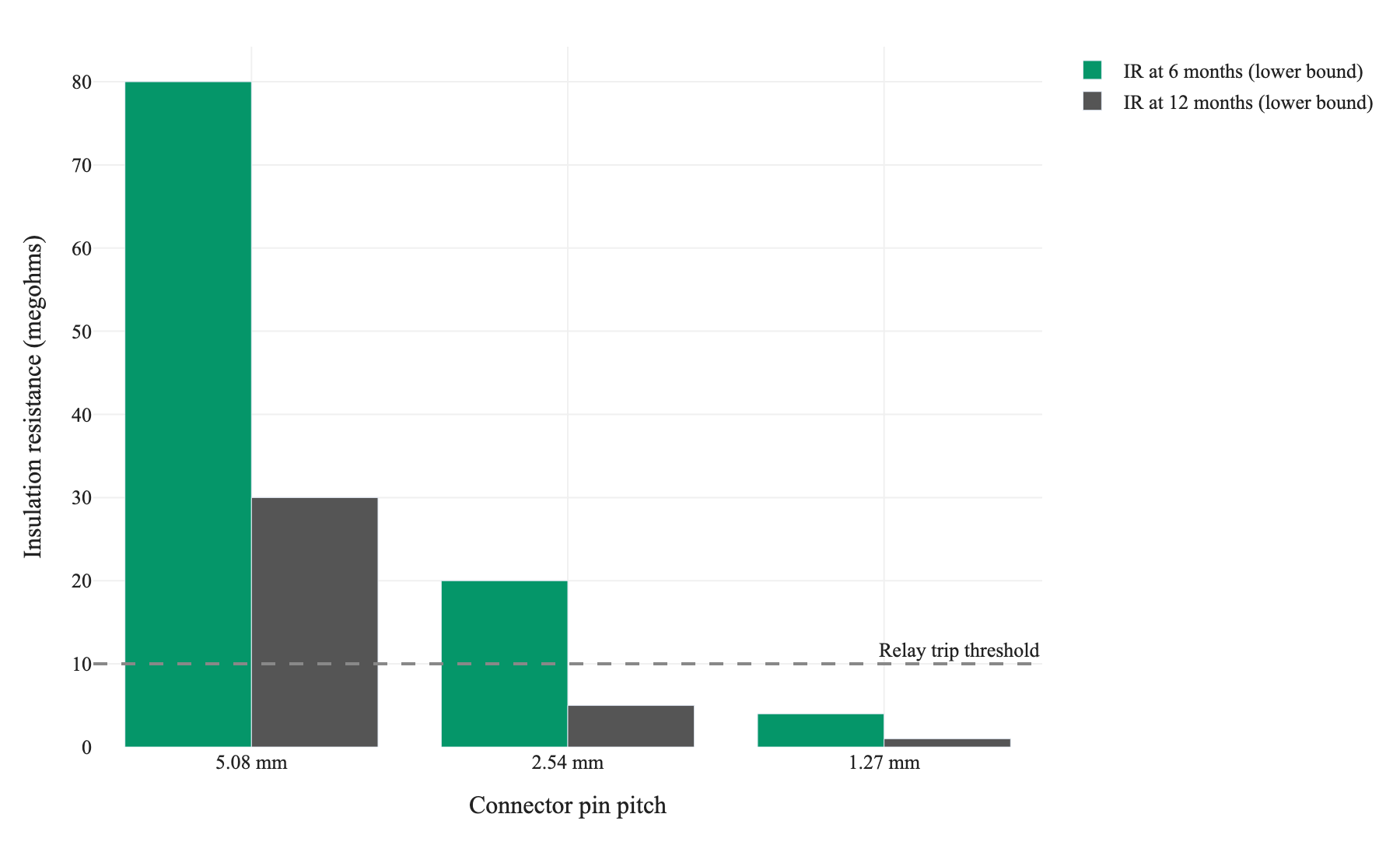
Connector pitch | Baseline IR (clean) | IR at 6 months vibration exposure | IR at 12 months | Relay trip threshold |
|---|---|---|---|---|
5.08 mm (power relay, coarse) | above 500 megohms | 80 to 150 megohms | 30 to 80 megohms | Below 10 megohms |
2.54 mm (standard signal) | above 500 megohms | 20 to 60 megohms | 5 to 20 megohms | Below 10 megohms |
1.27 mm (fine pitch, automotive ECU) | above 500 megohms | 4 to 18 megohms | 1 to 6 megohms | Below 10 megohms |
1.0 mm (ultra-fine, high-density PCB) | above 500 megohms | 1 to 8 megohms | Below 1 megohm | Below 10 megohms |
Values are representative ranges derived from field teardown data and published connector contamination studies (IEC 60512-3-1:2002 baseline; Newgate Simms 2023; Nye Lubricants 2024). The relay trip threshold of 10 megohms represents the point at which many low-voltage (5 to 24 V DC) relay coil circuits encounter leakage currents sufficient to trigger false activation in resistive-bridge sensing circuits or produce erroneous analog readings in connected programmable logic controllers (PLCs).
The table illustrates why contamination that would be tolerable on a 5.08 mm pitch power connector may be catastrophic on a 1.27 mm ECU connector under the same compound type and application volume. Compound specifications written for coarse-pitch heritage connectors become systematically inadequate when the same compound is applied to second-generation fine-pitch harnesses.
How Does Pin Density Amplify the Failure Rate?
Pin density compounds the pitch effect by increasing the probability of oil encountering a vulnerable gap. A 20-pin 2.54 mm pitch connector has 19 adjacent pairs at risk. A 40-pin 1.27 mm pitch connector on the same footprint has 39 adjacent pairs at risk plus a shorter gap between each pair. Contamination introduced at any one contact can reach two to four adjacent contacts within six months, meaning the proportion of degraded pairs scales faster than linearly with row and column density for the same initial compound volume.
Inspection data from industrial control cabinet teardowns indicates that connector assemblies with more than 20 pins on a face are significantly more likely to exhibit at least one inter-pin insulation resistance value below the relay trip threshold after 12 months of vibration service when a non-qualified compound is present.
IV. Cost: Relay Misfire, Connector Replacement, and Field Service
Relay misfire in an industrial control cabinet has three layers of cost that are almost never consolidated: the direct cost of the failed relay and connector, the process cost of the unplanned downtime, and the field service cost of travel and diagnosis time. These costs sit in separate budget lines in most facilities and are not attributed to the root cause.
What Is the Direct Cost of a Single Compound-Induced Relay Failure Event?
A standard 24 V DC control relay in an industrial distribution block costs USD 8 to 25 per unit. However, the relay is rarely replaced alone. When insulation resistance falls below the trip threshold, the first field response is to replace the relay and clean the connector socket, which costs 30 to 90 minutes of a technician's time at a burdened cost of USD 50 to 120 per hour. In installations where the root cause is not identified, the same failure recurs within 6 to 18 months, and the second service event typically involves connector replacement and harness rework, adding USD 150 to 800 per connector assembly depending on harness complexity.
Figure 2. Cost Accumulation per Relay Failure Event
Cost element | One-time event | Recurrence at 12 months (root cause unresolved) |
|---|---|---|
Relay unit replacement | USD 8 to 25 | USD 8 to 25 |
Technician labor (1 to 2 hours) | USD 50 to 240 | USD 50 to 240 |
Unplanned downtime (0.5 to 2 hours at USD 500/hr line rate) | USD 250 to 1,000 | USD 250 to 1,000 |
Connector harness rework (if IR not restored) | USD 0 | USD 150 to 800 |
Root cause investigation (if escalated) | USD 0 to 500 | USD 500 to 2,000 |
Total per event | USD 308 to 1,765 | USD 958 to 4,065 |
For a facility with 20 to 50 such connectors, and a misfire rate of 5 to 15 percent per year under compound migration conditions, the annual cost exposure ranges from USD 6,000 to over USD 60,000 before accounting for safety system trips or regulatory reporting if the relay governs a safety-rated function.
Automotive Connector Program Cost Dimension
In an automotive supplier program, insulation resistance failure detected during end-of-line testing or warranty return triggers a formal non-conformance report under IATF 16949 quality management system requirements (IATF, 2016). A single non-conformance that traces to a compound specification not matched to connector geometry can require a full PPAP (Production Part Approval Process) re-submission covering compound type, application volume, and post-assembly inspection criteria. PPAP re-submission costs range from USD 15,000 to 80,000 depending on program tier and OEM, before accounting for potential warranty liability if the non-conformance propagates to field units.
V. Selection by Pin Density, Vibration Profile, and Cure Type
Compound selection for a connector assembly requires matching four parameters simultaneously: base oil type, thickener system, cure class, and application volume limit. The following decision framework is operator-actionable, meaning a process engineer can apply it at the connector specification stage without additional laboratory work beyond the compound supplier's published data sheet.
Compound Selection Decision Framework
Step 1: Classify vibration severity. Measure or estimate the peak acceleration and dominant frequency at the connector mounting point.
Class A (Low): Peak acceleration below 2 g, dominant frequency 10 to 30 Hz. Typical installation: wall-mounted industrial control cabinet, low-vibration floor.
Class B (Medium): Peak acceleration 2 to 10 g, dominant frequency 20 to 100 Hz. Typical installation: machine-mounted cabinet, pump skid, conveyor drive enclosure.
Class C (High): Peak acceleration above 10 g, dominant frequency 50 to 500 Hz. Typical installation: automotive powertrain harness, engine bay, compressor body.
Step 2: Identify pin pitch and calculate adjacent pair count.
Coarse: pitch above 4 mm, adjacent pair count below 10.
Standard: pitch 2.0 to 4 mm, adjacent pair count 10 to 30.
Fine: pitch 1.0 to 2.0 mm, adjacent pair count above 20.
Step 3: Select compound class from the matrix below.
Figure 3. Compound Selection Matrix: Vibration Class, Pin Pitch, and Cure Type
Vibration class | Pin pitch category | Recommended base oil | Thickener requirement | Cure class | Max application volume |
|---|---|---|---|---|---|
A (Low) | Coarse (above 4 mm) | PAO or mineral | Lithium or polyurea | None (non-curing) | 5 to 10 mg per pin |
A (Low) | Standard (2 to 4 mm) | PAO | Polyurea, low-bleed | None (non-curing) | 2 to 5 mg per pin |
A (Low) | Fine (1 to 2 mm) | PFPE or low-bleed PAO | Polyurea, ASTM D6184 oil sep below 1% | UV-cure or anaerobic-cure preferred | 0.5 to 2 mg per pin |
B (Medium) | Coarse (above 4 mm) | PAO, low-bleed | Polyurea, ASTM D6184 below 2% | None to UV-cure | 3 to 8 mg per pin |
B (Medium) | Standard (2 to 4 mm) | PAO or PFPE | Polyurea, ASTM D6184 below 1% | UV-cure preferred | 1 to 3 mg per pin |
B (Medium) | Fine (1 to 2 mm) | PFPE | Polyurea or PTFE-thickened, ASTM D6184 below 0.5% | UV-cure or anaerobic-cure required | 0.3 to 1 mg per pin |
C (High) | Coarse (above 4 mm) | PAO, low-bleed formulation | Polyurea, ASTM D6184 below 1% | UV-cure preferred | 2 to 5 mg per pin |
C (High) | Standard (2 to 4 mm) | PFPE | Polyurea or PTFE-thickened | UV-cure required | 0.5 to 2 mg per pin |
C (High) | Fine (1 to 2 mm) | PFPE | PTFE-thickened, ASTM D6184 below 0.3% | UV-cure or conformal coating over compound | 0.2 to 0.8 mg per pin |
Note: Silicone base oil is excluded from all cells due to vapor-phase migration potential (Newgate Simms, 2023). PFPE = perfluoropolyether. PTFE = polytetrafluoroethylene.
Why Does Cure Class Matter?
Non-curing greases remain mobile throughout service life and rely solely on base oil bleed resistance and thickener hold-down. UV-cured and anaerobic-cured systems polymerize after application, converting the liquid or semi-solid compound into a fixed elastomeric matrix that has no free mobile phase available to migrate (Momentive Performance Materials, 2023). Cured systems are particularly important in Class B and C vibration environments at fine pitch, where the combination of mechanical energy and capillary geometry would otherwise drive non-curing greases into adjacent gaps within months. The trade-off is that cured systems require a controlled cure step (UV exposure time and intensity, or anaerobic exclusion of oxygen for 4 to 24 hours) and cannot be reworked without solvent cleaning.
Insulation Resistance Inspection Procedure
After compound application and before final assembly closure, and at first scheduled maintenance (typically 12 months for industrial, 24 months for automotive sealed), measure insulation resistance between all adjacent pin pairs using a 500 V DC insulation tester per IEC 60512-3-1:2002 Test 3a (IEC, 2002). The acceptance criterion for signal connectors is insulation resistance above 100 megohms between adjacent pins; for logic-level connectors driving relay coil circuits, the practical minimum is 50 megohms. Any value below 20 megohms on a connector not yet in service indicates compound migration during assembly or storage.
VI. Field Cases: Industrial Control Cabinets and Automotive Connector Programs
Company A: Phantom Relay Trips in a Vibrating Motor Drive Cabinet
Company A is a packaging equipment manufacturer that supplies automated shrink-wrap lines to food processing facilities. Each line includes a 24 V DC relay distribution module with 48 relays on a shared connector block, mounted on the drive cabinet panel 0.6 meters from a 15 kW induction motor running at 50 Hz. The cabinet accumulates an estimated 4 to 8 g of vibration amplitude at the connector mounting rail due to resonance amplification in the panel structure.
During a 2023 field audit following 11 unexplained relay trips in an 18-month window, the technician measured insulation resistance between all adjacent relay socket pins using a 500 V DC megohmmeter. Clean socket pairs measured 480 to above 500 megohms. The 11 affected socket pairs measured between 4.2 and 17.8 megohms. Visual inspection under 10x magnification revealed a thin translucent film bridging the insulating ribs between adjacent socket positions. The compound had been a mineral-base grease applied at assembly per the original specification for a previous 5.08 mm pitch connector family; the cabinet was then retrofitted with a 2.54 mm pitch module as part of a density upgrade. The original compound specification was carried forward without revision.
Three corrective actions were implemented. First, the team replaced the mineral-base grease with a PFPE polyurea formulation rated for ASTM D6184 oil separation below 0.8 percent, with application volume reduced from 8 mg to 3 mg per pin using a measured-volume dispensing tool. Second, the team installed vibration-isolation mounts on the cabinet panel to reduce connector exposure from 4 to 8 g down to 1 to 2 g. Third, the team added insulation resistance testing as an annual maintenance checkpoint using a 500 V DC tester per IEC 60512-3-1:2002. In the 18 months following the change, zero phantom relay trips were recorded on 14 production lines, and inter-pin insulation resistance at the 12-month inspection measured above 120 megohms on all surveyed socket pairs.
Company B: Automotive Harness PPAP Re-submission from Insulation Resistance Non-conformance
Company B is a tier-1 automotive electrical systems supplier in Korea providing instrument cluster harness assemblies for a passenger car platform. The connector assemblies used 1.27 mm pitch, 40-pin connectors with a non-curing PAO grease applied at the rate of 5 mg per pin to all male terminals. The grease specification had been validated on a previous 2.0 mm pitch connector family and was carried forward without re-qualification.
During first-off PPAP testing per IATF 16949 requirements after the harness was subjected to ISO 16750-3:2007 (vibration testing for road vehicles, 10 to 2,000 Hz frequency sweep, 10 hours per axis, three axes) followed by ISO 16750-4:2023 thermal cycling (minus 40 to plus 125 degrees Celsius, 300 cycles), measured inter-pin insulation resistance on 6 of 20 connector samples fell below 10 megohms, the OEM-specified minimum for this connector grade (ISO, 2007; ISO, 2023). The failure was traced to PAO base oil bleed from the non-curing compound driven by vibration test excitation, distributed by capillary action into the 0.4 mm inter-pin gaps of the 1.27 mm pitch housing.
The corrective action required a full PPAP re-submission covering three elements: a reformulated PFPE compound with UV cure, re-specified application volume of 0.8 mg per pin delivered by automated dispensing, and post-cure insulation resistance inspection at 500 V DC before panel closure. Re-qualification testing repeated the ISO 16750-3 vibration sweep and ISO 16750-4 thermal cycle sequence; all 20 samples measured above 200 megohms inter-pin after the full combined sequence. PPAP re-submission cost including engineering time, test fees, and OEM review was approximately USD 42,000.
VII. Key Takeaway
When insulation resistance drops between non-adjacent pins with no change in contact resistance at the intended mating interface, the failure mode is compound migration, not corrosion. Test insulation resistance at 500 V DC between all adjacent pin pairs before attributing the fault to other causes.
For connectors at pitch below 2.0 mm in any vibration environment above Class A (2 g), UV-cure or anaerobic-cure PFPE compounds are the correct specification. Non-curing greases regardless of NLGI grade will migrate under combined vibration and thermal cycling within 6 to 12 months.
Compound specifications validated on a previous connector generation at coarser pitch are not automatically transferable to fine-pitch replacements. A fresh selection review against the matrix in Section V is required when pin pitch decreases.
The ASTM D6184-17 oil separation test is the single most predictive screening metric for migration risk in dynamic environments. Require this value from compound suppliers and apply the thresholds in the selection matrix.
Add inter-pin insulation resistance measurement to annual connector maintenance programs using IEC 60512-3-1:2002 Test 3a. Trending from above 500 megohms to below 100 megohms within 12 months is an early warning that compound migration is active before the first relay trip occurs.
CTA
If you are seeing relay logic faults or intermittent insulation degradation in a connector assembly and the root cause is not confirmed, send your compound specification, connector geometry, and vibration data to AI Shooting, the Lubinpla per-case industrial chemistry analysis service. AI Shooting returns an evidence-based written analysis of your specific combination of compound chemistry, pitch, and vibration profile with selection guidance at the Standard tier (3-day turnaround) or Deep tier (5-day investigation including a review of your field measurement data) at https://www.lubinpla.com/ai-shooting.
VIII. References
ASTM International. (2017). ASTM D6184-17: Standard Test Method for Oil Separation from Lubricating Grease (Conical Sieve Method). https://www.astm.org/Standards/D6184.htm
ASTM International. (2020). ASTM D1742-20: Standard Test Method for Oil Separation from Lubricating Grease During Storage. https://store.astm.org/d1742-20.html
Connector Supplier. (2023). Connector contact lubricants: Selection and application. https://connectorsupplier.com/connector-contact-lubricants/
IEC (International Electrotechnical Commission). (2002). IEC 60512-3-1:2002: Connectors for electronic equipment — Tests and measurements — Part 3-1: Insulation tests — Test 3a: Insulation resistance. https://www.en-standard.eu/iec-60512-3-1-2002-connectors-for-electronic-equipment-tests-and-measurements-part-3-1-insulation-tests-test-3a-insulation-resistance/
IEC (International Electrotechnical Commission). (2002). IEC 60512-6-4:2002: Connectors for electronic equipment — Tests and measurements — Part 6-4: Dynamic stress tests — Test 6d: Vibration (sinusoidal). https://www.testinglab.com/en-60512-6-4-vibration-testing-for-electrical-connectors
IATF (International Automotive Task Force). (2016). IATF 16949:2016 — Quality management system requirements for automotive production and relevant service parts organizations. https://www.brifar.com/insights/automotive-connector-durability-testing-what-iatf-16949-really-requires/
ISO (International Organization for Standardization). (2007). ISO 16750-3:2007: Road vehicles — Environmental conditions and testing for electrical and electronic equipment — Part 3: Mechanical loads. https://www.komegtek.com/knowledgeblog/iso-16750-environmental-testing-standard-a-comprehensive-guide-for-automotive-electronics-reliability/
ISO (International Organization for Standardization). (2023). ISO 16750-4:2023: Road vehicles — Environmental conditions and testing for electrical and electronic equipment — Part 4: Climatic loads. https://blog.pacificcert.com/iso-16750-1-2023-environmental-conditions-and-testing-for-electrical-and-electronic-equipment-in-road-vehicles/
Momentive Performance Materials. (2023). Silicone materials for electronic devices and component assemblies. https://www.momentive.com/content/dam/momentive/global/docs/default-source/productdocuments/silcool-tia0220-neutral-alkoxy-cure-adhesive/silicone-materials-for-electronic-devices-and-component-assemblies.pdf
Newgate Simms Technical Support. (2023). How electrical connector lubricants work. https://support.newgatesimms.com/how-electrical-connector-lubricants-work/
Newgate Simms Technical Support. (2023). Silicone grease use on electrical connectors: Not recommended. https://support.newgatesimms.com/not-recommended-silicone-grease-use-on-electrical-connectors/
Newgate Simms Technical Support. (2023). Choosing an electrical connector grease: A product selection guide. https://support.newgatesimms.com/choosing-a-connector-lubricant/
Newgate Simms Technical Support. (2023). Fretting corrosion explanation for electrical connectors and connections. https://support.newgatesimms.com/fretting-corrosion-explanation-electrical-connectors-and-connections/
Nye Lubricants. (2024). Connector grease: Improving reliability and longevity. https://www.nyelubricants.com/connectors
Petrolube. (2024). ASTM D6184: Oil separation test for lubricating grease. https://www.petrolube.com/price-list-catalog/astm-d6184-4448/