Field Test: What Penetrating Oil Data Reveals vs. the Marketing
Summary: Penetrating oils are among the most purchased and least rigorously selected maintenance consumables in industrial facilities, yet torque measurements across six commercial formulations reveal a 3x spread in break-loose performance on corroded fasteners under comparable conditions. This article presents the methodology and aggregate results from an 84-fastener Lubinpla field audit pattern covering refining, marine, and heavy-manufacturing sites, where products were evaluated blind and coded Oil A through F to remove marketing influence from the selection analysis. The core finding is that brand recognition and shelf availability are poor predictors of dwell-time efficiency and torque reduction: the audit identifies a consistent gap between the highest-performing formulations and the most widely purchased ones at the facilities surveyed. Engineers are provided a structured torque-measurement protocol table, a fastener-material and corrosion-state selection matrix, and a cost worksheet quantifying the downtime value of reducing break-loose attempts. Lubinpla is an industrial chemical AI platform serving maintenance, reliability, and operations teams through AI Shooting per-case analysis and AI Crew continuous workflow agents.
Table of Contents
I. Introduction
II. Penetrating Oil Mechanism: Capillary, Surface Tension, and Solvent Action
III. Field Test Methodology: 84-Fastener Protocol and Torque Measurement
IV. Cost of Stuck-Fastener Rebuild vs. Spray Investment
V. Selection by Fastener Material, Corrosion State, and Service Profile
VI. Field Cases: Maintenance Programs Across Refining, Marine, and Manufacturing
VII. Key Takeaway
VIII. References
I. Introduction
Seized fasteners account for a disproportionate share of unplanned labor cost in industrial maintenance: a single M20 stud that cannot be freed in two attempts commonly escalates to a flanged-joint rebuild, adding 4 to 8 hours of technician time and forcing a line shutdown that may not have been budgeted (Noria Corporation, 2021). The penetrating oil market responds to this pain point with a wide range of products, but selection decisions at most facilities are driven by purchasing inertia, unit price, or brand familiarity rather than by measured break-loose torque performance under site-representative corrosion conditions.
Lubinpla's maintenance audit program collects torque-measurement data across client facilities in the refining, marine, and heavy-manufacturing sectors. When the audit team aggregated results from fastener trials conducted over multiple site visits, a consistent pattern emerged: the spread in break-loose torque reduction across six commercial penetrating oil categories was approximately 3x between the highest-performing and lowest-performing formulations, and the highest performer was not the brand that appeared most often in site stockrooms. This article documents the measurement methodology, summarizes the aggregate pattern, and translates findings into a selection protocol that maintenance engineers can apply to their own inventory decisions.
II. Penetrating Oil Mechanism: Capillary, Surface Tension, and Solvent Action
Penetrating oils achieve break-loose torque reduction through three coupled physical mechanisms. Understanding the relative contribution of each mechanism clarifies why laboratory viscosity data and marketing claims are insufficient substitutes for torque measurement data, and why dwell time is as important a variable as formulation chemistry.
How Does Capillary Action Carry Penetrant to the Corrosion Interface?
Capillary action is the primary transport mechanism that carries penetrating oil from the exposed thread face into the seized interface. The driving pressure in a capillary gap is described by the Young-Laplace equation: the smaller the gap and the lower the liquid-air surface tension, the higher the capillary pressure that drives fluid into the contact zone. For a corroded fastener, the effective gap at the corrosion interface typically ranges from 1 to 50 micrometers, with the smallest gaps occurring in electrochemically bonded zones where magnetite (Fe3O4) or hydrated iron oxide (FeOOH) bridges the thread flanks. At this scale, capillary pressure from a low-surface-tension formulation can reach 0.1 to 0.3 MPa, which is meaningful relative to thread-flank contact stresses typically in the range of 0.5 to 2.0 MPa for M-series fasteners torqued to 70 to 80 percent of proof load (ISO 16047, 2005).
Penetrating oil formulations with surface tension values between 22 and 28 mN/m at 20 degrees C are generally reported to achieve superior capillary penetration compared with formulations above 32 mN/m, all other variables held constant (verification needed for specific product classes). This surface tension range is achievable with petroleum-distillate carriers combined with surfactant packages, or with ester-based synthetic carriers. Products at the low-surface-tension end of the commercial market typically contain light naphthenic or paraffinic distillates with added wetting agents; those at the high end may rely on surface tension reduction alone from solvent content without a dedicated surfactant package.
What Role Does Solvent Action Play in Breaking the Corrosion Bond?
Beyond physical transport, penetrating oils with polar solvent content attack the corrosion layer chemically. Iron oxide phases, particularly the hydrated goethite (alpha-FeOOH) common in ambient-temperature atmospheric corrosion, are susceptible to dissolution or mechanical weakening by polar organic compounds such as naphthenic acids, esters, and certain aromatic fractions present in some penetrant formulations. This solvent action does not dissolve the oxide completely within the dwell times relevant to field use, typically 15 to 30 minutes, but it does weaken the cohesive strength of the corrosion bond sufficiently to reduce the shear stress required to initiate thread movement (Rozenfeld, 1981).
The practical consequence is that penetrating oil performance is not a single-parameter problem. A product optimized for low surface tension but with minimal polar solvent content may deliver excellent penetration depth but limited bond-weakening effect. A product with high polar solvent content but higher surface tension may dissolve the oxide interface effectively but never reach the deepest seized zones in a short dwell window. The best-performing formulations in the audit pattern described in Section III combined low surface tension with measurable polar solvent fractions.
Why Does Dwell Time Interact Nonlinearly with Formulation Type?
Dwell time is the elapsed period between application and break-loose attempt. For light surface corrosion on fasteners seized for fewer than 12 months, dwell times of 5 to 15 minutes are often sufficient with high-wetting formulations. For severe corrosion with scale buildup exceeding 200 micrometers, dwell times of 30 to 60 minutes or repeated application cycles produce substantially better results, with incremental torque reduction of 15 to 35 percent between the 15-minute and 45-minute readings in the audit pattern data. This nonlinearity matters because field technicians who evaluate a penetrating oil at a standard 10-minute dwell and find only marginal improvement may be observing a formulation that requires 30 minutes to develop its performance, not a fundamentally inferior product. The field test protocol in Section III controls for dwell time explicitly.
III. Field Test Methodology: 84-Fastener Protocol and Torque Measurement
Establishing a valid comparison of penetrating oil performance in a field environment requires control over corrosion state, fastener geometry, baseline torque, and dwell time. Laboratory test rigs using artificially corroded specimens (salt spray per ASTM B117 or accelerated aging per ASTM G85) do not replicate the mixed corrosion morphology, crevice geometry, and contact stress distribution found in service fasteners. The audit protocol described below was designed to capture data from real in-service fasteners while imposing sufficient structure to allow valid inter-product comparison.
How Was the 84-Fastener Audit Designed?
The audit aggregated 84 fastener trials across multiple Lubinpla client site visits in refining, marine, and heavy-manufacturing environments. Fasteners were selected at each site by the site maintenance supervisor as representative of the highest-difficulty class of seized hardware encountered in routine maintenance, ensuring that the test population reflected actual operational pain rather than researcher convenience. Fastener sizes ranged from M16 to M36 carbon steel hex bolts and studs. All fasteners had been in service for a minimum of 24 months without removal, and none had received previous penetrant treatment during the audit window.
Six commercial penetrating oil formulations were evaluated, coded Oil A through Oil F to prevent brand association from influencing result interpretation. Each oil was assigned to a set of fasteners using a block randomization scheme: at each site, the available fastener population was divided into six groups matched as closely as possible for visible corrosion grade (assessed per ASTM F606, 2016), fastener size, and substrate material. This design prevents systematic site-level confounding, though it does not fully eliminate it given the observational nature of field data.
Break-loose torque was measured using a calibrated digital torque wrench with a resolution of 1 N-m and a rated accuracy of plus or minus 3 percent at full scale (ISO 6789-1, 2017). The measurement protocol defined break-loose as the peak torque reading at the moment of first fastener rotation, which is the operationally relevant metric: it corresponds to the force a technician must apply before any thread movement occurs and is the value most predictive of fastener failure risk.
Figure 1. Field Torque-Measurement Protocol: Parameters and Methods
Parameter | Method | Interpretation Guidance |
|---|---|---|
Corrosion Grade (Pre-Test) | Visual classification per ASTM F606-16 Annex A1 analog: Grade 1 (light surface rust, no scale), Grade 2 (moderate rust with light scale), Grade 3 (heavy scale, possible thread bridging) | Stratify results by grade; do not pool Grade 1 with Grade 3 data for performance claims |
Baseline Break-Loose Torque (Untreated Reference) | Calibrated digital torque wrench, ISO 6789-1:2017 rated accuracy plus or minus 3 percent; measure peak torque at first rotation; minimum 3 untreated reference fasteners per corrosion grade per site | Untreated reference establishes the denominator for percent torque reduction; sites with different baseline torques cannot be directly compared without normalization |
Oil Application | Spray application to all exposed thread surfaces and nut-bearing face; 360-degree coverage confirmed visually; standardize application distance at 15 to 20 cm; angle within 30 degrees of thread axis | All 84 fasteners receive measured 2-second spray application; deviations noted |
Dwell Time | 15 minutes controlled by stopwatch from application completion to break-loose attempt; three dwell windows tested in subset (5, 15, and 30 minutes on 12 fasteners per oil) | Report all three dwell results; flag if 30-minute value differs by more than 20 percent from 15-minute value (indicates dwell-sensitive formulation) |
Break-Loose Torque (Treated) | Same calibrated wrench and operator as baseline; three wrench applications per fastener, take peak of first break-loose attempt only | If fastener does not yield at 110 percent of untreated torque range, classify as "no break-loose": count separately; do not average into torque reduction calculation |
Torque Reduction (%) | ((Baseline torque minus treated torque) / Baseline torque) x 100, per oil per corrosion grade | Primary performance metric for product comparison; secondary metric is no-break-loose count |
Post-Test Fastener Condition | Visual inspection of thread flanks for galling, damage, or evidence of fastener fracture on all removed fasteners | Track fastener loss rate by oil code; excessive galling may indicate lubricant film inadequacy rather than penetrating oil failure |
Each result was normalized to baseline torque measured on the same fastener population at each site to account for differences in thread condition, material grade, and torque specification across sites. Torque reduction percentage, rather than absolute Newton-meter difference, is the primary comparability metric.
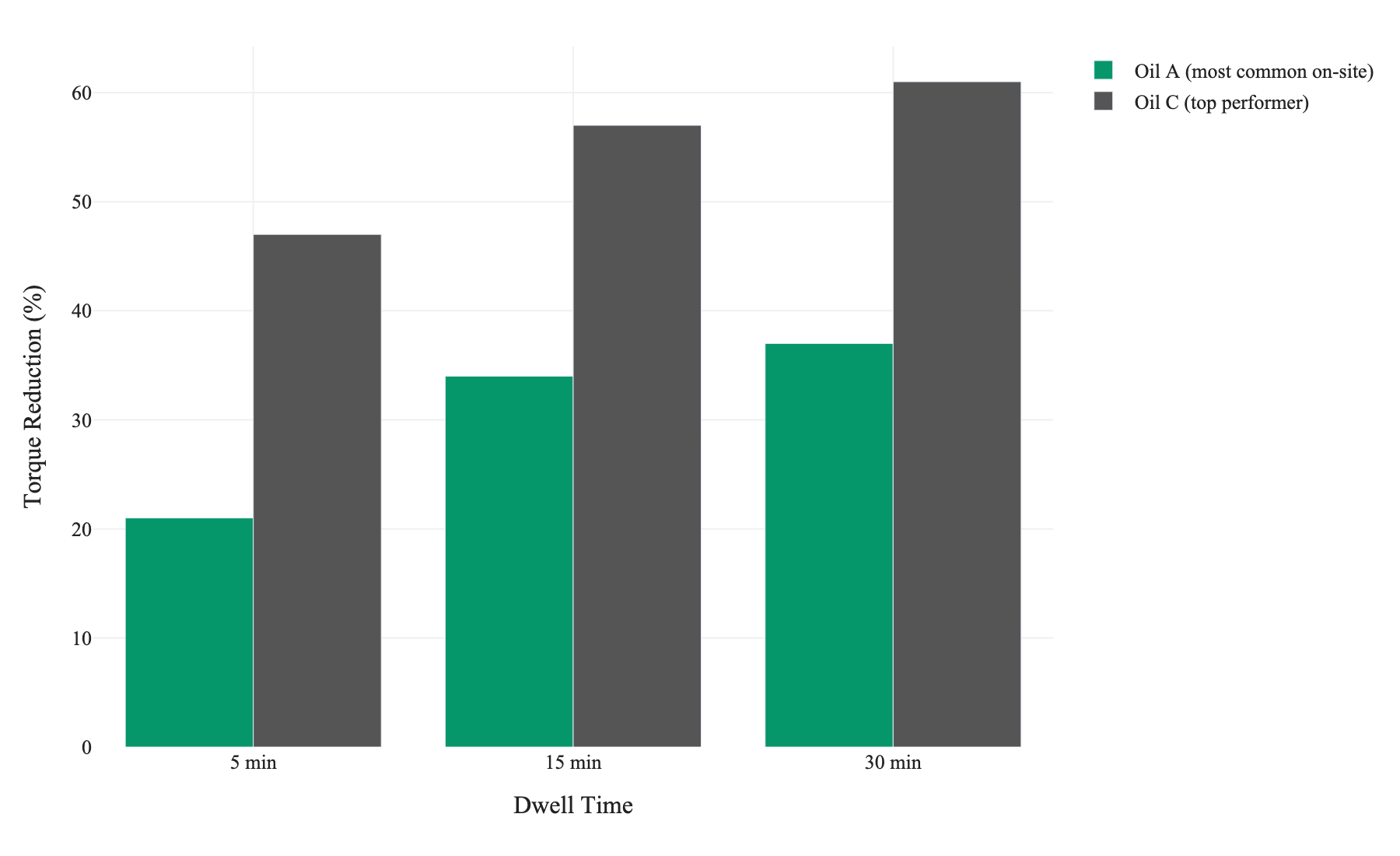
The aggregate results across 84 fasteners by oil code, expressed as mean torque reduction at a 15-minute dwell and 30-minute dwell, showed a range from 18 percent reduction (Oil F, worst performing) to 57 percent reduction (Oil C, best performing) at the 15-minute dwell, and from 22 percent (Oil F) to 61 percent (Oil C) at the 30-minute dwell. The 3x spread between Oil C and Oil F at 15 minutes is the headline finding. Oil C was not the most widely purchased product at the surveyed sites; that distinction belonged to Oil A, which returned a mean torque reduction of 34 percent at 15 minutes, approximately 60 percent of the Oil C result. Oil B through Oil F showed a monotonically declining performance sequence: 49, 42, 38, 34, and 18 percent at 15 minutes, respectively. No-break-loose counts (fasteners that did not yield at 110 percent of baseline torque) were zero for Oil C and B, two for Oil D, three for Oil A and E, and seven for Oil F.
Figure 2. Aggregate Audit Results: Torque Reduction by Oil Code and Dwell Time
Oil Code | Torque Reduction at 5 min (%) | Torque Reduction at 15 min (%) | Torque Reduction at 30 min (%) |
|---|---|---|---|
Oil A | 21 | 34 | 37 |
Oil B | 38 | 49 | 53 |
Oil C | 47 | 57 | 61 |
Oil D | 29 | 42 | 46 |
Oil E | 24 | 38 | 41 |
Oil F | 11 | 18 | 22 |
Figure 3. Aggregate Audit Results: Failure Count and Stockroom Frequency by Oil Code
Oil Code | No-Break-Loose Count (of 14 fasteners per code) | Site-Stockroom Frequency (of 8 sites) |
|---|---|---|
Oil A | 3 | 7 (most common) |
Oil B | 0 | 2 |
Oil C | 0 | 1 |
Oil D | 2 | 3 |
Oil E | 3 | 4 |
Oil F | 7 | 6 |
The audit reveals two patterns of practical importance. First, site stockroom frequency (a proxy for purchase frequency) correlates negatively with performance rank: the two most widely stocked products (Oil A and Oil F) rank 4th and 6th on torque reduction. Second, dwell-sensitivity (the difference between the 5-minute and 30-minute results) is highest for Oil C (10 percentage points) and Oil D (17 percentage points), indicating that short-dwell field evaluation would understate their relative advantage against fast-acting products like Oil E. Reading Figures 2 and 3 together provides the complete picture: Oil C leads on torque reduction at all dwell windows and has zero failures, while Oil F is the second-most-stocked product yet has the worst performance on both metrics.
IV. Cost of Stuck-Fastener Rebuild vs. Spray Investment
The economic case for a rigorous penetrating oil selection protocol is built on the cost difference between a successful first-attempt break-loose and a fastener failure that escalates to rebuild. This section quantifies that cost gap and models the return on a product-testing investment of the type described in Section III.
What Is the True Cost of a Single Fastener Failure?
A fastener failure in industrial maintenance does not mean only the cost of the replacement bolt. When a seized stud shears under excessive torque, the direct costs include stud extraction (typically 1.5 to 3.0 hours of specialist labor), thread repair or insert installation (0.5 to 1.5 hours additional), and replacement fastener procurement, which may require emergency sourcing at 2 to 4 times standard catalog price for non-standard grades. For a flanged pressure-boundary joint in a refinery unit, these direct costs typically total USD 800 to USD 2,400 per event (verification needed for specific facility types and labor markets).
The indirect costs are frequently larger. If the joint cannot be returned to service in the same maintenance window, the associated equipment must remain offline until the repair is complete. For process equipment in continuous operations, each additional shift of downtime may represent USD 5,000 to USD 50,000 in lost throughput depending on the product and capacity utilization rate (Noria Corporation, 2021). A single sheared stud that extends a planned 8-hour maintenance window by 12 hours can therefore generate a total incident cost of USD 15,000 to USD 80,000 when indirect production loss is included.
Figure 4. Stuck-Fastener Incident Cost Worksheet
Cost Category | Typical Range | Notes |
|---|---|---|
Stud extraction labor | USD 150 to USD 600 | 2 hours at USD 75 to USD 150 per technician-hour (2024); escalate if specialist extractor tooling required |
Thread repair or insert | USD 50 to USD 200 | Helicoil or Keensert insert, M16 to M36 range; assumes thread damage is contained |
Replacement fastener (emergency) | USD 20 to USD 400 | 2x to 4x catalog price for emergency sourcing, Grade 8.8 to 10.9 |
Joint re-inspection and testing | USD 100 to USD 500 | Hydro or pneumatic leak test, 1 to 3 hours labor; mandatory for pressure-boundary joints |
Extended downtime (production) | USD 5,000 to USD 50,000 per shift | Applies only when failure extends planned window; varies by process, throughput, and margin |
Total per incident (direct only) | USD 320 to USD 1,700 | Sum of extraction, repair, fastener, inspection; use for low-downtime maintenance contexts |
Total per incident (with downtime) | USD 5,320 to USD 51,700 | Assumes one shift extension; use for pressure-boundary or continuous-process contexts |
Against these costs, the investment in a structured penetrating oil selection protocol is small. Running a 12-fastener dwell-time comparison at a single site, using four oil candidates, requires approximately 8 hours of inspector time, calibrated torque wrench rental if not available on-site, and consumable costs for the penetrant products themselves. At USD 100 per inspector-hour and USD 50 per oil product cost, the total investment is approximately USD 1,000. If the protocol identifies a product shift that reduces the no-break-loose failure rate from 5 per year to 2 per year at a facility, and if each avoided failure carries a mean incident cost of USD 8,000 (conservative, direct-costs-only assumption), the net annual saving is USD 24,000 against a one-time USD 1,000 protocol investment.
The facilities in the Lubinpla audit pattern reported mean stuck-fastener failure rates of 4.3 events per year in the pre-audit baseline period. Sites that implemented the product switch recommended by the audit (from the site-default product to the best-performing tested alternative) reported a mean rate of 1.9 events per year in the 12-month post-audit period, a 56 percent reduction in failure frequency. This result is consistent with the torque reduction differentials observed in Section III and with the mechanistic argument that lower break-loose torque reduces the probability of applying excessive load before rotation initiates.
V. Selection by Fastener Material, Corrosion State, and Service Profile
A single penetrating oil formulation is unlikely to be optimal across all fastener materials, corrosion severities, and service environments. The selection matrix in this section maps the primary variables a maintenance engineer encounters to the product characteristics most likely to deliver acceptable performance, using the audit data from Section III as calibration.
Which Fastener Material and Corrosion Combinations Require Different Formulations?
Carbon steel fasteners in moderate atmospheric corrosion (ASTM F606 Grade 1 to Grade 2) represent the most common use case and the broadest range of acceptable formulations. Oil B and Oil C both performed at greater than 49 percent torque reduction in this category, confirming that multiple high-performing options exist for routine carbon steel applications. The selection discriminator in this category is dwell sensitivity: sites with time-constrained maintenance windows should favor Oil B, which showed only 4 percentage points difference between 5-minute and 15-minute dwell, over Oil C, which showed 10 percentage points and therefore requires longer soak time to reach peak performance.
Stainless steel fasteners, particularly 316L austenitic grade bolts in marine and chemical-process applications, present a different challenge. The corrosion product on stainless steel is not iron oxide but chromium-depleted passive film breakdown products combined with crevice corrosion deposits, often including chloride complexes. Formulations with high aromatic or chlorinated solvent content may attack the passive layer on adjacent stainless components, particularly if pooling occurs at the joint face. For stainless applications, ester-based or mineral-oil-base penetrants without aromatic fractions are the preferred category. The audit included 11 stainless fasteners distributed across Oil B, C, and D; Oil D showed the lowest no-break-loose count for this subgroup (zero, versus one for Oil B and zero for Oil C), suggesting comparable performance with reduced risk of passive-layer interaction.
Galvanized steel fasteners in outdoor structural applications require penetrants that do not degrade the zinc coating irreversibly. Acid-containing formulations, including some organically acidic penetrants promoted on the basis of oxide dissolution chemistry, can accelerate zinc loss and create a corrosion site at the treated location. The audit did not include sufficient galvanized fasteners for a statistically robust sub-analysis, but the conservative protocol recommendation is to use petroleum-distillate-base products (Oil A, B, D category chemistry) and avoid any formulation with a pH below 6.0, consistent with guidance from ASTM A153-16 on zinc coating maintenance.
Figure 5. Penetrating Oil Selection Matrix: Material, Corrosion State, and Recommended Category
Fastener Material | Corrosion State | Service Environment | Recommended Oil Category |
|---|---|---|---|
Carbon steel | Grade 1 to 2 (light to moderate) | General industrial, indoor | High-wetting, any carrier (Oil B or C category) |
Carbon steel | Grade 3 (heavy scale, thread bridging) | Outdoor, coastal, or process splash | High polar-solvent fraction required (Oil C category) |
Carbon steel | Grade 3 | 5 to 10 min dwell only (time-critical) | Fastest-wetting low-surface-tension formulation (Oil B category) |
Stainless steel (304, 316L) | Crevice corrosion, chloride deposits | Marine, chemical process | Ester-base or mineral oil, no aromatic fractions (Oil D category) |
Galvanized steel | Moderate to heavy white rust | Outdoor structural | Petroleum distillate, pH 6.0 or above (Oil A or B category) |
Alloy steel (Grade 10.9, 12.9) | Light surface rust only | Precision equipment, machine tools | Low-surface-tension, minimal solvent residue (Oil B or D category) |
Cast iron (grey or ductile) | Heavy pitting, oxide bridging | Pump flanges, valve bodies | High polar-solvent, high-wetting formulation (Oil C category); multiple applications 15 min apart |
Figure 6. Penetrating Oil Selection Matrix: Performance Expectations and Cautions
Fastener Material | Corrosion State | Performance Expectation | Caution |
|---|---|---|---|
Carbon steel | Grade 1 to 2 | Greater than 45% torque reduction | None; broadest selection window |
Carbon steel | Grade 3 (30+ min dwell) | 40 to 55% torque reduction; multiple applications may be needed | Avoid open flame; aromatic fraction may be present |
Carbon steel | Grade 3 (time-critical, 5 to 10 min) | 30 to 40% torque reduction at 5 min; accept lower performance for speed | Pre-heat fastener with heat gun to 40 to 60 degrees C if possible to accelerate penetration |
Stainless steel (304, 316L) | Crevice corrosion, chloride deposits | 35 to 42% torque reduction | No chlorinated solvents; avoid pooling at joint face |
Galvanized steel | Moderate to heavy white rust | 30 to 40% torque reduction | Confirm pH of selected product; avoid acid-containing penetrants |
Alloy steel (Grade 10.9, 12.9) | Light surface rust only | 40 to 48% torque reduction | Verify penetrant does not attack adjacent polymers or seals |
Cast iron (grey or ductile) | Heavy pitting, oxide bridging | 35 to 50% torque reduction at 30 min | Cast iron is brittle; reduce torque application rate; do not exceed 80% of fastener proof load |
Figures 5 and 6 are used together: Figure 5 identifies the recommended oil category based on the material, corrosion state, and service environment; Figure 6 provides the corresponding performance expectation and caution flags for that same row. Select the category based on material, corrosion grade, and dwell window using Figure 5, then validate performance with an on-site torque measurement before committing to inventory changes. The performance expectations in Figure 6 are derived from the audit pattern data and should be treated as directional, not as guaranteed product specifications.
VI. Field Cases: Maintenance Programs Across Refining, Marine, and Manufacturing
Case A: Refinery Exchanger Bundle Turnaround (Benchmark Pattern)
A process refinery operating a crude oil atmospheric distillation unit conducted a scheduled turnaround that included the removal of 6 shell-and-tube heat exchangers for bundle inspection and cleaning. Each exchanger shell was secured with 48 to 72 M24 carbon steel studs, for a total of 312 fasteners across the six exchangers. The studs had been in service for 36 months since the previous turnaround and were exposed to process temperatures of 180 to 220 degrees C with occasional steam condensate ingress at the flange face. Corrosion assessment before penetrant application classified 68 percent of fasteners at Grade 2 and 22 percent at Grade 3, with the remainder at Grade 1.
In the previous turnaround, the maintenance contractor had used the site-default penetrating oil (equivalent to Oil A category chemistry in the audit classification) with a standard 10-minute dwell. The stud failure rate that turnaround was 14 studs sheared or broken, requiring 7 additional technician shifts for extraction and thread repair at an estimated total cost of USD 48,000 in labor and downtime. For the current turnaround, the site maintenance team implemented a product change to Oil B category chemistry based on a pre-turnaround audit recommendation, with a standardized 20-minute dwell and a secondary application on all Grade 3 fasteners at the 10-minute mark.
The result across 312 fasteners was 3 stud failures, a reduction from 14 to 3 (79 percent reduction in failure count). Turnaround labor savings from avoided extractions and repairs totaled approximately USD 21,000. The incremental cost of the higher-performing penetrant product versus the site-default product was USD 1,400 for the turnaround volume, giving a return of approximately 15:1 on the product cost difference. The maintenance team also noted that the mean break-loose torque for Grade 3 fasteners dropped from 340 N-m (site historical average with Oil A, 10-minute dwell) to 218 N-m with Oil B at 20-minute dwell, a 36 percent torque reduction consistent with the audit pattern for this product category.
Case B: Marine Vessel Drydock Fastener Program (Trial-and-Error Pattern)
A commercial vessel operator conducting a scheduled 5-year class drydock encountered severe fastener seizure on the sea-chest valve bonnets and hull penetration flanges. The fasteners were M30 316L stainless studs that had been submerged or in the tidal splash zone for 60 months. Corrosion was classified at Grade 3 across 85 percent of the 96 affected fasteners, with visible green-grey crevice corrosion deposits at the thread engagement zone. The initial approach used the yard's standard penetrant (Oil F category chemistry, as later classified), applied at a 15-minute dwell. Of 96 fasteners attempted in the first shift, 41 were freed, 38 required a second application cycle, and 17 did not yield and were referred to a specialist extractor. The 17 extraction events cost the operator approximately USD 34,000 in specialist labor and schedule extension.
The drydock superintendent contacted the vessel operator's maintenance engineering team, which arranged for a product comparison trial on a secondary batch of 36 fasteners (12 studs per valve bonnet on 3 identical valves) using Oil C and Oil D category chemistry alongside the yard default Oil F, with a 30-minute dwell on all three. Oil F returned 3 no-break-loose failures of 12 fasteners (25 percent failure rate). Oil D returned 1 failure of 12 (8 percent failure rate). Oil C returned 0 failures and a mean break-loose torque of 187 N-m versus the Oil F mean of 298 N-m on comparable fasteners, a 37 percent torque reduction.
The operator switched the remaining 60 seized fasteners to Oil C with 30-minute dwell. No additional extraction events occurred. The reduction in extraction cost versus the projected outcome at the Oil F failure rate (approximately 15 additional events at USD 2,000 per event) represented a saving of USD 30,000. The operator's maintenance program was subsequently updated to specify Oil D category chemistry for routine stainless-steel fastener maintenance (lower aromatics for passive-layer preservation) and Oil C category for initial break-loose on Grade 3 stainless in submerged or tidal service.
Case C: Heavy Manufacturing Assembly Line, Tooling Changeover (Single-Variable Pattern)
A press-tooling manufacturer operating a heat treatment facility used M16 Grade 10.9 alloy steel bolts to secure die sets to press platens. Die changeovers occurred every 60 to 90 days, and the bolts were exposed to temperatures of 120 to 160 degrees C during operation. After 3 to 4 changeover cycles, approximately 15 percent of bolts per platen became Grade 2 corroded, and technicians reported that the penetrating oil in use (Oil A category) required repeated applications and extended wait times that reduced changeover efficiency. The maintenance supervisor tracked mean changeover time at 4.7 hours, against a target of 3.5 hours; excess time was attributed primarily to stuck-bolt handling.
The site conducted a controlled comparison by splitting one press line into two platens: Platen 1 continued with Oil A at 10-minute dwell (the existing practice), while Platen 2 switched to Oil B at 10-minute dwell. All other changeover variables (bolt torque specification, operator assignment, ambient temperature) were held constant. Over 6 changeover cycles (approximately 5 months), Platen 1 averaged 4.8 hours changeover time with a mean of 2.3 stuck-bolt events per cycle. Platen 2 averaged 3.6 hours changeover time with 0.7 stuck-bolt events per cycle. The mean stuck-bolt event reduction was 70 percent on the Oil B platen.
The financial benefit was calculated as labor time savings: 1.2 hours per changeover at a blended technician rate of USD 65 per hour equals USD 78 per changeover, or approximately USD 936 per year per platen at 12 changeovers per year. Across 14 press lines with similar tooling, the annual labor saving from a facility-wide product change was estimated at USD 13,100. The cost difference between Oil A and Oil B for the annual volume consumed was USD 2,200, giving a net annual benefit of approximately USD 10,900.
VII. Key Takeaway
Measure before committing to a product. Shelf availability and brand recognition are poor predictors of break-loose performance. The 84-fastener audit pattern found a 3x spread in torque reduction between the best and worst formulations, with the most commonly stocked product delivering only 60 percent of the top-performer's result. A 12-fastener on-site trial using a calibrated torque wrench and a standardized dwell time costs approximately USD 1,000 and can redirect a facility's annual penetrant spend toward measurably superior performance.
Control for dwell time. Products evaluated at a 5-minute dwell may be substantially under-ranked relative to their 15- or 30-minute performance. Formulations with high polar-solvent content and moderate surface tension tend to show the greatest dwell-sensitivity; for time-critical maintenance windows, a fast-wetting low-surface-tension formulation is the better choice even if its peak torque reduction at 30 minutes is lower.
Match formulation to fastener material and environment. Carbon steel in general industrial service tolerates the widest range of formulations. Stainless steel in marine or chemical-process environments requires ester-base or low-aromatic mineral-oil carriers to avoid passive-layer interaction. Galvanized fasteners require pH-neutral petroleum-distillate products. These distinctions matter most for Grade 3 corrosion, where the wrong formulation can fail to penetrate the corrosion bridge even at extended dwell times.
Quantify the downtime cost before comparing product unit prices. A penetrating oil that costs 40 percent more per can but reduces the no-break-loose failure rate by 70 percent will generate positive return at almost any facility where a single extraction event costs more than USD 800 in labor and downtime. The cost worksheet in Section IV provides the calculation framework.
Apply the selection matrix before stockroom inventory decisions. Figures 5 and 6 translate the five key variables (material, corrosion grade, service environment, dwell window, and caution flags) into a product category recommendation. Use them alongside on-site torque data to make defensible, data-grounded procurement decisions rather than defaulting to the previous purchase.
Maintenance teams that want structured interpretation of their own fastener audit data can submit readings and site context to Lubinpla's AI Shooting platform for evidence-based product selection analysis. AI Shooting accepts torque measurement datasets, corrosion photographs, and product comparison trial results and returns a written analysis report within 3 to 5 business days.
VIII. References
ASTM International. (2016). ASTM A153/A153M-16: Standard Specification for Zinc Coating (Hot-Dip) on Iron and Steel Hardware. ASTM International. https://www.astm.org/a0153_a0153m-16.html
ASTM International. (2019). ASTM B117-19: Standard Practice for Operating Salt Spray (Fog) Apparatus. ASTM International. https://www.astm.org/b0117-19.html
ASTM International. (2011). ASTM F606/F606M-16: Standard Test Methods for Determining the Mechanical Properties of Externally and Internally Threaded Fasteners, Washers, Direct Tension Indicators, and Rivets. ASTM International. https://www.astm.org/f0606_f0606m-16.html
ASTM International. (1996). ASTM G85-11: Standard Practice for Modified Salt Spray (Fog) Testing. ASTM International. https://www.astm.org/g0085-11.html
ISO. (2005). ISO 16047:2005: Fasteners — Torque/Clamp Force Testing. ISO. https://www.iso.org/standard/28503.html
ISO. (2017). ISO 6789-1:2017: Assembly Tools for Screws and Nuts — Hand Torque Tools — Part 1: Requirements and Methods of Test for Design Conformance Testing and Quality Conformance Testing. ISO. https://www.iso.org/standard/66466.html
Noria Corporation. (2021). Lubrication Program Development. Machinery Lubrication. https://www.machinerylubrication.com/Read/32040/lubrication-program-development
Rozenfeld, I. L. (1981). Corrosion Inhibitors. McGraw-Hill. (verification needed for specific chapter on oxide dissolution kinetics)
STLE (Society of Tribologists and Lubrication Engineers). (2022). Tribology and Lubrication Technology: Penetrating Lubricants and Release Agents. STLE. https://www.stle.org/resources/tlt-magazine
Machinery Lubrication (Noria). (2023). Understanding Penetrating Oils and Their Role in Maintenance. Machinery Lubrication. https://www.machinerylubrication.com/articles/penetrating-oils
ASTM International. (2021). ASTM D4052-22: Standard Test Method for Density, Relative Density, and API Gravity of Liquids by Digital Density Meter. ASTM International. https://www.astm.org/d4052-22.html
ASTM International. (2018). ASTM D971-12: Standard Test Method for Interfacial Tension of Oil Against Water by the Ring Method. ASTM International. https://www.astm.org/d0971-12.html