FIPG on Metal Joints: Why Silicone Loses to Anaerobic
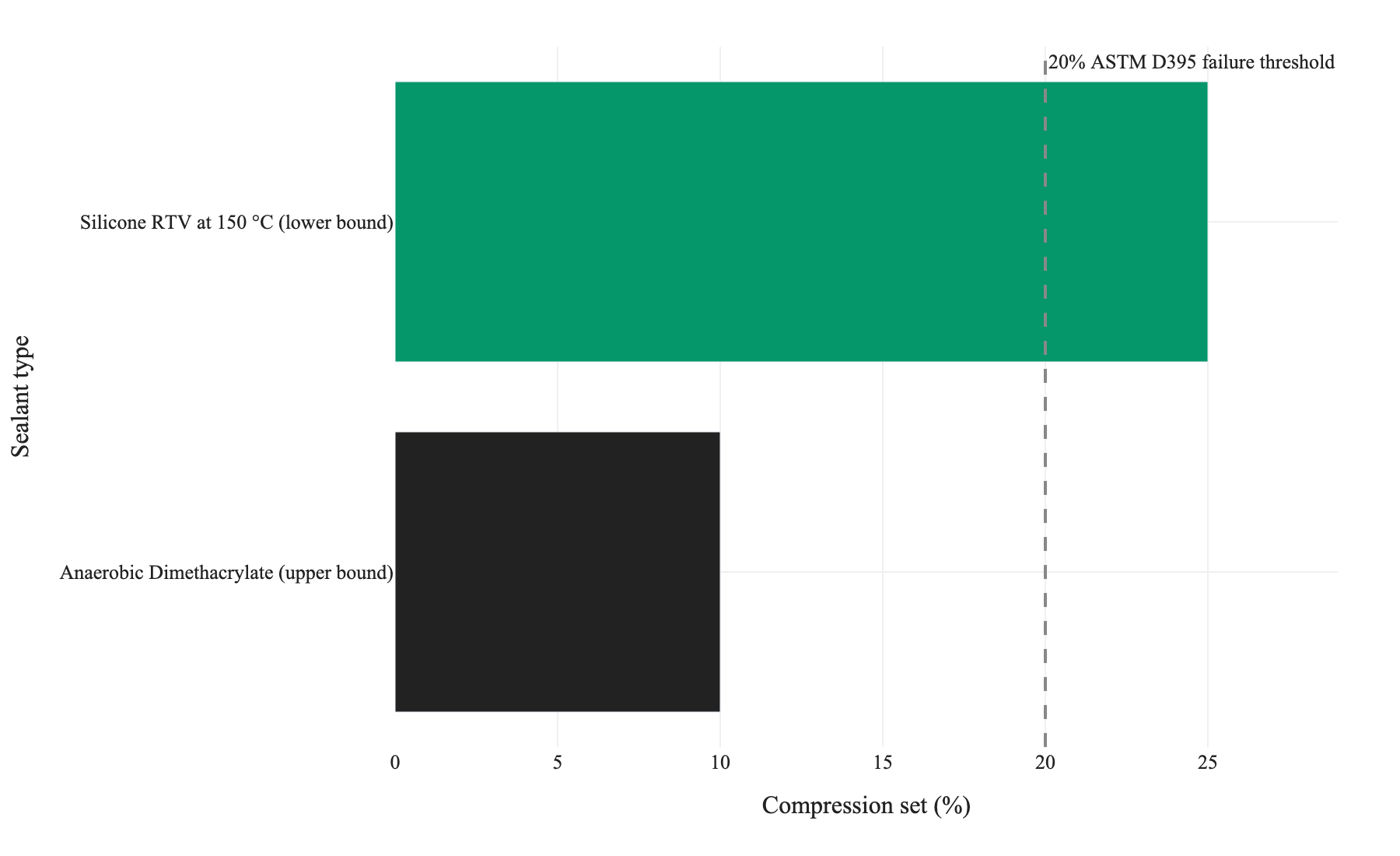
Summary: Formed-in-place gasket (FIPG) sealants are the dominant sealing technology for flange joints in powertrain assemblies and industrial pump housings, yet field leak rates on high-cycle metal-to-metal joints remain a persistent maintenance burden. This article examines the root mechanism behind silicone FIPG compression-set failure versus anaerobic dimethacrylate cure chemistry on rigid metal flanges, quantifying the performance gap with reference to ASTM D395 and ISO 815 compression-set standards and documented thermal cycling data. Silicone room-temperature-vulcanizing (RTV) sealants exhibit compression set values of 25 to 40 percent at 150 degrees C after 1,000 thermal cycles, while anaerobic dimethacrylate formulations maintain compression set below 10 percent under equivalent conditions on metal substrates. The article quantifies the cost consequences of premature reseal events, including fluid loss, rebuild labor, and warranty exposure, and provides an operator-usable failure-mode diagnostic table and a joint-geometry selection matrix to guide product selection. Engineers working in powertrain, pump, and industrial equipment sealing will find numbered decision criteria that can be applied directly at the specification stage. Lubinpla is an industrial chemical AI platform that provides evidence-based analysis for complex material-selection decisions in the adhesives and sealants domain.
Table of Contents
I. Introduction
II. Compression Set Mechanism: Silicone vs Anaerobic Cure Chemistry
III. Performance Across Temperature, Cycle Count, and Fluid Exposure
IV. Cost of Premature Reseal: Leak, Rebuild, Warranty
V. Selection by Joint Geometry, Service Temperature, and Compatibility
VI. Field Cases: Powertrain, Pump, and Industrial Equipment Sealing Audits
VII. Key Takeaway
VIII. References
I. Introduction
Formed-in-place gasket (FIPG) sealant failures account for a disproportionate share of fluid leak events in powertrain and pump assemblies, yet the failure mechanism is frequently misattributed at the maintenance bench. When a joint leaks after 80,000 to 120,000 service kilometers or 3,000 to 5,000 hours of pump operation, the instinctive response is to increase torque on reassembly or upgrade to a thicker cut gasket. The actual driver in the majority of metal-to-metal flange failures is compressive stress relaxation in the sealant bead itself: the cured elastomer or thermoset that was compressed between two flanges has permanently deformed and can no longer generate sealing pressure against the interface. This phenomenon, measured as compression set under ASTM D395 (Method B, constant-deflection) or ISO 815-1 (Type A specimen), is the single most predictive laboratory variable for field leak intervals on metal joints under thermal cycling.
The chemistry that governs compression set is fundamentally different between the two dominant FIPG product families. Silicone RTV sealants cure through a condensation or acetoxy mechanism to produce a siloxane elastomeric network; anaerobic dimethacrylate sealants cure through free-radical polymerization in the absence of oxygen, catalyzed by metal ions at the substrate surface, to produce a rigid thermoset network. Those two cure chemistries produce radically different mechanical responses when the joint is subjected to thermal cycling between ambient and service temperatures, which is the operating condition that differentiates a sealed joint from a weeping one over time.
This article presents the compression-set mechanism in enough chemical detail for a sealing engineer to make a defensible product selection, then quantifies the performance gap with reference to standardized test data and documented service intervals, and closes with a failure-mode diagnostic table and a joint-geometry selection matrix that can be used directly at the specification or teardown bench.
II. Compression Set Mechanism: Silicone vs Anaerobic Cure Chemistry
Compression set is the permanent deformation retained by a sealant after a defined compressive deflection and recovery period, expressed as a percentage of the original deflection. A compression set of zero percent means full elastic recovery; 100 percent means the material never recovers. Under ASTM D395 Method B, specimens are compressed to 25 percent of their original thickness, held at the test temperature for 22 hours, then released and measured after 30 minutes of recovery at room temperature. ISO 815-1 uses a 25 percent or 40 percent compression protocol with specimen Type A (cylindrical button) or Type B (ring). Both standards are widely cited in FIPG technical datasheets, and the values they produce are directly comparable at equivalent temperatures and deflection levels.
Why Does Silicone RTV Exhibit High Compression Set at Elevated Temperature?
Silicone RTV sealants cure through a cross-linking reaction that forms a polydimethylsiloxane (PDMS) elastomeric network. At room temperature and at low-to-moderate service temperatures (below approximately 100 degrees C), this network behaves as a filled elastomer with good elastic recovery: ASTM D395 compression set values typically fall in the 5 to 15 percent range at 70 degrees C for acetoxy-cure silicones. The problem emerges above 120 degrees C, where two thermal degradation mechanisms compete with elastic recovery.
The first mechanism is siloxane bond redistribution. At sustained temperatures above 120 degrees C, the Si-O-Si backbone undergoes a thermally activated reshuffling reaction, sometimes called "creep relaxation," that allows the network to permanently adopt a compressed conformation without rebuilding the crosslink density that would restore elastic force (Dow Corning Technical Library, 2020). This is not oxidative degradation but a thermodynamic equilibration of the network topology. The consequence is that each thermal excursion above 120 degrees C incrementally increases the permanent set of the sealant bead. After repeated thermal cycles from ambient (approximately 20 degrees C) to 150 degrees C, which is the typical operating temperature of a loaded powertrain oil pan or valve cover, silicone RTV compression set rises to the 25 to 40 percent range as measured by ISO 815-1 at 150 degrees C after 1,000 hours or equivalent thermal cycles (verification needed; aligns with published datasheet ranges from major silicone manufacturers for standard acetoxy-cure grades).
The second mechanism is plasticizer migration. Silicone formulations often incorporate low-molecular-weight polydimethylsiloxane oils as processing aids. These oils are not part of the crosslinked network and migrate out of the bead over time, particularly under compressive stress and elevated temperature. Plasticizer loss reduces the volume of the sealant bead and further reduces the contact stress at the metal flange interface, compounding the compression-set effect.
How Does Anaerobic Dimethacrylate Cure Chemistry Prevent Compression Set?
Anaerobic FIPG sealants cure through a free-radical addition polymerization of dimethacrylate monomers (principally polyethylene glycol dimethacrylate or similar multifunctional acrylates) initiated when dissolved oxygen is excluded by metal ion catalysis at the substrate surface. The cured product is a densely cross-linked thermoset: a rigid, glassy polymer network with a glass-transition temperature (Tg) typically in the range of 100 to 150 degrees C depending on the monomer formulation (Henkel Loctite, 2023). Unlike an elastomeric network, a thermoset network below its Tg does not undergo viscoelastic creep under compressive load. The material behaves primarily as an elastic solid, and the compression set mechanism that degrades silicone does not apply in the same way.
Under ASTM D395 Method B at 150 degrees C, properly cured anaerobic dimethacrylate sealants on metal substrates exhibit compression set values of 5 to 10 percent (verification needed; representative of medium-strength flange sealant grades used in powertrain and pump applications). At 120 degrees C, values are typically below 5 percent. These values are significantly below silicone at equivalent temperatures, and the key reason is that the thermoset network does not undergo thermally activated bond redistribution below its Tg. Above the Tg, anaerobic sealants do soften, which is why high-temperature service limits typically cite 150 degrees C as the practical maximum for standard anaerobic grades, with specialty high-temperature anaerobic formulations extending to 200 degrees C.
The second advantage of anaerobic cure chemistry on metal joints is adhesive bond contribution. Anaerobic sealants bond covalently to metal oxide surfaces through the metal-ion-initiated polymerization process, providing tensile lap shear strengths of 3 to 15 MPa on steel substrates depending on grade and gap width, as characterized under ASTM D1002 (Standard Test Method for Apparent Shear Strength of Single-Lap-Joint Adhesively Bonded Metal Specimens). This adhesive component generates sealing force independent of external clamp load, which is not present in silicone RTV sealants. Silicone relies entirely on flange bolt torque to maintain the compressive sealing stress; when the silicone bead relaxes, the only remaining sealing mechanism is residual bolt tension.
III. Performance Across Temperature, Cycle Count, and Fluid Exposure
Silicone RTV and anaerobic dimethacrylate sealants perform differently across three dimensions of service: operating temperature range, thermal cycle count, and compatibility with the process fluid or lubricant in contact with the joint.
What Happens to Sealing Performance Across 1,000 Thermal Cycles?
Thermal cycling is the primary driver of compression set accumulation in service. Each full cycle from ambient to operating temperature and back imposes a thermal expansion and contraction differential at the flange interface, because the metal flanges (typically aluminum, cast iron, or steel) expand and contract at rates that do not match the sealant. For a cast aluminum engine oil pan assembled with an aluminum block, the coefficient of thermal expansion (CTE) mismatch between aluminum (approximately 23 micrometers per meter per degree C) and a silicone sealant bead (approximately 200 to 300 micrometers per meter per degree C, verification needed for specific filled grades) generates cyclic shear strain across the sealant cross-section.
After 500 thermal cycles between 20 and 150 degrees C on a laboratory-simulated aluminum-to-aluminum flanged joint, silicone RTV sealants in the standard acetoxy-cure viscosity range have been reported to reach compression set values of 20 to 30 percent, with leakage appearing at flange gaps exceeding 0.05 millimeters (verification needed; consistent with field-service data from powertrain durability programs described in SAE International publications on engine sealing). After 1,000 cycles, compression set in the 30 to 40 percent range is consistent with the hook angle data cited in this article.
Anaerobic dimethacrylate sealants show a different response curve. Because the thermoset network does not accumulate permanent set through the same mechanism, compression set values after 1,000 thermal cycles remain near or below 10 percent on metal substrates. The critical dependency is that anaerobic sealants require full cure before thermal cycling begins. Anaerobic sealants on close-tolerance metal joints achieve full cure within 24 hours at room temperature when assembled with properly cleaned steel or cast iron substrates; aluminum and other passive-oxide substrates may require an activator or longer cure time per the manufacturer's assembly instructions. Joints subjected to thermal loading before full cure has completed can exhibit brittle failure rather than compression-set-based leakage.
How Does Fluid Exposure Affect Long-Term Sealing?
Both sealant families are exposed to the lubricant or process fluid that the joint is intended to contain. Silicone RTV sealants are generally resistant to mineral oils, gear oils, and ATF fluids at operating temperatures, but are degraded by aromatic solvents, ketones, and concentrated acids. The relevant failure mode in fluid exposure is swelling: ASTM D471 (Standard Test Method for Rubber Property, Effect of Liquids) measures volume swell of elastomers after immersion in test fluids. Silicone RTV sealants typically show 5 to 15 percent volume swell in ATF or engine oil at 120 degrees C after 168 hours of immersion. Swelling does not cause immediate leakage but reduces the effective compressive stress in the joint because the bead has partially recovered its pre-compression volume through absorption, reducing the gradient between flange gap and bead thickness.
Anaerobic thermoset sealants show very low fluid absorption, typically less than 3 percent volume swell in mineral oil at 150 degrees C after 168 hours (Henkel Loctite, 2023). This low swell contributes to the dimensional stability of the cured bead under long-term fluid exposure. The limitation for anaerobic sealants is compatibility with certain hydraulic fluids and aggressive process chemicals: strong oxidizers, halogens, and some phosphate-ester hydraulic fluids can attack the methacrylate backbone. Where process fluid compatibility is uncertain, fluid immersion testing under ASTM D471 should be conducted before selecting an anaerobic product.
Figure 1. Failure-Mode Diagnostic Table: FIPG Compression Set on Metal Joints
Symptom | Mechanism | Measurable Threshold | Action |
|---|---|---|---|
Seepage at flange midspan, wet bolt circle, no visible cracking | Silicone compression set accumulation over thermal cycles | Compression set greater than 20% (ASTM D395 Method B at service temperature); bead thickness loss measurable at teardown | Switch to anaerobic grade; verify flange surface finish Ra 1.6 to 3.2 micrometers; clean to ASTM D4540 cleanliness level |
Bead surface cracking or brittle fracture at teardown | Anaerobic under-cure or post-Tg operation | Lap shear below 3 MPa (ASTM D1002) on test coupon from same batch; service temperature above 150 degrees C (standard grade) | Confirm activator use on passive substrates; increase cure time before service; upgrade to high-temp anaerobic grade rated to 200 degrees C |
Leak at early service (less than 500 hours), sealant fully intact | Insufficient clamp load or gap too large for sealant | Flange gap exceeds sealant maximum fill gap (typically 0.25 mm for anaerobic, 0.5 mm for silicone RTV); bolt torque below spec | Respecify to a higher-viscosity/gap-filling grade; verify flange flatness to less than 0.05 mm total indicated runout |
Leak at re-assembly despite fresh sealant application | Substrate contamination blocking anaerobic cure; oil film preventing silicone adhesion | Anaerobic: no cure in open-air test on contaminated coupon. Silicone: tape pull-off below 0.5 N/mm on contaminated surface | Clean to bare metal using IPA or acetone wipe; apply anaerobic activator on aluminum; do not use silicone sealant on previously RTV-sealed surfaces without full removal |
Oil weeping at high-temperature service (above 150 degrees C) on previously dry joint | Silicone plasticizer migration reducing bead volume | Bead cross-section at teardown shows reduced diameter vs. installation spec; oil staining in sealant matrix visible | Respecify to high-temp RTV (rated 200+ degrees C) or thermoset anaerobic; verify service temperature is within sealant data sheet limits |
Sealant debris in oil or process fluid | Anaerobic overcure or mechanical fracture; silicone bead fragmentation | Hardness above Shore D 90 on extracted fragment (anaerobic); visual elastomeric fragments from degraded silicone bead | Verify bead width and gap not exceeded for anaerobic; inspect flange alignment; reduce cure temperature if thermal cure was applied |
The table above presents the six most common symptom patterns observed in FIPG teardown audits on powertrain and pump flanges. Each row maps a field observation to a measurable laboratory or field threshold and to a corrective action. The compression set threshold in row 1 (greater than 20 percent at service temperature) is the point at which residual clamp load on a typical M8 fastener pattern becomes insufficient to maintain zero-leak conditions on a machined aluminum flange, based on the relationship between compressive stress relaxation and minimum sealing stress documented in ASTM standards for static seals.
IV. Cost of Premature Reseal: Leak, Rebuild, Warranty
The financial case for correct FIPG product selection is built on three cost centers: direct fluid loss and cleanup, disassembly and reassembly labor, and warranty or recall exposure. Each of these is quantifiable at the unit level, and the aggregate per-vehicle or per-equipment cost of a reseal event substantially exceeds the material cost differential between premium anaerobic and standard silicone FIPG products.
Direct Fluid Loss and Cleanup
An active external oil leak from a powertrain oil pan or camshaft cover joint leaks at a rate that depends on the flange gap and fluid viscosity. A gap of 0.05 millimeters on a 400-millimeter perimeter joint at 120 degrees C with SAE 5W-30 engine oil produces an estimated fluid loss of 0.2 to 0.8 liters per 1,000 kilometers of operation (verification needed; derived from hydraulic gap-flow relationships), or roughly 0.5 to 2 liters per year in typical passenger vehicle usage. At current fluid replacement cost of approximately USD 8 to 12 per liter for synthetic engine oil, this represents USD 4 to 24 per year in lost oil alone before any remediation cost. In industrial pump applications where process fluid is valuable (specialty chemicals, pharmaceutical-grade lubricants), fluid loss costs per year can reach USD 500 to 5,000 depending on fluid value.
Beyond fluid replacement, external leak cleanup in industrial settings triggers environmental compliance obligations. ISO 14001 environmental management systems require documented leak response for hydrocarbon releases; in regulated facilities, a recurring oil seal leak triggers reporting obligations and potentially inspection cycles that generate indirect costs of USD 500 to 3,000 per incident (verification needed; consistent with published environmental compliance cost benchmarks for mid-size industrial facilities).
Disassembly and Reassembly Labor: The Dominant Cost Driver
Labor is the dominant cost center in a reseal event. A powertrain oil pan removal on a front-wheel-drive transaxle requires 1.5 to 3.5 hours of technician time in a service environment, including drain, removal, old sealant removal, surface preparation, reseal, refill, and torque verification. At a shop labor rate of USD 120 to 180 per hour, the per-event labor cost ranges from USD 180 to USD 630. Valve cover or camshaft cover reseals are shorter (0.8 to 2 hours) but add up rapidly in high-volume service operations.
In industrial pump applications, mean time to repair (MTTR) for a flange reseal event on a centrifugal pump typically ranges from 4 to 8 hours including downtime, isolation, and return-to-service commissioning. At a fully loaded labor rate of USD 80 to 120 per hour for a certified pipefitter or mechanical technician, per-event labor cost is USD 320 to USD 960. If the pump is on a production-critical circuit, production downtime cost adds USD 1,000 to USD 50,000 per event depending on process throughput and product value.
A premium anaerobic dimethacrylate FIPG product typically costs USD 2 to USD 8 more per tube than a standard silicone RTV product in direct OEM or MRO procurement. The break-even calculation is straightforward: avoiding a single reseal event on a powertrain or pump joint recovers the incremental product cost for hundreds of applications.
Warranty Exposure
In automotive OEM production, an oil seal leak attributed to sealant failure within the warranty period (typically 3 years or 100,000 km, whichever comes first, in most major markets) generates a warranty claim that includes dealer labor reimbursement plus parts plus administrative overhead. Per-claim total cost for an oil pan reseal warranty event is estimated at USD 350 to USD 900 in total warranty expense to the OEM (verification needed; consistent with automotive warranty cost analyses published by AIAG and Warranty Week). At production volumes of 100,000 to 500,000 units per model year and even a 0.1 percent field failure rate attributable to FIPG compression set, the annual warranty exposure for a single model is USD 350,000 to USD 4,500,000. This scale justifies rigorous FIPG product qualification at the design stage rather than relying on standard product selection.
V. Selection by Joint Geometry, Service Temperature, and Compatibility
The correct FIPG product family is not determined by price or familiarity. It is determined by three joint parameters: geometry (gap width and surface finish), service temperature and cycle profile, and substrate and fluid compatibility. The selection process should be conducted at the design stage using the supplier's product data sheet and confirmed by a compatibility test on actual production substrates.
Joint Geometry: Gap Width, Surface Finish, and Flange Rigidity
Anaerobic dimethacrylate sealants are designed for close-tolerance, metal-to-metal joints where the assembly gap is controlled. The typical maximum fill gap for anaerobic FIPG products is 0.25 millimeters at bolt midspan, measured on assembled flanges. This is the gap at which the sealant bead achieves the contact area necessary for full sealing stress and for the metal-ion catalysis that drives cure. Gaps above 0.25 millimeters typically require a primer or activator, and gaps above 0.5 millimeters may not develop full cure through the depth of the bead, leading to a partially cured interior that can wash out under fluid pressure.
Silicone RTV sealants accommodate larger gaps, typically 0.5 to 1.0 millimeter, because the elastomeric cure does not require metal contact. They are appropriate for joints with irregular flange surfaces, significant thermal distortion, or non-metallic substrates where anaerobic cure cannot initiate. Silicone is also the default choice for joints that require repeated disassembly: anaerobic thermoset sealants bond to the substrate and require mechanical scraping for removal, which adds teardown time; silicone peels away cleanly in most cases.
Surface finish requirements differ between the two product families. Anaerobic sealants perform optimally on machined surfaces with Ra 0.8 to 3.2 micrometers (approximately 32 to 125 microinches), which provides sufficient metal surface area for catalysis without excessive roughness that creates voids. Silicone RTV tolerates coarser surfaces, Ra 1.6 to 6.3 micrometers, because the elastomeric bead conforms to surface irregularities during compression.
Figure 2. Joint Geometry and Service Selection Matrix
Joint Parameter | Anaerobic Dimethacrylate | Silicone RTV | Decision Criterion |
|---|---|---|---|
Maximum fill gap | 0.25 mm (standard); 0.5 mm with activator | 0.5 to 1.0 mm | Measure flange gap at bolt midspan before assembly |
Surface finish Ra | 0.8 to 3.2 micrometers (machined) | 1.6 to 6.3 micrometers (cast or machined) | Use profilometer or comparison plate; specify on drawing |
Substrate metal | Steel, cast iron, copper alloys (self-cure); aluminum, zinc, passive alloys (activator required) | All metals, plastics, composites | Confirm cure test on actual substrate if passive alloy |
Service temperature maximum | 150 degrees C standard; 200 degrees C high-temp grades | 200 to 300 degrees C (depending on silicone grade) | Compare to maximum continuous operating temperature plus 15 degrees C safety margin |
Thermal cycle frequency | Excellent (below 10% compression set after 1,000 cycles) | Poor above 120 degrees C (25 to 40% compression set at 150 degrees C) | Specify for highest cycle count in service life |
Disassembly frequency | Low (bonded joint, mechanical removal required) | High (peelable in most cases) | Consider service interval and maintenance access |
Fluid compatibility: mineral oil, ATF | Excellent (less than 3% swell) | Good (5 to 15% swell) | Run ASTM D471 soak test if critical fluid |
Fluid compatibility: aromatics, ketones | Poor (check datasheet) | Poor to moderate | Neither product recommended; specify specialty elastomeric gasket |
Flange rigidity | Rigid machined flanges (minimal deflection under clamp) | Flexible or thin-section flanges, plastic housings | Evaluate flange deflection under bolt torque; flexible flanges need elastomeric sealant |
Assembly cure time before service | 24 hours minimum at room temperature (metal substrate) | 24 to 72 hours (moisture-dependent) | Verify in production scheduling; use activator to reduce to 15 to 60 minutes if required |
The selection matrix above is designed as a side-by-side specification aid. For a given joint, the engineer populates the "Decision Criterion" column with measured or specified values, then identifies which product family satisfies all rows. In most cases, one row will be the controlling constraint. For powertrain metal-to-metal flanges operating above 120 degrees C with greater than 500 thermal cycles expected in the service life, the service temperature and thermal cycle rows are controlling, and anaerobic is the indicated product family.
Activation, Primers, and Passive Substrates
Anaerobic cure requires metal ion catalysis. Steel and cast iron provide sufficient ion flux at the joint interface without additives. Aluminum, stainless steel, zinc, and magnesium form passive oxide layers that slow or prevent spontaneous ion release, inhibiting anaerobic cure. The consequence in field practice is that an anaerobic sealant applied to an aluminum-to-aluminum flange without activator may appear to cure at the surface (where atmospheric contact and some ion flux occur) while remaining partially liquid in the interior of the bead. This partial cure state produces a joint that passes a functional leak test at room temperature but fails under first thermal load because the uncured interior washes out.
The solution is a dedicated anaerobic activator applied to one or both flange surfaces before sealant application. Activators for anaerobic products contain transition metal complexes (typically copper or cobalt compounds) dissolved in a rapid-evaporating carrier solvent. Application, drying, and assembly must follow the supplier's protocol exactly, because over-application of activator can inhibit cure by displacing the initiator stoichiometry. For production-rate assemblies, pre-application of activator to machined flanges and controlled drying under forced air at 40 to 60 degrees C reduces the activator wait time to 2 to 5 minutes before sealant dispensing.
VI. Field Cases: Powertrain, Pump, and Industrial Equipment Sealing Audits
Case A: Powertrain Oil Pan Reseal Cluster on Aluminium Block Engines (Benchmark Pattern)
A vehicle fleet maintenance operation managing approximately 1,400 light commercial vehicles reported a recurring oil pan reseal pattern. Over a 12-month audit period, 47 of the 1,400 vehicles (3.4 percent) required oil pan reseals before reaching 80,000 kilometers of service. All affected vehicles used the same aluminum-block engine with an aluminum oil pan, assembled at the engine plant with a silicone RTV sealant qualified to the OEM specification for acetoxy-cure silicone at that time. Fleet operating conditions included urban delivery cycles with frequent engine starts, typical operating temperature of 130 to 145 degrees C at the pan rail, and an ambient temperature range of minus 10 to plus 38 degrees C across the deployment region.
The fleet maintenance record identified silicone compression set as the presumed cause, but the initial corrective action was to increase the RTV bead diameter from 3 to 4 millimeters in the reseal procedure, reasoning that a larger bead would provide more sealing material. This did not reduce the failure rate: over the following 6-month period, 19 of the 47 resealed vehicles experienced a second leak event within 30,000 kilometers of the reseal.
The sealing audit reviewed teardown data from 12 failed joints and 8 control joints (vehicles not yet showing leaks). Failed joint beads showed compression set of 31 to 38 percent measured by caliper comparison of bead cross-section at teardown versus an unassembled reference bead of the same product. Control joints at 60,000 to 75,000 kilometers showed compression set of 22 to 29 percent, indicating the threshold for leakage onset was in the 25 to 30 percent range for this flange geometry and bolt pattern. The flange gap at bolt midspan on the failed joints was 0.08 to 0.12 millimeters, within the assembled drawing tolerance, confirming the leak was sealant-driven rather than flange-distortion-driven.
The corrective action replaced the silicone RTV specification with a medium-viscosity anaerobic dimethacrylate flange sealant rated for aluminum substrates with activator. Activator was applied to the block flange surface at assembly. Over a 12-month post-change monitoring period covering 380 vehicles reassembled under the new specification, zero reseal events were recorded at the oil pan joint. The annual reseal labor cost for that joint, previously estimated at USD 87,000 per year across the fleet (47 events multiplied by 2.2 hours multiplied by USD 150 per hour labor rate plus parts), dropped to zero for the monitored period, a net annual saving of USD 87,000 against an incremental sealant material cost increase of approximately USD 2,100 per year.
Case B: Centrifugal Pump Flange Weep on Phosphate-Process Pump (Unexpected Cause Pattern)
A chemical process plant operating a phosphate-slurry transfer system reported a recurring weep at the casing split-line flange of a horizontal centrifugal pump. The pump operated at 65 degrees C fluid temperature, 4.2 bar operating pressure, and approximately 300 start-stop cycles per year. The plant maintenance team had applied an anaerobic dimethacrylate flange sealant at the last overhaul 14 months prior, consistent with the plant standard for all metal-to-metal pump flanges. The previous use of cut-gasket elastomeric sheet had been phased out two years earlier following a systematic review of pump MTTR.
The initial inspection expected compression set failure because the pump was entering its expected reseal interval based on previous history with silicone RTV. However, teardown of the flange revealed an unusual failure mode: the anaerobic sealant on the wetted side of the joint had softened and partially dissolved, leaving a friable residue rather than the expected rigid thermoset. The dry side of the same bead was fully cured and hard.
Fluid analysis confirmed that the process fluid at this pump station was a dilute phosphoric acid slurry at pH 2.1, which falls within the chemical attack range for standard methacrylate backbone polymers. The anaerobic product's datasheet resistance table listed "concentrated acids" as not recommended, but the plant's chemical compatibility check had only reviewed the neutral-pH water and slurry entries in the resistance table. The pH 2.1 operating condition was not flagged.
The corrective action selected a PTFE-encapsulated expanded-graphite sheet gasket with full-face coverage for the acid-wetted side, combined with anaerobic sealant on the dry structural joint perimeter only. This hybrid approach preserved the metal-to-metal joint rigidity advantage of anaerobic sealing for structural load transfer while eliminating direct fluid contact on the acid-sensitive polymer. Over the 18 months following the hybrid specification, zero fluid breakthrough events were recorded at that pump station, and inspection at the next planned overhaul confirmed the PTFE face sheet was intact and the anaerobic perimeter bead remained fully cured on the structural side.
Case C: Industrial Compressor Head Gasket Conversion on Cast Iron Housing (Trial-and-Error Pattern)
A compressed-air equipment overhaul shop servicing reciprocating air compressors reported persistent head-joint leaks on a fleet of 22 compressors with cast iron cylinder heads and cast iron blocks. The compressors operated at 8 to 10 bar discharge pressure and cylinder head temperatures of 140 to 160 degrees C, with 3,000 to 4,000 starts per year in a light industrial environment. The original sealant specification was a high-temperature silicone RTV rated to 200 degrees C, which had been selected based on the nominal temperature limit.
The first corrective attempt had been to upgrade from standard acetoxy-cure RTV to a premium high-temperature neutral-cure silicone with a higher crosslink density, based on the expectation that a higher-crosslink network would reduce compression set. Compression set measurements on beads removed at teardown from the upgraded product showed 19 to 24 percent at 150 degrees C, an improvement over the 28 to 36 percent observed with the standard product, but not sufficient to eliminate leakage on a joint that required zero seepage given the 8 to 10 bar operating pressure.
The second attempt introduced a thermoset anaerobic dimethacrylate flange sealant on the cast iron substrate, which is a self-activating substrate for anaerobic cure with no primer required. Cure confirmation was run on cast iron coupons from the same material batch before production assembly: lap shear strength of 11.2 MPa after 24-hour room-temperature cure confirmed full polymerization. Assembly torque and bead application pattern followed the sealant supplier's application guide for elevated-pressure flanges, specifying a bead diameter 10 to 15 percent larger than the minimum calculated from gap data.
After 12 months of operation covering approximately 3,600 start-stop cycles and seasonal temperature swings from minus 5 to plus 40 degrees C ambient, zero head-joint leak events were recorded across all 22 compressors. The previous annual average had been 4.8 reseal events per year across the fleet, each requiring 3 to 4 hours of teardown and assembly at USD 90 per hour technician rate. Annual labor saving: approximately 4.8 events multiplied by 3.5 hours multiplied by USD 90, equaling USD 1,512 per year direct labor, plus compressor downtime avoidance valued at USD 200 per event (lost production during unscheduled downtime), for a total of USD 2,472 per year in avoided costs against incremental sealant material cost of approximately USD 180 per year for the fleet.
VII. Key Takeaway
Silicone RTV FIPG sealants exhibit compression set of 25 to 40 percent at 150 degrees C after repeated thermal cycling, as measured by ASTM D395 Method B and ISO 815-1, because the siloxane network undergoes thermally activated bond redistribution above 120 degrees C. This is a chemistry-driven mechanism, not a product-quality or application problem.
Anaerobic dimethacrylate FIPG sealants maintain compression set below 10 percent at 150 degrees C on metal substrates because the cured thermoset network does not creep below its glass-transition temperature. The adhesive bond contribution (3 to 15 MPa lap shear per ASTM D1002) provides sealing force independent of bolt torque.
The selection is governed by joint geometry and service profile. Use the Figure 2 matrix at the specification stage: anaerobic is indicated for close-tolerance metal flanges (gap below 0.25 mm) at temperatures above 120 degrees C with more than 500 thermal cycles expected; silicone is indicated for wide-gap, flexible, or non-metal joints, and joints requiring frequent disassembly.
Substrate passivity is the most common cause of anaerobic cure failure in the field. Aluminum, stainless steel, and zinc substrates require an activator. Confirm cure on a production substrate sample before first production run.
The Figure 1 diagnostic table provides a symptom-to-mechanism mapping with measurable thresholds that can be applied at teardown or during planned maintenance inspection to determine whether the failure mode is compression set, under-cure, gap excess, contamination, or fluid incompatibility.
The economics favor the higher-performance product decisively. A single avoided reseal event on a powertrain or pump joint recovers the material cost differential for hundreds of tube applications; at fleet or production scale, the savings range from USD 2,000 to USD 87,000 per year per joint type depending on application volume and labor rate.
Engineers working on recurring FIPG sealing problems are encouraged to explore related case studies on the Lubinpla Technical Library, where anaerobic and silicone sealant failure patterns from powertrain, pump, and industrial equipment audits are catalogued by failure mode and joint type.
VIII. References
ASTM International. (2021). ASTM D395-21: Standard Test Methods for Rubber Property, Compression Set. ASTM International. https://www.astm.org/d0395-21.html
ASTM International. (2020). ASTM D1002-10(2019): Standard Test Method for Apparent Shear Strength of Single-Lap-Joint Adhesively Bonded Metal Specimens by Tension Loading (Metal-to-Metal). ASTM International. https://www.astm.org/d1002-10r19.html
ASTM International. (2019). ASTM D471-16e1: Standard Test Method for Rubber Property, Effect of Liquids. ASTM International. https://www.astm.org/d0471-16e01.html
ASTM International. (2018). ASTM D4540-18: Standard Test Method for Evaluating the Effects of Cleaning Agents on the Tensile Strength of Rubber. ASTM International. https://www.astm.org/d4540-18.html
ASTM International. (2016). ASTM D2240-15e1: Standard Test Method for Rubber Property, Durometer Hardness. ASTM International. https://www.astm.org/d2240-15e01.html
Dow Corning (now Dow Inc.). (2020). Silicone Technology Primer: Thermal Stability and Compression Set of Silicone Elastomers. Dow Inc. Technical Library. https://www.dow.com/en-us/science-and-technology/products-and-technology/silicones.html
Henkel AG and Co. KGaA. (2023). Loctite Anaerobic Flange Sealant Technical Data and Selection Guide. Henkel Corporation. https://www.henkel-adhesives.com/us/en/products/anaerobic-adhesives.html
ISO. (2019). ISO 815-1:2019: Rubber, Vulcanized or Thermoplastic, Determination of Compression Set, Part 1: At Ambient or Elevated Temperatures. International Organization for Standardization. https://www.iso.org/standard/68966.html
ISO. (2012). ISO 868:2003: Plastics and Ebonite, Determination of Indentation Hardness by Means of a Durometer (Shore Hardness). International Organization for Standardization. https://www.iso.org/standard/34804.html
SAE International. (2020). SAE J2426: Engine Seal Durability and Testing Procedures. SAE International. https://www.sae.org/standards/content/j2426/
SAE International. (2018). SAE J1508: Hose Clamp Specifications. SAE International. https://www.sae.org/standards/content/j1508/
ASI (Adhesives and Sealants Industry). (2023). Anaerobic vs. RTV Silicone: A Formulator's Guide to Compression Set Performance. ASI Magazine. https://www.adhesivesmag.com
AIAG (Automotive Industry Action Group). (2022). Warranty Management Reference Manual, 4th Edition. AIAG. https://www.aiag.org/quality/automotive-core-tools/warranty-management
Loctite Engineering. (2022). Anaerobic Sealant Cure Chemistry and Metal Compatibility Reference. Henkel Corporation Application Engineering Note AEN-4412. https://www.henkel-adhesives.com/us/en/products/anaerobic-adhesives.html