Firestop Sealant Penetration Compliance: UL 1479 F-Rating vs T-Rating Selection
Summary: Firestop sealant installations routinely pass visual inspection for flame containment yet fail authority-having-jurisdiction review because the specified product carries only an F-rating when the penetration type or assembly location requires a T-rating under UL 1479 (Underwriters Laboratories, current edition) and ASTM E814 (ASTM International, 2017). The F-rating confirms that a firestop system prevents flame passage through a penetration for a defined period. The T-rating adds a stricter requirement: the system must also prevent temperature transmission through the penetrating item from rising more than 325 degrees Fahrenheit above ambient on the unexposed side. The International Building Code (IBC 2021, Section 714) mandates a T-rating for floor-assembly penetrations with combustible contact and for certain Risk Category occupancies, but exempts most wall penetrations. This article maps which penetration types and assembly conditions require T-rating, provides a decision framework for specification engineers, quantifies the reinspection and occupancy-delay cost of rating mismatches, and describes how Lubinpla AI Crew supports penetration-specification audits across a facility portfolio. Lubinpla is an industrial-chemistry AI agent company; AI Crew is its subscription platform of specialized AI agents that automate technical-sales, customer-support, and operations workflows for industrial chemical companies.
Table of Contents
I. Introduction
II. UL 1479 Test Methodology and Rating Distinction
III. Sealant Selection Crosswalk Across Penetration Types
IV. Cost of Compliance Failure: Reinspection, Rework, Occupancy Delay
V. Specification Path: F-Only vs. F-and-T Rating Decision Framework
VI. Field Cases: Commercial Construction and Industrial Facility Penetration Audits
VII. Key Takeaway
VIII. References
I. Introduction
A firestop sealant that earns an F-rating under UL 1479 (Underwriters Laboratories Standard for Fire Tests of Through-Penetration Firestops) has demonstrated that it prevents flame passage through a wall or floor penetration for the rated number of hours. In most wall assemblies, that is the full code requirement. In floor assemblies with combustible contact, and in any penetration where a highly conductive metallic item runs through the barrier, flame suppression alone is insufficient because heat transfers along the penetrant itself. The unexposed side of the assembly can reach ignition temperature for surrounding materials even when no flame has crossed the plane. That thermal pathway is the T-rating failure mode, and it is the reason that installations specified using only F-rated products frequently fail authority-having-jurisdiction (AHJ) reinspection at the floor-assembly stage of a project.
The problem is not obscure. The International Firestop Council identifies improper specification as one of the leading contributors to failed inspections, alongside improper installation and absent inspection coverage (International Firestop Council, 2024). When the root cause is a specification error — an F-only product selected for a location requiring F-and-T — the installed sealant must be removed and replaced with a qualified system carrying the correct rating pair. That removal, replacement, and reinspection sequence is consistently more expensive than the original installation and can delay the certificate of occupancy by days to weeks.
What This Article Covers
This article addresses the specification decision between F-only and F-and-T firestop sealant ratings. It provides the technical basis for each rating, a crosswalk that maps penetration type and assembly position to the correct rating requirement, a cost analysis of rating-mismatch failures, and a decision framework operators can apply at the penetration-specification stage. Field cases illustrate how the framework resolves real inspection disputes.
II. UL 1479 Test Methodology and Rating Distinction
What does UL 1479 actually measure?
UL 1479 tests a complete through-penetration firestop system, not a sealant product in isolation. The tested assembly includes the specific barrier type (concrete wall, gypsum-board floor, composite deck), the penetrating item (steel pipe, PVC conduit, multi-cable bundle, insulated pipe), the annular space dimension, the sealant product and depth, and any required backing material. Changing any of these variables produces a different system listing, which is why a product with an F-rating achieved in one configuration does not carry that rating to a different penetrant or barrier type in the field (ICC-ES, 2024).
The test exposes the assembly to a standardized fire time-temperature curve based on ASTM E119 (ASTM International, 2020), followed by a hose stream test that simulates the thermal shock and hydraulic pressure of firefighting operations. Two independent ratings are recorded from the test:
The F-rating is the number of complete hours elapsed before any of the following occurs: flame passage through the specimen, sustained flaming on the unexposed side, or failure of the hose stream integrity test (UL, 2024). The F-rating addresses the compartmentation function: does the barrier hold as a separation between fire zones?
The T-rating is the number of complete hours elapsed before any thermocouple on the unexposed side of the assembly records a temperature rise exceeding 325 degrees Fahrenheit (181 degrees Celsius) above the pre-test ambient temperature (STI Firestop, 2023). The 325-degree threshold approximates the auto-ignition temperature of common wood-based construction materials. A system can achieve both an F-rating and a T-rating simultaneously, but the T-rating can never exceed the F-rating because T-rating measurement stops at the moment of flame breach.
How are F-rating and T-rating measured differently during the same test?
F-rating and T-rating diverge in what they observe, not when. The F-rating criterion watches for flame breakthrough at the unexposed face; the T-rating criterion watches for thermocouple response at the unexposed face and along the penetrating item itself. This is the mechanistic distinction that makes the T-rating more difficult to achieve with metallic penetrants: steel pipe and copper conduit transmit heat efficiently along their length even when the sealant does not breach. The annular fill may remain intact and block flame while the pipe wall temperature climbs beyond 325 degrees Fahrenheit at a thermocouple 1 inch from the unexposed face.
A note on the T-rating value: A T-rating of 0 is a codified outcome, not a test failure. It means the firestop system achieved its F-rating but the temperature rise on the unexposed side exceeded 325 degrees Fahrenheit before the first full hour elapsed (Infinita Lab, 2024). T-0 systems appear in UL listings and are code-compliant in wall assemblies where a T-rating is not mandated. Specifying a T-0 product in a floor assembly that requires a minimum T-1 rating is one of the most common mismatch patterns found during AHJ review.
What other ratings exist under UL 1479?
UL 1479 includes two optional ratings that ASTM E814 does not: the L-rating and the W-rating. The L-rating measures air leakage through the assembly in cubic feet per minute per square foot of opening area and matters in smoke-barrier applications under NFPA 101 (National Fire Protection Association, 2021 edition). The W-rating confirms water intrusion resistance. Neither affects the F-T determination, but facility engineers specifying smoke-compartment penetrations should confirm that the selected UL listing carries both an F-T and an L-rating.
III. Sealant Selection Crosswalk Across Penetration Types
The sealant and system selection decision follows a two-step hierarchy: first determine whether the penetration is in a wall or a floor assembly, then determine whether the penetrating item is in direct contact with combustible material. These two variables drive the IBC code requirement. Product catalog characteristics such as intumescent content, cure time, and chemical base (silicone, acrylic, latex, or epoxy) are secondary to the listing verification step.
What rating is required for wall penetrations?
IBC 2021, Section 714.4.1, requires through-penetration firestop systems in fire-resistance-rated walls to carry an F-rating at minimum equal to the fire-resistance rating of the wall. A T-rating is not mandated for wall penetrations under the IBC. This means that a 2-hour fire-resistance-rated wall requires a firestop system with at minimum a 2-hour F-rating. Whether the product also carries a T-rating does not affect code compliance at a wall location (Codes.ICCSafe.org, IBC 2021 Section 714.4.1.2).
An important exception applies when combustible materials are installed within 12 inches of the unexposed face of the wall along the run of the penetrant. In that condition, the AHJ may require a T-rated system as a performance measure even though the base IBC language does not mandate it. Mechanical rooms, cable trays in wood-framed commercial occupancies, and insulated pipe runs adjacent to wood blocking or substrate panels are the field conditions most commonly flagged in this pattern.
What rating is required for floor penetrations?
IBC 2021, Section 714.5.1.2, requires through-penetration firestop systems in horizontal assemblies (floors, roofs, or ceiling membranes of fire-resistance-rated floor-ceiling assemblies) to carry both an F-rating and a T-rating (Codes.ICCSafe.org, IBC 2021 Section 714.5.1.2). The minimum T-rating is equal to the fire-resistance rating of the assembly, with a floor of 1 hour.
The code provides three exceptions where a T-rating is not required for floor penetrations:
The penetration is contained within the cavity of a wall running through the floor, provided the cavity is continuous from below the floor to above it and the penetrant does not exit the wall cavity at the floor level.
The penetration is a floor drain, tub drain, or shower drain that is contained and located within the concealed space of a horizontal assembly.
The penetrating item is steel conduit or tubing of maximum 4 inches nominal diameter penetrating directly into the interior of metal-enclosed electrical power switchgear.
A steel conduit running from a mechanical room on one floor directly into open ceiling plenum on the floor above does not qualify for exception 3 unless it terminates inside enclosed switchgear. This specific condition is a recurring source of AHJ disputes in data-center and industrial-facility construction where 4-inch EMT is common.
Penetration Type and Rating Requirement Crosswalk
Assembly position | Penetrant type | Combustible contact | Required rating |
|---|---|---|---|
Fire-rated wall | Any penetrant | No | F-rating only (F equal to wall rating) |
Fire-rated wall | Any penetrant | Yes (within 12 in. of unexposed face) | F-rating; T-rating confirmed with AHJ |
Fire-rated floor | Steel or iron pipe, no insulation | No | F-rating and T-rating (T equal to floor rating, min T-1) |
Fire-rated floor | Steel conduit, max 4 in., into enclosed switchgear | No | F-rating only (IBC 2021 Section 714.5.1.2 exception) |
Fire-rated floor | PVC, CPVC, or ABS plastic pipe or conduit | Any | F-rating and T-rating (min T-1); intumescent collar required |
Fire-rated floor | Multi-cable bundle or insulated pipe | Any | F-rating and T-rating (min T-1) |
Smoke barrier (IBC or NFPA 101) | Any penetrant | Any | F-rating and L-rating; T-rating commonly specified |
This crosswalk is derived from IBC 2021 Sections 714.4.1 and 714.5.1.2 and UL 1479 listing guide interpretation. Every project should verify the adopted code edition and any local amendments with the AHJ before final specification.
The table above is the operator-decision artifact: read the assembly position and penetrant type from the construction drawings, confirm the combustible-contact condition from the architectural section, then confirm that the selected UL system listing carries the required rating combination.
Why do plastic pipe and insulated pipe require special treatment?
Plastic pipe and conduit composed of polyvinyl chloride (PVC), chlorinated polyvinyl chloride (CPVC), or acrylonitrile butadiene styrene (ABS) will soften and retract from the penetration opening under heat before the fire-resistance period expires. Without an active intumescent element, the retreating pipe leaves an open, unsealed annulus through the barrier. A plain sealant-only system cannot compensate for this behavior. UL 1479-listed systems for plastic pipe penetrations require an intumescent collar or sleeve that expands as the pipe retreats, maintaining closure of the annulus throughout the rated period. Such systems routinely achieve both F and T ratings because the intumescent material also limits heat transmission through the annulus.
Insulated metallic pipe presents a different failure mode. The pipe conducts heat, but the insulation jacket is typically organic and combustible, presenting direct combustible contact at the penetration annulus. IBC 2021 Section 714.5.1.2 treats this condition as requiring both F and T ratings regardless of pipe material. Engineers who specify steel pipe firestop systems and assume the metal classification exempts insulated pipe from T-rating requirements encounter the most common mismatch failure in heated-fluid piping installations.
IV. Cost of Compliance Failure: Reinspection, Rework, Occupancy Delay
Firestop rating mismatches discovered at the AHJ reinspection stage generate three cost categories that compound: direct material and labor for removal and replacement, reinspection fees and schedule float, and, in buildings that cannot receive a certificate of occupancy until the deficiency is cleared, the cost of delayed beneficial occupancy. The ratio between these three categories depends on project phase, occupancy type, and the density of the affected penetrations.
What does rework cost compared to correct first-time installation?
The construction industry's general benchmark for rework is that correcting an installation deficiency in a completed or partially occupied building costs between 5 and 15 times more per unit than the original first-time installation (Buildern, 2024; Inspected, 2024). For firestop specifically, one re-opened penetration in a completed floor-ceiling assembly can cost more than correctly firestopping 20 original penetrations because the rework sequence requires saw-cutting or core-drilling access, removing the existing material, documenting the as-built condition against the revised system listing, and applying and restoring the replacement system.
Direct material for a 4-inch pipe penetration firestop replacement runs USD 40 to USD 90 per penetration. Labor in a finished ceiling environment runs USD 180 to USD 350 per penetration for an experienced installer, compared with USD 40 to USD 80 during new construction. If above-ceiling access requires temporary scaffolding or lift equipment, the total installed rework cost can reach USD 600 to USD 1,200 per penetration.
What is the schedule impact of a failed T-rating inspection?
AHJ reinspection scheduling depends on jurisdiction, but a typical commercial-building reinspection cycle runs 10 to 20 business days from the date of the deficiency notice. In a Risk Category III or IV building (hospitals, emergency response facilities, Group H hazardous occupancies under IBC 2021 Section 1705.18) where firestop special inspection is mandatory, the special inspector must also re-witness or destructively verify corrected penetrations before the reinspection is certified. That adds 5 to 10 business days for scheduling the special inspector and generating the updated inspection report.
For a healthcare facility or data center where beneficial occupancy generates daily revenue, a 15 to 30 business day delay is a material financial impact. As an illustrative order-of-magnitude estimate (assuming a facility with 100 staffed beds, an average gross revenue per patient day of USD 2,500 to USD 3,500 as cited in U.S. hospital cost benchmarks, and a net operating margin of approximately 3 to 5 percent typical of non-profit acute-care hospitals per the American Hospital Association annual survey), a 100-bed acute-care hospital may realize a net benefit of roughly USD 75 to USD 175 per occupied bed per day. A full week of occupancy delay attributable to code deficiencies would represent an illustrative economic loss of approximately USD 50,000 to USD 120,000 for a 100-bed facility, depending on occupancy rate and payer mix. Projects with higher occupancy rates or for-profit structures would face proportionally larger impacts.
Firestop Rating Mismatch: Cost Impact Model
Cost category | Unit basis | F-only, rework required | F-and-T, first-time correct |
|---|---|---|---|
Material (4-in. floor penetration) | Per penetration | USD 40 to USD 90 | USD 55 to USD 110 |
Labor (finished ceiling) | Per penetration | USD 180 to USD 350 | USD 40 to USD 80 |
Reinspection fee | Per reinspection event | USD 500 to USD 2,500 | None |
Occupancy delay (hospital, 100 beds) | Per week delayed | USD 50,000 to USD 120,000 (illustrative; see note) | None |
Figure 1. Lower-bound per-penetration costs (USD) for three non-illustrative cost categories comparing an F-only path that requires rework against a first-time-correct F-and-T installation; midpoints of the published ranges were not used — lower bounds are applied consistently across both series.
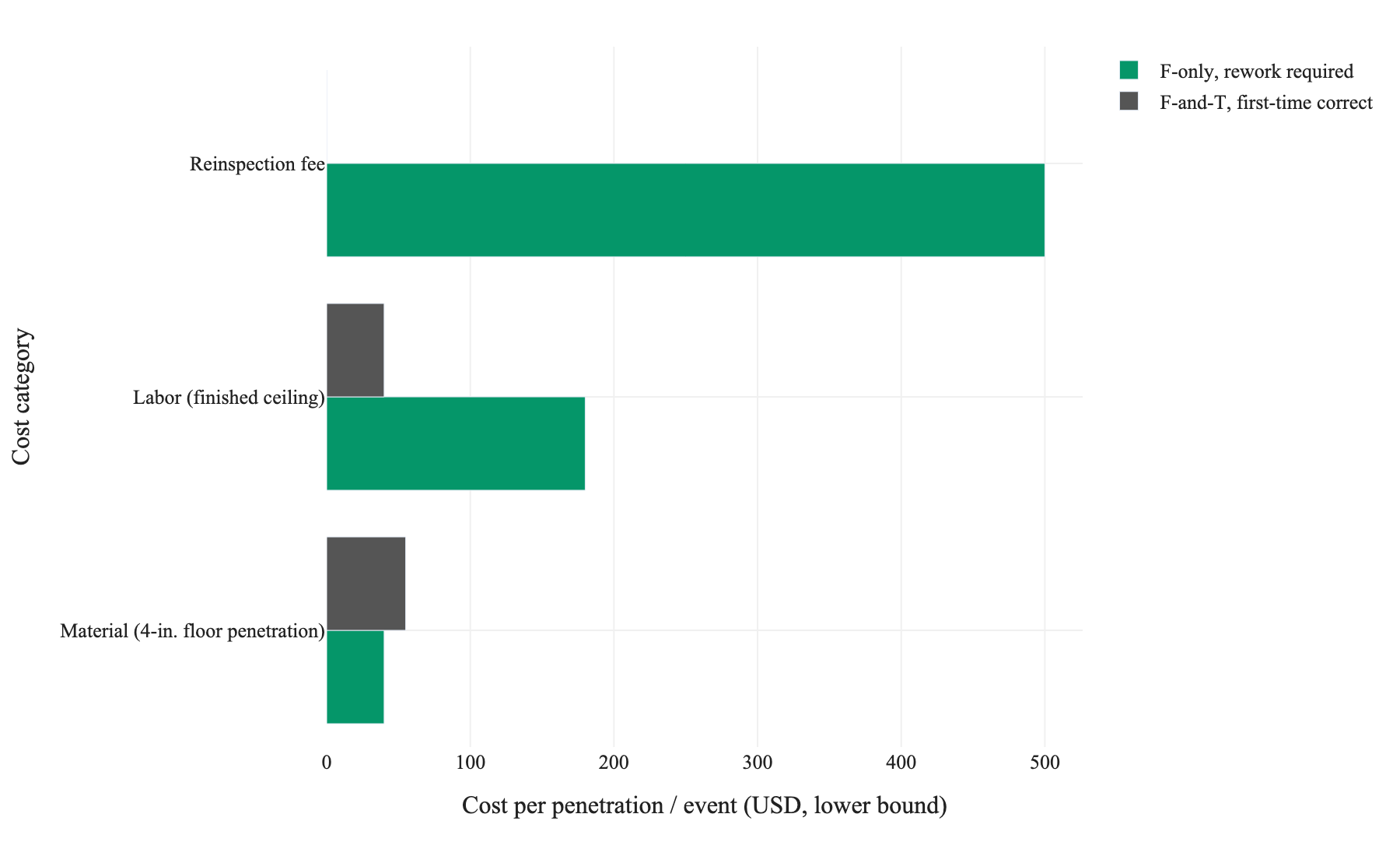
Note: Material and labor ranges are indicative for a 4-inch nominal pipe penetration in a concrete floor-ceiling assembly in the United States. Actual costs vary with contractor, geography, and scope density. The occupancy-delay range is an illustrative estimate derived from U.S. acute-care hospital revenue benchmarks (American Hospital Association, 2023) and a 3 to 5 percent net operating margin assumption; it is not a measured industry figure and should be verified against the specific facility's financial model.
The cost asymmetry in the table makes clear that the specification decision at design stage — adding USD 15 to USD 20 per penetration to specify an F-and-T system — is recovered within a single rework event. The failure mode is not product cost but information gap: the engineer selects a product without confirming that the UL system listing carries both ratings for the specific penetrant-assembly combination in the field.
V. Specification Path: F-Only vs. F-and-T Rating Decision Framework
Select an F-and-T rated firestop system whenever the penetration crosses a horizontal (floor) assembly, unless the penetrating item falls within one of the three IBC 2021 Section 714.5.1.2 exceptions and the AHJ has confirmed the exception applies. For wall penetrations, select an F-only system unless combustible materials are within 12 inches of the unexposed face of the wall along the penetrant run, in which case confirm T-rating requirements with the AHJ.
Decision Framework: F-Only or F-and-T?
The following numbered decision path mirrors the IBC 2021 requirement structure and is designed to be applied at each penetration listed in the design submittals or field penetration log.
Step 1. Identify the assembly type. Is the penetration through a wall assembly or a horizontal assembly (floor, roof, ceiling membrane)? If wall: proceed to Step 2. If floor: proceed to Step 3.
Step 2. Wall assembly path. Is the wall fire-resistance-rated under IBC Chapter 7 or a local equivalent? If not, firestop is not required by the IBC (local amendments may differ). If yes: confirm the required F-rating equals the wall rating. Confirm no combustible material is within 12 inches of the unexposed face along the penetrant run. If combustible contact exists: consult AHJ for T-rating determination. Select a UL 1479-listed system with the required F-rating for the specific penetrant and barrier type. Document the system number.
Step 3. Floor assembly path. Confirm the floor fire-resistance rating. Determine the required T-rating: at minimum T-1, not to exceed the floor rating. Check IBC 2021 Section 714.5.1.2 exceptions:
Is the penetrant contained within a continuous wall cavity through the floor? If yes, F-only may apply: confirm cavity continuity in drawings.
Is the penetrant a floor drain, tub drain, or shower drain within concealed assembly space? If yes, F-only may apply.
Is the penetrant steel conduit or tubing, maximum 4 inches nominal diameter, terminating inside enclosed metal-enclosed power switchgear? If yes, F-only may apply: confirm switchgear enclosure type with electrical engineer.
If no exception applies: select a UL 1479-listed system carrying both an F-rating and a T-rating for the specific penetrant type, pipe diameter, insulation condition, annular space, and barrier construction. Document the system number and the listing page.
Step 4. Confirm the UL system listing covers the exact field condition. The listed system must match: barrier material and thickness, penetrant material (steel, copper, PVC, insulated pipe), penetrant nominal diameter, annular space dimension, sealant product, sealant depth, and any required backing material. A T-rating achieved in one configuration does not transfer to a physically different configuration even with the same sealant product.
Step 5. Record the specification for audit. Record the penetration identifier, assembly type, penetrant classification, required rating, selected UL system number, and the date of specification. This record is the basis for both the special inspector's verification and for any future facility audit under ASTM E2174 (ASTM International, 2024 edition).
F-Only vs. F-and-T Specification Decision Tree
Decision point | Condition | Required rating |
|---|---|---|
Assembly type | Wall (vertical) | F-only (minimum) |
Assembly type | Floor or horizontal | F-and-T (minimum T-1) |
Combustible contact at wall | Combustibles within 12 in. of unexposed face | Consult AHJ for T-rating |
Floor exception check | Steel conduit, max 4 in., into enclosed switchgear | F-only (IBC 714.5.1.2 exception) |
Penetrant type at floor | PVC, CPVC, ABS, insulated pipe | F-and-T; intumescent collar required |
Penetrant type at floor | Uninsulated steel pipe or conduit, not in switchgear | F-and-T (standard path) |
Listing match | Field condition matches listed system exactly | Proceed to install |
Listing match | Field condition differs from listed system | Select new listing; do not substitute |
Each row in this decision tree corresponds to a verifiable check against the construction drawings and the UL product directory. An engineer or special inspector can work through the tree at each penetration identifier in the project log.
VI. Field Cases: Commercial Construction and Industrial Facility Penetration Audits
Case 1: Hospital New Build, Floor-Assembly Specification Error
Site background: Company A is a general contractor managing a 12-story, 320-bed hospital tower in the central United States. The project carries IBC Risk Category IV classification and triggered mandatory firestop special inspection under IBC 2021 Section 1705.18. Mechanical scope included approximately 1,400 floor-assembly penetrations across 11 occupied floors, predominantly 2-inch to 6-inch insulated CPVC domestic-water and hydronic-heating piping.
Problem sequence: The firestop specification in the project submittals called out a UL 1479-listed silicone sealant system with a 2-hour F-rating and a T-0 rating. The specification sheet identified the product as compliant with the 2-hour fire-resistance rating of the floor assemblies. During the special inspector's third-floor review, the inspector flagged 47 penetrations as non-compliant because the UL system listing carried T-0, and the floor assemblies required a minimum T-1 rating under IBC 2021 Section 714.5.1.2 for insulated plastic pipe penetrations.
The root cause was unexpected: the specifying engineer had confirmed the F-rating match but had not reviewed the T-rating column of the UL listing. The T-0 designation was present in the listing header but not in the product data sheet that the contractor had filed with the submittal package. Three floors of installed penetrations, totaling 183 locations, required verification before work on upper floors could proceed.
Actions taken: First, the project team halted installation on floors 4 through 12 and re-specified to a UL 1479-listed system carrying both a 2-hour F-rating and a 2-hour T-rating for 2-inch to 6-inch insulated CPVC pipe in concrete floor construction. Second, the special inspector verified the new listing against field conditions on three sample penetrations before authorizing resumed installation. Third, the 183 previously installed penetrations on floors 1 through 3 were reworked using the revised system.
Quantitative outcomes: Direct rework cost for the 183 floor-1-through-3 penetrations was USD 147,000 (labor USD 104,000, material USD 43,000). The reinspection event cost USD 18,500 in special inspector fees and AHJ re-filing. Occupancy delay attributable to the firestop deficiency combined with two concurrent unrelated deficiencies was 12 business days. As an illustrative estimate of economic impact (applying a USD 10 per bed per day net benefit proxy to a 320-bed facility as a conservative planning-level assumption), the 12-day delay represented an estimated USD 38,400 economic loss in addition to direct rework costs. Total attributable impact: approximately USD 204,000 for a specification gap that would have cost USD 8,000 to USD 12,000 to correct at the drawing-review stage.
Case 2: Chemical Processing Plant, Penetration Audit in Existing Facility
Site background: Company B operates a chemical process facility with eight buildings constructed between 2004 and 2018. An insurance carrier renewal audit in 2024 triggered a passive fire protection survey covering all fire-resistance-rated barriers in the facility. The survey scope included approximately 2,600 penetrations across the eight buildings. The facility had not maintained a penetration registry since original construction; individual trade contractors had installed firestop during each capital project using the products available at the time.
Benchmark finding: The insurance carrier's loss-prevention engineer benchmarked the facility against the IFC inspection guideline of 2 percent minimum destructive verification per penetration type per 10,000 square feet. The initial visual survey found 38 percent of floor-assembly penetrations either lacked any firestop material, used a product whose UL listing could not be confirmed, or used a confirmed F-only product in a location requiring F-and-T. Across wall assemblies, 14 percent had no identifiable firestop and 6 percent could not be matched to a current UL listing.
Actions taken: First, the facility compiled a penetration registry cross-referencing each location, assembly type, penetrant material and diameter, installed product code, and the rating required under IBC 2021 and NFPA 101. Second, 42 floor-assembly penetrations in the primary process building were prioritized for immediate remediation because they used confirmed F-only products on insulated steam piping above a combustible packing area. Third, remaining deficiencies were staged into a 24-month remediation plan timed to scheduled maintenance shutdowns.
Quantitative outcomes: The 42 priority penetrations were reworked at a total cost of USD 89,000 (USD 2,119 per penetration average). The insurance renewal was issued with a notation of the remediation plan, avoiding a USD 340,000 surcharge the carrier had indicated would apply if no commitment was documented. The full 24-month remediation plan carried an estimated cost of USD 680,000. Had F-and-T specifications been applied consistently at original construction, the incremental cost would have been approximately USD 120,000 — a factor of 5.7 less than the long-term rework cost.
VII. Key Takeaway
The F-rating and T-rating are independent performance thresholds. A product carrying a 2-hour F-rating and a T-0 rating is not T-1 compliant. Confirm both rating values from the UL system listing, not the product data sheet, before specification.
IBC 2021 Section 714.5.1.2 requires both F-and-T ratings for all floor-assembly penetrations except three narrow exceptions. The most commonly misapplied exception is the steel-conduit-into-enclosed-switchgear rule: the conduit must terminate inside metal-enclosed switchgear, not in open plenum. When in doubt, default to requiring T-rating and document the AHJ confirmation for the exception.
Plastic pipe and insulated metallic pipe require intumescent collar or sleeve systems for floor penetrations. Sealant-only systems do not address the pipe-retraction failure mode. Confirm the selected UL listing explicitly covers the insulation type and nominal pipe diameter in the field condition.
The decision tree in Section V is the operator-actionable tool. Apply it at each penetration in the design submittal log and record the required rating, selected UL system number, and the listing-match confirmation before issuing for construction.
Establish and maintain a penetration registry from the first construction document set. ASTM E2174-24 (ASTM International, 2024) governs on-site inspection of installed firestop systems. A registry that records penetration identifier, assembly type, penetrant classification, required rating, and installed system number reduces destructive verification scope during special inspection and provides the evidentiary basis for facility-audit reinspection cycles.
When compliance documentation workflows span multiple buildings, multiple trades, or recurring audit cycles, agent-based automation can maintain the registry population, route flagged penetrations to the responsible trade, and track closure status continuously. Review your product documentation workflow with AI Crew at https://www.lubinpla.com/ai-crew.
VIII. References
American Hospital Association. (2023). AHA Annual Survey Database. https://www.aha.org/statistics/fast-facts-us-hospitals
ASTM International. (2017). ASTM E814-13a(2017): Standard Test Method for Fire Tests of Penetration Firestop Systems. https://store.astm.org/e0814-13ar17.html
ASTM International. (2020). ASTM E119-20: Standard Test Methods for Fire Tests of Building Construction and Materials. https://www.astm.org/e0119-20.html
ASTM International. (2024). ASTM E2174-24: Standard Practice for On-Site Inspection of Installed Firestop Systems. https://store.astm.org/e2174-24.html
Buildern. (2024). Construction Rework: Costs, Causes, and Solutions. https://buildern.com/resources/blog/construction-rework-costs-statistics-eliminations/
Code Red Consultants. (2024). Firestopping: Frequently Asked Questions. https://coderedconsultants.com/insights/firestopping-frequently-asked-questions/
ICC-ES (ICC Evaluation Service). (2024). UL 1479 Fire Tests of Penetration Firestops. https://icc-es.org/product-testing-2/ul-1479/
Infinita Lab. (2024). ASTM E814 Firestop Fire Testing: F and T Ratings Explained. https://infinitalab.com/blog/astm-e814-firestop-fire-testing-guide/
International Building Code (IBC 2021), Section 714: Penetrations. International Code Council. https://codes.iccsafe.org/content/IBC2021P2/chapter-7-fire-and-smoke-protection-features
International Firestop Council. (2024). Understanding the Importance of Special Inspections for Firestopping in Construction. https://firestop.org/understanding-the-importance-of-special-inspections-for-firestopping-in-construction/
Jensen Hughes. (2024). Critical Factors Affecting Firestopping System Installation, Inspection, and Performance. https://www.jensenhughes.com/insights/critical-factors-affecting-installation-performance-of-firestopping-systems
NFPA 101: Life Safety Code, 2021 Edition. National Fire Protection Association. https://www.nfpa.org/codes-and-standards/nfpa-101-standard-development/101
STI Firestop. (2023). Understanding the T Rating. https://www.stifirestop.com/news/understanding-the-t-rating
UL Solutions. (2024). UL 1479: Standard for Fire Tests of Through-Penetration Firestops. https://www.uniquefirestop.com/ul-1479-standard-for-fire-tests-of-through-penetration-firestops/
US Made Supply. (2024). Firestop Inspection Requirements: IBC 2021 Special Inspection Guide. https://usmadesupply.com/resources/building-codes-standards/fire-inspection-compliance/firestop-inspection-requirements