Flash-Rust Inhibitor Carry-Over: Why Paint Adhesion Fails
Summary: Flash-rust inhibitors are a standard additive in aqueous cleaning and surface-preparation stages for carbon steel, yet a poorly understood failure mode, inhibitor carry-over, routinely causes paint adhesion failures that are misdiagnosed as substrate or application defects. This article explains the deposition chemistry of amine-based flash-rust inhibitors, how the resulting hydrophilic film raises contact angle and prevents adequate primer wetting, and why the adhesion loss can be severe enough to trigger ASTM D3359 cross-cut failures at grade 2B or worse on substrates that appeared clean at handoff. The article covers the cost cascade of paint rejects and rework cycles, and presents a diagnostic framework engineers can use to distinguish inhibitor carry-over from four look-alike adhesion failure modes. An inhibitor selection matrix by downstream process and substrate type provides a decision framework for substituting phosphate-ester or silicate-based systems that bond with the substrate rather than sitting on it as mobile films. Two field cases from automotive body shop and OEM paint-line audit contexts illustrate the diagnosis and correction sequence. Engineers facing inhibitor-related adhesion disputes can route case evidence to Lubinpla's AI Shooting analysis service for a structured, evidence-based root-cause report.
Table of Contents
I. Introduction
II. Flash-Rust Mechanism and Inhibitor Deposition Chemistry
III. Inhibitor Carry-Over Impact on Downstream Paint and Plating
IV. Cost: Paint Rejects, Rework, Substrate Damage
V. Inhibitor Selection by Downstream Process and Substrate
VI. Field Cases: Automotive Body Shop and OEM Paint Line Audits
VII. Key Takeaway
VIII. References
I. Introduction
Carbon steel parts that exit an aqueous cleaning stage can begin to rust within two to ten minutes in warm, humid conditions. Flash rust, the rapid superficial iron oxide formation on a freshly cleaned steel surface, is not merely a cosmetic event: even a partial oxide layer formed before paint application creates a mechanically weak boundary plane at the primer-steel interface, leading to adhesion failure that propagates during service. To suppress this oxidation window, cleaning formulations for steel carry flash-rust inhibitors. The inhibitor is present to protect the substrate during the interprocess gap, not to become part of the coating stack.
The failure mode this article addresses is one step removed from the flash rust itself. When the inhibitor selected for the cleaner is an amine-based compound, it can deposit a persistent hydrophilic residue film on the steel surface even after conventional rinsing. That residue does not cause visible rust, passes a casual visual inspection, and often passes a basic water-break test if the test is performed incorrectly. But when a solvent-borne or waterborne primer is applied over it, the amine film prevents adequate substrate wetting, produces a contact angle far above the threshold for film formation, and generates adhesion values that fail ASTM D3359 cross-cut tape testing (American Society for Testing and Materials, 2019) at grades that typically trigger complete rework of the affected lot.
The practical correction is not to remove the inhibitor from the cleaning chemistry. It is to select an inhibitor class whose film chemistry is compatible with, or consumed by, the downstream paint or pretreatment process. This article provides the mechanism, the diagnostic tools, and the selection framework to make that substitution decision with precision.
II. Flash-Rust Mechanism and Inhibitor Deposition Chemistry
Flash rust on carbon steel is an electrochemical process driven by the cathodic reduction of dissolved oxygen at anodic iron dissolution sites. When a cleaned steel surface is exposed to a water film, even a thin condensate, the reaction reaches measurable oxide thickness within the interprocess window. The deposition chemistry of the inhibitor added to suppress this reaction determines whether the inhibitor itself becomes the next problem.
Why Does Flash Rust Form So Rapidly on Cleaned Steel?
Mechanically and chemically cleaned steel has elevated surface energy, typically 65 to 75 mJ/m2 for blast-cleaned or pickled carbon steel (verification needed), compared with the 35 to 45 mJ/m2 characteristic of mildly corroded or oil-filmed surfaces. The high surface energy accelerates moisture adsorption and electrochemical cell formation. Industry guidance from the Society for Protective Coatings (SSPC) and the Association for Materials Protection and Performance (AMPP) identifies the critical interprocess time as the interval between surface preparation and the application of the first coat of primer or conversion coating. SSPC-SP 1 (Solvent Cleaning, 2015) and SSPC-PA 1 (Application of Organic Coatings, 2016) both require that surface contamination be absent at coating application, but neither addresses the chemical character of the inhibitor film when an inhibitor-containing cleaner is used in the preparation sequence.
The electrochemical mechanism proceeds as follows. Anodic sites on the iron surface release Fe2+ ions, which are oxidized to Fe3+ and precipitate as amorphous iron oxyhydroxide (FeOOH) in the presence of water and oxygen. The reaction rate at 25 degrees C and 70 percent relative humidity is sufficient to produce a visible tarnish layer within five to eight minutes on Sa 2.5-prepared carbon steel. At 35 degrees C and above 80 percent relative humidity, the window shortens to two to three minutes (verification needed). Flash rust at this early stage is powdery and weakly adherent; as it thickens, the oxide layer becomes a mechanically heterogeneous interphase that coating primers cannot penetrate.
How Do Amine Inhibitors Deposit on the Steel Surface?
Amine-based flash-rust inhibitors, which include alkanolamines such as monoethanolamine (MEA) and diethanolamine (DEA), morpholine derivatives, and amine carboxylate salts, function by adsorbing onto the steel surface and forming a monomolecular or multi-molecular polar barrier layer that blocks water and oxygen from reaching the iron. The mechanism is chemisorption through the nitrogen lone pair of the amine group, which coordinates with iron surface sites. This binding is effective at suppressing flash rust during the interprocess gap, typically reducing visible oxide formation to near zero over intervals of 30 to 120 minutes at 30 degrees C and 75 percent relative humidity.
The problem arises because the amine-iron bond is not removed by standard ambient-temperature rinse water. Water rinsing removes excess inhibitor from bulk solution but leaves the surface-bound amine film largely intact. The amine film has the following properties that matter for downstream paint application: the film is hydrophilic, with a water contact angle of 20 to 40 degrees when measured on amine-treated steel (verification needed); it is mobile, meaning that applied solvent or water can partially redissolve and redistribute it rather than displace it; and it is chemically reactive toward epoxy ring-opening, which means that in amine-cured epoxy primers, the amine from the inhibitor can consume a small fraction of the epoxy component, creating a stoichiometric imbalance in the cure chemistry at the interface.
What Do Phosphate-Ester and Silicate Inhibitors Do Differently?
Phosphate-ester inhibitors form a thin, covalently anchored iron phosphate layer at the steel surface. Unlike the amine film, the phosphate-ester reaction product is chemically equivalent to the conversion coatings applied in pretreatment stages and is compatible with or chemically continuous with subsequently applied phosphate conversion coatings. The resulting surface has a water contact angle of 60 to 75 degrees (verification needed), which lies within the range suitable for aqueous and solvent-borne primer application. Silicate-based inhibitors form a silicate-silanol network on the steel surface that bonds chemically to the silane adhesion promoters present in many waterborne primer formulations, creating a positive chemical bridge rather than a barrier. Neither class of inhibitor leaves a hydrophilic mobile film that resists rinsing.
III. Inhibitor Carry-Over Impact on Downstream Paint and Plating
Amine flash-rust inhibitor residue on a steel surface creates measurable failures at every downstream coating and pretreatment step, from electrocoat (e-coat) primer application in automotive lines to hot-dip galvanizing flux adhesion in steel fabrication. The magnitude of adhesion loss depends on inhibitor concentration in the cleaner, rinse water temperature, and dwell time in the rinse tank.
How Does the Amine Film Prevent Paint Adhesion?
Adequate paint adhesion requires that the liquid primer wet the substrate surface completely. Wetting is governed by the spreading coefficient and by the surface energy relationship between the substrate and the liquid primer. For a waterborne primer with a surface tension of approximately 35 mN/m (a representative value for commercial industrial primers at application viscosity), the substrate surface energy must be greater than 38 mN/m for complete spreading. An amine inhibitor film on steel, with an estimated surface energy of 25 to 35 mJ/m2 due to the hydrophilic polar groups oriented outward, can reduce the steel effective surface energy below this threshold (verification needed).
When the primer is applied over an amine film, three failure modes are possible simultaneously. First, the primer may fail to wet completely, leaving crater defects and pinhole voids that become sites for early corrosion. Second, the primer may wet but form only weak van der Waals adhesive bonds to the amine surface rather than the chemisorptive bonds that form on clean oxide-free steel or on conversion-coated steel. Third, in two-component epoxy primers, the amine groups at the interface can participate in the cure reaction, consuming stoichiometric equivalents of epoxy and producing a soft, inhibitor-rich interfacial zone that has lower cohesive strength than the bulk primer film.
The measurable outcome of all three mechanisms is adhesion loss as measured by ASTM D3359-19 cross-cut tape testing. Clean, adequately prepared carbon steel with a properly applied primer typically achieves classification 5B (no detachment) or 4B (less than 5 percent detachment area) in the cross-cut test. Inhibitor carry-over failures consistently produce classifications of 2B or 1B, corresponding to 15 to 35 percent and 35 to 65 percent detachment area respectively, on the same primer and steel combination (verification needed for published quantified carry-over correlation). ISO 2409:2020 (Paints and varnishes, Cross-cut test, International Organization for Standardization, 2020) reports equivalent classifications using the 0-to-5 rating scale, where Gt 3 and Gt 4 represent the corresponding failure grades.
What Is the Impact on Electrocoat and Zinc Phosphate Pretreatment?
In automotive and general-industry e-coat lines, the steel part passes through a zinc phosphate conversion coating bath before the electrocoat stage. Zinc phosphate conversion depends on the controlled dissolution of the iron surface in a phosphoric acid solution to nucleate and grow zinc phosphate crystals. Amine inhibitors that persist on the steel surface after the alkaline cleaner and rinse stages partially buffer the acidic phosphate bath at the immediate steel-liquid interface, reducing the rate of iron dissolution and producing a non-uniform or thin conversion crystal layer. Thin phosphate conversion coatings, below 1.0 g/m2 in weight, are associated with reduced e-coat adhesion (verification needed for specific data from published studies) and increased susceptibility to undercutting corrosion in salt-spray testing per ASTM B117-19 (Standard Practice for Operating Salt Spray Apparatus, ASTM International, 2019).
In hot-dip galvanizing, the zinc flux bath must wet the steel surface completely. Amine residues that survive the acid pickle stage (possible if the inhibitor forms an acid-stable complex) can create dewetting zones where zinc fails to alloy with the iron surface, producing bare spots or rough, porous galvanizing that does not meet the thickness requirements of ASTM A123/A123M-17 (Standard Specification for Zinc Coatings on Iron and Steel Products, ASTM International, 2017).
IV. Cost: Paint Rejects, Rework, Substrate Damage
Paint rejection and rework driven by inhibitor carry-over carry costs that are systematically underestimated because the inhibitor is typically not identified as the root cause. The failure is attributed to surface preparation quality, primer batch variation, or application error, and the corrective action targets those variables instead. The result is recurring rework without root-cause resolution.
What Does a Paint Reject Cycle Actually Cost?
A typical automotive body panel that fails e-coat adhesion testing must be stripped, re-prepared, and recoated. Strip-and-recoat costs for a single door panel in an OEM facility are estimated at USD 150 to USD 350 per panel in direct labor and material cost, excluding line stoppage (verification needed for current published benchmark). In a production run of 500 units where 8 to 12 percent of panels fail adhesion testing, the direct rework cost for a single shift is USD 6,000 to USD 21,000. If the root cause is not identified, the reject rate persists across subsequent production runs.
For heavy-equipment OEM and general-fabrication paint shops operating at lower volumes but with larger parts, the rework cost per failure event is proportionally higher. A structural steel fabrication that requires stripping and re-blasting a 25 to 40 m2 painted weldment to Sa 2.5 per ISO 8501-1 (Preparation of Steel Substrates Before Application of Paints and Related Products, ISO, 2007) incurs USD 2,500 to USD 8,000 in direct cost per event, with 3 to 10 days of schedule delay per occurrence.
How Does Undiagnosed Carry-Over Compound the Cost?
When inhibitor carry-over is not identified as the cause, the corrective actions typically taken are: increasing blast media expenditure, switching primer batches, extending curing time, or increasing film build. None of these actions address the inhibitor film at the interface. Each failed corrective action adds to the investigation cost and delays the production schedule. In documented cases at automotive supplier plants (pattern, not specific company data), undiagnosed inhibitor carry-over has sustained elevated reject rates of 6 to 14 percent for 4 to 12 weeks before the inhibitor was identified through systematic contact-angle and surface-energy mapping of the suspect panel population.
The longer the root cause remains unidentified, the higher the probability of substrate damage. Re-blasting corroded panels that have been stripped multiple times degrades the dimensional tolerance of stamped panels through surface metal removal. Steel parts that have been stripped by chemical strippers more than twice may require thickness verification against the engineering drawing before reuse.
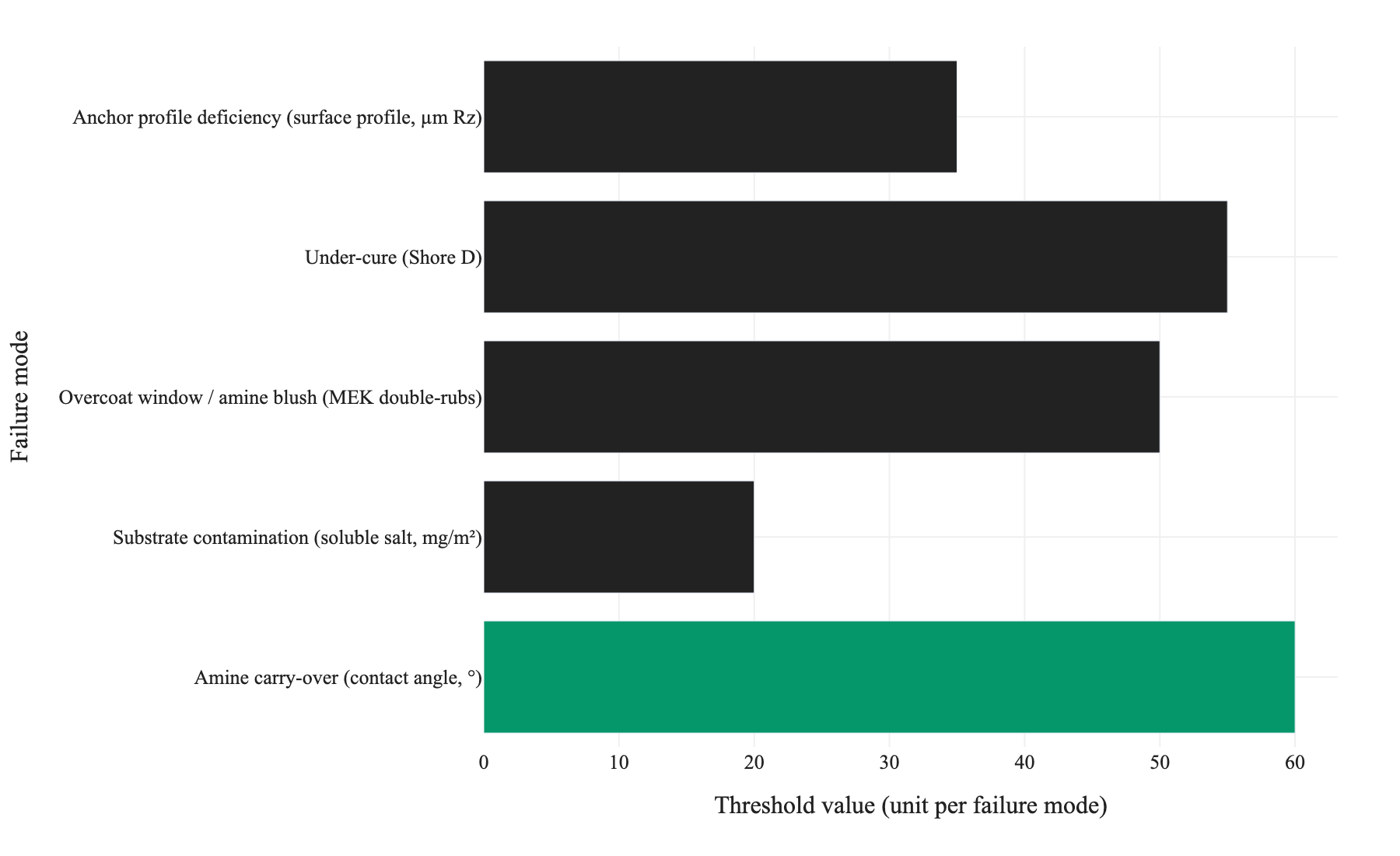
The tables below form the operator-usable diagnostic tool for distinguishing amine inhibitor carry-over from four look-alike adhesion failure modes. Figure 1a presents the failure mode identification criteria (symptom pattern, mechanism, and measurable threshold). Figure 1b presents the corresponding immediate corrective action for each mode. Both tables share the same five failure-mode rows and are used together. All adhesion ratings use ASTM D3359-19 (cross-cut) and ISO 2409:2020.
Figure 1a. Failure Mode Diagnostic: Identification Criteria
Failure Mode | Symptom Pattern | Mechanism | Measurable Threshold (Confirm Mode) |
|---|---|---|---|
Amine inhibitor carry-over | Adhesion fail (ASTM D3359 2B or worse / ISO 2409 Gt 3 or worse) at primer-steel interface; no visible rust under detached film; water-break failure on substrate after stripping | Hydrophilic amine film prevents primer wetting; weak van der Waals bonds form; epoxy stoichiometry disturbed at interface | Contact angle on cleaned substrate greater than 60 degrees (water droplet beading); amine detection by pH indicator strip on rinse-water runoff (pH greater than 9.5 suggests amine residue); surface energy below 36 mJ/m2 by Dyne pen |
Substrate rust/contamination (pre-paint oxidation) | Adhesion fail at primer-steel interface; brown or orange rust staining on detached film back-face | Flash rust formed before primer application; oxide layer is mechanically weak bond plane | Bresle patch per SSPC-PA 9 / ISO 8502-6: soluble salt above 20 mg/m2 NaCl equivalent; or visible FeOOH on substrate before coating |
Overcoat window exceeded or amine blush | Adhesion fail at inter-coat boundary (primer intact on steel; topcoat detaches in sheets) | Primer surface oxidizes or forms amine carbamate, reducing inter-coat bond | Recoat interval exceeded per product data sheet; amine blush visible as milky haze under oblique light; MEK double-rub below 50 double-rubs on primer (ASTM D5402-15) |
Under-cure (cohesive failure) | Adhesion fail within primer film; cohesive fracture; primer residue on steel and detached topcoat back-face | Insufficient crosslink density in primer; low Shore D hardness | Shore D below 55 (ASTM D2240-15) or Barcol below product minimum (ASTM D2583-13); MEK rub below 50 double-rubs |
Anchor profile deficiency | Adhesion fail at steel-primer interface; no rust; low pull-off value (ASTM D4541 below 1.5 MPa) | Insufficient mechanical keying surface for primer | Surface profile below product lower limit by replica tape (ASTM D4417-14 Method B); blast profile below 35 to 40 micrometers Rz for typical epoxy primers |
Figure 1b. Failure Mode Diagnostic: Immediate Corrective Action
Failure Mode | Immediate Action |
|---|---|
Amine inhibitor carry-over | Switch to phosphate-ester inhibitor; re-clean with amine-free alkaline cleaner followed by deionized-water rinse; re-test contact angle before primer application |
Substrate rust/contamination (pre-paint oxidation) | Reduce interprocess gap; lower ambient humidity at handoff; verify inhibitor is active and concentration is within specified range |
Overcoat window exceeded or amine blush | Sand or scuff prime coat; confirm cure before topcoat; address humidity or recoat timing |
Under-cure (cohesive failure) | Extend cure at temperature; verify ambient temperature at application was above 10 degrees C |
Anchor profile deficiency | Re-blast to specified Rz range; confirm angularity of fresh abrasive |
Figure 1a and 1b together distinguish inhibitor carry-over from the other four modes by the combination of contact-angle measurement and pH of the rinse-water runoff. Neither substrate rust failure nor overcoat failures produce an alkaline rinse-water runoff signal; profile deficiency produces a water-break pass (clean surface, adequate energy) rather than a failure.
V. Inhibitor Selection by Downstream Process and Substrate
The selection of a flash-rust inhibitor is not independent of the downstream coating or finishing process. An inhibitor that is acceptable in a shop primer application may be incompatible with a phosphate conversion coating + e-coat system, and an inhibitor suitable for ferrous substrates may cause adhesion problems on mixed ferrous and non-ferrous assemblies. The following section and selection matrix present the decision criteria for matching inhibitor chemistry to process requirements.
Inhibitor selection is governed by three primary variables: the chemistry of the inhibitor's surface film and whether it is compatible with or consumed by the subsequent pretreatment stage; the substrate alloy composition, since inhibitors optimized for carbon steel may attack aluminum or zinc by localized corrosion or may not adsorb effectively on passive oxide surfaces; and the rinse water quality and temperature available in the plant, since some inhibitors require elevated-temperature rinsing or deionized water to be fully removed when removal is the objective.
Which Inhibitor Classes Are Available and How Do They Work?
Four principal inhibitor classes are used in aqueous industrial cleaning formulations for metal surfaces.
Amine and alkanolamine inhibitors (MEA, DEA, triethanolamine (TEA), morpholine) adsorb on iron through nitrogen lone-pair coordination. They are effective at concentrations of 0.05 to 0.5 percent by weight in the cleaner solution and provide flash-rust protection for 30 to 120 minutes under typical shop conditions. Their limitation is the hydrophilic, mobile residue film described in Section II. They are the lowest-cost class and dominate in general metalworking and parts-cleaning applications where the cleaner and primer stages are managed by different suppliers or different plant departments without interface coordination.
Phosphate-ester inhibitors react with the iron surface to form a thin iron phosphate conversion layer that is chemically continuous with the zinc phosphate pretreatment stage. They are used at 0.1 to 0.3 percent by weight in cleaner formulations and require slightly longer contact time than amines to establish an effective film. The surface after phosphate-ester inhibition has a contact angle and surface energy compatible with waterborne and solvent-borne primer application without additional rinsing steps. They are widely used in automotive OEM cleaning lines where the cleaning and pretreatment stages are co-designed.
Silicate inhibitors form a silicate-silanol network on the iron surface by reaction between soluble silicate species in the alkaline cleaner and surface hydroxyl groups on the steel oxide. The silicate film provides flash-rust protection through oxygen and water barrier function and is compatible with silane-functionalized waterborne epoxy primers. They are used at 0.5 to 2.0 percent SiO2 equivalent in the cleaner and are particularly suitable for waterborne topcoat systems that use silane coupling agents. They are less common in purely solvent-borne systems.
Tannin-based (polyphenol) inhibitors convert existing surface rust to stable iron-tannate complexes rather than preventing formation. They are appropriate for surfaces where minor flash rust has already formed and full re-blasting is not feasible. The tannate surface is compatible with alkyd-based and single-component polyurethane primers but shows variable compatibility with two-component epoxy systems (verification needed for comprehensive data).
Figure 2. Inhibitor Selection Matrix by Downstream Process and Substrate
The selection matrix is presented in two linked tables. Figure 2a identifies the recommended inhibitor class and amine-class acceptability for each downstream process. Figure 2b shows substrate-level compatibility (carbon steel, galvanized/zinc-coated, aluminum) for each process. Multi-metal assemblies generally require separate per-metal cleaning stages; see the notes column in Figure 2a for process-specific guidance.
Figure 2a. Inhibitor Selection: Process-Level Decision
Downstream Process | Recommended Inhibitor Class | Amine Class Acceptable? | Notes |
|---|---|---|---|
Solvent-borne epoxy primer (direct-to-metal) | Phosphate-ester | No | Amine class: contact angle and epoxy stoichiometry interference. Multi-metal: separate per-metal process required |
Waterborne epoxy primer with silane adhesion promoter | Silicate | No | Amine class: incompatible with silane bonding mechanism. Silicate requires pH check on non-ferrous substrates |
Zinc phosphate + electrocoat (automotive) | Phosphate-ester | No | Amine class: buffers phosphate bath, thins conversion layer |
Alkyd or 1K polyurethane primer | Amine (low concentration) or tannin | Conditionally | Amine conditionally acceptable for interprocess gaps under 30 min and fast-dry conditions; verify contact angle before priming |
Hot-dip galvanizing (post-clean flux stage) | Phosphate-ester | No | Amine class: risk of acid-stable amine complex surviving pickle bath and causing bare-spot galvanizing |
Powder coating (polyester or epoxy-polyester) | Phosphate-ester or chromate-free pretreatment compatible | No | Amine class: surface energy interference with powder electrostatic deposition |
Shop primer only (no topcoat within 6 months) | Amine or tannin | Conditionally | Amine acceptable for temporary protection only; must be re-cleaned before final primer. Apply shop primer within 4 hours of clean |
Figure 2b. Substrate Compatibility by Downstream Process
Downstream Process | Carbon Steel | Galvanized/Zinc-Coated | Aluminum |
|---|---|---|---|
Solvent-borne epoxy primer (direct-to-metal) | Phosphate-ester or tannin | Not recommended (saponification risk) | Not recommended |
Waterborne epoxy primer with silane adhesion promoter | Silicate or phosphate-ester | Silicate (with caution, pH check) | Silicate-only (below pH 11) |
Zinc phosphate + electrocoat (automotive) | Phosphate-ester | Not applicable | Not applicable |
Alkyd or 1K polyurethane primer | Amine (low concentration) or tannin | Amine at reduced concentration | Not recommended |
Hot-dip galvanizing (post-clean flux stage) | Phosphate-ester | Not applicable | Not applicable |
Powder coating (polyester or epoxy-polyester) | Phosphate-ester or chromate-free pretreatment compatible | Chromate-free pretreatment compatible | Chromate-free pretreatment compatible |
Shop primer only (no topcoat within 6 months) | Amine or tannin | Amine at reduced concentration | Not recommended |
The selection matrix reflects the principle that amine inhibitors are appropriate only where the interprocess gap is short, the downstream primer is tolerant of amine surface films, and no intermediate conversion coating stage is present. In all other configurations, phosphate-ester or silicate systems are the technically correct selection.
VI. Field Cases: Automotive Body Shop and OEM Paint Line Audits
The two cases below illustrate how inhibitor carry-over presents in production environments, how the root cause is isolated, and what the cost outcome is when the inhibitor is and is not identified promptly. Both cases use anonymized designations per Lubinpla content standards.
Case A: Automotive Body Shop (Pattern 5, Unexpected Cause)
Company A is a Tier 2 stamped-steel body panel supplier producing approximately 18,000 door inner panels per month for passenger car assembly. The plant operates an alkaline spray cleaner followed by a cold-water rinse and a rust-inhibiting water-break rinse, then a two-component epoxy primer applied by automated electrostatic spray within 45 minutes of the clean cycle. The cleaner formulation contains a proprietary alkanolamine flash-rust inhibitor at 0.3 percent by weight.
Beginning in the third week of a production run, the plant recorded an adhesion failure rate of 9.4 percent on cross-cut tape testing per ASTM D3359. The failed panels showed primer detachment in sheets at the primer-steel interface, with clean steel visible on the panel and primer residue on the tape. No visible rust was present under the detached primer. The initial diagnosis was blast-media contamination, and the abrasive blast circuit was cleaned and refreshed. Reject rates did not change.
In the second week of investigation, a surface energy mapping exercise was conducted on a sample of 40 panels drawn equally from accepted and rejected populations. The rejected panels showed water contact angles of 68 to 82 degrees immediately after the rinse cycle, compared with 38 to 48 degrees on accepted panels. A pH indicator strip test on the rinse-water runoff from rejected panels showed pH 9.8 to 10.3, indicating amine contamination in the rinse water. Trace analysis of the rinse tank water confirmed alkanolamine concentration of 190 to 240 mg/L, approximately 35 to 40 times the target carryover limit.
The root cause was a drift in the inhibitor dosing pump rate combined with a drop in rinse tank water replenishment rate during the third week (a temperature-control valve failure in the fresh-water supply had reduced replenishment volume by 62 percent). The combined effect concentrated the amine carryover in the rinse water to levels that completely saturated the panel surface with inhibitor film.
Corrective actions: the rinse water replenishment valve was repaired; a conductivity monitor was installed on the rinse tank to detect amine carryover above 20 mg/L; and the inhibitor was changed from alkanolamine to a phosphate-ester product at equivalent active concentration. After inhibitor substitution, the reject rate fell from 9.4 percent to 0.3 percent within two production days. Direct rework cost for the 3.5-week diagnostic period was approximately USD 47,000 based on 1,690 rejected panels at USD 28 average rework cost per panel. Post-substitution reject rate of 0.3 percent represents a reduction of 94 percent.
Case B: OEM Industrial Equipment Paint Line (Pattern 2, Incident Trigger)
Company B is a mid-scale manufacturer of industrial pumps and compressor housings producing approximately 240 finished assemblies per month. Cast iron and carbon steel housings are cleaned in an immersion alkaline cleaner, rinsed, and passed through a manual inspection station before spray application of a two-component epoxy intermediate coat. The cleaning chemistry had been unchanged for 28 months.
A single shipment of 60 compressor housings was returned by the end-use customer with widespread primer delamination on the internal bore surfaces, identified during incoming inspection at the customer's site. The delamination was discovered 6 weeks after shipment. The return logistics and replacement manufacturing cost for the 60 units was USD 31,400. The delamination pattern was consistent across all 60 units: primer adhesion on external machined surfaces was acceptable (ASTM D3359 4B to 5B), but bore surfaces showed 2B to 1B classification.
Investigation revealed that a new batch of alkaline cleaner concentrate had been received and put into use without formulation comparison. The new batch contained a higher concentration of a mixed amine blend as the flash-rust inhibitor component, reflecting a reformulation by the cleaner supplier to address a customer complaint about flash rust on external surfaces in high-humidity summer conditions. The bore surfaces, being partially enclosed, retained water longer and experienced greater amine deposition per unit area than the open external surfaces. The amine concentration in the new batch was 0.51 percent by weight versus 0.18 percent in the prior batch, a 183 percent increase.
The external surfaces, with their higher surface area and direct airflow during drying, had sufficient amine dilution to stay within the adhesion-acceptable range. The enclosed bore surfaces did not. This differential explained why external adhesion passed and bore adhesion failed on the same part.
Corrective actions: the new concentrate batch was quarantined; the prior-formulation product was reinstated on an emergency basis; the cleaner supplier was notified and a formulation specification sheet with inhibitor concentration limits was formalized in the purchasing specification. An internal incoming-inspection procedure for cleaner concentrates was established, including contact-angle testing on a test panel for each new batch. The total incident cost including return logistics, replacement manufacturing, and investigation time was USD 31,400. Post-correction, the plant has recorded zero bore delamination incidents across the subsequent 9 months of production monitoring.
VII. Key Takeaway
Amine flash-rust inhibitors create a hydrophilic, mobile film on steel surfaces that survives standard cold-water rinsing. This film prevents adequate topcoat wetting and produces ASTM D3359 adhesion failures at grades 2B to 1B on substrates that appear clean at visual inspection. The failure mechanism is distinct from flash rust, substrate contamination, overcoat window errors, and profile deficiency, and requires a specific diagnostic approach (contact angle, rinse-water pH) to isolate.
The diagnostic tables in Figures 1a and 1b are the field starting point. Measure the contact angle on the cleaned substrate before primer application. A contact angle above 60 degrees on cleaned steel is the primary field indicator of carry-over or contamination. Confirm inhibitor carry-over specifically by testing rinse-water runoff pH: above pH 9.0 on the rinse stage outflow indicates amine concentration requiring investigation.
Inhibitor substitution is the root-cause fix, not aggressive rinsing. Increasing rinse temperature or volume can reduce amine carryover but will not eliminate it if the inhibitor concentration in the cleaner is outside specification. Switching from amine to phosphate-ester inhibitors resolves the problem without changing cleaner alkalinity, temperature, or contact time. Use the inhibitor selection matrix in Figures 2a and 2b to confirm which inhibitor class is compatible with the specific downstream primer or pretreatment system at the plant.
Monitor the cleaner system for inhibitor concentration drift. Both cases in Section VI trace to concentration drift: a replenishment failure in Case A and a supplier reformulation in Case B. Measuring rinse-water conductivity or pH at each shift start, with a documented action limit, would have detected both events before paint was applied to the affected parts.
When adhesion failures have been occurring without a clear root cause, submit the case evidence to AI Shooting. Lubinpla's AI Shooting analysis service is structured for exactly this type of multi-variable adhesion failure investigation. Submit contact-angle data, rinse-water chemistry, ASTM D3359 results, inhibitor product names, and the substrate-to-primer sequence. AI Shooting, Lubinpla's per-case industrial chemistry analysis service, returns an evidence-based root-cause assessment and prioritized corrective action list, typically within three to five business days depending on the selected tier.
VIII. References
[1] ASTM International. ASTM B117-19: Standard Practice for Operating Salt Spray (Fog) Apparatus. ASTM International, 2019. https://www.astm.org/b0117-19.html
[2] ASTM International. ASTM D2240-15: Standard Test Method for Rubber Property, Durometer Hardness. ASTM International, 2015. https://www.astm.org/d2240-15.html
[3] ASTM International. ASTM D2583-13: Standard Test Method for Indentation Hardness of Rigid Plastics by Means of a Barcol Impressor. ASTM International, 2013. https://www.astm.org/d2583-13.html
[4] ASTM International. ASTM D3359-19: Standard Test Methods for Rating Adhesion by Tape Test. ASTM International, 2019. https://www.astm.org/d3359-19.html
[5] ASTM International. ASTM D4417-14: Standard Test Methods for Field Measurement of Surface Profile of Blast Cleaned Steel. ASTM International, 2014. https://www.astm.org/d4417-14.html
[6] ASTM International. ASTM D4541-17: Standard Test Method for Pull-Off Strength of Coatings Using Portable Adhesion Testers. ASTM International, 2017. https://www.astm.org/d4541-17.html
[7] ASTM International. ASTM D5402-15: Standard Practice for Assessing the Solvent Resistance of Organic Coatings Using Solvent Rubs. ASTM International, 2015. https://www.astm.org/d5402-15.html
[8] ASTM International. ASTM A123/A123M-17: Standard Specification for Zinc (Hot-Dip Galvanized) Coatings on Iron and Steel Products. ASTM International, 2017. https://www.astm.org/a0123_a0123m-17.html
[9] International Organization for Standardization. ISO 2409:2020: Paints and varnishes, Cross-cut test. ISO, 2020. https://www.iso.org/standard/73529.html
[10] International Organization for Standardization. ISO 8501-1:2007: Preparation of steel substrates before application of paints and related products. Visual assessment of surface cleanliness. Part 1: Rust grades and preparation grades of uncoated steel substrates and of steel substrates after overall removal of previous coatings. ISO, 2007. https://www.iso.org/standard/42835.html
[11] International Organization for Standardization. ISO 8502-6:2020: Preparation of steel substrates before application of paints and related products. Tests for the assessment of surface cleanliness. Part 6: Extraction of soluble contaminants for analysis. The Bresle method. ISO, 2020. https://www.iso.org/standard/73525.html
[12] International Organization for Standardization. ISO 8502-9:2020: Preparation of steel substrates before application of paints and related products. Tests for the assessment of surface cleanliness. Part 9: Field method for the conductometric determination of water-soluble salts. ISO, 2020. https://www.iso.org/standard/73526.html
[13] Society for Protective Coatings. SSPC-PA 1: Shop, Field, and Maintenance Painting of Steel. SSPC, 2016. https://www.sspc.org/store/product/sspc-pa-1/
[14] Society for Protective Coatings. SSPC-PA 9: Measurement of Dry Coating Thickness on Cementitious Substrates Using Ultrasonic Gages. SSPC / AMPP, current edition. https://www.ampp.org/standards
[15] Society for Protective Coatings. SSPC-SP 1: Solvent Cleaning. SSPC, 2015. https://www.sspc.org/store/product/sspc-sp-1/