From Email Inquiry to Specification Recommendation: Anatomy of an AI Shooting Case
Summary: Metalworking fluid (MWF) bath instability is among the most common yet poorly diagnosed failure modes in precision machining, and distributor application engineers typically receive inquiries that describe symptoms rather than root causes. This article walks through a complete AI Shooting case anatomy: a single customer email about cutting fluid odor and concentration drift triggers a five-day diagnostic sequence covering pH, tramp oil, bacterial count, water hardness, and biocide compatibility. Lubinpla is the industrial chemistry AI agent company whose AI Shooting service delivers per-case written diagnostic reports and chemistry recommendations; AI Crew handles recurring monitoring and alert routing between cases. The case shows how AI Shooting isolates variables, eliminates incompatible biocide options, and delivers a ranked chemistry shortlist with field-validation criteria. A structured diagnostic approach required 4.5 engineer hours versus 12 to 17 hours for unstructured reactive calls, not counting potential sump-dump labor. The agent decision log is reconstructed to trace how each incoming data point opened or closed a recommendation branch, and a reusable five-variable threshold table is provided so application engineers can apply the same triage to the next inbound case.
Table of Contents
I. Introduction
II. The Inbound: Customer Email and Initial Signal Extraction
III. Diagnostic Sequence: Sampling Protocol, Lab Coordination, Variable Isolation
IV. Recommendation Logic: Chemistry Shortlist, Compatibility Check, Field Validation
V. Cost: Engineer Hours vs Reactive Service Calls
VI. The Agent Log: How Decisions Were Reconstructed
VII. Key Takeaway
VIII. References
I. Introduction
A cutting fluid inquiry arrives in a distributor's inbox. The customer describes odor, concentration drift, and slight discoloration in a semi-synthetic MWF bath that ran stably for four months before these symptoms appeared. The language is symptoms-first. There is no pH reading, no bacterial count, no tramp oil measurement, and no record of recent process changes. In this form, the email is representative of roughly 60 to 70 percent of MWF service inquiries that distributor application engineers receive (Master Fluid Solutions, 2023).
The question is not whether the fluid is degrading. The symptoms confirm it is. The question is which of the five most probable degradation mechanisms is primary, because each maps to a different corrective chemistry, and applying the wrong chemistry can accelerate the failure rather than arrest it. A reactive service call that jumps directly to a biocide addition without ruling out concentration drift or water hardness as the dominant driver is the single most common pattern that converts a recoverable bath into an unplanned sump dump.
This article reconstructs a representative AI Shooting case from the initial email to the written specification recommendation. It is written for distributor application engineers who receive these inquiries, want to reduce reactive service call hours, and need a structured diagnostic framework that can be adopted across cases of this class. Lubinpla (an industrial chemistry AI agent company that builds per-case diagnostic reports and recurring workflow agents for chemical distributors and manufacturers) designed the AI Shooting service specifically for this class of inbound. AI Shooting is the per-case analysis service that returns an evidence-based written report on a specific operating situation, including a ranked chemistry shortlist with field-validation criteria. AI Crew is the recurring workflow-automation layer that handles repetitive monitoring, alert routing, and report generation between cases.
II. The Inbound: Customer Email and Initial Signal Extraction
The first email in a service case rarely contains the data needed to diagnose the problem, but it always contains signals that constrain the hypothesis space before a single test is run.
The representative case used in this article began with an email from a precision machining facility operating eight CNC turning centers sharing a central sump system with approximately 800 liters of semi-synthetic MWF. The email described the following in three sentences: a strong sulfur odor had developed over the past two weeks; the refractometer reading had dropped from its normal 5.5 percent to 4.2 percent; and the fluid appeared slightly gray rather than its normal milky white. The customer asked whether they needed to "top up" the fluid or "add something to it."
What Does the Initial Email Signal?
The initial email contains three data points sufficient to constrain the diagnostic sequence to two primary hypotheses before any field measurement is taken. The sulfur odor signals anaerobic bacterial activity producing hydrogen sulfide as a metabolic byproduct, which is consistent with sulfate-reducing bacteria proliferating under conditions of elevated tramp oil or reduced biocide effectiveness (PMC, 2021). The refractometer drop from 5.5 to 4.2 percent concentration signals either true dilution through water addition without concentrate makeup, or emulsion splitting caused by microbial degradation of the emulsifier package. The gray color shift signals iron particulate suspension above normal levels, elevated bacterial byproducts, or tramp oil emulsification at a ratio that distorts the fluid's optical refraction.
Three hypotheses cannot yet be separated without field data, but two early hypotheses with the lowest diagnostic effort and highest clinical probability can be ranked. First: microbial contamination at or above 10 to the 6th colony-forming units per milliliter, the threshold at which the UK Health and Safety Executive (HSE, 2022) considers bacterial count "poor control requiring immediate action." Second: tramp oil contamination above 2 percent by volume, which creates anaerobic microenvironments that promote sulfate-reducing bacteria specifically. The customer's question about whether to add something reveals a third risk: that they have already added an unauthorized biocide or concentrate top-up since the symptoms appeared, which would need to be disclosed before any chemistry recommendation is made.
Signal Extraction Protocol: What AI Shooting Asked First
Before any field visit or sampling instruction was issued, AI Shooting's first agent response sent a structured signal extraction questionnaire back to the customer. The questionnaire covered eight items in order of diagnostic priority:
MWF fluid type and concentrate product name
Working concentration at last stable reading and current refractometer reading
Sump volume and estimated time since last full sump dump
Any additions made since symptoms appeared (concentrate, biocide, water)
Water supply source and any recent changes to the water supply
Tramp oil observations (visible sheeting, sheen, or sludge at sump edges)
Machine utilization pattern for the past four weeks (any extended shutdowns)
Operator skin reactions or complaints in the past 30 days
This questionnaire requires approximately 15 minutes for the customer to complete and returns data that reduces the subsequent diagnostic visit from an exploratory session to a focused variable-confirmation exercise. The customer in this case confirmed: the fluid was a semi-synthetic product used at manufacturer-recommended 5 to 6 percent working concentration; the sump had been in service for 11 months without a full dump; a weekend shutdown of 10 days had occurred six weeks prior; and the maintenance team had added approximately 2 liters of a commercial biocide product three days before emailing.
The shutdown disclosure and the biocide addition are the two most important signals from the questionnaire. Extended shutdown periods promote anaerobic bacterial growth by eliminating the dissolved oxygen input that aeration provides during machining cycles (PMC, 2024). The undocumented biocide addition raises a compatibility concern that must be resolved before any additional chemistry is recommended, because incompatible biocide combinations can destabilize the emulsion irreversibly.
III. Diagnostic Sequence: Sampling Protocol, Lab Coordination, Variable Isolation
The five-variable diagnostic sequence for MWF bath instability isolates pH, concentration, bacterial count, tramp oil, and water hardness in that order because each variable gates the next interpretation step and because the sampling methods for each variable have different equipment requirements and lead times.
A structured MWF diagnostic isolates the five primary instability variables in order, using established thresholds from ASTM E2275-19 (Standard Practice for Evaluating Water-Miscible Metalworking Fluid Bioresistance and Antimicrobial Pesticide Performance, ASTM International, 2019), HSE guidance MW5 (HSE, 2022), and fluid supplier technical data sheets. Skipping variable isolation and proceeding directly to chemistry addition is the root cause of the majority of secondary instability events encountered in field cases.
What Is the Standard On-Site Sampling Protocol for MWF Instability?
Field sampling for MWF diagnostic purposes should follow a standardized protocol because sampling location and technique affect the reliability of all downstream measurements. The following five-step on-site protocol is designed for application engineers without laboratory equipment on-site.
On-Site MWF Instability Sampling Protocol
Step | Action | Equipment and location | Key criterion |
|---|---|---|---|
1 | Collect sump mid-depth sample | 500 mL polyethylene bottle; 30 to 40 cm below surface, away from return inlet | Avoid surface skimmer zone; collect in duplicate |
2 | Measure pH on-site immediately | Calibrated pH meter or test strip; same bottle | Target range 8.5 to 9.5 (OSHA, 2023) |
3 | Measure refractometer concentration | Hand refractometer with fluid-specific correction factor; same bottle | Apply manufacturer correction factor before recording |
4 | Tramp oil settling test | 100 mL graduated cylinder; surface-skim plus mid-depth mixed sample | Allow 24 hours; tramp oil layer above emulsion |
5 | Dip slide for bacterial count | Aerobic bacteria dip slide per HSE MW5; mid-depth sample | Incubate 24 to 48 hours at 30 degrees Celsius |
The tramp oil settling test requires a 24-hour wait at the sampling site or a return visit, which is why it is scheduled on Day 1 of a five-day sequence rather than Day 2. Samples requiring laboratory analysis (bacterial speciation, water hardness, biocide residual concentration) are placed in labeled sealed bottles at 4 degrees Celsius and dispatched to the laboratory on Day 1.
What Are the Diagnostic Thresholds for Each Variable?
For each variable, the diagnostic threshold table below defines the normal operating range, the action threshold that triggers a specific response, and the escalation criterion that indicates the bath is no longer recoverable without a sump dump.
Figure 1. MWF Bath Instability Diagnostic Threshold Table
Variable | Normal operating range | Action threshold | Escalation criterion |
|---|---|---|---|
pH | 8.5 to 9.5 | Less than 8.3 or greater than 9.7 | Less than 7.9: irreversible microbial acid shift (OSHA, 2023) |
Working concentration | Manufacturer spec, typically 4 to 8% | Drift greater than 1.0% below spec | Less than 3%: lubricity and biostatic threshold lost (ASTM D2881-19) |
Bacterial count (aerobic) | Less than 10 to the 4th CFU/mL | 10 to the 4th to 10 to the 6th CFU/mL | Greater than 10 to the 6th CFU/mL: immediate action (HSE MW5, 2022) |
Tramp oil | Less than 1% by volume | Greater than 1% action; greater than 2% urgent | Greater than 5%: emulsion destabilized (OSHA, 2023) |
Water hardness | 150 to 300 ppm CaCO3 | Greater than 400 ppm: scale and foam risk | Greater than 500 ppm or less than 50 ppm (fluid supplier TDS) |
The 10 to the 6th CFU/mL threshold for bacterial count is the international consensus action level, consistent with HSE guidance and supported by research showing that microbial populations between 10 to the 7th and 10 to the 11th cells/mL can be established within one week of biocide depletion in semi-synthetic systems (PMC, 2024).
What Did the Field Measurements Reveal at Day 2?
The customer case produced the following measurements at Day 2 field visit confirmation:
pH: 7.8 (below the irreversible microbial shift escalation criterion of 7.9)
Working concentration: 3.8 percent (below the recoverable threshold)
Tramp oil settling: 3.1 percent at 24 hours (above the urgent action level)
Dip slide bacterial count at 48 hours: Grade 4 (greater than 10 to the 6th CFU/mL)
Water hardness (laboratory): 280 ppm CaCO3 (within normal range)
The biocide the customer had added was identified as a triazine-based product at an estimated in-sump concentration of approximately 0.08 percent. Triazine-based products (including hexahydrotriazine, HHT) remain the largest-volume bactericide in North American MWF concentrates, with a recommended end-use concentration of approximately 1,500 ppm (0.15 percent) to be effective (STLE, 2019). The customer's underdosed addition at 0.08 percent was below the minimum effective threshold, explaining why bacterial count continued rising despite the addition.
The laboratory also confirmed the presence of Pseudomonas species via culture at Day 4, consistent with the predominant Gram-negative contamination profile documented in semi-synthetic MWF systems at population levels of 10 to the 7th cells per mL (PMC, 2024).
Why Did the Biocide Added Before the Inquiry Fail to Control Bacteria?
Water hardness within the normal range removed a common confounding variable. However, laboratory analysis of the biocide residual confirmed the presence of triazine decomposition products at measurable concentrations, indicating that the previous biocide addition had partially decomposed without achieving bacteriostatic concentration. This is a known failure mode for HHT in highly contaminated systems: incoming bacterial load metabolizes the triazine compounds faster than the biocide achieves its lethal concentration, effectively converting a biocide addition into a nutrient source for resistant strains (PMC, 2021).
At this diagnostic stage, three variables were confirmed as causal: bacterial count at escalation level, concentration below recoverable threshold, and tramp oil at urgent level. A fourth variable, biocide compatibility, introduced a constraint on the chemistry recommendation: any subsequent biocide selection must demonstrate compatibility with HHT decomposition products in the fluid matrix.
IV. Recommendation Logic: Chemistry Shortlist, Compatibility Check, Field Validation
When multiple variables exceed action thresholds simultaneously, the chemistry recommendation cannot address them independently. The sequence of corrective actions matters because emulsion stability at depleted concentration constrains biocide addition volume, and a biocide addition that raises the fluid's pH will compound a pH already at 7.8 and require concurrent pH correction with an alkaline buffer.
How Does AI Shooting Build the Chemistry Shortlist?
AI Shooting builds a ranked chemistry shortlist by applying three sequential filters. Filter 1 eliminates all products that fail the biocide compatibility check with confirmed residual chemistry in the bath. Filter 2 ranks remaining candidates by corrective action sequence feasibility: which products can be added while the bath is in its current degraded state without triggering emulsion splitting. Filter 3 scores candidates against the customer's operational constraints: sump volume, batch addition capability, and lead time for chemistry procurement.
For this case, the compatibility check eliminated the following addition sequences as unsafe before a full sump dump and recharged bath:
Direct addition of further HHT above 0.1 percent into a bath with existing triazine decomposition products and greater than 10 to the 6th CFU/mL bacterial load, due to endotoxin release risk from rapid Gram-negative cell lysis at high biocide concentrations (PMC, 2024)
Addition of CMIT/MIT (chloromethylisothiazolinone/methylisothiazolinone) blend into the degraded bath, due to inactivation by sulfate-reducing bacteria byproducts confirmed present (PMC, 2021)
Two products remained on the shortlist after Filter 1: a benzisothiazolinone (BIT)-based preservative at 0.1 to 0.15 percent in-sump and a glutaraldehyde-based bactericide at 0.05 percent in-sump. BIT was ranked first because its efficacy is not inactivated by the sulfate-reducing bacteria byproducts confirmed present, and because it requires lower in-sump concentration than glutaraldehyde to achieve biostatic conditions (STLE, 2019).
Chemistry Shortlist and Field Validation Matrix
The following table shows the two shortlisted options, their required corrective action sequence, and the field validation criteria the customer should use to confirm effectiveness.
Figure 2a. Chemistry Shortlist: Product Class and Addition Sequence
Option | Product class | Addition sequence | In-sump target |
|---|---|---|---|
Option A (recommended) | BIT-based bactericide | 1. Concentrate top-up to 5.5%. 2. pH correction to 8.8. 3. BIT addition. 4. Tramp oil skim at 48 hours. | 0.10 to 0.15% in-sump |
Option B (alternate) | Glutaraldehyde-based | 1. Concentrate top-up to 5.5%. 2. pH correction to 8.8. 3. Glutaraldehyde addition. 4. Tramp oil skim at 48 hours. | 0.04 to 0.06% in-sump |
Figure 2b. Field Validation Criteria and Fallback Triggers
Option | Day 7 pH target | Bacterial count target (Day 10) | Fallback trigger |
|---|---|---|---|
Option A (recommended) | 8.6 to 9.2 | Less than 10 to the 4th CFU/mL | Count greater than 10 to the 5th at Day 10: proceed to sump dump |
Option B (alternate) | 8.4 to 9.0 | Less than 10 to the 4th CFU/mL | Count greater than 10 to the 5th at Day 10: proceed to sump dump |
The corrective action sequence is critical: the BIT addition must occur after concentration is restored to at least 5 percent, because below this threshold the biostatic properties of the emulsifier package are absent and the biocide must work against a higher bacterial load without chemical support from the fluid itself (OSHA, 2023).
What Is the Compatibility Check Process?
Compatibility checking requires three steps before any biocide is recommended for addition to an existing bath. Step 1: confirm the identity and residual concentration of any biocide previously added. Step 2: check the new candidate against known incompatibility pairs documented in supplier technical data sheets or published research. For example, quaternary ammonium compounds are incompatible with anionic emulsifiers present in most semi-synthetic MWF concentrates, and high-pH oxazolidine-based products are incompatible with certain boron-based corrosion inhibitors (STLE, 2019). Step 3: confirm that the recommended in-sump concentration falls within the range validated by ASTM E2275-19 for the fluid class, not the range from a supplier's general datasheet, because general datasheets are written for freshly charged baths and not for recovery additions to degraded systems.
V. Cost: Engineer Hours vs Reactive Service Calls
The cost differential between a structured diagnostic approach and an unstructured reactive service call is significant enough to change the ROI calculation for distributor service teams operating on thin margins.
The structured five-day approach in this case consumed 4.5 engineer hours: 0.5 hours for signal extraction questionnaire review and initial triage, 1.5 hours for Day 1 on-site sampling and measurement, 1.0 hour for lab coordination and result interpretation at Day 4, and 1.5 hours for recommendation documentation and customer handoff. Total: 4.5 hours over five days for a recoverable bath.
The reactive alternative, which is the pattern observed when distributor engineers respond to the same inquiry without a diagnostic framework, follows a different profile. Without a structured questionnaire, the first visit is typically exploratory, consuming 3 to 4 hours. Without variable isolation before biocide addition, a common outcome is the biocide compatibility failure pattern described in Section III, which requires a second visit at 3 to 4 hours. If the biocide-compatibility failure triggers emulsion splitting, the bath becomes unrecoverable and a full sump dump is required, adding 6 to 8 hours of direct labor plus the cost of new concentrate. Total unstructured reactive path: 12 to 16 engineer hours plus sump dump material costs.
Figure 3. Cost Comparison: Structured Diagnostic vs Reactive Service Call
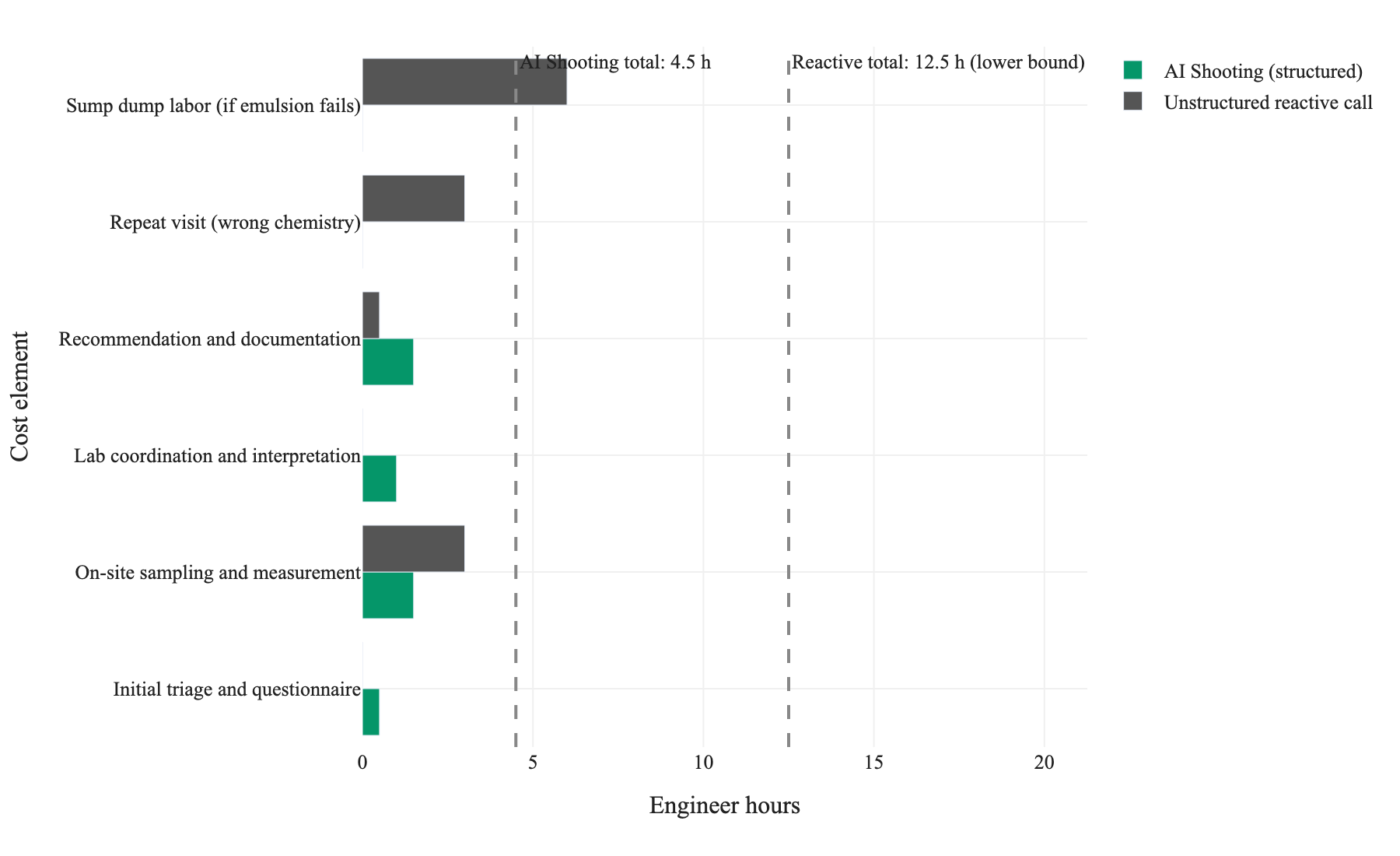
Cost element | Structured diagnostic (AI Shooting) | Unstructured reactive call |
|---|---|---|
Initial triage and questionnaire | 0.5 hours | Not performed |
On-site sampling and measurement | 1.5 hours | 3.0 to 4.0 hours (exploratory) |
Lab coordination and interpretation | 1.0 hour | 0 to 1.0 hour |
Recommendation and documentation | 1.5 hours | 0.5 to 1.0 hour |
Repeat visit (wrong chemistry) | Not required if protocol followed | 3.0 to 4.0 hours |
Sump dump labor (if emulsion fails) | Not required | 6.0 to 8.0 hours |
Total engineer hours | 4.5 hours | 12.5 to 17.0 hours |
Concentrate replacement cost (if dump) | Not required | USD 800 to USD 2,500 (800 L sump) |
Machine downtime during dump and recharge | Not required | 4.0 to 8.0 hours |
Metalworking fluid typically represents less than 1 percent of a manufacturer's total production budget, yet fluid management failures can generate downtime and scrap costs that are one to two orders of magnitude larger than the fluid cost itself (Master Fluid Solutions, 2022). A one-manufacturer case documented by Master Fluid Solutions (2022) demonstrated annual cutting fluid savings of USD 70,000 from structured maintenance alone, excluding downtime recovery value. The structured diagnostic framework does not guarantee bath recovery in every case. A bath at pH 7.8 with confirmed escalation-level bacterial count and 3 percent tramp oil sits at the boundary of recoverability. The diagnostic value is that it identifies the boundary clearly, provides a monitored recovery path, and documents the fallback trigger so the decision to dump is made on data rather than on the next customer complaint.
VI. The Agent Log: How Decisions Were Reconstructed
The agent decision log is what distinguishes an AI Shooting case from a manually assembled service report. Every data point that changed the recommendation trajectory is time-stamped, and the reasoning branch it closed is recorded alongside the branch it opened.
In this case, the agent log records five decision points where incoming data changed the active hypothesis. Understanding how those decision points work helps application engineers evaluate whether the AI Shooting recommendation is conservative, and whether to accept or override it in the field.
How Does the Agent Log Record Decision Branches?
The agent log records each incoming data point as an event that either confirms a standing hypothesis, eliminates a candidate from the shortlist, or introduces a new variable that was not in the original diagnostic tree. The following reconstructed log shows the five key branch points for this case.
Reconstructed Agent Decision Log: MWF Bath Instability Case
Decision Point 1 (Day 0, signal extraction questionnaire response received):
Incoming data: 10-day shutdown six weeks prior; undocumented biocide addition three days before inquiry
Branch closed: Clean-bath concentration drift as sole cause (shutdown and biocide addition make microbial plus chemical interaction more probable)
Branch opened: Biocide compatibility check added to mandatory diagnostic steps before any chemistry recommendation
Decision Point 2 (Day 2, on-site pH measurement: 7.8):
Incoming data: pH at 7.8, below the escalation criterion of 7.9
Branch closed: Mild bacterial contamination (pH this low implies sustained acid-producing bacterial load over multiple days; mild contamination does not sustain pH below 7.9 for more than 24 hours)
Branch opened: Sump dump probability elevated to 30 percent pending bacterial count confirmation; BIT shortlisted as primary candidate because it maintains efficacy in acidic conditions better than triazine products
Decision Point 3 (Day 2, tramp oil settling test: 3.1 percent):
Incoming data: Tramp oil at 3.1 percent, above the urgent threshold of 2 percent
Branch closed: Water hardness as primary concentration drift driver (high tramp oil with emulsifier degradation is sufficient to explain the refractometer drop independently)
Branch opened: Tramp oil skimming added to corrective action sequence as a prerequisite step before biocide addition (adding biocide into a bath with 3 percent tramp oil increases the risk of biocide partitioning into the oil phase, reducing in-sump effective concentration by 20 to 40 percent based on published biocide partition coefficient data for typical tramp oil compositions)
Decision Point 4 (Day 3, dip slide reading: greater than 10 to the 6th CFU/mL):
Incoming data: Bacterial count at escalation level confirmed
Branch closed: pH correction alone as sufficient intervention (pH below 7.9 with bacterial count at escalation level indicates the buffering capacity of the fluid has been consumed; pH will re-drop within 24 to 48 hours of correction unless bacterial load is simultaneously addressed)
Branch opened: Combination intervention confirmed as required: concentration restoration plus pH correction plus biocide addition in that sequence
Decision Point 5 (Day 4, laboratory biocide residual confirmation: HHT decomposition products present):
Incoming data: Triazine decomposition products confirmed; estimated original addition was underdosed at 0.08 percent versus 0.15 percent effective minimum
Branch closed: HHT retreat as a recovery option (adding more triazine into a bath with decomposition products and an established resistant microbial community carries the endotoxin release risk noted in Section IV)
Branch opened: BIT confirmed as sole viable chemistry path without full sump dump; Option A finalized as the recommendation
Each branch closure is a hypothesis that was data-disproven, not a guess that was abandoned. This distinction is what makes the agent log auditable: an application engineer reviewing the log can trace exactly which data point triggered each chemistry exclusion and assess whether that data point was measured reliably or should be re-tested.
What Does the Agent Log Not Capture?
The agent log does not capture information that was not measured. In this case, the log does not contain: a bacterial speciation analysis beyond Pseudomonas identification (speciation would have taken five additional days and was not required for biocide selection at this level); a biocide partition coefficient measurement for the specific tramp oil present (the 20 to 40 percent partitioning estimate is drawn from published literature ranges, not a site-specific measurement); or a water makeup analysis for the last three months, which would have been useful for trend analysis but was not available.
These documentation gaps are recorded in the AI Shooting report as stated limitations. They define the precision boundary of the recommendation. An application engineer who wants to close these gaps can add a bacterial speciation request to the Day 1 sampling kit at approximately two additional lab days and USD 40 to USD 80 in lab cost. The recommendation is valid without speciation for this instability class; speciation becomes material for recurring cases where different biocide classes are being evaluated systematically.
VII. Key Takeaway
An inbound customer email about MWF bath instability contains at least three signal categories before any measurement is taken: odor type (anaerobic versus aerobic), color change pattern, and refractometer drift direction. Extracting these signals with a structured questionnaire reduces diagnostic visit time by approximately 50 percent compared to unstructured exploratory visits.
The diagnostic threshold table in Section III (pH, concentration, bacterial count, tramp oil, water hardness) is the minimum variable set for any semi-synthetic MWF instability case. No chemistry recommendation is valid without values for all five variables, because a recommendation that addresses one variable while a second is at escalation level can cause secondary failure.
Biocide compatibility checking is not optional. For any bath that has received an undocumented or underdosed biocide addition, compatibility must be confirmed before a second addition. HHT decomposition products in a highly contaminated bath eliminate HHT retreatment and CMIT/MIT as safe options, narrowing the shortlist to BIT or glutaraldehyde in most semi-synthetic systems (STLE, 2019; ASTM E2275-19).
The corrective action sequence is as important as the chemistry selection. Biocide added before concentration is restored to the minimum effective threshold operates against a higher bacterial load than the dosing calculations assume, reducing effective in-sump concentration by the biocide partitioning factor into the tramp oil phase.
When an AI Crew agent flags an inbound email of the MWF instability class as an escalation, the structured diagnostic in this article is the response protocol. AI Crew handles routine monitoring, alert thresholding, and report generation for repeat customers; AI Shooting applies the per-case depth required for edge cases where one or more variables are at escalation level and the corrective action sequence is non-trivial.
When your AI Crew agent detects an MWF monitoring alert that falls outside routine thresholds, that is the escalation trigger for AI Shooting Deep. Submit the agent's flagged data set, the customer questionnaire responses, and your Day 1 field measurements to AI Shooting at https://www.lubinpla.com/ai-shooting for a structured per-case diagnostic report and ranked chemistry recommendation within three business days.
VIII. References
ASTM International. (2019). ASTM D2881-19: Standard Classification for Metalworking Fluids and Related Materials. https://www.astm.org/Standards/D2881.htm
ASTM International. (2019). ASTM E2275-19: Standard Practice for Evaluating Water-Miscible Metalworking Fluid Bioresistance and Antimicrobial Pesticide Performance. https://www.astm.org/Standards/E2275.htm
Cutwel Ltd. (2023). Expert Guide to Cutting Fluid Care and Maintenance. https://www.cutwel.co.uk/blog/expert-guide-to-cutting-fluid-care-and-maintenance
Cutting Tool Engineering. (2022). What are the Economic Benefits of Portable Sump Cleaners? https://www.ctemag.com/news/industry-news/what-are-economic-benefits-portable-sump-cleaners
Health and Safety Executive (HSE). (2022). Bacterial Contamination in Metalworking Fluids: Guidance Publication MW5. https://www.hse.gov.uk/metalworking/bacterial.htm
Master Fluid Solutions. (2022). The Cost Savings of Cutting Fluid Recycling Systems vs Disposal. https://www.masterfluids.com/blog/2022/12/13/the-cost-savings-of-cutting-fluid-recycling-systems-vs-disposal/
Master Fluid Solutions. (2023). How Unchecked Bacteria Growth and Poor Cutting Fluid Maintenance Can Derail Business Goals. https://www.masterfluids.com/blog/2023/08/03/how-unchecked-bacteria-growth-and-poor-cutting-fluid-maintenance-can-derail-business-goals/
Maunsell, S., Stewart, P., and Hamill, P. (2020). Microbiology in Water-Miscible Metalworking Fluids. Tribology Transactions, 63(5), 817–829. https://www.tandfonline.com/doi/full/10.1080/10402004.2020.1764684
Occupational Safety and Health Administration (OSHA). (2023). Metalworking Fluids: Safety and Health Best Practices Manual. https://www.osha.gov/metalworking-fluids/manual
Okwuosa, C. N., Ezeobiora, C., and Gugu, T. H. (2021). Ways to Improve Biocides for Metalworking Fluid. AIMS Microbiology, 7(1), 1–29. https://pmc.ncbi.nlm.nih.gov/articles/PMC7921375/
Puspita, I. D., Kamagata, Y., Tanaka, M., Asano, K., and Nakatsu, C. H. (2024). Microbial Community Establishment, Succession, and Temporal Dynamics in an Industrial Semi-Synthetic Metalworking Fluid Operation: A 50-Week Real-Time Tracking. Applied and Environmental Microbiology, 90(3). https://pmc.ncbi.nlm.nih.gov/articles/PMC10891577/
QualiChem. (2023). How to Correctly Use a Refractometer for Metalworking Fluids. https://qualichem.com/how-to-correctly-use-a-refractometer/
Society of Tribologists and Lubrication Engineers (STLE). (2019). Metalworking Fluids: The Quest for Bioresistance. Tribology and Lubrication Technology, March 2019. https://www.stle.org/files/TLTArchives/2019/03_March/Feature.aspx
Situ Biosciences. (2023). ASTM E2275: Evaluating Bioresistance and Microbicide Performance in Metalworking Fluids. https://www.situbiosciences.com/product/astm-e2275-evaluating-bioresistance-and-microbicide-performance-in-metalworking-fluids/