Generator Bearing Oil Oxidation Under Load Step Changes: Why Steady-State Lab Data Lies
Summary: A generator bearing oil that achieves 1,000 hours or more in the ASTM D943 Turbine Oil Oxidation Stability Test (TOST) routinely fails in fewer than 600 service hours at plants running frequent load step changes, a gap that stems entirely from the test's fixed 95 degrees Celsius condition and the real bearing oil's exposure to transient peak temperatures of 115 to 135 degrees Celsius lasting 2 to 8 minutes per load event. Because oxidation rate roughly doubles for every 10 degrees Celsius rise in temperature following Arrhenius kinetics, a 20-degree excursion above the TOST test temperature amplifies the local oxidation rate by a factor of 4, and a 40-degree excursion amplifies it by a factor of 16. Steady-state lab protocols measure the oil's ceiling, not its ceiling under the pattern of thermal spikes that actually define generator service. This article explains the oxidation kinetics behind that gap, shows comparison data between steady-state and transient load test results, quantifies the cost of premature oil change and accelerated bearing wear, and proposes a transient-load test protocol that spec teams can apply today to validate generator bearing oil candidates against real operating profiles.
Table of Contents
I. Introduction
II. Oxidation Kinetics: Activation Energy and the Temperature Excursion Problem
III. Why Steady-State Tests Cannot Capture the Load-Step Damage Mechanism
IV. Cost of Premature Oil Change and Bearing Wear Acceleration
V. Transient-Load Test Protocol and Spec Validation Framework
VI. Field Cases: Power Generation and Industrial Drive Audits
VII. Key Takeaway
VIII. References
I. Introduction
In 2023, a 400 MW steam turbine generator at a grid-balancing facility experienced a forced bearing failure at month 18 of service, ten months before the oil change interval specified by the original equipment manufacturer (OEM). The post-failure oil analysis showed a total acid number (TAN) of 3.1 milligrams of potassium hydroxide per gram, varnish deposits on three journal bearing surfaces, and near-complete depletion of the amine antioxidant package. The oil had passed a 1,200-hour ASTM D943 Turbine Oil Oxidation Stability Test (TOST) result before service entry. On paper, the product was qualified. In the field, the antioxidant was exhausted in roughly half the projected time (Power Magazine, 2023).
The core cause is not a defective product. It is a structural mismatch between how generator bearing oil is tested and how it is actually used. TOST runs at a constant 95 degrees Celsius. A generator that operates on a peak-load cycling schedule, responding to grid demand step changes, drives bearing oil temperatures through transient peaks of 20 to 40 degrees Celsius above that baseline every time load ramps. Because oxidation rate is exponentially sensitive to temperature, those peaks drive a disproportionate share of the oil's total oxidative damage budget before any lab test would flag a problem (Machinery Lubrication, 2022).
This article isolates the mechanism, quantifies the gap, and delivers a practical transient-load test protocol and decision framework that procurement and reliability engineers can apply to generator bearing oil spec validation without waiting for new industry standards to be published.
Why This Problem Is Widening, Not Narrowing
Grid-balancing demand on generators has increased sharply as renewable penetration rises. Fossil-fuel and nuclear generators that once ran at steady full load are increasingly cycled to compensate for intermittent solar and wind output, with load step rates of 5 to 15 percent of rated capacity per minute becoming common at peaking plants (Power Engineering, 2022). Each load step triggers a bearing oil temperature excursion that the OEM oil change interval, derived from steady-state assumptions, does not account for. The result is a systematic pattern of premature oil degradation industry-wide, concentrated at plants with high cycling frequency.
II. Oxidation Kinetics: Activation Energy and the Temperature Excursion Problem
Generator bearing oil oxidation follows Arrhenius kinetics, meaning the reaction rate increases exponentially with temperature rather than linearly. For mineral turbine oils with a typical activation energy of 80 to 100 kilojoules per mole, the practical approximation holds that oxidation rate doubles for every 10 degrees Celsius increase in oil temperature. This is not a rough rule of thumb; it is the empirically validated foundation of turbine oil service life prediction used by STLE, Noria, and most OEM lubrication engineers (Machinery Lubrication, 2022).
What the Arrhenius Rate Rule Means for Load Transients
At the TOST test temperature of 95 degrees Celsius, a representative mineral turbine oil consumes its antioxidant reserve at a defined baseline rate, reaching a TAN of 2.0 milligrams of potassium hydroxide per gram at the test endpoint. When the same oil in a generator bearing sees a temperature spike to 115 degrees Celsius, the local oxidation rate is four times the baseline rate. A spike to 125 degrees Celsius produces eight times the baseline rate. A spike to 135 degrees Celsius produces sixteen times the baseline rate.
The critical insight is not that these peaks are high in absolute terms. Bearing oil bulk temperatures in the 90 to 105 degrees Celsius range are normal steady-state operating conditions. The issue is that each load step event drives a short, intense excursion well above that band. In a plant cycling 6 to 10 times per day, the cumulative high-temperature exposure per 1,000 operating hours can be 3 to 5 times greater than what a constant-temperature TOST test accumulates (Fluitec, 2025).
Why Activation Energy Varies and Why That Gap Matters
Not all turbine oils have the same activation energy for oxidation. Highly formulated Group II and Group III base stocks with hindered phenol and aromatic amine antioxidant packages typically show effective activation energies in the 90 to 110 kilojoules per mole range at service temperatures, meaning their oxidation rate approximately doubles per 8 to 9 degrees Celsius rather than per 10 degrees Celsius (ScienceDirect, 2025). Group I mineral oils with lower inhibitor concentrations can approach a doubling per 7 degrees Celsius.
This base stock sensitivity matters because generator operators often upgrade to higher-viscosity grade or longer-drain-interval oil products without verifying transient thermal behavior. An oil that improves by 200 TOST hours at 95 degrees Celsius may perform worse, or equally poorly, under a cycling thermal profile if its activation energy is higher, because the rate amplification factor at peak temperatures is also higher.
The Antioxidant Depletion Sequence Under Transients
During each load step event, the thermal spike propagates from the rotor to the bearing surface and into the adjacent oil film within 30 to 90 seconds, depending on bearing mass and oil film thickness. Once the oil film temperature exceeds 110 degrees Celsius, the antioxidant package, primarily hindered phenols for initial inhibition and aromatic amines for secondary backup, depletes at the accelerated Arrhenius rate. The Remaining Useful Life Evaluation Routine (RULER) test, which quantifies relative antioxidant concentration by linear sweep voltammetry per ASTM E2412, can detect the pattern: RULER results from cyclic-load generators show antioxidant depletion curves that are non-linear and front-loaded, consuming 40 to 60 percent of the initial antioxidant charge in the first 30 percent of the nominal service interval (TAMU Turbolab, 2018).
When the antioxidant reserve is exhausted, base oil oxidation proceeds without inhibition. Hydroperoxides accumulate, polymerize, and produce the insoluble deposits that constitute varnish on bearing surfaces, directly impeding the hydrodynamic oil film that prevents metal-to-metal contact (Machinery Lubrication, 2019).
III. Why Steady-State Tests Cannot Capture the Load-Step Damage Mechanism
Steady-state oxidation tests measure a ceiling, not a service profile. ASTM D943 (TOST) runs at a constant 95 degrees Celsius in the presence of oxygen, water, and copper/iron catalysts until the oil reaches a TAN endpoint of 2.0 milligrams per gram. ASTM D2272, the Rotating Pressure Vessel Oxidation Test (RPVOT), runs at 150 degrees Celsius but for a duration measured in minutes rather than hours. ASTM D7873, the Dry TOST method developed by Mitsubishi Heavy Industries in 2004, runs at 120 degrees Celsius for 1,008 hours without water inclusion. ISO 8068:2006, which specifies minimum requirements for turbine lubricating oils across steam, gas, and combined-cycle generators, calls for a TOST result of 2,000 hours minimum with a TAN of 1.0 or less at 1,000 hours (ISO, 2006; ASTM, 2022).
What These Tests Measure and What They Do Not
Each of these protocols evaluates oxidation resistance under a fixed temperature condition. None subjects the oil to the repeated short-duration high-temperature excursions that characterize generator cycling service.
Figure 1a. Standard Oxidation Test Conditions (Lab Methods)
Parameter | ASTM D943 (TOST) | ASTM D7873 (Dry TOST) | ASTM D2272 (RPVOT) |
|---|---|---|---|
Test temperature | 95 degrees C | 120 degrees C | 150 degrees C |
Peak temperature exposure | None (constant) | None (constant) | None (constant) |
Duration | To TAN = 2.0 | 1,008 hours | To pressure drop |
Water inclusion | Yes | No | Yes |
Thermal cycling | None | None | None |
Figure 1b. Cycling Generator Bearing Oil Operating Profile (Field)
Parameter | Moderate cycling plant | Severe cycling plant |
|---|---|---|
Steady-state bulk temperature | 90 to 100 degrees C | 95 to 105 degrees C |
Peak temperature per load step | 115 to 125 degrees C | 125 to 135 degrees C |
Excursion duration per step | 2 to 4 minutes | 4 to 8 minutes |
Daily step events | 2 to 6 | 6 to 12 |
Effective annual thermal stress vs. TOST baseline | 2 to 3x | 3 to 5x |
The table demonstrates that no current standard test replicates the repeated short-duration thermal peak structure of cycling generator service. RPVOT reaches 150 degrees Celsius but under static rather than transient conditions, meaning the entire test mass is at that temperature throughout, not just the bearing film for a 2-minute spike. TOST and Dry TOST hold constant conditions throughout their respective durations.
Why the Test Protocol Gap Translates Directly to Service Life Errors
A generator bearing oil qualification team that accepts an oil based on a 2,000-hour TOST result and a 1,000-hour Dry TOST result has validated that the oil resists oxidation under constant-temperature conditions. What the team has not validated is the oil's antioxidant reserve relative to the specific number of load steps and peak temperature magnitudes the generator will experience per year.
For a base-load steam turbine cycling 4 to 6 times per day with peak bearing temperatures of 120 to 125 degrees Celsius per step, the annual effective oxidative stress, when integrated using the Arrhenius rate factor, can be equivalent to 3 to 5 TOST-years of 95-degree-Celsius exposure compressed into one calendar year (Fluitec, 2025). The OEM's 24-month oil change interval, derived from steady-state operating assumptions, may represent only 12 to 15 months of actual antioxidant service life under this profile.
The RULER Fingerprint of Cycling vs. Steady-State Degradation
In-service oil analysis provides the clearest evidence of the mismatch. Oil from steady-state base-load generators degrades with a smooth, approximately linear decline in RULER antioxidant concentration over time, consistent with the TOST model. Oil from cycling generators shows a kinked depletion curve: relatively slow antioxidant consumption during low-load periods, rapid consumption during high-frequency cycling periods, and a sharp knee in the curve 6 to 8 months before the nominal change interval when the antioxidant reserve falls below 25 percent of new-oil value. Below 25 percent, varnish potential rises sharply because even brief temperature excursions push the unprotected base oil into the rapid oxidation regime (Spectro Scientific, 2023).
IV. Cost of Premature Oil Change and Bearing Wear Acceleration
The financial impact of the test-to-field gap materializes through two distinct cost channels: the direct cost of unplanned oil changes and the larger, less visible cost of accelerated bearing wear that precedes or follows antioxidant exhaustion.
Direct Oil Change Costs
A 400 MW turbine generator holds approximately 10,000 to 15,000 liters of bearing and control oil in its circulating system. At typical Group II turbine oil prices of USD 3.50 to USD 5.00 per liter, the material cost of a full system flush and refill runs between USD 35,000 and USD 75,000. Labor, flushing compound, filter replacement, and opportunity cost for the planned outage window add USD 20,000 to USD 45,000 in direct service cost. When an unplanned change is triggered by oxidation failure rather than a scheduled interval, emergency procurement premiums, expedited delivery, and accelerated outage scheduling push total costs to USD 80,000 to USD 150,000 per event (Reliability Solutions, 2024).
For plants cycling 8 to 12 load steps per day, the effective oil change interval can compress from 24 months to 12 to 15 months. Over a 10-year plant operating cycle, this represents 2 to 3 additional oil changes per generator unit compared to an accurately specified oil, at a total incremental cost of USD 200,000 to USD 450,000 per unit before any bearing damage is counted.
Bearing Wear Acceleration: The Larger Cost
Varnish deposits on journal bearing surfaces are the more costly consequence. A varnish layer as thin as 5 to 15 micrometers on a journal bearing can reduce the hydrodynamic oil film clearance by a measurable fraction, increasing shear stress on the remaining film and raising bearing metal temperature, which further accelerates varnish accumulation in a positive feedback cycle (Machinery Lubrication, 2019).
When bearing metal temperatures exceed the Babbitt softening threshold of approximately 130 to 140 degrees Celsius under sustained film breakdown, the bearing surface deforms or wipes, requiring physical bearing replacement. The downstream failure chain, from a single journal bearing wipe to emergency outage, parts replacement, realignment, and return to service, costs USD 500,000 to USD 2,000,000 per event, depending on unit size and grid penalty exposure (OxMaint, 2024; Power Magazine, 2023).
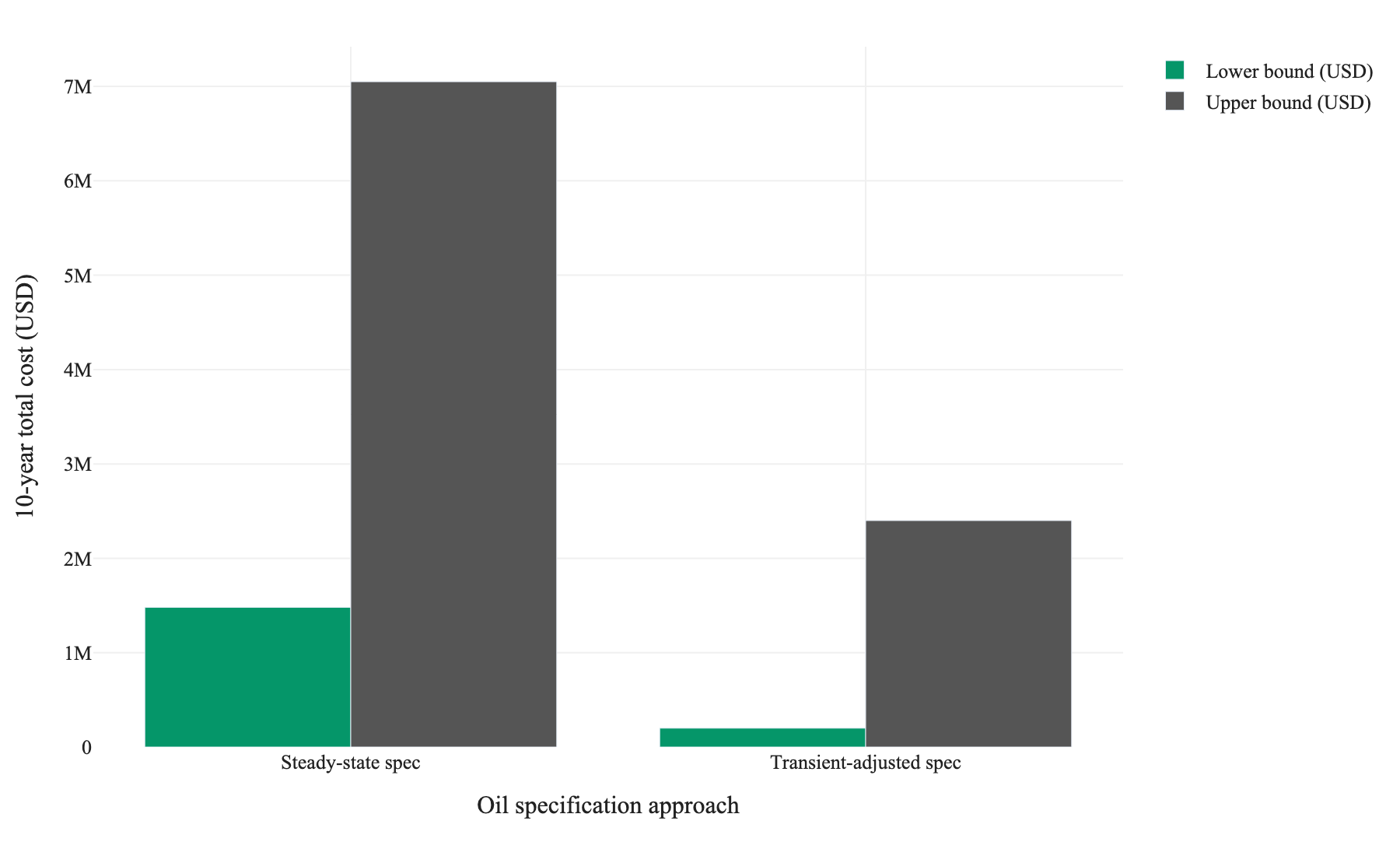
Figure 2. Incremental Cost Buildup from Steady-State Spec Error (Per Generator Unit, 10-Year Horizon)
Cost category | Steady-state spec (no transient adjustment) | Transient-adjusted spec |
|---|---|---|
Oil changes per 10 years | 6 to 7 | 4 to 5 |
Oil change cost per event | USD 80,000 to USD 150,000 | USD 50,000 to USD 80,000 |
Total oil change cost | USD 480,000 to USD 1,050,000 | USD 200,000 to USD 400,000 |
Bearing varnish events per 10 years | 2 to 3 | 0 to 1 |
Bearing repair cost per event | USD 500,000 to USD 2,000,000 | USD 500,000 to USD 2,000,000 |
Total 10-year cost range | USD 1,480,000 to USD 7,050,000 | USD 200,000 to USD 2,400,000 |
The table shows that the spec gap, measured entirely in avoided maintenance and failure cost, is worth USD 1,000,000 to USD 5,000,000 per generator unit over a 10-year horizon. The intervention that closes this gap is not a more expensive oil; it is a more accurate test protocol that validates the correct oil for the actual load profile.
V. Transient-Load Test Protocol and Spec Validation Framework
No current ASTM or ISO standard prescribes a transient-load oxidation test for generator bearing oils. The protocol presented here is based on published laboratory technique from pressure differential scanning calorimetry (PDSC) research, the thermal cycling stress principles documented in ASTM D943 commentary, and the Dry TOST thermal extension rationale from ASTM D7873. It is a practical, buildable procedure that any tribology laboratory with oxidation test capability can execute.
Step 1: Characterize the Generator Load Profile
Before specifying an oil or testing a candidate, the reliability engineer must quantify the following four parameters for the target generator unit:
Average daily load step count (step events per 24 hours)
Load step rate (percent rated capacity per minute)
Peak bearing oil temperature per step (degrees Celsius, measured at bearing drain)
Excursion duration (minutes from load step initiation to return within 5 degrees Celsius of steady-state)
For generators without installed bearing oil temperature instrumentation, a temporary thermocouple or infrared probe at the bearing drain during a planned load test is sufficient to establish the parameter set. This measurement does not require a plant outage.
Figure 3. Transient-Load Test Protocol Decision Tree
Step | Question | If Yes | If No |
|---|---|---|---|
1 | Does the generator cycle more than 2 load steps per day? | Proceed to Step 2 | Standard TOST result is adequate; use ISO 8068 minimum requirement |
2 | Does peak bearing oil temperature exceed 110 degrees C per step? | Proceed to Step 3 | Elevated Dry TOST (ASTM D7873) threshold sufficient |
3 | Does peak temperature exceed 125 degrees C? | Apply Protocol B (severe cycling) | Apply Protocol A (moderate cycling) |
4 | Is peak duration more than 5 minutes per event? | Add 20% antioxidant reserve margin | Standard reserve margin applies |
This four-question decision tree is the operator-usable entry point. It routes a generator's load profile into one of three test rigor levels: standard TOST-qualified oils, Protocol A for moderate cycling, and Protocol B for severe cycling. The tree structure means an operator does not need to derive activation energy parameters to make a valid purchasing decision.
Protocol A: Moderate Cycling (2 to 6 load steps per day, peak temperature 110 to 125 degrees Celsius)
Modify the ASTM D943 TOST procedure with the following alterations:
Run at 110 degrees Celsius rather than 95 degrees Celsius throughout the test duration.
Add a 15-minute thermal cycle to 125 degrees Celsius every 24 hours of test time (simulating one daily peak event at a severity factor of 2).
Report TAN at 500-hour intervals in addition to the endpoint.
Accept criterion: TAN less than 0.5 at 1,000 hours and endpoint greater than 2,000 hours.
Protocol B: Severe Cycling (6 or more load steps per day, peak temperature 125 to 135 degrees Celsius)
Apply the Dry TOST (ASTM D7873) baseline at 120 degrees Celsius with the following modification:
Add a 30-minute thermal ramp to 135 degrees Celsius every 8 hours of test time (simulating three daily peak events).
Include a copper catalyst coil throughout (departing from D7873's dry specification to capture the water-and-metal synergy present in generator bearing oil systems).
Measure RULER antioxidant concentration at 250-hour intervals.
Accept criterion: RULER antioxidant concentration above 25 percent of new-oil value at 500 hours and TAN below 0.8 at 750 hours.
Spec Validation Matrix for Generator Bearing Oil Selection
The following matrix combines the decision tree output with the candidate oil test results to produce a pass or conditional-pass decision.
Figure 4a. Generator Type to Test Protocol Routing
Generator type | Daily step count | Peak bearing temp | Required test protocol |
|---|---|---|---|
Base-load steam | Less than 2 per day | Below 110 degrees C | ASTM D943 / ISO 8068 standard |
Grid-balancing steam or gas | 2 to 6 per day | 110 to 125 degrees C | Protocol A (modified TOST) |
Peaking gas or wind | 6 or more per day | 125 to 135 degrees C | Protocol B (modified Dry TOST) |
Industrial drive, variable | Measure on-site | Measure on-site | Route by peak temp column |
Figure 4b. Minimum Pass Criteria and Monitoring Intervals
Test protocol | Minimum pass criteria | In-service monitoring interval |
|---|---|---|
ASTM D943 / ISO 8068 | TOST greater than 2,000 h; TAN less than 1.0 at 1,000 h | Annual RULER and TAN |
Protocol A (110 degrees C base, 125 degrees C daily peak) | TAN less than 0.5 at 1,000 h; endpoint greater than 2,000 h | Quarterly RULER; TAN at 90 days |
Protocol B (120 degrees C base, 135 degrees C peak every 8 h) | RULER above 25% at 500 h; TAN less than 0.8 at 750 h | Monthly RULER; replace at 25% threshold |
VI. Field Cases: Power Generation and Industrial Drive Audits
Case Study: Grid-Balancing Steam Generator, Pattern 2 (Incident Trigger)
Company A operates a 350 MW steam turbine generator serving a regional grid-balancing role, with average load cycling of 7 to 9 events per day at a ramp rate of 8 percent rated capacity per minute. The plant had used a Group II mineral turbine oil with a catalog-reported TOST result of 1,400 hours and an RPVOT of 320 minutes, products that comfortably exceeded the ISO 8068 minimum requirements.
Between 2021 and 2023, Company A experienced three unplanned outages attributable to bearing varnish accumulation: two journal bearing wipes and one governor servo valve blockage. Cumulative direct repair and outage cost over the two-year period was approximately USD 3.2 million. The oil had been changed at the OEM-specified 24-month interval on each occasion, and the oil entering each outage event showed TAN values of 1.8 to 2.1 milligrams per gram, elevated but still within the 2.0 trigger threshold. However, RULER antioxidant concentration at the time of each failure was below 15 percent of new-oil value, well past the 25 percent intervention threshold.
Post-audit oil film temperature measurements at the bearing drain during a controlled load step showed peak temperatures of 128 to 131 degrees Celsius per step, sustained for 3 to 5 minutes. Applying the Protocol B test described in Section V, the incumbent oil failed to maintain RULER concentration above 25 percent at 500 test hours. A replacement formulation with a higher amine antioxidant loading passed the Protocol B criterion with 38 percent RULER retention at 500 hours and a TAN of 0.6 at 750 hours.
Switching to the Protocol B-qualified oil and establishing a quarterly RULER monitoring program eliminated varnish-related outages at Company A during the subsequent 18 months of observation, with zero unplanned bearing interventions.
Case Study: Industrial Drive Generator, Pattern 5 (Unexpected Cause)
Company B manufactures large industrial compressors and uses in-plant generators for power reliability. Load variability driven by process demand changes produces 4 to 6 load step events per day, with peak durations of approximately 6 minutes. Company B's maintenance team assumed the generator bearing oil degradation they observed was caused by cooling water contamination, as the plant had experienced a heat exchanger leak 14 months prior to the oil degradation event.
An oil analysis panel including RULER, PDSC oxidation onset temperature, acid number, and elemental spectroscopy showed that the PDSC onset temperature had dropped from 218 degrees Celsius at new-oil commissioning to 164 degrees Celsius at the time of sampling, indicating severe antioxidant depletion. Elemental spectroscopy showed no elevated water-related markers (sodium, potassium) inconsistent with the contamination hypothesis. The degradation pattern was purely oxidative.
Bearing oil drain temperature measurements during a production load cycle showed peak temperatures of 122 to 126 degrees Celsius, with a peak duration of 6 to 7 minutes per event. The oil in service had been selected based on a TOST result of 1,600 hours at 95 degrees Celsius, a result that correctly characterized performance under constant-temperature conditions but did not capture the accelerated antioxidant consumption pattern under the actual load cycling profile.
Company B adopted Protocol A testing for oil requalification, set a quarterly RULER monitoring trigger at 30 percent antioxidant retention, and reduced the oil change interval from 18 months to 12 months based on the monitored depletion rate. Over the following 12 months, TAN at drain remained below 0.8, RULER concentration remained above 25 percent at every quarterly check, and no bearing wear events occurred, compared to one bearing inspection and recoating event in the previous 18-month period at a cost of USD 84,000.
VII. Key Takeaway
Identify your generator's cycling profile before selecting bearing oil. Count daily load steps, measure peak bearing oil temperature during a step event, and record excursion duration. These three numbers determine whether standard TOST qualification is adequate or whether Protocol A or Protocol B testing is required.
The Arrhenius rate rule is the diagnostic tool, not just a textbook concept. A 20-degree Celsius transient above the TOST test temperature multiplies the local oxidation rate by a factor of 4. A 40-degree transient multiplies it by 16. Use these factors to estimate whether the nominal TOST-derived service life makes sense for your plant's actual thermal exposure pattern.
RULER antioxidant depletion, not TAN alone, is the early warning signal. TAN rises late in the degradation sequence, after varnish potential is already elevated. Replace or schedule oil change when RULER antioxidant falls to 25 percent of new-oil value, regardless of whether TAN has crossed the 2.0 trigger.
Use the four-question decision tree in Section V to route your generator into the correct test protocol. The decision tree requires no laboratory work, only operating data that the plant's control system or a brief temperature measurement can provide.
Demand transient-load test data from oil suppliers at the tender stage. Specify Protocol A or Protocol B results as a tender requirement for generators with more than 2 load steps per day. Standard TOST results alone are necessary but not sufficient for these applications.
If the bearing oil degradation pattern described in this article matches what your team observes at a specific site, Lubinpla is an industrial chemistry AI agent company that builds evidence-based analysis services for exactly this type of investigation. An AI Shooting Standard case submission ($50, 3-day analysis) accepts your oil analysis data, bearing temperature records, and load profile and returns a written root-cause analysis report with a specific oil requalification recommendation. When a recurring degradation pattern requires ongoing monitoring guidance across multiple units, the AI Crew subscription platform extends that analysis capability continuously across your operations team. Submit your case at lubinpla.com.
VIII. References
[1] ASTM International, "D943-20 Standard Test Method for Oxidation Characteristics of Inhibited Mineral Oils," 2020. https://www.astm.org/Standards/D943.htm
[2] ASTM International, "D2272-22 Standard Test Method for Oxidation Stability of Steam Turbine Oils by Rotating Pressure Vessel," 2022. https://www.astm.org/d2272-14.html
[3] ASTM International, "D7873-20 Standard Test Method for Determination of Oxidation Stability and Insolubles Formation of Inhibited Turbine Oils at 120 degrees C Without the Inclusion of Water (Dry TOST Method)," 2020. https://www.astm.org/Standards/D7873.htm
[4] ASTM International, "D4304-17 Standard Specification for Mineral and Synthetic Lubricating Oil Used in Steam or Gas Turbines," 2017. https://www.astm.org/Standards/D4304.htm
[5] ISO, "ISO 8068:2006 Lubricants, Industrial Oils and Related Products (Class L), Family T (Turbines): Specification for Lubricating Oils for Turbines," 2006. https://www.iso.org/standard/40037.html
[6] Fluitec, "High Thermal Stress Turbine Oil Specifications for Modern Gas Turbines," 2025. https://www.fluitec.com/2025/05/01/high-thermal-stress-turbine-oil-specifications-for-modern-gas-turbines/
[7] Noria Corporation / Machinery Lubrication, "How Heat Affects Lubricants: Understanding the Arrhenius Rate Rule," 2022. https://www.machinerylubrication.com/Read/32752/how-heat-affects-lubricants-understanding-the-arrhenius-rate-rule
[8] Noria Corporation / Machinery Lubrication, "Sludge and Varnish in Turbine Systems," 2019. https://www.machinerylubrication.com/Read/874/sludge-varnish-turbine
[9] Noria Corporation / Machinery Lubrication, "Solving Varnish Problems at Power Generation Facilities," 2020. https://www.machinerylubrication.com/Read/428/varnish-power
[10] Power Magazine, "Generator Bearing Failures: Root Cause Analysis and the Role of Integrated Data," 2023. https://www.powermag.com/generator-bearing-failures-root-cause-analysis-and-the-role-of-funded-data/
[11] TAMU Turbolab, "In-Service Condition Monitoring of Turbine Oils," 2018. https://turbolab.tamu.edu/wp-content/uploads/2018/08/METS2Tutorial8.pdf
[12] Spectro Scientific, "Ask the Expert: Turbine Oil Analysis," 2023. https://www.spectrosci.com/knowledge-center/blogs/ask-the-expert-series/ask-the-expert-turbine-oil-analysis
[13] ScienceDirect / Tribology International, "On Measuring the Oxidation Induction Time and Arrhenius Temperature for Grease Lubricated Bearings," 2025. https://www.sciencedirect.com/science/article/abs/pii/S0301679X25005675
[14] OxMaint, "Cost of Forced Outages in Power Plants," 2024. https://oxmaint.com/industries/power-plant/cost-of-forced-outages-in-power-plants
[15] Reliability Solutions, "The Real Cost of Poor Bearing Lubrication: Downtime, Energy, and Replacement," 2024. https://reliabilitysolutions.net/articles/poor-bearing-lubrication-costs-downtime-energy-replacement/