How Anaerobic Adhesives Lock Threaded Fasteners: Chemistry and Failure Modes
Summary: Anaerobic adhesives cure through free-radical polymerization initiated by metal ion contact in the absence of oxygen, but their performance varies dramatically depending on substrate metallurgy, fastener geometry, plating type, and temperature. This article explains the cure mechanism at the chemical level, examines how substrate and environmental factors affect cure development and long-term holding power, walks through grade selection criteria by strength class, identifies the most common failure modes, and provides a substrate-grade decision matrix for reliable threadlocker selection including primer requirements for passive metals.
Table of Contents
I. Why Threaded Fasteners Need Chemical Locking
II. The Anaerobic Cure Mechanism
III. Threadlocker Grade Selection: Low, Medium, and High Strength
IV. How Substrate Metallurgy Controls Cure Performance
V. Temperature and Chemical Resistance by Grade
VI. Common Failure Modes and Root Causes
VII. Primer and Activator Selection for Difficult Substrates
VIII. Field Cases: Matching Threadlocker to Application
IX. Key Takeaway
X. References
I. Why Threaded Fasteners Need Chemical Locking
Threaded fasteners rely on friction between mating threads to maintain clamp load. In dynamic environments with vibration, thermal cycling, or shock loading, this friction degrades over time as micro-movements between threads cause progressive loosening. Studies indicate that vibration-induced fastener loosening is responsible for approximately 23 percent of mechanical joint failures in industrial equipment (Bickford, 2007). Mechanical locking devices such as lock washers, nylon inserts, and prevailing torque nuts address loosening but add cost, increase assembly complexity, and have limited effectiveness under severe vibration.
The economic impact extends beyond the cost of a failed joint. A single loosened fastener on a rotating equipment flange can trigger an unplanned shutdown costing tens of thousands of dollars per hour in lost production. In petrochemical or power generation plants, a loosened bolt on a pressurized line introduces leak risk with safety and environmental consequences that dwarf the cost of the fastener itself.
The Anaerobic Alternative
Anaerobic threadlockers provide a chemical solution. They cure in the narrow gap between mating threads, forming a thermoset polymer that fills the thread clearance and bonds to both surfaces. This eliminates the micro-movements that cause loosening and provides a seal against fluid ingress. The result is a joint that maintains clamp load indefinitely under service conditions within the adhesive's design limits.
Unlike mechanical locking methods, anaerobic threadlockers distribute load across the entire engaged thread length rather than concentrating stress at a single locking feature. The cured polymer also fills the helical leak path between threads, providing a seal against fluid ingress without separate thread sealant tape or paste.
II. The Anaerobic Cure Mechanism
Anaerobic adhesives are based on methacrylate monomers, most commonly dimethacrylate esters, that remain liquid in the presence of oxygen but polymerize rapidly when oxygen is excluded and metal ions are present. The cure proceeds through free-radical polymerization, a chain reaction that converts liquid monomer into a rigid, cross-linked thermoset polymer.
Initiation: The Metal-Catalyzed Redox Reaction
The adhesive formulation contains hydroperoxide initiators, typically cumene hydroperoxide, along with amine accelerators and stabilizers. When the adhesive contacts a transition metal surface, the metal ions (Fe2+, Cu+, Mn2+) catalyze decomposition of the hydroperoxide through a redox reaction. This decomposition generates free radicals that initiate the polymerization chain reaction.
On copper substrates, this process is particularly efficient. Research published in PMC (2024) demonstrated that copper ions lower the activation energy required for hydroperoxide decomposition compared to iron. An equilibrium forms between Cu+ and Cu2+ oxidation states: the hydroperoxide oxidizes Cu+ to Cu2+, generating reactive radicals, while simultaneously reducing Cu2+ back to Cu+, continuously regenerating the catalytic species. The amine accelerator complexes with the metal ions, further increasing reactivity. The key requirement is direct contact between the adhesive and an active metal surface -- the metal acts as the catalyst, making anaerobic adhesives "substrate-activated."
Propagation and Cross-Linking
Once initiated, the free radicals react with methacrylate monomers, adding them to a growing polymer chain. Because the monomers are difunctional (two reactive methacrylate groups), the growing chains cross-link, building a three-dimensional thermoset network. This cross-linked structure gives cured anaerobic adhesives their rigidity, chemical resistance, and resistance to creep.
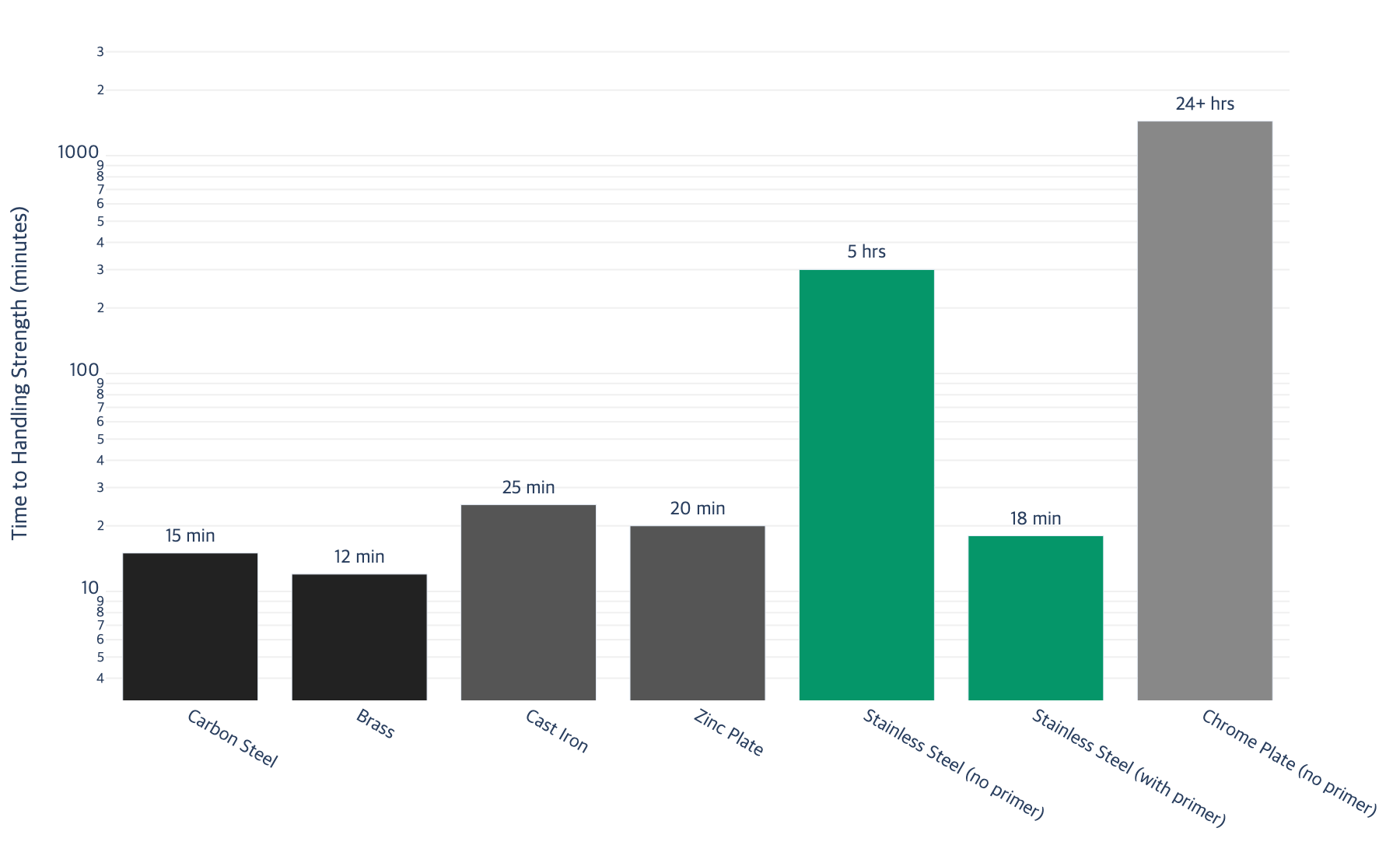
The polymerization progresses from the metal-adhesive interface inward. Full cure typically develops within 24 hours at room temperature, but handling strength develops within 10 to 30 minutes on active metals such as carbon steel and brass. Cure speed also depends on temperature: above room temperature, cure accelerates; below 5 degrees Celsius, cure slows dramatically.
Oxygen Inhibition and Gap Limits
On exposed surfaces, dissolved oxygen scavenges free radicals and prevents polymerization. This is why anaerobic adhesives remain liquid in the bottle (with oxygen present) but cure when confined between metal surfaces (oxygen excluded). The gap must be small enough to exhaust dissolved oxygen quickly.
For standard formulations, the maximum recommended gap fill is 0.25 mm (0.01 inches), with some higher-viscosity products rated to 0.5 mm (0.02 inches). When gaps exceed these limits, excess trapped oxygen inhibits polymerization, resulting in partially cured or still-liquid material in the center of the joint. This is a critical consideration for worn or damaged threads.
III. Threadlocker Grade Selection: Low, Medium, and High Strength
Threadlockers are classified by strength grade, which determines the breakaway torque required for disassembly and which fastener sizes are appropriate. Selecting the wrong grade is one of the most common threadlocker-related problems in the field.
Low Strength (Purple)
Low-strength threadlockers are designed for fasteners from M2 to M12 that require frequent adjustment or disassembly. They prevent vibration-induced loosening while allowing removal with standard hand tools.
Typical breakaway torque on steel: 3 to 8 Nm on M10 nuts and bolts. Representative product: Loctite 222, with a rated breakaway torque of approximately 6 Nm.
Common applications include instrument panel screws, calibration adjustment fasteners, and set screws on positioning equipment. The low-strength polymer fractures cleanly during disassembly, and threads can be reassembled with fresh adhesive without removing cured residue.
Medium Strength (Blue)
Medium-strength threadlockers are suitable for fasteners from M6 to M20, balancing vibration resistance against disassembly requirements. They allow removal with standard hand tools, though with more effort than low-strength grades.
Typical breakaway torque on steel: 10 to 27 Nm on M10 nuts and bolts, depending on formulation. Representative products include Loctite 242 (breakaway torque approximately 11.5 Nm) and Loctite 243 (breakaway torque approximately 26 Nm). The 243 formulation also has improved oil tolerance, making it more forgiving on surfaces with residual machining fluid.
Medium-strength threadlockers are the default choice for general assembly, covering the majority of threaded fasteners in pumps, compressors, mechanical drives, and process equipment.
High Strength (Red)
High-strength threadlockers are designed for permanent assemblies where disassembly is infrequent. They generate breakaway torques exceeding 25 to 30 Nm on M10 fasteners.
Representative products include Loctite 271 and Loctite 272 (272 being the higher-strength formulation). Disassembly typically requires heating the joint to 250 degrees Celsius with a heat gun or propane torch, which degrades the polymer and reduces breakaway torque to manageable levels. Common applications include studs in heavy equipment engine blocks, structural bolts, and critical fasteners on mining and earthmoving equipment.
Strength Grade Decision Factors
The grade selection depends on four factors evaluated together: (1) fastener size, since high-strength products on small fasteners risk exceeding the bolt's yield strength during disassembly; (2) disassembly frequency, with routine-maintenance fasteners using low or medium strength; (3) vibration severity, where the prevailing torque matters more than breakaway torque; and (4) service temperature, since elevated temperatures soften the polymer and may require a higher-strength grade or specialty formulation to compensate.
IV. How Substrate Metallurgy Controls Cure Performance
The cure rate and ultimate strength depend directly on the substrate's ability to provide metal ions for hydroperoxide decomposition.
Figure 1. Cure Speed by Substrate Type
Active vs. Passive Substrates
Substrate Category | Examples | Cure Speed | Typical Handling Strength Time | Primer Required? |
|---|---|---|---|---|
Highly active | Carbon steel, brass, copper | Fast | 10-20 minutes | No |
Moderately active | Cast iron, bronze | Moderate | 20-40 minutes | Usually no |
Passive | Stainless steel (300 series) | Slow | 2-8 hours | Recommended |
Very passive | Anodized aluminum, chrome plate | Very slow or no cure | Incomplete without primer | Required |
Inactive | Plastic, glass, ceramic | No cure | Not applicable | Activator required |
The difference is dramatic. On carbon steel, a medium-strength threadlocker achieves handling strength in 15 minutes. The same product on stainless steel may require 4 to 8 hours, and on chrome-plated fasteners, it may never achieve full cure without a primer or activator.
Copper is the most effective catalyst for anaerobic cure because Cu+ ions have the lowest activation energy for hydroperoxide decomposition among common engineering metals. Iron (Fe2+) is also effective, which is why carbon steel and cast iron support fast cure. Stainless steel contains iron, but the chromium oxide passive layer prevents the underlying iron from participating in the redox reaction at the adhesive interface.
Plating Effects
Zinc plating is moderately active and supports cure, though slightly slower than bare steel. Cadmium plating is active and supports normal cure. Chrome plating is passive and inhibits cure. Nickel plating is also passive. A carbon steel bolt with chrome plating behaves like a passive substrate, not an active one -- a frequent source of specification errors where the bolt material is listed as "steel" without noting the plating.
Phosphate coatings (manganese phosphate, zinc phosphate) are generally compatible with anaerobic cure and can slightly accelerate it, because the porous phosphate layer retains adhesive and provides additional surface area for metal ion transfer.
V. Temperature and Chemical Resistance by Grade
The cured polymer's ability to maintain holding strength under service conditions is as important as the initial cure performance. Temperature and chemical exposure are the two primary environmental factors that degrade threadlocker performance over time.
Temperature Resistance
Standard anaerobic threadlockers are rated for continuous service from -54 degrees Celsius (-65 degrees Fahrenheit) to +150 degrees Celsius (300 degrees Fahrenheit). Above 150 degrees Celsius, standard formulations begin to soften as the polymer approaches its glass transition temperature. Holding strength decreases progressively: at 175 degrees Celsius, a standard medium-strength threadlocker may retain only 50 to 60 percent of its room-temperature breakaway torque. Above 200 degrees Celsius, chain scission begins, leading to irreversible strength loss.
High-temperature formulations extend the upper limit to 200 to 230 degrees Celsius (390 to 450 degrees Fahrenheit) for continuous service, using modified monomer chemistry that produces a polymer with a higher glass transition temperature. These are specified for applications near exhaust manifolds, turbine housings, engine blocks, and process equipment operating at elevated temperatures.
For applications that experience short-duration temperature excursions above the continuous rating, the continuous temperature rating is the relevant specification, not the peak excursion temperature, provided the excursion is brief (minutes, not hours).
Chemical Resistance
Cured anaerobic threadlockers exhibit broad chemical resistance. Verified resistance includes:
Petroleum-based fluids: motor oil, hydraulic fluid, diesel fuel, gasoline, kerosene
Glycol-based coolants: ethylene glycol, propylene glycol
Aromatic solvents: toluene, xylene (limited exposure duration recommended)
Water and mild aqueous solutions: excellent resistance, including salt water
Jet fuel: verified resistance per aerospace qualification testing
The primary chemical vulnerability is prolonged exposure to strong organic solvents such as methylene chloride, acetone, or MEK, which can penetrate and swell the cross-linked polymer matrix. Strong oxidizing acids (concentrated nitric acid, chromic acid) can also attack the polymer backbone. In practice, the most common exposure scenario is a threadlocked fastener submerged in lubricating oil, hydraulic fluid, or process water, all of which standard anaerobic threadlockers handle without measurable strength loss over years of continuous immersion.
VI. Common Failure Modes and Root Causes
Figure 2. Threaded Fastener Failure Cause Distribution
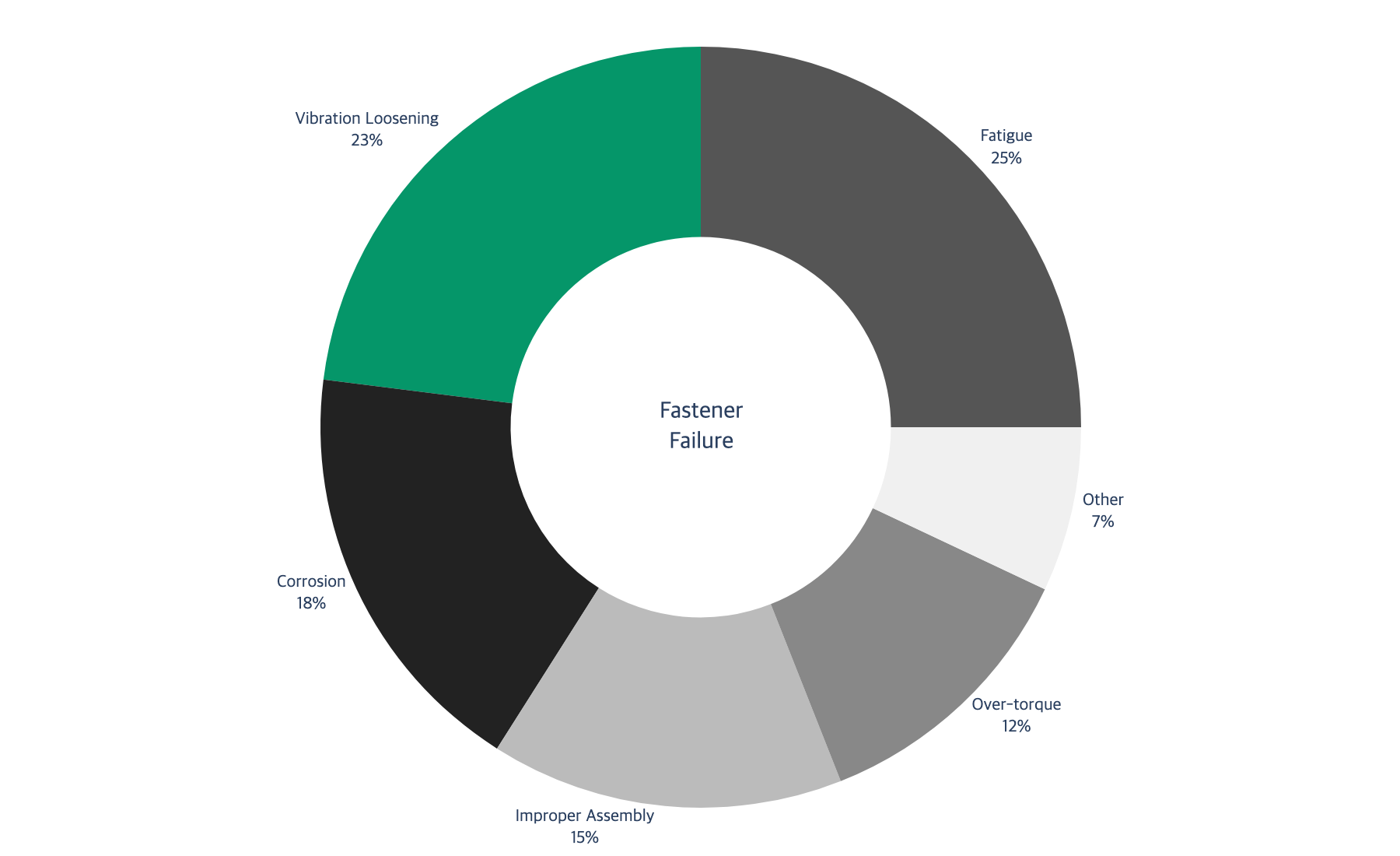
Threadlocker failures are almost always preventable through correct product selection and application technique.
Under-Cure on Passive Substrates
The most common failure mode. Engineers select a threadlocker based on strength grade without checking substrate compatibility. The product is applied to stainless steel or chrome-plated fasteners, develops only partial cure, and fails under service loads.
This failure is insidious because the adhesive appears to have cured during assembly. The partial cure provides some initial resistance, passing the "feel test." But incomplete cross-link density leaves the polymer weaker and more susceptible to creep under sustained load. The fastener loosens gradually over weeks or months, and by the time the failure is discovered, the root cause is not obvious.
Contamination Interference
Oil, grease, or cutting fluid residue on threads can interfere with metal ion contact and cure initiation. Light oil films (below 5 micrometers) are typically absorbed by the adhesive. Heavy contamination creates a physical barrier preventing hydroperoxide-metal contact. The practical rule: if you can see contamination, clean the threads with solvent (isopropyl alcohol or acetone) and air-dry before application. Some products (such as Loctite 243) are formulated for improved oil tolerance.
Exceeding the Gap Fill Limit
Standard threadlockers are formulated for gaps up to 0.25 mm, with some higher-viscosity products rated to 0.5 mm. Worn or oversized threads may exceed these limits. When the gap is too large, dissolved oxygen cannot be fully excluded, and the cure stalls, leaving a soft or liquid center beneath a cured outer shell. Field identification: hard adhesive around the periphery with wet adhesive in the center indicates gap fill failure. The remedy is restoring the thread (retapping, helicoil) or switching to a gap-filling formulation.
Over-Torque Breakaway on Small Fasteners
High-strength threadlockers on small fasteners (M6 or smaller) can generate breakaway torques exceeding the bolt's yield strength, causing twist-off during disassembly. Prevention: M2 to M6 should use low-strength (purple), M6 to M12 can use medium-strength (blue), and M10 and above can use high-strength (red) where permanent locking is required.
Thermal Degradation in Service
Above the rated temperature limit (150 degrees Celsius standard, 200-230 degrees Celsius for high-temperature grades), the polymer degrades through chain scission. The failure signature is adhesive residue that appears darkened and crumbles rather than fracturing cleanly. If joints show this pattern, review threadlocker selection against actual service temperatures, which may exceed nominal design values due to process upsets or ambient heat from adjacent equipment.
VII. Primer and Activator Selection for Difficult Substrates
For passive substrates where the metal surface cannot provide adequate free-radical initiation, two solutions are available. The choice between them depends on the production or maintenance context.
Surface Primers
Primers are applied to the substrate surface before the adhesive. They contain metal ion complexes (typically copper-based) that provide the transition metal ions needed for hydroperoxide decomposition. The primer is applied as a thin coat and allowed to dry (30 to 60 seconds) before the adhesive is applied. Primers convert a passive substrate into an effectively active one, enabling normal cure speed and full strength development.
The dried primer film is extremely thin (a few micrometers) and does not add measurable thickness to the thread engagement. Primers are the preferred solution when maximum joint strength is required, producing the same cure quality as an active metal substrate. They are standard practice for all threadlocking on 300-series stainless steel, chrome-plated fasteners, anodized aluminum, and nickel-plated components.
Activators
Activators are co-applied with the adhesive and contain additional free-radical generators that do not depend on the substrate metal. They are sprayed onto one surface while the adhesive is applied to the mating surface. Activators are useful when primer application is impractical (field repairs, high-volume production where primer drying time is not acceptable) but may slightly reduce ultimate strength compared to primer-activated cure.
The trade-off is practical: activators add no process time because they are applied simultaneously with assembly, while primers require a 30 to 60 second drying step. In high-volume production or urgent field repairs, this time savings may outweigh the marginal strength reduction.
Substrate-Preparation Decision Matrix
Substrate | Treatment | Cure Time |
|---|---|---|
Carbon steel, brass, copper | None needed | 10-20 min |
Zinc-plated steel | None needed | 15-30 min |
Cadmium-plated steel | None needed | 10-20 min |
Phosphate-coated steel | None needed | 10-25 min |
Cast iron, bronze | None or activator for speed | 20-40 min |
300-series stainless steel | Primer recommended | Slow without primer |
400-series stainless steel | Primer recommended | Slow without primer |
Chrome-plated steel | Primer required | No reliable cure without |
Nickel-plated steel | Primer required | No reliable cure without |
Anodized aluminum | Primer or activator required | No cure without |
Bare aluminum | Primer recommended | Slow, variable |
VIII. Field Cases: Matching Threadlocker to Application
Case 1: Loosening on Stainless Steel Fittings
A food processing equipment manufacturer applied medium-strength threadlocker to 316 stainless steel fittings. After 6 months, 12 percent showed loosening. Investigation revealed breakaway torque at only 30 percent of specification due to the chromium oxide passive layer inhibiting cure. Introducing a copper-based primer raised breakaway torque to 105 percent of specification, dropping the loosening rate to zero. Annual maintenance savings: approximately USD 45,000.
Case 2: Bolt Failure During Disassembly
A manufacturer used high-strength threadlocker on M5 socket head cap screws. During maintenance, 8 percent of bolts twisted off because breakaway torque (~15 Nm) exceeded the bolt's yield point. Switching to medium-strength (breakaway ~7 Nm on M5) provided adequate vibration resistance while allowing safe disassembly, with no loosening over 24 months.
Case 3: Thermal Failure on Exhaust System Studs
Company C applied a standard medium-strength threadlocker (rated to 150 degrees Celsius) to exhaust manifold studs on a diesel generator set. After 18 months, multiple studs loosened. Disassembly revealed darkened, friable adhesive residue consistent with thermal degradation. Temperature logging recorded sustained temperatures of 175 to 190 degrees Celsius. Replacing the standard product with a high-temperature, high-strength formulation rated to 230 degrees Celsius eliminated the issue, with follow-up inspections at 12 and 24 months confirming full adhesive integrity.
Case 4: Contamination-Related Cure Failure in Machining Environment
Company D assembled machine tool spindle housings using medium-strength threadlocker on M8 cap screws. Intermittent loosening occurred on approximately 5 percent of assemblies. Root cause: some fasteners were taken directly from the machining line with residual cutting fluid on the threads, creating a barrier between the adhesive and the steel surface. Implementing a solvent wipe step (isopropyl alcohol, 10-second air dry) before adhesive application eliminated the failures at a cost of less than USD 0.15 per assembly.
IX. Key Takeaway
Anaerobic threadlockers cure by free-radical polymerization initiated by metal ions in oxygen-free gaps; substrate metallurgy directly controls cure speed and ultimate strength
Three strength grades serve different ranges: low (purple) for small fasteners requiring frequent adjustment, medium (blue) for general-purpose locking, and high (red) for permanent assemblies requiring heat for removal
Passive substrates (stainless steel, chrome plate, anodized aluminum) require primers or activators; applying anaerobic adhesive to passive metals without surface preparation is the most common cause of threadlocker failure
Match strength grade to fastener size: high-strength products on M6 and below risk bolt breakage during disassembly
Standard grades are rated to 150 degrees Celsius, high-temperature grades to 230 degrees Celsius; verify service temperature does not exceed the limit
Maximum gap fill is 0.25 to 0.5 mm; worn threads exceeding this produce incomplete cure
Clean heavily contaminated threads before application; light oil films are acceptable, heavy grease is not
What if the threadlocker chose itself?
Every threadlocked joint involves at least six interacting variables: substrate material, plating type, fastener size, strength requirement, service temperature, and chemical environment. A field engineer making this selection from a product catalog is doing manual pattern-matching across dozens of combinations, often under time pressure during a shutdown.
This is exactly the kind of multi-variable decision that AI systems handle better than lookup tables. Lubinpla's AI-powered chemical management platform cross-references all six variables simultaneously, drawing on a continuously updated database of product specifications, substrate compatibility data, and field performance records. It flags substrate risks, warns about gap fill limits for worn threads, and verifies temperature compatibility against actual operating data rather than design specifications. When a field engineer enters the service conditions, Lubinpla returns a complete recommendation -- product grade, primer requirement, cure time estimate, and the specific application procedure -- in seconds rather than the minutes it takes to work through a paper-based selection guide. For maintenance teams managing thousands of threaded connections across a facility, the difference between getting this decision right every time and getting it right most of the time is the difference between zero unplanned shutdowns and costly, preventable failures.
X. References
[1] Bickford, J.H., "Introduction to the Design and Behavior of Bolted Joints", 2007. https://www.taylorfrancis.com/books/mono/10.1201/9780849381874/
[2] PMC, "Kinetic Study of Anaerobic Adhesive Curing on Copper and Iron Base Substrates", 2024. https://pmc.ncbi.nlm.nih.gov/articles/PMC11205158/
[3] Henkel, "Loctite Threadlocker Design Guide", 2024. https://www.henkel-adhesives.com/
[4] Henkel, "Loctite Threadlocker Properties Chart". https://www.ellsworth.com/globalassets/literature-library/manufacturer/henkel-loctite/henkel-loctite-selector-guide-threadlocker-properties-chart.pdf
[5] ScienceDirect, "Decomposition of peroxides by transition metal ions in anaerobic adhesive cure chemistry". https://www.sciencedirect.com/science/article/abs/pii/S0143749698000566
[6] Permabond, "Anaerobic Threadlockers Technical Resource". https://www.permabond.com/resource-center/anaerobic-threadlockers/
[7] ResearchGate, "Mechanism of Initiation of the Curing of Anaerobic Adhesives". https://www.researchgate.net/publication/327597274_Mechanism_of_Initiation_of_the_Curing_of_Anaerobic_Adhesives
[8] Reliable Plant, "Basics on Anaerobic Adhesives and Threadlockers". https://www.reliableplant.com/Read/24136/anaerobic-adhesives-threadlockers
[9] INCURE, "Anaerobic Sealant Gap Fill: What Manufacturers Need to Know". https://incurelab.com/wp/anaerobic-sealant-gap-fill-what-manufacturers-need-to-know
[10] Products Finishing, "Surface Treatment for Adhesive Bonding", 2024. https://www.pfonline.com/topics/clean
[11] MDPI Polymers, "Temperature and Humidity Effects on Adhesive Properties", 2023. https://www.mdpi.com/2073-4360/15/2/339
[12] ScienceDirect, "Cyclic Fatigue Testing of Adhesive Joints", 2021. https://www.sciencedirect.com/science/article/pii/S2666330921000133
[13] NASA, "Performance Characterization of Loctite 242 and 271". https://ntrs.nasa.gov/api/citations/20110011064/downloads/20110011064.pdf
[14] EPA, "Safer Alternatives for Solvent Degreasing", 2024. https://www.epa.gov/p2/case-studies-safer-alternatives-solvent-degreasing-applications
Powered by Lubinpla
Discover how technical teams solve complex challenges faster with AI.