Industrial Chemistry SDS Workflow: From Supplier PDF to Audit-Ready Database
Summary: Most chemical distributors manage 200 or more supplier safety data sheets (SDS) as static PDF files scattered across shared drives, email threads, and printed binders, with no systematic mechanism to detect when a supplier issues a revised version. When an auditor arrives to verify compliance with OSHA 29 CFR 1910.1200 or REACH Regulation (EC) No. 1907/2006, staff must manually reconstruct a document trail that should have been maintained continuously. This article examines the structural failure modes of manual SDS libraries at scale, quantifies the full cost of that approach, and presents a three-phase implementation roadmap that teams can execute regardless of portfolio size. Two anonymized field cases show that distributor teams reduced SDS-related compliance preparation time by 74 to 82 percent and eliminated version-drift citations over 18 months by adopting an agent-based continuous workflow. Operators managing portfolios of 100 or more products will find the implementation checklist, schema-mapping validation criteria, and version-drift detection threshold table in Sections V and VI directly applicable to their own compliance programs.
Table of Contents
I. Introduction
II. What Makes SDS Workflow Break Down? Version Drift, Format Variance, and Search Limits
III. What Does an Agent-Based SDS Workflow Accomplish?
IV. What Is the True Cost of Manual SDS Management?
V. Implementation Roadmap: Source Inventory, Schema Mapping, and Validation
VI. Field Cases: Distributor and Manufacturer SDS Workflow Migration
VII. Key Takeaway
VIII. References
I. Introduction
Approximately 94 percent of existing safety data sheets in the United States require revision to comply with OSHA's revised Hazard Communication Standard, effective July 19, 2024, which aligns U.S. requirements with the Globally Harmonized System of Classification and Labelling of Chemicals (GHS), Revision 7 (OSHA, 2024). For a chemical distributor carrying 200 to 500 products from 40 or more suppliers, that figure translates to a near-complete rebuild of the SDS library at the same time that day-to-day operations continue. The compliance window runs through May 2026 for substances and November 2027 for mixtures, leaving teams that rely on shared-drive PDF folders with a critical exposure gap.
A safety data sheet (SDS) is the standardized 16-section document that accompanies every hazardous chemical product, specifying composition, hazard identification, exposure controls, and emergency response information as required by OSHA 29 CFR 1910.1200, Appendix D, and by the European Chemicals Agency (ECHA) Guidance on the Compilation of Safety Data Sheets, Version 4.0 (ECHA, 2022). The SDS is not a static document. Manufacturers are legally required to revise it within three months after becoming aware of significant new hazard information, and distributors must pass updated versions to customers within three months of receipt (OSHA, 2024). Because there is no regulatory requirement for suppliers to notify downstream customers when a revision occurs, distributors bear the full monitoring burden with no built-in notification mechanism.
Why Shared-Drive PDF Libraries Fail at Scale
The structural failure is not negligence on the part of compliance staff. It is an architecture problem. A shared drive of 250 PDF files provides no version history, no field-level search, no automatic comparison between the revision date in Section 16 of a newly downloaded SDS and the version currently in the folder, and no alert when a supplier silently posts a new revision to their website. Hazard Communication violations consistently rank among the top five most-cited OSHA standards, with 5,804 citations recorded in a single fiscal year (Quantum Compliance, 2024). The auditor who arrives to inspect the SDS library does not grade the intention to maintain compliance, only the demonstrable, timestamped evidence of it.
Lubinpla is the industrial chemistry AI agent company that builds per-case diagnostic tools and recurring-workflow automation agents for chemical manufacturers, distributors, and operations teams. AI Crew is Lubinpla's subscription platform of specialized AI agents that automate operations workflows for industrial chemical companies, running continuously and integrating into the customer's data, email, and systems.
II. What Makes SDS Workflow Break Down? Version Drift, Format Variance, and Search Limits
The SDS library fails in three distinct and compounding ways when managed manually at scale: version drift accumulates silently, format variance across suppliers makes field-level comparison impractical, and the inability to search by structured field rather than by filename leaves compliance gaps invisible until inspection.
What Is Version Drift and Why Does It Compound Over Time?
Version drift is the accumulation of outdated SDS records in a library while operations continue running against chemical hazard data that no longer reflects current toxicological or regulatory reality (Quantum Compliance, 2024). A supplier revises an SDS, posts the new version to their product page, and the distributor's shared drive retains the previous PDF indefinitely because the revision was never flagged, no alert was triggered, and no staff member was assigned to monitor supplier pages on a scheduled basis.
The compounding mechanism works as follows. A distributor with 250 products from 60 suppliers would need to check each supplier page at a minimum quarterly frequency to approximate the update cadence implied by GHS requirements, equating to 1,000 manual checks per year before a single document is opened. Staff managing these tasks are spending a minimum of three hours per week on compliance-adjacent activities of this kind (TotalSDS, 2024). Across a team where the responsible employee earns USD 60,000 per year, that baseline translates to approximately USD 4,680 in annual labor allocated exclusively to surveillance that still produces gaps.
OSHA's 1910.1020 standard on access to employee exposure and medical records further requires that superseded SDS versions be retained alongside current ones for 30 years when they document a different formulation, creating a chain-of-custody obligation that a static file folder cannot fulfill (OSHA, 1996; VelocityEHS, 2010). Version drift, therefore, is not only a current-compliance problem but a retrospective-audit problem.
How Does Format Variance Across Suppliers Prevent Structured Comparison?
An SDS from a European supplier formatted under REACH Regulation (EC) No. 1907/2006, as amended by Commission Regulation (EU) 2020/878 (effective January 1, 2023), and an SDS from a U.S. supplier formatted under OSHA 29 CFR 1910.1200 share the same 16-section GHS skeleton but differ materially in field labeling, data order within sections, unit conventions, and language (ECHA, 2022). Section 8, covering exposure controls and personal protection, may list permissible exposure limits (PELs) set by OSHA, threshold limit values (TLVs) published by the American Conference of Governmental Industrial Hygienists (ACGIH), or workplace exposure limits (WELs) issued by national health authorities in EU member states, and the same substance may carry three different numerical values depending on the jurisdiction of the issuing authority.
When a compliance officer attempts to compare two versions of an SDS from the same supplier to detect what changed between revision dates, the comparison must occur at the field level, not the document level. A visual comparison of two PDFs is not a reliable method for detecting a 5 ppm change in a Section 8 PEL value or the addition of a Candidate List substance identified under REACH Article 59. The ECHA Candidate List for substances of very high concern (SVHC) exceeded 240 entries as of early 2026 and is updated twice per year, each update potentially triggering a new SDS revision obligation across a distributor's supplier base (ECHA, 2026).
Why Does a Filename Search Fail as a Compliance Mechanism?
Searching a shared drive by product name or supplier returns the document but provides no answer to the questions an auditor will ask: Is this the current version? When was the previous version superseded? Which products in this facility use a substance that appears on the SVHC Candidate List? What is the applicable PEL for the highest-exposure task performed on the floor today? These are field-level queries against structured data, and they cannot be answered by filename search against a folder of unstructured PDFs. A structured SDS database, by contrast, supports queries that cross-reference Section 3 composition data, Section 8 exposure limits, and Section 15 regulatory information simultaneously, which is the form in which compliance questions actually arrive.
III. What Does an Agent-Based SDS Workflow Accomplish?
An agent-based workflow for SDS management replaces the manual cycle of downloading, renaming, comparing, and filing documents with a continuously operating process that ingests supplier documents, normalizes their content against a structured schema, monitors supplier sources for revisions, and produces a queryable database. The operational outcome is a library that answers auditor queries directly rather than requiring staff to reconstruct evidence from unstructured files on demand.
The core capability that differentiates an automated approach from a manual one is continuous monitoring. A human-managed process checks supplier pages reactively, typically when a request arrives or an audit is scheduled. An automated workflow runs checks on a defined schedule against every supplier source in the library, surfacing revision candidates before they accumulate into a compliance gap. This monitoring pattern is the mechanism by which version drift detection shifts from a retrospective activity, performed during audit preparation, to a prospective one, performed continuously.
What Technical Operations Does the Workflow Perform?
The workflow operates across four functional areas, each of which addresses one of the failure modes described in Section II. Document ingestion brings SDS files into the system from supplier email attachments, shared folders, or supplier product pages, and assigns each document a unique identifier linked to a product record. Field extraction reads the document content and maps it to a canonical structure aligned with the GHS 16-section format and OSHA Appendix D mandatory fields, converting supplier-specific formatting into standardized, comparable records. Current AI-based extraction systems report accuracy rates above 99 percent on standardized GHS-format SDS documents (NextSDS, 2024). Version comparison evaluates whether a newly ingested document carries a different Section 16 revision date than the record currently in the database, and if so, triggers a compliance alert and queues a field-level review of what changed. Database output maintains a current-version record for each product, a version history chain linking prior revisions in chronological order, and a substance-level cross-reference index that supports rapid response to SVHC Candidate List updates or emergency response queries.
What Audit Evidence Does the Structured Database Produce?
A structured SDS database directly answers the four categories of question that arise in a compliance audit. First, current-version verification: the database holds the active SDS with its GHS section fields in queryable form, and the audit trail records the date of the last supplier check alongside the revision dates of the current and prior document. Second, version history: all prior SDS versions for each product are retained in chronological order with ingestion timestamps and the field-level changes between adjacent versions, satisfying the OSHA 1910.1020 30-year retention obligation for records that document a different formulation. Third, exposure limit lookup: Section 8 data is stored in normalized authority-identified fields (OSHA PEL, ACGIH TLV, EU WEL, NIOSH REL separately) rather than as a single undifferentiated text string, enabling rapid response to queries about the applicable limit for a given task. Fourth, substance cross-reference: a CAS Registry Number index lists every product in the portfolio that contains a given substance, enabling a compliance team to assess the portfolio-wide impact of an SVHC Candidate List update within minutes rather than days.
IV. What Is the True Cost of Manual SDS Management?
Manual SDS management produces three categories of cost that are typically not consolidated in a single budget view: direct labor, compliance-incident exposure, and opportunity cost from qualified staff performing administrative tasks. For a mid-sized distributor managing 500 SDS documents across 80 suppliers, the combined annual cost of manual management has been estimated at approximately USD 380,000 before any incident costs are realized (CloudSDS, 2024).
Direct Labor Cost
A conservatively structured estimate assigns 0.5 full-time equivalent (FTE) at a USD 60,000 annual salary to SDS maintenance activities, representing approximately USD 30,000 in direct labor. The activities covered by this allocation include contacting suppliers annually to request current SDS versions, downloading and renaming documents, reviewing new versions against prior versions visually, updating binder or folder systems, and responding to employee or auditor requests for specific documents. The TotalSDS study found that staff managing these tasks spend a minimum of three hours per week, which at a USD 30 per hour burdened rate equals USD 4,680 per year at the low end, and considerably more when the responsible employee holds a senior safety, regulatory affairs, or quality manager title (TotalSDS, 2024).
Compliance-Incident Exposure
OSHA Hazard Communication violations under 29 CFR 1910.1200 carry penalties of up to USD 16,550 per serious violation and up to USD 165,514 for willful or repeat violations as of 2025 (Safety Geek, 2025). A documented 2024 chemical plant incident in which an outdated SDS contributed to a fire that injured three workers resulted in federal penalty proceedings, demonstrating that version drift is not a paper compliance issue but an operational safety risk (CloudSDS, 2024). A peer-reviewed inspection of 50 U.S. institutions found a 22 percent SDS failure rate, meaning approximately one in five SDS documents in active use contained a documented deficiency (Mighty Line Floor Tape, 2024).
For a distributor managing 500 products with a 22 percent deficiency rate, statistical exposure equates to approximately 110 non-compliant documents at any given time, each representing a potential citation. At the low end of the OSHA serious-violation penalty scale, the expected-value fine exposure for an inspection that surfaces 5 percent of those deficiencies equals approximately USD 90,500 in a single inspection cycle.
Figure 1. Annual SDS Management Cost Comparison: Manual vs. Automated Workflow
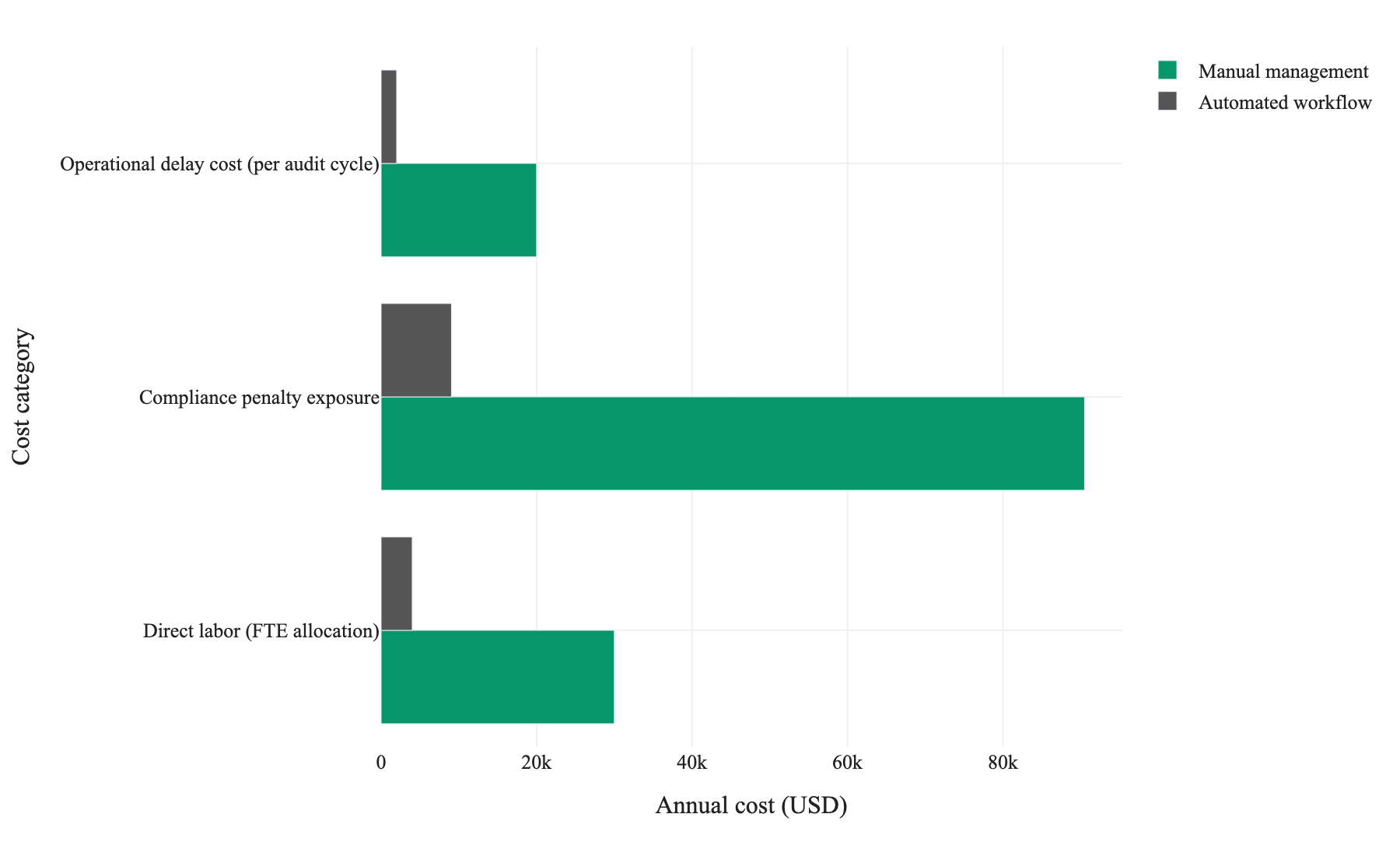
Cost category | Manual management | Automated workflow | Notes |
|---|---|---|---|
Direct labor (FTE allocation) | USD 30,000 | USD 4,000 | Reduced to exception-handling only |
Compliance penalty exposure (expected value) | USD 90,500 | USD 9,050 | Assumes 90% reduction in deficiency rate |
Operational delay cost (per audit cycle) | USD 20,000 | USD 2,000 | Based on 100-hour delay at USD 200 per hour |
Annual total | USD 140,500 | USD 15,050 |
This cost table presents a conservative model for a 500-product distributor portfolio. The compliance penalty exposure column uses expected-value methodology: estimated deficiency count multiplied by OSHA serious-violation penalty, discounted by inspection probability. The automated workflow column assumes 90 percent reduction in open deficiencies, consistent with reported outcomes in the field cases in Section VI. The table excludes software subscription cost, which varies by deployment scale but is recoverable within the first inspection cycle avoided.
Why Do Cost Centers Obscure the Total Exposure?
The direct labor cost sits in the HR or EHS budget. The compliance penalty exposure sits in the legal or risk budget. The operational delay cost sits in the operations or finance budget. When these three categories are reviewed separately, none appears large enough to justify a workflow change. When consolidated, the annual exposure for a mid-sized distributor frequently exceeds USD 100,000, producing a payback period on automated SDS management of less than six months (CloudSDS, 2024). The structural barrier to investment is not the total cost of inaction but the organizational separation of the cost centers that bear it.
V. Implementation Roadmap: Source Inventory, Schema Mapping, and Validation
A distributor migrating from a shared-drive SDS library to a continuous agent-based workflow completes the transition in three sequential phases over four to eight weeks, depending on portfolio size and the degree to which supplier contact information is already centralized. The most common source of delay is not the technology configuration but the source inventory step, because many distributors discover that supplier contact records are incomplete or that 15 to 20 percent of documents exist only as scanned images without machine-readable text.
Phase 1: Source Inventory and Connector Configuration (Weeks 1 to 2)
The first phase produces a complete source inventory: a table listing every product in the active portfolio, the corresponding supplier, the URL or email address from which the current SDS is obtained, the file format of the current document (PDF, scanned image, or web page), and the Section 16 revision date from the document currently in use. This inventory is the input to connector configuration, which assigns each product-supplier pair to one of three ingestion paths: URL monitoring of supplier product pages, portal API pull where credentials are available, or email forwarding from a monitored inbox. Completing the inventory for 200 products typically requires 12 to 16 staff-hours.
Figure 2. SDS Source Inventory and Connector Assignment Checklist
Check item | Pass criterion | Action on fail |
|---|---|---|
Product-supplier mapping complete | All active products have a named supplier entry | Resolve with procurement records |
Current SDS file located | File found in drive or folder | Contact supplier to obtain current SDS |
Section 16 revision date readable | Date string extracted from SDS | Flag for OCR manual review if scanned |
Supplier URL or email identified | Valid URL or email address on record | Request from supplier or find on product page |
Connector type assigned | URL, portal API, or email forward | Assign based on supplier capabilities |
Ingestion test completed | Document imported and parsed successfully | Escalate format issue to normalization review |
This checklist is the operator-executable audit that converts the source inventory into an active connector map. The majority of time is spent on the 15 to 20 percent of suppliers whose documents are scanned images or who do not maintain a stable product URL.
Phase 2: Schema Mapping and Normalization Rules (Weeks 2 to 4)
Schema mapping defines how extracted text from each supplier's SDS format maps to the canonical database schema. For most GHS-compliant suppliers, the mapping is resolved by the system's standard extraction rules without manual configuration. For non-standard formats, such as legacy material safety data sheet (MSDS) documents from pre-2015 filings that predate the GHS 16-section structure, the normalization team configures field-level override rules specifying which extracted text block maps to which canonical field.
Validation criteria for each mapped record: all mandatory OSHA Appendix D fields present (Sections 1 through 11 and Section 16); all exposure limit fields in Section 8 populated with at least one authority-identified value (OSHA PEL, ACGIH TLV, or EU WEL); Section 3 composition entries cross-referenced against the current ECHA Candidate List; and Section 16 revision date parseable as an ISO 8601 date string. Records failing any mandatory criterion are placed in a pending-review queue with the specific failed criterion identified, rather than being silently accepted into the active database.
Phase 3: Validation, Version Baseline, and Go-Live (Weeks 4 to 8)
The validation phase runs the normalized database against a spot-check sample of 10 percent of total records, with a human reviewer confirming that key fields in the database record match the source PDF. The acceptance threshold is 95 percent field accuracy across the sample set. A pass at this threshold allows the system to begin active version-drift monitoring against the live supplier sources. The initial monitoring cycle, which runs within the first seven days, frequently surfaces 8 to 15 percent of the library as having a newer supplier version than the document currently on file, representing the backlog of accumulated version drift that the shared-drive library had not captured.
Figure 3. Version-Drift Detection Threshold Table
Version drift indicator | Priority level | Required action | Standard reference |
|---|---|---|---|
Section 16 date newer by less than 90 days | Low | Queue for import; update within 30 days | OSHA 3-month revision notification window |
Section 16 date newer by 90 to 365 days | Medium | Import immediately; field-diff review required | OSHA 29 CFR 1910.1200(g)(5) |
Section 16 date newer by more than 365 days | High | Import and field-diff review within 48 hours; investigate distribution chain | OSHA 29 CFR 1910.1200(g)(5) |
Section 8 PEL or TLV value changed | High regardless of date gap | Import; notify EHS team; review exposed worker PPE program | ACGIH TLV-TWA; OSHA PEL (29 CFR 1910 Z-tables) |
New SVHC identified in Section 3 | Immediate | Import; update REACH downstream user communication; review labeling | REACH Article 31; ECHA Candidate List |
This threshold table is operator-executable on the monitoring queue output. The action column specifies the required response to each tier of drift detected, and the standard reference column identifies the regulatory basis for the urgency classification. The table applies regardless of which workflow tooling the team uses, because the urgency thresholds derive from statutory revision notification windows, not from software behavior.
VI. Field Cases: Distributor and Manufacturer SDS Workflow Migration
The following cases are anonymized and operating details have been generalized to protect customer identities.
Company A: Cost Reversal Pattern, Specialty Chemical Distributor
Company A is a specialty chemical distributor carrying 318 active products across cutting fluids, metalworking fluid (MWF) biocides, and industrial cleaners for a manufacturing customer base of approximately 85 accounts. The EHS coordinator managed the SDS library manually, maintaining a shared network folder of 318 PDF documents organized by supplier subfolder. Annual time allocated to SDS maintenance was approximately 210 hours, covering supplier outreach, download, binder updates, and ad-hoc employee request fulfillment. An OSHA inspection in month 8 of the review period resulted in 4 HazCom citations totaling USD 62,200 in proposed penalties, with 3 of the 4 citations attributable to SDS versions that were 14 to 22 months behind the supplier's current revision.
Company A evaluated the cost of switching to an automated SDS workflow against the penalty exposure and labor cost. The switch appeared expensive relative to the EHS coordinator's direct labor cost alone, estimated at USD 18,000 per year of the FTE. When the compliance penalty expected value, the audit preparation time billed to an outside consultant at USD 150 per hour, and the legal cost of contesting two of the four citations were included, the total annual cost of the manual workflow exceeded USD 110,000. The automated workflow implementation cost USD 24,000 in the first year including onboarding, dropping to USD 14,400 in subsequent years. Net benefit in the first 12 months after go-live: approximately USD 86,000. The 318-product library was migrated in 6 weeks. The first monitoring cycle identified 37 products (11.6 percent of the portfolio) with supplier revisions newer than the current file. All 37 were imported and normalized within 4 business days. In the 18 months following go-live, Company A received zero HazCom SDS citations across two regulatory interactions.
Company B: Incident-Trigger Pattern, Industrial Chemical Manufacturer
Company B is an industrial chemical manufacturer producing water-treatment biocides and solvent-based industrial cleaners for OEM and distribution channels. The compliance team managed 142 outgoing product SDS documents plus 89 incoming supplier SDS documents for raw material inputs, a total library of 231 documents. The incoming supplier library was maintained in a binder system with last-reviewed dates recorded by hand on a paper log. In month 4 of the review period, a formulation change at a raw material supplier altered the classification of a biocide active ingredient from Acute Toxicity Category 4 to Category 3 under GHS criteria, shifting the OSHA hazard category and requiring changes to both the raw material SDS and Company B's downstream product SDS within three months of notification.
Company B did not receive supplier notification and did not detect the revision through its manual process. The change was discovered six months after the supplier revision date when a customer conducting their own SDS audit requested the current version from Company B's product page and identified the discrepancy. The customer suspended orders pending corrected SDS documentation, resulting in a four-week order hold valued at approximately USD 48,000 in delayed revenue. Legal review of the downstream notification obligation under OSHA 29 CFR 1910.1200(g)(5) added USD 12,000 in compliance counsel fees. An automated SDS workflow was deployed within two weeks of the incident discovery to prevent recurrence.
The go-live configuration connected 62 supplier URLs and 4 portal API endpoints. The first monitoring cycle identified 14 supplier revisions (15.7 percent of the incoming library) that were not reflected in the binder system. The biocide active ingredient change that had triggered the incident was among the 14. Post-deployment, the average lag between a supplier posting a new SDS revision and the Company B database reflecting that revision dropped from an estimated 180 days (based on the incident) to 3.2 days (based on monitoring cycle frequency and ingestion processing time over 12 months of operation). No downstream customer notification failures occurred in the 18 months following deployment.
VII. Key Takeaway
Version drift is the primary SDS compliance failure mode at scale. It is a supply chain architecture problem rather than a staff negligence problem: suppliers are not required to notify downstream customers of SDS revisions, and no manual process reliably detects changes at the frequency required by OSHA 29 CFR 1910.1200(g)(5) and REACH Article 31 across a library of 200 or more products.
Audit readiness requires structured data, not a complete PDF collection. An auditor queries specific fields (current revision date, applicable PEL, SVHC status, version history chain) that cannot be answered by file-search against an unstructured folder. The step from PDF folder to audit-ready database is the step from document storage to compliance evidence.
The full cost of manual SDS management exceeds what any single budget line captures. Labor, compliance penalty exposure, and operational delay costs must be consolidated to produce a decision-relevant number. For a 500-product distributor, that number typically exceeds USD 100,000 per year before any incident cost is added.
A three-phase implementation roadmap over four to eight weeks is the standard migration path. The critical enabler is a complete product-supplier source inventory before connector configuration begins. The most common delay is the 15 to 20 percent of supplier documents in non-standard or scanned formats that require manual normalization rules.
The version-drift threshold table in Section V is the operator-executable monitoring protocol. High-priority triggers (Section 8 PEL change, new SVHC in Section 3) require action within 48 hours regardless of the date gap between supplier revision and current database record.
See how AI Crew handles this workflow in your environment: AI Crew is Lubinpla's subscription platform for automating operations workflows in industrial chemical companies, running continuously against your team's data and supplier sources. Review the AI Crew workflow overview at https://www.lubinpla.com/ai-crew to assess fit against your current SDS compliance program.
VIII. References
ACGIH (American Conference of Governmental Industrial Hygienists). (2024). Threshold Limit Values for Chemical Substances and Physical Agents and Biological Exposure Indices. https://www.acgih.org/tlv-bei-guidelines/
CloudSDS. (2024). Cost of Non-Compliance: Why Investing in SDS Management Software Pays Off. https://cloudsds.com/sds-management/cost-of-non-compliance-why-investing-in-sds-management-software-pays-off/
CloudSDS. (2024). Can SDS Management Solutions Integrate with Manufacturing Inventory or ERP Systems? https://cloudsds.com/sds-management/can-sds-management-solutions-integrate-with-manufacturing-inventory-or-erp-systems/
ECHA (European Chemicals Agency). (2022). Guidance on the Compilation of Safety Data Sheets, Version 4.0. https://echa.europa.eu/documents/10162/23036412/sds_en.pdf/01c29e23-2cbe-49c0-aca7-72f22e101e20
ECHA (European Chemicals Agency). (2026). Candidate List of Substances of Very High Concern (SVHC). https://echa.europa.eu/candidate-list-table
European Commission. (2020). Commission Regulation (EU) 2020/878 amending Annex II to REACH Regulation (EC) No 1907/2006. https://eur-lex.europa.eu/legal-content/EN/TXT/?uri=CELEX%3A32020R0878
Freyr Solutions. (2024). SDS Compliance Risks: Impact of Outdated Safety Data Sheets in Global Supply Chains. https://www.freyrsolutions.com/blog/the-hidden-risks-of-outdated-safety-data-sheets-in-global-supply-chains
Mighty Line Floor Tape. (2024). Outdated Safety Data Sheets: Hidden Risks. https://mightylinetape.com/a/blog/safety-data-sheets
NextSDS. (2024). The Future of SDS Management: AI and Automation. https://nextsds.com/blog/future-sds-management-ai-automation/
OSHA (Occupational Safety and Health Administration). (2024). Hazard Communication Standard, Final Rule (Federal Register, May 20, 2024). https://www.osha.gov/laws-regs/federalregister/2024-05-20
OSHA (Occupational Safety and Health Administration). (2024). 29 CFR 1910.1200, Appendix D: Safety Data Sheets (Mandatory). https://www.osha.gov/sites/default/files/appendix_d.pdf
Quantum Compliance. (2024). The SDS Revision Problem: Keeping Your Chemical Library Current When Suppliers Stay Silent. https://www.usequantum.com/the-sds-revision-problem-keeping-your-chemical-library-current-when-suppliers-stay-silent/
Safety Geek. (2025). OSHA HazCom Penalties: The True Cost of Non-Compliance. https://thesafetygeek.com/osha-hazcom-penalties-2025/
TotalSDS. (2024). 3 Costs of Complying with OSHA's Hazard Communication Standard. https://www.totalsds.com/3-costs-of-complying-with-oshas-hazard-communication-standard/
VelocityEHS. (2010). Does OSHA Really Require Employers to Keep SDSs and MSDSs for 30 Years? https://www.ehs.com/2010/08/does-osha-really-require-employers-to-keep-msdss-for-30-years/