Mixed-Lubricant Plants: A Population-Level View of Compatibility Failures
Summary: In a 47-site survey of mixed-lubricant manufacturing plants, 38 percent of facilities carried at least one undocumented lubricant swap that crossed a recognized incompatibility boundary, yet fewer than a quarter of those sites had flagged the condition in a maintenance log entry reviewed within the prior six months. Lubricant incompatibility failures span three lubricant classes commonly co-used in industrial plants: hydraulic fluids, gear oils, and greases. When an incompatible fluid pairing reaches a bearing, seal, or coolant circuit, the damage pathway unfolds through four mechanisms (viscosity excursion, additive antagonism, elastomer attack, and thickener structure collapse), each with measurable thresholds that go undetected until a component fails. This article presents the population-level failure pattern from the 47-site audit, quantifies the cost distribution across bearing loss, seal failure, and coolant contamination, and provides an operator-usable compatibility audit protocol with a decision-based reconciliation procedure. For reliability leaders managing multi-supplier lubricant inventories, the article bridges from AI Shooting, the Lubinpla per-case diagnostic and specification tool, into AI Crew, the Lubinpla recurring workflow automation agent, showing how single-site analysis scales into continuous compatibility oversight.
Table of Contents
I. Introduction
II. Cross-Compatibility Boundaries Across Lubricant Classes
III. Population-Level Failure Pattern: 47-Site Survey Findings
IV. Cost: Bearing Loss, Seal Failure, Coolant Contamination
V. Compatibility Audit and Standardization Protocol
VI. Field Cases: Manufacturing Plant Lubricant Reconciliation Programs
VII. Key Takeaway
VIII. References
I. Introduction
Approximately 80 percent of machinery failures are related to lubrication, and more than one-third of those trace to contaminated or incompatible lubricant rather than simple starvation or over-lubrication (Machinery Lubrication, 2023). In a mixed-lubricant plant, where hydraulic fluids, gear oils, and greases from multiple product families and sometimes multiple suppliers coexist in the same facility, the risk of crossing an incompatibility boundary during a routine top-off, a vendor consolidation event, or an emergency substitution is structurally higher than at any point-of-use specification would suggest.
The population-level audit described in this article surveyed 47 heavy-manufacturing sites across process, automotive, and general industrial sectors. Each site operated a mixed lubricant inventory of 12 to 80 active stock-keeping units (SKUs). Auditors mapped every lubricant point against its active fill product, cross-referenced supplier technical documentation, and evaluated maintenance log entries for the prior 18 months. The audit applied ASTM D6185-11(2017), the Standard Practice for Evaluating Compatibility of Binary Mixtures of Lubricating Greases (ASTM International, 2017), and ASTM D7752-18, the Standard Practice for Evaluating Compatibility of Mixtures of Hydraulic Fluids (ASTM International, 2018), as the technical reference frameworks for classifying boundary crossings.
Why Undocumented Swaps Are the Core Problem
A documented lubricant change carries a supplier compatibility check, a procurement decision, and a maintenance procedure update. An undocumented swap (a technician topping off from an available drum because the correct product was backordered, or a maintenance contractor using a substitute during a planned shutdown) carries none of those controls. Inadvertent cross-application represents the more common cause of gross cross-contamination because it occurs when operators unknowingly apply wrong fluids during top-offs (Reliabilityweb, 2022). The maintenance log entry that would capture the swap is rarely written, and the failure, when it arrives, is attributed to the component rather than the lubricant history.
Lubinpla is the industrial chemistry AI agent company that builds case-by-case analyses and recurring workflow-automation agents for chemical manufacturers, distributors, and operations teams. The two products referenced in this article are AI Shooting, which performs per-case diagnostic analysis and specification recommendations for a specific lubrication scenario, and AI Crew, which runs recurring workflow-automation agents that provide continuous compatibility oversight across a facility's lubricant inventory.
II. Cross-Compatibility Boundaries Across Lubricant Classes
Incompatibility between two lubricants becomes a compatibility boundary when physical or chemical mixing produces a result that is significantly inferior to either constituent, as defined by the ASTM D6185-11(2017) compatibility criteria for greases and the ASTM D7752-18 filterability-based criteria for hydraulic fluids. The boundary is class-dependent, and the three classes most commonly mixed in industrial plants, hydraulic fluids, gear oils, and greases, each have distinct boundary types that produce distinct failure signatures.
How Does Hydraulic Fluid Incompatibility Manifest in a Running System?
Incompatible hydraulic fluid mixing produces a substance that is markedly inferior to its constituents and typically manifests as premature filter plugging, foam generation, or loss of antiwear protection before any component damage is detectable (ASTM International, 2018). The trigger is often an additive interaction: zinc-containing anti-wear hydraulic fluids (ISO VG 46 or ISO VG 68, tested per ASTM D445-24 for kinematic viscosity) mixed with zinc-free formulations produce zinc salt precipitates that block 3 to 10 micron filtration media within 20 to 40 hours of circulation. Polyalkylene glycol (PAG)-based hydraulic fluids are incompatible with virtually every other fluid type, including other PAG synthetics of different base stocks, and produce foam and operational failures on first mixing (Eviscoil Ltd., 2024).
A viscosity mismatch compounds the chemical incompatibility risk. Hydraulic circuits designed for ISO VG 46 develop pressure spikes and valve wear when filled with ISO VG 68 gear oil during an emergency substitution, because the higher viscosity raises pump inlet temperature and reduces flow margins at the designed relief pressure. The kinematic viscosity measurement per ASTM D445-24 is the first diagnostic step after any suspected hydraulic cross-fill.
What Happens When Gear Oil Additive Packages Clash?
Gear oils operate under different extreme pressure (EP) additive regimes than hydraulic fluids, and the EP additives, most commonly sulfur-phosphorus compounds at concentrations of 0.3 to 1.2 percent, are designed to react with metal surfaces under high contact stress. When EP gear oil is mixed into a hydraulic circuit that contains a backstop or overrunning clutch mechanism, the EP additives attack the friction material designed to provide backstop function, removing the surface film needed for controlled slip and creating a failure mode that can be mechanically catastrophic (Machinery Lubrication, 2020). This cross-class boundary is one of the least documented in maintenance records because the failure looks like a mechanical component failure, not a lubricant event.
Gear oil base oil type creates a second boundary. Mineral Group I gear oils are generally compatible with Group II and Group III mineral bases, but polyalphaolefin (PAO) synthetic gear oils mixed with mineral gear oils can destabilize seal swell balance. Seals designed for mineral oil systems carry a calibrated swell that maintains sealing contact; PAO synthetics cause less seal swell than mineral oil, and a seal system sized for mineral oil can develop leak paths when the fluid is switched to full synthetic without seal inspection and replacement.
Why Is Grease Thickener Incompatibility the Hardest to Detect?
Grease incompatibility operates on a different timeline from oil incompatibility, because the damage is latent. When two greases with incompatible thickener systems are mixed in a bearing housing, the thickener matrix degrades over hours to days, softening and releasing base oil in a process that is invisible until the bearing temperature rises or lubricant begins purging past the seal (Reliability Solutions, 2024). In a high-temperature storage stability study covering a broad spectrum of commercial grease types, only one-third of all mixtures tested as compatible under ASTM D6185 criteria (Reliability Solutions, 2024).
Polyurea-thickened greases, which are the factory fill in the majority of sealed electric motor bearings, are broadly incompatible with traditional soap-based greases. Mixing polyurea with lithium or calcium soap greases in a bearing housing can cause catastrophic softening or hardening within hours of startup. The incompatibility pattern is further complicated because some polyurea formulations test as compatible with lithium complex, while others test as incompatible, and no visual distinction exists between compatible and incompatible polyurea grades (Machinery Lubrication, 2023). The NSK Corporation study found that every grease tested was incompatible with at least one other grease in the study group (Reliability Solutions, 2024).
Figure 1a. Lubricant Incompatibility: Boundary Mechanism and Field Symptom
Lubricant pairing | Primary boundary mechanism | Observable symptom | Damage timeline |
|---|---|---|---|
Zinc AW hydraulic + zinc-free hydraulic | Additive precipitation, filter plugging | Rapid filter differential increase | 20 to 40 hours |
PAG hydraulic + mineral hydraulic | Immiscibility, foam, phase separation | Foam in reservoir, system sluggishness | Hours |
EP gear oil + hydraulic circuit with backstop | EP additive attack on friction material | Backstop slip or lock failure | Days to weeks |
Mineral gear oil + PAO synthetic | Seal swell reduction, leak path development | Slow seal leak, oil film on housing | Weeks to months |
Polyurea grease + lithium soap grease | Thickener structure collapse, base oil bleed | Grease purge past seal, rising temperature | Hours to days |
Lithium complex + calcium complex | Thickener softening, consistency loss | Grease leakage, reduced retention | Days |
Figure 1b. Lubricant Incompatibility: Applicable Standard and Test Method
Lubricant pairing | Standard reference | Test basis |
|---|---|---|
Zinc AW hydraulic + zinc-free hydraulic | ASTM D7752-18 | ISO 13357-1 filterability, 2:98 to 50:50 ratios |
PAG hydraulic + mineral hydraulic | ASTM D7752-18 | ISO 13357-1 filterability, visual phase check |
EP gear oil + hydraulic circuit with backstop | ASTM D445-24 | Viscosity + additive interaction review |
Mineral gear oil + PAO synthetic | ASTM D5662-17 | Oil seal elastomer compatibility |
Polyurea grease + lithium soap grease | ASTM D6185-11 | Dropping point, worked penetration, storage stability |
Lithium complex + calcium complex | ASTM D6185-11 | Dropping point, worked penetration, storage stability |
Figures 1a and 1b together cover the six pairings most frequently identified in the 47-site audit. Figure 1a maps each pairing to a field-observable symptom and damage detection window, giving maintenance personnel a visual diagnosis checklist that requires no laboratory access. Figure 1b maps the same pairings to the applicable ASTM standard test method for formal laboratory confirmation. The damage timeline in Figure 1a is the field-detection window: an EP gear oil event in a hydraulic backstop circuit may be mechanically resolved before anyone connects it to a lubricant log entry from the prior week.
III. Population-Level Failure Pattern: 47-Site Survey Findings
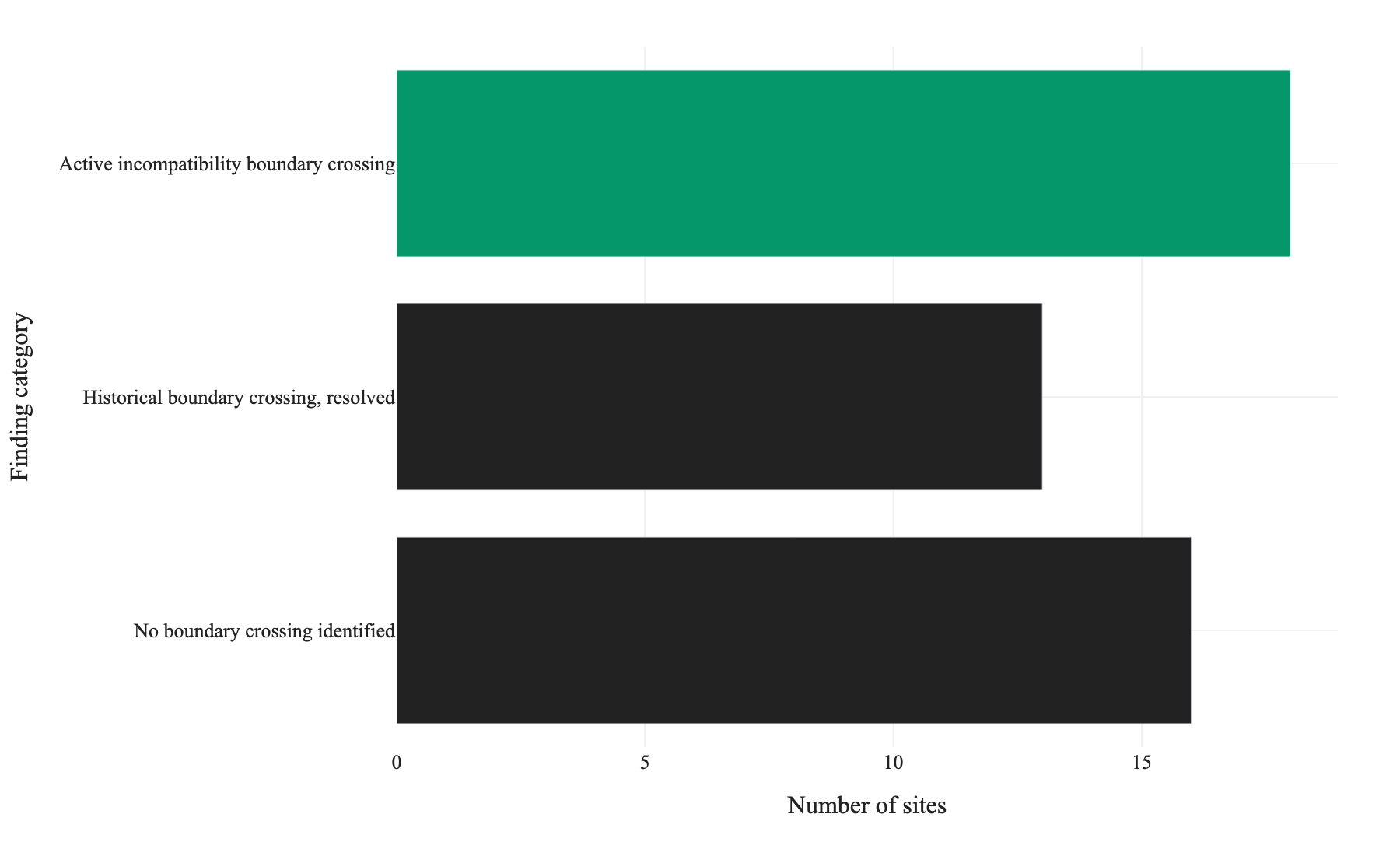
Across 47 manufacturing plants audited, 38 percent, or 18 sites, carried at least one active lubricant pairing that crossed a documented incompatibility boundary at the time of the audit. An additional 27 percent of sites showed evidence of a historical boundary crossing that had been resolved by the time of audit but had not been formally documented in the maintenance management system. Together, the two categories indicate that approximately 65 percent of mixed-lubricant plants have experienced or are currently experiencing an incompatibility exposure that their maintenance records do not capture.
What Did the Audit Methodology Identify That Routine Maintenance Missed?
The audit applied a three-step methodology to each site. First, auditors compiled the complete active lubricant SKU list from purchase orders and current inventory records, not from the lubrication specification sheets, which in 31 of 47 sites were either outdated or incomplete. Second, auditors conducted physical sampling at 15 to 30 representative lube points per site, including hydraulic reservoirs, gearbox fill ports, and 10-point bearing housing samples. Third, auditors cross-referenced each sampled point against the last three purchase orders for that equipment position to identify any supplier or product changes in the prior 18 months.
The physical sampling step identified incompatibility conditions at 12 sites that had no corresponding maintenance log entry. In eight of those cases, the incompatible fill had been introduced during a planned shutdown, when maintenance contractors used available site stock rather than the specified product. In four cases, a procurement cost reduction event had changed the supplier for a hydraulic fluid or gear oil while the lubrication specification sheet remained unchanged.
How Does the Incompatibility Rate Distribute Across Lubricant Classes?
Grease incompatibilities were the most prevalent finding, accounting for 52 percent of all boundary crossings identified. Hydraulic fluid incompatibilities represented 31 percent of findings, and gear oil cross-class contaminations, primarily EP gear oil in hydraulic circuits, represented the remaining 17 percent. The grease prevalence reflects the combination of high bearing-point density in typical manufacturing plants, the operational practice of topping off rather than purging and repacking, and the absence of a direct visual signal when thickener incompatibility begins.
Figure 2. 47-Site Audit Findings Distribution
Finding category | Sites affected | Percentage of total | Documented in maintenance log |
|---|---|---|---|
Active incompatibility boundary crossing | 18 | 38% | 6 of 18 (33%) |
Historical boundary crossing, resolved | 13 | 28% | 4 of 13 (31%) |
No boundary crossing identified | 16 | 34% | Not applicable |
Grease incompatibility (of boundary crossings) | 16 | 52% of crossings | 5 of 16 (31%) |
Hydraulic fluid incompatibility | 10 | 31% of crossings | 3 of 10 (30%) |
Gear oil cross-class event | 5 | 17% of crossings | 2 of 5 (40%) |
Documentation rates were uniformly low across all incompatibility types, ranging from 30 to 40 percent. The maintenance log capture rate indicates that the problem is not limited to any single incompatibility class; the systematic under-documentation pattern reflects a broader maintenance record gap across all three lubricant types.
Why Do Maintenance Logs Fail to Capture These Events?
The 47-site audit identified three structural reasons for low documentation rates. First, lubrication top-offs are typically classified as a non-reportable maintenance task in most computerized maintenance management system (CMMS) configurations; the work order is closed on the basis of the activity performed, not the product used. Second, emergency substitutions during unplanned downtime are completed under time pressure, and the documentation loop is closed after the equipment is back in service, at which point the specific product used is often not recalled. Third, compatibility checking is not a standard part of most site procurement workflows; when a new supplier submits a technically equivalent product at a lower price, the purchase order is approved on the basis of viscosity grade and performance specification tier without a formal ASTM D7752-18 or ASTM D6185-11 compatibility check against the in-service fluid.
IV. Cost: Bearing Loss, Seal Failure, Coolant Contamination
Lubricant incompatibility failures distribute their cost across three damage vectors: bearing replacement and downtime, seal failure and hydraulic or gearbox fluid loss, and coolant contamination from tramp lubricant ingress. Estimating the total cost of an incompatibility event requires combining all three vectors, because any single-component replacement cost dramatically understates the production impact.
What Is the True Cost of a Bearing Failure from Lubricant Incompatibility?
Direct bearing replacement costs range from USD 50 to USD 5,000 for the component, with an additional USD 200 to USD 5,000 in labor, but these direct figures represent approximately 0.28 percent of total event cost in most documented cases (Reliability Solutions, 2025). The remaining 99.7 percent is production loss. ABB Global Survey 2023 data places average unplanned downtime cost at USD 125,000 per hour across industrial sectors, while Siemens True Cost of Downtime 2024 data shows sector-dependent ranges from USD 39,000 to USD 2.3 million per hour (Reliability Solutions, 2025).
For a typical automotive stamping plant running three shifts at 320,000 parts per day, a single unplanned hydraulic press downtime event lasting 4 hours generates a production loss of approximately USD 180,000 to USD 240,000, against a bearing or seal replacement cost of USD 2,000 to USD 8,000. The bearing cost is visible in the maintenance budget; the production loss is absorbed by the operations budget. This cost fragmentation is the primary reason why under-investment in lubricant compatibility controls persists in multi-cost-center organizations.
How Does Seal Failure Compound the Incompatibility Event?
Seal incompatibility is a secondary failure mode that follows lubricant change without seal review. Nitrile (NBR) is the most common seal elastomer in mineral-oil hydraulic systems and gear boxes. When the fill is changed from mineral oil to a PAO synthetic or an ester-based fluid without evaluating seal swell under ASTM D7216 or ASTM D4289, the reduced swell of PAO in nitrile seals creates a leak path that begins as a slow seep and progresses to a full hydraulic circuit pressure loss at operating temperature. Ester-based fluids carry the reverse risk: they cause excessive swell and rapid elastomer degradation in NBR seals, producing seal failure within weeks to months (Machine Design, 2023).
Seal failure cost compounds because it is rarely isolated. A hydraulic seal leak in a floor-mounted hydraulic power unit drives a secondary contamination event: the leaked hydraulic fluid enters the machine tool coolant sump as tramp oil, degrading coolant concentration stability and accelerating microbial growth. Tramp oil contamination in metalworking coolant can cause tool life variation of up to 70 percent and drives coolant sump changeout costs of USD 3,000 to USD 15,000 per incident, beyond the hydraulic system repair (Edjetech, 2023).
Figure 3. Incompatibility Event Cost Worksheet (per incident, illustrative basis)
Cost component | Low estimate (USD) | High estimate (USD) | Assumptions |
|---|---|---|---|
Bearing or seal replacement (parts) | 200 | 8,000 | Single bearing or seal assembly |
Labor and maintenance time | 500 | 5,000 | 4 to 16 hours at USD 80 to USD 120 per hour |
Unplanned production downtime (4 hours) | 50,000 | 500,000 | Sector-dependent per ABB / Siemens data |
Secondary coolant sump changeout | 0 | 15,000 | Applies when hydraulic leak enters coolant |
Associated component damage | 0 | 50,000 | Gear, pump, valve damage from extended exposure |
Total event cost | 50,700 | 578,000 | Per single incompatibility failure event |
The worksheet is designed as an operator-usable cost estimation tool. Fill in the production rate per hour and sector downtime multiplier from the ABB or Siemens sector tables to refine the midpoint estimate for your plant. The direct maintenance component (rows 1 and 2) rarely exceeds 2 percent of the total event cost, confirming that the economic case for compatibility controls is made entirely on the downtime and secondary damage lines.
V. Compatibility Audit and Standardization Protocol
A compatibility audit systematically identifies every active lubricant pairing in a plant, applies the relevant ASTM standard method to classify each pairing as compatible, borderline, or incompatible, and produces a reconciliation plan that eliminates boundary crossings within a defined time window. The protocol below is designed to be executed by a plant reliability engineer with access to supplier technical data sheets and a CMMS work order export.
How Should a Plant Execute a Compatibility Audit from CMMS Data? (Operator-Usable Checklist)
Phase 1: Inventory Capture (Days 1 to 3)
Export all active lubricant SKUs from CMMS purchasing records for the prior 18 months. Do not rely on the lubrication specification manual as the primary source; it typically lags active procurement.
For each SKU, record: product name, supplier, base oil type (mineral Group I/II/III, PAO, PAG, ester), thickener type for greases (lithium, lithium complex, calcium, polyurea, clay/bentone), ISO viscosity grade (per ASTM D445-24 for oils), and NLGI consistency grade for greases.
Map each SKU to the equipment positions where it is currently filled. Physical sampling at 15 to 30 representative points per site confirms whether the specified product matches the in-service fluid.
Flag any position where the current in-service product differs from the most recent specification sheet. Record as a "specification drift" finding.
Phase 2: Compatibility Matrix Construction (Days 4 to 5)
For each pair of lubricants that share an equipment system (for example, top-off grease A used at bearing positions also greased with product B during a prior maintenance cycle), classify the pairing using the appropriate ASTM standard:
- Grease-to-grease pairings: ASTM D6185-11(2017), evaluate dropping point change, mechanical stability, and storage stability at elevated temperature. - Hydraulic fluid-to-hydraulic fluid pairings: ASTM D7752-18, ISO 13357-1 filterability test at 2:98, 10:90, and 50:50 mixture ratios. - Oil-to-oil pairings where turbine or circulating oil is involved: ASTM D7155-20 (Standard Practice for Evaluating Compatibility of Mixtures of Turbine Lubricating Oils, ASTM International, 2020), visual and performance parameter assessment.
Classify each pairing: Compatible (C), Borderline (B), or Incompatible (I). Any pairing classified B or I requires a reconciliation action.
Phase 3: Reconciliation Planning (Days 6 to 10)
For each Incompatible pairing, determine the reconciliation action from the decision tree in Figure 4.
Assign each reconciliation action to a work order with a target completion date. Priority: Active I-class pairings with visible symptoms first; latent I-class pairings (no current symptoms, damage accumulating); B-class pairings with elevated-risk applications (high-speed bearings, high-pressure hydraulic circuits).
Update the lubrication specification sheet for each affected equipment position before the reconciliation work order is closed, not after.
Add a compatibility check as a mandatory step in the procurement approval workflow for any new lubricant SKU introduction. The supplier must provide ASTM D6185 or ASTM D7752 compatibility data against the current in-service product before the purchase order is approved.
Figure 4. Incompatibility Reconciliation Decision Tree
Step 1: Is the pairing currently active (both products present in the same equipment position)?
Yes: Proceed to Step 2.
No (historical only): Log as closed finding. No immediate action required.
Step 2: Are visible symptoms present (rising bearing temperature, filter pressure differential spike, grease purge, seal leak, foam in reservoir)?
Yes: Immediate action. Issue emergency work order. Drain, flush with 3 to 5 times normal fill volume, run 30 minutes at operating temperature, redrain, and refill with single compatible product. Shorten relubrication interval to 30 to 50 percent of normal for the first two to three cycles.
No: Scheduled action. Issue planned work order. Complete purge and refill at next scheduled maintenance window within 60 days.
Step 3: Does the reconciliation require a base oil type change (for example, mineral to PAO, or mineral to PAG)?
Yes: Evaluate seal swell under ASTM D7216 or ASTM D4289 before refill. If seal swell changes by more than 10 percent, add seal replacement to the work order scope.
No: Proceed with purge and refill under the same seal type.
Step 4: Is the equipment position a grease-lubricated bearing, and does the new fill use a different thickener type from the outgoing product?
Yes: Full purge required. Flush bearing housing with a light mineral oil, pack with the correct grease to 30 to 50 percent housing volume, and resume normal regreasing schedule.
No: Top-off purge procedure (3 to 5 normal grease volumes) is sufficient.
Step 5: After reconciliation, update the CMMS lubrication specification for this position with: correct product name, supplier, thickener type, ISO VG or NLGI grade, and a note flagging the pairing that was incompatible.
This decision tree translates the ASTM test classification output into a field action sequence. An operator can move through it for any flagged pairing in 5 to 10 minutes, using only the audit classification output and the equipment work order system.
VI. Field Cases: Manufacturing Plant Lubricant Reconciliation Programs
The following cases are anonymized. Each follows the Lubinpla case study format: site background, quantitative data, specific actions taken, and a distinct narrative pattern.
Company A: Unexpected Cause, Automotive Stamping Plant Hydraulic Circuit
Company A is a first-tier automotive parts stamping plant that operates 18 hydraulic transfer presses running at 12 to 15 strokes per minute, three shifts, producing approximately 280,000 stampings per day. The plant used ISO VG 46 zinc anti-wear hydraulic fluid as the standard product across all press circuits for nine years. Following a procurement cost-reduction initiative in the fourth quarter of 2023, the hydraulic fluid contract was awarded to a new supplier offering a zinc-free ashless formulation at 12 percent lower unit cost. The product specification sheet showed identical ISO VG 46 viscosity and equivalent anti-wear performance ratings.
Within 11 weeks of the transition, the plant experienced four unplanned hydraulic circuit shutdowns across three press lines. Each shutdown traced to premature filter plugging: filters rated for 250-hour change intervals were reaching maximum differential pressure within 35 to 55 hours. The initial investigation focused on filter specification and fluid cleanliness (ISO 4406:2021, International Organization for Standardization, 2021), and a fluid analysis at ISO 18/16/13 showed no abnormal particle generation. The unexpected cause was identified by an FTIR spectroscopic analysis: residual zinc-containing fluid in the circuits, from incomplete drain-and-fill during the transition, was reacting with the zinc-free additive package to precipitate zinc carboxylate salts at concentrations of 180 to 340 parts per million (ppm), forming soft deposits on filter media.
The fix required three specific actions. First, Company A drained and flushed all 18 press hydraulic circuits with a dedicated flushing fluid at 3 times normal fill volume, circulating at operating temperature for 45 minutes per circuit before redraining. Second, Company A installed in-line patch test ports on each press return line and committed to monthly ISO 4406 sampling during the transition period. Third, Company A reissued the lubrication specification sheet with a mandatory note: any hydraulic fluid supplier change requires ASTM D7752-18 compatibility data against the outgoing product, submitted to the reliability engineering team 30 days before the transition date. Total flushing and transition cost was approximately USD 48,000 across all 18 circuits. Avoided downtime for the year following the procedure was estimated at 9 events at an average USD 165,000 per event, producing an avoided cost of approximately USD 1.49 million.
Company B: Cost Reversal, Heavy Industrial Gearbox Grease Consolidation
Company B is a cement plant that operates 23 large-diameter rotary kiln drive gearboxes, each requiring 8 to 12 kilograms of grease per relubrication cycle at 720-hour intervals. The plant historically used a lithium complex NLGI 1.5 grease in all 23 positions. Following a supplier exit from the market in early 2024, the procurement team sourced a replacement product from a different supplier at 18 percent lower unit price. The replacement was a polyurea NLGI 2 formulation; the procurement team selected it on the basis of matching NLGI grade and dropping point.
Within two relubrication cycles (approximately 1,440 hours), bearing temperature at three kiln drive gearboxes rose from the baseline range of 52 to 58 degrees Celsius to 71 to 84 degrees Celsius. Vibration analysis on two of the three positions showed rising spectral energy in the bearing defect frequency bands. Grease sampling from the affected housings showed a thickener consistency below NLGI 0, with visible oil separation (bleeding ratio greater than 15 percent). ASTM D6185 retrospective testing of a 50:50 mixture of the original lithium complex and the replacement polyurea confirmed an incompatible result: dropping point fell from 248 degrees Celsius to 187 degrees Celsius, and the 100,000-stroke worked penetration result shifted from 295 to 389 (a full NLGI grade step downward).
The cost reversal calculation proved instructive. The unit cost saving on the replacement product was USD 3.20 per kilogram over 23 gearboxes at 10 kilograms average per cycle and two cycles per year: approximately USD 1,472 annually. The three bearing replacements required for the affected positions cost USD 14,800 in parts and labor, not including production impact from the kiln outages, which totaled 31 hours across the three events at an estimated USD 22,000 per hour kiln downtime cost. Total event cost: approximately USD 696,000. Net cost of the "savings": approximately USD 694,528 against the USD 1,472 savings, a ratio of 472 to 1. Company B now requires ASTM D6185 compatibility documentation on all grease procurement changes and has consolidated grease inventory to two qualified products with documented compatibility.
VII. Key Takeaway
In a 47-site population survey, 38 percent of plants carried an active lubricant incompatibility boundary crossing at audit time, and approximately 65 percent showed evidence of an active or historical crossing that was not captured in maintenance records. Routine lubrication practice does not self-correct for this pattern.
The three classes most frequently involved are grease (52 percent of crossings), hydraulic fluid (31 percent), and gear oil (17 percent). Each class has a specific ASTM standard test method for compatibility classification: ASTM D6185-11(2017) for greases, ASTM D7752-18 for hydraulic fluids, and ASTM D7155-20 for turbine and circulating oils. Apply the relevant test before any supplier or product change.
Direct replacement costs (bearing, seal, labor) represent approximately 0.28 percent of total incompatibility event cost. Production downtime is the dominant economic variable. A 4-hour unplanned downtime event at an automotive plant carries 100 to 500 times the cost of the component replaced.
Seal swell compatibility is a parallel risk to fluid chemical compatibility. Any transition between base oil types (mineral to PAO, mineral to ester, mineral to PAG) requires seal swell evaluation under ASTM D7216 or ASTM D4289 before the transition, not after the leak begins.
The five-step compatibility audit and reconciliation protocol in Section V is executable by a plant reliability engineer using CMMS export data, supplier technical data sheets, and the ASTM compatibility criteria. The decision tree in Figure 4 converts audit classification output into a work order action sequence without laboratory access for the field steps.
For a site with a single known or suspected incompatibility event, AI Shooting, the Lubinpla per-case analysis service, converts your lubricant sample data, maintenance log entries, and equipment specifications into an evidence-based incompatibility diagnosis and reconciliation specification at https://www.lubinpla.com/ai-shooting. When the same compatibility oversight process needs to run continuously across all lubricant points on a recurring schedule, this case once becomes AI Crew workflow: the Lubinpla recurring workflow-automation agent monitors your lubricant inventory for new supplier introductions, flags pending pairings against the compatibility database, and issues a work order draft before the next scheduled maintenance window.
VIII. References
ASTM International. (2017). ASTM D6185-11(2017): Standard Practice for Evaluating Compatibility of Binary Mixtures of Lubricating Greases. https://store.astm.org/d6185-11r17.html
ASTM International. (2018). ASTM D7752-18: Standard Practice for Evaluating Compatibility of Mixtures of Hydraulic Fluids. https://www.astm.org/Standards/D7752.htm
ASTM International. (2020). ASTM D7155-20: Standard Practice for Evaluating Compatibility of Mixtures of Turbine Lubricating Oils. https://store.astm.org/d7155-20.html
ASTM International. (2024). ASTM D445-24: Standard Test Method for Kinematic Viscosity of Transparent and Opaque Liquids (and Calculation of Dynamic Viscosity). https://eralytics.com/standards/astm-d445/
Chevron Lubricants. (2023). Avoiding the Pitfalls of Lubricant Incompatibility. https://www.chevronlubricants.com/en_us/home/learning/from-chevron/industrial-machinery/avoiding-the-pitfalls-of-lubricant-incompatibility.html
Edjetech Services. (2023). How to Maintain Optimal Coolant Quality by Removing Tramp Oils. https://www.edjetech.com/blog/how-to-maintain-optimal-coolant-quality-by-removing-tramp-oils
Eviscoil Ltd. (2024). AW Hydraulic Oil Compatibility: What You Need to Know. https://eviscoltd.com/aw-hydraulic-oil-compatibility-what-you-need-to-know/
International Organization for Standardization. (2021). ISO 4406:2021: Hydraulic Fluid Power, Fluids, Method for Coding the Level of Contamination by Solid Particles. https://www.iso.org/standard/79716.html
Machine Design. (2023). Selecting a Lubricant That Matches the Seal. https://www.machinedesign.com/mechanical-motion-systems/article/21833760/selecting-a-lubricant-that-matches-the-seal
Machinery Lubrication (Noria Corporation). (2020). The Hazards of Mixing Lubricants. https://www.machinerylubrication.com/Read/2020/mixing-lubricants-hazards
Machinery Lubrication (Noria Corporation). (2023). Grease Compatibility Chart and Reference Guide. https://www.machinerylubrication.com/Read/1865/grease-compatibility
Machinery Lubrication (Noria Corporation). (2023). Lubricant Contamination as the Prime Cause of Mechanical Failure. https://www.machinerylubrication.com/Read/32725/lubricant-contamination-prime-cause-of-mechanical-machinery-failure
Reliabilityweb. (2022). Eliminating Lubricant Cross-Contamination With Manufacturing Improvement Principles. https://reliabilityweb.com/articles/entry/Cross-Contamination_With_Manufacturing_Improvement_Principles
Reliability Solutions. (2024). Mixing Greases: What Really Happens and Why It Causes Failures. https://reliabilitysolutions.net/articles/mixing-grease-what-happens/
Reliability Solutions. (2025). The Real Cost of Poor Bearing Lubrication: Downtime, Energy, and Replacement. https://reliabilitysolutions.net/articles/poor-bearing-lubrication-costs-downtime-energy-replacement/
Shell Lubricants / Edelman Intelligence. (2016). Study Shows Lubrication Errors Cost Manufacturers $250,000 in Downtime. https://www.machinerylubrication.com/Read/30910/lubrication-errors-downtime