MS Polymer vs Hybrid Sealant: When STP Wins on Joint Movement
Summary: Specifying the wrong sealant chemistry for a high-movement industrial joint does not fail at installation -- it fails at year three when a resealing crew arrives with scaffolding. MS polymer sealants, built on a polyether backbone with dimethoxy-silyl end groups, deliver reliably at the Class 25 (plus or minus 25 percent) movement range with good chemical resistance to dilute acids, alkalis, and mineral oils. Silyl-terminated polyether (STP) hybrid sealants share the same backbone chemistry but reach Class 50 (plus or minus 50 percent) movement capability, at the cost of reduced resistance to concentrated aromatic solvents. This article compares the two chemistries across joint movement capacity, chemical exposure profiles, substrate compatibility, and multi-cycle service cost. A decision matrix covering eight industrial joint scenarios and a five-step field selection procedure allow glazing engineers and equipment-sealing teams to assign the correct chemistry at the point of joint design. Field cases quantify the cost of misspecification and the savings from chemistry-matched selection. Lubinpla is an industrial chemistry AI agent company whose AI Shooting service provides per-case analysis and recommendation reports for sealant selection and chemical compatibility evaluation.
Table of Contents
I. Introduction
II. MS Polymer vs Silyl-Terminated Polyether Chemistry
III. Joint Movement Capability and Chemical Resistance Crosswalk
IV. Cost -- Sealant Replacement, Service Cycle, Substrate Compatibility
V. Selection by Joint Movement, Chemical Exposure, and Aesthetic Requirement
VI. Field Cases -- Industrial Facility, Glazing, and Equipment Sealing Programs
VII. Key Takeaway
VIII. References
I. Introduction
Sealant joint failures in industrial and commercial facilities account for a disproportionate share of building envelope maintenance spend. Facilities that operate continuous-process equipment, chemical storage, or glazed rooftop structures report resealing intervals as short as four to six years when the original chemistry was under-specified for actual joint movement (MPS Concrete Solutions, 2023). The two sealant families most commonly considered for demanding industrial joints are MS polymer and STP hybrid -- both silane-terminated polyether-based systems -- and the performance difference between them is neither marginal nor aesthetic.
The core distinction is functional: MS polymer grades reliably accommodate plus or minus 25 percent joint movement under ASTM International test method ASTM C719-22, which cycles sealant specimens in compression and extension under the Hockman procedure. STP hybrid grades, formulated with longer polyether chain segments and adjusted crosslink density, reach plus or minus 50 percent or higher at Class 100 (plus or minus 100 percent), per the same standard. When an engineer selects MS polymer for a joint that moves at 40 percent due to differential thermal expansion between aluminum cladding and a steel subframe, the sealant will debond or cohesively crack within two to four annual thermal cycles. When an STP hybrid is selected for a chemical processing area where aromatic solvent splash is routine, swelling and loss of adhesion follow within months.
This article resolves that misspecification risk by presenting the chemistry behind both families, a quantitative movement-and-chemical-resistance crosswalk, a service cost comparison, and a decision matrix that outputs a chemistry assignment for eight common industrial joint scenarios.
Why Does the Terminology Cause Persistent Misspecification in the Field?
MS polymer is the commercial name trademarked by Kaneka Corporation, which launched the first silyl-terminated polyether construction sealant in 1978 in Japan (Kaneka, 2024). The underlying chemistry -- a polyether backbone capped with dimethoxysilyl or trimethoxysilyl groups -- is also sold under the names STPE (silyl-terminated polyether), SMP (silane-modified polymer), and hybrid sealant. STP and STPE are functionally synonymous in most commercial literature and refer to the same class of moisture-cure technology. The confusion arises because formulators use different chain lengths, crosslink densities, and filler packages to position products anywhere from Class 12.5 to Class 100 on the movement scale. A distributor calling a high-movement STP formulation simply "hybrid sealant" and a low-movement MS grade "MS polymer" implies a chemistry boundary where there is actually a formulation continuum. This article uses MS polymer to mean the standard Class 25 formulations and STP hybrid to mean the Class 50 or above formulations.
II. MS Polymer vs Silyl-Terminated Polyether Chemistry
Both MS polymer and STP hybrid sealants cure through the same moisture-activated silanol condensation mechanism and share a polyether backbone, but they diverge in chain architecture and crosslink density in ways that determine movement capacity and long-term elastic recovery.
How Does the Polyether Backbone Govern Movement Capacity?
The polyether backbone in both chemistries consists of polypropylene oxide (PPO) or polyethylene oxide (PEO) repeat units that give the cured rubber its elastic character. The silane end groups (typically dimethoxysilyl in standard MS grades and trimethoxysilyl in high-movement STP grades) undergo hydrolysis in the presence of atmospheric moisture, releasing methanol and forming silanol groups that condense to create Si-O-Si crosslinks (Wikipedia, 2023). The reaction is catalyzed by organotin compounds or amine catalysts.
The crosslink density, governed by the number of reactive silane groups per chain and by chain molecular weight, controls the balance between stiffness and extensibility. Standard MS polymer grades use chains with molecular weights in the range of 10,000 to 20,000 g/mol and produce Shore A hardness values between 20 and 55, with elongation at break ranging from 300 to 650 percent (Bopin Chem, 2024). STP hybrid grades formulated for Class 50 movement use higher-molecular-weight chains, typically above 25,000 g/mol, producing softer, more elastic networks with elongation values above 600 percent and Shore A hardness between 25 and 50. The StoSeal STPE commercial product, for example, achieves greater than 600 percent elongation and Shore A 46, with a movement capability of plus 100 percent to minus 50 percent tested per ASTM C920 and C719 (Sto Corp., 2024).
The practical consequence is that high-movement STP grades form a more compliant network that distributes strain across a larger polymer volume. Under cyclic thermal loading, this network recovers its original geometry more completely, sustaining adhesion longer than the stiffer MS polymer network when the joint amplitude exceeds the Class 25 boundary.
What Distinguishes the Backbone Bonds and Why Does It Matter for Chemical Resistance?
The critical structural difference between MS polymer and STP hybrid grades is bond energy, not backbone type. Both families use C-O and C-C bonds in the polyether backbone with no C-N bonds in the chain itself, giving bond energies of 340 to 360 kJ/mol. This is distinct from polyurethane-backbone sealants (STPU class), which carry C-N bonds throughout the backbone at approximately 284 kJ/mol -- a bond weaker than the 399 kJ/mol carried by 300 nm UV photons, explaining why STPU sealants chalk and degrade outdoors while MS and STP formulations do not (Mantasil, 2023).
Within the MS and STP family, chemical resistance differences arise from formulation rather than backbone chemistry. Standard MS polymer grades achieve good resistance to water, aliphatic solvents, mineral oils, dilute inorganic acids, and dilute alkalis. Resistance to aromatic solvents (toluene, xylene), concentrated acids above approximately 10 percent, and chlorinated hydrocarbons is rated poor across most MS and STP commercial grades (SpecialChem, 2024). The STP hybrid grades do not improve on chemical resistance; the higher-movement formulation trades crosslink density for extensibility, and a less-densely crosslinked network is marginally more susceptible to solvent swelling. For applications where both high movement and aggressive chemical exposure are required simultaneously, the only technically correct response is silicone sealant, which accepts continuous service to 150 degrees Celsius and resists most solvents and concentrated chemicals at the cost of poor paintability and higher unit price.
Cure Mechanism and Application Window Comparison
Both chemistries cure from the outside in, with a skin-forming time of 10 to 30 minutes at 23 degrees Celsius and 50 percent relative humidity, and a through-cure rate of approximately 2 to 3 millimeters per 24 hours. Cure rate falls significantly below 10 degrees Celsius for standard formulations, though some STP grades -- including StoSeal STPE -- retain fast tack-free cure at temperatures approaching 4 degrees Celsius, which is an installation advantage in outdoor programs during cooler seasons (Sto Corp., 2024). Neither chemistry requires isocyanate-containing components, avoiding the regulatory and health hazards associated with one-component polyurethane sealants that release isocyanates during cure. Both are isocyanate-free and carry VOC content below 50 grams per liter, with commercial STP grades such as StoSeal STPE measured at 8 g/L (Sto Corp., 2024).
III. Joint Movement Capability and Chemical Resistance Crosswalk
MS polymer handles plus or minus 25 percent joint movement reliably; STP hybrid handles plus or minus 50 percent and -- in Class 100 formulations -- up to plus or minus 100 percent. Chemical resistance is comparable between the two families for dilute inorganic environments, and both are inadequate for concentrated aromatic solvents. The crosswalk below maps this against the conditions found in six common industrial and glazing joint types.
What Are the Movement Classes and How Are They Tested?
ASTM C920-18 (Standard Specification for Elastomeric Joint Sealants, ASTM International) classifies sealants by movement capability in five grades: Class 12.5 (plus or minus 12.5 percent), Class 25 (plus or minus 25 percent), Class 35 (plus or minus 35 percent), Class 50 (plus or minus 50 percent), and Class 100 (plus or minus 100 percent) (US Made Supply, 2023). ISO 11600:2002 (Building Construction -- Jointing Products -- Classification and Requirements for Sealants, International Organization for Standardization) uses a parallel system for glazing and facade joints, with Class 25 LM (low modulus) and Class 25 HM (high modulus) covering most commercial glazing applications, and Class 25 E (elastic) for the highest-movement subclass (ISO, 2002).
The Hockman cycle test per ASTM C719-22 is the standard evaluation method. Sealant specimens are cured, then subjected to ten movement cycles at room temperature and ten cycles at variable temperatures across the rated movement range. A passing specimen shows no adhesive or cohesive failure at the rated amplitude. ASTM C1193 additionally recommends a safety factor of 1.25 to 1.50 applied to the calculated maximum joint movement before specifying the sealant class, to account for construction tolerances and material variability (Bopin Chem, 2024).
The thermal movement calculation drives joint design: joint movement equals the coefficient of thermal expansion multiplied by the joint span length multiplied by the design temperature differential. For aluminum facade panels (coefficient 23 times ten to the minus 6 per degree Celsius) at a 1,000 mm span and a 60 degree Celsius temperature differential, the calculated movement is 1.38 mm. For a 10 mm joint width, that translates to 13.8 percent movement -- within Class 25 range for MS polymer. Extending the span to 2,000 mm doubles the movement to 27.6 percent, which exceeds the Class 25 threshold and requires STP hybrid or higher.
Figure 1a. Movement Class Requirements by Application Type
Application type | Movement range | Class needed | MS polymer adequate? |
|---|---|---|---|
Interior metal panel joints, climate-controlled | Less than 10 percent | Class 12.5 | Yes |
Exterior facade, concrete or masonry, 1,000 mm panels | 10 to 20 percent | Class 25 | Yes |
Exterior aluminum curtain wall, 2,000 mm panels, industrial climate | 25 to 35 percent | Class 25 to 35 | Marginal |
Rooftop expansion joints, industrial facility, 50 degree C differential | 35 to 50 percent | Class 50 | No |
Process equipment steel flange seals, thermal cycling | 30 to 50 percent | Class 35 to 50 | No |
Secondary containment joint, chemical plant floor | Less than 15 percent | Class 25 | Yes |
Figure 1b. Chemical Exposure Profile by the Same Application Types
Application type | Chemical exposure concern | MS and STP adequate? | Escalate to specialist? |
|---|---|---|---|
Interior metal panel joints, climate-controlled | Low | Yes | No |
Exterior facade, concrete or masonry, 1,000 mm panels | UV, rain | Yes | No |
Exterior aluminum curtain wall, 2,000 mm panels | UV, moderate acid rain | Yes | No |
Rooftop expansion joints, industrial facility | UV, occasional solvent splash | Yes if splash is aliphatic | No for aliphatic; Yes for aromatic |
Process equipment steel flange seals | Dilute acid, mineral oil | Yes | No |
Secondary containment joint, chemical plant floor | Concentrated acid, alkali | No | Yes |
The two-part table above operationalizes the movement boundary and the chemical boundary separately. For the secondary containment scenario (row 6), the joint movement is low, falling within Class 25, but the chemical exposure is severe. In this case neither MS polymer nor STP hybrid is the correct answer -- chemical-resistant silicone or epoxy sealant with specific acid certifications is required. Both MS polymer and STP hybrid are adequate for dilute exposures and insufficient for concentrated aggressive chemicals. The selection matrix in Section V integrates this crosswalk into a five-step procedure.
What Chemical Exposures Disqualify Both MS Polymer and STP Hybrid?
Both MS polymer and STP hybrid sealants are rated for good resistance to water, aliphatic solvents, mineral oils, and dilute inorganic acids and alkalis. Both carry poor resistance to aromatic solvents (toluene, xylene, benzene), concentrated inorganic acids above approximately 10 percent, concentrated alkalis above approximately 10 percent, and chlorinated hydrocarbons (SpecialChem, 2024). When joints will be exposed to immersion in these media, or to repeated splash and pooling, the engineer must specify a chemical-resistant silicone, a chemically resistant epoxy-polyurethane hybrid, or a secondary containment-rated sealant (Pelseal Technologies, 2023).
The boundary between "dilute" and "concentrated" matters in industrial practice. A food processing plant with occasional citric acid wash-down at pH 4 is within the dilute range. A phosphate fertilizer facility with phosphoric acid drainage at 30 to 50 percent concentration is not. Confirming the specific chemicals, concentrations, temperatures, and contact duration is a prerequisite to MS polymer or STP hybrid specification in any chemical process environment.
IV. Cost -- Sealant Replacement, Service Cycle, Substrate Compatibility
MS polymer and STP hybrid sealants both have potential service lives exceeding 20 years when correctly matched to their joint movement conditions. The cost penalty for misspecification is not the material cost -- which is modest -- but the labor and scaffold cost for early resealing, which typically exceeds the original installation cost by three to five times when access is difficult.
What Is the True Total Cost of Sealant Misspecification?
A correctly specified and installed elastomeric sealant will typically last 10 to 20 years before requiring replacement (MPS Concrete Solutions, 2023). MS polymer sealants from leading commercial grades show service lives exceeding 20 years (Kingdeli Sealant, 2024). Standard polyurethane joint sealants require replacement every 7 to 10 years due to UV hardening and cohesive cracking under repeated movement cycles.
When an MS polymer sealant is installed in a Class 50 joint, the mismatch causes cyclic strain at the adhesive interface to exceed the adhesion strength during summer-to-winter temperature swings. Field observations at industrial glazing programs indicate first visible debonding at two to three years, with full joint re-opening requiring resealing at four to six years (General Sealants, 2023). For a 200-meter-perimeter industrial building with 15 mm joints at 500 mm centers (400 joint meters total), the labor cost of resealing at year five -- including joint preparation, primer application, and backup rod replacement -- is approximately three to five times the original sealant material cost, with scaffold access on a rooftop structure adding further.
The material cost premium for STP hybrid over MS polymer is approximately 20 to 40 percent per linear meter installed, depending on joint width and product grade (Kingdeli Sealant, 2024). This premium is recovered within the first avoided resealing cycle at any joint-access difficulty rating above ground level.
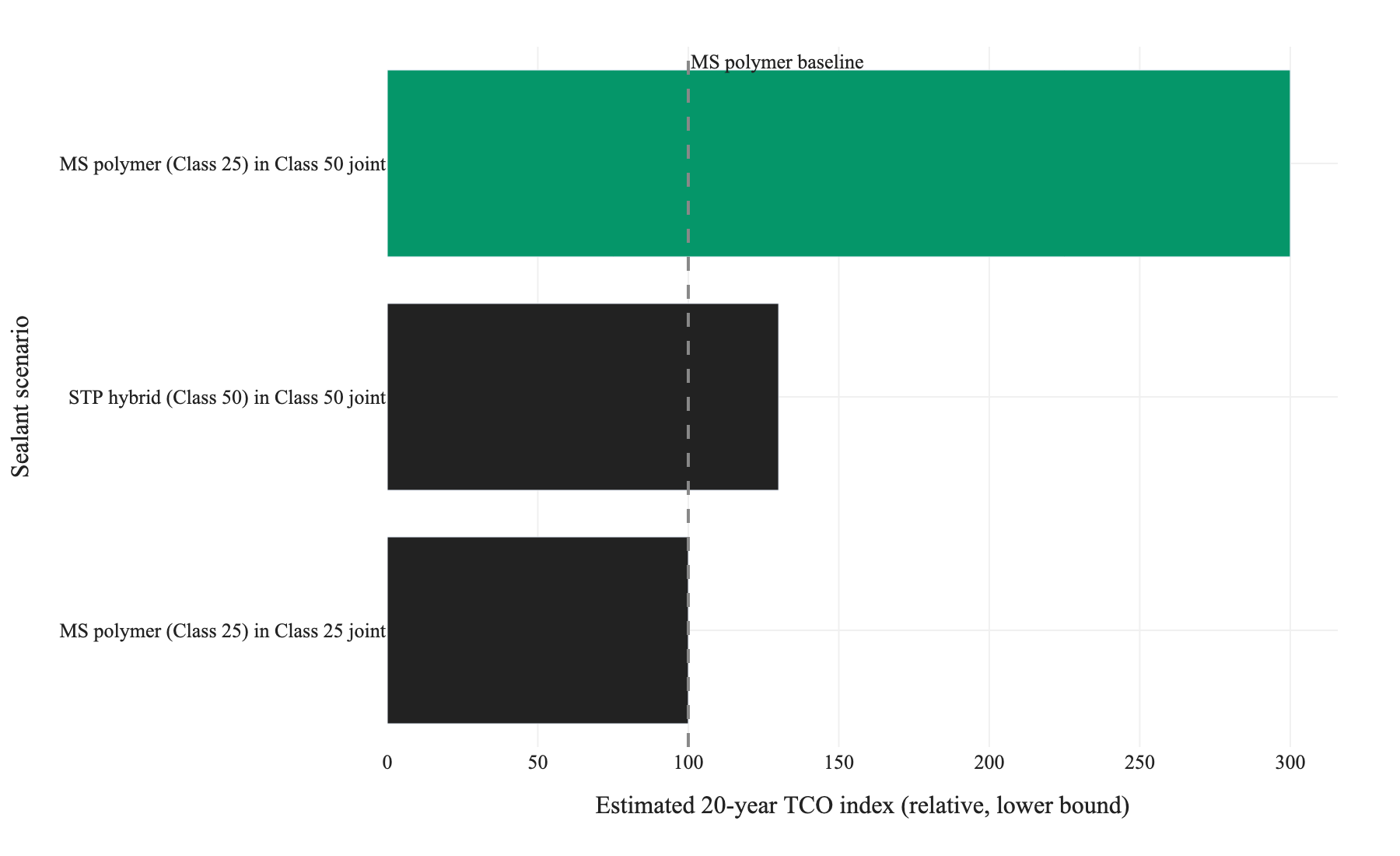
How Does the 20-Year Total Cost Change When the Sealant Class Is Mismatched?
Cost element | MS polymer (Class 25) in Class 25 joint | MS polymer (Class 25) in Class 50 joint | STP hybrid (Class 50) in Class 50 joint |
|---|---|---|---|
Initial material cost (relative index) | 100 | 100 | 130 to 140 |
Resealing cycles in 20 years | 0 to 1 | 3 to 4 | 0 to 1 |
Labor cost per resealing event | Low to high depending on access | Low to high depending on access | Low to high depending on access |
Estimated 20-year TCO index | 100 | 300 to 500 | 130 to 150 |
The table illustrates the cost structure rather than absolute figures, which vary by geography, access complexity, and labor rates. The central finding is that using MS polymer in a joint exceeding its movement class multiplies the 20-year total cost by a factor of three to five relative to using it in the correctly matched application.
How Does Substrate Compatibility Differ Between MS Polymer and STP Hybrid?
Both chemistries bond to most construction and industrial substrates without primer, including concrete, masonry, steel, aluminum, stainless steel, glass, PVC, wood, and fiber cement (Sto Corp., 2024; Bopin Chem, 2024). This primer-free adhesion is a shared advantage over polyurethane sealants, which frequently require priming on porous substrates. On anodized aluminum and powder-coated steel panels -- common in industrial glazing and equipment housings -- adhesion tests per ISO 8339:2014 (Building Construction -- Sealants -- Determination of Tensile Properties, ISO) should be conducted on representative substrate samples before final specification, as coating formulations vary and can reduce bond strength.
One substrate-specific advantage of STP hybrid formulations is adhesion to damp or wet concrete without blistering, which is relevant for joints in below-grade equipment housings, secondary containment structures, and facilities in high-humidity operating environments (Sto Corp., 2024). Standard MS polymer grades specify dry substrate for adhesion; some can tolerate surface moisture with primer, but the STP hybrid formulations handle this condition more consistently without the additional step.
V. Selection by Joint Movement, Chemical Exposure, and Aesthetic Requirement
The selection procedure below outputs a chemistry assignment for a given joint condition in five steps. It is designed to be completed by a glazing engineer, maintenance supervisor, or procurement engineer at the point of joint design or specification review.
What Procedure Routes a Joint Condition to the Correct Chemistry in Five Steps?
Step 1: Calculate maximum joint movement percentage.
Measure or estimate the joint span and the design temperature differential for the specific climate and installation. Apply the thermal expansion coefficient for the substrate material: steel at 12 times ten to the minus 6 per degree Celsius, aluminum at 23 times ten to the minus 6 per degree Celsius, and concrete at 10 to 14 times ten to the minus 6 per degree Celsius (Bopin Chem, 2024). Multiply by the safety factor of 1.25 per ASTM C1193. Divide calculated movement by joint width to obtain the movement percentage.
Example: 2,500 mm aluminum panel, 60 degree Celsius differential, 12 mm joint width. Movement = 23 x 10^-6 x 2,500 x 60 = 3.45 mm. With 1.25 safety factor = 4.3 mm. Movement percentage = 4.3 / 12 = 36 percent. This exceeds the Class 25 ceiling. STP hybrid is required.
Step 2: Identify chemical exposure category.
Classify the expected chemical environment using three levels:
Level A: Water, UV, rain, road salt, dilute cleaning agents. MS polymer and STP hybrid both adequate.
Level B: Mineral oils, fuels (aliphatic), dilute acids below 10 percent, dilute alkalis below 10 percent. MS polymer and STP hybrid both adequate.
Level C: Aromatic solvents, concentrated acids above 10 percent, concentrated alkalis above 10 percent, chlorinated hydrocarbons. Neither MS polymer nor STP hybrid adequate. Specify chemical-resistant silicone or epoxy-based sealant.
Step 3: Apply the movement-chemical matrix.
Use the crosswalk table in Section III and the Step 1 and Step 2 outputs to identify the feasible chemistry set. If the movement is below 25 percent and the exposure is Level A or B, MS polymer is the primary specification. If the movement is 25 to 50 percent and the exposure is Level A or B, STP hybrid is required. If the movement exceeds 50 percent, Class 100 STP hybrid or silicone structural sealant is required. If the exposure is Level C at any movement percentage, exit this procedure and specify a chemical-specialist product outside the MS/STP family.
Step 4: Check aesthetic and overcoat requirements.
Both MS polymer and STP hybrid are paintable and overcoatable with most water-based and solvent-based topcoats after 24 hours. If the joint will be painted to match a facade color, both are acceptable. If the joint requires a silicone-finish appearance (non-paintable, glass-clear), neither MS polymer nor STP hybrid achieves this. Silicone sealant is required for structural glazing with no paint overcoat.
Step 5: Confirm temperature service range.
Both chemistries carry a service temperature range of approximately minus 40 degrees Celsius to plus 90 degrees Celsius continuous. Above 90 degrees Celsius continuous, silicone is the specification. For joints on hot-process equipment surfaces exceeding this threshold, confirm the substrate surface temperature in service, not just the ambient temperature.
Figure 3a. Selection Decision Matrix: Eight Scenarios (Movement and Chemistry)
Scenario | Joint movement | Chemical level | Correct chemistry |
|---|---|---|---|
Interior aluminum partition panel joint | Less than 10 percent | A | MS polymer |
Exterior concrete facade, 1,000 mm panels | 12 to 18 percent | A | MS polymer |
Industrial rooftop aluminum skylight, 2,000 mm panels | 30 to 38 percent | A | STP hybrid |
Steel equipment housing, thermal cycling 50C differential | 28 to 40 percent | B (mineral oil) | STP hybrid |
Exterior aluminum curtain wall, desert climate, 80C differential | 40 to 55 percent | A | STP hybrid (Class 50) |
Chemical plant secondary containment, epoxy floor joint | Less than 15 percent | C (acids, solvents) | Chemical-resistant silicone or epoxy |
Structural glazing, glass to aluminum frame | Less than 15 percent | A | Silicone structural |
High-temp process equipment joint, 100 to 120C surface | Any | B | High-temp silicone |
Figure 3b. Selection Decision Matrix: Eight Scenarios (Temperature and Aesthetic)
Scenario | Surface temperature | Aesthetic requirement | Action if neither MS nor STP |
|---|---|---|---|
Interior aluminum partition panel joint | Below 90C | Paintable | Not applicable |
Exterior concrete facade, 1,000 mm panels | Below 90C | Paintable | Not applicable |
Industrial rooftop aluminum skylight, 2,000 mm panels | Below 90C | Paintable | Not applicable |
Steel equipment housing, thermal cycling 50C differential | Below 90C | Not critical | Not applicable |
Exterior aluminum curtain wall, desert climate | Below 90C | Paintable | Not applicable |
Chemical plant secondary containment joint | Below 90C | Not critical | Consult chemical-sealant specialist |
Structural glazing, glass to aluminum frame | Below 90C | Glass-clear | Consult structural glazing engineer |
High-temp process equipment joint | Above 90C | Not critical | Specify high-temp silicone |
The two-part matrix is operator-actionable: for each scenario, the engineer reads the row across both tables to confirm the chemistry and verify temperature and aesthetic constraints. The matrix is not exhaustive -- edge cases with simultaneous high movement and chemical Level C exposure require specialist engineering advice, which is the escalation trigger for AI Shooting case submission described in the CTA section.
VI. Field Cases -- Industrial Facility, Glazing, and Equipment Sealing Programs
The following cases are anonymized. Industry type and technical data are presented to allow direct field application. Each case follows the Lubinpla quantitative case format with before-and-after comparison, specific actions, and site background.
Case 1: Incorrect Chemistry on Rooftop Glazing (Incident Trigger Pattern)
Company A is a chemical manufacturing facility with a 3,200 square meter production building in a temperate continental climate. The building features aluminum-framed rooftop glazing panels measuring 2,400 by 1,200 mm, installed on a structural steel grid. Ambient temperature swing from minus 15 degrees Celsius in winter to plus 42 degrees Celsius in summer produces a 57-degree Celsius operational differential. The original specification called for MS polymer sealant (Class 25) at a joint width of 10 mm, applied in 2018.
By 2021, the facilities maintenance team reported 38 visible joint failures on the 850-meter perimeter glazing -- a 4.5 percent failure rate by joint count. Joint inspection confirmed adhesive debonding at the aluminum substrate interface on the north and east elevations, where the temperature differential was most pronounced. The calculated movement for these joints was 24 x 10^-6 x 2,400 mm x 57 degrees Celsius = 3.29 mm, divided by 10 mm joint width = 32.9 percent. Including the ASTM C1193 safety factor of 1.25, the design movement was 41 percent -- well outside the Class 25 ceiling.
The resealing program specified STP hybrid sealant (ASTM C920, Class 50) at the original joint width. Joint preparation included mechanical removal of the failed MS polymer, isopropanol solvent wipe, and application of a non-priming adhesion activator on the powder-coated aluminum frame. Total resealing cost was approximately USD 61,000 for 850 linear meters, including scaffold hire and labor. At the three-year follow-up inspection in 2024, zero joint failures were recorded. The cost of the original misspecification, including the 2021 resealing program plus three years of water ingress remediation at joints adjacent to the failures, was approximately USD 95,000 -- a direct consequence of selecting Class 25 for a Class 35 to 50 application.
Case 2: Correct Chemistry but Incorrect Joint Width (Unexpected Cause Pattern)
Company B is a logistics facility with a 140-meter-long cold storage extension built in 2019. The building uses glass-fiber-reinforced concrete (GRC) panels at 3,000 mm spans with 12 mm joints sealed in STP hybrid sealant (Class 50), correctly specified for the calculated 28 percent movement on the GRC-to-steel-subframe joint. The sealing contractor reported zero failures through the first winter cycle.
During year-two inspection, the maintenance team identified 14 joint failures -- 10 percent of all joints -- showing cohesive failure at the joint centerline, not adhesive debonding at the substrate. Root cause investigation revealed that the backing rod had been installed at the same diameter as the joint width, rather than 25 to 30 percent oversized as required. This produced a sealant depth exceeding joint width, creating three-sided adhesion at the backing rod surface -- a geometry that multiplies the effective strain on the sealant during extension, causing the sealant to fail at its centroid even though adhesion at the substrate was intact.
The corrective action replaced the failed joints with correctly staged backing rod (15 mm diameter in a 12 mm joint), re-sealed with the same STP hybrid, and added a joint installation checklist to the quality procedure. No additional failures were recorded over the following 36 months. This case demonstrates that correct chemistry selection does not substitute for correct joint geometry: the sealant selection matrix in Section V addresses chemistry, but the installer must independently verify the backing rod specification per the sealant manufacturer's joint design guide before application.
Case 3: Chemical Exposure Driven Failure on Process Equipment (Cost Reversal Pattern)
Company C is a contract chemical blending facility that installed STP hybrid sealant on steel equipment housing joints in 2020. The joints were specified correctly for 35 percent movement between the steel frame and equipment panels. The specification did not review the chemical environment, which included periodic splash of xylene-based cleaning solvent used to flush blending vessels.
By 2022, 22 of 64 sealing joints on the equipment housing showed swelling, surface tackiness, and partial debonding consistent with aromatic solvent ingress. Test specimens cut from failed joints showed 28 percent volume swell after 72-hour immersion in xylene, confirming the failure mode. The correct replacement specification was a two-component polysulfide sealant with documented xylene resistance, at approximately 2.4 times the unit cost of the STP hybrid.
The cost comparison, however, supported the upgrade: the two-component polysulfide installation on 64 linear meters of equipment housing cost approximately USD 8,400 in materials and USD 11,000 in labor for joint preparation and application -- a total of USD 19,400. The failed STP hybrid program had cost USD 7,200 in materials and required three remediation rounds at USD 6,000 each, totaling USD 25,200 over the same 30-month period. The higher-cost chemical-specialist sealant was less expensive in total by USD 5,800 over a comparable service period. This case illustrates the cost reversal pattern: the chemically matched sealant appears expensive at procurement but reduces total expenditure through elimination of remediation cycles.
VII. Key Takeaway
MS polymer sealants (plus or minus 25 percent, Class 25, ASTM C920) are the correct specification for facade, glazing, and equipment joints where calculated movement after the ASTM C1193 safety factor does not exceed 25 percent, and where chemical exposure is Level A (UV, rain, salt) or Level B (dilute acids, alkalis, mineral oils). Do not specify MS polymer as a default without calculating the actual joint movement percentage first.
STP hybrid sealants (plus or minus 50 percent or higher, Class 50 or Class 100) are required when calculated movement exceeds 25 percent. The movement-class threshold is the primary specification driver. The 20 to 40 percent material cost premium over MS polymer is recovered within the first avoided resealing cycle on any joint that requires scaffold access.
Neither MS polymer nor STP hybrid is adequate for Level C chemical environments: aromatic solvents, concentrated acids above 10 percent, concentrated alkalis above 10 percent, or chlorinated hydrocarbons. Specifying either chemistry in these conditions produces a service life measured in months rather than years.
Joint geometry determines whether even a correctly specified chemistry will perform. Install closed-cell polyethylene backing rod at 25 to 30 percent oversize relative to joint width to prevent three-sided adhesion. Confirm the width-to-depth ratio targets 2:1 for joints wider than 10 mm.
Run the five-step selection procedure in Section V and the eight-scenario matrix in Section V at the joint design stage, before installation. Chemistry assignment after joint failure costs three to five times as much as chemistry assignment at specification.
When your joint conditions combine unusual movement amplitudes, mixed substrate materials, or chemical exposures near the boundary between Level B and Level C, the decision cannot be resolved by a general table. Submit your joint geometry, movement calculations, substrate types, and chemical exposure profile to AI Shooting -- Lubinpla's per-case industrial chemistry analysis service -- which returns a written evidence-based recommendation on sealant chemistry, joint width, and installation sequence. Access the service at https://www.lubinpla.com/ai-shooting.
VIII. References
ASTM International. (2018). ASTM C920-18: Standard Specification for Elastomeric Joint Sealants. https://store.astm.org/c0920-18.html
ASTM International. (2019). ASTM C719-14(2019): Standard Test Method for Adhesion and Cohesion of Elastomeric Joint Sealants Under Cyclic Movement (Hockman Cycle). https://www.astm.org/Standards/C719.htm
Bopin Chem. (2024). MS Polymer Adhesive Sealants: The Complete Construction Bonding Guide. https://bopinchem.com/ms-polymer-adhesive-sealants-the-complete-construction-bonding-guide/
Bopin Chem. (2024). Understanding Sealant Movement Capability and Joint Design. https://bopinchem.com/understanding-sealant-movement-capability-and-joint-design/
General Sealants. (2023). Why Cheaper Industrial Sealants Tend to Cost More in the Long Run. https://generalsealants.com/why-cheaper-industrial-sealants-cost-more-in-long-run/
ISO (International Organization for Standardization). (2002). ISO 11600:2002: Building Construction -- Jointing Products -- Classification and Requirements for Sealants. https://www.iso.org/standard/26328.html
Kaneka. (2024). History of Kaneka MS Polymer. https://www.kaneka.be/technology-products/liquid-polymers/kaneka-ms-polymertm/history
Kingdeli Sealant. (2024). MS Polymers vs. Traditional Sealants: The Definitive Comparison for Durability and Cost-Efficiency. https://www.kingdelisealant.com/article/ms-polymers-vs-traditional-sealants-the-definitive-comparison-for-durability-and-cost-efficiency-2026-guide/
Mantasil. (2023). Difference Between MS, STPE, SMP, STPU and SPU. https://www.mantasil.com/difference-between-ms-stpe-smp-stpu-and-spu/
MPS Concrete Solutions. (2023). Movement Joints and Expansion Joint Sealing: Why They Fail and How to Fix Them. https://www.mpsconcrete.com/blog/movement-joints-expansion-joint-sealing-repair-guide
Pelseal Technologies. (2023). Secondary Containment Chemical Resistant Sealant. https://www.pelseal.com/secondary-containment
SpecialChem. (2024). MS Polymer Sealant -- Properties, Formulations and Applications. https://www.specialchem.com/adhesives/guide/ms-polymer-sealants
Sto Corp. (2024). StoSeal STPE Sealant: Everything You Need to Know. https://www.stocorp.com/stpe-sealant/
US Made Supply. (2023). ASTM C920 Joint Sealant: Type, Grade, Class and Use. https://usmadesupply.com/resources/building-codes-standards/astm-ul-general/astm-c920
Wikipedia. (2023). Silyl modified polymers. https://en.wikipedia.org/wiki/Silyl_modified_polymers