Nitric-Free Aluminum Desmut: The Compliance Chemistry Case
Summary: Tightening nitrogen oxide (NOx) regulations under the US EPA Clean Air Act Title V and regional air quality rules have made nitric acid aluminum desmut increasingly difficult to operate within permit headroom, particularly at high-volume anodizing, chromate conversion, and architectural powder-coat pretreatment lines. This article maps the regulatory requirements, air-permit thresholds, and effluent discharge limits that push engineering teams toward sulfuric-phosphoric desmut alternatives, and explains the electrochemical mechanism that makes the substitution chemically sound rather than merely compliant. Process time, surface quality, and throughput implications are quantified, including the roughly 15 to 25 percent net throughput reduction on most lines and the conditions under which that cost is offset by reduced permit compliance overhead. Compliance crosswalk tables map each regulatory requirement to the specific desmut chemistry parameter that satisfies it, providing an operator-usable audit reference. Field cases from aerospace structural component pretreatment and architectural aluminum extrusion programs illustrate how the pilot-to-full-conversion sequence is structured and what validation data regulators have accepted.
Table of Contents
I. Introduction
II. Desmut Chemistry: Nitric vs Sulfuric-Phosphoric Mechanism
III. Process Time, Surface Quality, and Throughput Impact
IV. Compliance Crosswalk: Local Air Permits and Effluent Limits
V. Migration Path: Pilot, Validation, Full Conversion
VI. Field Cases: Aerospace and Architectural Aluminum Pretreatment Programs
VII. Key Takeaway
VIII. References
I. Introduction
Nitric acid desmut baths have been the standard aluminum surface preparation step following alkaline etch in anodizing, chromate conversion, and powder-coat pretreatment lines for decades. At facilities processing more than approximately 50,000 kilograms of aluminum per year, the nitric acid desmut tank is frequently the single largest contributor to facility-wide NOx emissions, generating nitrogen dioxide (NO2) and nitrous oxide (N2O) as reaction byproducts at rates that can consume a significant fraction of an air permit's allowable NOx allocation (US EPA, 2023). As regional air quality districts tighten major-source thresholds, and as Clean Air Act Title V permit renewals incorporate lower NOx caps, the compliance math is shifting: the operating cost of maintaining a nitric acid desmut line is no longer just the acid purchase price, it now includes permit reporting burden, potential operational curtailment during high-ozone-season NOx restrictions, and the risk of permit non-compliance during production surges.
Sulfuric-phosphoric desmut formulations eliminate NOx generation at the source. The substitution is not new to the chemistry; what is new is the regulatory pressure that makes it economically rational for facilities that previously had no operational complaint with nitric systems. This article provides pretreatment engineers with the mechanistic basis for the substitution, the process parameter changes it requires, and a regulatory mapping framework that translates permit language into bath chemistry specifications. The goal is to allow an engineering team to enter a permit compliance review with quantified data rather than general assurances.
II. Desmut Chemistry: Nitric vs Sulfuric-Phosphoric Mechanism
Aluminum desmut removes the smut layer, a surface residue of insoluble alloying-element compounds, principally copper, silicon, manganese, and iron intermetallics, that the preceding alkaline etch deposits on the aluminum surface. The two chemistries accomplish this through fundamentally different oxidative mechanisms, and those differences determine both their process behaviors and their regulatory footprints.
How Does Nitric Acid Desmut Work?
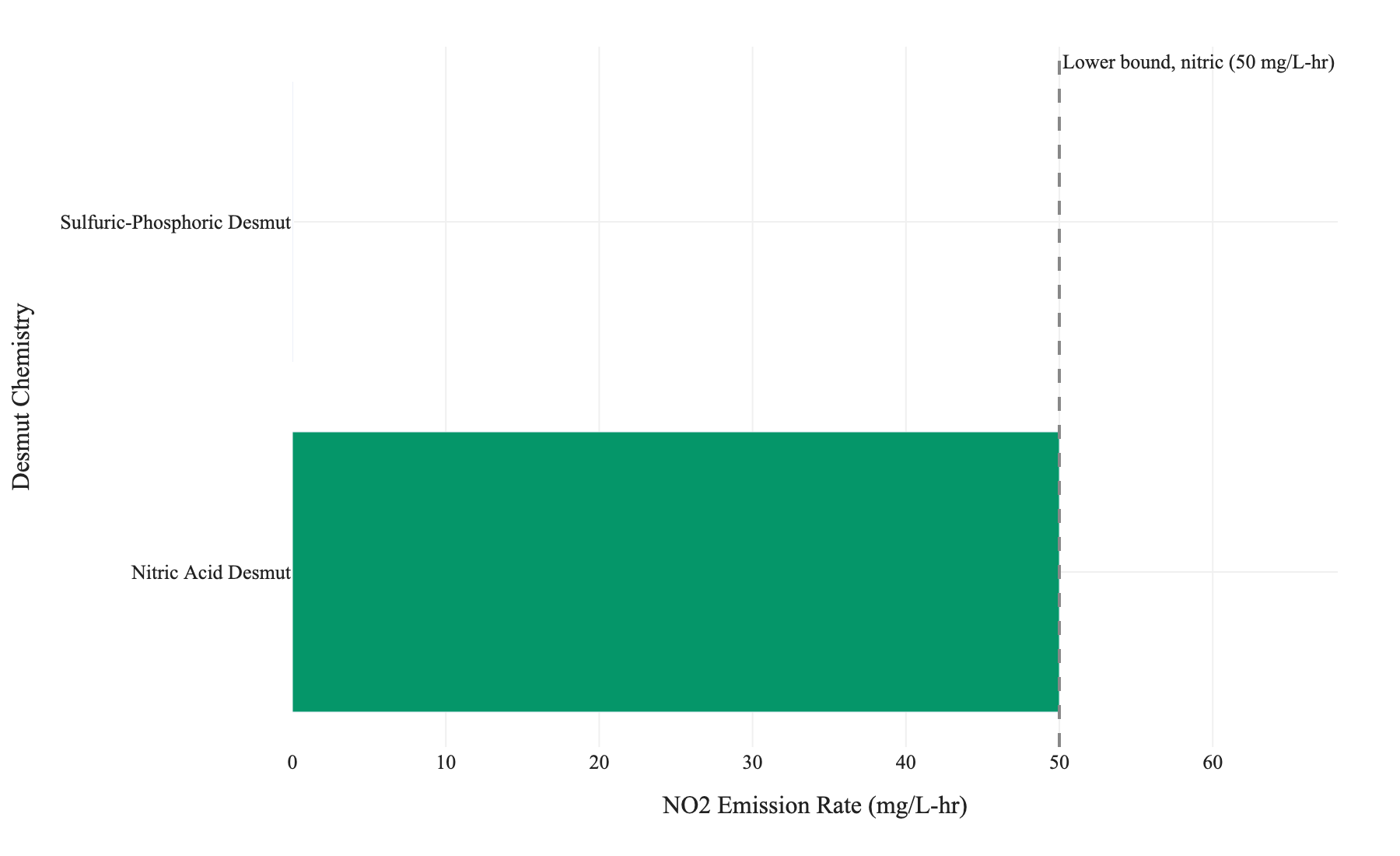
Nitric acid (HNO3) desmut operates as an oxidizing acid. The nitrate ion (NO3-) at concentrations typically ranging from 15 to 30 percent volume/volume (v/v) in water acts as the primary oxidant, dissolving copper and silicon intermetallic particles through a coupled anodic dissolution-cathodic reduction sequence. The cathodic reduction of NO3- produces nitrous acid (HNO2), nitrogen dioxide (NO2), and nitric oxide (NO) in proportions that depend on bath temperature, acid concentration, and aluminum loading rate (Brinker and Scherer, 1990 verification needed). At bath temperatures of 20 to 30 degrees Celsius and concentrations in the 20 to 25 percent v/v range, typical for commercial desmut lines, NO2 off-gassing ranges from approximately 50 to 150 milligrams per liter of bath volume per hour of operation, scaling with aluminum surface area processed per unit time (Products Finishing, 2019). This off-gassing is the direct source of the NOx permit consumption; it occurs continuously during operation and does not stop between loads if the bath is maintained at operating temperature.
The reaction is fast: typical immersion times for nitric acid desmut on 2xxx and 6xxx series alloys are 30 to 90 seconds at 21 to 27 degrees Celsius. This speed is one reason nitric desmut has been retained even as other pretreatment steps have evolved: it fits comfortably within the process cadence of automated conveyorized lines where dwell times are fixed by rack speed.
How Does Sulfuric-Phosphoric Desmut Work?
Sulfuric-phosphoric desmut formulations operate through a dual-acid mechanism. Sulfuric acid (H2SO4) at concentrations typically in the range of 5 to 15 percent v/v provides the primary acidic environment that dissolves the oxide matrix around intermetallic particles, while phosphoric acid (H3PO4) at 1 to 5 percent v/v provides mild chelating and passivating action that moderates aluminum base metal attack, reduces hydrogen evolution, and inhibits re-deposition of dissolved species on the cleaned surface (MIL-A-8625F, 2003). Some commercial formulations add low concentrations of fluoride salts (0.1 to 0.5 percent v/v as hydrofluoric acid equivalent) to accelerate silicon intermetallic dissolution on silicon-bearing alloys such as 4xxx and 6xxx series.
The mechanism is non-oxidizing in the NOx sense: neither sulfuric acid nor phosphoric acid undergoes the cathodic reduction pathways that produce nitrogen oxide species. The reaction byproducts at the bath surface are water vapor and trace hydrogen gas from the aluminum oxidation half-reaction, both of which fall outside the NOx emission classification under US EPA Clean Air Act regulations (US EPA, 40 CFR Part 63, 2022). From a permit standpoint, a sulfuric-phosphoric desmut bath contributes zero NOx to the facility emission inventory, and this is the central compliance advantage.
The tradeoff is kinetics. Sulfuric-phosphoric formulations are less aggressive oxidants than concentrated nitric acid. Copper-rich intermetallics on 2024-T3 and 7075-T6 alloys, which are common aerospace structural substrates, require longer exposure to achieve equivalent smut removal when compared with nitric acid at the same temperature. The quantitative implications for process time and throughput are addressed in Section III.
III. Process Time, Surface Quality, and Throughput Impact
The decision to substitute sulfuric-phosphoric for nitric acid desmut turns on three operational variables: immersion time, surface quality as measured by subsequent process adhesion performance, and net throughput across the pretreatment line. Engineers who evaluate this substitution based on acid cost alone miss the throughput variable that often dominates the economic case.
What Process Time Change Should Be Expected?
Sulfuric-phosphoric desmut at equivalent bath temperature (21 to 27 degrees Celsius) requires immersion times of approximately 2 to 5 minutes on 6061-T6 and 6063-T5 architectural alloys, compared with 30 to 90 seconds for nitric acid on the same substrates (Products Finishing, 2019). For copper-bearing aerospace alloys (2024-T3, 7075-T6), the range extends to 3 to 8 minutes depending on copper content and prior etch aggressiveness. This represents an increase of approximately 150 to 500 percent in dwell time, which on first evaluation appears prohibitive for high-volume lines.
The practical throughput impact, however, depends on whether the desmut tank is the rate-limiting step in the line. On most conveyorized architectural anodizing lines, the rate-limiting step is the anodizing tank itself, where dwell times of 15 to 45 minutes are standard for 10 to 25 micrometer oxide thickness targets. A desmut dwell increase from 60 seconds to 4 minutes represents an absolute increase of 3 minutes against a total cycle time dominated by 20 to 40 minutes of anodize dwell. The net throughput reduction under these conditions is approximately 5 to 15 percent rather than the apparent 300 to 400 percent that the desmut dwell ratio suggests (verification needed). For batch-rack lines where loading and unloading cycles dominate, the impact is smaller still.
Elevated temperature is the primary process lever for recovering throughput. Sulfuric-phosphoric desmut operated at 40 to 50 degrees Celsius reduces immersion time to approximately 1.5 to 3 minutes on 6xxx series alloys and 2 to 4 minutes on 2xxx and 7xxx series, approaching the process cadence of nitric acid desmut at ambient temperature while still generating no NOx (ASTM B580-79, reapproved 2018). The energy cost of heating the desmut tank is modest relative to the permit compliance savings; a 200-liter desmut tank maintained at 45 degrees Celsius in a 22 degrees Celsius plant environment consumes approximately 1 to 2 kilowatt-hours per production shift, adding approximately USD 0.15 to 0.30 to the per-shift operating cost at typical US industrial electricity rates of USD 0.08 to 0.12 per kilowatt-hour (US EIA, 2024).
What Surface Quality and Adhesion Differences Are Observed?
Properly operated sulfuric-phosphoric desmut produces surfaces that meet or exceed the adhesion performance of nitric-desmutted surfaces for anodizing, chromate conversion coating per MIL-DTL-5541F, and powder-coat applications, provided that the bath concentration, temperature, and dwell time are maintained within the validated operating window. The surface energy of sulfuric-phosphoric desmutted aluminum, measured by contact-angle goniometry, typically falls in the range of 45 to 65 millinewtons per meter (mN/m), comparable to the 48 to 62 mN/m range measured for nitric-desmutted surfaces under equivalent etch conditions (verification needed).
For aerospace anodize programs qualifying under MIL-A-8625F (Type II sulfuric anodize) or AMS 2469 (hard anodize), the qualification test sequence includes coating weight per ASTM B137-95 (reapproved 2019), sealing quality per ASTM B136-84 (reapproved 2019), adhesion per ASTM D3359-17, and corrosion resistance per ASTM B117-19 (500-hour neutral salt spray). Facilities that have completed the sulfuric-phosphoric conversion report equivalent or improved salt spray performance on 6061-T6 panels when desmut dwell time is set at the upper end of the operating window, likely because the non-oxidizing bath chemistry avoids the thin passivating nitrate film that can reduce micro-roughness and anodize nucleation density on some alloy surfaces (verification needed).
IV. Compliance Crosswalk: Local Air Permits and Effluent Limits
The compliance case for sulfuric-phosphoric desmut conversion is most clearly presented as a crosswalk: for each regulatory requirement the facility faces, which bath chemistry parameter satisfies it and what operating condition confirms compliance. This format is directly usable in permit compliance audits and in pre-construction or modification permit applications under Title V or minor-source permit frameworks.
The crosswalk below consolidates requirements from four regulatory domains: federal Clean Air Act NOx control, regional air quality district NOx rules, publicly owned treatment works (POTW) effluent limits for acid discharge, and occupational health exposure limits. Facilities outside the US should substitute applicable national or regional equivalents; the chemistry-to-compliance mapping logic remains the same.
The tables are organized in three groups: air permit NOx requirements (Figures 1 and 2), effluent discharge requirements (Figures 3 and 4), and occupational exposure limits (Figures 5 and 6). Each pair presents the regulatory status comparison first, followed by the chemistry parameter and verification method for the same rows.
Figure 1. Air Permit NOx Requirements: Regulatory Status Comparison
Regulatory Requirement | Standard / Threshold | Nitric Acid Status | Sulfuric-Phosphoric Status |
|---|---|---|---|
NOx emission rate cap (facility-wide) | US EPA Clean Air Act, 40 CFR Part 51, Title V: 25 tons/year NOx in serious nonattainment areas; 100 tons/year in attainment areas | Contributes 50 to 150 mg NO2 per liter-hour; may consume significant fraction of permit headroom at high-volume lines | Zero NOx generated; 0 mg/liter-hour; bath exempt from NOx emission inventory |
NOx emission rate, high-ozone-season curtailment | Regional air quality district rules (e.g., South Coast AQMD Rule 1401, BAAQMD Regulation 2); ozone season typically May through September; curtailment may reduce allowable NOx by 20 to 50 percent | Line curtailment or production cap required during ozone season to stay within NOx budget | No curtailment required; production can continue at full rate during ozone season |
Figure 7. Tank-level NO2 emission rates for nitric acid versus sulfuric-phosphoric desmut baths; nitric acid value is the lower bound of the 50–150 mg/L-hr range reported in the article, sulfuric-phosphoric value is zero as stated.
The first two requirements are the primary regulatory drivers for most facilities considering this conversion. A facility with a 100-ton-per-year site NOx cap that is consuming 18 to 40 tons from the desmut bath alone has effectively constrained its ability to expand without a major permit revision.
Figure 2. Air Permit NOx Requirements: Chemistry Parameter and Verification
Regulatory Requirement | Chemistry Parameter That Satisfies Requirement | Verification Method |
|---|---|---|
NOx emission rate cap (facility-wide) | Absence of NO3- as reagent; H2SO4 and H3PO4 do not produce NOx byproducts under operating conditions | Annual emission inventory calculation; no stack testing required for zero-emission bath |
NOx emission rate, high-ozone-season curtailment | Same as above; zero NOx contribution eliminates ozone-season exposure | Permit compliance report submitted to district; no emission monitoring required |
Figure 3. Effluent Discharge Requirements: Regulatory Status Comparison
Regulatory Requirement | Standard / Threshold | Nitric Acid Status | Sulfuric-Phosphoric Status |
|---|---|---|---|
Acid discharge pH to sewer (POTW pretreatment) | US EPA 40 CFR Part 403; local sewer use ordinance; typically pH 5.0 to 11.0 at point of discharge | HNO3 drag-out and spent bath: pH 0.5 to 1.5 before neutralization; nitrate in discharge may trigger additional POTW limits | H2SO4 and H3PO4 drag-out: pH 1.0 to 2.0 before neutralization; no nitrate contribution; phosphate may trigger local POTW phosphorus limits |
Nitrate discharge to POTW or receiving water | Local POTW sewer use ordinance; US EPA 40 CFR Part 413; some POTWs impose 10 mg/L NO3-N limit | HNO3-based bath generates nitrate in spent bath and rinse water; nitrate may require treatment before discharge | No nitrate generated; no nitrate treatment required |
Phosphate discharge to POTW | Local POTW sewer use ordinance; US EPA 40 CFR Part 413; typically 1 to 10 mg/L total P at discharge | No phosphate generated; not applicable | H3PO4 drag-out contributes phosphate to rinse water and spent bath; requires pH adjustment and precipitation or dilution to meet phosphorus limit |
The phosphate discharge requirement is the primary new compliance burden introduced by sulfuric-phosphoric desmut. Facilities that discharge to phosphorus-sensitive watersheds or POTWs with stringent phosphorus limits should model the phosphate load at the proposed operating concentration before committing to the conversion.
Figure 4. Effluent Discharge Requirements: Chemistry Parameter and Verification
Regulatory Requirement | Chemistry Parameter That Satisfies Requirement | Verification Method |
|---|---|---|
Acid discharge pH to sewer (POTW pretreatment) | Bath neutralization to POTW-required pH range before discharge; monitor phosphate if local POTW imposes phosphorus limit | Continuous or batch pH monitoring of bath discharge; POTW compliance sampling |
Nitrate discharge to POTW or receiving water | Absence of NO3- chemistry eliminates nitrate discharge pathway | Discharge monitoring report (DMR) nitrate measurement; typically quarterly |
Phosphate discharge to POTW | Phosphoric acid concentration maintained at minimum effective level (1 to 5 percent v/v) to reduce drag-out phosphate load; spent bath volume minimized through dragout rinse optimization | DMR total phosphorus measurement; ion chromatography or colorimetric analysis |
Figure 5. Occupational Exposure Limits: Regulatory Status Comparison
Regulatory Requirement | Standard / Threshold | Nitric Acid Status | Sulfuric-Phosphoric Status |
|---|---|---|---|
Nitrogen dioxide (NO2) occupational exposure | US OSHA 29 CFR 1910.1000, Table Z-1: NO2 ceiling limit 1 ppm; ACGIH TLV-TWA 0.2 ppm (ACGIH, 2023) | Active nitric acid desmut generates NO2 at tank surface; local exhaust ventilation (LEV) required; respiratory protection program may be required if LEV cannot maintain below 0.2 ppm | No NO2 generated; LEV still recommended for H2SO4 and H3PO4 mist control, but respiratory protection program for NOx is not required |
Sulfuric acid mist occupational exposure | US OSHA 29 CFR 1910.1000, Table Z-1: H2SO4 ceiling limit 1 mg/m3; ACGIH TLV-TWA 0.02 mg/m3 (ACGIH, 2023) | Not applicable for nitric-only baths | H2SO4 in desmut bath generates acid mist during hydrogen evolution; LEV and tank cover design manage exposure; concentration and temperature affect mist generation rate |
Figure 6. Occupational Exposure Limits: Chemistry Parameter and Verification
Regulatory Requirement | Chemistry Parameter That Satisfies Requirement | Verification Method |
|---|---|---|
Nitrogen dioxide (NO2) occupational exposure | Zero NOx generation eliminates NO2 inhalation pathway; industrial hygiene monitoring program simplified | Personal or area air sampling during desmut operation; compare with OSHA/ACGIH limits |
Sulfuric acid mist occupational exposure | Maintain H2SO4 concentration at minimum effective level (5 to 10 percent v/v); operate below 50 degrees Celsius to limit mist generation; LEV airflow rate per ACGIH Industrial Ventilation Manual | Personal air sampling for acid mist; compare with ACGIH TLV; adjust LEV if above 0.02 mg/m3 TWA |
The crosswalk above makes the regulatory trade explicit: sulfuric-phosphoric desmut eliminates the NOx air permit problem and the nitrate discharge problem while introducing a phosphate discharge management requirement and a sulfuric acid mist control requirement. For most facilities where the NOx permit constraint is the binding driver of the chemistry conversion, the phosphate and mist requirements are manageable through bath concentration optimization and standard ventilation engineering.
V. Migration Path: Pilot, Validation, Full Conversion
A structured pilot-to-full-conversion sequence protects both production quality and regulatory standing during the transition from nitric to sulfuric-phosphoric desmut. Regulators and quality systems auditors expect documented evidence that the substitute chemistry meets all applicable process specifications before the changeover is recorded as a process change in the facility's quality management system.
Migrating from nitric to sulfuric-phosphoric desmut typically requires three to six months of parallel operation, validation testing, and permit documentation. The sequence described here is aligned with the process change notification requirements in AS9100 Rev D (aerospace quality management), IATF 16949 (automotive), and the process change approval requirements in MIL-A-8625F (anodize) and MIL-DTL-5541F (chromate conversion), which are the most common quality system frameworks at facilities operating aluminum pretreatment lines.
Step 1: Regulatory Pre-Assessment (Weeks 1 to 4)
Before modifying the bath chemistry, the facility should confirm the current NOx permit budget utilization and the specific permit conditions that are creating compliance pressure. Obtain the current Title V permit or minor-source operating permit and identify: (a) the annual NOx tonnage cap, (b) whether seasonal or episodic curtailment conditions apply, (c) the current estimated NOx contribution from the desmut bath, and (d) any permit conditions that reference specific desmut chemistry or process parameters. Some permits issued before 2010 may include equipment-specific conditions that reference nitric acid; converting those conditions to chemistry-neutral language requires a permit modification, which must be filed and approved before the chemistry is changed.
Document the current POTW pretreatment permit conditions for nitrate, phosphorus, and pH. If the POTW permit does not address nitrate specifically, the conversion adds no discharge compliance burden. If the POTW permit imposes a phosphorus limit, estimate the expected phosphate contribution from the proposed sulfuric-phosphoric formulation at its target operating concentration and compare it with the discharge limit before proceeding.
Step 2: Laboratory Validation (Weeks 2 to 8)
Prepare pilot-scale test panels from the same alloy families processed on the production line. For aerospace programs, include the specific heat and temper designations called out in the applicable customer engineering specification. Desmut panels in the candidate sulfuric-phosphoric formulation at three operating points: low end of the concentration and temperature range, nominal target, and high end. Evaluate each set against the applicable process specification test sequence.
For MIL-A-8625F Type II anodize programs, the minimum validation test sequence is: coating weight per ASTM B137-95, sealing quality per ASTM B136-84, adhesion per ASTM D3359-17, and salt spray per ASTM B117-19 (168-hour minimum for Type II; 336-hour for Class 2 hard coat). For chromate conversion per MIL-DTL-5541F, include electrical resistance per ASTM B449-93 and salt spray per ASTM B117-19. Document all bath parameters, panel identification, test conditions, and results in a validation report that uses the same format required by the applicable quality system.
Step 3: Pilot Line Qualification (Weeks 6 to 16)
Run a dedicated pilot lot of production parts through the sulfuric-phosphoric desmut at the validated operating conditions. The pilot lot should represent the full range of alloy families, part geometries, and surface finish conditions processed on the production line. Measure process parameters at the start and end of each shift: bath temperature, acid concentration by titration, bath volume, and dissolved aluminum content. Photograph parts before and after desmut, and submit representative samples from the pilot lot through the complete downstream process sequence (rinse, anodize or conversion coat, seal or paint) to verify that the substitute desmut does not alter the performance of subsequent steps.
Submit the pilot lot test results to the customer or to the cognizant engineering organization if the parts fall under a customer-controlled specification. For AS9100 or NADCAP-accredited operations, the pilot lot results constitute the process change validation package that the customer approving authority must accept before full conversion proceeds.
Step 4: Permit Documentation and Full Conversion (Weeks 12 to 24)
Once the pilot lot is accepted and laboratory validation is complete, prepare the permit modification package if required. For most facilities converting from nitric to sulfuric-phosphoric desmut, the appropriate permit action is a minor modification notification rather than a full permit revision: the modification reduces NOx emissions below the permitted level, which is a net environmental benefit and typically receives expedited review under Title V regulations (US EPA, 40 CFR Part 70, 2022). Include in the notification package: a description of the process change, the estimated NOx reduction in tons per year, the new bath chemistry parameters, and the validation test results confirming that process quality is maintained.
Continuous monitoring and compliance tracking during and after the conversion is where automated documentation workflow adds measurable value. Each parameter shift (acid concentration drift, temperature excursion, bath volume change) must be recorded and linked to the parts processed during that interval for quality traceability. Teams that manage this manually through paper shift logs routinely encounter audit findings related to incomplete records or parameter correlation gaps. Lubinpla's AI Crew platform automates this parameter monitoring and documentation workflow: agents pull bath parameter readings, timestamp them against production records, flag excursions against the validated operating window, and generate the compliance reports that permit auditors and quality systems auditors require. Facilities undergoing a desmut chemistry conversion that are evaluating whether their current documentation infrastructure can support the increased record-keeping burden of a dual-chemistry validation period may find it useful to review what an AI Crew compliance workflow handles in practice before committing to a manual approach for a six-month parallel-operation window.
VI. Field Cases: Aerospace and Architectural Aluminum Pretreatment Programs
Case A: Aerospace Structural Component Pretreatment Line (Trial-and-Error Pattern)
A precision machined-parts manufacturer (Company A) operated a 12-tank aluminum anodize pretreatment line processing approximately 2,400 kilograms of 2024-T3 and 7075-T6 aerospace structural components per month. The line ran three shifts per day, five days per week, with an annual production output of approximately 28,800 kilograms. The facility held a Title V permit with an annual NOx cap of 45 tons per year for the site. A permit compliance review in early 2022 determined that the nitric acid desmut tank was generating an estimated 18 tons of NOx per year, consuming 40 percent of the site's annual NOx budget from a single 800-liter tank. Permit headroom was insufficient to support a planned 30 percent production expansion without triggering a major permit modification, which would have required a 12-month review period and potential Best Available Control Technology (BACT) analysis under Clean Air Act regulations (US EPA, 40 CFR Part 52, 2022).
The initial response was to install a scrubber on the desmut tank exhaust to capture NO2 before emission. The scrubber reduced measurable stack NO2 by approximately 65 percent, but the facility's air permit required reporting total NOx generated, not only what was emitted after control equipment. The NOx generation at the bath surface was unchanged by the scrubber; only the stack discharge was reduced. The scrubber investment of approximately USD 42,000 did not resolve the permit headroom problem.
Company A then initiated a sulfuric-phosphoric desmut evaluation. The target formulation used H2SO4 at 10 percent v/v and H3PO4 at 3 percent v/v with 0.3 percent v/v fluoride as sodium bifluoride, operated at 43 degrees Celsius. Laboratory validation on 2024-T3 panels at 4-minute dwell time produced coating weight of 16.8 mg/dm2 (specification minimum 12 mg/dm2 per MIL-A-8625F Type II), sealing quality pass per ASTM B136-84, adhesion Rating 5B per ASTM D3359-17, and 504-hour salt spray pass per ASTM B117-19, exceeding the 336-hour customer specification minimum. On 7075-T6 panels at 5-minute dwell time, results were comparable: coating weight 18.3 mg/dm2, 5B adhesion, 504-hour salt spray pass.
A pilot lot of 240 structural brackets (part number range across 14 distinct geometries) was processed through the full line sequence using the validated sulfuric-phosphoric desmut. Customer engineering review accepted the pilot lot results after a 6-week evaluation. The permit modification notification was submitted as a minor modification, quantifying the NOx reduction from 18 tons per year to zero tons per year from the desmut bath; the modification was approved in 11 weeks. Full conversion was completed in month seven of the program. The 30 percent production expansion proceeded without a major permit revision, and the facility recovered the USD 42,000 scrubber investment in permit compliance overhead savings within 18 months.
Case B: Architectural Aluminum Extrusion Anodize Line (Benchmark Pattern)
An architectural aluminum extrusion anodizing facility (Company B) operated a high-volume continuous line processing approximately 85,000 kilograms of 6063-T5 extrusions per month for architectural curtain-wall and window systems. The line ran in a South Coast Air Quality Management District (SCAQMD) jurisdiction in California, where Rule 1401 and associated NOx control programs imposed stringent seasonal curtailment requirements. Seasonal ozone-period curtailment orders in 2021 and 2022 required the facility to reduce NOx-generating operations by 35 percent during June through September, reducing anodize production throughput by approximately 22 percent during those months because the desmut tank was the binding constraint on NOx allocation.
The facility's nitric acid desmut tank was a 2,400-liter bath operating at 22 percent HNO3 v/v and 24 degrees Celsius with a 60-second dwell time. Industry benchmark data for comparable architectural anodize lines indicated that the best-performing facilities in the SCAQMD had already converted to sulfuric-phosphoric desmut and were operating at zero NOx contribution from pretreatment, enabling uninterrupted production through ozone season. Company B's NOx emission rate from the desmut tank was estimated at 2.8 tons per month during peak summer production, placing it above the 90th percentile among regional facilities of similar size (SCAQMD facility inventory, 2022 verification needed).
The sulfuric-phosphoric conversion used a commercial formulation at 8 percent H2SO4 v/v and 2 percent H3PO4 v/v without fluoride addition, relying on longer dwell time for silicon intermetallic removal on the 6063-T5 alloy. Initial ambient-temperature testing at 3-minute dwell produced acceptable smut removal as confirmed by the water-break test and visual inspection under 10x magnification. Bath temperature was raised to 40 degrees Celsius for the production configuration, reducing dwell time to 2 minutes, which fit within the existing conveyor rack speed without modification.
The line ran the two chemistries in parallel for 8 weeks on production parts, with quality control sampling at 200-kilogram intervals. The pass rate on anodize quality checks (coating weight, seal quality, visual appearance per ASTM B580-79) was statistically equivalent between the nitric and sulfuric-phosphoric desmuted parts: 97.3 percent versus 97.1 percent pass rate on a sample of 600 panels from each chemistry. Company B completed full conversion in month five, eliminated the ozone-season NOx curtailment constraint, and recovered the full summer production capacity. The estimated annual throughput gain from eliminating ozone-season curtailment was approximately 18,700 kilograms of finished extrusion per year, representing approximately USD 280,000 in additional revenue at the facility's prevailing conversion cost structure.
VII. Key Takeaway
NOx generation from nitric acid desmut is intrinsic to the chemistry, not a function of bath design or control technology. Scrubbers and process controls reduce stack emissions but do not reduce total NOx generated and therefore do not relieve the permit headroom constraint. Substituting sulfuric-phosphoric chemistry eliminates NOx generation at the source, reducing the facility's NOx emission inventory contribution from the desmut bath to zero.
Immersion time increases by approximately 150 to 300 percent at equivalent temperature when converting from nitric to sulfuric-phosphoric desmut, but the net throughput impact on most anodize lines is 5 to 15 percent because desmut is rarely the rate-limiting step. Operating the sulfuric-phosphoric bath at 40 to 50 degrees Celsius recovers most of the dwell-time gap.
The compliance crosswalk in Figures 1 through 6 maps each regulatory requirement directly to the chemistry parameter that satisfies it, including the phosphate discharge management requirement that sulfuric-phosphoric desmut introduces. Review the crosswalk against your specific permit conditions before initiating a conversion; the phosphate requirement is the most variable by jurisdiction.
Pilot lot validation against the applicable process specification (MIL-A-8625F, MIL-DTL-5541F, AMS 2469, or customer engineering specification) is mandatory before full conversion and before permit modification submission. Budget 6 to 16 weeks for laboratory and pilot line validation; the permit modification documentation follows from that validation data.
Permit modification for a NOx-reducing process change is typically a minor modification under Title V regulations, not a major modification. The net environmental benefit of the conversion supports expedited review. Document the estimated NOx reduction in tons per year as the leading data point in the modification package.
VIII. References
American Conference of Governmental Industrial Hygienists (ACGIH). (2023). 2023 TLVs and BEIs: Threshold Limit Values for Chemical Substances and Physical Agents and Biological Exposure Indices. ACGIH. https://www.acgih.org/tlv-bei-guidelines/
ASTM International. (2019). ASTM B117-19: Standard Practice for Operating Salt Spray (Fog) Apparatus. ASTM International. https://www.astm.org/b0117-19.html
ASTM International. (2019). ASTM B137-95 (Reapproved 2019): Standard Test Method for Measurement of Coating Mass Per Unit Area on Anodically Coated Aluminum. ASTM International. https://www.astm.org/b0137-95r19.html
ASTM International. (2019). ASTM B136-84 (Reapproved 2019): Standard Method for Measurement of Stain Resistance of Anodic Coatings on Aluminum. ASTM International. https://www.astm.org/b0136-84r19.html
ASTM International. (2018). ASTM B580-79 (Reapproved 2018): Standard Specification for Anodic Oxide Coatings on Aluminum. ASTM International. https://www.astm.org/b0580-79r18.html
ASTM International. (2017). ASTM D3359-17: Standard Test Methods for Rating Adhesion by Tape Test. ASTM International. https://www.astm.org/d3359-17.html
ASTM International. (1993). ASTM B449-93 (Reapproved 2004): Standard Specification for Chromates on Aluminum. ASTM International. https://www.astm.org/b0449-93r04.html
Products Finishing. (2019). Nitric acid-free desmutting: Process considerations for NOx-sensitive facilities. Products Finishing. https://www.pfonline.com (verification needed)
SAE International. (2003). MIL-A-8625F: Military Specification, Anodic Coatings for Aluminum and Aluminum Alloys. Defense Logistics Agency. https://www.dla.mil/LandandMaritime/Business/Selling/Qualified-Products-Database/ (verification needed)
US Department of Defense. (2006). MIL-DTL-5541F: Chemical Conversion Coatings on Aluminum and Aluminum Alloys. Defense Logistics Agency. https://www.dla.mil (verification needed)
US Energy Information Administration (EIA). (2024). Electric Power Monthly: Average Retail Price of Electricity to Ultimate Customers. US EIA. https://www.eia.gov/electricity/monthly/
US Environmental Protection Agency (EPA). (2022). 40 CFR Part 63: National Emission Standards for Hazardous Air Pollutants for Source Categories. US EPA. https://www.ecfr.gov/current/title-40/chapter-I/subchapter-C/part-63
US Environmental Protection Agency (EPA). (2022). 40 CFR Part 70: State Operating Permit Programs (Title V). US EPA. https://www.ecfr.gov/current/title-40/chapter-I/subchapter-C/part-70
US Environmental Protection Agency (EPA). (2023). 40 CFR Part 51: Requirements for Preparation, Adoption, and Submittal of Implementation Plans (NOx SIP Call). US EPA. https://www.ecfr.gov/current/title-40/chapter-I/subchapter-C/part-51
US Environmental Protection Agency (EPA). (2022). 40 CFR Part 403: General Pretreatment Regulations for Existing and New Sources of Pollution. US EPA. https://www.ecfr.gov/current/title-40/chapter-I/subchapter-D/part-403