PU Sealant in Industrial Joints: Hydrolytic Stability Under 80°C Humidity
Summary: A common selection error causes systematic premature failure of polyurethane (PU) sealants in industrial joints: specifying polyester-based PU in environments sustaining 80 degrees Celsius and 85 percent relative humidity. Under these conditions, ester bonds in the polyol backbone undergo autocatalytic hydrolytic chain scission, reducing molecular weight by more than 90 percent within 60 days and eliminating elastic function. Polyether-based PU carries ether linkages that water cannot cleave, maintaining functional service life for 300 or more days under identical conditions. This article explains the backbone chemistry, correlates accelerated aging data to field failure timelines, quantifies the cost of premature joint failure, and delivers a backbone-first selection matrix and nine-item inspection checklist aligned with ASTM C920, ISO 11600:2002, and ASTM C793-05(2017). Engineers specifying sealants for hot, humid industrial joints can apply the 60-degree Celsius threshold rule to eliminate the most frequent avoidable failure mode. Lubinpla is an industrial-chemistry AI agent company that builds AI Shooting, a per-case diagnostic and specification recommendation service, and AI Crew, a recurring workflow-automation agent platform for chemical manufacturers and operations teams.
Table of Contents
I. Introduction
II. PU Backbone Chemistry: Why Does Polyester PU Hydrolyze at 80°C?
III. Accelerated Aging Data and Field Correlation
IV. Cost of Premature Sealant Failure: Leak, Substrate Damage, and Recall
V. Selection by Service Temperature, Humidity, and Joint Movement
VI. Field Cases: Industrial Building Envelope and Equipment Joint Audits
VII. Key Takeaway
VIII. References
I. Introduction
A polyurethane (PU) sealant specified for an industrial expansion joint at a food-processing facility or a chemical plant can fail within two to three months of installation when the operating environment sustains temperatures at 80 degrees Celsius and relative humidity above 85 percent. The failure presents as cohesive cracking, surface tackiness, or complete delamination from the substrate, and field investigators typically attribute the result to poor installation or product defect. The actual cause is a chemistry-level selection error: a polyester-polyol backbone was placed in a service environment where hydrolytic ester-bond scission is thermodynamically inevitable (Bepto Pneumatic, 2024).
Why the Backbone Variable Is Systematically Overlooked
Procurement specifications for industrial sealants routinely list performance class under ASTM C920 or ISO 11600, movement capability, and cure time. Polyol backbone type, the variable that determines hydrolytic service life at elevated temperature and humidity, rarely appears in a standard specification sheet. A specifier comparing two products of equivalent movement class and shore hardness has no visible signal that one will last 300 days and the other will fail in 60 days under the same joint conditions. This informational gap is the root cause of the pattern.
The global polyurethane sealants market reached USD 3.0 to 3.4 billion in 2024 and is expanding at 4.2 to 5.9 percent compound annual growth rate (Cognitive Market Research, 2024; Data Bridge Market Research, 2024). Construction and industrial maintenance account for the largest share of consumption. In hot, humid regions, which include Southeast Asia, South Asia, the Middle East, and subtropical industrial corridors in the Americas, an estimated meaningful fraction of installed polyester-based PU sealant is operating in environments where hydrolytic failure is predictable. The financial and operational consequences of that failure are the subject of this article.
II. PU Backbone Chemistry: Why Does Polyester PU Hydrolyze at 80°C?
Polyester-based PU sealants fail in high-temperature, high-humidity environments because the ester linkages in the soft-segment polyol backbone undergo hydrolytic chain scission at a rate that becomes functionally destructive within weeks, not years. The failure is not a product defect; it is a thermodynamic consequence of placing an ester bond in an aqueous environment above 60 degrees Celsius. Polyether-based PU carries ether linkages that water molecules cannot cleave under the same conditions, producing a service life 5 to 10 times longer in equivalent environments (Bepto Pneumatic, 2024; Gantrade, 2023).
How the Ester Bond Breaks: The Autocatalytic Mechanism
A polyurethane sealant consists of a hard segment (formed by the reaction of an isocyanate, either methylene diphenyl diisocyanate [MDI] or toluene diisocyanate [TDI], with a chain extender) and a soft segment (the polyol backbone, either a polyester or polyether). The soft segment dominates the low-modulus, elastic behavior of the cured sealant and is the primary load-bearing element in joint-movement accommodation.
In a polyester-based PU, the soft segment polyol is synthesized from a diol and a diacid, producing repeating ester linkages of the form -CO-O-. Water attacks these linkages at the carbonyl carbon, cleaving the bond to produce a carboxylic acid and an alcohol fragment. This reaction follows two important kinetic rules. First, the reaction rate doubles to triples for every 10 degrees Celsius of temperature increase above 60 degrees Celsius (Bepto Pneumatic, 2024). Second, the carboxylic acid produced by hydrolysis is itself a catalyst for further ester hydrolysis, a phenomenon called autocatalytic chain scission. As the soft segment degrades, it generates acid end groups that accelerate the degradation of adjacent ester bonds, producing a self-amplifying destruction of molecular weight (Polymer Degradation and Stability, 2024; Journal of Chemical Reviews, 2025).
In a polyether-based PU, the soft segment polyol carries ether linkages of the form -C-O-C-. Unlike ester bonds, ether bonds are not susceptible to nucleophilic attack by water under typical service conditions. Water molecules cannot insert into the ether linkage to cause chain scission, so the mechanism that destroys polyester-based PU is simply unavailable to polyether-based PU. This is why the service-life divergence between the two backbone types is not incremental but categorical: one backbone is hydrolysis-susceptible, the other is not (Gantrade, 2023; SpecialChem, 2023).
How Much Molecular Weight Does Polyester PU Lose at 80% Relative Humidity?
PMC (National Center for Biotechnology Information) published a microstructure study of a commercial polyester polyurethane, Estane 5703, aged at 70 degrees Celsius across three humidity levels: 11, 45, and 80 percent relative humidity (PMC, 2019). The data show that number-average molecular weight (Mn) fell from 33,000 grams per mole in the original material to 1,750 grams per mole after two months at 80 percent relative humidity and 70 degrees Celsius, a reduction of 94.7 percent. Even at 45 percent relative humidity, the two-month Mn fell to 4,400 grams per mole, a reduction of 86.7 percent. The soft-segment glass transition temperature simultaneously decreased from minus 37.6 degrees Celsius to minus 51 degrees Celsius, indicating phase separation and loss of the hard-soft segment co-organization that gives the sealant its elastic behavior. These molecular-level changes produce macroscopic failure: the material loses its ability to accommodate joint movement and eventually cohesively fractures or becomes permanently soft.
At 80 degrees Celsius and 85 percent relative humidity, consistent with conditions in industrial ovens, automotive paint shops, food-processing wash zones, and tropical building envelopes, the degradation rate is substantially faster than the 70-degree study conditions, because ester hydrolysis kinetics accelerate with both temperature and humidity. Published kinetic modeling of polyester polyurethane chain scission indicates that a 10-degree Celsius increase above 60 degrees Celsius produces a two- to three-fold rate acceleration (Bepto Pneumatic, 2024), consistent with the Arrhenius relationship commonly applied to polymer degradation.
When Is Modified Polyester PU an Acceptable Intermediate Option?
Not all polyester-based PU systems have identical hydrolytic stability. Polycaprolactone (PCL) polyols and polycarbonate polyols carry ester or carbonate linkages that are significantly less reactive toward hydrolysis than adipate-based polyesters, because their pendant structure reduces water accessibility to the hydrolyzable bond (Gantrade, 2023). Modified polyester polyols incorporating 2-methyl-1,3-propanediol (MPO) achieve hydrolysis resistance comparable to the neopentyl glycol standard in the coatings industry through steric shielding of the ester linkage by the pendant methyl group (Gantrade, 2022). Carbodiimide-based anti-hydrolysis additives can extend the service life of standard polyester PU by reacting with the carboxylic acid produced during chain scission, interrupting the autocatalytic cycle (HyMax Anti-hydrolysis Additive, 2024; Journal of Chemical Reviews, 2025). However, none of these modifications produce a material that equals a well-formulated polyether PU in severely humid and hot service environments.
III. Accelerated Aging Data and Field Correlation
Polyester-based PU sealants tested under ASTM C793-05(2017) accelerated weathering or equivalent humid-heat exposure protocols show functional property loss within 30 to 90 days at 80 degrees Celsius and 85 percent relative humidity. Polyether-based PU sealants tested under identical protocols retain functional properties through 300 or more days (Bepto Pneumatic, 2024). This section correlates published laboratory data to field failure timelines and establishes the practical thresholds engineers need for service-life prediction.
What Accelerated Aging Standards Apply to Industrial PU Sealants?
Three test standards are directly applicable to PU sealant durability assessment in hot, humid service environments. ASTM C793-05(2017), Standard Test Method for Effects of Laboratory Accelerated Weathering on Elastomeric Joint Sealants, subjects cured sealant specimens to actinic radiation, moisture, and heat cycles and evaluates changes in tensile and adhesion properties. ASTM C792-15(2020), Standard Test Method for Effects of Heat Aging on Weight Loss, Cracking, and Chalking of Elastomeric Sealants, evaluates sealant behavior under thermal exposure. ISO 11600:2002, Building Construction: Jointing Products: Classification and Requirements for Sealants, establishes performance classes including movement capability and provides conditioning procedures that can be adapted for humid-heat service (ISO, 2002). For broader mechanical property measurement before and after aging, ASTM D412-22, Standard Test Methods for Vulcanized Rubber and Thermoplastic Elastomers in Tension, provides the dumbbell-specimen protocol for tensile strength and elongation at break (ASTM International, 2022).
The NIST Building Joint Sealant Service Life Prediction research program established that sealant durability is governed by four primary factors operating in combination: temperature, humidity, ultraviolet radiation, and mechanical loading. The program demonstrated that no single-factor test predicts integrated service life; simultaneous multi-factor exposure must be applied to generate reliable field-correlated predictions (NIST, 2024). This finding is directly relevant to industrial joint applications, where temperature and humidity cycle together on a daily and seasonal basis while the joint is simultaneously under mechanical strain from thermal and process-induced movement.
Temperature-Humidity Threshold Map for PU Backbone Types
Published data from accelerated aging studies and field correlation establish the following service life estimates for sealant backbone types at constant temperature-humidity exposure:
Figure 1. PU Sealant Service Life Estimate by Backbone Type and Service Condition
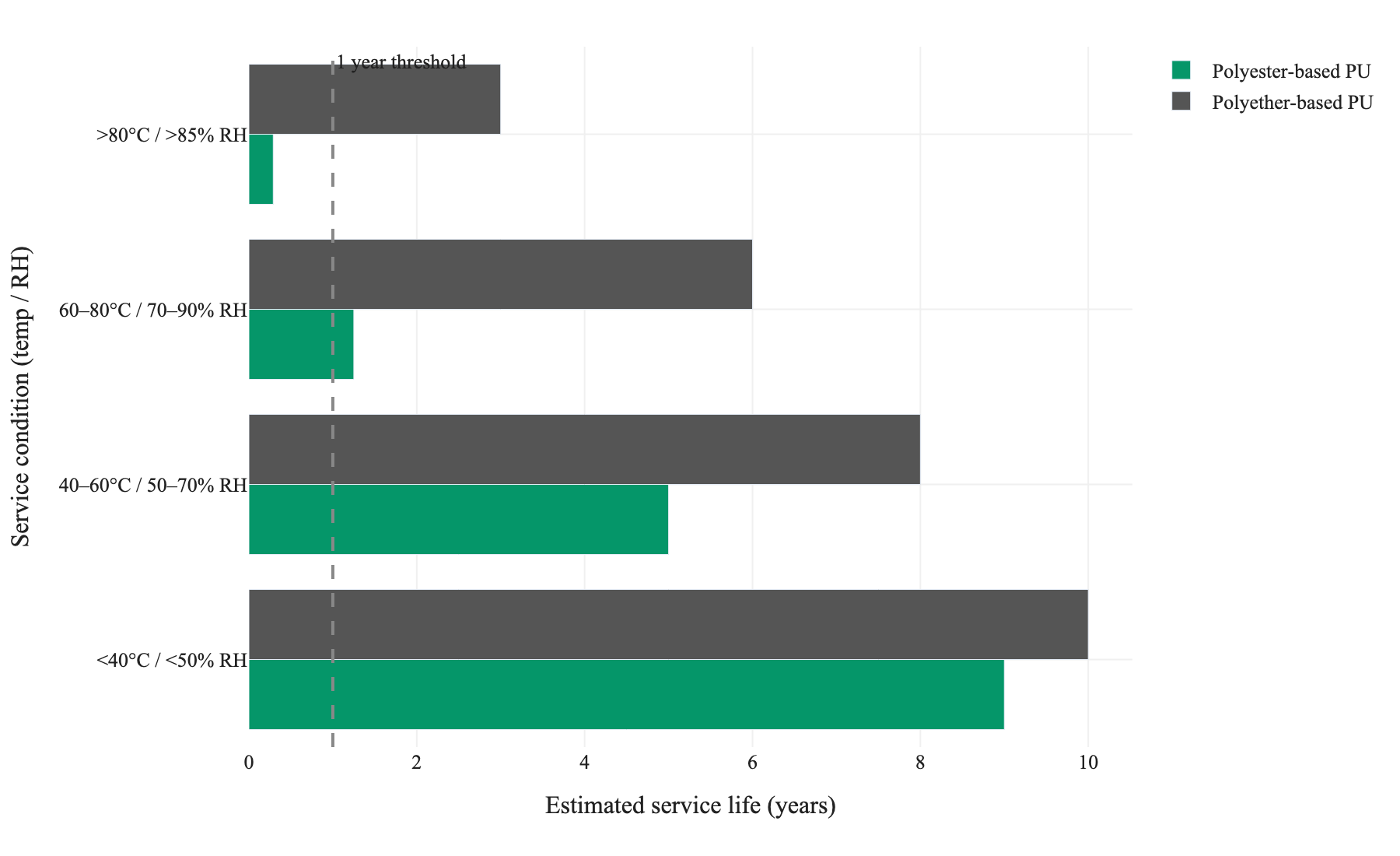
Service condition | Polyester-based PU | Polyether-based PU | Supporting reference |
|---|---|---|---|
Below 40°C, below 50% RH | 8 to 10 years | 8 to 12 years | Bepto Pneumatic, 2024 |
40 to 60°C, 50 to 70% RH | 4 to 6 years | 6 to 10 years | Bepto Pneumatic, 2024 |
60 to 80°C, 70 to 90% RH | 6 to 24 months | 4 to 8 years | Bepto Pneumatic, 2024; PMC, 2019 |
Above 80°C, above 85% RH | 1 to 6 months | 2 to 4 years | Bepto Pneumatic, 2024 |
The 60 degrees Celsius threshold is the critical inflection point. Below 60 degrees Celsius, polyester-based PU delivers acceptable service life for most industrial applications. Above 60 degrees Celsius, the hydrolysis rate acceleration makes polyester-based PU unsuitable for continuous service in joints exposed to humidity above 70 percent. At 80 degrees Celsius and 85 percent or higher relative humidity, the practical service life of polyester-based PU falls below 60 days in many documented cases, while polyether-based PU holds its functional properties for 300 or more days under the same conditions.
How Do Laboratory Aging Data Correlate to Field Failure Timelines?
The accelerated data correlate to field failure patterns in the following industrial environments. In automotive body-shop paint-oven expansion joints, where joint-surface temperatures reach 80 to 90 degrees Celsius and steam-based humidity is common, polyester-based PU sealants installed in summer have been reported to show cohesive cracking within 8 to 14 weeks. The Louisiana paper mill case documented in Bepto Pneumatic (2024) reported polyester PU seal failure at 14 months in a humid high-temperature process zone. A Florida beverage-processing facility documented visible failure within 2 to 3 weeks following an extended period of adequate initial performance across 10 to 12 months, consistent with the autocatalytic kinetics: slow initial degradation builds acid end-group concentration until the rate accelerates past the failure threshold.
The field correlation is consistent with the laboratory finding that polyester PU at 80 degrees Celsius and 80 percent relative humidity loses more than 90 percent of molecular weight within two months, and that this molecular-weight loss corresponds to loss of elongation, loss of adhesion, and eventual cohesive fracture.
IV. Cost of Premature Sealant Failure: Leak, Substrate Damage, and Recall
Premature PU sealant failure in an industrial joint produces a cost cascade that is systematically larger than the sealant material cost because the failed joint allows water or process fluid ingress into substrates, equipment, and product streams. Sealants represent approximately 1 percent of total construction cost for a typical commercial facility, but when those sealants fail prematurely, the consequential damage routinely costs 10 to 50 times the original sealant installation budget (Greenspec Building Design, 2024; JS Goray, 2024).
What Does It Cost to Remove and Replace a Failed Industrial PU Joint?
Removing and replacing a failed sealant in an industrial joint is not a simple material swap. Failed polyester PU undergoes cohesive cracking or becomes tacky and adhesive to the joint walls, requiring mechanical grinding, solvent cleaning, and surface preparation before a new sealant can be installed. Joint-wall contamination by degraded PU residue is the primary cause of adhesion failure in the subsequent installation if preparation is incomplete. A typical industrial building envelope joint replacement in a 1,000-square-meter facility, covering 200 to 400 linear meters of sealant joints, carries labor and material costs of USD 10,000 to USD 20,000 at minimum and can exceed USD 100,000 when substrate damage requires concrete repair or facade restoration (JS Goray, 2024).
Consequential Cost: Water Ingress, Substrate Damage, and Product Contamination
The consequential costs of a failed joint exceed the direct replacement cost in most industrial scenarios. Water ingress through a failed expansion joint in a concrete floor or wall will reach reinforcing steel in approximately 12 to 36 months in a tropical environment, initiating corrosion, rebar expansion, and concrete spalling that require structural repair. Energy loss through failed envelope joints carrying heated or cooled process air can increase HVAC and process energy consumption by 10 to 20 percent (JS Goray, 2024). In food and pharmaceutical processing facilities, water ingress through a failed joint into a production zone can trigger a product recall or a regulatory inspection closure.
The cost of a single product recall triggered by contamination linked to a failed joint can exceed USD 1 million, a consequence entirely disproportionate to the cost difference between polyester and polyether PU sealant, which for most industrial applications is USD 0.50 to USD 2.00 per linear meter of joint.
What Is the Market-Level Scale of Misspecified PU Sealant?
Industry analysis estimates that failed building envelope sealants in commercial properties contribute to billions of dollars annually in water-damage insurance claims. The global polyurethane sealants market at USD 3.0 to 3.4 billion in 2024 includes a meaningful fraction of installed sealant operating in conditions where polyester backbone selection produces predictable premature failure (Cognitive Market Research, 2024). In Asia-Pacific, which accounts for 41 percent of market consumption and includes the world's densest concentration of hot, humid industrial facilities, the fraction of installed polyester-based PU operating outside its service envelope is likely highest (Data Bridge Market Research, 2024).
V. Selection by Service Temperature, Humidity, and Joint Movement
Correct PU sealant selection for hot, humid industrial joints requires three sequential decisions: backbone type first, performance class second, and installation geometry third. Reversing this order, which the standard practice of specifying to ASTM C920 class and chemistry family without backbone specification does, produces the selection error that leads to systematic premature failure.
How Should Engineers Apply the Backbone-First Decision Rule?
The following decision tree operationalizes the backbone selection rule:
Step 1: Determine service temperature and humidity. Record the maximum sustained service temperature at the joint face and the maximum sustained relative humidity. Both must be assessed; temperature alone is not sufficient.
Step 2: Apply the 60 degrees Celsius and 70 percent relative humidity threshold. If maximum sustained joint temperature is at or below 60 degrees Celsius and maximum sustained relative humidity is at or below 70 percent, polyester-based PU is acceptable. Proceed to Step 3. If either threshold is exceeded, polyester-based PU is not acceptable. Specify polyether-based PU or polycarbonate-based PU. If budget constrains to polyester, require a carbodiimide-stabilized formulation with documented extended service life data at the actual service conditions.
Step 3: Determine movement class. Calculate joint movement per ASTM C1193 guidance: thermal movement equals the coefficient of thermal expansion of the substrate multiplied by joint length multiplied by maximum temperature range, with a safety factor of 1.25 to 1.50 applied. Select the ASTM C920 movement class (12.5, 25, 35, 50, or 100/50) that exceeds the calculated movement. For high-movement industrial joints, Class 50 or 100/50 is common (ASTM International, 2018).
Step 4: Verify joint geometry. Confirm width-to-depth ratio: joints 13 millimeters or less in width require a 1:1 ratio; joints 13 to 25 millimeters require a 2:1 ratio (depth equal to half width, minimum 6 millimeters); joints above 25 millimeters require a fixed 6 millimeter depth. Install backer rod or bond-breaker tape on the joint floor to prevent three-sided adhesion, which prevents elongation under movement and causes cohesive failure regardless of backbone type (ASTM C1193 guidance).
Step 5: Confirm substrate compatibility. For porous substrates (concrete, masonry, gypsum), apply manufacturer-specified primer per ASTM C1521 field adhesion test verification. For dense substrates, primer requirement varies by formulation.
Selection Matrix for Common Industrial Service Environments
Figure 2. PU Sealant Backbone Selection Matrix by Industrial Service Environment (Part A: Service Conditions)
Service environment | Max sustained temp (°C) | Max sustained RH (%) | Recommended backbone |
|---|---|---|---|
Interior dry warehouse joint | 40 | 60 | Polyester or polyether |
Food processing wash-down zone | 70 | 95 | Polyether or polycarbonate |
Automotive paint oven expansion joint | 90 | 80 | Polyether, carbodiimide-stabilized |
Chemical plant equipment pedestal joint | 80 | 85 | Polyether |
Tropical building envelope joint | 50 | 90 | Polyether |
Pharmaceutical clean-room floor joint | 60 | 70 | Polyether |
Figure 3. PU Sealant Performance Class and Standards Reference by Environment
Service environment | ASTM C920 class | Primary standard | Secondary standard |
|---|---|---|---|
Interior dry warehouse joint | 25 | ASTM C920 | ISO 11600 |
Food processing wash-down zone | 35 to 50 | ASTM C920 | ASTM C793 |
Automotive paint oven expansion joint | 50 | ASTM C920 | ISO 11600 |
Chemical plant equipment pedestal joint | 50 | ASTM C920 | ASTM D412 |
Tropical building envelope joint | 35 to 50 | ISO 11600 | ASTM C920 |
Pharmaceutical clean-room floor joint | 25 to 35 | ASTM C920 | ISO 11600 |
Which Inspection Items Detect Hydrolytic Failure Before Full Joint Collapse?
Annual inspection per the guidance of the Pecora Corporation sealant maintenance framework (Pecora, 2024) and the NIST service life prediction program should cover the following items. Operators should record findings against this checklist and trigger replacement when any failure indicator is observed.
Pre-inspection setup:
Record joint service temperature and relative humidity from facility monitoring logs for the prior 12 months. Flag any period where joint-face temperature sustained above 60 degrees Celsius with relative humidity above 70 percent for more than 72 consecutive hours.
Confirm backbone type from installation record. If record is absent, obtain material safety data sheet from the current product and verify polyol type.
Confirm sealant installation date and expected service life from manufacturer specification at actual service conditions.
Visual inspection items (pass or fail):
Surface cohesion: no visible cracks, splits, or crazing running parallel to joint length (fail: any crack deeper than 1 millimeter).
Surface texture: not tacky under light finger pressure; not chalking or powdering (fail: tacky, powdering, or surface dissolution on contact).
Color and opacity: uniform across joint length; no localized yellowing, browning, or transparency change (fail: discoloration covering more than 10 percent of joint face).
Bond to substrate: no separation gap visible at either joint wall (fail: any visible gap at substrate interface).
Mechanical probe items (pass or fail):
Probe elongation: insert a flat probe 2 millimeters wide and press gently perpendicular to joint axis. Sealant should deform and spring back (fail: sealant cracks on probe contact or does not recover).
Adhesion check: using a utility knife, make a 20-millimeter cut parallel to the substrate and peel at 90 degrees. Cohesive failure in the sealant body is acceptable; adhesive failure at the sealant-substrate interface is a fail.
Action thresholds:
All 9 items pass: no action; re-inspect in 12 months.
Items 4 through 7 any fail: immediate sealant replacement; also investigate whether service conditions exceed backbone specification.
Items 8 or 9 fail: replacement within 30 days; root cause investigation on backbone type versus service conditions before re-specification.
VI. Field Cases: Industrial Building Envelope and Equipment Joint Audits
The following cases are anonymized, and site-identifying details have been generalized. Each case follows the Lubinpla case study format: quantitative data, specific actions taken, site background, and a distinct narrative pattern.
Company A: Unexpected Cause, Food-Processing Wash-Down Facility
Company A is a contract food manufacturer operating a facility with approximately 8,500 square meters of production floor in a subtropical coastal location where mean ambient temperature is 28 degrees Celsius and mean relative humidity is 82 percent. The facility uses high-pressure hot-water wash-down cycles at 70 degrees Celsius for daily sanitation of all production zones. Total installed expansion and control joint length in production zones was approximately 620 linear meters, sealed with a one-part polyurethane sealant rated to ASTM C920 Type S, Grade NS, Class 25. The facility reported 47 joint sections showing visible cracking, tacky surface, or complete substrate separation within 11 months of a full joint re-seal project that cost approximately USD 22,000 in material and labor.
The initial investigation focused on installation quality: surface preparation, primer application, and joint geometry. Inspection confirmed that installation was consistent with specification requirements. The unexpected cause was traced to the sealant backbone: the specified product used a polyester-polyol soft segment, and the wash-down cycle was driving joint-face temperatures to 68 to 72 degrees Celsius under steam exposure with ambient relative humidity of 88 to 94 percent inside the production zones. This combination placed the sealant consistently above the 60-degree / 70-percent-relative-humidity threshold for polyester PU viability.
The corrective action comprised three steps. First, the team removed all 47 failed joint sections, mechanically ground joint faces to remove degraded polyester PU residue, applied solvent wipe, and re-primed. Second, the replacement specification was changed to a polyether-based one-part PU sealant rated to ASTM C920 Type S, Grade NS, Class 35, with a documented service-life rating at 70 degrees Celsius and 95 percent relative humidity of greater than 36 months from the manufacturer technical data sheet. Third, the facility added a simple joint-face temperature and humidity log: a single data logger at two representative production zones recording hourly, with a monthly review against the sealant backbone specification threshold. Replacement material cost was approximately USD 2,400 more than the original specification for the 47 sections. No joint failures were reported in the subsequent 18 months of observation. The cost of re-doing the failed sections, including production downtime for two 4-hour joint-cure windows and the additional sanitation cycles required, was approximately USD 31,000, against a specification upgrade cost of less than USD 500 at project inception.
Company B: Single Variable, Chemical Plant Equipment Joint
Company B is a specialty chemical manufacturer operating a batch processing building with expansion joints in the building envelope and equipment isolation joints on process equipment pedestals. The building envelope joints, 380 linear meters total, were sealed with a two-component polyurethane sealant rated to ASTM C920 Type M, Grade NS, Class 25. Equipment isolation joints on 22 process-equipment pedestals were sealed with the same product. Mean building-interior temperature was 55 degrees Celsius with relative humidity of 65 percent under normal operation. Twice per week, a hot-water flush cycle raised joint-face temperatures on process pedestals to 82 to 85 degrees Celsius for approximately 90 minutes, with relative humidity rising to 90 to 95 percent during the flush.
The building envelope joints, which were never exposed to the flush cycle, showed no failure after 30 months. The equipment pedestal joints showed cohesive cracking and substrate separation in 18 of 22 locations within 14 months, a pattern that led the maintenance engineer to initially conclude a product batch defect. The single variable distinguishing the pedestal joints from the envelope joints was the twice-weekly hot-water flush. FTIR analysis on removed joint samples showed substantially elevated carbonyl ester band intensity at 1,726 wavenumber, indicative of free ester hydrolysis product accumulation, and a molecular weight profile consistent with the advanced chain-scission pattern described in the PMC (2019) study.
The corrective action changed only the pedestal joint specification: a polyether-based PU sealant, ASTM C920 Type M, Grade NS, Class 35, replaced the polyester-based product on all 22 pedestals. Material cost premium was USD 38 per pedestal joint. No pedestal joint failures were observed in the 24 months following replacement. The cost of the 18 failed joint repairs, including process downtime for curing windows and engineering investigation time, was approximately USD 67,000 against a specification upgrade cost at original installation of approximately USD 840.
VII. Key Takeaway
Polyol backbone type, not product brand or ASTM C920 movement class, is the primary predictor of PU sealant service life in industrial joints operating above 60 degrees Celsius and 70 percent relative humidity. Specify backbone type explicitly.
Polyester-based PU undergoes autocatalytic ester-bond hydrolysis above 60 degrees Celsius, with rate acceleration of two to three times per 10-degree Celsius increment. At 80 degrees Celsius and 85 percent relative humidity, functional service life is 30 to 90 days.
Polyether-based PU carries ether linkages that water cannot cleave, maintaining functional service life of 300 or more days under 80-degree Celsius and 85-percent-relative-humidity conditions. Specify polyether-based PU for all sustained-humidity or steam-exposed industrial joints above 60 degrees Celsius.
Apply the backbone-first selection rule before specifying movement class or chemistry family: record maximum sustained joint-face temperature and maximum sustained relative humidity; if either threshold is exceeded (temperature above 60 degrees Celsius or humidity above 70 percent), polyester-based PU is not acceptable regardless of other specification attributes.
Use the nine-item inspection checklist in Section V at annual intervals. Joint replacement triggered by early checklist failure costs 5 to 20 times less than consequential damage from water ingress, substrate degradation, or product contamination.
If your facility has joints showing the failure pattern described in this article, submit your sealant specification, service temperature and humidity records, and joint failure history to AI Shooting, the Lubinpla per-case industrial chemistry analysis service that returns an evidence-based written report identifying whether backbone hydrolysis is the root cause and recommending a re-specification with quantified service life projection. Submit your case at https://www.lubinpla.com/ai-shooting.
VIII. References
ASTM International. (2018). ASTM C920-18: Standard Specification for Elastomeric Joint Sealants. https://store.astm.org/c0920-18.html
ASTM International. (2017). ASTM C793-05(2017): Standard Test Method for Effects of Laboratory Accelerated Weathering on Elastomeric Joint Sealants. https://www.astm.org/Standards/C793.htm
ASTM International. (2020). ASTM C792-15(2020): Standard Test Method for Effects of Heat Aging on Weight Loss, Cracking, and Chalking of Elastomeric Sealants. https://www.astm.org/Standards/C792.htm
ASTM International. (2022). ASTM D412-22: Standard Test Methods for Vulcanized Rubber and Thermoplastic Elastomers in Tension. https://www.astm.org/d0412-16re21.html
Bepto Pneumatic. (2024). Polyurethane Hydrolysis: Why Seals Crumble in Humid Environments. https://rodlesspneumatic.com/blog/polyurethane-hydrolysis-why-seals-crumble-in-humid-environments/
Cognitive Market Research. (2024). Global Polyurethane Sealants Market Size and Forecast. https://www.cognitivemarketresearch.com/polyurethane-sealants-market-report
Data Bridge Market Research. (2024). Global Polyurethane Sealants Market Size, Share and Trends Analysis Report. https://www.databridgemarketresearch.com/reports/global-polyurethane-sealants-market
Gantrade Corporation. (2022). Hydrolysis Resistance in Polyester-Based Polyurethanes. https://www.gantrade.com/blog/hydrolysis-resistant-polyester-polyurethane
Gantrade Corporation. (2023). Polyurethane Elastomers: Polyether Polyols vs. Polyester Polyols. https://www.gantrade.com/blog/making-the-case-for-polyurethane-elastomers-polyether-polyols-vs-polyester-polyols
Greenspec Building Design. (2024). Sealants: Durability and Cost. http://www.greenspec.co.uk/building-design/sealants-costs/
HyMax Anti-hydrolysis Additive. (2024). Application and Prospects of Hydrolysis-Resistant Agents in Solvent-Free Polyester-Type Polyurethane Systems. https://carbodiimide.com/application-and-prospects-of-hydrolysis-resistant-agents-in-solvent-free-polyester-type-polyurethane-systems/
ISO (International Organization for Standardization). (2002). ISO 11600:2002: Building Construction, Jointing Products, Classification and Requirements for Sealants. https://www.iso.org/standard/26328.html
JS Goray. (2024). How Failing Sealants Lead to Costly Water Damage in Commercial Properties. https://www.jsgoray.com/blog/how-failing-sealants-lead-to-costly-water-damage-in-commercial-properties/
Journal of Chemical Reviews. (2025). Carbodiimide Chemistry from Isocyanates: Advancing Hydrolysis Resistance in Polyester and Polyurethane Materials. https://www.jchemrev.com/article_226112.html
NIST (National Institute of Standards and Technology). (2024). Building Joint Sealant Service Life Prediction. https://www.nist.gov/programs-projects/building-joint-sealant-service-life-prediction
Pecora Corporation. (2024). Sealants Need Regular Maintenance to Ensure Optimal Performance. https://www.pecora.com/sealants-need-regular-maintenance-to-ensure-optimal-performance/
PMC (National Center for Biotechnology Information). (2019). Microstructure Changes in Polyester Polyurethane upon Thermal and Humid Aging. https://pmc.ncbi.nlm.nih.gov/articles/PMC6432114/
US Made Supply. (2024). How to Choose a Joint Sealant: ASTM C920 Buyer's Guide. https://usmadesupply.com/resources/guides/joint-sealant-selection-guide