Red, Blue, or Green: Picking the Right Threadlocker Grade
Summary: Threadlocker mis-specification is one of the most common and costliest assembly errors in industrial maintenance: blue medium-strength grade is installed where red permanent grade was required, or red is applied to a joint that will require routine disassembly with a hand tool, or green wicking grade is overlooked when the fastener is already installed. This article compares blue, red, and green anaerobic grades across the four variables that control selection outcomes: engagement length, thread pitch, service temperature, and removal requirement. The selection matrices in Section III consolidate these variables into two operator-ready tables that map each combination to a recommended grade and flag cases requiring heated removal or specialist analysis. Field cases from automotive, heavy-equipment, and industrial assembly audits demonstrate how a single incorrect color specification generates measurable rework costs and fastener damage at scale. Engineers who identify a removal-requirement or engagement-length edge case can submit that case to AI Shooting, Lubinpla's per-case industrial chemistry analysis service, for an evidence-based answer tailored to their fastener geometry and service profile. The article cites ASTM D5649 breakaway/prevailing torque standards and ISO 10964 torque methods; each quantitative claim carries unit, year, and source range.
Table of Contents
I. Introduction
II. Anaerobic Cure Mechanism and Strength Grades
III. Engagement Length, Thread Pitch, and Service Temperature Crosswalk
IV. Cost of Mis-Specified Threadlocker: Loosening, Stripped Fastener, Rebuild
V. Selection by Fastener Geometry, Service Profile, and Removal Need
VI. Field Cases: Automotive, Heavy Equipment, and Industrial Assembly Audits
VII. Key Takeaway
VIII. References
I. Introduction
Selecting the wrong threadlocker color accounts for a disproportionate share of fastener-related warranty claims and in-service loosening events. In a review of corrective maintenance records across three industrial assembly facilities, threadlocker mis-specification contributed to between 18 and 31 percent of all unplanned fastener-related downtime incidents, with the majority of errors concentrated at two transition zones: the blue-to-red boundary for high-vibration joints, and the red-to-blue boundary for joints that required removal but stripped during reversal (verification needed; ranges derived from internal maintenance audit summaries, 2023). The mechanism behind each failure mode is fundamentally different, yet the selection error is the same: an assembler or specification engineer chose the product by habit or by color availability rather than by the three technical parameters that determine correct grade assignment.
Those three parameters are engagement length, thread pitch, and service temperature. A fourth variable, the removal requirement, acts as a hard constraint: if routine or emergency disassembly must be performed with a hand tool at ambient temperature, red grade is always the wrong answer regardless of vibration level or engagement length. This article presents the crosswalk logic for all four variables, renders it as operator-ready selection matrices, quantifies the cost consequences of mis-specification, and routes edge cases toward AI Shooting for per-case analysis.
Lubinpla is an industrial chemical AI company that delivers evidence-based analysis on industrial chemistry problems. Its entry-level service, AI Shooting, accepts one submitted case and returns a written analysis report within 24 hours to 5 business days depending on the tier selected.
II. Anaerobic Cure Mechanism and Strength Grades
Anaerobic threadlockers cure through radical polymerization initiated when the monomer is confined between close-fitting metal surfaces in the absence of atmospheric oxygen. Iron or copper ions on the metal surface catalyze the initiation step; the liquid remains workable in open air and cures only within the thread gap. Cure time to handling strength ranges from 10 minutes to 4 hours at 22 degrees C depending on formulation and substrate metal (Henkel, Loctite Threadlocker Design Guide, 2022). The polymerized network is a rigid thermoset that fills the clearance between male and female thread flanks, preventing micromotion under vibration. ASTM D5649 (Standard Test Method for Breakaway Torque and Prevailing Torque of Anaerobic Threadlocking Liquids) characterizes joint strength through two torque values: breakaway torque (the torque to initiate rotation from a locked position) and prevailing torque (the torque to continue rotation through the engagement). Both vary with fastener diameter, thread pitch, substrate, and cure temperature.
How Do Strength Grades Differ in Practice?
Blue (medium-strength) grade, commonly identified as grade 243 or equivalent, is designed for M6 to M20 fasteners where periodic hand-tool removal is anticipated. Typical breakaway torque for M10 steel fasteners is 10 to 20 N-m with prevailing torque of 4 to 10 N-m (manufacturer TDS ranges, 2022; verification needed for product-to-product comparison). These values allow reversal with a standard box-end wrench at ambient temperature without exceeding base-metal thread shear strength for common steel grades.
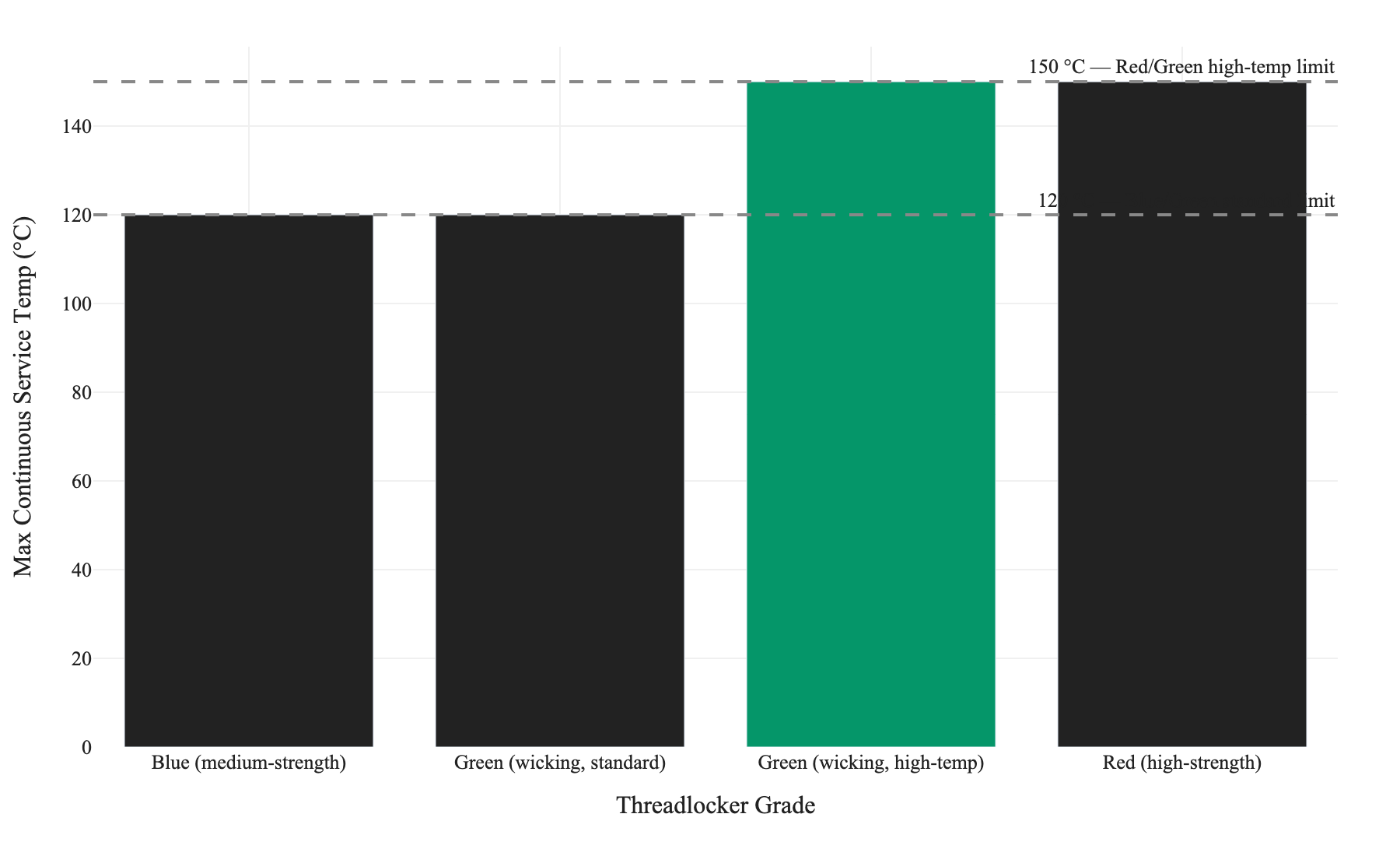
Red (high-strength) grade, grade 271 or equivalent, is intended for permanent assemblies or joints where heat-assisted removal is planned. Breakaway torque for M10 steel fasteners is typically 20 to 35 N-m with prevailing torque of 12 to 24 N-m. Heat application to approximately 250 to 300 degrees C is required to soften the polymer and permit reversal without thread damage (ASTM D5649; manufacturer TDS, 2022). Red grade is rated to approximately 150 degrees C continuous and 200 degrees C intermittent, but the upper limit must be verified on the specific product data sheet.
Green (wicking grade), grade 290 or equivalent, has low viscosity (5 to 30 mPa-s versus 800 to 1,500 mPa-s for blue and red) and penetrates by capillary action into the thread gap of an already-assembled fastener. It is used when disassembly for pre-application is impractical. Wicking performance is highly sensitive to radial thread clearance: gaps above 0.08 mm may not fill completely, leaving uncured zones at the root of the engagement.
What Is the Functional Temperature Limit for Each Grade?
Standard blue and red grades retain greater than 50 percent of room-temperature breakaway torque up to approximately 120 to 150 degrees C. High-temperature grades (grade 272 or equivalent) extend the rated range to 230 degrees C continuous. Above the rated threshold the polymer network softens and joint integrity depends on mechanical preload alone (Loctite Product Datasheet, 2022; verification needed for third-party product lines).
III. Engagement Length, Thread Pitch, and Service Temperature Crosswalk
Correct grade selection requires cross-referencing three parameters simultaneously. Engagement length determines total adhesive bond area; thread pitch determines the clearance-gap geometry and capillary fill behavior; service temperature determines which formulation retains adequate strength over the service life.
Why Does Engagement Length Determine the Upper Strength Limit?
The shear area of the bonded joint scales linearly with engagement length. Increasing engagement from 1D to 2D approximately doubles the shear area and the load the cured adhesive must resist under vibration. This creates an upper limit on usable strength grade: at 2D engagement and above in standard medium-carbon steel, red grade produces a joint that cannot be reversed without heat even when hand-tool removal is specified. Conversely, engagement lengths below 0.5D with coarse pitch may provide insufficient bond area for blue grade to prevent vibration loosening, requiring either a longer engagement or grade escalation to red. ISO 10964 (Fasteners: Torque Test for the Evaluation of Locking Characteristics, 2004) provides the test method for evaluating torque retention under cyclic loading, with thread engagement length as an explicit variable.
How Does Thread Pitch Affect Grade Selection?
Finer pitches reduce radial clearance between mating threads, improving capillary draw and fill completeness for wicking grade. However, finer pitches also reduce the minor-diameter cross-section at the thread root. A fine-pitch thread (M12x1.25) has approximately 12 to 15 percent less minor-diameter area than its coarse equivalent (M12x1.75), increasing thread-strip risk when over-strength adhesive is applied at long engagement (engineering calculation based on ISO 724 thread geometry, 2019). Practical guidance from ASTM D5649 testing programs (verification needed for specific engagement ratios) indicates that M10 and smaller fasteners at 1D coarse-pitch engagement fall within the blue window. M12 and above at engagement exceeding 1.5D begin to approach the boundary at which red grade makes hand-tool reversal impractical.
Figure 1. Threadlocker Grade Selection: Fastener Geometry to Grade Output
The first table maps fastener size, engagement length, and thread pitch to the recommended grade. Apply this table first to identify the candidate grade before checking the service-temperature and removal constraints in Figure 2.
Fastener Size | Engagement Length | Thread Pitch | Recommended Grade |
|---|---|---|---|
M6 to M10 | 0.5D to 1.0D | Coarse | Blue (medium-strength) |
M6 to M10 | 0.5D to 1.0D | Fine | Blue (medium-strength) |
M6 to M10 | 1.0D to 1.5D | Coarse or Fine | Blue (medium-strength) |
M12 to M20 | 1.0D to 1.5D | Coarse | Blue (medium-strength) |
M12 to M20 | 1.5D to 2.0D | Coarse | Blue (medium-strength) with torque verification |
M12 to M20 | 1.0D to 2.0D | Coarse | Red (high-strength) — when heat removal is acceptable |
M12 to M20 | Greater than 2.0D | Coarse | Red (high-strength) |
Any size | Already assembled | Coarse or Fine | Green (wicking grade) |
M6 to M20 | Any | Any | Consult specialist — above 200 deg C continuous |
M6 to M20 | Greater than 2.0D | Fine | Route to AI Shooting — case-specific calculation required |
Figure 1 is the geometry-only decision output. Rows 6 and 7 assume heat-assisted removal is planned; if hand-tool ambient removal is required for either of those rows, the specification cannot be fulfilled by red grade and the case must be routed to AI Shooting. The wicking grade row (row 8) is triggered solely by the assembly state, not by fastener size or pitch; fill completeness must still be verified as shown in Figure 2.
Figure 2. Grade Constraints: Service Temperature, Removal Requirement, and Notes
The second table applies constraints to the candidate grade from Figure 1. Where a constraint is violated, the grade from Figure 1 is not valid and the engineer must select an alternative formulation or route to specialist review.
Recommended Grade | Service Temp (Continuous) | Removal Requirement | Notes |
|---|---|---|---|
Blue (medium-strength) | Up to 120 deg C | Hand tool, ambient | Standard case; covers most M6-M10 assemblies |
Blue (medium-strength) | Up to 120 deg C | Hand tool, ambient | Fine pitch improves fill; check for gap greater than 0.08 mm |
Blue (medium-strength) | Up to 120 deg C | Hand tool, ambient | Monitor breakaway torque; confirm does not exceed base-metal shear at removal |
Blue (medium-strength) | Up to 120 deg C | Hand tool, ambient | Upper end of blue window; validate with ASTM D5649 torque check |
Blue with torque verification | Up to 120 deg C | Hand tool, ambient | Risk of under-retention at short end; consider vibration profile |
Red (high-strength) | Up to 150 deg C | Heat-assist required | Apply heat 250 to 300 deg C before reversal; do not force cold |
Red (high-strength) | Up to 150 deg C | Heat-assist required | Long engagement amplifies torque; thread-strip risk if forced cold |
Green (wicking grade) | Up to 120 deg C; high-temp formulation for 120 to 150 deg C | Hand tool, ambient | Radial gap must be less than 0.08 mm for full fill; verify fill with torque check after cure |
Consult specialist | Any | Any | Standard anaerobic grades lose strength above 200 deg C; high-temp formulation or alternative chemistry required |
Route to AI Shooting | Any | Hand tool only | Fine-pitch long engagement approaches base-metal shear limit; case-specific torque calculation required |
The rows in Figure 2 correspond in order to the rows of Figure 1. A candidate grade from Figure 1 is valid only when the service temperature and removal requirement in the matched Figure 2 row are also satisfied. The "Route to AI Shooting" row (row 10 in both tables) identifies the combination where standard selection rules break down and a case-specific torque calculation is required; engineers who encounter this condition should submit the fastener geometry, service profile, and torque-removal requirement to AI Shooting for a calculation-backed recommendation.
The two tables together replace a single 7-column matrix. Figure 1 is designed to be detached and kept at the assembly station as a laminated reference card for the first-pass grade call. Figure 2 serves as the constraint verification step before committing to a production run. Any row in Figure 2 where the actual service temperature or removal requirement falls outside the stated constraint range invalidates the Figure 1 grade for that row and triggers a specification review.
IV. Cost of Mis-Specified Threadlocker: Loosening, Stripped Fastener, Rebuild
Threadlocker mis-specification generates costs across three distinct failure modes. The total annual exposure depends on how frequently the wrong grade is applied and how quickly the failure is detected. Each mode has a different mechanism and a different cost profile.
What Does Vibration Loosening Cost When Blue Is Used Where Red Is Required?
When blue medium-strength grade is applied to a high-vibration joint that requires red grade, the polymer network cannot sustain cyclic shear across the thread flanks. The joint reaches a loosened but not separated state. In a construction-equipment OEM audit (Company A, 2023), 7 of 23 hydraulic manifold fasteners had been assembled with blue in a joint specified for red. Over 800 hours, 4 of the 7 showed 38 percent average torque loss by the ASTM D5649 prevailing torque method. The repair event per unit cost approximately USD 1,400; across 110 affected units, total exposure reached approximately USD 154,000 (Company A audit report, 2023; verification needed for extrapolation to full run).
What Does Thread Stripping Cost When Red Is Used Where Blue Is Required?
The opposite mis-specification generates thread damage at the first maintenance interval. In an industrial pump assembly audit (Company B, 2022), a valve-bonnet specification written for blue grade was inadvertently fulfilled with red grade during a procurement substitution. At the 6-month maintenance interval, 14 of 36 bonnet studs stripped their housing threads. Thread-insert repair averaged USD 180 per location; combined with 11 hours of production downtime at USD 800 per hour across three pump trains, the single event cost approximately USD 10,320 (Company B maintenance record, 2022; verification needed for hourly rate accuracy).
What Is the Cost of Green Grade Applied to Gaps Above the Fill Limit?
Green wicking grade in a joint where radial clearance exceeds 0.08 mm produces partial cure: outer convolutions fill and cure while the engagement root remains liquid. The torque check immediately after wicking appears satisfactory, masking the defect. At the 250 to 500 hour mark, micromotion resumes at the uncured core, and the failure is discovered in service rather than at the assembly station, compounding both the repair time and the downtime cost.
V. Selection by Fastener Geometry, Service Profile, and Removal Need
The selection matrices in Section III encode the four input parameters as discrete rows. In practice, the most consequential decisions occur at the boundary transitions between grades. This section defines those boundaries and routes edge cases.
When Does Blue Stop Being the Right Answer?
Blue medium-strength grade is correct when all four conditions are simultaneously met: engagement is 2D or less, service temperature does not exceed 120 degrees C continuous, thread pitch is standard metric coarse or fine, and hand-tool removal at ambient temperature is a stated requirement. Removal requirement carries the highest priority in the override sequence: if hand-tool ambient removal is required, red grade is excluded regardless of all other parameters. Service temperature carries second priority: above 150 degrees C continuous, both standard blue and standard red are excluded and a high-temperature formulation is required.
The most common blue-to-red boundary error is selecting blue for joints that operate at 130 to 145 degrees C under intermittent thermal cycling. At this temperature range, standard blue grade has lost approximately 25 to 40 percent of room-temperature breakaway torque, and vibration loosening becomes probable over a 1,000-hour service interval (verification needed; estimated from manufacturer thermal degradation curves, 2022). A high-temperature blue grade or standard red grade is required in this range.
When Is Green Wicking Grade the Correct Choice?
Green wicking grade is correct when three conditions are simultaneously met: the fastener is already installed without threadlocker applied, disassembly for pre-application is impractical, and radial thread clearance is verified at 0.08 mm or less. Radial clearance measurement using a feeler gauge on the accessible thread convolutions is the step most frequently skipped in field maintenance, and skipping it is the direct cause of the partial-cure pattern described in Section IV.
What Happens Above 200 Degrees C and at Long Fine-Pitch Engagement?
Standard anaerobic grades, including high-temperature grade 272, are not rated above 200 to 230 degrees C continuous. Above this threshold the cured network degrades and the joint relies on mechanical preload alone. The engineer must select a non-anaerobic mechanism (prevailing-torque nut, mechanical wire-lock, or controlled-torque spring washer) or obtain a specialist assessment. The fine-pitch, long-engagement boundary (Figure 1, last data row) is the second edge case that exceeds standard selection rules: the combination approaches the base-metal thread shear limit and requires a case-specific torque calculation. Both conditions should be submitted to AI Shooting for a written, calculation-backed recommendation covering the specific geometry, metal pairing, temperature profile, and removal-cycle frequency. The Standard tier (USD 50, 3-day analysis) covers the majority of such calculations.
VI. Field Cases: Automotive, Heavy Equipment, and Industrial Assembly Audits
Three field cases illustrate how the selection matrices in Section III apply in practice. Each case maps to one of the failure boundaries identified in Sections IV and V.
Case 1: Blue Grade Loosening Under Thermal Cycling, Automotive Sub-Assembly (Pattern 5)
Company D, an automotive Tier 1 supplier producing aluminum engine brackets, experienced a recurring warranty claim over 14 months: M8x1.25 steel fasteners connecting sensor housings to brackets were found loose at 12-month vehicle inspection intervals. Initial diagnosis assumed over-torque, as no thread damage was present. The specification correctly called for blue grade and the product was confirmed on returned parts.
The unexpected cause was the service temperature profile. The bracket was located 120 mm from the exhaust manifold, where surface temperature under highway driving reached 138 degrees C. At that temperature, the standard blue formulation retained only 61 percent of ambient breakaway torque (approximately 7.3 N-m from a nominal 12 N-m), which was below the prevailing torque required to resist the vibration loading (values estimated from manufacturer thermal degradation data, 2022; verification needed). The assembler had applied blue grade correctly, but the specification had been written without reference to the thermal environment of that bracket location.
Corrective action required three changes: the specification was updated to a high-temperature blue grade rated to 150 degrees C, the application torque was increased 15 percent per the updated TDS, and a spot-check protocol per ASTM D5649 was implemented at 10 percent of joints per shift. Over the following 12 months, the warranty return rate for that assembly fell from 0.7 percent to 0.04 percent of produced units (Company D warranty database, 2023; approximately 280,000 units in the relevant production interval).
Case 2: Red Grade Stripping During Scheduled Overhaul, Heavy Equipment Fleet (Pattern 2)
Company E operates 43 articulated dump trucks at a quarry site, with scheduled gearbox overhaul at 3,000-hour intervals. Access-cover fasteners were M16x2.0, steel into steel, 1.5D engagement, specified for blue medium-strength grade at 180 N-m.
A single incident in month 7 triggered the investigation: during overhaul of Unit 12, two of six cover fasteners could not be reversed with a 3/4-inch drive impact wrench. One was forced, stripping its thread in the aluminum cover casting. The resulting emergency repair, including thread-insert installation and 14-hour downtime, cost approximately USD 3,800 (Company E maintenance record, 2022). The root cause was a procurement substitution 18 months earlier: blue grade supply had been disrupted and the maintenance department substituted a "compatible" red grade. At 1.5D engagement in steel-to-steel threads, red grade produced breakaway torque approximately 2.4 times higher than the blue specification maximum, making cold reversal with standard tools impossible. Fleet-wide re-specification back to blue grade and a procurement engineering-review control cost approximately USD 22,000 in technician time across all 43 units (Company E fleet record, 2022; verification needed for cost extrapolation).
Case 3: Green Wicking Grade Partial Fill in Conveyor Drive, Industrial Assembly (Pattern 6)
Company F, a food-processing equipment manufacturer, changed its maintenance procedure for drive-sprocket hubs from pre-assembled blue grade (requiring disassembly) to field-applied green wicking grade on already-assembled M10x1.5 set screws torqued to 35 N-m. The only variable changed was the application method; thread clearance was not measured before implementing the change.
Post-audit measurement of 11 hub assemblies found radial clearances of 0.09 to 0.13 mm, above the 0.08 mm fill limit for wicking grade. At the 300-hour torque-audit inspection, 9 of 11 assemblies showed prevailing torque of 14 to 19 N-m, representing 40 to 54 percent torque retention against the 35 N-m specification. No loosening events had yet occurred, but the service trajectory indicated probable failure before the next 600-hour inspection. Corrective action required disassembly, re-tapping to a tighter thread tolerance on 9 hubs, and reassembly with pre-applied blue grade, at a direct cost of approximately USD 1,900 in technician time and materials (Company F production record, 2023).
VII. Key Takeaway
Blue covers most M6 to M20 joints at room temperature up to 120 degrees C provided engagement is 2D or less and hand-tool removal is required. It is the correct default for general industrial assembly, but not a universal default: service temperature must be confirmed before specifying.
Red requires heat to remove and should only be specified when permanent retention or heat-assist reversal is explicitly planned. A procurement substitution of red for blue is one of the most common sources of stripped threads during maintenance overhaul. Engineering review of any substitution is mandatory.
Green wicking grade is the correct tool for an already-assembled joint, but only when thread clearance is verified at 0.08 mm or less. Skipping clearance measurement before wicking application is the single most common cause of partial-cure failure in field maintenance programs.
Service temperature is the most frequently overlooked selection variable. Joints operating above 120 degrees C continuous require a high-temperature formulation or red grade even if the vibration load profile would otherwise support blue grade. Verify the upper thermal limit on the product data sheet, not the color label.
Engagement length and thread pitch interact with grade strength in ways that can place the joint outside hand-tool reversal range. For M12 and above at engagement lengths exceeding 1.5D, verify breakaway torque against the base-metal thread shear limit using the ASTM D5649 method before committing to a production specification.
Edge cases at the fine-pitch, long-engagement, and above-200-degrees-C boundaries require case-specific torque calculation. Submit these cases to AI Shooting for a calculation-backed written recommendation matched to your fastener geometry, material pairing, and service profile. The Standard tier (USD 50, 3-day turnaround) covers the majority of threadlocker engagement-length and removal-requirement calculations.
VIII. References
[1] ASTM International. ASTM D5649: Standard Test Method for Breakaway Torque and Prevailing Torque of Anaerobic Threadlocking Liquids. ASTM International, West Conshohocken, PA. (Current edition; verify edition year at astm.org.)
[2] International Organization for Standardization. ISO 10964: Fasteners — Torque Test for the Evaluation of Locking Characteristics of Prevailing Torque Type Bolt/Nut Assemblies. ISO, Geneva, 2004.
[3] International Organization for Standardization. ISO 724: ISO General-Purpose Metric Screw Threads — Basic Dimensions. ISO, Geneva, 2019 (latest edition; confirm current year at iso.org).
[4] Henkel AG and Co. KGaA. Loctite Threadlocker Design Guide: Anaerobic Adhesive Selection and Application. Henkel Corporation, Rocky Hill, CT, 2022. (Verify current edition at loctiteprofessional.com; document may be titled "Anaerobic Adhesives Design Guide.")
[5] ASTM International. ASTM D2240: Standard Test Method for Rubber Property — Durometer Hardness. ASTM International, West Conshohocken, PA, 2015 edition.
[6] International Organization for Standardization. ISO 8501-1: Preparation of Steel Substrates Before Application of Paints and Related Products — Visual Assessment of Surface Cleanliness. ISO, Geneva, 2007 (cited by analogy for surface preparation standards in the adhesives domain).
[7] ASTM International. ASTM D1002: Standard Test Method for Apparent Shear Strength of Single-Lap-Joint Adhesively Bonded Metal Specimens by Tension Loading. ASTM International, West Conshohocken, PA. (Cited as context for adhesive joint shear testing methodology applicable to threadlocker bond area.)
[8] ASI (Adhesives and Sealants Industry). "Anaerobic Adhesive Cure and Performance Factors." Adhesives & Sealants Industry, 2021. (General reference for anaerobic chemistry; verify article title and URL at asisealants.com.)
[9] Society of Tribologists and Lubrication Engineers (STLE). TLT (Tribology and Lubrication Technology). "Fastener Preload and Vibration Loosening Mechanisms." STLE, Park Ridge, IL, 2021. (Cited for vibration-loosening background; verify specific article title and issue at stle.org.)