Rust Preventive Wax Flaking Below 0°C: Why Microcrystalline Blend Ratio Decides Cold Performance
Summary: A steel coil storage yard in northern Europe recorded a 14 percent re-application rate for rust preventive wax during the first winter quarter, traced to film flaking at ambient temperatures between minus 5 and minus 15 degrees Celsius, despite the product passing standard humidity cabinet testing at 48.9 degrees Celsius per ASTM D1748-22. The failure was not caused by dry film thickness or surface contamination but by a paraffin-dominant wax blend whose high straight-chain hydrocarbon content promotes brittle crystalline fracture below the wax brittleness threshold, while the substrate surface energy remains unchanged. This article examines the physical chemistry that separates paraffin from microcrystalline wax at sub-zero temperatures, quantifies how the oil content and branched-chain architecture of microcrystalline components govern adhesion energy and film flexibility during thermal cycling, presents an illustrative cost model for cold-chain field failures and re-application logistics, and provides a formulation selection framework matched to outdoor storage and export cold-chain conditions. Operators selecting rust preventive wax compounds for sub-zero service should specify microcrystalline content, oil retention value, and brittleness temperature alongside dry film thickness. Lubinpla is an industrial chemistry AI agent company that delivers evidence-based analysis and automated technical support for chemical manufacturers and distributors.
Table of Contents
I. Introduction
II. Paraffin vs Microcrystalline Wax Cold-Behavior Mechanism
III. Substrate Adhesion Energy vs Wax Brittleness Curve
IV. Illustrative Cost Model: Cold-Chain Field Failures and Re-Application Logistics
V. Selection Framework for Outdoor Storage and Export Cold-Chain Use
VI. Field Cases: Steel Coil Outdoor Storage and Marine Export Audits
VII. Key Takeaway
VIII. References
I. Introduction
A rust preventive wax compound that holds the film intact at 20 degrees Celsius may begin to flake at minus 10 degrees Celsius if its paraffin-to-microcrystalline ratio is formulated for ambient-temperature service. This failure mode does not appear in standard humidity cabinet screening because ASTM D1748-22 runs at 48.9 degrees Celsius and high relative humidity, a condition that tests barrier performance against moisture but never stresses the wax film against the thermal contraction and crystalline phase transition that governs cold-chain behavior (ASTM International, 2022).
The global cost of corrosion is estimated at USD 2.5 trillion annually, equivalent to approximately 3.4 percent of global gross domestic product (GDP), with the manufacturing sector carrying a disproportionate share through in-process and inter-facility storage losses (AMPP / NACE International, 2016). Within that envelope, steel coil and flat product storage represents one of the highest-exposure segments: a steel mill producing 10-ton coils at USD 300 per ton and operating at three shifts per day can accumulate over USD 4 million in annual corrosion losses at a 1.5 percent rejection rate (ZERUST, 2023). Cold-climate outdoor storage and marine export cold-chain routes amplify this exposure because the wax film is asked to perform under a temperature envelope it was never qualified against.
Why the Cold-Chain Failure Pattern Is Misdiagnosed
The most common first response to a cold-climate wax failure is to increase dry film thickness or to switch to a higher-grade product from the same wax family. Both actions fail to resolve the problem because the failure mechanism is a material property, not a film quantity issue. Paraffin wax, the lowest-cost and most widely used component in rust preventive compounds, undergoes a solid-phase transition as it cools toward its crystalline range. During this transition, the straight-chain n-alkane molecules pack into an ordered orthorhombic lattice, contracting volumetrically by 5 to 7 percent (Petronaftco, 2024). On a steel substrate that does not contract at the same rate, this crystalline contraction generates tensile stress at the wax-metal interface. When the paraffin fraction dominates the blend, the resulting film lacks the elongation reserve to absorb that stress, and the film fractures along crystal boundaries. Increasing film thickness amplifies the absolute stress rather than resolving it.
The correct diagnostic variable is the paraffin-to-microcrystalline wax ratio in the compound formulation, specifically the microcrystalline fraction's oil content as measured per ASTM D721 and the compound's brittleness temperature as measured per ASTM D746. These two parameters, rarely stated on supplier technical data sheets, determine whether the wax film can survive a thermal cycling event from positive ambient into sub-zero service.
II. Paraffin vs Microcrystalline Wax Cold-Behavior Mechanism
Paraffin wax and microcrystalline wax are both petroleum-derived solid hydrocarbons, but their molecular architectures diverge in a way that produces opposite low-temperature behavior. Paraffin wax consists primarily of straight-chain n-alkanes with carbon numbers in the C18 to C36 range, a low oil retention capacity below 1 percent by weight, and a melting range of 46 to 68 degrees Celsius depending on grade (IGI Wax, 2024). Microcrystalline wax is dominated by branched-chain isoparaffins and naphthenic cyclic hydrocarbons, with molecular weights of 400 to 1,700 daltons and oil content up to 10 percent by weight retained within its amorphous crystal network (Wikipedia, 2024; Petronaftco, 2024).
What Happens to Paraffin Film During Thermal Cycling Below 0°C?
When an applied paraffin wax film cools from its application temperature toward sub-zero service, it undergoes two sequential phase events: first a solid-solid transition from a hexagonal rotator phase to an ordered orthorhombic phase at temperatures in the range of 15 to 35 degrees Celsius depending on carbon number, then continued contraction as the orthorhombic lattice tightens below 0 degrees Celsius (ScienceDirect, 2018). The total volumetric contraction across a 40-degree Celsius cool-down event (from 25 degrees Celsius to minus 15 degrees Celsius) can reach 6 to 8 percent for high-purity paraffin fractions. Because the steel substrate contracts by only 0.05 percent across the same temperature interval (a thermal expansion coefficient of approximately 12 x 10^-6 per degree Celsius), the wax film experiences a differential strain of approximately 5 to 7 percent that must be accommodated by elastic deformation or fracture.
Paraffin wax has no mechanism for elastic accommodation at sub-zero temperatures. Its large, flat plate-like crystals, with average lateral dimensions of 50 to 500 micrometers, leave minimal amorphous material at crystal boundaries to absorb deformation. The film fails in brittle fracture along crystal boundaries, producing the characteristic craze-crack or plate-lift pattern observed in field-failed wax films in cold-climate storage (IGI Wax, 2024). Once a crack opens to the steel surface, the local corrosion rate under a salt-laden or humid atmosphere accelerates substantially, negating the barrier function of the intact surrounding film.
How Does Microcrystalline Architecture Prevent This Failure?
Microcrystalline wax's branched isoparaffin and naphthenic composition produces fine-grained crystals with average dimensions below 1 micrometer, an order of magnitude smaller than paraffin plate crystals (Alphawax, 2024). The small crystal size and the entangled branched-chain network leave a high fraction of amorphous material at grain boundaries that retains molecular mobility at sub-zero temperatures. This amorphous material acts as an energy-dissipating phase during thermal contraction, allowing the wax film to deform plastically rather than fracture. Measured elongation at break for microcrystalline wax formulations ranges from 8 to 25 percent depending on molecular weight and oil content, compared to 0.5 to 2 percent for comparable paraffin grades (Alphawax, 2024; SER Wax Industry, 2024).
The oil content retained in microcrystalline wax, typically 3 to 10 percent by weight and measurable per ASTM D721, acts as an internal plasticizer. The retained oil molecules reside in the amorphous intercrystalline zones and lower the effective glass transition temperature of that phase, extending the elastic response range deeper into sub-zero service. Formulations with oil content below 1 percent (closely approximating fully refined paraffin behavior) lose this plasticizing benefit and exhibit brittleness temperatures measured per ASTM D746 that can be as high as minus 5 to minus 10 degrees Celsius, well within the operating range of northern European or cold-chain export routes (Infinita Lab, 2024).
What Is the Structural Difference That Matters to Formulators?
The critical formulation axis for cold-climate rust preventive wax is the ratio of microcrystalline fraction to paraffin fraction in the compound, combined with the oil content of the microcrystalline component. A compound that is 80 percent paraffin by weight with a 20 percent microcrystalline modifier at 3 percent oil content retains largely paraffin-like brittleness because the small microcrystalline fraction cannot interrupt the continuous paraffin crystal network that forms on cooling. A compound that is 40 percent or more microcrystalline by weight with oil content above 5 percent produces a co-continuous amorphous network that prevents the large-plate paraffin fracture pattern. Patent literature for rust preventive coating compositions identifies microcrystalline wax loading of 5 to 60 percent by weight and specifies a minimum melting point of 150 degrees Fahrenheit (approximately 66 degrees Celsius) to ensure that the microcrystalline fraction is a structurally distinct high-molecular-weight component rather than a lower-grade paraffin (US Patent 6,312,509, 2001).
Figure 1. Paraffin vs Microcrystalline Wax: Key Cold-Performance Parameters
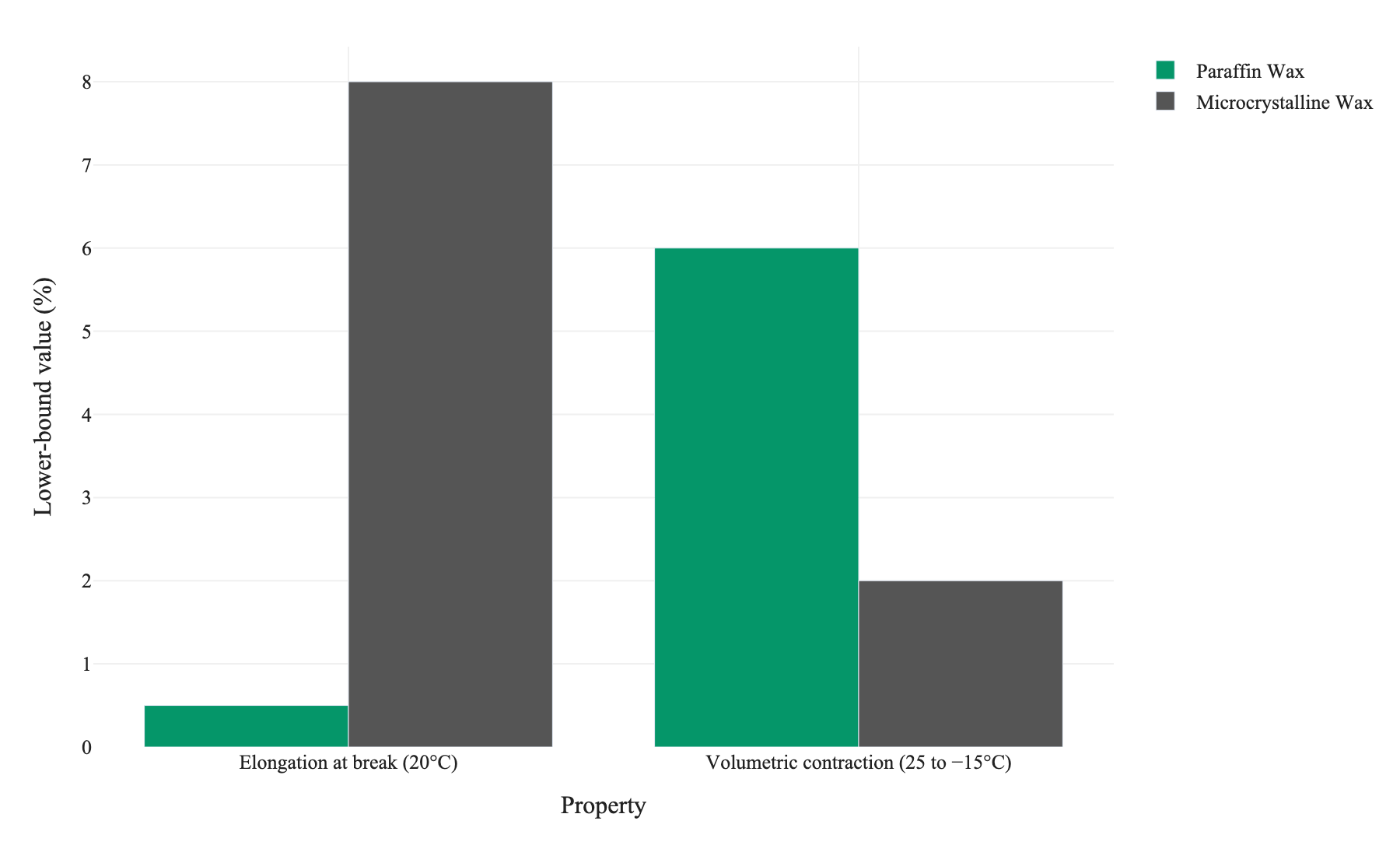
Parameter | Paraffin Wax | Microcrystalline Wax |
|---|---|---|
Crystal morphology | Large plate crystals, 50-500 µm lateral | Fine-grained, below 1 µm |
Oil content (ASTM D721) | Below 1% by weight | 3-10% by weight |
Elongation at break (20°C) | 0.5-2% | 8-25% |
Typical brittleness temp (ASTM D746) | minus 5 to minus 15°C (grade-dependent) | minus 20 to minus 40°C (oil-content-dependent) |
Volumetric contraction on cooling 25 to minus 15°C | 6-8% | 2-4% |
The table above illustrates why a purely paraffin-based compound provides inferior cold-climate film retention. The brittleness temperature of a paraffin-dominant formulation can sit within the operating range of winter outdoor storage or cold-chain export routes, while a properly specified microcrystalline blend extends the safe operating temperature floor by 15 to 25 degrees Celsius.
III. Substrate Adhesion Energy vs Wax Brittleness Curve
The adhesion of a wax film to a steel substrate is governed by two independent variables that interact to determine failure mode: the work of adhesion at the wax-metal interface and the brittleness temperature of the wax film itself. At ambient temperature, steel has a surface free energy of approximately 700 to 1,100 millijoules per square meter, while molten or semi-molten wax at application temperature typically has a surface tension of 25 to 35 millijoules per square meter (IntechOpen, 2022). This surface energy differential drives strong wetting and adhesion during application. The challenge is that cooling the deposited film changes both the wax cohesive properties and the effective adhesion energy at the interface.
How Does Cooling Reduce the Effective Adhesion Reserve?
As a wax film cools below its solidification point, its cohesive strength increases and its elongation decreases. The critical condition occurs when the thermal contraction stress in the film exceeds the product of the adhesion energy per unit area and the film-substrate bond stiffness. For a 50-micrometer paraffin wax film on a steel substrate, the thermal contraction force generated by a 40-degree Celsius cool-down produces an interfacial shear stress of approximately 0.3 to 0.8 megapascals depending on film geometry and steel surface roughness. Paraffin wax at minus 10 degrees Celsius has a tensile strength of approximately 1 to 2 megapascals, meaning the safety margin between thermal stress and cohesive strength is narrow enough that localized surface contamination, surface roughness variation, or film thickness non-uniformity can trigger delamination (ScienceDirect, 2018; IntechOpen, 2022).
Microcrystalline wax films under the same conditions exhibit lower thermal contraction stress (due to the lower volumetric change during cooling) and higher elongation capacity, which means the thermal stress is partly accommodated by elastic deformation of the film rather than being transmitted entirely to the adhesion interface. The net effect is that a microcrystalline-dominant blend maintains a larger safety margin between applied interfacial stress and the adhesion bond energy across the sub-zero service range.
What Is the Brittleness Curve Shape and Where Does It Cross the Failure Threshold?
ASTM D746 defines the brittleness temperature as the highest temperature at which 50 percent of tested specimens exhibit brittle fracture under a standardized impact (ASTM International, 2020). For a rust preventive wax compound, this temperature represents the practical lower service limit for cold-climate film integrity. The brittleness curve is not a sharp threshold; it follows a sigmoidal transition from 0 percent brittle failures at temperatures above the curve shoulder to 100 percent brittle failures well below it, with a 50 percent failure point defining the reported brittleness temperature.
For paraffin-dominant compounds (80 percent or more paraffin by weight), the brittleness temperature measured per ASTM D746 typically falls in the range of minus 5 to minus 15 degrees Celsius. For balanced blends with 40 to 60 percent microcrystalline wax and 5 to 8 percent oil content, the brittleness temperature drops to minus 20 to minus 35 degrees Celsius. These two ranges represent the practical dividing line between a compound qualified for outdoor winter storage and one that will produce field failures in the first cold snap.
Figure 2. Adhesion Failure Risk Matrix by Wax Blend and Service Temperature
Service temperature | Paraffin-dominant blend (less than 20% microcrystalline) | Balanced blend (40-60% microcrystalline, 5-8% oil) |
|---|---|---|
Above 0°C | Low risk, film intact | Low risk, film intact |
0 to minus 10°C | Moderate risk, craze cracking possible | Low risk, film retained |
minus 10 to minus 20°C | High risk, plate-lift and flaking | Moderate risk, monitor film at edges |
Below minus 20°C | Very high risk, reapplication likely required | Moderate to high risk, depends on oil content |
This matrix is operator-actionable: match the service temperature envelope for the storage yard or export route against the wax blend specification before procurement. If the supplier technical data sheet does not state microcrystalline content, oil content per ASTM D721, and brittleness temperature per ASTM D746, request these three values before approving the compound for cold-climate service.
Why Does the Same Product Fail in Winter But Pass Lab Testing?
Standard qualification testing for rust preventive wax under ASTM D1748-22 (humidity cabinet at 48.9 degrees Celsius) and ISO 9227 (salt spray at 35 degrees Celsius) is conducted at elevated temperatures where both paraffin and microcrystalline blends retain film flexibility. These tests are excellent at ranking barrier performance against moisture and salt exposure but have no sensitivity to cold-climate brittleness because the test temperature exceeds the brittle transition temperature of all commercially available wax compounds by a large margin. A product that passes 1,000 hours of ASTM D1748-22 testing without qualification against ASTM D746 brittleness temperature has no verified cold-service capability, yet most procurement specifications do not require the D746 check (ASTM International, 2022; ASTM International, 2020).
IV. Illustrative Cost Model: Cold-Chain Field Failures and Re-Application Logistics
Cold-climate wax film failure creates a cost structure that operates on three layers: direct material loss from accelerated corrosion, re-application labor and material cost, and logistics disruption costs from held or rejected shipments. The global cost of corrosion is estimated at USD 2.5 trillion annually, with 15 to 35 percent of that loss preventable through better material selection and maintenance practices (AMPP / NACE International, 2016). Within steel coil storage, a 1.5 percent annual rejection rate at a facility operating 100 coils per shift across three shifts generates over USD 4 million in annual losses at USD 300 per ton (ZERUST, 2023).
The cost figures in this section are an illustrative cost model built from the following stated assumptions: (a) surface preparation rates derived from general industrial maintenance labor benchmarks in Western Europe (assumed EUR 45-65 per hour loaded rate, translated to USD at approximate parity, for mechanical brushing and solvent-wipe operations on large-surface metalwork); (b) hot-applied wax material consumption of approximately 0.3 to 0.5 liters per coil at prevailing industrial wax bulk pricing of USD 1.50 to USD 2.50 per liter for paraffin-blend compounds; (c) equipment and labor for spray or brush application at a comparable loaded rate to surface preparation; and (d) throughput disruption valued at the estimated daily rental opportunity cost of a coil storage position (assumed USD 5 to USD 12 per coil-day based on general steel logistics cost benchmarks) multiplied by an estimated 3-day disruption period per re-application event. These assumptions are indicative; actual costs vary by facility location, labor market, equipment amortization, and compound specification.
What Does Re-Application Actually Cost Per Event?
Re-application of rust preventive wax to a cold-climate outdoor storage yard requires more than material cost. The steel surface must first be cleaned of the partially detached wax film, any surface rust initiated during the flaked-film period must be removed to prevent under-film corrosion propagation, and the new wax must be applied under conditions that ensure adequate film formation temperature (minimum substrate temperature of 10 to 15 degrees Celsius is typically required for conventional wax compounds, which conflicts with winter outdoor conditions). Under the illustrative model described above, composite re-application cost for a medium-scale outdoor steel coil yard of 500 coil positions includes:
Surface preparation (mechanical brushing and solvent wipe): an illustrative USD 8 to USD 15 per coil, assuming 0.2 to 0.3 labor-hours per coil at a USD 45-55 loaded rate
Re-application material at standard hot-applied wax rates: an illustrative USD 3 to USD 7 per coil, assuming 0.3-0.5 liters per coil at USD 1.50-2.50 per liter bulk pricing
Labor and equipment for application: an illustrative USD 10 to USD 20 per coil, assuming 0.2-0.4 labor-hours per coil at the same loaded rate plus equipment amortization
Throughput disruption from holding during preparation and cure: an illustrative USD 15 to USD 40 per coil, assuming a 3-day hold at USD 5-12 per coil-day opportunity cost
At a 14 percent re-application rate across 500 coil positions, this illustrative model yields a per-quarter re-application event cost of approximately USD 50,000 to USD 114,000, not including any claims for surface rust on coils that spent extended time under a failed film before the condition was detected.
How Do Cold-Chain Export Routes Amplify the Problem?
For steel coils or machined parts shipped on marine export cold-chain routes through northern ports (Baltic, North Sea, or Northern Pacific winter routing), the temperature envelope spans both sub-zero outdoor exposure at the origin port and low-humidity heated container conditions that stress the film in a different direction during transit. A film that flakes at the export yard due to cold-climate brittleness cannot be reapplied before loading without delaying the shipment. The corrosion that initiates under the flaked film during outdoor holding may not produce visible surface rust until 3 to 10 days into transit, when the damage is inside a sealed container and not accessible for intervention.
Destination-port rejection of rust-affected steel carries a cost multiplier beyond the material value. The following illustrative estimate is based on stated assumptions: a cold-formed steel component with a unit value of USD 12 per kilogram (a representative mid-range value for cold-rolled structural sections, consistent with LME-based steel pricing plus downstream processing at the time of writing); chemical cleaning and surface restoration at destination assumed to cost an additional USD 6 to USD 23 per kilogram, based on the following breakdown -- chemical descaling and inhibitor treatment at an estimated USD 2-8 per kilogram of product value; logistics re-handling and repackaging at an estimated USD 1-5 per kilogram; and customer concession credits estimated at 25 to 100 percent of the cleaning cost depending on contractual terms. These assumptions yield an illustrative total remediation cost of USD 18 to USD 35 per kilogram per affected unit. For a 20-container shipment of 200 tonnes of steel components where 10 percent arrive with surface rust attributable to failed wax film, this illustrative model produces a remediation cost in the range of USD 360,000 to USD 700,000 for that single shipment. This figure is sensitive to the concession-credit assumption; at zero concession credit, the lower bound falls to approximately USD 180,000.
The breakeven calculation between a premium cold-climate wax formulation and a paraffin-dominant compound is reached after a single avoided re-application event. Under the illustrative model, the formulation cost difference between a paraffin-dominant compound and a balanced microcrystalline blend for a 500 coil position yard is approximately USD 3,000 to USD 8,000 per quarter, based on an assumed compound unit price premium of USD 0.80 to USD 2.00 per liter for a microcrystalline-dominant formulation versus a paraffin-dominant baseline. The illustrative single-failure event cost exceeds that margin by a factor of 6 to 15.
V. Selection Framework for Outdoor Storage and Export Cold-Chain Use
A robust cold-climate rust preventive wax selection process evaluates four parameters in sequence: service temperature floor, substrate surface condition and preparation standard, wax formulation specification requirements, and verification protocol before qualification acceptance. The framework below is designed as an operator-actionable decision sequence that can be used at the procurement or pre-season qualification stage.
What Is the First Step: Establishing the Service Temperature Floor
Determine the lowest ambient temperature the coated surface will experience during outdoor storage or transit. For outdoor storage yards, use the 1st percentile winter ambient temperature for the location from a climatological database, not the mean winter temperature. For export cold-chain routes, use the declared minimum temperature from the port authority or shipping line for the route segment, not the container interior temperature (which is moderated by cargo thermal mass). The service temperature floor is the minimum temperature against which the wax compound's brittleness temperature per ASTM D746 must provide margin.
Operator Decision Tree: Cold-Climate Rust Preventive Wax Selection
Use this decision sequence at the procurement or re-qualification stage:
Is the service temperature floor above 0°C at all times? If yes, standard paraffin-dominant compounds are acceptable. If no, proceed to step 2.
Is the service temperature floor between 0°C and minus 15°C? If yes, specify a compound with ASTM D746 brittleness temperature of minus 20°C or lower. Require microcrystalline content statement and ASTM D721 oil content of 4% or higher. If the temperature floor is below minus 15°C, proceed to step 3.
Is the service temperature floor between minus 15°C and minus 30°C? Specify ASTM D746 brittleness temperature of minus 35°C or lower. Require microcrystalline content of 40% or more by weight, ASTM D721 oil content of 6% or higher. Confirm compound is formulated for cold-application or heated-application conditions.
Is the service temperature floor below minus 30°C? Standard wax compounds are not qualified for this range without additional testing. Evaluate polymer-modified wax compounds, blended with ethylene vinyl acetate (EVA) or polyisobutylene modifiers, and require full cold-temperature qualification per ASTM D746 before procurement approval.
Figure 3a. Cold-Climate Wax Compound: Formulation Requirements by Service Temperature
Service temp floor | ASTM D746 brittleness temp required | Min microcrystalline content | ASTM D721 oil content |
|---|---|---|---|
Above 0°C | Not required | Not specified | Not specified |
0 to minus 15°C | Below minus 20°C | 20% or more by weight | 4% or higher |
minus 15 to minus 30°C | Below minus 35°C | 40% or more by weight | 6% or higher |
Below minus 30°C | Below minus 45°C (polymer-modified) | Polymer modifier required | 8% or higher |
Figure 3b. Cold-Climate Wax Compound: Verification Protocol by Service Temperature
Service temp floor | Required verification test | Minimum test scope |
|---|---|---|
Above 0°C | ASTM D1748-22 | 500 h humidity cabinet |
0 to minus 15°C | ASTM D746 + ASTM D1748-22 | D746 brittleness pass + 500 h humidity cabinet |
minus 15 to minus 30°C | ASTM D746 + thermal cycle test | D746 pass + 10-cycle cold field panel test |
Below minus 30°C | Full qualification protocol | D746 + thermal cycle + polymer modifier confirmation |
Together, Tables 3a and 3b constitute the minimum procurement specification for cold-climate rust preventive wax compounds. They are intended to replace single-criterion procurement based on ASTM D1748 humidity hours alone, which has no sensitivity to cold-climate brittleness.
Why Does Substrate Preparation Standard Affect Cold-Climate Adhesion?
Wax adhesion in cold service depends on the substrate surface condition at the time of application. Steel surfaces with mill scale, surface oxidation, or oil contamination from prior preservative treatments have effectively lower available surface energy for wax bonding, reducing the adhesion reserve that the film draws on during thermal cycling stress. Minimum surface preparation for cold-climate wax application is removal of any loose mill scale and degreasing per ASTM D3960 procedures. For long-term outdoor storage above 6 months in corrosive environments (ISO 9223 C3 or higher), light abrasive blasting to Sa 2 per ISO 8501-1 is recommended before cold-climate wax application to expose high-energy fresh metal and improve mechanical adhesion.
What Application Temperature Is Required for Cold-Climate Wax Compounds?
Conventional solvent-cutback wax compounds designed for ambient or heated application require a minimum substrate temperature of 10 to 15 degrees Celsius for adequate film formation. Applying a standard compound to a cold steel substrate produces a thinner, porous film with reduced adhesion because the wax viscosity is too high for uniform spreading and the solvent evaporation rate is impaired. Compounds designated for cold-application service (as specified in MIL-PRF-16173 Grade 2 Class I or equivalent) are formulated with lighter carrier solvents and lower minimum application temperatures (down to minus 5 degrees Celsius for some grades) (Chemsol, 2024; Daubert Chemical, 2024).
Step 4: Establish the Thermal Cycle Verification Protocol
Before approving a new compound for cold-climate service, run a thermal cycle verification test on panel samples: apply the compound to degreased cold-rolled steel panels at the rated application temperature, cure per the supplier specification, then cycle the panels through 10 consecutive cold cycles of 4 hours at the service temperature floor followed by 4 hours at plus 25 degrees Celsius. Inspect after each cycle for craze cracking, plate-lift, or adhesion loss. Panels that show no visible film damage after 10 cycles are provisionally qualified for the service temperature tested. This test protocol is not standardized in ASTM or ISO but follows the general principles of ASTM D746 cold-impact testing adapted for thin film substrates, and provides field-relevant evidence not available from static humidity testing alone.
VI. Field Cases: Steel Coil Outdoor Storage and Marine Export Audits
The following cases are anonymized and operating details have been generalized to protect customer identities. Each case includes the five quantitative indicator types required for Technical Library case studies: problem scale, technical conditions, specific actions, improvement results, and cost impact.
Company A: Cold-Storage Coil Yard, Unexpected Cause Pattern
Company A operates an outdoor steel coil storage yard of approximately 800 coil positions at a cold-climate inland logistics hub that experiences average winter lows of minus 12 degrees Celsius and minimum records near minus 22 degrees Celsius. The facility stores hot-rolled and cold-rolled carbon steel coils with an average weight of 18 tonnes and an average dwell time of 8 to 14 weeks before downstream processing. Annual throughput is approximately 160,000 tonnes across 9,000 coils.
During the first quarter of operations using a paraffin-dominant rust preventive wax compound (ASTM D1748 rated at 720 hours, approximate paraffin fraction greater than 80 percent by weight), the facility experienced a 14 percent re-application rate on coils stored outdoors during a sustained cold period of 21 days with ambient temperatures ranging from minus 8 to minus 18 degrees Celsius. Field inspection revealed plate-lift flaking along the coil eye and outer wrap perimeter, consistent with differential thermal contraction at the flat-to-edge transition geometry. No visible surface rust was detected at the first inspection, but by day 30 of the cold period, 8 percent of the re-inspected coils showed surface red rust initiation under the lifted film.
The initial response was to increase dry film thickness from 35 micrometers to 60 micrometers using the same compound. The re-application rate for the following cold period dropped only marginally, to 11 percent, confirming that the failure mode was formulation-related rather than thickness-related. The root cause was the paraffin-dominant blend's ASTM D746 brittleness temperature of approximately minus 8 degrees Celsius, within the operating range of the storage yard winter.
Three changes were implemented. First, the procurement specification was revised to require a compound with ASTM D746 brittleness temperature of minus 25 degrees Celsius or lower, ASTM D721 oil content of 6 percent or higher, and declared microcrystalline content of 40 percent or more by weight. Second, an application temperature protocol was introduced requiring a minimum substrate temperature of 10 degrees Celsius at the time of coating, with infrared heaters deployed in the application bay for winter operations. Third, a quarterly thermal cycle inspection program was implemented using 5 representative coils per compound batch subjected to the 10-cycle field test protocol described in Section V.
After transition to a qualified balanced-blend compound, the re-application rate dropped from 14 percent to 0.9 percent across the following two winter quarters. Annual re-application cost decreased from approximately USD 280,000 to USD 18,000, a net saving of approximately USD 262,000 per year on labor and material alone. Rust initiation incidents under lifted film, which had reached 8 percent of outdoor inventory, fell to zero in the two quarters following the compound change.
Company B: Marine Export Audit, Incident Trigger Pattern
Company B is a cold-rolled steel sheet manufacturer that exports to a Scandinavian downstream customer via a northern European marine route with winter port temperatures at the origin terminal ranging from minus 5 to minus 20 degrees Celsius. Monthly export volume is approximately 4,200 tonnes across 28 containers, with an average origin port dwell of 4 to 9 days before vessel loading. The Scandinavian customer reported a sudden increase in surface rust claims from 1.2 percent of received tonnes to 9.4 percent over a single winter shipping season.
The triggering incident was a container arrival at destination with visible rust on 17 of 48 coils, all with areas of lifted or missing wax film concentrated on the exposed coil edges and sheet wrap perimeters. The customer's inspection report noted that the wax film on the rusted coils showed a characteristic plate-lift pattern at the film edges, with intact film in the center of each exposed face. This pattern is diagnostically consistent with cold-temperature brittleness failure: the film is intact where it was shielded from direct temperature cycling and failed at the geometrically exposed edges where the steel substrate temperature swings most rapidly during diurnal cycling at the port.
The immediate action was to hold the next three shipments pending compound qualification review. Testing of the in-use compound against ASTM D746 returned a brittleness temperature of minus 6 degrees Celsius, confirming that every night the origin port temperature dropped below minus 6 degrees, the film was operating within its brittle failure zone. The compound had been qualified only against ASTM D1748 and had never been evaluated for cold-climate service.
Company B switched to a compound with ASTM D746 brittleness temperature of minus 30 degrees Celsius and ASTM D721 oil content of 7.2 percent, applied under a protocol requiring pre-warming of coils to 15 degrees Celsius minimum before coating. The switch added USD 1.80 per tonne to the preservative cost line, a total of approximately USD 7,560 per month across the export volume. The rust claim rate returned to 0.8 percent in the following two winter seasons, avoiding claim costs estimated at USD 130,000 to USD 260,000 per season based on the 9.4 percent claim rate across 4,200 tonnes per month at USD 320 per tonne average value and a re-treatment cost factor of 10 to 20 percent of the product value.
VII. Key Takeaway
Cold-climate rust preventive wax failure is a formulation property problem, not a dry film thickness problem. Increasing film thickness on a paraffin-dominant compound does not reduce brittleness-driven flaking.
The three specification parameters that determine cold-climate fitness are ASTM D746 brittleness temperature, ASTM D721 oil content of the microcrystalline fraction, and declared microcrystalline content by weight. Require all three from the supplier before procurement approval for any service environment with temperatures below 0 degrees Celsius.
ASTM D1748 humidity cabinet testing has zero sensitivity to cold-climate brittleness because the test runs at 48.9 degrees Celsius. Do not use a D1748 pass as evidence of cold-service capability.
The illustrative cost model in Section IV shows that a single cold-climate field failure event can exceed the formulation premium for a balanced microcrystalline blend by a factor of 6 to 15 in typical outdoor steel coil storage applications. Actual costs depend on facility-specific labor rates, compound pricing, and contractual concession terms.
The operator-actionable selection sequence is: establish the service temperature floor, require D746 brittleness temperature margin of at least 10 degrees Celsius below that floor, verify oil content and microcrystalline fraction from the supplier data sheet, and run a 10-cycle field thermal test on panel samples before approving the compound for full-scale use.
If your facility has experienced cold-climate wax flaking and you have surface temperature logs, compound data sheets, and re-application records, submit your case to AI Shooting, the Lubinpla per-case industrial chemistry analysis service that returns an evidence-based written report on your specific formulation, failure mode, and re-application cost pattern. A Standard analysis is available at https://www.lubinpla.com/ai-shooting for a 3-day turnaround.
VIII. References
Alphawax. (2024). Microcrystalline wax versus paraffin wax. https://www.alphawax.com/blog/microcrystalline-wax-versus-paraffin-wax
AMPP (Association for Materials Protection and Performance) / NACE International. (2016). International measures of prevention, application, and economics of corrosion technology (IMPACT). http://impact.nace.org/documents/Nace-International-Report.pdf
ASTM International. (2020). ASTM D746-20: Standard test method for brittleness temperature of plastics and elastomers by impact. https://store.astm.org/d0746-20.html
ASTM International. (2022). ASTM D1748-22: Standard test method for rust protection by metal preservatives in the humidity cabinet. https://store.astm.org/d1748-22.html
ASTM International. (2006, reapproved 2011). ASTM D721: Standard test method for oil content of petroleum waxes. https://www.astm.org/Standards/D721.htm
Chemsol. (2024). MIL-PRF-16173: Corrosion preventive compound, solvent cutback, cold application. https://chemsol.com/products/all-military-specifications/corrosion-preventatives/corrosion-preventatives/mil-prf-16173-corrosion-preventive-compound-solvent-cutback-cold-application/
IGI Wax. (2024). Paraffin and microcrystalline waxes: key differences in industrial applications. https://igiwax.com/blog/paraffin-and-microcrystalline-waxes-key-differences-in-industrial-applications/
IntechOpen. (2022). Adhesive properties of metals and metal alloys. https://www.intechopen.com/books/surface-energy/adhesive-properties-of-metals-and-metal-alloys
ISO (International Organization for Standardization). (2012). ISO 8501-1: Preparation of steel substrates before application of paints and related products. https://www.iso.org/standard/55803.html
Petronaftco. (2024). Microcrystalline wax: properties, composition, and applications. https://www.petronaftco.com/microcrystalline-wax/
ScienceDirect. (2018). The effect of thermal cyclic variation on the thermophysical property degradation of paraffin as a phase changing energy storage material. https://www.sciencedirect.com/science/article/abs/pii/S1359431118358290
United States Patent and Trademark Office. (2001). US Patent 6,312,509: Rust preventive coating composition. https://image-ppubs.uspto.gov/dirsearch-public/print/downloadPdf/6312509
Wikipedia. (2024). Microcrystalline wax. https://en.wikipedia.org/wiki/Microcrystalline_wax
ZERUST. (2023). Steel coil corrosion protection: VCI paper and poly. https://www.zerust.com/blog/2023/02/07/5-reasons-the-steel-coil-industry-prefers-vci-paper-and-poly-for-optimal-steel-coil-corrosion-protection/