Salt Remover Saturation Above 500 ppm Chloride: Why Ion Exchange Capacity Caps Field Use
Summary: On a coastal steel substrate carrying 600 to 800 ppm soluble chloride, a single salt-remover application typically reduces surface contamination by 40 to 60 percent, leaving residual levels that still exceed the 50 mg/m2 (5 µg/cm2) threshold required for protective coating adhesion. The reason is not product deficiency: commercial salt removers work through ion exchange and chelation chemistry that saturates predictably when the active-site supply is overwhelmed by ion load. This article explains the ion exchange capacity ceiling that governs every commercial decontaminant formulation, quantifies the chloride loading point at which saturation dominates field behavior, and provides a two-stage pre-treatment protocol designed for coastal and marine substrates where initial contamination routinely exceeds 500 ppm. Understanding this mechanism allows surface protection engineers to stop misreading repeat-treatment failures as product failure and to design the correct treatment sequence before coating application. Lubinpla is an industrial chemistry AI agent company that provides evidence-based analysis services and automated workflows for industrial chemical manufacturers and operators.
Table of Contents
I. Introduction
II. Salt Remover Chemistry: How Chelation and Ion Exchange Remove Chlorides
III. What Happens at the Saturation Threshold: Active-Site Depletion Above 500 ppm Chloride
IV. The Cost of Getting It Wrong: Repeat Treatment, Coating Failure, and Field Audit Burden
V. Two-Stage Protocol: Pre-Wash, Active Treatment, and Verification
VI. Field Cases: Marine Equipment and Coastal Infrastructure Recovery
VII. Key Takeaway
VIII. References
I. Introduction
A single coat of salt remover applied to a coastal steel substrate eliminated 67 percent of soluble chloride in laboratory testing but left a residual of 420 ppm, well above the threshold at which protective epoxy coatings begin to fail within six months. That number, 420 ppm, is not the exception in port-side or marine maintenance work. It is the predictable outcome when an operator applies a standard product volume to a heavily contaminated substrate without first reducing the ion load to a range where the product's active sites can complete the reaction.
The U.S. Federal Highway Administration estimates that steel coating failures caused by salt corrosion cost more than USD 6 billion annually (FHWA, 2020). A significant fraction of those failures originate not from incorrect coating selection but from inadequately decontaminated steel surfaces. When chloride ions are trapped at the steel interface before coating application, they act as nucleation sites for osmotic blistering: water permeates through the coating film, dissolves the salt, and generates internal osmotic pressure that lifts the film from the substrate (AMPP Corrosionpedia, 2024). The coating may pass all laboratory salt-spray tests and still fail in six to eighteen months of field service because the failure mechanism was buried under it at application.
Why Does the Same Product Work on 100 ppm and Fail at 500 ppm?
Salt remover formulations do not fail randomly at high chloride loading. They follow a predictable saturation curve governed by the finite number of active exchange or chelation sites available in the applied solution volume. At low contamination levels, those sites are in excess and the chemistry runs to completion. At high contamination levels, the ion supply exceeds the available site count, the reaction stops, and the remaining chloride ions stay bound to the steel surface. The product has not degraded; it has been exhausted. This article explains why that ceiling exists, where it occurs, and how the pre-treatment dilution and wash sequence resets the available capacity before the decontaminant is applied.
II. Salt Remover Chemistry: How Chelation and Ion Exchange Remove Chlorides
Commercial salt removers lower surface chloride by two related but mechanistically distinct pathways: direct chelation of ionic species and anion exchange displacement of chloride from surface-bound positions. Understanding which pathway dominates at a given chloride concentration determines why dilution and pre-wash steps increase effectiveness.
What Is the Chelation Pathway?
Chelation in salt remover chemistry refers to the formation of stable coordination complexes between multidentate organic ligands in the formulation and the cation counterparts of chloride salts at the steel surface. Sodium chloride (NaCl), the dominant salt species in marine contamination, dissociates on the wet steel surface. The chelating agent sequesters the sodium ion by forming a ring complex, pulling the ion into solution and disrupting the electrostatic association between sodium and chloride at the substrate. Once the cation is removed from the surface environment, the chloride ion loses its adsorption anchor and is displaced into the wash solution. Products in this class are typically pH neutral to mildly acidic (pH 3 to 5) and leave no film residue on the substrate, which is essential for subsequent coating adhesion (AMPP Corrosionpedia, 2024; Chlor-Rid International, 2024).
The chelation pathway is limited by ligand concentration per unit volume of applied solution. Every chelating molecule occupies exactly one binding event. When the number of salt molecules on the surface exceeds the number of chelating molecules in the applied volume, the excess salt remains. This is not a failure of chemistry; it is a stoichiometric limit.
What Is the Ion Exchange Pathway?
The ion exchange pathway operates through a separate mechanism. Certain formulations contain mobile exchange ions, typically hydroxyl or sulfate species, that displace chloride from adsorption sites on the steel oxide surface and on any rust layer present. The exchange follows Le Chatelier's principle: a large excess of the displacing ion drives chloride off the surface and into solution. The standard application rates recommended by manufacturers, typically 1 gallon per 300 to 1,000 square feet depending on contamination level, are calibrated for low-to-moderate chloride loading. Above that loading, the displacing ion is consumed faster than the surface is cleared, and equilibrium shifts back toward chloride retention before decontamination is complete (Springer Applied Water Science, 2022; DuPont AmberLite IER Manual, 2020).
Ion exchange capacity in water treatment contexts is reported in milliequivalents per milliliter (meq/mL). Strong base anion exchange resins, the functional analogs of the exchange sites in commercial decontaminants, carry a typical capacity of 1.0 to 1.3 meq/mL before breakthrough occurs (DuPont AmberLite IER Manual, 2020). Once breakthrough is reached, exchange efficiency drops sharply and output concentration approaches input concentration, meaning the product passes over the surface without meaningfully reducing chloride levels.
How Do Chloride Levels Convert Between Field Units?
Surface chloride on steel is reported in three unit systems, and conversions matter for protocol design. The international standard measurement method is ISO 8502-6:2020 (Bresle method), which extracts soluble contaminants using a patch and reports results in micrograms per square centimeter (µg/cm2) or milligrams per square meter (mg/m2). The International Maritime Organization (IMO) Performance Standard for Protective Coatings (PSPC) sets a maximum allowable surface concentration of 50 mg/m2 (equivalent to 5 µg/cm2) for new vessel construction (ISO, 2020). Field wash-water analysis, used when operators measure the liquid rinsate, commonly reports in parts per million (ppm) as a mass concentration. A useful field approximation: a contamination reading of 50 mg/m2 on a Bresle patch corresponds to roughly 50 to 100 ppm in a standard extraction volume wash test, depending on the extraction efficiency and area tested.
Figure 1. Measurement Unit Crosswalk: Surface Chloride Reporting Systems
Reporting unit | Method | Threshold value (IMO PSPC / US Navy) | Field context |
|---|---|---|---|
µg/cm2 | ISO 8502-6 Bresle patch | 5 µg/cm2 (new construction); 7 µg/cm2 (SSPC-SP COM Level B) | Maintenance painting, bridge recoating |
mg/m2 | ISO 8502-9 conductance | 50 mg/m2 (IMO PSPC); 30 mg/m2 (U.S. Navy immersion) | Shipbuilding, offshore structure QA |
µS/cm (conductance) | ISO 8502-9 / SSPC Guide 15 | 30 µS/cm (guidance level, no universal standard) | Rapid field verification |
ppm (in wash extract) | ASTM D4940 abrasive test; field rinsate | No standard; field equivalence approximately 50–100 ppm to 5 µg/cm2 | Abrasive cleanliness, rinsate check |
This crosswalk is operator-actionable: read the column matching your available test kit and identify the corresponding threshold. Verify with the specified test method after every treatment cycle, not only at project end.
III. What Happens at the Saturation Threshold: Active-Site Depletion Above 500 ppm Chloride
At chloride concentrations above approximately 500 ppm in the surface environment, the active-site count of a standard single application of commercial salt remover is insufficient to reduce the surface load to compliant levels in one treatment cycle. This behavior follows from the breakthrough curve concept used in ion exchange engineering: as input concentration rises, saturation is reached faster, and output quality degrades sooner relative to input.
Why Does 500 ppm Represent a Practical Threshold?
The 500 ppm figure (in surface-zone wash-water terms, approximating 50 to 100 µg/cm2 on a Bresle reading) represents the region where the ratio of available active sites to surface-bound chloride ions shifts below the 1:1 stoichiometric requirement for complete reaction. At lower contamination levels, applied product volume per unit area is in excess and the chemistry runs to completion, typically achieving 70 to 90 percent reduction in a single application (Chlor-Rid International, 2024; KTA-Tator, 2023). Above this threshold, each additional increment of chloride competes for a diminishing pool of active sites, and marginal removal efficiency drops sharply.
Laboratory studies on anion exchange resin behavior in chloride-rich solutions confirm this pattern: as input chloride concentration rises from 50 ppm to 500 ppm, the volume of solution treated before breakthrough decreases roughly linearly, and at concentrations above 500 ppm the resin reaches saturation in a fraction of its normal service life (Springer Applied Water Science, 2022; PMC Anion Exchange Resin Performance, 2004). The analogy to surface decontaminants is direct: the active molecules in the applied solution behave as a single-use batch, not a flow-through column, and their capacity is exhausted at a predictable surface loading.
What Do Field Measurements Show on Coastal and Marine Substrates?
Marine maintenance environments commonly present surface chloride levels far above the 500 ppm threshold. Research on coastal steel infrastructure documents atmospheric chloride deposition rates of 300 to 900 mg/m2 per year in C5-M (marine) environments classified under ISO 9223:2012 (Springer Nature, 2025). A steel structure that has been in coastal service for three to five years without protective coating maintenance can accumulate chloride loads of 150 to 400 µg/cm2 on its surface, eight to eighty times the 5 µg/cm2 compliant threshold. Offshore platforms and ship hull topsides inspected before drydock painting routinely measure 100 to 300 µg/cm2 at rust-pocket locations, according to AMPP field data (AMPP, 2024).
When a field crew applies a single treatment of salt remover at standard dilution to a surface carrying 200 µg/cm2 of chloride, the treatment may reduce the reading to 80 to 120 µg/cm2, a visible reduction but still 16 to 24 times the allowable threshold. The crew repeats the treatment and achieves another 40 to 60 percent reduction, arriving at 35 to 70 µg/cm2, still above threshold. At this point the active chemistry has been exhausted against the accessible surface salt, and the remaining contamination sits in micropitting and scale pockets where it is protected from direct chemical contact.
How Does Rust Morphology Trap Chloride Below the Reaction Front?
Chloride accumulation on corroded steel is not uniform. Iron corrosion products form layered structures, and chloride ions migrate into the innermost layers, particularly into the porous, hygroscopic beta-FeOOH (akaganeite) phase, which has a specific affinity for chloride in its crystal tunnels (ResearchGate, ScienceDirect, 2007). A salt remover applied to the outer rust surface can only react with chloride that is accessible at the solution-rust interface. Chloride bound within the akaganeite lattice is shielded by overlying corrosion product and does not participate in the first treatment cycle. Only after the outer layer is dissolved or mechanically disrupted does the underlying chloride become available for extraction. This is why a dilution pre-wash, which physically disrupts and floats loosely adherent rust product, increases the effective chloride accessible to the subsequent active-treatment cycle.
IV. The Cost of Getting It Wrong: Repeat Treatment, Coating Failure, and Field Audit Burden
Applying a single standard treatment to a heavily chloride-contaminated surface and proceeding to coat without verification testing creates three compounding cost categories: direct repeat treatment and rework, warranty claim and recoating cycles, and ongoing field audit burden.
What Is the Annual Cost Baseline for Salt-Driven Coating Failure?
Corrosion costs the maritime industry between USD 50 billion and USD 80 billion annually (AMPP, 2023). The global corrosion cost, across all industries, is estimated at USD 2.5 trillion per year, representing 3.4 percent of global gross domestic product (NACE IMPACT Study, 2016). The subset attributable to premature coating failure driven by inadequate surface decontamination is not reported separately in industry studies, but the FHWA research program on steel bridge coating performance estimated that soluble salt contamination is a contributing factor in a significant share of field coating failures before the design service life (FHWA-HRT-20-065, 2020).
Offshore corrosion protection represents a USD 3.5 billion market as of 2024, growing at a compound annual growth rate (CAGR) of 6.1 percent through 2033, driven in part by the need to replace or extend the service life of structures whose original coatings failed prematurely (Verified Market Reports, 2024).
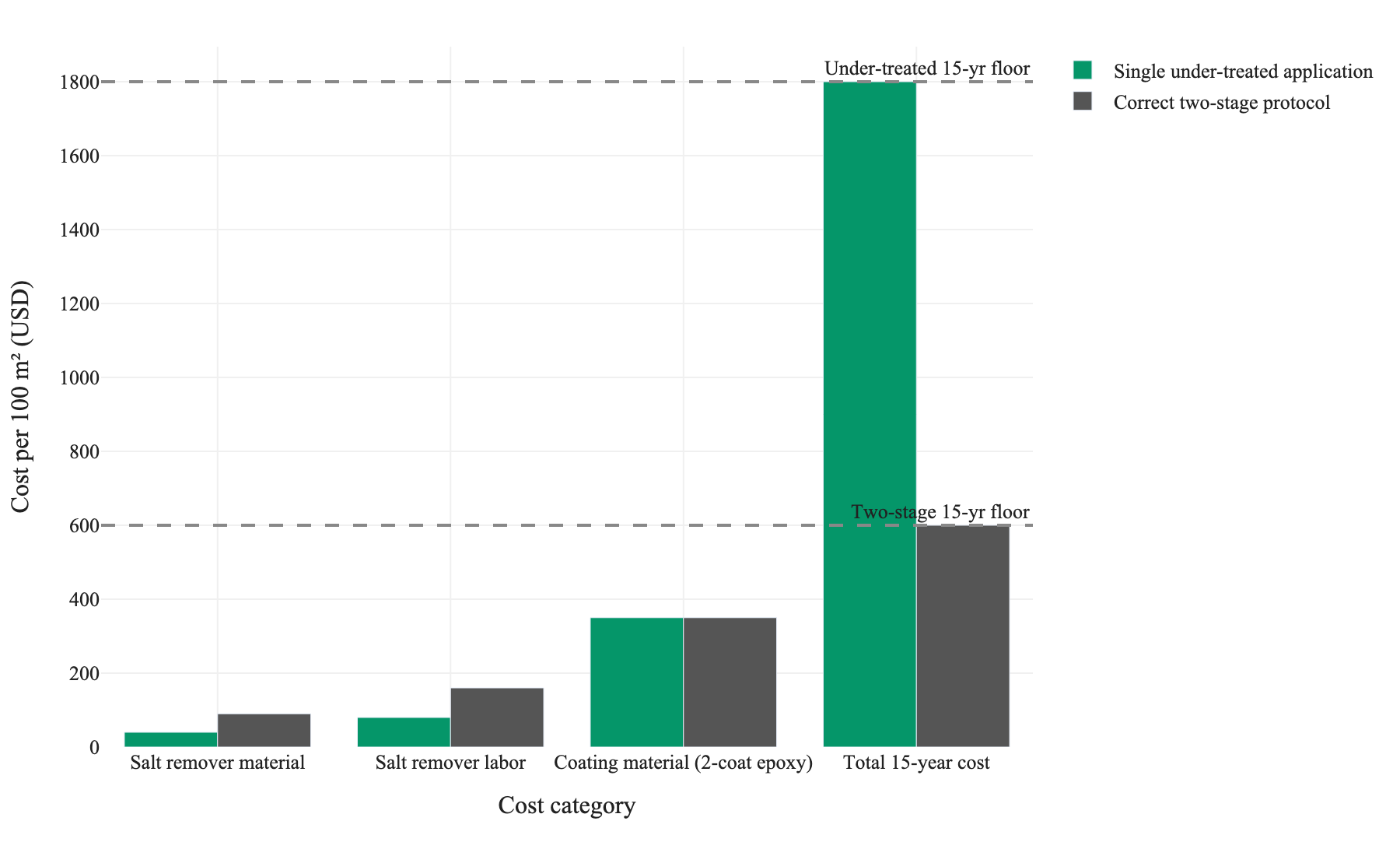
Figure 2. Cost Impact of Under-Decontaminated Steel Before Coating
Cost category | Single under-treated application | Correct two-stage protocol |
|---|---|---|
Salt remover material cost per 100 m2 | USD 40 to USD 80 | USD 90 to USD 150 |
Salt remover labor cost per 100 m2 | USD 80 to USD 120 | USD 160 to USD 220 |
Coating material (2-coat epoxy) per 100 m2 | USD 350 to USD 600 | USD 350 to USD 600 |
Expected service life of coating | 2 to 5 years (premature failure likely) | 8 to 15 years (design life) |
Recoating frequency over 15 years | 2 to 4 cycles | 0 to 1 cycles |
Total 15-year cost per 100 m2 | USD 1,800 to USD 3,600 | USD 600 to USD 970 |
The differential is substantial. Underinvestment in pre-treatment chemistry at the rate of USD 50 to USD 70 per 100 m2 generates three to five times that cost in recoating cycles over the asset lifetime. The accounting distortion that drives this pattern is the same as in packaging cost management: the decontamination line sits in one budget, while coating failure remediation sits in a separate operations or warranty cost center.
What Does Verification Failure Look Like in Field Audits?
Surface soluble salt testing is described in SSPC Guide 15 and ISO 8502-6:2020 as a standard pre-coating inspection step, but adoption in field maintenance projects remains inconsistent. AMPP data from its 2024 conference presentation on soluble salt contamination noted that there is currently no industry-wide consensus on maximum acceptable chloride levels, and that many project specifications either omit a chloride limit entirely or cite limits without specifying a test method (AMPP, 2024). When a chloride limit is specified without a verification procedure, field teams have no method to confirm compliance, and the first evidence of failure is a blistering coating six to twelve months after application.
The repeat-treatment cycle that follows a failed verification test adds mobilization, test kit, labor, and downtime costs that typically range from USD 200 to USD 500 per 100 m2 for a re-treatment plus re-test sequence. Over a large marine maintenance project of 2,000 m2, a single unplanned re-treatment cycle adds USD 4,000 to USD 10,000 in unbudgeted cost. A correctly designed two-stage protocol, budgeted from project start, eliminates the probability of an unplanned cycle.
V. Two-Stage Protocol: Pre-Wash, Active Treatment, and Verification
A two-stage decontamination protocol for substrates with initial chloride loadings above 500 ppm in surface-zone equivalents (approximately 50 µg/cm2 on a Bresle reading) works by separating the physical chloride reduction step from the chemical active-site binding step. Stage 1 reduces the absolute ion load to a range where Stage 2 chemistry can run to completion.
Stage 1: Physical Pre-Wash to Reduce Ion Load
The purpose of Stage 1 is to flush the freely soluble chloride fraction from the surface and from loosely adherent rust product before any active-chemistry product is applied. This preserves the active-site budget of the salt remover for the residual, tightly bound fraction that physical flushing cannot remove alone.
Stage 1 procedure:
Conduct a baseline chloride reading using ISO 8502-6 Bresle patch or SSPC Guide 15 Method A before beginning. Record the result in µg/cm2. If the reading is at or below 20 µg/cm2, proceed directly to Stage 2.
Apply a high-pressure fresh-water wash at a minimum pressure of 70 bar (1,000 psi). A minimum water volume of 5 liters per square meter is required to flush the loosely bound chloride fraction. Ultra-high pressure waterjetting at above 700 bar (10,000 psi) is preferred for substrates with heavy rust scale, as physical disruption of the outer rust layer exposes the underlying chloride to flushing action.
Allow the surface to drain for 10 to 15 minutes. Do not allow the surface to dry fully before re-testing; a partially wet surface allows the Bresle method to extract from the active contamination layer.
Take a second chloride reading. If the result is at or below 50 µg/cm2, proceed to Stage 2 at standard dosing. If the result remains above 50 µg/cm2, repeat the high-pressure fresh-water wash and re-test. Do not proceed to Stage 2 until Stage 1 has brought the reading below 50 µg/cm2 or until three physical wash cycles have been completed, whichever comes first.
Stage 2: Active Salt Remover Treatment at Adjusted Dosing
Once Stage 1 has brought surface chloride below 50 µg/cm2, the active chemistry of the salt remover operates within the range where its site capacity is sufficient for complete reaction.
Stage 2 procedure:
Mix the salt remover at the manufacturer-specified concentration for moderate contamination. For products that specify a dilution range (such as 1:100 to 1:25), use the more concentrated end (1:25 to 1:50) for substrates that measured 20 to 50 µg/cm2 after Stage 1. Do not exceed the manufacturer's maximum concentration specification.
Apply by brush, roller, or airless spray. Ensure full wet coverage of all surface areas, including edges, crevices, and areas of visible corrosion product. Dwell time should be a minimum of 10 minutes on a wet surface; do not allow the product to dry on the surface before rinsing.
Rinse thoroughly with clean potable water. A minimum of two rinse passes is required. Rinsate should run clear before the rinse step is considered complete.
Allow the surface to drain for 5 to 10 minutes.
Stage 3: Verification and Hold-for-Coating Decision
Stage 3 is not optional. Coating application is prohibited until verification testing confirms compliance.
Verification procedure:
Apply a Bresle patch per ISO 8502-6:2020 to three locations: the most heavily corroded area identified in the baseline reading, a representative mid-panel area, and an edge or crevice area.
Test the extract per ISO 8502-9 or an ion-specific chloride tube (Chlor*Test, Merckoquant, or equivalent). Record all three readings.
Apply the following hold-for-coat decision matrix.
Figure 3. Hold-for-Coat Decision Matrix After Two-Stage Treatment
Post-treatment chloride reading (µg/cm2) | Environment / end use | Decision |
|---|---|---|
0 to 5 | All environments | Proceed to coat |
5 to 10 | Non-immersion, C1 to C3 | Proceed with coating system approved for moderate salt tolerance |
5 to 10 | Immersion, C4 to CX, offshore | Repeat Stage 2 treatment; re-test before proceeding |
10 to 25 | Non-immersion, maintenance recoat | Consult coating supplier for specific system tolerance; do not use standard epoxy primers without supplier written concurrence |
Above 25 | All environments | Repeat both Stage 1 and Stage 2; re-test; if above 25 µg/cm2 after second full cycle, escalate to abrasive blast preparation per SSPC-SP 10/NACE No. 2 |
This matrix is driven directly by the U.S. Navy chloride limits (5 µg/cm2 for non-immersion, 3 µg/cm2 for immersion) and the SSPC-SP COM Level B limit of 7 µg/cm2, adapted to field maintenance conditions where zero-detectable (Level A) is rarely achievable without abrasive blasting (KTA-Tator, 2023; SSPC-SP 12/NACE No. 5, 2002).
VI. Field Cases: Marine Equipment and Coastal Infrastructure Recovery
The following cases are anonymized. Operating details and quantitative data have been generalized to protect customer identities. Each case follows the four elements of the Lubinpla case study format: quantitative data, specific actions taken, site background, and a distinct narrative pattern.
Company A: Unexpected Cause, Offshore Platform Maintenance Recoat
Company A is a maintenance contractor responsible for periodic coating rehabilitation of a fixed offshore steel platform located in the C5-M atmospheric zone of the South China Sea. The platform top-structure, consisting of approximately 1,800 m2 of carbon steel structural members and equipment supports, was scheduled for a maintenance recoat using a 250-micron dry-film-thickness epoxy mastic system. Pre-blast surface contamination at 12 sample locations measured a range of 40 to 320 µg/cm2 chloride, with a median of 190 µg/cm2.
The initial work scope specified a single salt-remover wash at standard 1:100 dilution followed by abrasive blasting to SSPC-SP 6/NACE No. 3 commercial blast. Post-blast verification testing measured chloride at 8 to 45 µg/cm2 at the same 12 locations, with 7 of 12 readings above the specified project limit of 10 µg/cm2. The project manager halted coating application and ordered re-treatment, resulting in a three-day schedule extension and an unbudgeted cost of approximately USD 28,000 for mobilization, re-treatment labor, and re-testing.
Root cause analysis identified that the single salt-remover application at standard dilution was insufficient to reduce contamination at the rust-pocketed areas where the baseline reading exceeded 200 µg/cm2. The revised protocol implemented Stage 1 high-pressure fresh-water wash (70 bar, 5 liters per square meter) at each identified hot-spot area, followed by a Stage 2 salt-remover application at 1:50 concentration. Post-Stage-2 Bresle readings at the 7 previously non-compliant locations measured 2 to 9 µg/cm2. Coating proceeded without further interruption. The project team estimated that budgeting the two-stage protocol from the outset would have cost USD 6,500 additional in material and labor, avoiding the USD 28,000 remediation event. Net cost avoidance on the revised approach: approximately USD 21,500 on a single maintenance contract.
Company B: Single Variable, Coastal Bridge Recoating Program
Company B is a state highway authority in a coastal region whose steel bridge inventory includes 43 structures classified as C4 to C5 per ISO 9223:2012. The authority's standard specification for protective coating maintenance required surface preparation to SSPC-SP 10/NACE No. 2 near-white metal blast and a post-blast chloride limit of 7 µg/cm2. Pre-blast salt remover wash was specified as a single application at standard dilution. Annual coating maintenance covered approximately 4,000 m2 of steel per year across 6 to 8 structures.
Over three consecutive years, the authority's field inspection records showed that 22 to 35 percent of post-blast locations on structures near tidal water (within 500 meters of coastline) failed the 7 µg/cm2 chloride limit on first test, requiring re-treatment and re-blasting. The authority isolated the single variable driving the excess failure rate: all non-compliant locations were on structures within 500 meters of the coastline where pre-blast Bresle readings averaged 280 µg/cm2, compared to 45 µg/cm2 for inland structures in the same program.
The authority revised the specification for coastal structures only, inserting a Stage 1 fresh-water high-pressure wash before blast preparation and a Stage 2 salt-remover application at 1:50 dilution at locations where pre-treatment readings exceeded 100 µg/cm2. In the first program year after the specification change, the post-blast failure rate at coastal structures dropped from 31 percent to 4 percent of test locations. Material and labor cost for the additional Stage 1 step across the coastal bridge portfolio was estimated at USD 18,000 per year. Avoided re-treatment and re-blast costs were estimated at USD 65,000 per year. Net annual saving: USD 47,000.
VII. Key Takeaway
Salt removers work through ion exchange and chelation chemistry that is subject to stoichiometric saturation. Above approximately 500 ppm chloride in the surface zone (approximately 50 to 100 µg/cm2 on a Bresle reading), a single standard application cannot reduce contamination to compliant levels in one cycle.
The two-stage protocol separates the physical chloride reduction step (Stage 1 high-pressure fresh-water flush) from the active chemistry step (Stage 2 salt remover), allowing the active sites to operate in the concentration range for which they are specified.
Verify surface chloride using ISO 8502-6:2020 Bresle patches at a minimum of three locations per work zone after Stage 2 treatment. Do not apply coating until all readings are within the specification limit for the intended environment.
The hold-for-coat decision matrix in Section V drives the field decision: readings above 25 µg/cm2 after two full treatment cycles require escalation to abrasive blasting per SSPC-SP 10/NACE No. 2, not additional chemical treatment cycles.
Budget the two-stage protocol from project start. The incremental material and labor cost of USD 50 to USD 70 per 100 m2 for the additional Stage 1 step is recovered from the first avoided re-treatment event. Field cases show net cost avoidance of USD 3.5 to USD 4.5 for every USD 1 of additional pre-treatment investment.
If your team is encountering repeat post-blast failures or inconsistent Bresle readings at coastal or marine sites, send the contamination data, substrate description, and current treatment sequence to AI Shooting, the Lubinpla per-case industrial chemistry analysis service that returns an evidence-based written report within 3 days. Submit at https://www.lubinpla.com/ai-shooting for a Standard analysis.
VIII. References
AMPP (Association for Materials Protection and Performance). (2024). Soluble Salt Contamination: Testing and Cleaning before Coating. AMPP Annual Conference Proceedings, New Orleans, LA. https://content.ampp.org/ampp/proceedings-abstract/CONF_MAR2024/2024/1/60471
AMPP (Association for Materials Protection and Performance). (2024). Critical Review of International Standards on Soluble Salts Measurement Methods. AMPP Annual Conference Proceedings, New Orleans, LA. https://content.ampp.org/ampp/proceedings-abstract/CONF_MAR2024/2024/1/60440
AMPP. (2023). Corrosion in the Maritime Industry. https://www.ampp.org/technical-research/what-is-corrosion/corrosion-reference-library/maritime-industry
AMPP Corrosionpedia. (2024). Soluble Salts and Coating Performance. https://www.corrosionpedia.com/soluble-salts-and-coating-performance/2/6502
Chlor-Rid International. (2024). CHLOR*RID Liquid Soluble Salt Remover FAQ. https://chlor-rid.com/index.php/chlorrid-salt-remover/chlorrid-faq/
DuPont Water Solutions. (2020). AmberLite Ion Exchange Resins Water Conditioning Manual. https://www.dupont.com/content/dam/water/amer/us/en/water/public/documents/en/IER-AmberLite-Water-Conditioning-Manual-45-D01951-en.pdf
Federal Highway Administration (FHWA). (2020). Coating Performance on Existing Steel Bridge Superstructures, FHWA-HRT-20-065. https://highways.dot.gov/research/publications/infrastructure/FHWA-HRT-20-065
ISO (International Organization for Standardization). (2020). ISO 8502-6:2020: Preparation of Steel Substrates Before Application of Paints and Related Products, Extraction of Water Soluble Contaminants for Analysis (Bresle Method). https://www.iso.org/standard/73862.html
ISO (International Organization for Standardization). (2020). ISO 8502-9:2020: Preparation of Steel Substrates, Field Method for the Conductometric Determination of Water-Soluble Salts. https://www.iso.org/standard/73863.html
ISO (International Organization for Standardization). (2012). ISO 9223:2012: Corrosion of Metals and Alloys, Corrosivity of Atmospheres, Classification, Determination and Estimation. https://www.iso.org/standard/53499.html
KTA-Tator. (2023). Let's Talk About Surface Soluble Salt Remediation Practices. https://kta.com/surface-soluble-salt-remediation-practices/
KTA-Tator. (2023). Let's Talk Surface Soluble Salt Testing. https://kta.com/surface-soluble-salt-testing/
NACE International (now AMPP). (2016). International Measures of Prevention, Application, and Economics of Corrosion Technologies (IMPACT) Study. http://impact.nace.org/documents/Nace-International-Report.pdf
NACE/AMPP. (2002). SSPC-SP 12/NACE No. 5: Surface Preparation and Cleaning of Metals by Waterjetting Prior to Recoating. https://asremavad.com/wp-content/uploads/2019/04/SSPC-SP-12_2002.pdf
PMC (PubMed Central). (2004). Determination of Anion-Exchange Resin Performance Based on Facile Chloride-Ion Monitoring by FIA-Spectrophotometry. https://www.researchgate.net/publication/8536004
ScienceDirect. (2007). Fundamental Investigation on the Stability of the Steel/Coating Interfaces Contaminated by Submicroscopic Salt Particles. https://www.sciencedirect.com/science/article/abs/pii/S030094400700272X
Springer Applied Water Science. (2022). Laboratory Evaluation of Operating Conditions for Chloride Removal Using Ion Exchange Resin. https://link.springer.com/article/10.1007/s13201-022-01752-x
Springer Nature. (2025). A Review on the Environment's Influence on Coastal Marine Steel Corrosion and In-Situ Monitoring. https://link.springer.com/article/10.1186/s40712-025-00352-2
Verified Market Reports. (2024). Offshore Corrosion Protection Market Size, Share, Industry SWOT and Forecast. https://www.verifiedmarketreports.com/product/offshore-corrosion-protection-market/