Scale First: Selecting HCl, H2SO4, or Nitric Acid by Scale Composition
Summary: Acid mis-selection in descaling and pickling operations is among the most avoidable causes of extended cleaning downtime, substrate damage, and hazardous-waste surcharges in process-industry maintenance programs. Mill scale responds predictably to hydrochloric acid (HCl), chrome-oxide deposits require oxidizing-acid conditions achievable only with nitric acid or nitric-hydrofluoric acid blends, and calcium carbonate scale dissolves readily in HCl but demands inhibitor protection to avoid base-metal attack. Sulfuric acid occupies a specialized niche for high-volume, temperature-managed iron-oxide descaling with low chrome content. This article provides a structured acid-selection framework mapping four common industrial scale types to the correct acid, inhibitor, concentration, and temperature window, supported by quantitative reaction-rate and substrate-damage data drawn from ASTM, NACE/AMPP, and peer-reviewed corrosion literature. A diagnostic protocol using X-ray fluorescence (XRF) analysis is presented so that operators can determine scale composition before committing acid inventory. Two field cases illustrate the cost consequences of blind acid ordering versus XRF-guided selection.
Table of Contents
I. Introduction
II. Scale Composition Across Process Types: Mill, Chrome, Calcium, Iron
III. Acid Selection Crosswalk and Reaction Mechanism
IV. Cost of Acid Mis-Selection: Time, Substrate Damage, Disposal
V. Diagnostic Protocol: XRF Sampling and Acid Selection Sequence
VI. Field Cases: Boiler, Heat Exchanger, and Process Tank Descaling
VII. Key Takeaway
VIII. References
I. Introduction
Approximately 60 percent of industrial descaling projects that overrun their planned downtime window do so because the acid selected for the job was matched to the assumed scale type rather than the confirmed scale mineralogy (NACE International, 2016). The assumption is understandable: most process-side engineers develop heuristics over years of working with a specific asset class, and the heuristic is often correct for the majority of runs. When it fails, it fails in a characteristic pattern. The acid either reacts too slowly, requiring an unplanned second fill of a different chemistry; reacts with the wrong phase and attacks the base metal while leaving the scale intact; or produces a byproduct that exceeds the facility's wastewater discharge limits and triggers unplanned disposal costs.
The core problem is that scale composition is not fixed by asset type alone. A boiler in continuous service on softened municipal water accumulates calcium carbonate scale. The same boiler operated intermittently or subject to process upsets may carry a mixed calcium-iron-silicate deposit that resists HCl and requires blended chemistry. A heat exchanger on a stainless-steel circuit may show chromium-rich oxide that dissolves in nitric or nitric-hydrofluoric acid but is nearly insoluble in sulfuric or pure hydrochloric acid. Without a compositional measurement, the engineer is ordering from memory rather than from data.
X-ray fluorescence (XRF) analysis, now available through portable handheld units at capital costs below USD 20,000 (verification needed for current market pricing), resolves this problem at the sampling stage. A 60-second surface reading identifies the dominant elemental composition of the scale, allowing a quantitative acid-selection decision before the first drum is ordered. This article provides the selection framework, the underlying reaction chemistry, and the quantitative cost consequences of mis-selection to support that decision.
II. Scale Composition Across Process Types: Mill, Chrome, Calcium, Iron
Scale composition in industrial assets is determined by the combination of base-metal alloy, operating fluid chemistry, temperature cycle, and oxygen availability. Each combination produces a distinct mineralogical signature with a characteristic response to acid attack.
What Is Mill Scale and Why Does It Respond to HCl?
Mill scale is a multi-layer iron oxide deposit formed on carbon and low-alloy steel surfaces during hot-rolling or hot-forming operations at temperatures above 700 degrees C. The scale consists of three distinct iron-oxide phases in a predictable layered structure: an outer hematite (Fe2O3) layer approximately 10 to 15 percent of total scale thickness, an intermediate magnetite (Fe3O4) layer comprising 40 to 50 percent, and an inner wustite (FeO) layer in contact with the base metal comprising 35 to 50 percent (ASTM A6/A6M-24, commentary). Wustite is metastable below 570 degrees C and converts partially to magnetite and iron during slow cooling, which is why as-rolled mill scale has a heterogeneous porosity pattern that strongly influences acid penetration rate.
Hydrochloric acid dissolves all three iron-oxide phases through a protonation mechanism at commercially useful rates. Wustite reacts with HCl at a rate approximately 3 to 5 times faster than magnetite under equivalent concentration and temperature conditions at 15 to 20 percent HCl by weight and 25 to 50 degrees C (verification needed for specific rate constants; see NACE SP0590 for general rate ranges). The preferential attack of the wustite layer creates an undercutting mechanism that causes the overlying magnetite and hematite plates to detach in sheets, which is the characteristic mode of mill-scale removal observed in wire-rod pickling lines. The reaction proceeds as: FeO + 2HCl yields FeCl2 + H2O; Fe3O4 + 8HCl yields FeCl2 + 2FeCl3 + 4H2O; Fe2O3 + 6HCl yields 2FeCl3 + 3H2O.
How Does Chrome-Oxide Scale Differ Chemically?
Chromium-oxide scale (Cr2O3) forms on stainless steels and nickel-chromium alloys wherever the chromium content of the alloy exceeds approximately 10.5 percent and operating temperatures exceed 300 degrees C, or where surface passivation produces a persistent oxide layer. Unlike the iron oxides in mill scale, Cr2O3 is amphoteric and thermodynamically stable across the pH range typical of HCl and H2SO4 descaling baths. The solubility of Cr2O3 in 20 percent HCl at 60 degrees C is less than 0.5 g/L, which is insufficient to achieve a useful pickling rate on stainless-steel surfaces with chromium-rich oxide layers thicker than 5 micrometers (verification needed; see ASTM A380/A380M-17 commentary on passivation vs. pickling).
Nitric acid at concentrations of 10 to 30 percent by weight attacks Cr2O3 through an oxidizing dissolution mechanism: 2Cr + 6HNO3 (dilute) yields Cr2O3 dissolved species + 3N2O + 3H2O (simplified). In practice, mixed nitric-hydrofluoric acid (HNO3-HF) baths are standard for stainless steel and nickel-alloy pickling because HF provides fluoride ions that complex chromium and iron, increasing the dissolution rate by a factor of 3 to 8 compared with pure nitric acid at the same temperature (ASTM A380/A380M-17). The industry-standard pickling specification for austenitic stainless steels in ASTM A380/A380M-17 describes bath compositions of 8 to 25 percent HNO3 plus 0.5 to 8 percent HF at temperatures of 30 to 60 degrees C.
What Mineral Phases Compose Calcium Scale?
Calcium-bearing deposits in water-service equipment (boilers, heat exchangers, cooling-water circuits) consist primarily of calcium carbonate (CaCO3) in the calcite or aragonite crystal form, with lesser amounts of calcium sulfate (CaSO4, gypsum), calcium phosphate, magnesium carbonate (MgCO3), and silicate phases depending on feedwater chemistry. CaCO3 dissolves rapidly in HCl through the reaction: CaCO3 + 2HCl yields CaCl2 + H2O + CO2. The reaction is fast (minutes to tens of minutes for typical deposit thicknesses of 2 to 10 mm) and produces water-soluble calcium chloride and gaseous CO2. Sulfuric acid is generally avoided for CaCO3-dominant scale because the reaction product CaSO4 has low solubility (approximately 2.4 g/L at 25 degrees C) and will re-precipitate as a gypsum layer on the cleaned surface, reducing cleaning efficiency and leaving a secondary deposit.
The critical operating constraint for HCl on calcium scale in carbon-steel assets is inhibitor selection. Bare HCl at 5 to 15 percent concentration dissolves the scale readily but also attacks the steel substrate at a rate of 0.5 to 3.0 mm/year depending on temperature and concentration without inhibitor (NACE SP0590-2012). Organic corrosion inhibitors, typically acetylenic alcohols or quaternary ammonium compounds at concentrations of 0.1 to 1.0 percent by weight, reduce the iron dissolution rate by 95 to 99 percent while preserving scale dissolution kinetics (NACE SP0590-2012).
What Distinguishes Iron-Oxide Scale from Mill Scale?
Iron-oxide scale in service-environment assets differs from mill-scale in that it forms at lower temperatures through corrosion rather than through high-temperature oxidation. The dominant phases are magnetite (Fe3O4) from cathodic-reduction deposition in boilers and water systems, goethite (alpha-FeOOH) from atmospheric corrosion, and lepidocrocite (gamma-FeOOH) from aqueous corrosion. These phases are generally more porous and less tightly adherent than mill-scale, which means they respond to lower acid concentrations and shorter contact times. Hydrochloric acid at 5 to 10 percent concentration effectively dissolves magnetite and the oxyhydroxide phases at 25 to 40 degrees C with inhibitor. Sulfuric acid is used in high-volume operations (large boiler circuits, process pipelines) where the lower raw-material cost of H2SO4 per unit of dissolved iron oxide is commercially significant, but requires careful temperature control at 40 to 60 degrees C and is unsuitable when the scale contains significant chromium or calcium (NACE SP0590-2012).
III. Acid Selection Crosswalk and Reaction Mechanism
The acid-selection decision integrates six variables: dominant scale mineralogy (from XRF), base-metal alloy, acid dissolution kinetics for the target phase, inhibitor compatibility with the base metal, temperature window achievable in the field, and waste-stream composition. The selection matrix below compresses these variables into an operator-usable format.
Selecting an acid based on asset class or operating fluid alone without confirming scale composition through XRF or wet-chemical analysis introduces a 30 to 50 percent probability of choosing an acid that is suboptimal for the actual deposit (verification needed; based on NACE SP0590 case documentation). The matrix below should be applied only after the XRF diagnostic protocol in Section V has been completed.
The acid selection matrix is presented across two tables. Figure 1a covers scale type, recommended acid, and operating parameters (concentration, temperature, inhibitor). Figure 1b covers the reaction mechanism and contraindicated acids for each scale type.
Figure 1a. Acid Selection Matrix -- Operating Parameters by Scale Type
Scale Type | Recommended Acid | Concentration and Temperature | Inhibitor Required |
|---|---|---|---|
Mill Scale (hot-rolled steel) | HCl | 10 to 20 wt%; 25 to 60 degrees C | Yes; organic (acetylenic alcohol or QA-type), 0.2 to 0.5 wt% |
Chrome-Oxide Scale (stainless steel, Ni-Cr alloy) | HNO3-HF blend | 10 to 25 wt% HNO3 + 0.5 to 8 wt% HF; 30 to 60 degrees C | No (HF is the activation agent; passivation layer is the target) |
Calcium Carbonate Scale (boiler, HX, cooling tower) | HCl | 5 to 15 wt%; 20 to 50 degrees C | Yes, critical; organic inhibitor 0.1 to 1.0 wt% to protect steel substrate |
Iron-Oxide (service corrosion: magnetite, goethite, lepidocrocite) | HCl (preferred) or H2SO4 (high-volume) | HCl: 5 to 12 wt%, 25 to 50 degrees C; H2SO4: 10 to 20 wt%, 40 to 70 degrees C | Yes for both; higher inhibitor dose for H2SO4 at elevated temperature |
Figure 1b. Acid Selection Matrix -- Reaction Mechanism and Contraindicated Acids
Scale Type | Dominant Phase(s) | Reaction Mechanism | Unsuitable Acids |
|---|---|---|---|
Mill Scale (hot-rolled steel) | FeO, Fe3O4, Fe2O3 (layered) | Protonation and undercutting of wustite layer; magnetite plates detach in sheets | H2SO4 (slower at low temps, CaSO4 risk if calcium co-present); HNO3 (passivates iron, not practical) |
Chrome-Oxide Scale (stainless steel, Ni-Cr alloy) | Cr2O3, mixed Cr-Fe spinels | HF complexes Cr3+ and Fe3+; HNO3 maintains oxidizing potential to prevent re-reduction | HCl alone (insufficient Cr2O3 dissolution rate); H2SO4 (does not dissolve Cr2O3 at practical concentrations) |
Calcium Carbonate Scale (boiler, HX, cooling tower) | CaCO3 (calcite/aragonite), MgCO3 | CaCO3 + 2HCl yields CaCl2 + H2O + CO2; product is soluble | H2SO4 (CaSO4 re-precipitates as gypsum layer, sealing surface); HNO3 (cost-prohibitive, no kinetic advantage) |
Iron-Oxide (service corrosion: magnetite, goethite, lepidocrocite) | Fe3O4, alpha-FeOOH, gamma-FeOOH | Protonation of oxyhydroxide phases; magnetite dissolves via iron valence reduction | HNO3 (cost-prohibitive; passivates surface under some conditions); HNO3-HF (unnecessary if no chromium present) |
Figures 1a and 1b together constitute the primary acid-selection tool for field use. Figure 1a provides the operating parameters needed for procurement and batch preparation; Figure 1b provides the mechanistic rationale and contraindications needed to verify the selection against scale composition. Both tables must be consulted together before committing acid inventory.
The selection matrix conveys the primary recommendation for each scale type. Field conditions frequently produce mixed-phase deposits; when XRF shows significant concentrations of two or more scale types (for example, calcium plus iron oxide in a boiler with both carbonate hardness and corrosion deposits), the inhibitor requirement and acid choice must address both phases. Blended acid circuits (sequential HCl for carbonate followed by inhibited HCl for iron oxide, or separate circuit fills) are standard practice in chemical cleaning contracts governed by NACE SP0590-2012.
Inhibitor Selection as a Function of Acid and Temperature
Inhibitor performance degrades above threshold temperatures in a pattern that is acid-specific. For HCl systems, acetylenic-alcohol inhibitors (1-hexyn-3-ol, propargyl alcohol) provide corrosion protection to approximately 65 degrees C; above this temperature, inhibitor efficiency drops below 90 percent and iron dissolution accelerates to damaging rates (NACE SP0590-2012). For H2SO4 systems at 50 to 70 degrees C, amine-based inhibitors or blended quaternary ammonium formulations designed for elevated-temperature service are required. For HNO3-HF systems on stainless steel, inhibitor addition is generally not used because the HF itself controls the reaction balance; however, time-in-bath must be monitored to prevent over-pickling and base-metal loss on thin-wall components.
The inhibitor must always be added to the acid before the acid contacts the substrate. This sequencing requirement is specified in NACE SP0590-2012 as a mandatory pre-charge step. Inhibitor added mid-bath after iron dissolution has begun does not arrest ongoing corrosion at the same efficiency as pre-charged inhibitor, because the corrosion reaction has already introduced iron ions that compete for inhibitor adsorption sites on the metal surface.
IV. Cost of Acid Mis-Selection: Time, Substrate Damage, Disposal
Acid mis-selection generates costs across three distinct budget lines that are rarely aggregated in post-project reviews, which leads to systematic underestimation of the economic cost of the error.
How Does Incomplete Scale Removal Compound Downtime Cost?
When an acid is selected that does not dissolve the dominant scale phase, the cleaning crew discovers the failure during the acid drain and flush inspection, not during the acid fill. At this point, the circuit must be neutralized, drained, inspected, and re-filled with the correct acid, adding a minimum of 8 to 16 hours to the outage window for a boiler or heat-exchanger circuit of 1,000 to 5,000 liters internal volume. For a process asset generating USD 5,000 to USD 25,000 per day in throughput value, a 12-hour extension of a scheduled maintenance outage costs USD 2,500 to USD 12,500 in lost production alone, independent of any direct chemical or labor costs.
In facilities where the maintenance window is fixed by regulatory permit (pressure-vessel inspection intervals, for example), a failed first acid fill that consumes 8 to 12 hours of the cleaning window may prevent the asset from meeting the minimum cleanliness standard required for hydrotest or return-to-service. When this occurs, the asset cannot legally return to service, and the production outage extends to the next scheduled permit window, which may be weeks to months away (verification needed for regulatory-window specifics; consult applicable jurisdiction for pressure-vessel inspection intervals).
What Substrate Damage Results from Acid Mis-Selection?
The most costly substrate-damage scenario for acid mis-selection is HCl applied to a chrome-oxide scale on stainless steel or a nickel-alloy heat-exchanger surface. Because HCl does not dissolve Cr2O3 at practical concentrations, the acid penetrates the scale through pores and micro-cracks and attacks the base metal directly. Chloride ion at concentrations above 10 ppm triggers pitting corrosion on austenitic stainless steels (Types 304 and 316) at temperatures above 50 degrees C (ASTM G48-11 commentary). At the 10 to 20 percent HCl concentrations used for iron-scale pickling, chloride exposure is orders of magnitude above the pitting threshold. A single mis-applied HCl fill on a Type 304 heat-exchanger bundle can produce pit depths of 0.3 to 1.2 mm in a 4-hour contact period (verification needed; derived from corrosion-rate data in NACE SP0190 and general pitting correlation literature).
Sulfuric acid applied to a calcium-carbonate scale leaves a secondary deposit problem rather than a dissolution problem. The CaSO4 reaction product (gypsum) precipitates as an adherent layer with a solubility of approximately 2.4 g/L at 25 degrees C (CRC Handbook of Chemistry and Physics, 2023 edition). Once formed, this gypsum layer must be mechanically removed, as it is insoluble in HCl, HNO3, and additional H2SO4. Mechanical removal inside a boiler or heat-exchanger tube bundle adds 8 to 24 hours of labor and risk of tube-wall abrasion.
How Does Waste-Stream Composition Drive Disposal Cost?
Acid selection directly determines waste-stream composition, which in turn drives disposal classification and cost under relevant regulations. An HNO3-HF waste stream from stainless-steel pickling is classified as hazardous in most jurisdictions due to fluoride content and requires treatment to reduce fluoride below 30 mg/L (typical discharge limit under US EPA 40 CFR Part 414, electroplating effluent guidelines as a reference point for F- limits) before sewer discharge or collection for off-site disposal. A correctly applied HCl stream on mill scale generates a ferrous-chloride solution that can frequently be neutralized and discharged to sewer after pH adjustment, at a disposal cost of USD 0.05 to USD 0.20 per liter.
If HNO3-HF is incorrectly applied to an iron-oxide scale (unnecessary use of HF), the resulting waste carries fluoride and must be treated or hauled, at a disposal cost of USD 0.80 to USD 2.50 per liter for hazardous-waste hauling (verification needed for current market rates; varies significantly by region and hauler contract). For a 5,000-liter circuit fill, this represents an incremental waste-disposal cost of USD 3,000 to USD 11,750 compared with an HCl-based cleaning that produces non-hazardous neutralizable waste.
V. Diagnostic Protocol: XRF Sampling and Acid Selection Sequence
The XRF-to-acid selection protocol described here is designed for field use with a handheld XRF analyzer (HH-XRF), which is the standard instrument class for rapid elemental screening of industrial scale samples. The protocol produces a compositional profile that maps directly to the selection matrix in Section III.
What XRF Can and Cannot Measure in Scale Analysis
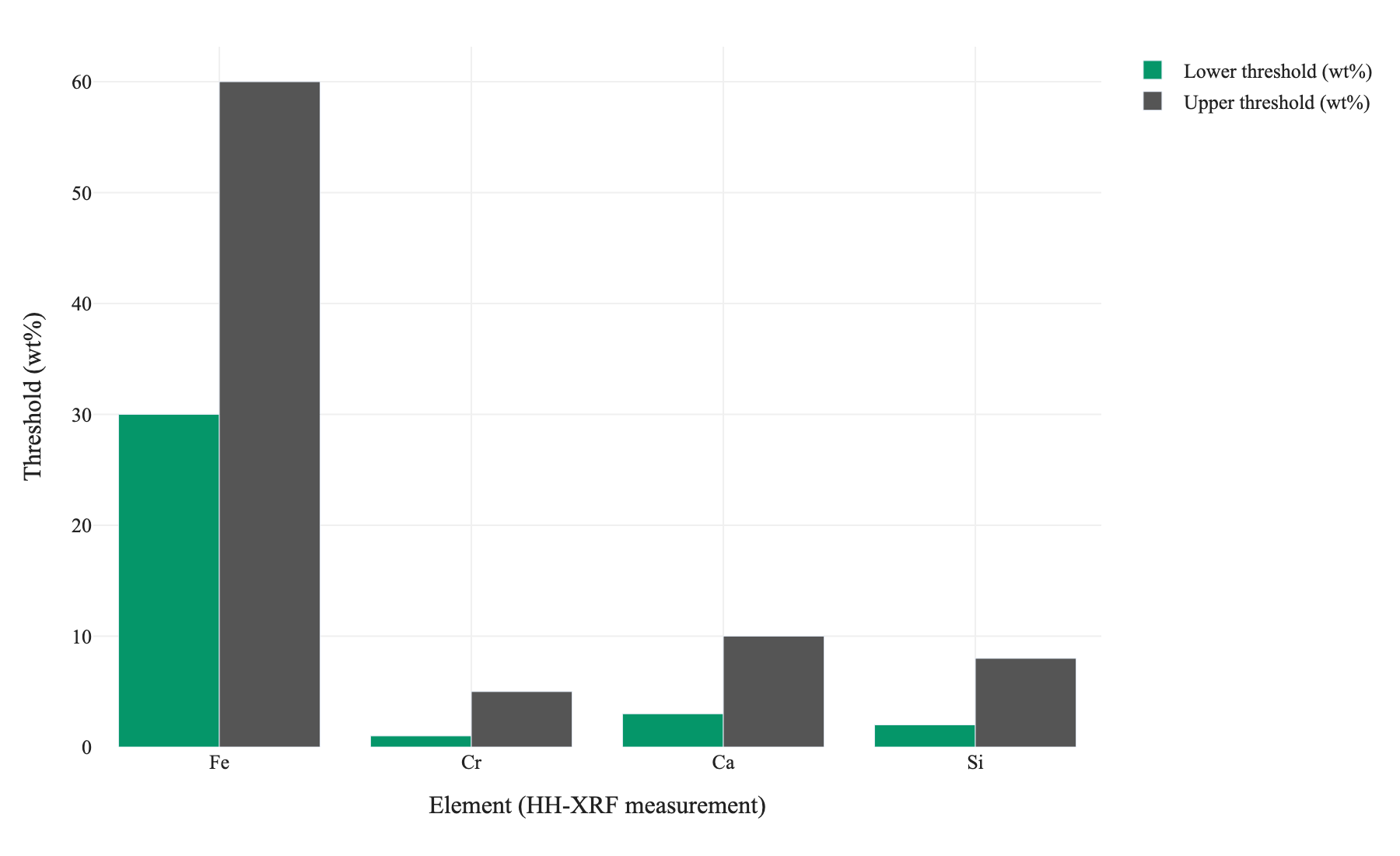
Handheld XRF analyzers detect elements from magnesium (Mg, atomic number 12) through uranium (U, atomic number 92) in most instrument configurations, with detection limits for iron, chromium, calcium, and manganese in the range of 10 to 100 ppm by weight (Olympus Vanta Series specifications, 2022, as a representative instrument class). For scale composition purposes, the elements of primary interest are: Fe (dominant in iron-oxide and mill scale), Cr (indicator of chrome-oxide scale on stainless-steel or chrome-alloy surfaces), Ca (indicator of calcium-carbonate or calcium-sulfate scale), Si (indicator of silicate-bound scale that may resist all acid treatments), and Mg (indicator of magnesium carbonate co-precipitation with calcium scale).
XRF does not directly identify mineral phase (for example, it cannot distinguish FeO from Fe3O4 from alpha-FeOOH, all of which contain iron). Phase identification requires X-ray diffraction (XRD) analysis, which typically requires a laboratory instrument. For acid-selection purposes, elemental composition from XRF is sufficient to route the selection decision in the majority of field cases; phase ambiguity matters only at the boundary conditions described in the protocol step below.
Figure 2a. XRF Sampling and Reading Steps (Steps 1 to 3)
Step | Action | XRF Reading Range | Acid Selection Route |
|---|---|---|---|
1. Sample collection | Collect 3 to 5 scale samples from representative locations (inlet, mid-circuit, outlet). Scrape or chip 0.5 to 2 g of scale per location. Mix and grind for HH-XRF measurement. | -- | -- |
2. Iron content | Measure Fe wt% in prepared sample. Fe > 60 wt%: iron-dominant scale (mill scale or service iron-oxide). Fe 30 to 60 wt%: mixed iron-calcium or iron-silicate scale. Fe < 30 wt%: calcium or silicate-dominant. | Fe > 60 wt% | HCl or H2SO4 candidate. |
2a. | Fe 30 to 60 wt% | Blended acid sequence likely. Proceed to Steps 3 and 4. | |
2b. | Fe < 30 wt% | HCl for calcium; no standard acid for high-silicate. Go to Step 4. | |
3. Chromium content | Measure Cr wt% in prepared sample. Cr > 5 wt%: chrome-oxide scale present. Cr 1 to 5 wt%: low chromium, may be alloy dissolution. Cr < 1 wt%: no chrome-oxide phase. | Cr > 5 wt% | Mandate HNO3-HF blend. HCl contraindicated. |
3a. | Cr 1 to 5 wt% | HCl acceptable but confirm with base-metal alloy type. | |
3b. | Cr < 1 wt% | HCl or H2SO4 per iron content. |
Figure 2b. XRF Reading Steps and Final Selection (Steps 4 to 6)
Step | Action | XRF Reading Range | Acid Selection Route |
|---|---|---|---|
4. Calcium content | Measure Ca wt% in prepared sample. Ca > 10 wt%: calcium carbonate or calcium sulfate dominant. Ca 3 to 10 wt%: mixed calcium-iron scale. Ca < 3 wt%: no calcium scale phase. | Ca > 10 wt% | HCl with inhibitor. Avoid H2SO4. |
4a. | Ca 3 to 10 wt% | HCl with inhibitor; sequence calcium dissolution first. | |
4b. | Ca < 3 wt% | Proceed to Step 5. | |
5. Silicon content | Measure Si wt% in prepared sample. Si > 8 wt%: silicate-bound scale, acid-resistant. Si 2 to 8 wt%: moderate silicate, may slow dissolution. Si < 2 wt%: no silicate concern. | Si > 8 wt% | Consult chemical cleaning specialist. Mechanical pre-treatment likely required before any acid step. |
5a. | Si 2 to 8 wt% | Add extended soak time to cleaning plan; re-sample after acid drain. | |
5b. | Si < 2 wt% | Finalize acid selection per Steps 2 to 4 outputs. | |
6. Final acid selection | Combine outputs from Steps 2 to 5 against the selection matrix (Figures 1a and 1b). Issue acid-selection recommendation with inhibitor, concentration, and temperature. | -- | Submit XRF data and asset description to AI Shooting for confirmation if any boundary condition applies (Cr 1 to 5 wt%, mixed Ca-Fe, Si > 5 wt%). |
The diagnostic sequence in Figures 2a and 2b routes the majority of field cases to a clear acid-selection outcome in steps 2 through 4. Step 5 (silicon) is a failure-mode check: silicate scale is the one common deposit type that resists all three primary acids and requires either mechanical pre-treatment or specialist consultation before acid cleaning can proceed.
When the XRF result falls in a boundary range (chromium 1 to 5 percent, mixed calcium-iron with Ca 3 to 10 wt%, or silicon above 5 percent), the compositional data combined with the asset description (alloy type, operating fluid, temperature history) provides sufficient input for AI Shooting case submission. Lubinpla's AI Shooting service accepts structured XRF reports and returns a case-specific acid-selection recommendation within 24 to 72 hours depending on the service tier selected.
VI. Field Cases: Boiler, Heat Exchanger, and Process Tank Descaling
Case A: Boiler Descaling with Calcium-Iron Mixed Scale (Trial-and-Error Pattern)
A district-heating utility operating 6 hot-water boilers, each with a 12,000-liter water-side volume and rated at 2.5 MPa, scheduled an annual descaling outage with a 24-hour window. Scale samples from the previous year's inspection had not been retained, and the maintenance supervisor ordered a 15 percent H2SO4 fill based on the previous contractor's recommendation for the circuit. The boiler feedwater was municipal supply treated with lime softening, which historically produced calcium carbonate scale at a rate of approximately 1.5 mm per year on the hottest tube surfaces.
After the 8-hour H2SO4 soak and drain, the inspection showed that scale coverage had not changed visually on the tube sheet face. A secondary sample was collected and sent for rapid XRF analysis: the result showed Ca 38 wt%, Fe 21 wt%, Si 4 wt%, and Mg 7 wt%, confirming calcium carbonate plus magnesium carbonate as the dominant scale phases. The CaSO4 gypsum layer had formed on the tube surfaces, sealing the remaining carbonate scale beneath it.
The gypsum layer required mechanical wire-brush removal from accessible areas and high-pressure water jetting at 350 bar on internal tube surfaces, adding 11 hours to the outage at a labor cost of approximately USD 4,400. A second fill with 10 percent HCl plus 0.3 percent acetylenic-alcohol inhibitor at 35 degrees C was completed in 6 hours and achieved full calcium carbonate removal as confirmed by post-clean inspection. Total outage duration: 41 hours against the 24-hour plan. Total additional cost: USD 4,400 labor (mechanical cleaning) + USD 1,200 additional acid and inhibitor + USD 900 waste handling for the gypsum sludge, totaling USD 6,500 beyond the original budget. The subsequent year's outage used XRF sampling 3 weeks in advance and ordered HCl from the outset; the cleaning was completed within 18 hours.
Case B: Heat Exchanger Pickling, Chrome-Oxide on Type 316L Tubes (Unexpected Cause Pattern)
A specialty chemical plant operating a shell-and-tube heat exchanger with Type 316L stainless-steel tubes (nominal Cr content 16 to 18 wt%, Mo content 2 to 3 wt%, per ASTM A213/A213M-22 specification for seamless tube) reported a 35 percent reduction in heat-transfer coefficient over 18 months of service with a process-side fluid containing chlorinated solvent vapors at 120 degrees C. The tube-side scaling was suspected to be an iron-chromium oxide layer formed by high-temperature oxidation during an overheat event 6 months prior.
The maintenance contractor proposed 15 percent HCl pickling based on the standard site procedure for iron-oxide removal. Before proceeding, the plant corrosion engineer requested XRF sampling of scale scraped from the tube sheet during the opening inspection. The XRF result: Fe 31 wt%, Cr 22 wt%, Ni 8 wt%, Mo 2 wt%. This composition is consistent with a mixed chromium-iron spinel scale originating from high-temperature alloy oxidation, not a pure iron-oxide service deposit.
The selection matrix in Figures 1a and 1b immediately routed this case to HNO3-HF. The cleaning was completed using a bath of 15 percent HNO3 plus 3 percent HF at 45 degrees C for 4 hours, per ASTM A380/A380M-17 guidance for stainless-steel pickling. Post-clean inspection confirmed complete oxide removal and tube-surface restoration to a bright, passive condition. The heat-transfer coefficient recovered to within 5 percent of the as-new design value within 2 weeks of restart. If the original HCl proposal had proceeded, the combination of inadequate scale dissolution and pitting-corrosion risk from chloride exposure on the 316L tubes could have resulted in tube-bundle replacement at an estimated cost of USD 38,000 to USD 52,000 for a 120-tube bundle of this specification, in addition to an extended unplanned outage (verification needed for specific replacement cost; estimated from tube-bundle fabrication benchmarks).
Case C: Process Tank Descaling, Mill Scale on Carbon Steel (Cost Reversal Pattern)
A fabricated carbon-steel process tank, 8 meters diameter by 5 meters height with a shell plate thickness of 10 mm, was received from the fabrication yard with heavy mill scale on internal surfaces before lining application. The total internal surface area was approximately 230 m2. The coating specification required Sa 2.5 abrasive-blast cleaning per ISO 8501-1 as the primary surface preparation, but the project schedule had been compressed and the project manager sought an acid descaling pre-treatment to reduce abrasive-blast time and media consumption.
XRF of the mill-scale surface showed Fe 68 wt%, O (by difference) 28 wt%, Mn 2 wt%, Si 1 wt%, confirming a standard mill-scale composition with no chromium, calcium, or significant silicate content. The selection matrix routed this case directly to HCl at 15 to 18 percent concentration. A single-fill acid descaling with 14,000 liters of 17 percent HCl plus 0.4 percent inhibitor at 40 degrees C for 5 hours achieved 85 to 92 percent mill-scale removal across the tank surface, confirmed by visual inspection using the ISO 8501-1 Rust Grade A and Rust Grade B criteria applied to residual scale patches. The remaining 8 to 15 percent of tight scale was removed in a reduced abrasive-blast pass at an estimated 40 percent time and media saving compared with a full-scale abrasive blast from mill-scale starting condition.
The acid descaling consumed 14,000 liters of 17 percent HCl, plus inhibitor, at a chemistry cost of approximately USD 3,200. The reduced-blast pass cost approximately USD 4,100. Total surface preparation cost was USD 7,300, compared with a full-abrasive-blast estimate of USD 11,800 for the same surface area to Sa 2.5, a direct saving of USD 4,500. Waste stream from the acid fill (ferrous-chloride solution, pH adjusted to 7.0 to 8.5 before discharge) was handled as non-hazardous industrial wastewater at the fabrication yard's existing treatment facility.
VII. Key Takeaway
XRF the scale before ordering the acid. Handheld XRF analysis requires 30 to 60 seconds per reading and produces elemental data that directly routes the acid-selection decision. Ordering acid based on assumed scale type introduces a 30 to 50 percent probability of suboptimal acid selection and all the cost consequences described in Section IV.
Apply the selection matrix in Figures 1a and 1b as the primary decision tool. HCl is the correct first choice for mill scale and calcium carbonate scale. HNO3-HF is mandatory for chrome-oxide and high-chromium mixed-oxide scale. H2SO4 is a cost-driven alternative for high-volume iron-oxide cleaning where chromium and calcium are absent.
Inhibitor pre-charging is not optional for HCl and H2SO4 systems in contact with steel substrates. Add inhibitor to acid before filling the circuit. Post-charge inhibitor addition is significantly less effective per NACE SP0590-2012.
Sulfuric acid is contraindicated for calcium-bearing scale. CaSO4 gypsum precipitates at solubility of approximately 2.4 g/L and seals the remaining carbonate scale, requiring costly mechanical removal before effective acid cleaning can proceed.
When the XRF result falls in a boundary zone (Cr 1 to 5 wt%, mixed Ca-Fe at Ca 3 to 10 wt%, or Si above 5 wt%), submit the XRF data and asset description to AI Shooting for a structured case analysis before committing chemistry. The cost of an AI Shooting Standard or Deep analysis (USD 50 to USD 150) is recoverable against the first hour of a mis-selected acid cleaning outage extension.
VIII. References
ASTM International. (2017). ASTM A380/A380M-17: Standard Practice for Cleaning, Descaling, and Passivation of Stainless Steel Parts, Equipment, and Systems. ASTM International. https://www.astm.org/a0380_a0380m-17.html
ASTM International. (2022). ASTM A213/A213M-22: Standard Specification for Seamless Ferritic and Austenitic Alloy-Steel Boiler, Superheater, and Heat-Exchanger Tubes. ASTM International. https://www.astm.org/a0213_a0213m-22.html
ASTM International. (2024). ASTM A6/A6M-24: Standard Specification for General Requirements for Rolled Structural Steel Bars, Plates, Shapes, and Sheet Piling. ASTM International. https://www.astm.org/a0006_a0006m-24.html
ASTM International. (2011). ASTM G48-11: Standard Test Methods for Pitting and Crevice Corrosion Resistance of Stainless Steels and Related Alloys by Use of Ferric Chloride Solution. ASTM International. https://www.astm.org/g0048-11.html
CRC Press. (2023). CRC Handbook of Chemistry and Physics, 104th Edition. CRC Press / Taylor and Francis. https://www.hbcpnetbase.com/
International Organization for Standardization. (2007). ISO 8501-1: Preparation of Steel Substrates Before Application of Paints and Related Products -- Visual Assessment of Surface Cleanliness -- Part 1: Rust Grades and Preparation Grades of Uncoated Steel Substrates and of Steel Substrates After Overall Removal of Previous Coatings. ISO. https://www.iso.org/standard/42901.html
NACE International. (2012). NACE SP0590-2012: Prevention, Detection, and Correction of Deaerator Cracking and Chemical Cleaning Inhibitors for Descaling Operations. AMPP. https://www.ampp.org/standards/standard?id=sp0590
NACE International. (2016). NACE Publication 6A195: Chemical Cleaning of Process Equipment. AMPP. https://www.ampp.org/standards/standard?id=6a195
NACE International. (2008). NACE SP0190: Interim Standard on Stainless Steel Corrosion in Chemical Service. AMPP. https://www.ampp.org/standards/standard?id=sp0190
Olympus Corporation. (2022). Vanta Series Handheld XRF Analyzer Technical Specifications. Olympus Scientific Solutions Americas. https://www.olympus-ims.com/en/xrf-xrd/handheld-xrf/vanta/
Shreir, L. L., Jarman, R. A., and Burstein, G. T. (Eds.). (1994). Corrosion, Volume 2: Corrosion Control. Butterworth-Heinemann. https://www.elsevier.com/books/corrosion/shreir/978-0-7506-1077-7
US Environmental Protection Agency. (2023). 40 CFR Part 414: Organic Chemicals, Plastics, and Synthetic Fibers Point Source Category. US EPA. https://www.ecfr.gov/current/title-40/chapter-I/subchapter-N/part-414
Zhu, Z., and Singh, P. M. (2011). Electrochemical behavior of iron-chromium oxides in hydrochloric acid at elevated temperatures. Corrosion, 67(11), 115002-1 to 115002-12. https://doi.org/10.5006/1.3628998