Solvent Residue on Precision Parts: A 6-Step Diagnostic
Summary: Solvent residue on precision parts is rarely a cleaning agent problem alone. On mixed-substrate lines that share a single solvent loop across polymers and metals, residue is the surface signature of a mismatch between solvent surface tension, substrate surface energy, and drying kinetics. This article walks process and quality engineers through the chemistry behind that mismatch, the cross-contamination pathways that develop in shared baths, and a structured six-step diagnostic that isolates the root cause within one shift. It draws on ASTM F22 water-break testing, ASTM D7334 advancing contact angle measurement, IPC-CH-65B cleaning guidance, IEST-STD-CC1246D cleanliness levels, and MIL-STD-1330D oxygen system precision-cleaning protocol, and lands on an inspection checklist with explicit pass and fail criteria. Field teams running mixed polymer-and-metal cleaning lines can adopt the flowchart and checklist directly, route their case to AI Shooting, and convert recurring residue tickets from guesswork into a one-page diagnosis. The intended outcome is a reduction in scrap and rework on parts that pass a visual inspection but fail downstream adhesion, plating, or sealing operations.
Table of Contents
I. Introduction
II. Solvent Vapor Pressure and Drying Curve Analysis
III. Substrate Compatibility Matrix Across Polymers and Metals
IV. Cross-Contamination Risks in Shared Process Lines
V. Step-by-Step Diagnostic Procedure
VI. Key Takeaway
VII. References
I. Introduction
A shift supervisor at a precision components plant flags the same line twice in a week. Stainless steel fittings and a polycarbonate housing cleaned in the same isopropyl alcohol (IPA) vapor degreaser are passing the visual inspection, but the housings are failing the downstream contact-angle check at 62 degrees, well above the 30-degree pass line for the silicone primer step. The metal parts pass. The polymer parts fail. The cleaning chemistry has not changed. Approximately 70 percent of unplanned adhesion and coating rejects in precision manufacturing originate upstream of the coating step, in cleaning and surface preparation (Brighton Science, 2024).
Lubinpla, an industrial chemical AI agent company that serves manufacturers, distributors, and plant operations teams, sees this scenario in roughly one of every four MRO support tickets routed through AI Shooting, its per-case industrial chemistry analysis service that returns a written, evidence-based diagnosis on a single submitted problem. The pattern is consistent enough that it warrants a structured diagnostic rather than a fresh root-cause investigation each time.
This article reframes solvent residue on mixed-substrate precision lines as a three-variable mismatch problem, not a cleaning-bath formulation problem. The three variables are solvent surface tension, substrate surface energy, and drying-curve kinetics. When any two of the three drift out of alignment, residue appears on the lower-energy substrate first while the higher-energy substrate continues to look clean. The six-step diagnostic that follows isolates which variable has shifted.
Why Substrate-Energy Mismatch Is the Common Root Cause
The cleaning industry tends to default to "change the solvent" or "raise the bath temperature" when residue appears. Both can mask the underlying mismatch for a week, then the residue returns. The actual diagnostic question is: does the solvent wet every substrate on this line, and does it dry uniformly across every substrate on this line? When the answer is no on either count, residue is the inevitable outcome.
Mixed-substrate lines amplify this because the operating window that satisfies a 45 mN per m steel surface does not satisfy a 30 mN per m polycarbonate surface (Kolorguide Surface Energy Chart, 2024). The two substrates require different solvent-substrate contact angles to displace the same contaminant, and a single fixed bath cannot deliver both simultaneously.
II. Solvent Vapor Pressure and Drying Curve Analysis
Solvent drying is governed by vapor pressure at the part-surface temperature, not by the bulk bath temperature. A solvent with high vapor pressure dries fast and leaves contaminant behind as a film when the evaporation front outruns the convective lift-out. A solvent with low vapor pressure dries slowly and may carry contaminant back to the surface if the bath itself is no longer clean. This section defines the operating envelope that prevents both failure modes on a mixed line.
How Vapor Pressure Determines Residue Risk
Three solvents dominate precision cleaning of mixed substrates: isopropyl alcohol (IPA), hydrofluoroether (HFE), and methyl ethyl ketone (MEK). Their vapor-pressure and surface-tension profiles drive completely different drying behavior on the same part. IPA boils at 82.5 degrees C and has a surface tension near 21 mN per m at 25 degrees C, which wets polymers but leaves IPA-water azeotrope residue if humid air contacts the part during lift-out (Layton Technologies, 2023). HFE-7100 boils at 61 degrees C with a surface tension of approximately 13.6 mN per m, dries water-mark free at room temperature, and is non-flammable, but it does not dissolve polar organic contaminants by itself (Unistar Chemical, 2024). MEK is a strong polar solvent with a vapor pressure of approximately 105 mmHg at 25 degrees C, dries quickly, and attacks many engineering polymers including polycarbonate and ABS (Enviro Tech International, 2026).
Figure 1. Solvent Drying Envelope on Mixed Substrates
Solvent | Boiling point (C) | Surface tension (mN per m) | Polymer attack risk | Best paired substrate |
|---|---|---|---|---|
IPA | 82.5 | 21.0 | Low | Glass, ceramic, hard metals |
HFE-7100 | 61.0 | 13.6 | Very low | Polymers, mixed lines |
MEK | 79.6 | 23.5 | High (PC, ABS, PMMA) | Bare metals only |
Acetone | 56.0 | 23.0 | High | Bare metals only |
IPA and HFE blend | 60 to 65 | 14 to 16 | Low | Mixed polymer-metal lines |
An IPA and HFE azeotropic blend is the typical compromise for mixed-substrate lines because it dissolves polar contaminants in the IPA fraction and rinses with the low-tension HFE fraction (Microcare, 2024). A bath should be kept as close to azeotrope as possible so the composition does not drift across repeated vaporization cycles. Drift above 5 percent on either component flips the surface tension out of the operating envelope and residue returns.
Reading the Drying Curve in the Field
The drying curve can be read with a stopwatch and a clean glass coupon. After lift-out, a properly dried surface shows no visible film within 8 to 12 seconds at 22 degrees C ambient and 40 to 60 percent relative humidity. A coupon that retains a visible film at 30 seconds indicates either bath contamination above 1 percent dissolved non-volatile residue or a vapor zone that has cooled below the dew point. Field teams should log lift-out-to-dry time daily as a leading indicator. A drift of more than 50 percent over baseline triggers a Step 2 check in the diagnostic procedure in Section V.
III. Substrate Compatibility Matrix Across Polymers and Metals
A mixed-substrate line typically processes three to seven distinct substrates: low-carbon steel, stainless steel, anodized aluminum, untreated aluminum, polycarbonate (PC), acrylonitrile butadiene styrene (ABS), and polyetheretherketone (PEEK) are the most common. Each substrate has a different surface energy in mN per m and a different chemical tolerance. The solvent must wet every one of them and chemically attack none of them. This is the matrix that defines the safe operating window.
The Surface-Energy Gap Between Metals and Polymers
High-energy substrates including bare steel and bare aluminum sit at 45 to 60 mN per m and are wet by every common cleaning solvent. Low-energy polymers including polypropylene at 29 mN per m, polyethylene at 31 mN per m, and PEEK at 36 mN per m sit below the surface tension of water at 72 mN per m and below the surface tension of many cleaning agents (Kolorguide Surface Energy Chart, 2024). The gap between a 50 mN per m steel surface and a 30 mN per m polymer surface is the structural reason a single bath cannot deliver identical residue performance on both.
Figure 2. Substrate Surface Energy and Solvent Compatibility
Substrate | Surface energy (mN per m) | IPA compatible | HFE compatible | MEK compatible | Notes |
|---|---|---|---|---|---|
Carbon steel, degreased | 45 to 60 | Yes | Yes | Yes | High wetting |
Stainless steel 304 | 40 to 55 | Yes | Yes | Yes | Passive layer |
Aluminum, untreated | 38 to 45 | Yes | Yes | Yes | Native oxide |
Aluminum, anodized | 35 to 42 | Yes | Yes | Caution | Pore retention |
Polycarbonate (PC) | 34 to 37 | Caution | Yes | No, attack | Crazing |
ABS | 35 to 42 | Caution | Yes | No, attack | Crazing |
PEEK | 36 to 42 | Yes | Yes | Yes | Solvent-resistant |
Polypropylene (PP) | 29 to 31 | Yes | Yes | Yes | Low wetting |
PTFE | 18 to 19 | Marginal | Yes | Yes | Very low wetting |
The compatibility matrix in Figure 2 is the first input to per-case analysis submissions on mixed-substrate residue cases. A substrate appearing in the line but absent from the matrix is itself a flag. Drawings sometimes specify a polymer grade for a single component that was selected on cost or strength, not on cleaning compatibility, and the cleaning team is the last to see the change order.
Why Anodized Aluminum Behaves Like a Polymer in This Context
Anodized aluminum has a porous oxide layer that can retain solvent inside the pores after the bulk surface appears dry. The same pore structure that gives anodized aluminum its corrosion resistance also extends its drying time by a factor of two to four compared with bare aluminum (PCBSync IPC-CH-65 summary, 2024). A line that processes anodized parts alongside polymers should treat anodized aluminum as a polymer-class substrate in the diagnostic, not as a metal. This is the most common misclassification observed in the analysis service cases.
IV. Cross-Contamination Risks in Shared Process Lines
Cross-contamination on a shared line is the slow, invisible failure mode. The bath looks clean by visual inspection. The flow-through filter has not been changed because the pressure drop is still within spec. The parts running through it last week were fine. Then a different substrate runs through, and the residue appears. The contaminant is not what came in on the new parts. It is what the previous lot deposited into the bath and what the new substrate now picks up.
The Three Cross-Contamination Pathways
Cross-contamination has three pathways on a shared solvent line. First, dissolved non-volatile residue (NVR) accumulates in the bath over time, and once it exceeds 1 mg per 100 mL the bath redeposits residue on every part lifted out (IEST-STD-CC1246D, 2002, IEST). Second, vapor-phase carryover moves low-volatility plasticizers and mold-release agents from polymer parts into the headspace, where they condense on cooler metal parts entering the vapor zone. Third, mechanical carryover transfers particles from one substrate to another via the conveyor, baskets, or fixturing. Each pathway has a distinct field signature and a distinct corrective action.
Figure 3. Cross-Contamination Pathway and Field Signature
Pathway | Mechanism | Field signature | Corrective action |
|---|---|---|---|
Dissolved NVR | Bath accumulates oils and plasticizers | All parts develop residue, gradually worse over weeks | Bath turnover, NVR test below 1 mg per 100 mL |
Vapor carryover | Plasticizers vaporize at bath temperature, condense on cooler parts | Polymer-run lot followed by metal-run lot, metals develop sticky film | Run polymers and metals in separate cycles, raise vapor zone temperature |
Mechanical carryover | Particles transfer via baskets, conveyor, fixtures | Discrete spots, often correlated with fixture contact points | Dedicated fixturing per substrate class, basket pre-rinse |
The corrective actions in Figure 3 are non-interchangeable. A bath turnover does not fix vapor carryover. A fixturing change does not fix dissolved NVR. The Step 4 check in the diagnostic procedure isolates which pathway is active before any corrective action is committed.
Why IPC-CH-65B and MIL-STD-1330D Matter Here
IPC-CH-65B, the Guidelines for Cleaning of Printed Boards and Assemblies issued by the Institute for Printed Circuits in 2011, codifies the ionic and organic contamination limits that govern shared cleaning lines in the electronics industry (IPC, 2011). MIL-STD-1330D, the Department of Defense precision cleaning standard for shipboard oxygen and inert-gas systems issued in 1996 and updated through Change Notice 1 in 2010, codifies non-volatile residue thresholds and includes the optical surface quality monitor protocol that is also valid for non-oxygen precision work (US Department of Defense, 1996, MIL-STD-1330D). Both standards explicitly require that cleanliness be verified after every batch, not after every shift. A line that verifies only after a shift will accumulate cross-contamination across the lots within that shift.
V. Step-by-Step Diagnostic Procedure
The diagnostic below isolates substrate-energy mismatch in six structured steps. Each step has a binary pass-fail criterion. A pass moves to the next step. A fail routes to the corresponding corrective action and halts further investigation until the action is verified. The procedure should be executable by a process engineer in one shift, using equipment a typical precision-cleaning line already owns: a contact-angle goniometer or dyne pens, a stopwatch, a clean glass coupon, an NVR test kit, and the line's own batch records.
Step 1: Confirm the Residue Is Real, Not a Visual Artifact
Run an ASTM F22 water-break test on three representative parts from the failing lot, one from each substrate type on the line (ASTM F22-13, 2024, ASTM International). Apply distilled water to the cleaned surface and observe for 5 seconds. A continuous film for 5 seconds means the surface passes. Water beading into discrete drops within 5 seconds means residue is present. If all three parts pass the water-break test but downstream operations still fail, the residue is hydrophilic, not hydrophobic, and the diagnostic continues at Step 2 with contact angle measurement. If parts fail the water-break test, residue is confirmed and the diagnostic continues at Step 3.
Step 2: Quantify the Surface with a Contact-Angle Reading
Per ASTM D7334-08, the advancing contact angle test, place a 4 microliter water droplet on the cleaned surface and read the angle with a goniometer or, in the field, with calibrated dyne pens stepping from 30 to 60 mN per m (ASTM D7334-08, 2024, ASTM International). A clean steel surface should read below 20 degrees. A clean polymer surface should read below 40 degrees. A reading above 60 degrees on either confirms hydrophobic residue. A reading between 40 and 60 degrees on a polymer is borderline and routes to Step 3.
Step 3: Sample the Bath for Dissolved Non-Volatile Residue
Draw 100 mL from the bath at mid-depth, weigh a clean evaporating dish to four decimal places, evaporate the solvent at 105 degrees C for 60 minutes, and reweigh. Residue above 1 mg per 100 mL fails the IEST-STD-CC1246D Level 100 cleanliness threshold (IEST-STD-CC1246D, 2002, IEST). Residue above 10 mg per 100 mL fails any precision cleaning specification. A failed bath NVR routes to bath turnover before any other corrective action. A passed bath NVR routes to Step 4.
Step 4: Identify the Cross-Contamination Pathway
Review the last 10 lots run through the line. If all 10 lots show progressively worse residue and the bath has not been turned over, the pathway is dissolved NVR and the corrective action is bath turnover, even if Step 3 just passed marginally. If a polymer-run lot is immediately followed by a metal-run lot and only the metal lot shows residue, the pathway is vapor carryover and the corrective action is lot segregation. If residue is localized to fixture contact points, the pathway is mechanical carryover and the corrective action is fixturing review. Pathway identification is binary per lot history.
Step 5: Verify the Solvent Vapor Envelope
Measure bath temperature, vapor-zone temperature, and ambient relative humidity. The vapor zone should sit 5 to 10 degrees C above the bath temperature, and the ambient relative humidity should be below 60 percent. A vapor zone collapsed to within 2 degrees C of ambient temperature has lost its drying capacity and will redeposit dissolved contaminant on every part. An ambient humidity above 70 percent causes IPA-water azeotrope residue on lift-out even on a clean bath (Layton Technologies, 2023). Failures at Step 5 route to environmental controls before any solvent change.
Step 6: Reconcile with the Substrate Compatibility Matrix
Cross-check every substrate in the failing lot against the compatibility matrix in Figure 2. A substrate absent from the matrix or marked Caution for the current solvent is a confirmed root cause of the residue and routes to either a solvent change, a substrate separation across two baths, or an additional rinse step. Step 6 is the gate that exits the diagnostic. A failure at Step 6 that cannot be resolved by an in-house change should be routed to Lubinpla's analysis service with the inspection checklist attached.
Figure 4. Diagnostic Decision Flowchart
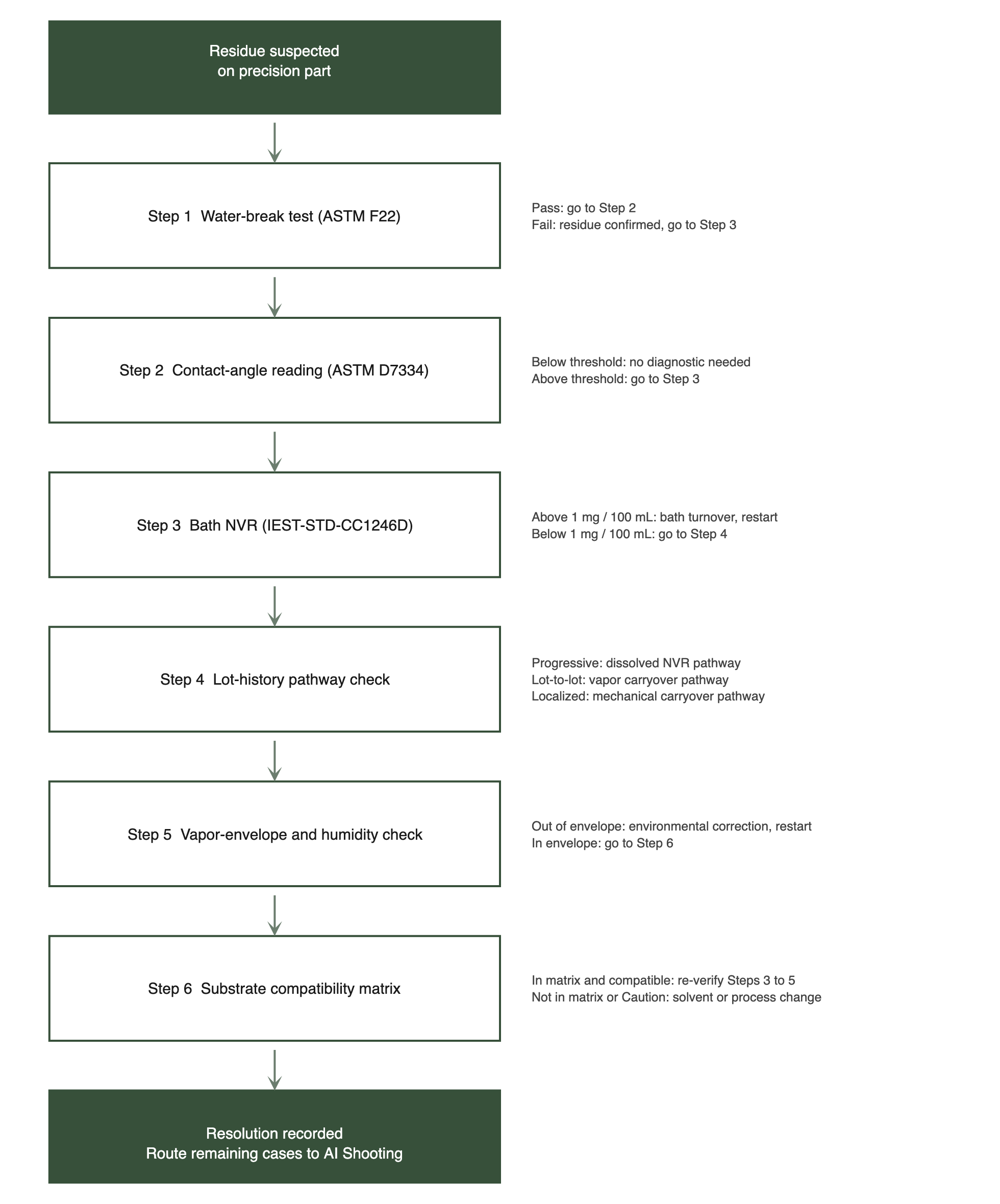
Work the chart from top to bottom. Each step routes either to the next step or to a resolution, with the branch conditions shown beside each step. After the path resolves, record the resolution and route any remaining cases to AI Shooting.
Figure 5. Inspection Checklist with Pass and Fail Criteria
Step | Check | Pass criterion | Fail criterion | Standard |
|---|---|---|---|---|
1 | Water-break, three substrates | Continuous water film for 5 sec | Beading within 5 sec | ASTM F22-13 |
2 | Contact angle, water on cleaned surface | Below 20 deg metal, below 40 deg polymer | Above 60 deg either | ASTM D7334-08 |
3 | Bath NVR at mid-depth | Below 1 mg per 100 mL | Above 1 mg per 100 mL | IEST-STD-CC1246D |
4 | Last 10 lot history pattern | One pathway clearly identified | No pattern, escalate | IPC-CH-65B |
5 | Vapor zone delta T, ambient RH | 5 to 10 deg C above bath, RH below 60 percent | Outside either range | MIL-STD-1330D, IPC-CH-65B |
6 | Substrate vs. compatibility matrix | All substrates in matrix and compatible | Any substrate absent or Caution | IPC-CH-65B |
The inspection checklist in Figure 5 is the artifact to attach to a Lubinpla analysis submission. It pre-classifies the failure into one of three pathways and one of six failure modes, which shortens the analysis time from a typical 3-day Standard tier to a Quick 24-hour triage. Submitting the checklist filled out is the difference between a useful diagnosis and a re-investigation from scratch.
VI. Key Takeaway
Solvent residue on a mixed-substrate precision line is almost never a solvent formulation problem on its own. It is a mismatch between solvent surface tension, substrate surface energy, and drying-curve kinetics, with cross-contamination as the slow second-order driver.
The six-step diagnostic in Section V isolates the mismatch within one shift using equipment the line already owns. Each step has a binary pass-fail gate, and the corrective actions are non-interchangeable across pathways.
Anodized aluminum should be classified as a polymer-class substrate in this diagnostic, not as a metal. Pore-retained solvent extends drying by a factor of two to four and produces residue patterns that look like dissolved-NVR contamination.
IPC-CH-65B, IEST-STD-CC1246D, MIL-STD-1330D, ASTM F22, and ASTM D7334 together define the inspection envelope. A line that meets all five at once cannot produce systemic residue.
A failed Step 6 with no in-house resolution is the right submission point for Lubinpla AI Shooting. Attach the filled inspection checklist to convert the case from open-ended investigation to bounded analysis.
Use this as your submission checklist. Fill out the Step 1 to Step 6 entries in Figure 5 on your next mixed-substrate residue ticket and submit the completed checklist to Lubinpla AI Shooting at https://www.lubinpla.com/ai-shooting for a 24-hour triage or 3-day Standard analysis on the remaining open variables.
VII. References
[1] ASTM International. (2024). ASTM D7334-08(2024), Standard Practice for Surface Wettability of Coatings, Substrates and Pigments by Advancing Contact Angle Measurement. ASTM International. https://www.astm.org/Standards/D7334.htm
[2] ASTM International. (2024). ASTM F22-13(2024), Standard Test Method for Hydrophobic Surface Films by the Water-Break Test. ASTM International. https://matestlabs.com/test-standards/astm-f22/
[3] Astro Pak. (2024). Precision Cleaning Standards: IEST-STD-CC1246, MIL STD 1246, CGA G-4.1. Astro Pak Corporation. https://astropak.com/precision-cleaning-standards/
[4] Biolin Scientific. (2024). How to Evaluate Surface Cleanliness Through Contact Angle Measurements. Biolin Scientific. https://www.biolinscientific.com/blog/how-to-evaluate-surface-cleanliness-through-contact-angle-measurements
[5] Brighton Science. (2024). The Water Break Test as a Surface Measurement Gauge. Brighton Science. https://www.brighton-science.com/blog/the-water-break-test-as-a-surface-measurement-gauge
[6] Enviro Tech International. (2026). Vapor Degreasing Guide: Solvents, Cost, Compliance and How to Choose. Enviro Tech International, Inc. https://envirotechint.com/vapor-degreasing-services-guide/
[7] IEST. (2002). IEST-STD-CC1246D, Product Cleanliness Levels and Contamination Control Program. Institute of Environmental Sciences and Technology. https://standards.globalspec.com/std/10036529/iest-std-cc1246
[8] Institute for Printed Circuits. (2011). IPC-CH-65B, Guidelines for Cleaning of Printed Boards and Assemblies. IPC. https://shop.ipc.org/ipc-ch-65/ipc-ch-65-standard-only/Revision-b/english
[9] Kolorguide. (2024). Surface Energy Chart by Material: Dyne Levels for Plastics, Films, Foil and Materials. Kolorguide. https://kolorguide.com/surface-energy-chart-by-material/
[10] Layton Technologies. (2023). IPA Cleaning and Vapour Drying Whitepaper. Layton Technologies Ltd. https://www.laytontechnologies.com/vapour-drying-whitepaper/
[11] MicroCare. (2024). Vapor Degreasing: A Triple Threat to Contaminant. MicroCare LLC. https://www.microcare.com/en-US/Resources/Resource-Center/Tech-Articles/Vapor-Degreasing-A-Triple-Threat-to-Contaminant
[12] PCBSync. (2024). IPC-CH-65 Standard: What Engineers Need to Know About PCB Assembly Cleaning. PCBSync. https://pcbsync.com/ipc-ch-65/
[13] Pavco. (2024). Avoid Plating Failures: How to Perform a Proper Water Break Test. Pavco Inc. https://pavco.com/blog/water-break-test
[14] Unistar Chemical. (2024). HFE-347: Solvent Used for Drying, Cleaning, and Carrying. Unistar Chemical. https://unistarchemical.com/service/hfe-347
[15] US Department of Defense. (1996). MIL-STD-1330D, Precision Cleaning and Testing of Shipboard Oxygen, Helium, Helium-Oxygen, Nitrogen, and Hydrogen Systems (with Change Notice 1, 2010). US Department of Defense. http://everyspec.com/MIL-STD/MIL-STD-1300-1399/MIL-STD-1330D_CHG-1_52140/