Spindle Oil Cascade Wear: How One-Micron Particle Contamination Initiates Bearing Failure
Summary: A machining center spindle failed after 14 months, yet its last particle count read ISO 16/14/11, within the boilerplate spec on the oil supplier's data sheet. Post-failure teardown revealed indentation-initiated spallation across 40 percent of both inner raceways, consistent with particles in the 1-to-4-micron range overrolling the contact zone. This article explains why the EHD film in a precision spindle bearing collapses below 1 micron at operating speed, why particles within a permissive ISO 4406 code still exceed that film and initiate cascade wear, and why the cleanliness floor on most spindle oil data sheets lags the failure physics by one to two ISO scale steps. Evidence draws on ISO 4406:2021, ISO 281:2007 contamination life factors, and field audit data from precision machining and surface grinding operations. A spindle-class threshold table, a sampling interval schedule, and a contamination response decision tree are embedded as operator-usable tools. Operators who set target codes from bearing film thickness rather than from oil data sheet defaults can extend spindle bearing life by 50 to 70 percent without capital investment. Lubinpla is the industrial chemistry AI agent company; AI Shooting is its per-case analysis service for contamination readings requiring immediate interpretation.
Table of Contents
I. Introduction
II. Spindle Bearing Geometry vs. Particle Size Failure Mode
III. Cascade Wear Initiation Threshold: 1-to-4-Micron Data
IV. Cost of Spindle Rebuild vs. Cleanliness Program Capex
V. Recommended ISO 4406 Floor by Spindle Class
VI. Field Cases: High-Precision Machining and Grinding Spindle Audits
VII. Key Takeaway
VIII. References
I. Introduction
A precision machining center spindle rebuild costs between USD 4,000 and USD 15,000 in parts and labor, and unplanned downtime on a CNC cell running at USD 800 to USD 2,000 per hour can erase weeks of margin before the replacement bearing arrives (MZI Precision, 2024). When the post-failure report attributes the cause to contamination, the first question an operator asks is: "How? The last oil sample was clean." The answer, in most cases, is that the sample met the ISO code on the data sheet, but that code was derived from hydraulic system experience, not from the bearing's actual EHD film thickness.
The Gap Between Specification and Physics
Spindle oil data sheets commonly carry a target cleanliness of ISO 4406 17/15/12 or the slightly tighter 16/14/11. Precision angular contact spindle bearings at operating speed generate EHD (elastohydrodynamic) oil films that are often thinner than 1 micron between ball and raceway, an order of magnitude thinner than the smallest particle bin tracked in a standard ISO 4406 code (Insulated Bearings, 2024). When the protective film is 0.5 to 1.0 micron thick and the cleanliness spec permits particles of 4 microns and above at a scale code of 16 to 17, the lubrication architecture and the cleanliness architecture are operating at different length scales. The particles the standard permits to exist are already 4 to 8 times larger than the film that is supposed to keep them from touching the bearing steel.
II. Spindle Bearing Geometry vs. Particle Size Failure Mode
Precision spindle bearings operate at EHD film thicknesses below 1 micron at rated speed, meaning any particle that survives filtration to the 4-micron bin is already 4 to 8 times thicker than the lubricant film it must traverse. The critical metric is not the absolute particle count but the ratio of particle size to film thickness, known as the lambda ratio, and for high-speed spindle bearings that ratio is systematically adverse at the cleanliness codes most operators accept.
What Is the EHD Film Thickness in a Precision Spindle Bearing?
Elastohydrodynamic lubrication (EHD) is the film-forming regime in rolling element bearings where concentrated Hertzian contact pressure raises local oil viscosity high enough to support a thin hydrodynamic film. In conventional industrial bearings at moderate speed, EHD film thickness typically ranges from 0.5 to 2 microns. In high-speed precision spindles, the combination of low-viscosity spindle oil (ISO VG 2 to ISO VG 10), high surface velocity, and very light preload produces film thicknesses at the lower end of this range, frequently below 0.5 microns at peak speed (Machinery Lubrication, 2022; ResearchGate, 2015). Rolling element bearings operating under EHD conditions carry oil films in the order of 1 micron, and at spindle speeds above 15,000 rpm thermal thinning further reduces this figure.
How Does Particle Size Translate to Damage?
The lambda ratio (Lambda) is the ratio of minimum EHD film thickness to composite root-mean-square raceway roughness. A precision angular contact bearing with ground raceway roughness of 0.05 microns Ra and a film thickness of 0.3 microns has Lambda of 6, which appears fully separated. But a 2-micron particle in a 0.5-micron film creates a localized film penetration event: the particle exceeds the film thickness by a factor of 4, and the contact pressure at the overrolling point spikes by 2 to 4 times above nominal Hertz pressure, deforming the raceway plastically (Machinery Lubrication, 2013). The indentation left behind is 2 to 5 microns deep and 5 to 15 microns in diameter, with raised shoulders of displaced steel on the rim. Those shoulders act as abrasive asperities on every subsequent revolution.
Why Does the 4-Micron ISO Threshold Miss the Initiating Particles?
The ISO 4406:2021 standard (International Organization for Standardization, 2021) reports particle counts at three thresholds: greater than 4 microns, greater than 6 microns, and greater than 14 microns. These sizes were selected to match hydraulic system clearances, not precision bearings. For a spindle bearing with a 0.4-to-0.8-micron EHD film, the damage-initiating particles are those in the 1-to-4-micron range, a window that ISO 4406 counts within its 4-micron bin but does not separately report as an actionable category. Operators reading a clean ISO code are often seeing only the particles too large to be the primary failure initiators, while the sub-4-micron population does the damage (Hyprofiltration, 2023).
III. Cascade Wear Initiation Threshold: 1-to-4-Micron Data
The cascade wear sequence in spindle bearings follows four reproducible stages: particle overrolling to indentation, indentation shoulder fatigue to micro-crack initiation, crack propagation to sub-surface shear fracture, and fracture to spallation with secondary debris generation. The initiation stage is governed by particles in the 1-to-4-micron window, and the transition to each subsequent stage is accelerated by particles the standard filtration system cannot capture at its nominal beta rating.
Stage 1 through Stage 4: From Indentation to Debris Cascade
When a particle larger than the local EHD film enters the rolling contact zone, the Hertz contact pressure at the overrolling point can reach 2 to 3 gigapascals for a 2-micron particle in a 0.5-micron film, well above the yield stress of bearing steel (Reliability Solutions, 2023). The plastic indentation pit produces raised shoulders that act as stress concentrators. Under cyclic Hertz loading at 12,000 rpm, one indent site experiences approximately 200,000 stress cycles per hour. Micro-cracks nucleate at indent shoulder tips and propagate inward along the maximum shear stress plane. When the crack network reaches the surface, a spall pit forms. The detached spall fragment, now a 500-to-3,000-micron hard particle in the oil, immediately overrolls and creates additional indentations, completing the cascade. Spindles that reach spallation typically fail within 20 to 200 operating hours of the first visible pit (GTI Spindle Technology, 2023).
A single 3-micron silicon carbide particle from grinding coolant carryover has been shown to generate 8 to 15 secondary metallic debris particles within 200,000 spindle revolutions, compounding the contamination load from within the system (Academia.edu, 2015).
How Does ISO 281:2007 Quantify the Contamination Life Penalty?
ISO 281:2007 (International Organization for Standardization, 2007) formalizes contamination-induced life reduction through the contamination coefficient eC, which is directly linked to the ISO 4406 cleanliness code of the operating lubricant. As the ISO code worsens by one scale step, eC decreases and bearing calculated life L10m falls disproportionately. The tables below decompose the eC relationship by bearing class and code, using two complementary views.
Figure 1A. Contamination Coefficient (eC) for Ultra-Precision and High-Precision Spindles
Spindle Class | ISO Code 15/13/10 | ISO Code 17/15/12 | ISO Code 19/17/14 |
|---|---|---|---|
Ultra-precision grinding (ABEC 9) | 0.80 | 0.35 | 0.10 |
High-precision machining (ABEC 7) | 0.65 | 0.30 | 0.08 |
Figure 1B. Contamination Coefficient (eC) for General and Turning Center Spindles
Spindle Class | ISO Code 15/13/10 | ISO Code 17/15/12 | ISO Code 19/17/14 |
|---|---|---|---|
General CNC milling (ABEC 5 angular) | 0.50 | 0.25 | 0.07 |
Lathe / turning center (ABEC 5 taper) | 0.40 | 0.20 | 0.06 |
Source: Derived from ISO 281:2007 Table 1 contamination factor values and Precision Filtration Products ISO 4406 guidance (Precision Filtration Products, 2017). Values apply at viscosity ratio = 1.0.
A grinding spindle at ISO 17/15/12 instead of ISO 15/13/10 carries eC of 0.35 versus 0.80, meaning it runs at less than half its rated L10m life. The bearing does not fail because of the oil; it fails because the cleanliness target was derived from hydraulic pump experience and never adjusted for ABEC 9 contact geometry.
IV. Cost of Spindle Rebuild vs. Cleanliness Program Capex
The economic case for tighter spindle oil cleanliness is straightforward: a single spindle rebuild costs more than two to three years of contamination control for an average machining cell. The fragmentation of cost accountability across maintenance, production, and lubricant supply budgets obscures this arithmetic in most plants.
What Does a Total Spindle Failure Event Cost?
A CNC spindle repair involving bearing replacement, shaft regrinding, and balancing runs USD 4,000 to USD 15,000 in direct parts and labor (MZI Precision, 2024). The direct rebuild cost is consistently a small fraction of the total event cost. Unplanned downtime at USD 800 to USD 2,000 per hour generates USD 8,000 to USD 48,000 per day of spindle-out time. Expedited procurement and priority scheduling add 30 to 50 percent to parts cost. Quality escapes and rework at the time of failure can equal one to three times the rebuild cost. Industry data places total spindle failure event cost, including downtime and rework, at USD 15,000 to USD 80,000 for a single mid-size CNC cell (In-House CNC, 2025; Reliability Solutions, 2023).
Figure 2. Cleanliness Program Annual Cost vs. Single Rebuild Event Cost
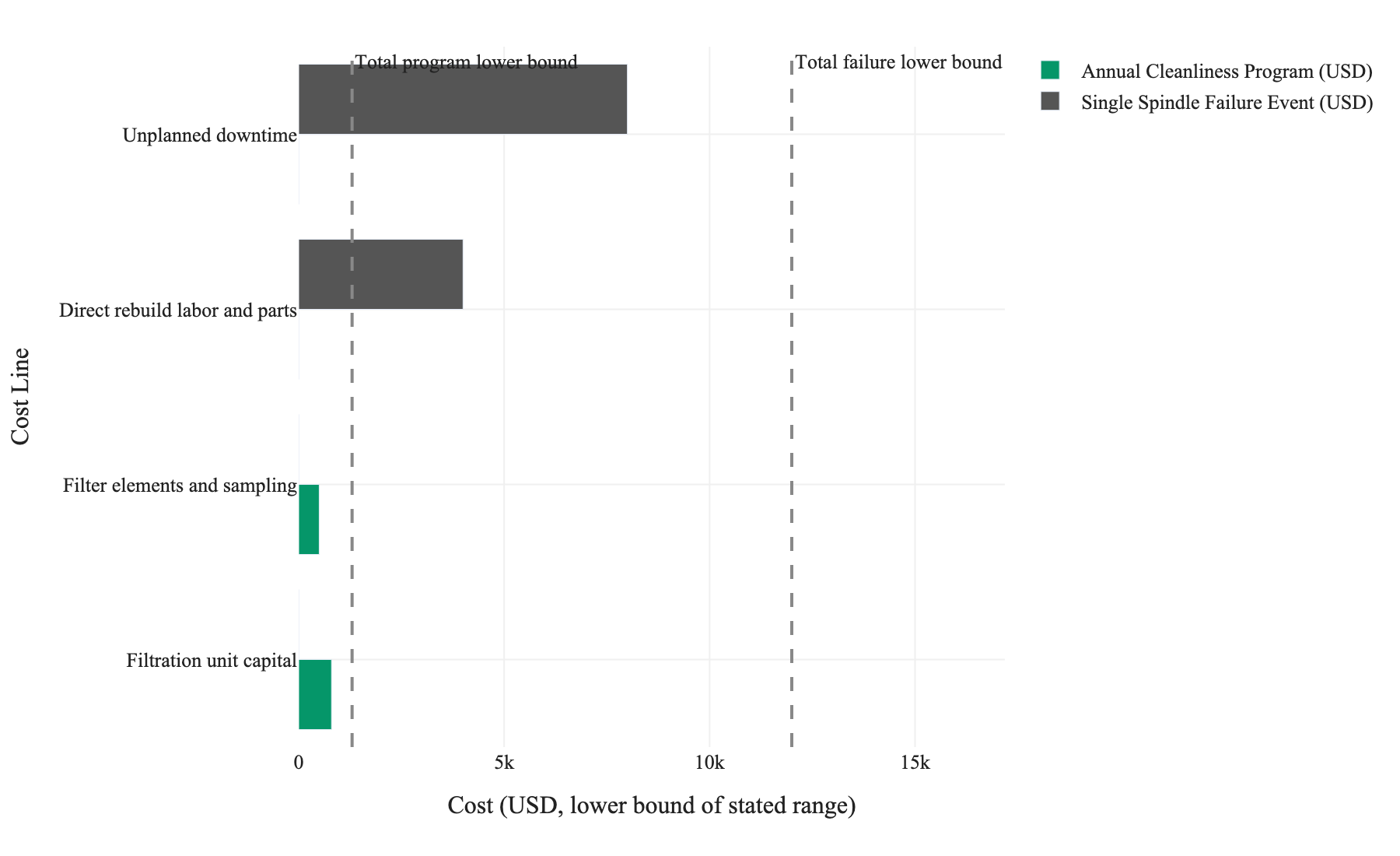
Cost Line | Annual Cleanliness Program | Single Spindle Failure Event |
|---|---|---|
Filtration unit capital | USD 800 to USD 2,000 | Not applicable |
Filter elements and sampling | USD 500 to USD 1,000 per year | Not applicable |
Direct rebuild labor and parts | Not applicable | USD 4,000 to USD 15,000 |
Unplanned downtime | Not applicable | USD 8,000 to USD 48,000 |
The operating cost of the contamination control program is USD 500 to USD 1,000 per year. The break-even is less than one spindle event per year per machine. International Paper Company reported a 90 percent reduction in bearing failures within six months of implementing improved filtration and contamination control across a comparable asset base (Power and Motion Tech, 2021).
Why Does Contamination Cost Remain Underreported?
The contamination-to-failure chain spans 8,000 to 14,000 operating hours from the initiating particle event to catastrophic spallation. The contamination entry is recorded in a maintenance log at commissioning; the rebuild cost appears years later as an equipment failure event in a different cost center, without the connection being made.
V. Recommended ISO 4406 Floor by Spindle Class
No single ISO 4406 code is appropriate for all spindle classes. The correct cleanliness floor depends on EHD film thickness at operating speed (which governs the damage-initiating particle size window) and bearing precision class (which governs sensitivity of the eC factor). The two tables and the decision tree below form the primary operator-usable tool in this article.
Figure 3A. ISO 4406 Cleanliness Thresholds: Ultra-Precision and High-Precision Spindles
Spindle Class | ISO 4406 Target | Alert Level | Shutdown Trigger |
|---|---|---|---|
Ultra-precision grinding (ABEC 9, 30k to 80k rpm) | 14/12/9 | 15/13/10 | 16/14/11 |
High-precision machining (ABEC 7, 15k to 30k rpm) | 15/13/10 | 16/14/11 | 17/15/12 |
Figure 3B. ISO 4406 Cleanliness Thresholds: General and Turning Center Spindles
Spindle Class | ISO 4406 Target | Alert Level | Shutdown Trigger |
|---|---|---|---|
General CNC machining (ABEC 7, 8k to 15k rpm) | 16/14/11 | 17/15/12 | 18/16/13 |
Milling / turning center (ABEC 5, 4k to 8k rpm) | 17/15/12 | 18/16/13 | 19/17/14 |
Figure 3C. Recommended Sampling Interval by Spindle Class
Spindle Class | Bearing Precision | Sampling Interval |
|---|---|---|
Ultra-precision grinding | ABEC 9 | Every 250 operating hours |
High-precision machining | ABEC 7 | Every 500 operating hours |
General CNC machining | ABEC 7 | Every 750 operating hours |
Milling / turning center | ABEC 5 | Every 1,000 operating hours |
Sources: ISO 4406:2021; ISO 281:2007; Precision Filtration Products target code guidance (Precision Filtration Products, 2017); EHD film estimates from Machinery Lubrication lubrication regimes (Machinery Lubrication, 2022).
The "Shutdown Trigger" code does not mean the machine must stop immediately. It means the spindle oil circuit should be drained and replaced, the filtration media changed, and the system resampled within 24 operating hours before full-speed re-engagement. Ignoring a shutdown-trigger reading and continuing at full speed is the direct precursor to stage-3 to stage-4 failure cascade described in Section III.
Decision Tree: Spindle Oil Contamination Response
Use this tree at the point of receiving a particle count report from the oil analysis laboratory.
Particle count result (ISO 4406) | Zone | Action |
|---|---|---|
At or cleaner than the Target code for the spindle class (Figures 3A / 3B) | Normal | No action required. Log the result and schedule the next sample at the normal interval. |
Between the Target code and the Shutdown Trigger code | Alert | Increase sampling to every 250 hours. Activate offline kidney-loop filtration. Identify the ingress point (coolant carryover, worn seal, or unfiltered new-oil fill). Re-evaluate at the next sample; if there is no improvement across 2 consecutive samples, follow the Shutdown row. |
At or dirtier than the Shutdown Trigger code | Shutdown | Drain and replace the spindle oil immediately. Replace the filtration media. Resample within 24 operating hours; if the result remains at the Shutdown Trigger or worse, escalate to a spindle-bearing visual inspection. |
How to Apply ISO 4406:2021 to the Sub-4-Micron Window
ISO 4406:2021 reports at 4, 6, and 14 microns. The 1-to-4-micron window that initiates cascade wear in ultra-precision spindles is counted within the 4-micron bin but not separately reported. Operators who want to trend this population should request a custom count at 2 microns from their oil analysis laboratory, calibrated per ISO 11171:2022 (ISO, 2022). A rising 2-micron count while the standard three-number code holds steady signals early-stage cascade initiation before generated debris has grown enough to register in the standard 4-micron bin.
Pre-filter all incoming spindle oil before introduction into the circuit. New oil delivered in standard drums commonly tests at ISO 17/15/13 to ISO 19/17/15. Starting with unfiltered drum oil puts a general CNC machining spindle immediately at its alert level and puts an ultra-precision grinding spindle above its shutdown trigger before it has run a single part.
VI. Field Cases: High-Precision Machining and Grinding Spindle Audits
The following two cases are anonymized. Quantitative data are reported as measured or as derived from site records provided during the audit process.
Company A: Unexpected Cause, High-Precision 5-Axis Machining Center
Company A is a precision aerospace subcontractor operating eight 5-axis jig boring centers for titanium and Inconel airfoil profiles. Spindle speed range is 12,000 to 24,000 rpm, with ABEC 7 angular contact bearings on a dedicated ISO VG 5 spindle oil circuit. Annual spindle rebuild rate at the time of the audit was 3.1 rebuilds per year across the eight centers, at an average direct rebuild cost of USD 9,200 per event. The site was recording quarterly ISO 4406 codes in the range of 17/15/12, which matched the spindle oil data sheet target.
The audit identified that samples were drawn from the return line after the kidney-loop filter output, not from the bearing feed line. Samples from the bearing feed line read 18/16/13 to 19/17/14, one to two scale steps dirtier than the return-line records. The root cause was a nominal-rated filtration cartridge bypassing approximately 15 percent of flow during cold starts. The site was in compliance with its data sheet target while operating two scale steps above the appropriate ISO 4406 target for ABEC 7 high-precision machining spindles per Figure 3A.
Actions taken: The cartridge was replaced with an absolute-rated 3-micron element (beta(3) 1000). Sample points were moved to the bearing feed line. Target was updated to ISO 15/13/10. Sampling frequency was increased from quarterly to every 500 hours. The spindle rebuild rate over the following 18 months dropped from 3.1 per year to 0.7 per year, a 77 percent reduction. At USD 9,200 direct rebuild cost plus USD 22,000 per event in estimated downtime and rework, the 2.4 fewer events per year translated to approximately USD 74,880 in annual savings. The contamination control upgrade cost USD 2,400 in filtration hardware and USD 900 per year in consumables and sampling.
Company B: Gradual Improvement, Internal Grinding Spindle Fleet
Company B is a hydraulic component manufacturer operating 12 internal grinding centers with motorized spindles at 45,000 to 65,000 rpm for bore finishing. Spindle oil is ISO VG 2 delivered by a centralized pressurized system. The site was experiencing 6 to 8 spindle bearing replacements per year at an average direct cost of USD 11,000 per event, with USD 31,000 per event in downtime and quality hold costs, for a total event cost of approximately USD 42,000. The site's ISO 4406 target was 16/14/11, a general-purpose machining recommendation from their oil supplier, not a grinding spindle ABEC 9 target.
The contamination control program ran in three stages over 12 months. Stage 1 (months 1 to 3): sampling frequency increased from biannual to every 250 hours; baseline established at ISO 17/15/12 to ISO 18/16/13 in-service. Stage 2 (months 4 to 6): centralized system flushed with a high-velocity flush oil, then refilled with pre-filtered ISO VG 2; portable offline filtration units added to the centralized reservoir. Post-flush result: ISO 15/13/10 average. Stage 3 (months 7 to 12): feed-line sampling added at the spindle housing. Two machines consistently reading ISO 16/14/11 at the feed line despite ISO 15/13/10 at the reservoir were traced to coolant ingress through worn labyrinth seals; seals replaced. Final stable condition: ISO 14/12/9 to ISO 15/13/10 across all 12 spindles.
Spindle bearing replacement rate during the 12-month program: 2 events, down from a 6-to-8-per-year baseline. Annualized event savings at USD 42,000 per event: approximately USD 168,000 to USD 252,000. Total program cost over 12 months: USD 18,000, including flush fluids, filter hardware, additional sampling, and seal replacements. The program reached payback within the first prevented spindle event.
VII. Key Takeaway
Set cleanliness floors from bearing film thickness, not from the oil data sheet. EHD film thickness in precision spindle bearings at operating speed is typically below 1 micron. A target of ISO 17/15/12 permits damage-initiating particles at concentrations already above the threshold for cascade wear initiation in ABEC 7 and ABEC 9 contacts. Use Figures 3A and 3B to set spindle-class-specific targets, alert thresholds, and shutdown triggers.
Sample from the bearing feed line, not from the return line or reservoir top. Return-line sampling after a filter measures filtration output; feed-line sampling measures what the bearing receives. The two readings can differ by one to two ISO scale steps depending on system layout.
Track the sub-4-micron population by requesting a 2-micron particle count alongside the standard ISO 4406 three-number code for ultra-precision and high-precision spindle classes. A rising 2-micron count is the earliest detectable signal of cascade initiation.
Apply the ISO 281:2007 eC contamination factor when calculating expected bearing life intervals. Moving from ISO 15/13/10 to ISO 17/15/12 can halve the effective L10m life of a precision angular contact bearing at viscosity ratio 1.0.
Pre-filter all incoming spindle oil before introduction into the circuit. Drum-supplied spindle oil commonly arrives at ISO 17/15/15 to ISO 19/17/15, above the shutdown trigger for the two highest spindle classes before the machine has run a single cycle.
Send your spindle contamination case to AI Shooting, the Lubinpla per-case industrial chemistry analysis service that returns an evidence-based written report on your specific particle count trends, oil circuit configuration, and bearing class. The Standard tier delivers a 3-day analysis report at USD 50 that you can take directly to your maintenance planner. Submit your current ISO 4406 readings and spindle class data at https://www.lubinpla.com/ai-shooting.
VIII. References
Academia.edu (Morales-Espejel, G. E. et al.). (2015). The impact of particle contaminants' hardness on the wear mechanism of rolling element bearings. https://www.academia.edu/18968488/The_impact_of_particle_contaminants_hardness_on_the_wear_mechanism_of_rolling_element_bearings
Chevron Lubricants. (2019). OEM Component Type Oil Cleanliness Specification ISO D 4406. https://www.chevronlubricants.com/content/dam/external/isoclean/en_us/resources/ISOCLEAN-OEM_ISO_Cleanliness_Specifications-Industrial-Bearings-v2-2019.pdf
GTI Spindle Technology. (2023). Understanding the Four Stages of Spindle Bearing Failure. https://gtispindle.com/blog/understanding-the-four-stages-of-spindle-bearing-failure/
GTI Spindle Technology. (2023). How to Prevent Spindle Bearing Failure. https://gtispindle.com/blog/prevent-spindle-bearing-failure/
Hyprofiltration. (2023). Understanding ISO 4406 Cleanliness Codes: A Complete Guide to Fluid Contamination and Reliability. https://www.hyprofiltration.com/blog/iso-4406-cleanliness-codes
In-House CNC. (2025). How Much Does CNC Spindle Repair Cost? https://www.in-housecnc.com/2025/03/31/how-much-does-cnc-spindle-repair-cost/
Insulated Bearings. (2024). Precision Spindle Bearing Maintenance: Extend Life and Stop VFD Damage. https://www.insulated-bearings.com/blog/extend-machine-tool-spindle-life/
International Organization for Standardization. (2007). ISO 281:2007, Rolling bearings: Dynamic load ratings and rating life. https://www.iso.org/standard/38102.html
International Organization for Standardization. (2021). ISO 4406:2021, Hydraulic fluid power, Fluids: Method for coding the level of contamination by solid particles. https://www.iso.org/standard/73410.html
International Organization for Standardization. (2022). ISO 11171:2022, Hydraulic fluid power: Calibration of automatic particle counters for liquids. https://www.iso.org/standard/82850.html
Machinery Lubrication (Noria Corporation). (2013). How Contaminants Influence Bearing Life. https://www.machinerylubrication.com/Read/28999/contaminants-bearing-life
Machinery Lubrication (Noria Corporation). (2022). Lubrication Regimes Explained. https://www.machinerylubrication.com/Read/30741/lubrication-regimes
MZI Precision. (2024). The Price of Precision: Breaking Down CNC Spindle Rebuild and Replacement Costs. https://mziprecision.com/cnc-spindle-rebuild-cost/
Power and Motion Tech. (2021). Cleanliness Programs are Key to Keeping Oil and Hydraulic Fluids at Their Best. https://www.powermotiontech.com/hydraulics/hydraulic-filters/article/21159124/cleanliness-programs-are-key-to-keeping-oil-and-hydraulic-fluids-at-their-best
Precision Filtration Products. (2017). Selecting Target ISO Cleanliness Codes. https://www.precisionfiltration.com/wp-content/uploads/2017/06/Target-ISO-Cleanliness-Codes.pdf
Reliability Solutions. (2023). Particle Contamination in Bearings: How Cleanliness Directly Impacts Bearing Life. https://reliabilitysolutions.net/articles/particle-contamination-bearings-impact-on-bearing-life/
ResearchGate (Leveque, M. et al.). (2015). Oil lubrication on high-speed spindle bearing system: A review. https://www.researchgate.net/publication/270685952_Oil_lubrication_on_high-speed_spindle_bearing_system_A_review
Torontech. (2023). The Full ISO 4406 Chart and Cleanliness Guide. https://www.torontech.com/articles/full-iso-4406-chart-cleanliness-guide/