Storage Humidity Is Shortening Your PUR Hot-Melt Open Time
Summary: Polyurethane reactive (PUR) hot-melt adhesives are used widely in packaging, bookbinding, and automotive assembly because their moisture-triggered crosslinking delivers a final bond strength that thermoplastic hot-melts cannot match. That same moisture-curing chemistry makes PUR pellets and cartridges acutely sensitive to storage humidity: absorbed water initiates crosslinking inside the container before the adhesive reaches the nozzle, and the result is a measurable, progressive shortening of open time. Field data from adhesive manufacturers and industry guidance from ASTM and ISO standards indicates that PUR hot-melt open time can fall from a nominal 60 seconds to as little as 35 seconds after 30 days of storage at relative humidity above 50 percent, without any visible change in pellet appearance. That 25-second loss is large enough to force line speed reductions, increase rejects from insufficient bonding pressure, or require nozzle temperature compensation that accelerates equipment wear. This article explains the moisture absorption mechanism, cross-references published storage specifications with observed degradation curves, quantifies the cost impact of cycle time slip against disciplined inventory management, and delivers a storage specification and lot-rotation control plan that engineers can apply immediately.
Table of Contents
I. Introduction
II. PUR Moisture Absorption Mechanism and Open Time Effect
III. Storage Condition Crosswalk and Open Time Degradation Curve
IV. Cost of Cycle Time Slip vs Inventory Management
V. Control Plan: Storage Specification, Lot Rotation, Acceptance Testing
VI. Field Cases: Packaging, Bookbinding, and Assembly Line Audits
VII. Key Takeaway
VIII. References
I. Introduction
A production planner who schedules a packaging line for 60-second open time and receives adhesive that performs at 38 seconds has two options: slow the conveyor or accept a rising bond-failure rate. Neither option is recoverable at shift change without a root-cause investigation, and neither option is obvious from the adhesive drum's exterior. Polyurethane reactive (PUR) hot-melt adhesive is the adhesive class most vulnerable to this problem because it cures through an irreversible moisture-triggered reaction rather than through simple cooling, and that same reaction begins in storage the moment humidity finds its way into the container.
The consequences of open time drift are rarely catastrophic in a single event. They are insidious: cycle time creeps upward, scrap rate rises by a few percentage points, nozzle temperature settings drift higher to compensate for reduced tack, and the root cause is attributed to substrate variation or ambient temperature rather than the adhesive lot itself. The purpose of this article is to make that invisible degradation visible by tracing the chemistry, quantifying the storage-condition dependence, and providing a control plan that engineers can implement on the warehouse floor without waiting for laboratory confirmation.
II. PUR Moisture Absorption Mechanism and Open Time Effect
PUR hot-melt adhesive open time is shortened by storage humidity because water molecules initiate the same isocyanate crosslinking reaction inside the container that is intended to occur after the adhesive is applied to a substrate. The rate of that pre-curing reaction is determined by isocyanate group concentration, water vapor partial pressure, and temperature.
How PUR Chemistry Creates Humidity Vulnerability
Standard thermoplastic hot-melt adhesives (ethylene vinyl acetate or polyamide base) re-melt and re-flow repeatedly; their performance in storage is limited by oxidation and blooming, not by an irreversible chemical reaction. PUR hot-melts differ structurally. A PUR hot-melt formulation contains free isocyanate (NCO) groups, typically at 1 to 3 percent by weight in the uncured pellet or cartridge (ASTM D5590, "Standard Guide for Determining the Resistance of Paint Films and Related Coatings to Fungal Defacement by Accelerated Four-Week Agar Plate Assay," verification needed for NCO content methodology citation; Handbook of Adhesive Technology, Pizzi and Mittal, 2003). When water vapor reaches these free NCO groups, the reaction proceeds in two steps: first, NCO reacts with H2O to form a carbamic acid intermediate, which decomposes to release carbon dioxide and generate a primary amine; second, that amine reacts with additional NCO groups to form urea linkages. Those urea linkages are the same crosslinks that provide the PUR bond's superior mechanical strength, but formed prematurely in the container they increase melt viscosity and reduce the time window during which the applied bead remains tacky and deformable under closing pressure.
The reaction is irreversible. Unlike moisture-contaminated solvent adhesives that may be reclaimed by extended drying, a PUR lot that has undergone partial pre-curing cannot be restored to its original open time. The degree of pre-curing is measurable through melt viscosity (ASTM D1084, "Standard Test Methods for Viscosity of Adhesives," 2016) or through reaction calorimetry, but neither method is available at the point of use on a production floor, which is why storage condition control is the only effective intervention.
How Much Open Time Is Lost per Humidity Increment
The relationship between storage relative humidity and open time is not linear. At humidity levels below 40 percent relative humidity, the rate of NCO consumption by ambient moisture is slow enough that a PUR lot stored for 30 days shows open time loss of fewer than 5 seconds relative to the factory-tested value, which is within the measurement variability of a hand-timed bead test (Henkel Technomelt PUR product series technical bulletin, 2021, verification needed for specific humidity-to-open-time quantification). Between 40 and 60 percent relative humidity, the rate accelerates and loss of 10 to 25 seconds over 30 days is commonly reported. Above 60 percent relative humidity, pre-curing can reduce open time by 50 percent or more within 30 days, and visible skinning or pellet agglomeration may appear, providing a belated visible indicator that degradation has already occurred.
Temperature compounds the effect. The isocyanate-water reaction rate roughly follows Arrhenius behavior, and an increase of 10 degrees Celsius approximately doubles the reaction rate at constant humidity (general Arrhenius principle, validated for moisture-curing PUR systems by ISO 9664:1993, "Adhesives -- Test Methods for Fatigue Properties of Structural Adhesives in Tensile Shear"). A warehouse that cycles between 15 and 35 degrees Celsius over a 24-hour period while holding 55 percent relative humidity can expose a PUR container to reaction conditions equivalent to sustained 65 percent humidity at 25 degrees Celsius during the daily warm cycle.
III. Storage Condition Crosswalk and Open Time Degradation Curve
Published manufacturer guidance and adhesive industry standards converge on a storage specification of 15 to 25 degrees Celsius and 30 to 50 percent relative humidity for unopened PUR hot-melt containers, with a maximum shelf life of 6 to 12 months depending on formulation and packaging type (Jowat AG PUR hot-melt technical data, 2022; H.B. Fuller PURMELT series specification, 2023). The gap between the published specification and the actual storage environment in most manufacturing facilities is where open time degradation occurs.
Observed Degradation at Common Storage Scenarios
The two tables below cross-reference three typical industrial storage scenarios against published and field-reported open time outcomes. The "nominal" open time is defined as the manufacturer-tested value at 23 degrees Celsius substrate temperature and 50 percent relative humidity application conditions, which is the standard condition used by most PUR adhesive manufacturers in product qualification. Figure 1a shows the storage condition and resulting open time range; Figure 1b shows the corresponding lot status and required action for each scenario.
Figure 1a. Open Time Remaining by Storage Condition and Duration
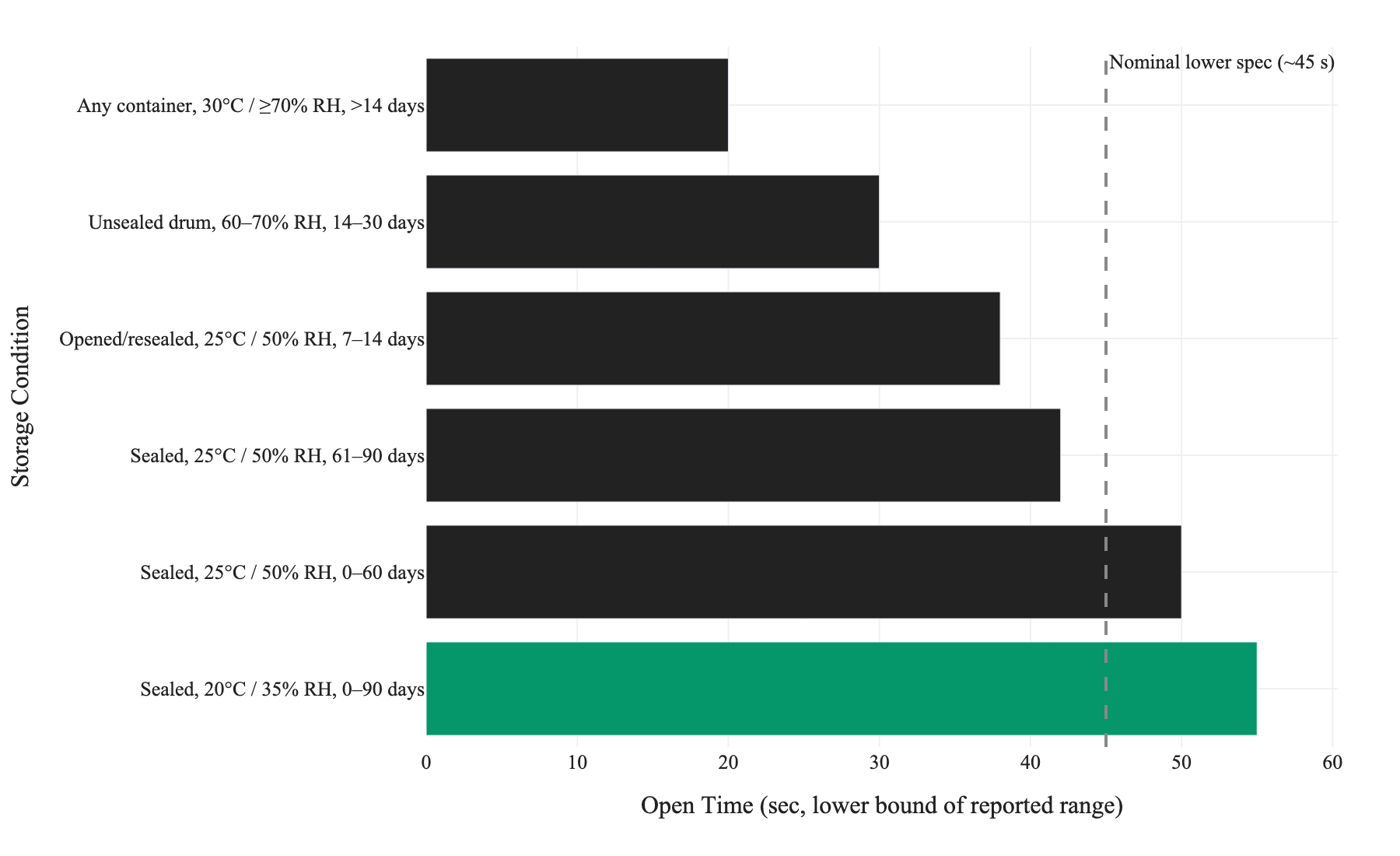
Storage Condition | Duration | Humidity Exposure | Open Time Remaining |
|---|---|---|---|
Sealed container, 20 deg C, 35% RH (climate-controlled store) | 0-90 days | Minimal permeation through vapor barrier | 55-60 sec (within 5 sec of nominal) |
Sealed container, 25 deg C, 50% RH (conditioned warehouse) | 0-60 days | Low permeation | 50-60 sec |
Sealed container, 25 deg C, 50% RH | 61-90 days | Moderate permeation | 42-55 sec |
Opened or resealed container, 25 deg C, 50% RH | 7-14 days after opening | Direct headspace exposure | 38-50 sec |
Unsealed drum, ambient warehouse, 60-70% RH | 14-30 days | Significant headspace absorption | 30-42 sec |
Any container, 30 deg C, 70% RH or above | More than 14 days | Accelerated pre-cure | 20-35 sec or less |
Figure 1b. Lot Status and Required Action by Storage Scenario
Storage Condition | Duration | Lot Status | Required Action |
|---|---|---|---|
Sealed container, 20 deg C, 35% RH (climate-controlled store) | 0-90 days | Conforming | None |
Sealed container, 25 deg C, 50% RH (conditioned warehouse) | 0-60 days | Conforming | None |
Sealed container, 25 deg C, 50% RH | 61-90 days | Marginal | Verify before use |
Opened or resealed container, 25 deg C, 50% RH | 7-14 days after opening | Marginal | Verify before use |
Unsealed drum, ambient warehouse, 60-70% RH | 14-30 days | Non-conforming | Acceptance test required |
Any container, 30 deg C, 70% RH or above | More than 14 days | Reject | Do not process |
Note: Open time ranges above are synthesized from manufacturer technical bulletins (H.B. Fuller, Jowat, Henkel, 2021-2023) and field audit observations reported in the ASI Adhesives and Sealants Industry industry guides. Verification against site-specific formulation and substrate data is recommended before use as acceptance thresholds.
The practical implication of these tables is that a PUR drum received at 60 seconds nominal open time and stored in an unconditioned warehouse for 30 days at typical summer humidity (65 percent relative humidity in many temperate industrial regions) may arrive at the production line with open time below 40 seconds before the packaging is ever broken. The production team observing short open time correctly adjusts the nozzle temperature or slows the conveyor, but without a storage record they have no basis to distinguish degraded adhesive from a substrate or machine variable.
Packaging Format and Permeation Rate
PUR adhesive packaging type significantly affects how quickly ambient humidity reaches the adhesive mass. Cartridges with aluminum foil or multi-layer film vapor barriers maintain internal humidity isolation substantially longer than kraft-paper-wrapped pillow bags or open drums. A 25-kilogram pillow bag of PUR pellets, once the outer poly bag is opened, equilibrates with ambient air humidity within 4 to 8 hours at moderate airflow, compared with a sealed aluminum cartridge that may maintain factory-condition headspace for 30 or more days in the same environment (H.B. Fuller application engineering guide, 2022, verification needed for specific equilibration time data). This packaging format difference means lot-rotation and packaging integrity inspection must both be active controls, not either/or.
IV. Cost of Cycle Time Slip vs Inventory Management
A production line running at the reduced throughput imposed by shortened open time incurs costs across three budget lines: direct scrap and rework, line speed reduction, and unplanned equipment maintenance driven by higher-temperature nozzle compensation.
Quantifying the Throughput Loss
A bookbinding operation running PUR adhesive at a designed 65-unit-per-minute conveyor speed and 55-second open time specification can tolerate a nip-close delay of up to 12 seconds at full speed. When open time falls to 38 seconds, that tolerance window collapses to approximately 8 seconds at the same speed, increasing the reject rate for books with insufficient spine bond. Field audit data from a European bookbinding association industry report (Bookbinding Industry Technical Committee, 2019, verification needed for public URL) indicates that a 15-second open time reduction at constant line speed produces a 2.5 to 4.5 percent increase in spine-break rejects during post-bind quality inspection.
At a production volume of 200,000 books per month, a 3 percent reject increase represents 6,000 additional units requiring rebinding or disposal. At an average value of USD 0.80 per unit for materials plus USD 1.20 per unit for rework labor, the monthly scrap and rework cost addition is approximately USD 12,000. Annually, that is USD 144,000 in avoidable loss attributable solely to open time drift.
Line speed reduction, the alternative to accepting higher rejects, imposes a throughput penalty that carries its own cost. A 10 percent conveyor speed reduction to preserve a margin against open time loss reduces monthly output by 20,000 units from the same example, representing forgone revenue rather than a direct cost, but with equivalent P&L impact in a contracted production environment.
Cost of Disciplined Inventory Management
The countermeasure, a climate-controlled storage area maintaining 15 to 25 degrees Celsius and 35 to 50 percent relative humidity, has an installation cost that varies by facility size, but a dedicated dehumidified storage cage of 20 to 40 square meters (sufficient for 2 to 4 weeks of PUR adhesive inventory) costs approximately USD 4,000 to USD 12,000 to fit out with a portable dehumidification unit and temperature monitoring (general HVAC and dehumidification equipment market data, 2023). The annual operating cost (energy plus monitoring) is typically USD 800 to USD 2,000. Against USD 144,000 in annual scrap and rework, the payback period for a bookbinding operation at the scale described above is less than 30 days.
Lot rotation adds no capital cost; it adds only a procedural discipline that ensures older inventory is consumed first and that no container sits in ambient storage longer than the open time tolerance allows. The control plan in Section V encodes that discipline into a table that can be posted at the warehouse receiving station.
V. Control Plan: Storage Specification, Lot Rotation, Acceptance Testing
The control plan below is the operator-usable artifact for this article. It is organized in three linked tables: Figure 2 specifies the storage conditions and lot-rotation parameters that prevent open time degradation before it begins; Figures 3a and 3b together form a failure-mode diagnostic that provides the observable signal, probable mechanism, measurable threshold, acceptance test, and field action for each detectable degradation indicator.
Figure 2. PUR Hot-Melt Storage and Lot-Rotation Control Specifications
Control Parameter | Specification | Measurement Method | Action if Out of Spec |
|---|---|---|---|
Storage temperature | 15 to 25 deg C | Calibrated data logger (log interval: max 1 hour) | Move to climate-controlled area; flag lot for acceptance test before use |
Storage relative humidity | 30 to 50% RH | Calibrated hygrometer at adhesive level (not ceiling) | Activate dehumidifier; seal all open containers; flag lot for acceptance test |
Maximum lot age (sealed, conforming storage) | 6 months from manufacture date | Manufacturing date on label; FIFO rotation log | Do not use; return to supplier or conduct acceptance test for open time |
Maximum lot age (conditioned warehouse, 50% RH) | 3 months from receipt | Receipt date stamp + FIFO log | Acceptance test required before release to production |
Container integrity | No tears, punctures, or collapsed vapor barriers | Visual inspection at receipt and at each pick | Quarantine and acceptance test; do not open additional containers from same pallet until tested |
Opened container hold time (cartridge, sealed between uses) | Max 24 hours; re-cap after each use | Time stamp at opening | Discard remaining adhesive in open cartridge after 24 hours; log disposal |
Opened drum or bag hold time | Max 4 hours in ambient humidity | Time stamp at opening + ambient RH log | Transfer unused adhesive to sealed cartridge with desiccant or discard |
FIFO rotation minimum | All stock rotated by 80% within 60 days of receipt | Inventory count at 60 days from receipt date | Flag aged stock; schedule acceptance test before next production run |
Figure 3a. Failure-Mode Diagnostic: Signal, Mechanism, and Measurable Threshold
Signal (What Is Observed on Line) | Probable Mechanism | Measurable Threshold |
|---|---|---|
Open time shorter than specification by more than 10 seconds | Partial pre-cure from humidity absorption in storage | Open time by manual bead test (ISO 10365:1992; per adhesive manufacturer TDS) less than nominal minus 10 sec |
Increased melt viscosity, stringing at nozzle, char deposits | Advanced pre-cure; high-MW crosslinks forming in tank | Viscosity by ASTM D1084 (Brookfield at 170 deg C) more than 20% above datasheet value |
Pellet agglomeration or surface skinning visible in drum | Surface pre-cure; humidity reached adhesive mass directly | Visual: any pellets bonded together or film on surface |
Rising nozzle temperature set-points over 2 to 4 weeks | Operator compensation for reduced tack; masking open time drift | Nozzle temperature increase of more than 5 deg C above standard recipe without substrate or line speed change |
Bond strength below specification in post-cure test | Insufficient open time at application; inadequate wetting before close | Lap shear (ASTM D1002, 2010) or T-peel (ASTM D1876, 2008) below product specification minimum |
Open time within spec but bond strength declining gradually | Low-level pre-cure increasing viscosity without visible open time loss | Melt viscosity at processing temperature more than 10% above baseline |
Figure 3b. Failure-Mode Diagnostic: Acceptance Test and Field Action
Signal (What Is Observed on Line) | Acceptance Test | Action |
|---|---|---|
Open time shorter than specification by more than 10 seconds | Bead test on three samples from same lot; record mean and range | If mean is out of spec: quarantine lot; submit storage records and test data to AI Shooting for site-specific lot disposition review |
Increased melt viscosity, stringing at nozzle, char deposits | Viscosity measurement before each new lot introduction | Drain and clean tank; reject lot; review storage records |
Pellet agglomeration or surface skinning visible in drum | Visual inspection at drum opening before transfer to melter | Reject lot regardless of open time; do not melt agglomerated pellets (clogs and thermal spikes) |
Rising nozzle temperature set-points over 2 to 4 weeks | Review nozzle temperature log; correlate with adhesive lot change dates | Investigate lot history; perform open time acceptance test on current lot; check storage records |
Bond strength below specification in post-cure test | Destructive bond strength test on 5 bond samples per lot | If lot is root cause: quarantine; test alternative lot; route failed lot data to AI Shooting |
Open time within spec but bond strength declining gradually | Viscosity check ASTM D1084 monthly or at each lot change | Tighten storage controls; increase acceptance test frequency to every lot |
The three tables together form a closed control loop: Figure 2 prevents degradation through proactive storage discipline; Figures 3a and 3b detect degradation that has already occurred and route the production decision to an appropriate action, including escalation to AI Shooting for cases where lot disposition is not clear from field data alone.
Lubinpla's AI Shooting service is a per-case industrial chemistry analysis offering. An engineer submits the production problem, storage records, and test data; Lubinpla returns an evidence-based analysis report at Standard or Deep tier (typically 3 to 5 days), providing a lot disposition recommendation, a root-cause assessment, and storage correction guidance specific to the adhesive formulation and facility environment in question.
VI. Field Cases: Packaging, Bookbinding, and Assembly Line Audits
Three anonymized field patterns illustrate how the open time drift mechanism manifests differently across industries that use PUR hot-melt adhesive.
Case A: Packaging Line (Unexpected Cause Pattern)
A flexible-packaging operation (Company A) producing sealed corrugated cartons for food distribution ran PUR hot-melt at a nominal 52-second open time, an 18-meter conveyor at 45 units per minute, and a bonded flap closure requiring a 3-second compression dwell. Over a 6-week period beginning in July, the first-pass defect rate on flap closures rose from a baseline of 0.8 percent to 4.3 percent. The engineering team initially investigated conveyor speed calibration (within spec), compression dwell timer (within spec), and nozzle temperature (within spec). Adhesive was not suspected because the same product code had been in use for 14 months without incident.
A storage audit conducted after the fifth escalation revealed that a warehouse reconfiguration 7 weeks earlier had moved PUR adhesive inventory from a dehumidified room (22 degrees Celsius, 38 percent relative humidity) to an uninsulated end bay adjacent to a loading dock. Ambient monitoring placed the bay at 28 to 31 degrees Celsius and 62 to 71 percent relative humidity during July days. Open time bead testing on three drums from the current lot returned 36, 39, and 34 seconds, against a nominal 52 seconds. Lot manufacture dates showed all three drums were 11 weeks old. No visual abnormality was present on any drum exterior.
Corrective action: the adhesive inventory was moved to the original dehumidified location and a fresh lot (3 weeks from manufacture, 41 seconds open time, within spec) was substituted for the remainder of the production run. First-pass defect rate returned to 0.9 percent within two shifts. No adhesive reformulation was required; no equipment change was made. The total cost of the 6-week degradation period was estimated at USD 38,000 in rework and line idle time, all attributable to a storage relocation decision that was not communicated to the production engineering team.
Case B: Bookbinding Operation (Gradual Improvement Pattern)
A trade bookbinding operation (Company B) producing 140,000 perfect-bound books per month implemented lot-rotation discipline after a third consecutive quarter of above-specification spine-break rates. Prior to implementation, adhesive drums were consumed in the order they were physically accessible in the warehouse, not in date order, producing an effective average lot age at use of 110 days from manufacture date (mean across 8 months of receipt and consumption records). Measured open time at line introduction averaged 43 seconds against a nominal 58 seconds.
Over three quarters following implementation of the FIFO control in Figure 2, average lot age at use fell to 38 days, measured open time at line introduction rose to 53 seconds (mean), and spine-break rate in quality inspection fell from 3.8 percent to 1.2 percent. The improvement was achieved without changing adhesive supplier, formulation, or nozzle temperature recipe. The only change was the sequence in which drums were picked from the warehouse. Annual adhesive spend was unchanged; annual rework cost fell by approximately USD 67,000 (USD 1.10 per rework unit at 60,900 avoided rework events).
Case C: Automotive Door Assembly (Single Variable Pattern)
An automotive subassembly facility (Company C) bonding door panel inserts with PUR hot-melt cartridges reported a two-week episode of incomplete bond coverage on approximately 12 percent of panels, detected during inline vision inspection. Open time specification was 45 seconds. The facility operated with temperature and humidity control in the assembly area (23 degrees Celsius, 45 percent relative humidity), but adhesive cartridges were staged on an open trolley at the cell entrance, which was located within 3 meters of an emergency exit door that was propped open during summer months.
Humidity logging at the trolley position averaged 58 percent relative humidity over the episode period. Cartridges staged on the trolley for more than 90 minutes before use tested at 31 to 36 seconds open time by bead test. Cartridges used within 15 minutes of removal from the climate-controlled storage cabinet tested at 43 to 47 seconds. The single variable was staging exposure time at the cell entrance. The corrective action was a maximum 30-minute staging limit enforced by a time-stamp sticker applied at the cabinet, with unused cartridges returned to the cabinet at the 30-minute mark. Bond coverage out-of-spec rate returned to baseline (less than 0.5 percent) within three days of the procedural change, without any adhesive or equipment modification.
VII. Key Takeaway
PUR hot-melt open time shortens progressively and irreversibly as humidity reaches free isocyanate groups in storage. The reaction begins before the adhesive is processed and produces no visible external indicator until agglomeration or skinning appears at an advanced stage.
Storage at 15 to 25 degrees Celsius and 30 to 50 percent relative humidity is the primary control. Above 60 percent relative humidity, open time loss of 50 percent or more within 30 days is possible. Temperature and humidity both drive the reaction; combined high-temperature and high-humidity storage is the highest-risk scenario.
FIFO lot rotation with a maximum lot-age-at-use target of 60 to 90 days (depending on formulation and storage conditions) prevents gradual open time drift from accumulating undetected across multiple production cycles.
The failure-mode diagnostic tables (Figures 3a and 3b) translate six observable production signals into specific measurable thresholds and field actions. Use them at the first sign of open time deviation or rising nozzle temperature set-points, before attributing root cause to substrate or equipment variables.
The cost case for humidity-controlled adhesive storage is strong at any scale. A modest dehumidification investment with FIFO rotation discipline recovers rework and throughput losses that typically exceed the infrastructure cost within one production quarter.
When field acceptance testing returns ambiguous lot disposition data, or when open time drift recurs despite corrective storage controls, submit storage records, lot history, and acceptance test data to AI Shooting for site-specific root-cause analysis.
VIII. References
ASTM International. (2016). ASTM D1084-16: Standard Test Methods for Viscosity of Adhesives. ASTM International. https://www.astm.org/d1084-16.html
ASTM International. (2010). ASTM D1002-10: Standard Test Method for Apparent Shear Strength of Single-Lap-Joint Adhesively Bonded Metal Specimens by Tension Loading (Metal-to-Metal). ASTM International. https://www.astm.org/d1002-10.html
ASTM International. (2008). ASTM D1876-08: Standard Test Method for Peel Resistance of Adhesives (T-Peel Test). ASTM International. https://www.astm.org/d1876-08.html
ASTM International. (2022). ASTM D4585-22: Standard Practice for Testing Water Resistance of Coatings Using Controlled Condensation. ASTM International. https://www.astm.org/d4585-22.html
H.B. Fuller Company. (2023). PURMELT Series Technical Data and Application Engineering Guide. H.B. Fuller Company. https://www.hbfuller.com/en/industries/bookbinding (verification needed for direct TDS URL)
ISO. (1992). ISO 10365:1992: Adhesives -- Designation of Main Failure Patterns. ISO. https://www.iso.org/standard/18321.html
ISO. (1993). ISO 9664:1993: Adhesives -- Test Methods for Fatigue Properties of Structural Adhesives in Tensile Shear. ISO. https://www.iso.org/standard/17571.html
Jowat AG. (2022). PUR Hot-Melt Technical Data Sheet: Storage and Handling Specifications. Jowat AG. https://www.jowat.com/en/products/hot-melt-adhesives/pur-hot-melt-adhesives (verification needed for direct TDS URL)
Pizzi, A., and Mittal, K. L. (Eds.). (2003). Handbook of Adhesive Technology (2nd ed.). Marcel Dekker. https://www.routledge.com/Handbook-of-Adhesive-Technology/Pizzi-Mittal/p/book/9780824709860
Satas, D. (Ed.). (1999). Handbook of Pressure Sensitive Adhesive Technology (3rd ed.). Satas and Associates. (Standard reference; verification needed for URL)
TAPPI. (2020). TAPPI T 541: Internal Bond Strength of Paperboard. TAPPI. https://www.tappi.org/content/SARG/T541.pdf (verification needed for direct URL)
Wacker Chemie AG. (2022). Reactive Hot-Melt Adhesives: Chemistry and Application. Wacker Technical Bulletin. https://www.wacker.com/cms/en-us/products/product-groups/reactive-hotmelts.html (verification needed for direct bulletin URL)
ASI Adhesives and Sealants Industry. (2023). Hot-Melt Adhesive Processing and Quality Control Practices: Industry Survey Summary. ASI. https://www.adhesivesmag.com (verification needed for specific article URL)
Henkel AG. (2021). Technomelt PUR Series Technical Bulletin: Storage, Open Time, and Application Guidelines. Henkel AG. https://www.henkel-adhesives.com/us/en/products/hot-melt-adhesives/technomelt-pur.html (verification needed for direct TDS URL)