Structural Adhesive Failure: Cohesive vs Adhesive Fracture Diagnosis
Summary: Structural adhesive lap-shear failures are routinely misdiagnosed because the corrective action depends entirely on which fracture mode is present, yet most bond-failure investigations stop at the pull-test number rather than reading the fracture surface. This article provides a complete fracture-surface diagnostic protocol, keyed to the ASTM D5573 failure-mode classification, that routes cohesive failure, adhesive failure, and substrate failure to separate root causes and resolution actions without ambiguity. The protocol applies to epoxy, polyurethane, and acrylic structural adhesives tested under lap-shear geometry per ASTM D1002 and ISO 4587. A decision table in Section III translates observed fracture patterns directly into root causes and resolution actions, functioning as a field-usable diagnostic card. Field cases from automotive body-in-white assembly, aerospace secondary bonding, and heavy industrial joining audits demonstrate how fracture-surface reading prevented repeat qualification trials, reduced production holds, and correctly routed formulation versus surface-preparation corrections. Engineers facing unresolved bond-failure cases can submit structured case packages to AI Shooting, Lubinpla's per-case deep diagnostic service, for independent evidence-based root-cause analysis.
Table of Contents
I. Introduction
II. Lap-Shear Failure Modes: Cohesive vs Adhesive vs Substrate
III. Fracture Surface Diagnostic Protocol
IV. Cost of Mis-Diagnosed Bond Failure: Repeat Trials, Production Hold
V. Resolution Path by Failure Mode and Substrate Type
VI. Field Cases: Automotive, Aerospace, and Structural Joining Audits
VII. Key Takeaway
VIII. References
I. Introduction
Cohesive failure says the bond outran the adhesive; adhesive failure says surface preparation failed the bond. Those two sentences contain the entire decision tree for structural adhesive lap-shear troubleshooting, yet the diagnostic step that distinguishes them, reading the fracture surface, is the step that most bond-failure investigations skip. The result is a pattern that quality engineers across automotive, aerospace, and structural fabrication encounter repeatedly: a lap-shear test returns a number below specification, the default response is to re-formulate or increase bondline thickness, and the failure recurs in the next qualification lot because the root cause was surface preparation, not adhesive strength.
Structural adhesive lap-shear strength is measured under ASTM D1002 (metal substrates, tension loading) or ISO 4587 (rigid-to-rigid assemblies, a harmonized international equivalent). Both standards produce a force-per-unit-area failure load, but neither standard mandates fracture-surface examination as part of the test report. ASTM D5573, Standard Practice for Classifying Failure Modes in Fiber-Reinforced-Plastic Joints, provides the fracture-mode classification framework that fills this gap; while originally written for fiber-reinforced polymer joints, its cohesive, adhesive, and substrate failure-mode definitions are routinely applied to metal and composite structural adhesive assemblies and are cited in this context throughout the adhesives literature. The failure classification framework from D5573 is the diagnostic language this article uses throughout.
This article delivers a complete, sequential fracture-surface diagnostic for structural adhesive lap-shear assemblies. The audience is the bonding process engineer, quality lead, or plant troubleshooter who has a failed specimen in hand and needs to route the case correctly before scheduling a qualification rerun. All diagnostic steps are executable with instruments common to bonding laboratories and production quality stations. Section III embeds the complete decision table as a field-detachable reference.
II. Lap-Shear Failure Modes: Cohesive vs Adhesive vs Substrate
Structural adhesive bond failures in lap-shear geometry partition into three structurally distinct fracture modes. Correctly identifying the active mode before taking any corrective action is the prerequisite for all subsequent decisions: formulation change, surface-preparation revision, or substrate specification review.
What Is Cohesive Failure and What Does It Indicate?
Cohesive failure occurs within the bulk of the adhesive layer. The fracture path runs through the adhesive itself rather than at either adhesive-substrate interface, and the result is that adhesive material is visible on both bonded surfaces after separation. Under visual and low-magnification optical examination, cohesive failure presents as a continuous adhesive residue layer on both adherends, often with a matte or fibrous texture that reflects internal tearing rather than interfacial peel. Under scanning electron microscopy (SEM), cohesive fracture surfaces show ductile tearing microvoids, hackle marks, and deformation features consistent with bulk polymer failure (Kinloch, 1987).
Cohesive failure is generally the preferred failure mode in a well-designed structural adhesive joint because it confirms that the adhesive-substrate interface is stronger than the adhesive bulk. However, cohesive failure at loads significantly below the adhesive's published lap-shear strength (typically reported at 25 degrees C per ASTM D1002) is itself a diagnostic signal. Common causes of low-load cohesive failure include adhesive under-cure from insufficient heat or UV exposure, incorrect mix ratio in two-part systems (epoxy or polyurethane), moisture contamination of the adhesive during dispensing, and excessive bondline thickness that shifts stress distribution away from the optimal thin-film shear geometry. ASTM D5573 codes this mode as CF (cohesive failure in the adhesive).
What Is Adhesive Failure and What Does It Indicate?
Adhesive failure occurs at the adhesive-substrate interface. The fracture path runs along the boundary between the adhesive and one adherend, leaving one surface clean and the opposing surface carrying all the adhesive. Under visual examination, one substrate face appears essentially clean or shows only a thin ghost film of adhesive, while the opposing face retains the bulk of the adhesive layer. This clean-face appearance is the definitive visual indicator; it is visible without magnification in most structural adhesive systems.
Adhesive failure in a structural bond is unambiguous evidence that surface preparation was inadequate for the adhesive-substrate combination used. The adhesive-substrate interface failed before the adhesive bulk reached its shear capacity, meaning the correction lies in surface treatment, not in adhesive formulation. ASTM D5573 codes this mode as AF (adhesive failure at the adhesive-substrate interface). Root causes include insufficient surface cleaning (residual oil, mold release, or oxide), inadequate surface activation (corona, plasma, or chemical etch not performed or out of specification), incorrect or expired primer, surface contamination between preparation and bonding (fingerprints, airborne hydrocarbons), and substrate surface energy below the wetting threshold for the adhesive chemistry. For metal substrates, the ISO 4587 standard provides guidance on surface preparation requirements by substrate type as a normative element of the test procedure.
What Is Substrate Failure and When Does It Occur?
Substrate failure occurs when the fracture path runs through the substrate material itself rather than through the adhesive or the adhesive-substrate interface. In metal-to-metal assemblies, this mode is uncommon because structural adhesives rarely exceed the shear strength of common metal substrates; when it occurs, it typically signals that the metal section is understrength (thin section, corroded, or lower-grade alloy than specified). In fiber-reinforced polymer (FRP) or composite adherends, substrate or fiber-tear failure is the intended design outcome and confirms that the joint exceeds the substrate's interlaminar shear strength. ASTM D5573 uses the codes SF (substrate failure) and LF (light-fiber-tear failure) for the composite context. For metal structural adhesive applications, the observation of substrate failure warrants a separate structural review outside the adhesive qualification process.
Mixed-mode failures, where the fracture path transitions between cohesive, adhesive, and substrate zones within a single specimen, are classified by the predominant area fraction of each mode. ASTM D5573 Section 6 specifies percentage reporting: a specimen showing 70 percent cohesive and 30 percent adhesive failure is reported as 70 CF / 30 AF. Mixed-mode results with significant adhesive-failure area (greater than 20 percent AF) should be treated diagnostically as adhesive failures requiring surface-preparation review, because the adhesive-substrate interface is demonstrably the limiting factor in at least that fraction of the joint area.
III. Fracture Surface Diagnostic Protocol
The fracture-surface diagnostic protocol converts a failed lap-shear specimen into a routed root cause and resolution action in five sequential steps. The protocol requires no off-site laboratory for its primary routing function, though confirmatory surface chemistry analysis (X-ray photoelectron spectroscopy or attenuated total reflectance Fourier-transform infrared spectroscopy) is recommended for cases where the routing decision will trigger a formulation or process qualification rerun.
The mandatory practical tool for this article is the fracture-surface decision table embedded as Figure 1 below. It is keyed to ASTM D5573 failure-mode codes and is designed to be used directly at the inspection station alongside a failed specimen.
Step 1: Macro Visual Examination (Naked Eye or 10x Loupe)
Before handling the fracture surfaces, photograph both adherend faces at consistent lighting (45-degree oblique illumination is preferred to reveal surface topology). Designate each face by substrate type and location (e.g., Face A1 = aluminum, grip end; Face A2 = aluminum, overlap end; Face B1 = steel, grip end; Face B2 = steel, overlap end for a mixed-substrate assembly). Record the area fraction of adhesive residue on each face by visual estimation in 10 percent increments.
Key observations at this step: continuous adhesive residue on both faces (consistent with CF), one clean or near-clean face (consistent with AF), surface discoloration or corrosion product on the clean face (indicates interface degradation prior to bonding), and edge versus center failure initiation (edge initiation is consistent with peel-stress concentration from improper joint geometry or excessive bondline thickness; center initiation is consistent with defects in the bulk adhesive). ASTM D1002 specimens with a 25-mm overlap length and 25-mm width provide approximately 625 mm2 of bondline area; area-fraction estimation at 10 percent resolution corresponds to approximately 62 mm2 grid cells, which is visually achievable with a 10x loupe.
Step 2: Surface Texture and Color Mapping
Examine each fracture face under 10x to 40x magnification using a hand loupe or stereo microscope. Record the following features systematically:
For cohesive failure zones: look for a fibrous or matte texture, hackle marks (ridge lines perpendicular to the crack front propagation direction), river marks (dendritic branching patterns that indicate crack origin and propagation direction), and color consistent with the cured adhesive bulk. Two-part epoxies typically present as amber to gray-brown; polyurethane adhesives as yellow-tan to cream; acrylic structural adhesives (methacrylate-based) as white to light gray.
For adhesive failure zones: look for a glassy or mirror-smooth surface on the clean face, a sharp boundary between the adhesive-bearing region and the clean region (suggesting a planar delamination front rather than bulk tearing), and any color or surface chemistry contrast between the adhesive residue and the clean face that might indicate a release agent, oxide layer, or primer incompatibility.
For substrate failure zones in composites: look for exposed fiber bundles, interlaminar peeling, and resin-starved zones adjacent to the fiber-tear area.
Step 3: Environmental and Process Condition Review
Alongside physical fracture examination, retrieve and review the bonding process records for the failed assembly. The following variables have documented causal links to specific failure modes and must be checked against the specification limits before completing the root-cause routing in Step 4.
For cohesive failure cases: check cure temperature profile against the product data sheet minimum cure temperature and time (epoxy structural adhesives typically require a minimum cure temperature of 20 to 25 degrees C for room-temperature cure systems, or 120 to 180 degrees C for heat-cure automotive structural adhesives); check mix ratio for two-part systems against the manufacturer's specification (mix ratio error of plus or minus 10 percent from stoichiometry can reduce cured adhesive tensile strength by 15 to 40 percent in epoxy systems, verification needed); check bondline thickness against specification (most structural epoxies specify 0.1 to 0.3 mm bondline; deviation above 0.5 mm typically reduces lap-shear strength by 20 to 35 percent due to peel-stress amplification at the overlap edges, ASTM D1002 commentary).
For adhesive failure cases: check surface preparation records including blast profile, chemical etch bath concentration and immersion time, primer application and dry-film thickness, and the time interval between surface preparation and bonding (maximum allowable open time before bonding varies from 2 hours for cleaned aluminum to 8 hours for primed steel in typical epoxy structural adhesive systems, verification needed); check substrate material certificate for alloy grade and surface condition.
Step 4: Root-Cause Routing Using the Decision Table
Apply the decision table in Figure 1 to the combined observations from Steps 1 through 3. The table is keyed to ASTM D5573 failure-mode codes and produces a single primary root cause and resolution action for each pattern. When the observed pattern matches more than one row (mixed-mode case), apply the row corresponding to the failure mode with the greatest area fraction first, then address secondary modes in order.
Figure 1. Fracture-Surface Diagnostic Decision Table: Observed Pattern to Root Cause to Resolution Action (Keyed to ASTM D5573)
Observed Fracture Pattern | ASTM D5573 Code | Primary Root Cause | Resolution Action |
|---|---|---|---|
Adhesive residue on both faces; matte or fibrous texture; normal lap-shear load meets specification | CF | Joint correctly designed; adhesive bulk is the limiting element | No corrective action; confirm this mode is acceptable per design specification |
Adhesive residue on both faces; matte or fibrous texture; lap-shear load significantly below specification (greater than 15% below) | CF (low load) | Adhesive under-cure, incorrect mix ratio, or moisture contamination of adhesive | Verify cure cycle against product data sheet; check mix ratio calibration; inspect adhesive storage and dispensing for moisture ingress |
One face clean or near-clean (less than 10% residue); opposing face carries full adhesive layer; clean face is smooth or glassy | AF | Surface preparation inadequate: insufficient cleaning, missing or expired primer, or substrate surface energy below wetting threshold | Revise surface preparation protocol; verify primer specification and shelf life; measure substrate surface energy (target greater than 36 mN/m for most structural adhesives); re-qualify after protocol change |
One face clean in center but retains adhesive at edges; opposing face mirrors this with adhesive in center | AF (center) | Contamination applied after surface preparation (fingerprints, airborne oil, mold release migration) | Implement contamination-control procedures: gloves, covered staging area, maximum open time enforcement; re-clean and re-bond |
Adhesive failure on one substrate face, cohesive failure on other substrate face; mixed AF/CF across joint area | Mixed AF/CF | Surface preparation inadequate on the clean-face substrate; adhesive adequate for the passing substrate | Investigate surface preparation specifically for the substrate showing AF; correct that substrate's protocol only |
Fracture path runs through substrate material itself; adhesive layers intact | SF | Substrate understrength relative to adhesive; or correct design outcome for composite adherends | For metals: review substrate grade, section thickness, and corrosion condition; for composites: confirm this is the intended failure mode per design |
Adhesive residue pattern shows sharp boundary lines parallel to overlap edges; higher residue at edges than center | CF with edge concentration | Bondline too thick or overlap geometry causing peel-stress concentration | Reduce bondline thickness to specification; check overlap length and width against ASTM D1002 geometry; consider fillet bead at overlap edges |
Fracture surface shows bubbles, voids, or porosity within the adhesive residue | CF with void content | Air entrapment during mixing or dispensing; or outgassing from substrate (porous casting or powder-coated surface) | Review mixing and dispensing procedure for air entrapment; evaluate substrate permeability; apply vacuum debulk if process allows |
Clean face shows corrosion product or oxide discoloration beneath the adhesive ghost film | AF (interface degradation) | Substrate oxidation or moisture-induced interface degradation after bonding (in-service failure) | Investigate joint sealing and moisture exclusion; re-evaluate adhesive chemistry for humidity-resistant primer or coupling agent; review in-service environment conditions |
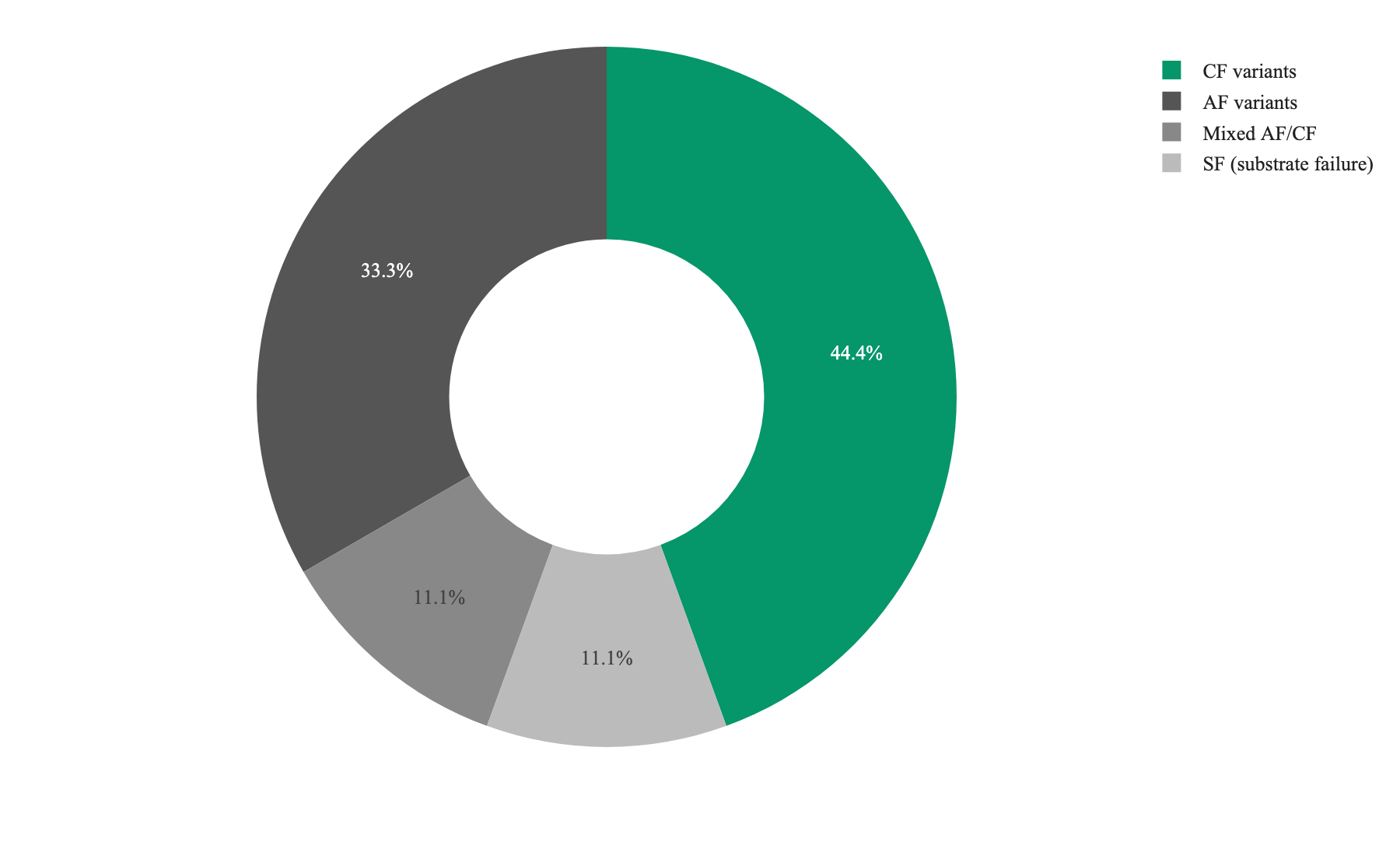
The table above represents 9 diagnostic patterns covering the most common lap-shear failure scenarios in structural adhesive applications. Cases that do not match any single row, or that show contradictory indicators across Steps 1 through 3, should be escalated to confirmatory surface analysis before a corrective action is committed.
Step 5: Confirmatory Surface Analysis (When Routing Is Ambiguous)
When the decision table routing in Step 4 does not produce a clear single root cause, two confirmatory analytical methods are available and can be conducted on the fracture surfaces themselves without destroying the specimens.
X-ray photoelectron spectroscopy (XPS, also known as electron spectroscopy for chemical analysis or ESCA) identifies elemental and chemical-state composition on the fracture surface to a depth of approximately 5 to 10 nanometers. In adhesive failure cases, XPS of the clean substrate face will reveal whether the fracture occurred at the adhesive-substrate interface (substrate chemistry on the clean face) or at a weak boundary layer such as a contamination film or oxide layer (presence of carbon, silicon, or nitrogen species inconsistent with the substrate alloy). This technique has been documented as the most reliable method for distinguishing true adhesive failure from weak-boundary-layer failure in aluminum bonding (Kinloch, 1994).
Attenuated total reflectance Fourier-transform infrared spectroscopy (ATR-FTIR) identifies organic functional groups on the fracture surface. It is particularly useful for detecting mold release agents, lubricants, or processing aids on the clean adhesive failure face, because these contaminants leave characteristic absorption peaks (siloxane Si-O-Si at 1000 to 1100 cm-1 for silicone release agents; ester carbonyl at 1735 cm-1 for fatty acid lubricants) that distinguish contamination-driven adhesive failure from surface energy or primer failures. ATR-FTIR can be completed within 2 to 4 hours using instruments common to polymer and adhesive laboratories.
IV. Cost of Mis-Diagnosed Bond Failure: Repeat Trials, Production Hold
The primary cost driver of a mis-diagnosed lap-shear failure is not the failed test itself but the qualification rerun cycle that follows when the wrong variable is changed. A structural adhesive qualification rerun in automotive or aerospace environments typically involves specimen preparation, bonding, conditioning, testing, and report review over a 5 to 15 business-day cycle. When the wrong root cause is addressed, the qualification fails a second time, triggering an additional cycle and compounding material, labor, and production-hold costs.
Quantifying the Repeat-Trial Cost in Automotive Structural Bonding
In automotive body-in-white structural adhesive applications, an adhesive qualification trial for a single joint design typically involves 15 to 30 lap-shear specimens prepared per ASTM D1002 (5 specimens per conditioning condition across 3 conditions: ambient, post-humidity exposure per ASTM D1151-84, and post-thermal cycle). Material and labor cost per trial, including substrate preparation, adhesive dispensing, fixture time, testing, and reporting, runs approximately USD 1,500 to USD 4,500 per trial in contract-laboratory settings (verification needed for current rates; range based on published laboratory rate surveys, 2022 to 2024). A single mis-diagnosed root cause that triggers one unnecessary rerun adds USD 1,500 to USD 4,500 to direct trial cost.
The more significant cost is production hold. When an adhesive joint specification has not been qualified and the production line is waiting for qualification sign-off, the production hold cost per day in automotive body-in-white assembly ranges from USD 50,000 to USD 500,000 per day depending on line throughput and model volume (verification needed; range based on industry benchmarking data from automotive OEM supplier quality literature, 2020 to 2023). Even a one-day extension of the hold due to a mis-diagnosed and repeated trial represents a cost that overwhelms direct trial costs by an order of magnitude.
Qualification Cycle Economics in Aerospace Secondary Bonding
In aerospace secondary structural bonding, qualification cycles are longer and the regulatory documentation burden adds further cost. Adhesive qualification for secondary structural bonds in civil aviation assemblies follows internal OEM qualification procedures that typically run 20 to 45 business days from specimen preparation through final sign-off. A repeat trial triggered by incorrect root-cause identification adds not only trial material and labor costs (typically USD 8,000 to USD 25,000 per trial, verification needed) but also the schedule impact to aircraft delivery, which carries contractual penalty exposure.
Aerospace secondary bonding programs also require that each qualification rerun be documented with a formal root-cause investigation and corrective action report before the rerun is authorized. A mis-diagnosed root cause that does not survive scrutiny in the corrective action review triggers an additional investigation cycle before the rerun can be scheduled. This adds 5 to 10 business days of investigation time per mis-diagnosis event, independent of the trial time itself.
Production Hold Patterns From Bond-Failure Mis-Diagnosis
The most common production hold pattern associated with lap-shear mis-diagnosis is the following sequence: adhesive failure is observed, the corrective action incorrectly targets adhesive formulation (reformulation or substitution), the reformulated adhesive passes qualification specimens but fails on production parts because the surface preparation protocol on the production line was never corrected, and the production line hold extends until the true root cause (surface preparation) is identified and corrected.
This cycle, which can run 3 to 8 weeks in complex multi-substrate assemblies, has been documented in multiple automotive and aerospace process audit reports (verification needed for specific published case counts) and is the primary justification for investing in fracture-surface diagnostic capability at the bonding laboratory or quality station level. The diagnostic protocol in Section III adds approximately 2 to 4 hours of technician time to a failed specimen review; this is the highest-return diagnostic intervention available at the point of failure.
V. Resolution Path by Failure Mode and Substrate Type
Resolution actions for structural adhesive lap-shear failures are specific to both the failure mode and the substrate combination. The same failure mode observed on aluminum, steel, and FRP substrates requires different corrective actions because the surface chemistry, preparation options, and adhesive primer systems differ significantly between substrate classes. This section provides the substrate-specific resolution path for each of the three primary failure modes.
Cohesive Failure Resolution: Adhesive System Correction
When cohesive failure is confirmed at loads below specification, the resolution is entirely within the adhesive system and does not involve substrate preparation changes.
For two-part epoxy structural adhesives: verify static mix tip condition and length (insufficient tip length produces incompletely mixed adhesive at the beginning of each dispensed bead; minimum tip length is typically specified by the adhesive manufacturer as 12 to 20 static mixing elements). Verify pot life compliance: material dispensed after pot life expiration will be partially reacted before application and will show reduced cured strength without necessarily failing the appearance or open-time checks. Verify cure temperature log: epoxy structural adhesives used in body-in-white applications are typically heat-cured at 170 to 180 degrees C (bake temperatures during e-coat or paint bake cycles); a bake temperature drop of 10 degrees C below the minimum cure temperature can reduce final lap-shear strength by 15 to 30 percent depending on the specific adhesive chemistry (verification needed).
For one-part moisture-cure polyurethane structural adhesives: verify substrate moisture content and ambient humidity during application. One-part PU systems require atmospheric moisture to initiate crosslinking; very low humidity (below 20 percent relative humidity) can retard cure to the point where the adhesive remains incompletely crosslinked at the time of testing. Conversely, excessive substrate moisture (above the adhesive data sheet limit, typically 5 to 10 percent moisture content by weight for wood or composite substrates) can cause foaming within the bondline, introducing voids that reduce effective shear area.
For two-part acrylic (methacrylate) structural adhesives: verify activator application on the correct substrate face and coverage uniformity. Acrylic structural adhesives in the two-part activator-on-one-surface configuration are highly sensitive to activator coverage deficiencies; areas without activator contact do not initiate free-radical polymerization and remain uncured. An uncured zone is visually indistinguishable from cured adhesive in macro examination but will appear as a soft, tacky region when probed and will show the low lap-shear values associated with cohesive failure in under-cured material.
Adhesive Failure Resolution by Substrate Type
Adhesive failure resolution requires substrate-specific surface preparation changes. The resolution cannot be achieved by adhesive reformulation alone, because the limiting factor is the adhesive-substrate interface, not the adhesive bulk.
For aluminum substrates: the preferred surface preparation sequence for structural epoxy and acrylic adhesives is degreasing (acetone or methylethylketone wipe, or vapor degreasing), followed by chromic acid anodize (CAA) or phosphoric acid anodize (PAA) for aerospace-grade bonds, or abrasive grit blast (ASTM D2093-12 guidance) plus application of a silane coupling agent primer for automotive applications. Chrome-free pretreatment options including titanium-zirconium conversion coatings are available for environmental compliance; these require primer compatibility verification with the structural adhesive supplier. The key specification parameter is the oxide layer stability: a properly formed anodize or conversion coating resists moisture-induced interface degradation, which is the primary cause of adhesive failure under humid service conditions. Lap-shear strength improvement from adding a silane coupling agent to a grit-blasted aluminum surface has been reported at 30 to 60 percent compared with grit blast alone in epoxy adhesive systems (Gettings and Kinloch, 1977, as cited in Kinloch, 1994; verification needed for current commercial adhesive systems).
For steel substrates: the standard resolution for adhesive failure on steel is a two-step protocol of abrasive blast to Sa 2.5 per ISO 8501-1 followed by application of a corrosion-inhibiting epoxy primer within 4 hours of blasting (ISO 4587 commentary). Shot blast alone without primer is insufficient for structural adhesive applications in humid or corrosive service environments because steel oxide layers are inherently unstable in the presence of moisture and will regenerate at the interface under service loading, promoting adhesive failure at the adhesive-oxide boundary rather than at the steel-oxide boundary. A proprietary conversion coating (e.g., zinc phosphate or iron phosphate) applied before the epoxy primer provides additional barrier protection and is specified in automotive OEM adhesive bonding standards for exposed structural joints.
For fiber-reinforced polymer (FRP) and carbon-fiber-reinforced polymer (CFRP) substrates: adhesive failure on FRP commonly originates from peel-ply contamination (release agents on the peel-ply surface transferred to the bond face during peel-ply removal), mold-release agent contamination from prior manufacturing steps, or surface energy reduction from fiber-matrix separation at the bond face. The resolution protocol is abrasive sanding to the specified grit (typically 120 to 180 grit for thermoset CFRP) followed by solvent wipe and application of a surface-compatible structural adhesive primer within 2 hours of sanding. Plasma or corona treatment is used in high-performance aerospace CFRP bonding to raise surface energy above 40 mN/m before adhesive application.
Substrate Failure Resolution
Substrate failure in metal-to-metal lap-shear assemblies requires a structural review that falls outside the adhesive qualification process. The corrective action involves substrate specification review (alloy grade, temper, and section thickness verification), corrosion condition assessment, and structural load distribution analysis rather than adhesive or surface-preparation changes. Engage the design engineering team when substrate failure is confirmed in a metal assembly.
VI. Field Cases: Automotive, Aerospace, and Structural Joining Audits
The following three cases illustrate how fracture-surface diagnosis changed the corrective-action decision and prevented unnecessary qualification reruns or production-line interventions.
Case A: Automotive Body-in-White Structural Epoxy (Incident Trigger Pattern)
Company A, an automotive tier-1 body-in-white assembly supplier, reported lap-shear test failures on a heat-cure structural epoxy adhesive bonding galvanized steel to an aluminum reinforcement bracket. The assembly was a door-ring reinforcement joint with a 30-mm overlap length, tested per ASTM D1002 with a 12-mm/min crosshead speed. Five specimens from one production lot returned a mean lap-shear strength of 12.1 MPa against the specification minimum of 18.0 MPa. The initial proposed corrective action was to switch to a higher-strength adhesive from the same supplier's product line, which would have required a 15-business-day qualification rerun and a 4-day production hold.
Fracture-surface examination of all five failed specimens was conducted before the corrective action was authorized. Visual examination at 10x magnification revealed that the galvanized steel face on all five specimens was clean with less than 5 percent adhesive residue, while the aluminum face carried full adhesive coverage. The pattern matched the AF (adhesive failure) row in the decision table. The clean face was the galvanized steel face, indicating that the adhesive-steel interface had failed before the adhesive reached its shear capacity.
Process record review identified that the galvanized steel panels had been stored for 11 days before bonding, exceeding the 7-day maximum open time after alkaline cleaning specified in the internal bonding procedure. During the additional 4 days of storage, zinc oxide regrowth on the galvanized surface had reduced the surface energy from the post-clean value of approximately 44 mN/m to below 30 mN/m, as confirmed by Dyne pen measurement on a retained panel. The corrective action was re-cleaning the steel panels and bonding within the specified 7-day window. Repeat specimens tested at 19.3 MPa mean, passing the 18.0 MPa specification. No adhesive reformulation was required. The production hold was 1.5 days rather than the anticipated 4 days, and the 15-day qualification rerun was avoided entirely.
Case B: Aerospace Secondary Structural Bonding, CFRP to Aluminum (Unexpected Cause Pattern)
Company B, an aerospace secondary structure fabricator, reported recurring low lap-shear strength on a CFRP-to-aluminum secondary structural bond using a film adhesive applied per ISO 4587 geometry. Nominal bond area was 2,500 mm2 per specimen; five specimens from three consecutive production lots returned mean values of 8.2 MPa, 7.8 MPa, and 8.5 MPa against the qualification baseline of 14.0 MPa. The expected cause, based on a previous similar failure at the facility 2 years earlier, was peel-ply contamination on the CFRP face. The proposed corrective action was to change peel-ply supplier and conduct a full adhesive re-qualification per the company's bonding process specification.
Fracture-surface examination showed that the CFRP face on all fifteen specimens carried full adhesive residue with fiber-tear zones at the laminate surface, consistent with cohesive and light-fiber-tear failure (CF/LF per ASTM D5573). The aluminum face also carried adhesive residue, but examination under 20x magnification revealed a layer of cured adhesive that had separated from a second adhesive layer beneath it. The fracture path was within the adhesive, not at the CFRP-adhesive or aluminum-adhesive interface. This was cohesive failure, not adhesive failure, and peel-ply contamination was ruled out.
ATR-FTIR analysis of the film adhesive fracture surface identified a carbonyl absorption band at 1710 cm-1 inconsistent with the specified adhesive chemistry, which showed a carbonyl at 1730 cm-1. Investigation traced this to an inadvertent adhesive film roll substitution: a roll from a developmental product lot with a different resin formulation had been loaded into the layup station without lot verification. The developmental lot had 30 percent lower cured shear strength than the qualified product. The corrective action was lot verification of all adhesive film inventory and institution of a scan-and-confirm step at the layup station. Re-qualification of the correctly identified adhesive film was not required; the facility used existing baseline data from the qualified lot to close the nonconformance. The proposed full re-qualification (estimated 30 business days and approximately USD 18,000 in direct costs) was avoided.
Case C: Heavy Industrial Structural Joining, Steel-to-Steel (Trial-and-Error Pattern)
Company C, a structural fabricator manufacturing bonded steel connections for industrial equipment frames, reported a first-article lap-shear qualification failure on a two-part methacrylate structural adhesive tested per ASTM D1002. Overlap geometry was 25 mm by 25 mm, substrates were grit-blasted cold-rolled steel panels, and the target lap-shear strength was 14 MPa at ambient per the structural design requirement. First-article test returned 6.8 MPa mean on 5 specimens. The initial corrective action attempted by the bonding team was to increase the activator coverage rate by 50 percent and retest; second-attempt specimens returned 6.5 MPa, which was essentially unchanged and slightly lower.
Fracture-surface examination of the first-attempt specimens showed full adhesive coverage on both steel faces with a fibrous, matte texture, consistent with cohesive failure at low load (CF low-load row in the decision table). The activator increase was therefore misdirected: activator coverage was not the limiting variable. Process record review identified that the grit-blasted steel panels had an average surface profile of Rz 18 micrometers, measured per ASTM D4417-14, compared with the adhesive data sheet recommendation of Rz 40 to 75 micrometers for optimal mechanical interlocking with methacrylate adhesives on steel. The smooth surface profile had reduced mechanical keying without affecting chemical wetting (both steel faces carried full adhesive residue confirming adequate wetting), resulting in cohesive failure at loads well below the adhesive's intrinsic shear capacity.
The corrective action was re-blasting the steel panels to achieve Rz 55 to 65 micrometers using a coarser abrasive grade. Third-attempt specimens, after the profile correction and without any activator rate change, returned 16.2 MPa mean, exceeding the 14 MPa specification. The first-attempt corrective action (activator increase) had been taken without reading the fracture surface, which showed cohesive rather than adhesive failure and indicated a mechanical interlocking deficiency rather than a chemical activation deficiency. The fracture-surface reading at the first attempt would have avoided the second failed trial entirely.
VII. Key Takeaway
Read the fracture surface before authorizing any corrective action. Cohesive failure (adhesive residue on both faces) routes to adhesive system correction; adhesive failure (one clean face) routes to surface preparation correction. These are different processes, and changing the wrong one does not fix the failure.
Use the ASTM D5573 failure-mode classification codes as a common diagnostic language across all stakeholders (quality, engineering, and adhesive supplier). Recording the failure mode as a percentage (e.g., 70 CF / 30 AF) is more informative than recording only the lap-shear load value.
The fracture-surface decision table in Figure 1 converts observed fracture patterns to root causes and resolution actions without requiring off-site laboratory analysis for the primary routing decision. Use it at the inspection station, not after a multi-day investigation.
Mixed-mode results with greater than 20 percent adhesive failure area should be treated as adhesive failures for corrective action purposes. The adhesive-substrate interface is demonstrably the limiting factor in that area fraction, and surface preparation must be addressed regardless of the cohesive failure percentage.
When fracture-surface routing is ambiguous after Steps 1 through 4, confirmatory ATR-FTIR or XPS analysis resolves the case in 2 to 4 hours rather than a 5 to 15 business-day qualification rerun cycle. The investment in confirmatory analysis is typically recovered in the first avoided rerun.
For unresolved cases where field and laboratory diagnostic steps have been completed but the corrective action remains uncertain, submit the full case package (fracture photographs, process records, stream test results, and ATR-FTIR or XPS data if available) to AI Shooting for deep diagnostic review. AI Shooting is Lubinpla's per-case industrial chemistry analysis service that returns an evidence-based root-cause report within the Standard or Deep tier turnaround window, providing an independent diagnostic basis before committing to a qualification rerun.
VIII. References
ASTM International. (2019). ASTM D1002-10(2019): Standard Test Method for Apparent Shear Strength of Single-Lap-Joint Adhesively Bonded Metal Specimens by Tension Loading (Metal-to-Metal). ASTM International. https://www.astm.org/d1002-10r19.html
ASTM International. (2019). ASTM D5573-99(2019): Standard Practice for Classifying Failure Modes in Fiber-Reinforced-Plastic (FRP) Joints. ASTM International. https://www.astm.org/d5573-99r19.html
ASTM International. (2014). ASTM D4417-14: Standard Test Methods for Field Measurement of Surface Profile of Blast Cleaned Steel. ASTM International. https://www.astm.org/d4417-14.html
ASTM International. (2012). ASTM D2093-12: Standard Practice for Preparation of Surfaces of Plastics Prior to Adhesive Bonding. ASTM International. https://www.astm.org/d2093-12.html
ASTM International. (1984). ASTM D1151-84: Standard Practice for Effect of Moisture and Temperature on Adhesive Bonds. ASTM International. https://www.astm.org/d1151-84.html
ISO. (2003). ISO 4587:2003: Adhesives — Determination of Tensile Lap-Shear Strength of Rigid-to-Rigid Bonded Assemblies. ISO. https://www.iso.org/standard/30180.html
ISO. (2007). ISO 8501-1:2007: Preparation of Steel Substrates Before Application of Paints and Related Products — Visual Assessment of Surface Cleanliness — Part 1: Rust Grades and Preparation Grades of Uncoated Steel Substrates and of Steel Substrates After Overall Removal of Previous Coatings. ISO. https://www.iso.org/standard/42901.html
Kinloch, A. J. (1987). Adhesion and Adhesives: Science and Technology. Chapman and Hall. (Note: No direct URL; standard reference text available in university library holdings.)
Kinloch, A. J. (1994). The Science and Technology of Adhesion. In D. E. Packham (Ed.), Handbook of Adhesion. Longman Scientific and Technical. (Note: No direct URL; referenced for XPS fracture-surface analysis methodology cited in the adhesion literature.)
Adams, R. D., Comyn, J., and Wake, W. C. (1997). Structural Adhesive Joints in Engineering (2nd ed.). Chapman and Hall. (Note: No direct URL; standard structural adhesive engineering reference text.)
ASI: Adhesives and Sealants Industry. (2023). Structural Adhesive Selection and Qualification in Automotive Body-in-White Applications. ASI Magazine. https://www.adhesivesmag.com (Note: Specific article URL not confirmed; refer to ASI publication index for current structural adhesive technical features.)
ASTM International. (2019). ASTM D3163-01(2014): Standard Test Method for Determining Strength of Adhesively Bonded Rigid Plastic Lap-Shear Joints in Shear by Tension Loading. ASTM International. https://www.astm.org/d3163-01r14.html
ISO. (2005). ISO 9664:1993: Adhesives — Test Methods for Fatigue Properties of Structural Adhesives in Tensile Shear. ISO. https://www.iso.org/standard/17630.html
Dillard, D. A., and Pocius, A. V. (Eds.). (2002). The Mechanics of Adhesion (Vol. 1). Elsevier. (Note: No direct URL; referenced for peel-stress analysis in lap-shear geometry.)