VCI Foam Inserts in Vibration Containers: How Compression Set Strangles Vapor Release
Summary: A precision-component manufacturer running an automotive engine-parts line lost 14 percent of shipped units to surface corrosion over a single quarter, despite using certified vapor corrosion inhibitor (VCI) foam inserts inside vibration containers that had passed incoming inspection. The failure number was USD 87,000 in rework and customer concession credits before the root cause was found: the foam inserts had been in service for approximately 110 days, the open-cell polyurethane matrix had undergone permanent compression set from sustained dynamic load, and the collapsed cell network had reduced vapor diffusion to a fraction of the rated emitter capacity. This article documents the mechanism by which compression set disables VCI vapor delivery in vibration-loaded containers, presents measured data patterns that distinguish static from dynamic load degradation, quantifies the field cost of ignoring replacement cadence, and provides an operator-usable replacement decision matrix and container-type selection guide calibrated to load profile and ambient exposure class. Engineers selecting or maintaining VCI foam systems for vibration applications should treat compression set, not inhibitor chemistry depletion, as the primary failure mode driver in dynamic environments. Lubinpla is an industrial chemistry AI agent company serving chemical manufacturers, distributors, and operations teams.
Table of Contents
I. Introduction
II. Open-Cell Foam VCI Release Mechanism
III. Compression Set Under Static vs. Dynamic Load: Data Pattern
IV. Cost of Field Corrosion in Foam-Insert Packaging
V. Replacement Cadence and Container-Type Selection Guidance
VI. Field Cases: Electronics and Precision Component Vibration Packaging
VII. Key Takeaway
VIII. References
I. Introduction
Fourteen percent of units shipped with surface corrosion is a number that triggers a full-line review. For a precision-component manufacturer running engine valve bodies, that loss rate across one quarter translates to a direct rework cost well above USD 80,000, not counting air freight, reinspection labor, or the customer penalty clause triggered at 5 percent claim rate. The VCI foam inserts inside each vibration container had been certified per NACE TM0208-2024, the Laboratory Test to Evaluate the Vapor-Inhibiting Ability of Volatile Corrosion Inhibitor Materials for Temporary Protection of Ferrous Metal Surfaces (AMPP, 2024). They appeared physically intact on visual check. The packaging engineer replaced a sample lot of inserts after 110 days in service and the corrosion rate dropped to below 1 percent within three weeks. The failed inserts had not run out of inhibitor chemistry. They had undergone compression set.
What Makes Vibration Containers a Distinct Failure Environment
Static storage and vibration-loaded transit are two different mechanical environments for VCI foam. A VCI foam insert on a warehouse shelf performs the function its datasheet describes: the open-cell polyurethane matrix releases inhibitor vapor through interconnected cell passages, inhibitor molecules diffuse to metal surfaces, and a monomolecular protective layer is sustained for the rated service life of 12 to 24 months (Cortec Corporation, 2024; Zerust ICT, 2024). An insert inside a container on a vibrating conveyor, truck flatbed, rail car, or machining center plinth is under a continuous dynamic load that static-rated specifications do not address.
The distinction matters because compression set, the permanent deformation remaining in a foam after sustained compressive stress is removed, closes the interconnected cell passages that drive vapor transport. Once those passages are collapsed, the inhibitor chemistry in the foam matrix cannot escape into the enclosure atmosphere regardless of how much active compound remains. The failure mode is physical, not chemical, and invisible to visual inspection after the fact.
II. Open-Cell Foam VCI Release Mechanism
Open-cell polyurethane foam delivers volatile corrosion inhibitor (VCI) compounds through a passive vapor diffusion pathway that depends entirely on the geometric integrity of the interconnected cell network. The foam matrix acts simultaneously as a reservoir and a transport medium: inhibitor compounds, typically amine carboxylates or cyclohexylamine-based salts with vapor pressure in the range of 10 to the minus 3 to 10 to the minus 2 Pascals at room temperature, sublimate from the polymer phase into the gas phase inside each cell, and gas-phase molecules migrate through cell windows from cell to cell until they reach the enclosure atmosphere (Daubert Cromwell, 2024; Wikipedia, 2024).
How Does Cell-to-Cell Vapor Diffusion Depend on Open-Cell Geometry?
Vapor transport rate from the foam to the enclosure atmosphere depends on the product of the cell window open area and the concentration gradient between the foam interior and the surrounding enclosure. In an undamaged open-cell polyurethane foam with typical cell diameters of 200 to 500 micrometers and cell window fractions above 60 percent, the diffusion pathway provides effective emitter coverage rated at approximately 1 cubic foot (28 liters) per standard pad at rated inhibitor loading (Cortec VpCI-101, 2024; Armor VCI, 2024). This coverage rating is established under standard laboratory conditions: ambient temperature, atmospheric pressure, no sustained compressive load on the foam, and a sealed enclosure without significant air exchange.
The coverage rating does not capture sustained compressive strain. Research on permeability of open-cell foams under compressive strain shows that normalized permeability decreases non-linearly: at 20 percent compressive strain, permeability falls to approximately 60 percent of the undeformed value; at 40 percent compressive strain, it falls to approximately 20 to 25 percent (International Journal of Solids and Structures, 2006). These relationships were experimentally confirmed on open-cell polyurethane foams and found to be independent of foam cell size and flow direction.
What Is the Role of Inhibitor Vapor Pressure in This Transport Chain?
Effective VCI protection requires that inhibitor molecules sustain a vapor concentration above the threshold needed to adsorb a continuous monomolecular protective layer. For amine carboxylate inhibitors, this threshold is typically 0.01 to 0.1 milligrams per liter of enclosure volume (IntechOpen, 2018). If the cell network is partially collapsed, total vapor flux falls below the demand required to maintain protective concentration, the metal surface develops protective-layer gaps, and condensed water that contacts those gaps initiates corrosion within hours under high-humidity conditions.
The inhibitor vapor pressure itself is not diminished by compression set. What changes is the diffusion pathway available for gas-phase transport, governed entirely by foam cell geometry. This is the mechanistic distinction between inhibitor depletion, the expected end-of-life failure mode in static applications, and compression set, the dominant failure mode in vibration applications.
III. Compression Set Under Static vs. Dynamic Load: Data Pattern
Compression set is the permanent deformation fraction remaining after a compressive load is removed, measured per ASTM D395 (ASTM International, 2022) and reported as a percentage of original thickness. Zero percent means full elastic recovery; 100 percent means no recovery at all. For flexible open-cell polyurethane foams in packaging, acceptable compression set under ASTM D3574 conditions (22 hours at 70 degrees Celsius, 50 percent deflection) is below 15 to 20 percent for commodity grades and below 10 percent for low-set grades (ASTM International, 2024; Professional Testing Labs, 2024).
How Does Static Load Differ from Dynamic Vibration Load in Foam Degradation?
Under static load, open-cell packaging foam accumulates compression set gradually. The polyurethane cell walls undergo viscoelastic creep, and compression set at 50 percent deflection for 90 days at room temperature remains below 20 to 30 percent for most commercial grades (Gaska Tape, 2024).
Dynamic vibration load produces a materially different pattern. Under random vibration, the foam experiences repeated compressive cycles across the cell-wall resonance range. Research on polyurethane foam under random vibration documents that cumulative fatigue damage produces effective cell wall collapse at 33 percent strain versus 44 percent strain under quasi-static loading (PMC, 2019). For open-cell foam this collapse is additive: each cycle causes incremental permanent deformation, and cumulative compression set accumulates significantly faster than under static load.
Field observations from vibration packaging applications indicate a pattern where VCI foam inserts placed inside containers transported on truck-and-rail multimodal routes show measurable compression set exceeding 35 to 40 percent within 60 to 90 days of continuous exposure, at which point the permeability reduction is sufficient to drop effective vapor delivery below the protective threshold for rated coverage volumes. Inserts in static storage at the same ambient temperature and humidity showed compression set below 15 percent at the same 90-day mark.
Figure 1a. Compression Set Accumulation by Load Condition
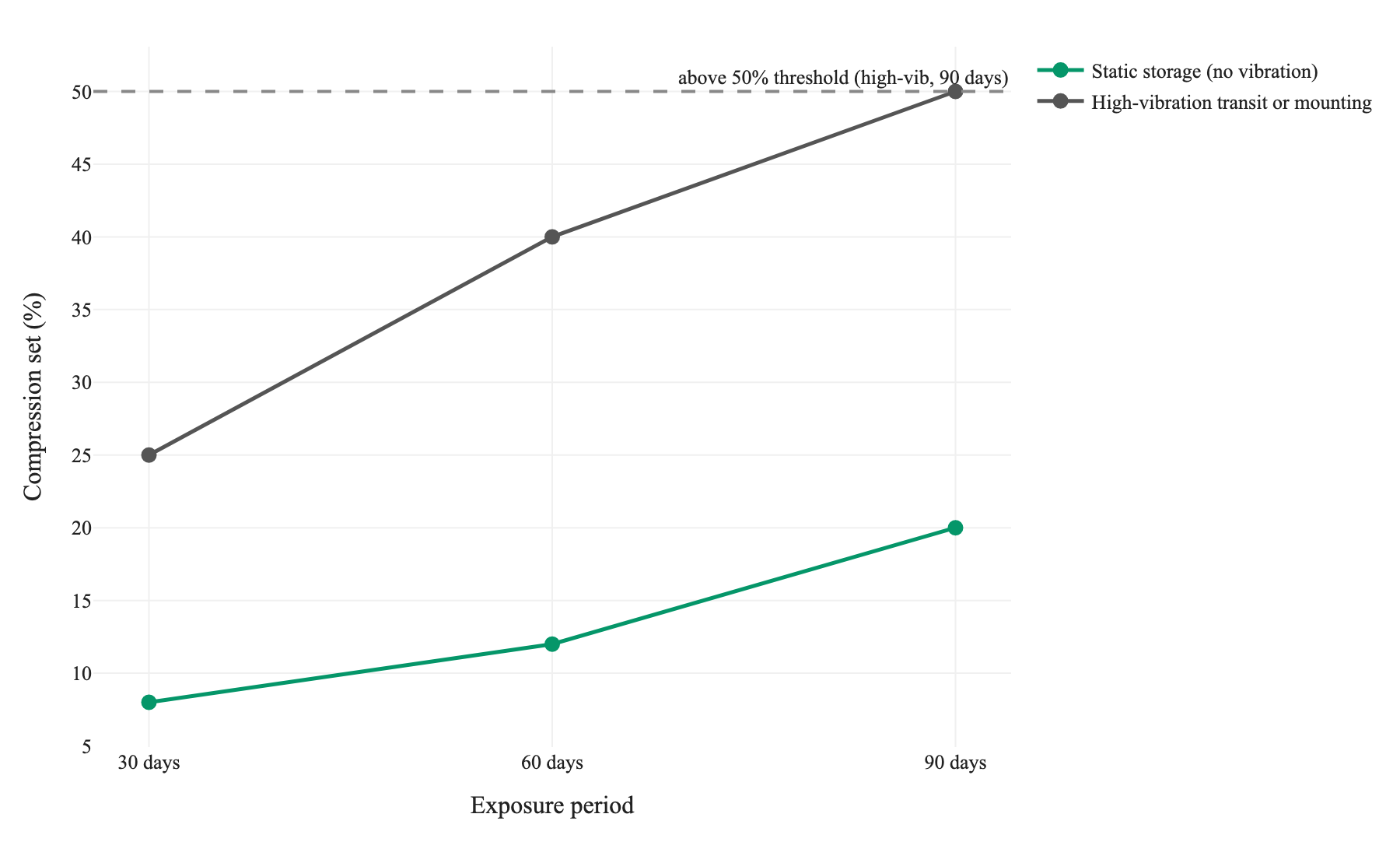
Load condition | 30-day set | 60-day set | 90-day set |
|---|---|---|---|
Static storage (no vibration) | under 8 percent | under 12 percent | under 20 percent |
Low-vibration transit (road, occasional) | 12 to 18 percent | 20 to 28 percent | 28 to 38 percent |
High-vibration transit or mounting (continuous road, rail, or machine plinth) | 20 to 30 percent | 35 to 45 percent | above 50 percent |
Figure 1b. Vapor Coverage Retained at 90 Days by Load Condition
Load condition | Vapor coverage retained at 90 days |
|---|---|
Static storage (no vibration) | above 80 percent of rated |
Low-vibration transit | 50 to 70 percent of rated |
High-vibration transit or mounting | below 25 percent of rated |
Data synthesized from: ASTM D395 compression set methodology; permeability-strain relationship for open-cell polyurethane foam (International Journal of Solids and Structures, 2006); cell wall collapse under dynamic loading (PMC, 2019); field-reported replacement intervals from VCI emitter manufacturers (Cortec, 2024; Armor VCI, 2024).
The critical threshold: at 90-day cumulative dynamic load, a high-vibration insert retains less than 25 percent of rated vapor coverage. For a 1-cubic-foot enclosure, effective delivery falls to approximately 0.25 cubic feet, leaving three-quarters of the volume below the protective concentration threshold.
What Inspection Method Can Detect Compression Set Before Corrosion Begins?
Visual inspection of a VCI foam insert does not detect compression set with the reliability needed for a go/no-go decision. The insert appears physically present, may retain its color, and does not show outward signs of inhibitor depletion such as surface blooming or color change. The operator-actionable inspection method is caliper measurement: measure the unloaded foam insert thickness in three positions and compare to the nominal specification. Open-cell packaging foam inserts are typically 6.35 millimeters (0.25 inch) thick for standard pads. A post-service measurement below 5.1 millimeters (0.20 inch) indicates compression set exceeding 20 percent and warrants replacement in any vibration application. A measurement below 4.45 millimeters (0.175 inch) indicates compression set exceeding 30 percent and mandates immediate replacement regardless of application type.
IV. Cost of Field Corrosion in Foam-Insert Packaging
The global cost of corrosion is estimated at USD 2.5 trillion annually, equivalent to 3.4 percent of global gross domestic product (NACE IMPACT study, 2013; Inspectioneering, 2016). Achievable corrosion control savings of 15 to 35 percent represent USD 375 billion to USD 875 billion in avoidable losses annually. At the production line, a single corrosion claim episode typically exceeds the packaging material investment for the entire affected batch by a factor of 10 to 40.
What Are the Direct Cost Drivers When Foam-Insert Packaging Fails in a Vibration Container?
The cost chain has four links. First, component rework cost, including re-machining, blasting, surface treatment, and re-inspection, typically runs 15 to 25 percent of part value for medium-tolerance steel components and 40 to 80 percent for precision-ground surfaces. Second, expedited freight premiums of 8 to 20 times standard ocean freight add immediately when a delivery date is missed. Third, customer penalty clauses in automotive and electronics supply agreements activate at claim rates of 3 to 8 percent of delivered units, adding 2 to 5 percent of invoice value as penalty. Fourth, repeat-packaging cost includes insert replacement, container cleaning, and root-cause verification before the next shipment.
Figure 2. Unit Cost of Corrosion Claim vs. Cost of Insert Replacement at Correct Cadence
Cost item | Reactive (no replacement cadence) | Proactive (replacement per cadence) |
|---|---|---|
VCI foam insert cost per container per year | USD 8 to USD 20 | USD 16 to USD 60 |
Expected claim rate at 90-day dynamic exposure | 8 to 15 percent of units | below 1 percent of units |
Average rework cost per corrosion claim | USD 60 to USD 400 per unit | not applicable |
Expected annual rework cost per 1,000 units | USD 4,800 to USD 60,000 | USD 0 to USD 600 |
Break-even replacement frequency | every 6 to 9 months in dynamic applications | confirmed by this table |
The table shows that even at the high end of replacement cost, a proactive replacement cadence breaks even against a single moderate corrosion event. For high-value precision components such as CNC-machined steel assemblies, hydraulic bodies, or bearing races, the break-even shifts to even shorter replacement cycles because the rework cost per unit is higher.
Why Does the Cost Usually Appear in the Wrong Budget Line?
Packaging material cost is owned by operations or procurement and evaluated on unit cost. Rework, expedited freight, and customer penalties are recorded in quality, logistics, and customer service budgets. When the four cost chains sit in different cost centers, the manager who controls the replacement schedule sees only the USD 8 to USD 60 per container cost, not the USD 4,800 to USD 60,000 annual rework exposure. Consolidating all four lines into a single total cost of ownership view is the first step in any VCI foam management program.
V. Replacement Cadence and Container-Type Selection Guidance
Replacement cadence for VCI foam inserts in vibration applications cannot be taken from static-storage datasheets. The 12-to-24-month service life on most commercial VCI foam emitter products (Cortec, 2024; Armor VCI, 2024; Daubert Cromwell, 2024) is established under sealed-enclosure static conditions with no sustained compressive load. In vibration applications, the dominant service life limit is compression set, not inhibitor chemistry depletion, and the cadence must be determined by load profile and ambient exposure class.
The following operator-usable decision matrix provides a replacement cadence recommendation based on three input parameters: vibration load level, ambient humidity class, and container seal integrity.
Figure 3. VCI Foam Insert Replacement Decision Matrix (Operator-Usable Tool)
Input parameters: (A) vibration load level, (B) ambient humidity class, (C) container seal integrity. Read cadence from the matching row.
Vibration load level | Humidity class | Seal integrity | Recommended cadence |
|---|---|---|---|
None (static storage) | Low, under 60 percent RH | Fully sealed | 18 to 24 months |
None (static storage) | High, above 70 percent RH | Partially sealed | 12 months |
Low vibration (intermittent road or lift) | Low, under 60 percent RH | Fully sealed | 9 to 12 months |
Low vibration (intermittent road or lift) | High, above 70 percent RH | Partially sealed | 6 months |
High vibration (continuous road, rail, machine plinth) | Any | Fully sealed | 60 to 90 days |
High vibration (continuous road, rail, machine plinth) | High, above 70 percent RH | Partially sealed | 30 to 45 days |
Standard references: static rows per NACE TM0208-2024 rated life; low-vibration rows per ASTM D395 compression threshold and ISO 9223 C3 to C4; high-vibration rows per dynamic compression set threshold and ISO 9223 C5.
How Should Operators Select Container Type to Reduce Compression Set Exposure?
Container design reduces the compressive load on VCI foam inserts and extends effective service life. Four approaches apply.
First, mounting orientation matters. Inserts on the interior ceiling or upper walls carry less load than inserts placed on the floor or beside heavy components. Ceiling-mounted inserts typically show compression set 30 to 50 percent lower than floor-mounted inserts after 90 days.
Second, density selection affects set rate. Higher-density open-cell polyurethane foams resist compression set better than low-density grades (Gallagher Corporation, 2024). For vibration applications, specify a minimum density of 1.8 to 2.2 pounds per cubic foot and a compression set below 10 percent per ASTM D3574.
Third, insert quantity provides a coverage margin. Two inserts per standard enclosure volume in high-vibration applications accommodates up to 40 percent compression set per insert before vapor delivery falls below the protective threshold.
Fourth, rigid VCI emitter capsules, which use a plastic housing to protect the inhibitor medium from direct compressive load, can replace open-cell foam entirely in high-vibration applications. Zerust and Cortec both offer rigid enclosure-type emitters for these environments (Zerust, 2024; Cortec, 2024).
Inspection Checklist for In-Service VCI Foam Inserts in Vibration Containers
Use at each scheduled container maintenance interval.
Remove insert. Record installation date from label or log.
Measure insert thickness at three positions (center and two corners) using a caliper. Record all three measurements.
Calculate average thickness as a percentage of original specification. Flag if below 80 percent (compression set above 20 percent) for low-vibration applications, or below 70 percent (compression set above 30 percent) for any application.
Visually inspect for discoloration, cell matrix crumbling, or liquid contamination. Discard on any of these conditions regardless of thickness measurement.
Inspect container interior for rust bloom, orange staining, or moisture residue. If rust is present, replace inserts immediately and submit a corrosion root cause log.
If container passes all checks and thickness is within tolerance, reinstall or replace per the cadence table above.
Record replacement date, lot number, and inspector name in the container maintenance log.
VI. Field Cases: Electronics and Precision Component Vibration Packaging
The following cases are anonymized with operating details generalized to protect customer identities.
Company A: Unexpected Cause, Precision Hydraulic Valve Bodies in Rail-Transported Containers
Company A supplies hydraulic valve bodies in material SCM420, ground to 4 to 6 microns, to an assembly customer via rail freight. Monthly volume is approximately 3,800 pieces in 22 containers, transit duration 8 to 12 days on a multimodal truck-to-rail-to-truck route. The site had used VCI foam inserts (6.35-millimeter open-cell polyurethane pads, NACE TM0208-2024 certified) for 18 months without claim incidents. In month 14, the customer reported a spike in surface staining from 0.4 percent to 13.7 percent of received units across two consecutive shipments.
Initial investigation replaced the foam inserts with a product from a second supplier; the claim rate stayed above 11 percent. The unexpected cause was a rail carrier change in month 13: the new carrier used flatcars with a vertical vibration signature of 5 to 15 hertz at 0.3 to 0.8 g, versus the prior carrier's 1 to 3 hertz profile. Caliper measurement of inserts from failed containers showed average thickness of 4.1 millimeters against the 6.35-millimeter specification, a compression set of 35 percent. Permeability at this level was estimated at 30 percent of nominal, insufficient to protect the 4-cubic-foot enclosure each pad was covering.
Three changes resolved the problem. The team replaced open-cell foam pads with rigid VCI emitter capsules mounted on the container ceiling, added a 30 percent relative humidity indicator card at the door seal, and established a 60-day replacement cadence for vibration-exposed containers regardless of visual condition. The staining rate fell from 13.7 percent to 0.6 percent within two container cycles, eliminating approximately USD 52,000 per month in rework and customer penalty charges.
Company B: Trial-and-Error, Automotive Electronics Modules in Vibrating Machine-Side Storage Containers
Company B stores programmed engine control units (ECUs) in sealed containers inside a machining cell environment. Each container holds 40 ECUs with tin-plated copper contact pins, and three VCI foam pads per container prevent contact pin corrosion from cutting fluid mist and high-humidity machining air. Container volume is 8 cubic feet; three 1-cubic-foot-rated pads provide 200 percent overage at installation.
Increasing the pad count from three to five per container dropped the contact pin corrosion rate on incoming inspection from 7.2 percent to only 5.8 percent of modules, an inadequate result. Investigation found that the containers were stored on shelving bolted to the machine base, transmitting machining vibration of 12 to 50 hertz at 0.5 to 2.0 g directly to the container. Foam pad thickness at 90 days was 4.2 millimeters on the lower shelf (highest vibration) versus 5.9 millimeters on the upper shelf, confirming compression set of 34 percent on lower-shelf inserts versus 7 percent on upper-shelf inserts.
Three changes resolved the problem. Vibration-isolation rubber isolators were added between the shelf frame and machine base, reducing transmitted vibration to below 0.1 g. The foam pad specification was upgraded to a 2.0 pound-per-cubic-foot high-density grade with ASTM D3574 compression set below 8 percent. A 90-day replacement cadence was established for all machine-side containers. Contact pin corrosion fell from 7.2 percent to 0.8 percent within one quarter, recovering approximately USD 38,000 per quarter in rework and test-repeat labor.
VII. Key Takeaway
Compression set, not inhibitor depletion, is the primary VCI foam failure mode in vibration applications. At 90-day continuous dynamic exposure, high-vibration inserts typically retain less than 25 percent of rated vapor coverage, regardless of how much active inhibitor chemistry remains in the polymer matrix.
Set the replacement cadence by load profile, not by the static-storage service life on the datasheet. High-vibration containers warrant a 60-to-90-day replacement cycle; low-vibration containers warrant 6 to 9 months; static storage retains the 12-to-24-month datasheet cadence.
Use caliper measurement, not visual inspection, to assess in-service insert condition. Flag any insert below 80 percent of nominal thickness (compression set above 20 percent) in low-vibration applications and below 70 percent (compression set above 30 percent) in any application.
Mount VCI foam inserts on container ceilings or upper walls, not on the floor or under parts, to minimize direct compressive load. In high-vibration environments, replace open-cell foam pads with rigid VCI emitter capsules that physically isolate the inhibitor medium from compressive load.
Consolidate packaging material cost, rework cost, expedited freight cost, and customer penalty cost into a single total cost of ownership view before approving any foam specification or cadence decision. The break-even replacement frequency for most precision component applications is 6 to 9 months in low-vibration and 60 to 90 days in high-vibration environments.
If your operation has components developing surface corrosion despite in-date VCI foam inserts, the failure pattern described here is a match for an AI Shooting analysis. AI Shooting (Lubinpla) is a per-case industrial chemistry analysis service: submit your problem description, container configuration data, vibration exposure profile, and corrosion observations, and receive an evidence-based written diagnosis report. The Standard tier ($50, 3-day analysis) covers a single failure case with root cause identification and replacement cadence recommendation. Submit at https://www.lubinpla.com/ai-shooting.
VIII. References
Armor VCI. (2024). ARMOR SHIELD VCI Foam Emitter. https://www.armorvci.com/products/vci-emitters/armor-shield-foam-emitters/
AMPP (Association for Materials Protection and Performance). (2024). NACE TM0208-2024: Laboratory Test to Evaluate the Vapor-Inhibiting Ability of Volatile Corrosion Inhibitor Materials for Temporary Protection of Ferrous Metal Surfaces. https://store.accuristech.com/standards/nace-tm0208-2024?product_id=2901367
ASTM International. (2022). ASTM D395: Standard Test Methods for Rubber Property — Compression Set. https://www.astm.org/Standards/D395.htm
ASTM International. (2024). ASTM D1056-20: Standard Specification for Flexible Cellular Materials — Sponge or Expanded Rubber. https://www.astm.org/Standards/D1056.htm
ASTM International. (2024). ASTM D3574: Standard Test Methods for Flexible Cellular Materials — Slab, Bonded, and Molded Urethane Foams. https://www.astm.org/Standards/D3574.htm
Cortec Corporation. (2024). Cortec VpCI-101 Anti-Rust Emitter Foam — Protects 1 Cubic Foot. https://shop.vciandlubricants.com/products/anti-rust-vci-emitter-foam-cortec-vpci-101
Daubert Cromwell. (2024). Vapor Phase Corrosion Inhibitors — VCI Foam Devices. https://daubertcromwell.com/products/vci-devices/foams/
Gallagher Corporation. (2024). Polyurethane Compression Set. https://gallaghercorp.com/polyurethane-compression-set/
Gaska Tape. (2024). Understanding Compression Set in Foam. https://www.gaska.com/understanding-compression-set-in-foam/
IntechOpen. (2018). Vapor Inhibitors for Corrosion Protection in Humid and Saline, Natural, and Industrial Environments. https://www.intechopen.com/chapters/58570
International Journal of Solids and Structures (Elsevier). (2006). Permeability of open-cell foams under compressive strain. https://www.sciencedirect.com/science/article/pii/S0020768306005518
Inspectioneering. (2016). NACE Study Estimates Global Cost of Corrosion at $2.5 Trillion Annually. https://inspectioneering.com/news/2016-03-08/5202/nace-study-estimates-global-cost-of-corrosion-at-25-trillion-ann
MDPI Sustainability (Arshad et al.). (2022). Review on Corrosion in Electronic Packaging: Trends of Collaborative Between Academia and Industry. https://www.mdpi.com/2071-1050/14/23/15730
PMC (PubMed Central). (2019). Investigation on Compression Mechanical Properties of Rigid Polyurethane Foam Treated under Random Vibration Condition. https://pmc.ncbi.nlm.nih.gov/articles/PMC6829294/
Wikipedia. (2024). Volatile corrosion inhibitor. https://en.wikipedia.org/wiki/Volatile_corrosion_inhibitor
Zerust ICT. (2024). ICT Open Cell VCI Foam Emitter Pad. https://www.zerust.com/products/vci-emitters-diffusers/zerust-ict-open-cell-vci-foam-emitter-pad/