When Dual-Function Fluids Fail: The Ocean Export Corrosion Gap
Summary: Dual-function clean-and-protect fluids deliver measurable value in short-cycle mixed-process manufacturing, combining a surfactant cleaning stage with an adsorptive corrosion barrier in a single product pass. Under controlled indoor storage, the protection films they deposit typically satisfy corrosion targets of 30 to 60 days for ferrous and non-ferrous substrates. The premise breaks down when the protected component enters an ocean export carry case, where container humidity can cycle between 40 and 95 percent relative humidity within a single transit leg due to Dew Point condensation -- a condition that overwhelms the thin barrier chemistry that dual-function fluids can sustain. This article examines the mechanism of combined cleaner-inhibitor failure, quantifies the protection-duration boundary at specific humidity and storage-time thresholds using ASTM D1748 and ISO 9227 salt-spray data, and translates those findings into a field-usable diagnostic table and export-profile selection guide. Two field case patterns illustrate how specification gaps translate into rust claims, customer returns, and warranty costs. Lubinpla's AI Shooting and AI Crew services are introduced for one-time case diagnosis and continuous export-line monitoring.
Table of Contents
I. Introduction
II. Dual-Function Chemistry: Cleaning Surfactant and Corrosion Barrier
III. Protection Duration vs. Humidity Profile and Storage Time
IV. Cost of Mis-Specified Protection: Field Rust, Returns, and Warranty
V. Selection by Process Cycle, Storage Duration, and Export Profile
VI. Field Cases: Mixed-Process Manufacturing and Export-Ready Component Audits
VII. Key Takeaway
VIII. References
I. Introduction
Approximately 25 to 40 percent of rust claims on machined and formed components originate not from processing errors but from protection specification mismatches that compound during storage and transit (AMPP Materials Performance, 2021). The failure pattern that accounts for the largest share of that group is the over-extension of dual-function clean-and-protect fluids into ocean export applications for which the chemistry was never designed. A plant engineer who successfully uses a single-pass cleaner-inhibitor for 30-day domestic warehouse storage can reasonably assume it will cover a 28- to 35-day container transit. That assumption is false in a significant fraction of export routes, because the driving variable is not transit time alone but the humidity excursion profile inside the carry case during that transit.
Dual-function clean-and-protect fluids have become a standard tool in mixed-process manufacturing environments where the line must transition quickly between a cleaning operation and an in-process protection step without a separate rust-preventive oil application. The convenience is real and the cost savings are documentable. The problem is a chemistry boundary that is rarely stated on the product data sheet: the inhibitor film deposited by a dual-function fluid is thinner, less persistent under humidity cycling, and more permeable to oxygen ingress than the dedicated rust-preventive compounds it is intended to replace in short-cycle applications.
This article defines exactly where that boundary sits, using published ASTM D1748 humidity-cabinet and ISO 9227 salt-spray data as quantitative anchors. It provides a field-usable diagnostic table mapping protection-duration threshold against humidity profile and storage time, and a selection guide aligned to process cycle, storage duration, and export destination humidity class.
II. Dual-Function Chemistry: Cleaning Surfactant and Corrosion Barrier
Dual-function clean-and-protect fluids work by combining two chemically distinct active systems in one aqueous or semi-synthetic carrier: a surfactant-based cleaning package that removes cutting-fluid emulsions, stamping lubricants, and particulate soils from the metal surface, and a corrosion-inhibitor package that adsorbs onto the clean metal surface immediately after the surfactant action completes. Understanding how each system works, and how they interact, is the foundation for recognizing where the dual-function approach reaches its limit.
How the Cleaning Surfactant System Works
The surfactant package in a clean-and-protect fluid operates through the same mechanism as any industrial aqueous cleaner: emulsification and micelle formation around hydrocarbon soils, assisted by alkalinity that saponifies fatty-acid ester lubricants. Typical dual-function concentrates are formulated at pH 8.5 to 10.5, with non-ionic and anionic surfactant ratios optimized to provide adequate soil lift at the low temperatures common in spray-washer or ultrasonic-bath applications. The cleaning stage is not substantially different in chemistry from a dedicated parts washer concentrate. The distinction begins in what happens in the rinse and dry stages, where the inhibitor package is intended to deposit a protective film rather than being completely removed.
The dual-function design assumes that some fraction of the inhibitor molecules present in the wash or rinse solution will adsorb onto the metal surface before the water evaporates. This is a kinetically controlled process, and the resulting film coverage depends on concentration, contact time, metal surface energy, and the competitive adsorption dynamics between the inhibitor molecules and any residual surfactant. Incomplete surface coverage is the first structural weakness of the dual-function approach relative to a dedicated rust-preventive oil, which is applied to a clean, dry surface under conditions that maximize coverage.
How the Corrosion Barrier Is Deposited and What Limits Its Thickness
The inhibitor compounds in dual-function fluids are typically amine-based, carboxylate, or benzotriazole-derivative compounds for non-ferrous metals, used alone or in combination. Amine carboxylates are the dominant class for ferrous substrates in mixed-process applications. Their protection mechanism involves forming a monomolecular or near-monomolecular adsorptive film on the metal surface that presents a hydrophobic outer face to the atmosphere, increasing the activation energy for oxygen and water molecule arrival at the steel surface where the electrochemical corrosion reaction initiates.
The critical structural constraint is film thickness. Dedicated rust-preventive oils (rust-preventive compounds, or RPCs, under ASTM D665 classification) deposit films between 2 and 25 micrometers depending on grade, providing a physical barrier that buffers humidity transients. The inhibitor film deposited by a dual-function fluid after aqueous processing is estimated at 0.01 to 0.1 micrometers, roughly one to two orders of magnitude thinner. At that thickness, the film provides adequate protection against steady-state humidity at or below 60 to 65 percent relative humidity, but it cannot sustain the oxygen and water vapor exclusion function when humidity cycles above 80 percent and then condenses on the metal surface (verification needed for exact threshold range across all substrate types; this range is consistent with ASTM D1748 humid-cabinet failure modes reported in corrosion literature).
Why Mixed-Process Lines Favor Dual-Function Products Despite the Limitation
Mixed-process lines operate under constraint of cycle time and floor space. A machining or forming line that must transition components from a processing step to an in-process buffer rack cannot accommodate a dedicated rust-preventive application station between every process step. The dual-function product solves that constraint elegantly for domestic or short-transit applications: one product, one wash station, one drain and dry cycle, and the component is clean and protected simultaneously. The cost saving relative to a two-step clean-then-oil operation is 15 to 30 percent of the protection step cost, not counting labor and equipment savings from eliminating a station (verification needed for range across different production scales; cost data is site-specific and varies significantly). For components that will be used within 30 days in a controlled indoor environment, this is frequently the correct specification.
The selection error occurs when that same product is carried forward into an ocean-export packaging specification without re-evaluating the protection duration and humidity exposure profile that the export container will impose.
III. Protection Duration vs. Humidity Profile and Storage Time
The humidity profile inside an ocean-export container is the decisive variable that separates acceptable from unacceptable performance of dual-function protection. It is not transit duration alone. A 28-day transit in a temperature-stable, humidity-controlled container moving between two dry-climate ports may impose a lower corrosion risk than a 14-day transit through a tropical route with morning Dew Point condensation cycling inside the container.
ASTM D1748, the standard test method for rust protection by metal preservatives in the humidity cabinet (American Society for Testing and Materials, ASTM D1748-16), provides the canonical laboratory protocol for evaluating short-term rust-preventive film performance under controlled humidity at 49 degrees C and greater than 97 percent relative humidity. Products that pass 24-hour ASTM D1748 testing are considered adequate for short-term indoor storage. Products rated for 96-hour ASTM D1748 testing correspond roughly to 30 to 60 days of indoor storage protection under the conditions of the test, which is a more aggressive single-condition exposure than the cycling profile of an export container. ISO 9227 (International Organization for Standardization, 2017) salt-spray testing at 5 percent NaCl provides an accelerated corrosion exposure used to compare corrosion resistance across product classes, with 24-hour ISO 9227 performance roughly correlating to 30 to 90 days of outdoor or uncontrolled storage depending on the environment class.
What Happens Inside an Export Container During a Tropical Route
A typical ocean container in a tropical export lane (Southeast Asia, West Africa, South America) experiences internal temperature swings of 15 to 30 degrees C over a diurnal cycle due to solar heating on the container skin (ISO 9223, 2012, corrosivity category classification). When container internal temperature falls at night or during a shaded docking period, relative humidity rises and can reach or exceed the Dew Point of the contained air mass. Condensation on metal surfaces delivers liquid water directly to the metal-atmosphere interface, bypassing the vapor-phase exclusion mechanism that the thin inhibitor film is designed to exploit.
The corrosivity inside a container experiencing repeated Dew Point excursions corresponds to ISO 9223 category C3 to C4 (medium to high corrosivity), not the C1 or C2 (low corrosivity) environment that dual-function product specifications implicitly assume for their rated protection windows. At C3 to C4 corrosivity, uncoated carbon steel in the 10-day corrosion thickness loss range specified by ISO 9223 is 12 to 50 micrometers, which exceeds the capacity of the 0.01- to 0.1-micrometer inhibitor film to prevent visible rust formation.
Figure 1a. Failure-Mode Diagnostic: Protection Rating, Humidity Class, and Predicted Outcome
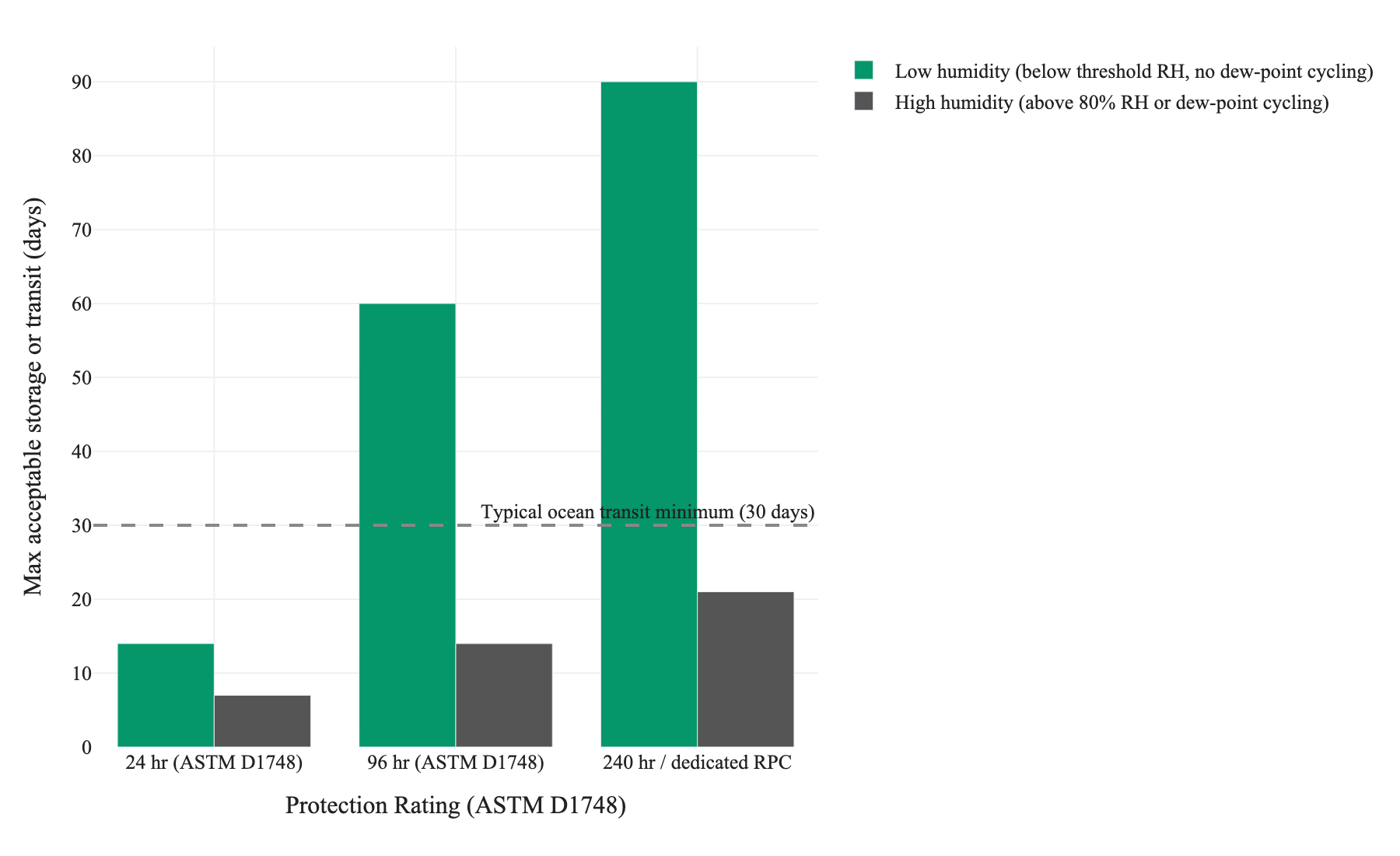
This table maps protection-duration specification against actual humidity exposure and storage time to the predicted field outcome. Use it in combination with Figure 1b (Required Action) to classify a specification and determine the appropriate response.
Protection Rating (ASTM D1748) | Humidity Exposure Class | Storage or Transit Time | Predicted Field Outcome |
|---|---|---|---|
24 hr (short-term indoor) | Below 60% RH, no cycling | Up to 14 days | Acceptable: no visible rust expected on clean carbon steel |
24 hr (short-term indoor) | 60-80% RH, stable | 14 to 30 days | Marginal: surface rust possible at edges and recesses by day 20 to 25 |
24 hr (short-term indoor) | Above 80% RH or cycling with Dew Point excursion | Any duration above 7 days | Failure: visible rust expected; dual-function chemistry insufficient |
96 hr (medium-term indoor) | Below 60% RH, no cycling | Up to 60 days | Acceptable: performance within rated window |
96 hr (medium-term indoor) | 60-80% RH, stable | 30 to 60 days | Marginal: acceptable for ferrous substrates; monitor non-ferrous closely |
96 hr (medium-term indoor) | Above 80% RH or cycling with Dew Point excursion | Any duration above 14 days | Failure: protection boundary exceeded; rust risk on all substrate types |
240 hr or dedicated RPC | Below 80% RH, no Dew Point cycling | Up to 90 days | Acceptable: within rated window for most carbon and alloy steels |
240 hr or dedicated RPC | Above 80% RH or tropical route with Dew Point cycling | Any transit above 21 days | Marginal to acceptable depending on film weight; verify with ASTM B117 salt-spray test on packaging lot |
Figure 1b. Failure-Mode Diagnostic: Protection Rating, Humidity Class, and Required Action
This companion table provides the action column for each row in Figure 1a. Match row by Protection Rating and Humidity Exposure Class.
Protection Rating (ASTM D1748) | Humidity Exposure Class | Storage or Transit Time | Action Required |
|---|---|---|---|
24 hr (short-term indoor) | Below 60% RH, no cycling | Up to 14 days | No change; monitor with humidity indicator card |
24 hr (short-term indoor) | 60-80% RH, stable | 14 to 30 days | Upgrade to 96-hr ASTM D1748 product or add desiccant in packaging |
24 hr (short-term indoor) | Above 80% RH or cycling with Dew Point excursion | Any duration above 7 days | Mandatory switch to dedicated RPC (rust-preventive compound) or VCI (vapor corrosion inhibitor) film |
96 hr (medium-term indoor) | Below 60% RH, no cycling | Up to 60 days | No change |
96 hr (medium-term indoor) | 60-80% RH, stable | 30 to 60 days | Add humidity indicator card inside package; verify at 30-day check |
96 hr (medium-term indoor) | Above 80% RH or cycling with Dew Point excursion | Any duration above 14 days | Switch to wax-based or oil-film RPC (ASTM D665-grade) for ocean export; add VCI inner bag |
240 hr or dedicated RPC | Below 80% RH, no Dew Point cycling | Up to 90 days | Standard export packaging protocol adequate |
240 hr or dedicated RPC | Above 80% RH or tropical route with Dew Point cycling | Any transit above 21 days | Confirm packaging integrity; consider VCI inner bag as supplementary layer for C4+ routes |
The outcomes and actions in Figures 1a and 1b are based on comparative ASTM D1748 and ISO 9227 performance data in corrosion literature and are not a warranty of performance for any specific product formulation. Engineering verification on representative samples per ASTM B117-19 (American Society for Testing and Materials, ASTM B117-19, Standard Practice for Operating Salt Spray Apparatus) is required before specifying a protection system for a new export route or substrate type.
The Carry-Case Humidity Profile: Why Ocean Export Is a Different Problem
The carry case introduces a second compounding factor beyond ambient container humidity: the internal microenvironment of the package itself. A sealed poly bag, blister pack, or chipboard carry case traps the humid air present at pack time and concentrates any moisture outgassing from packaging materials. Corrugated cardboard, foam padding, and non-dried timber dunnage all contribute moisture vapor into the enclosed package headspace. If packaging is sealed at 70 percent relative humidity and the internal temperature drops 10 degrees C during transit, the internal relative humidity rises to approximately 90 to 95 percent, crossing the Dew Point for typical tropical container conditions (verification needed: exact values depend on initial temperature, headspace volume, and material moisture content; this is a representative calculation for illustration).
Dual-function fluids provide no vapor-phase inhibitor protection inside the sealed package. The inhibitor is adsorbed onto the metal surface only; it provides no vapor-phase emission that would scavenge humidity in the package headspace the way a vapor corrosion inhibitor (VCI) film would. This is the specific gap that makes the dual-function approach structurally inadequate for sealed ocean-export packaging, independent of how well the inhibitor film performs in an open indoor storage environment.
IV. Cost of Mis-Specified Protection: Field Rust, Returns, and Warranty
The financial consequence of a protection specification mismatch is not linear with the number of rusted parts. The cost structure of a rust claim on exported components cascades through four separate budget lines, each of which can individually exceed the cost of the correct protection specification that was not used.
The direct cost of the rusted parts themselves is usually the smallest line item. A stamped or machined component that arrives at the customer with visible rust is typically returned as a full shipment lot, not inspected piece by piece, because the rust discovery triggers a batch rejection under most customer quality protocols. A shipment lot of 500 to 2,000 components at USD 2 to USD 15 per piece yields a direct part cost of USD 1,000 to USD 30,000 per rejection event. That range is already meaningful, but it does not include ocean freight return cost, which for a 20-foot container from a Southeast Asian destination runs USD 1,500 to USD 3,500 one-way, or airfreight replacement cost if the customer requires an emergency resupply, which can run USD 8,000 to USD 25,000 for a 300 to 500 kg component lot (verification needed: freight cost ranges are illustrative and based on general export cost benchmarks; actual costs vary significantly by route and carrier).
Warranty exposure adds a third layer. If the component is a sub-assembly in a higher-value end product and the rust causes a field failure or quality downgrade at the customer's assembly stage, the supplier's warranty liability can extend to the full value of the customer's work in process, not just the component cost. In automotive tier-1 supply chains, a single rust claim that stops an assembly line can generate a chargeback of USD 50,000 to USD 250,000 per hour of line stoppage (this figure represents a commonly cited automotive supply chain cost of quality benchmark; verification with a current supplier contract is recommended for specific applications). The corrosion source does not need to cause the line stoppage directly; a quality hold on incoming components pending inspection is sufficient to trigger the chargeback mechanism in many contracts.
The fourth cost line is the most persistent: customer qualification status. A supplier that receives two or more corrosion claims within a 12-month period is typically placed on a corrective action requirement under ISO 9001:2015 customer audit provisions, which requires a formal root-cause investigation and documented preventive action before orders resume at normal volume. The administrative cost of a corrective action cycle, including internal engineering time, customer audit coordination, and documentation, is typically USD 5,000 to USD 20,000, and the revenue impact of order holds during the corrective action period can multiply that figure by 5 to 10 times.
The total cost of a single mis-specified export protection event typically ranges from USD 30,000 to USD 300,000 when all four cost lines are included. The cost of upgrading the protection specification to an appropriate dedicated RPC or VCI system is typically USD 0.05 to USD 0.50 per component in incremental product cost, and USD 500 to USD 3,000 in engineering time to validate the new specification. The cost-benefit ratio in favor of correct specification is at least 100:1 in most export scenarios.
V. Selection by Process Cycle, Storage Duration, and Export Profile
Selecting a protection specification for a mixed-process line serving export markets requires a structured decision that integrates three independent variables: the process cycle (how clean and dry the component surface is when protection is applied, and how long between application and packaging), the storage and transit duration (total time from protection application to customer use), and the export humidity profile (whether the transit route imposes Dew Point cycling or sustained high-humidity conditions).
The following selection guide covers the five most common mixed-process export scenarios. It is designed as an operator-usable reference that can be applied at the product specification review stage without specialized corrosion laboratory equipment.
Figure 2a. Protection Selection Guide: Process Cycle, Duration, and Recommended Protection Class
Process Cycle Condition | Total Duration (Days) | Export Humidity Profile | Recommended Protection Class |
|---|---|---|---|
Aqueous clean with immediate protection application; line speed under 30 min dwell | Up to 30 | Indoor, below 65% RH, no cycling (domestic or air freight) | Dual-function clean-and-protect fluid, 24-hr ASTM D1748 minimum |
Aqueous clean with immediate protection application; line speed under 30 min dwell | Up to 60 | Indoor, 65 to 80% RH, stable (domestic warehouse, temperate region export) | Dual-function fluid with 96-hr ASTM D1748 rating OR dedicated water-displacing RPC applied over a clean surface |
Aqueous clean with immediate protection application | Over 60, or any ocean transit | Ocean export, tropical or monsoon route with Dew Point cycling | Dedicated RPC (oil-film or wax-film grade, minimum 96-hr ASTM D1748) PLUS VCI inner bag (carbon-steel-specific VCI film) |
Machining fluid residue present; oil-mist contamination likely; surface not fully cleaned | Any duration | Any export profile | Step 1: Dedicated alkaline cleaner to confirmed clean surface per ASTM F22 water-break test. Step 2: Dedicated RPC or VCI. Dual-function fluid ONLY acceptable if surface passes water-break test before application |
Mixed-metal substrates (ferrous and non-ferrous in same package) | Any duration | Any export profile with above 60% RH or ocean transit | Dedicated multi-metal RPC or VCI formulated for mixed ferrous/non-ferrous compatibility; confirm absence of copper-accelerating compounds |
Figure 2b. Protection Selection Guide: Standard References and Application Notes
This table provides the standard reference and notes for each scenario in Figure 2a. Match rows by Process Cycle Condition and Total Duration.
Process Cycle Condition | Total Duration (Days) | Standard Reference | Notes |
|---|---|---|---|
Aqueous clean with immediate protection application; line speed under 30 min dwell | Up to 30 | ASTM D1748-16 | Adequate for domestic distribution; confirm with humidity indicator card |
Aqueous clean with immediate protection application; line speed under 30 min dwell | Up to 60 | ASTM D1748-16; ASTM D665-A | Add desiccant (silica gel, 5 g per liter of package headspace) inside sealed package |
Aqueous clean with immediate protection application | Over 60, or any ocean transit | ASTM D1748-16; MIL-PRF-3420H (VCI paper equivalent standard) | Dual-function fluid alone is insufficient; VCI inner bag provides vapor-phase scavenging in sealed package |
Machining fluid residue present; oil-mist contamination likely; surface not fully cleaned | Any duration | ASTM F22-02 (water-break test); ASTM D1748-16 | Dual-function products cannot compensate for inadequate surface preparation; surfactant load in the presence of oil contamination reduces inhibitor adsorption efficiency |
Mixed-metal substrates (ferrous and non-ferrous in same package) | Any duration | ASTM B117-19 (verify on representative mixed-metal sample); consult product data sheet for substrate compatibility matrix | Benzotriazole-class inhibitors required for copper alloys; amine-carboxylate-only formulas may cause copper tarnish |
The selection guide in Figures 2a and 2b is a screening tool. For any application where the export route, substrate type, or packaging design is outside the five scenarios listed, engineering verification on representative samples per ASTM B117-19 salt-spray testing is required before committing to a specification change across a production volume.
How to Verify a New Protection Specification Before Full Adoption
When switching from a dual-function fluid to a dedicated RPC or VCI system, the verification sequence recommended by corrosion engineering practice is the following. First, confirm that the clean-surface condition is reproducible on the production line by running the water-break test per ASTM F22-02 on 10 randomly selected components per shift for one week. Second, seal a sample lot of 20 to 50 components in the actual export packaging under the actual desiccant and VCI conditions, and expose them to 40 degrees C and 95 percent relative humidity for 96 hours in a humidity cabinet, or for the equivalent ASTM D1748 test duration for the rated product. Third, inspect visually and under 10x magnification at the end of the exposure. If any rust is present on the test lot, the specification is not adequate for the rated humidity class.
This three-step verification requires no specialized laboratory equipment beyond a humidity cabinet (available through most contract testing laboratories at USD 200 to USD 500 per test run) and is achievable within two to three weeks for a normal new-product qualification cycle.
VI. Field Cases: Mixed-Process Manufacturing and Export-Ready Component Audits
Case A: Stamped Steel Fastener Exporter, Ocean Transit Rust Claim (Unexpected Cause Pattern)
Company A operated a high-volume stamping and surface-treatment line producing approximately 8,000 kilograms of carbon steel fasteners per shift, with a product mix covering hex bolts, flange nuts, and threaded inserts in S20C and S45C grades. Annual export volume was approximately 950 metric tons, with 60 percent destined for Southeast Asian automotive assembly customers via ocean container. Transit time on the primary route was 22 to 28 days. Company A had used the same dual-function aqueous cleaner-inhibitor concentrate for three years across both domestic and export volumes without a rust claim. The product carried a 96-hour ASTM D1748 humidity-cabinet rating per the supplier's technical data sheet.
In the third year of operation, the export customer mix shifted to include two new accounts in a port city with a documented high-humidity coastal environment classified as ISO 9223 category C3 to C4. Within 90 days of the first shipments to these accounts, Company A received three consecutive rust claims covering a combined 14,600 units across two container loads. The rust pattern was uniform surface bloom on fastener thread flanks and under-head recesses, exactly the geometry where aqueous cleaning solutions pool and inhibitor film deposition is least consistent. The customer's incoming inspection protocol detected 100 percent visible rust on thread flanks at 10x magnification on the first 50 units inspected per lot, triggering full lot rejection.
Initial investigation at Company A focused on the cleaner-inhibitor concentration and process bath temperature, both of which were within the supplier's specified range. Bath pH was 9.2, within the 8.5 to 10.0 operating window. Application was by spray washer at 60 degrees C for 90 seconds contact time, consistent with the product qualification. The investigation did not find a process deviation. The deviation was not in the cleaning line. It was in the packaging specification.
The root-cause finding required packaging the fasteners in their actual export carry case (poly bag sealed inside a corrugated chipboard box with no desiccant) and measuring the headspace relative humidity over 72 hours at ambient conditions in the production facility at the time of peak summer humidity. The headspace relative humidity reached 88 percent within 36 hours, sustained by moisture outgassing from the corrugated board and the residual moisture in the fastener threads from the aqueous cleaning process. The dual-function inhibitor film, rated to 96-hour ASTM D1748 exposure at 49 degrees C and greater than 97 percent RH, was not designed for sustained near-Dew Point conditions inside a sealed package with continuous moisture vapor supply from packaging materials.
Corrective action was implemented in two steps. First, Company A added 10 grams of silica gel desiccant per kilogram of fastener content to each sealed poly bag, reducing measured headspace RH to below 45 percent within 24 hours. Second, a VCI poly bag (carbon-steel-specific, nitrogen-based VCI compound) replaced the plain poly bag for all ocean-export shipments. Cost per kilogram of product increased by USD 0.08. Rust claims ceased within one shipping cycle. The net cost of the three rust claim events before correction, including rejected lot replacement and airfreight on two emergency resupply shipments, was estimated at USD 94,000. The annual incremental cost of the corrective packaging specification was USD 11,400, representing a return on specification upgrade of approximately 8:1 in year one alone.
Case B: Hydraulic Component Manufacturer, Mixed-Metal Export Audit (Trial-and-Error Pattern)
Company B manufactured hydraulic valve bodies and manifolds from a mix of gray cast iron, ductile iron, and copper-alloy pilot ports, with a production volume of approximately 2,400 units per month. Export volume was 35 percent of production, primarily to European industrial OEM customers via container shipment on routes averaging 18 to 24 days. The protection specification was a dual-function semi-synthetic cleaner-inhibitor rated for mixed-metal compatibility on the supplier's data sheet, applied through an ultrasonic bath followed by a forced-air drying tunnel at 80 degrees C for 8 minutes.
Company B first encountered a rust claim when a European OEM customer reported red oxide staining on the cast-iron valve body faces of 12 units in a shipment of 80 units. The customer's inspection protocol required cosmetically clean valve faces for optical seal inspection; the rust staining was not a functional failure but triggered a non-conformance report under the customer's quality system. Company B's first response was to increase the dual-function fluid concentration from 3 percent to 5 percent in the process bath, consistent with the supplier's recommendation for aggressive environments. The next two shipments, processed at 5 percent concentration, also produced rust claims on cast-iron faces.
The second investigation examined the drying cycle. The forced-air drying tunnel was confirmed to reach 78 degrees C at the part surface, consistent with the specification. Dwell time was 8 minutes, consistent with the qualifier test. The investigation then examined the export carry case: components were individually wrapped in VCI paper, placed in foam-lined chipboard boxes, and sealed with tape. The VCI paper was a generic mixed-metal inhibitor paper specified for ferrous and non-ferrous substrates. Inspection of the paper specification revealed that the VCI inhibitor compound included an amine-type inhibitor at a concentration targeted for ferrous substrates, with no benzotriazole-class inhibitor component for copper alloys.
The copper-alloy pilot ports were developing a thin copper oxide tarnish layer during the ocean transit, which was the expected behavior in the absence of a benzotriazole-class inhibitor on the copper surface. That copper oxide layer, combined with the condensation-deposited moisture on the valve body faces in close physical contact with the copper ports, was creating an electrochemical cell that accelerated cast-iron face corrosion at the point of closest proximity. The dual-function fluid's amine-carboxylate inhibitor package on the cast-iron surface was being overwhelmed by the locally elevated electrochemical activity, not by a general failure of the inhibitor concentration.
Corrective action required two changes. Company B replaced the generic VCI paper with a benzotriazole-containing multi-metal VCI paper specified for ferrous and copper alloy co-packaging. The dual-function fluid concentration was returned to 3 percent, which had been adequate before the copper-mediated acceleration was resolved. After the specification change, rust and tarnish claims were eliminated over the following 6-month period covering 14 shipments and 1,680 units. The earlier attempt to resolve the problem by increasing the dual-function fluid concentration at 5 percent had cost an incremental USD 3,200 in product cost over the two failed shipment cycles without resolving the root cause.
VII. Key Takeaway
Dual-function clean-and-protect fluids rated at 96-hour ASTM D1748 performance are adequate for domestic indoor storage up to 60 days at or below 65 percent relative humidity, but they deposit inhibitor films of 0.01 to 0.1 micrometers that cannot sustain protection during Dew Point condensation cycling inside sealed ocean-export carry cases. The chemistry boundary is structural, not a product-quality failure.
The decisive variable for ocean export is the carry-case humidity profile, not transit duration. A 28-day tropical route with packaging sealed at 70 percent RH and no desiccant creates an internal headspace that routinely reaches 85 to 95 percent RH, exceeding the corrosivity class for which dual-function products are designed.
The failure-mode diagnostic tables (Figures 1a and 1b) map protection-duration rating against humidity class and storage time to predicted field outcome and action. Use them at the specification review stage, before a product line is committed to an export packaging specification.
Mixed-metal export packages require explicit verification of VCI inhibitor compatibility with every metal type present. Amine-carboxylate inhibitors adequate for ferrous substrates will not protect copper alloys, and the resulting copper oxide tarnish can accelerate corrosion on adjacent ferrous surfaces through electrochemical cell formation.
The total cost of a single mis-specified export protection event typically ranges from USD 30,000 to USD 300,000 when rejected-lot replacement, airfreight resupply, warranty exposure, and corrective-action overhead are included. The incremental cost of the correct specification is typically USD 0.05 to USD 0.50 per component.
When a protection failure has already occurred in the field, submit the case details (component specification, process conditions, packaging description, humidity data if available, and failure photos) to AI Shooting for a structured one-case diagnosis. For export lines where this protection specification decision recurs across multiple product families or shipping seasons, the progression to AI Crew provides continuous humidity and corrosion pattern surveillance across the production and packaging workflow, reducing the reliance on post-claim root cause analysis.
VIII. References
American Society for Testing and Materials. (2002). ASTM F22-02: Standard Test Method for Hydrophobic Surface Films by the Water-Break Test. ASTM International. https://www.astm.org/f0022-02.html
American Society for Testing and Materials. (2016). ASTM D1748-16: Standard Test Method for Rust Protection by Metal Preservatives in the Humidity Cabinet. ASTM International. https://www.astm.org/d1748-16.html
American Society for Testing and Materials. (2019). ASTM B117-19: Standard Practice for Operating Salt Spray (Fog) Apparatus. ASTM International. https://www.astm.org/b0117-19.html
American Society for Testing and Materials. (2015). ASTM D665-15: Standard Test Method for Rust-Preventing Characteristics of Inhibited Mineral Oil in the Presence of Water. ASTM International. https://www.astm.org/d0665-15.html
AMPP (formerly NACE International and SSPC). (2021). Corrosion Costs and Preventive Strategies in the Industrial Sector. AMPP. https://www.ampp.org/resources/corrosion-costs
International Organization for Standardization. (2012). ISO 9223:2012: Corrosion of Metals and Alloys -- Corrosivity of Atmospheres -- Classification, Determination, and Estimation. ISO. https://www.iso.org/standard/51819.html
International Organization for Standardization. (2017). ISO 9227:2017: Corrosion Tests in Artificial Atmospheres -- Salt Spray Tests. ISO. https://www.iso.org/standard/63543.html
Roberge, P. R. (2019). Corrosion Engineering: Principles and Practice (2nd ed.). McGraw-Hill. https://www.mhprofessional.com/corrosion-engineering-principles-and-practice-9781259860508-usa
Shreir, L. L., Jarman, R. A., & Burstein, G. T. (Eds.). (1994). Corrosion: Metal/Environment Reactions (3rd ed.). Butterworth-Heinemann. https://www.sciencedirect.com/book/9780750610490
Trabanelli, G. (1991). Inhibitors -- An old remedy for a new challenge. Corrosion, 47(6), 410-419. https://doi.org/10.5006/1.3585268
U.S. Department of Defense. (2003). MIL-PRF-3420H: Performance Specification -- Wrapping Material, Volatile Corrosion Inhibitor Treated, Opaque. Defense Technical Information Center. https://www.eaton.com/content/dam/eaton/products/specialty-hydraulics/pdf/mil-prf-3420h.pdf
Wharton, J. A., Barik, R. C., Kear, G., Wood, R. J. K., Stokes, K. R., & Walsh, F. C. (2005). The corrosion of nickel-aluminium bronze in seawater. Corrosion Science, 47(12), 3336-3367. https://doi.org/10.1016/j.corsci.2005.05.053