Why Alkaline Cleaners Fail on Aluminum Substrates: The Etching and Staining Mechanism
Summary: Alkaline cleaning of aluminum parts is one of the most common sources of surface damage in industrial manufacturing. Dark staining, pitting, and visible etching on 6000-series alloys after cleaning are frequently reported but poorly understood at the mechanism level. This article traces the root cause from the amphoteric dissolution of the aluminum oxide layer in high-pH environments through the galvanic micro-cell corrosion role of alloying elements such as copper, magnesium, and silicon. The practical outcome is a pH-alloy compatibility matrix and inhibitor selection guide that enables engineers to clean aluminum safely across common industrial alloy grades.
Table of Contents
I. The Problem: Surface Damage After Alkaline Cleaning
II. How Aluminum Dissolves in Alkaline Environments
III. The Role of Alloying Elements in Cleaning Damage
IV. Root Cause Identification: Three Failure Modes
V. pH-Alloy Compatibility and Inhibitor Selection
VI. Bath Monitoring and Process Control
VII. Field Cases: When Cleaning Chemistry Mismatches the Alloy
VIII. Key Takeaway
IX. References
I. The Problem: Surface Damage After Alkaline Cleaning
Aluminum parts returned from alkaline cleaning operations with dark staining, surface haze, or visible pitting represent one of the most persistent quality problems in metalworking, automotive components, and electronics manufacturing. The damage is particularly common on 6000-series alloys (6061, 6063) that are widely used in structural extrusions, machined components, and heat sinks. Field reports consistently describe the same pattern: parts enter the cleaning bath in good condition and exit with surface defects that range from cosmetic discoloration to functional damage that compromises downstream processes such as anodizing, painting, or adhesive bonding.
Why This Problem Persists
The problem persists because troubleshooting focuses on process parameters without understanding the underlying electrochemical mechanism. A pH safe for steel cleaning can be destructive to aluminum within minutes. Many facilities run multi-metal cleaning lines where steel and aluminum share the same bath. The cleaner is formulated for steel, and aluminum parts are exposed to conditions that exceed their electrochemical tolerance.
The Stakes
Aluminum surface damage during cleaning affects part quality, production yield, and customer relationships. In precision manufacturing, even minor surface etching can change dimensional tolerances. In decorative applications such as architectural extrusions, any visible staining is an automatic rejection criterion. In bonded assemblies, oxide layer damage reduces adhesion reliability. For anodizing operations, surface etching creates uneven oxide film thickness, resulting in color inconsistency and reduced corrosion protection. The downstream cost extends beyond scrap value to include rework labor, production disruption, and customer claims.
The Scale of the Issue
Alkaline cleaners represent approximately 60 to 70 percent of all aqueous industrial cleaning chemistry in metalworking. As aluminum usage grows across automotive lightweighting, electronics, and architectural applications, cleaning-related damage incidents increase proportionally. The problem is systemic, and it follows a predictable electrochemical pattern that can be prevented once the mechanism is understood.
II. How Aluminum Dissolves in Alkaline Environments
Aluminum is amphoteric, meaning it dissolves in both acidic and alkaline environments. This distinguishes it from most engineering metals and is the fundamental reason why alkaline cleaners designed for steel are risky for aluminum. The Pourbaix diagram shows that the protective aluminum oxide layer (Al2O3) is stable only within approximately pH 4 to 9 (Corrosion Doctors, 2024). Outside this range, the oxide dissolves and the base metal is exposed to direct chemical attack.
The Pourbaix Diagram and Oxide Stability
The Pourbaix diagram reveals three distinct regions. In the passive region (pH 4 to 9), hydrated aluminum oxide provides a stable barrier. Below pH 4, the oxide dissolves to form Al3+ ions, and above pH 9, it dissolves to form aluminate ions (AlO2-). The transition from passive to active dissolution is not gradual. Once pH exceeds the oxide stability threshold, dissolution accelerates rapidly, particularly at elevated temperatures. A cleaning solution at pH 9.5 may cause only minor dulling, while the same formulation at pH 10.5 can produce visible etching within minutes.
The Aluminate Formation Reaction
In alkaline solutions, aluminum reacts with sodium hydroxide and water to produce sodium aluminate (NaAlO2) and hydrogen gas. This reaction is exothermic and self-accelerating: as the oxide dissolves, fresh aluminum reacts more aggressively. Hydrogen gas evolution creates visible bubbling on the part surface, a useful diagnostic indicator that the bath pH is too high for the alloy.
The dissolution rate follows Arrhenius kinetics with an activation energy of approximately 50 kJ/mol (ScienceDirect, 2024), meaning the rate approximately doubles per 10 degrees Celsius. A bath marginally safe at 40 degrees Celsius can become destructive at 60 degrees Celsius with no change in pH.
The Oxide Layer as the Critical Barrier
The entire mechanism hinges on the integrity of the aluminum oxide layer. The native oxide forms within milliseconds of air exposure and reaches approximately 2 to 5 nanometers thick. This layer is self-healing in neutral environments. In alkaline environments above the stability threshold, the oxide dissolves faster than it can reform.
Once breached, the base metal is vulnerable to three concurrent attack mechanisms: direct chemical dissolution into aluminate ions, hydrogen evolution at cathodic sites which creates mechanical pitting, and galvanic corrosion driven by potential differences between the aluminum matrix and alloying element precipitates. The dissolution rate can exceed 10 milligrams per square centimeter per hour at pH 10 to 11 and 60 degrees Celsius.
Temperature Acceleration
Temperature is the single most critical accelerator. At room temperature, a pH 10 solution may cause only minor dulling after 30 minutes. At 60 degrees Celsius, the same solution can cause visible etching within 5 minutes. Most industrial cleaning operations run at 50 to 70 degrees Celsius for effective oil removal, placing the process in the zone of maximum dissolution risk.
The temperature effect is compounded by two factors. First, silicate inhibitor degradation also accelerates with temperature, meaning the protective chemistry weakens faster in heated baths. Second, higher temperatures increase dissolved aluminum solubility, delaying precipitation that would otherwise slow the reaction. Heated alkaline baths attack aluminum faster, lose their inhibitor faster, and sustain the attack longer.
III. The Role of Alloying Elements in Cleaning Damage
Pure aluminum dissolves uniformly in alkaline attack. However, industrial alloys contain copper, magnesium, silicon, manganese, and zinc that create localized electrochemical heterogeneity. This heterogeneity explains why cleaning damage on alloys appears as localized pitting, staining, and roughening rather than uniform dissolution, following a pattern dictated by the alloy's microstructure.
Galvanic Micro-Cell Formation
In 6000-series alloys, magnesium silicide (Mg2Si) precipitates form during aging heat treatment. These precipitates have a different electrochemical potential than the surrounding aluminum matrix, creating galvanic micro-cells when exposed to an electrolyte. The Mg2Si precipitates are anodic relative to the matrix, meaning they dissolve preferentially when the oxide layer is compromised, creating microscopic pits that appear as surface roughening or haze after cleaning.
The precipitate characteristics depend on heat treatment condition. A T6 temper produces finely dispersed precipitates resulting in uniform micro-pitting that appears as even surface haze. A T4 temper has fewer, coarser precipitates that produce more localized pitting. Cleaning parameters acceptable for one temper may cause visible damage to another temper of the same alloy.
Copper-Containing Alloys: The Worst Case
Alloys with significant copper content, such as 2024 (4.4 percent Cu), present the most severe challenge. Copper-rich intermetallics (Al2Cu, Al2CuMg) are cathodic relative to the aluminum matrix, reversing the polarity compared to Mg2Si. Instead of the precipitate dissolving, surrounding aluminum dissolves preferentially around the copper particles. Al2CuMg, the most abundant intermetallic in 2024-T3, is largely responsible for its localized corrosion vulnerability (PMC, 2024).
This creates deep localized pitting and the characteristic dark staining pattern. The dark appearance results from copper particles left exposed after the surrounding aluminum is etched away. The copper-enriched surface then acts as a persistent cathode that accelerates further corrosion, creating a self-reinforcing damage cycle that continues if residual alkaline solution is not thoroughly rinsed.
The 5xxx and 7xxx Series
The 5xxx series (Al-Mg) alloys with magnesium above 3 percent can develop beta-phase (Al3Mg2) precipitates along grain boundaries through sensitization. In alkaline cleaning, this beta-phase dissolves preferentially along grain boundaries, causing intergranular corrosion that penetrates deep into the material and reduces mechanical properties without visible surface staining.
The 7xxx series (Al-Zn-Mg) exhibits the most rapid dissolution rate among common alloy families. The strengthening precipitate MgZn2 is strongly anodic, and its high volume fraction creates a dense micro-cell network. Research measured corrosion current densities of approximately 300 microamps per square centimeter for 6061 in alkaline solutions, with 7xxx alloys exhibiting even higher values (ScienceDirect, 2021).
Figure 1. pH vs. Alloy Series Damage Risk Heatmap
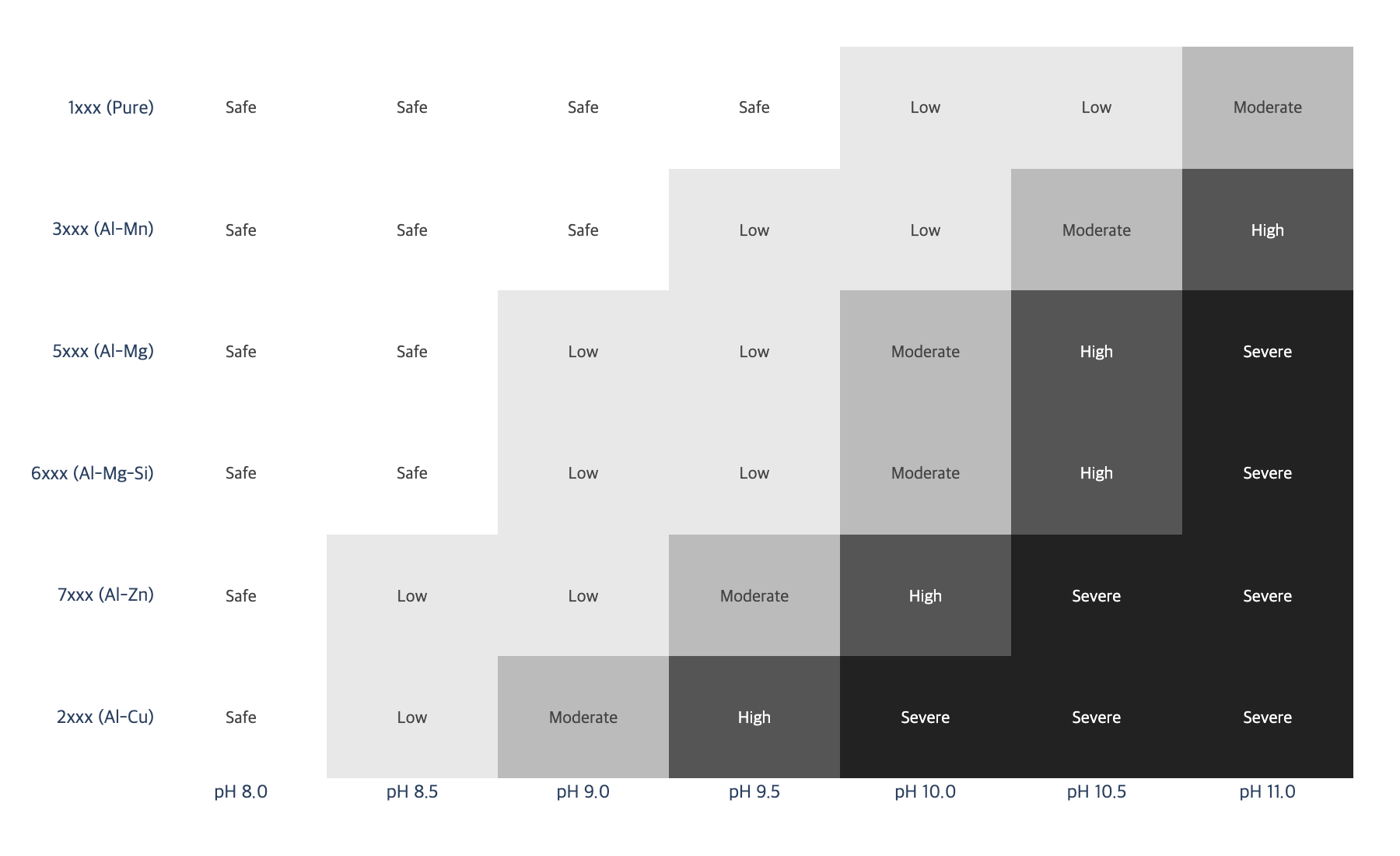
Figure 1b. Galvanic Potential Differences in Common Aluminum Alloys
Alloy Series | Primary Alloying Element | Key Precipitate | Galvanic Behavior in Alkaline | Damage Risk |
|---|---|---|---|---|
1xxx (pure) | None | None | Uniform dissolution | Low |
2xxx | Copper (3-5%) | Al2Cu, Al2CuMg | Severe localized pitting (Cu cathodic) | Very high |
3xxx | Manganese (1-1.5%) | Al6Mn | Mild localized pitting | Low-medium |
5xxx | Magnesium (2-5%) | Al3Mg2 (beta) | Intergranular attack if sensitized | Medium |
6xxx | Mg + Si (0.5-1.2%) | Mg2Si | Preferential precipitate dissolution | Medium-high |
7xxx | Zinc (5-8%) | MgZn2 (eta) | Rapid general attack | High |
Cleaning risk depends on alloy composition and electrochemical heterogeneity, not pH alone. A cleaner safe for 1xxx series may cause severe damage to 2xxx or 7xxx at the same pH and temperature. Temper condition adds another variable, as heat treatments change precipitate characteristics within the same alloy grade.
IV. Root Cause Identification: Three Failure Modes
Field investigations of aluminum cleaning damage consistently trace to one or more of three root causes. Understanding these modes allows targeted corrective action rather than generalized adjustments.
Failure Mode 1: Cleaner pH Too High for Alloy Grade
Many industrial alkaline cleaners are formulated for steel at pH 11 to 13. Applied to aluminum without reformulation, the pH exceeds the oxide stability threshold. The safe ceiling varies by alloy: 1xxx tolerates pH 10.5 with inhibitors, while 2xxx should not exceed pH 9. This is common in job shops where the bath is formulated for steel and aluminum parts are processed without adjustment.
Failure Mode 2: Excessive Dwell Time
Even cleaners within the acceptable pH range cause damage if dwell time is not controlled. A 3-minute cycle may produce acceptable results, but 10 minutes at the same conditions can produce visible etching. For 2xxx alloys at 50 degrees Celsius, the margin between acceptable cleaning and visible damage can be as little as 2 minutes. Dwell time limits must be established per alloy-temperature-pH combination, and production systems should include automatic cycle timers.
Failure Mode 3: Inadequate or Degraded Inhibitor Package
Silicate-based inhibitors (sodium metasilicate, Na2SiO3) form a protective aluminosilicate film that blocks alkaline contact with the metal (Allan Chemical Corporation, 2024), extending the safe pH range by 1 to 2 units. However, silicates degrade in heated solutions through polymerization. A fresh bath may safely clean at pH 10, but after 4 to 6 weeks, active silicate drops below the effective threshold.
This failure mode is invisible during routine monitoring. Bath pH, temperature, and concentration may all test within specification while inhibitor activity is critically low. Only a silicate activity test or corrosion coupon test can identify the root cause.
V. pH-Alloy Compatibility and Inhibitor Selection
Preventing damage requires matching cleaner chemistry to the alloy grade and controlling process variables. The following matrix and inhibitor guide provide the framework.
Figure 2. pH-Alloy Compatibility Matrix
Alloy Grade | Maximum Safe pH (with silicate inhibitor) | Maximum Safe pH (without inhibitor) | Maximum Temperature | Maximum Dwell Time |
|---|---|---|---|---|
1xxx (pure Al) | 11.0 | 9.5 | 65C | 10 min |
3xxx (Al-Mn) | 10.5 | 9.0 | 60C | 8 min |
5xxx (Al-Mg) | 10.0 | 8.5 | 55C | 5 min |
6xxx (Al-Mg-Si) | 10.0 | 8.5 | 55C | 5 min |
2xxx (Al-Cu) | 9.0 | 8.0 | 45C | 3 min |
7xxx (Al-Zn) | 9.5 | 8.5 | 50C | 3 min |
The copper-containing 2xxx series has the narrowest safe window, requiring both low pH and low temperature. The values assume fresh inhibitor at recommended concentration. As inhibitor degrades, effective safe pH decreases toward the uninhibited column values, making bath monitoring essential.
Inhibitor Selection Guide
Three inhibitor strategies are used for aluminum-safe alkaline cleaning, each with distinct mechanisms.
Sodium metasilicate (Na2SiO3) forms a thin aluminosilicate barrier film on the metal surface. Effective up to pH 11 when fresh, it degrades in heated baths as silicate monomers polymerize. Typical concentrations are 5 to 15 grams per liter, with replenishment every 2 to 4 weeks.
Sodium gluconate provides chelation-based protection, sequestering dissolved aluminum and copper ions rather than forming a barrier film. This reduces both staining from aluminum hydroxide re-deposition and galvanic pitting on copper-containing alloys. Effective at 0.5 to 2.0 percent by weight (IntechOpen, 2023), gluconate excels as a secondary inhibitor alongside silicates for 2xxx alloys.
Phosphate-silicate combinations offer the broadest protection range and best bath life. Phosphate stabilizes silicate against polymerization, extending bath life by 30 to 50 percent. The trade-off is increased wastewater treatment complexity.
Figure 2b. Inhibitor Strategy Comparison
Inhibitor Type | Mechanism | Effective pH Range | Typical Concentration | Bath Life | Best Application |
|---|---|---|---|---|---|
Sodium metasilicate | Barrier film (aluminosilicate) | Up to pH 11 | 5-15 g/L | 2-4 weeks | General aluminum cleaning |
Sodium gluconate | Chelation of metal ions | Up to pH 10 | 0.5-2.0 wt% | 4-6 weeks | Cu-containing alloys (2xxx) |
Phosphate-silicate blend | Dual film formation | Up to pH 11.5 | Proprietary blend | 4-8 weeks | High-volume multi-alloy lines |
For single-alloy 6xxx operations, sodium metasilicate with proper replenishment is usually sufficient. For mixed-alloy operations including 2xxx alloys, a gluconate-silicate combination provides better coverage. For high-volume lines, phosphate-silicate blends justify their higher cost through reduced rejects and longer bath life.
VI. Bath Monitoring and Process Control
Correct initial chemistry is necessary but not sufficient. The bath is a dynamic system where concentrations and inhibitor activity change continuously. Without monitoring, a bath that starts within safe parameters will drift into damaging conditions.
Dissolved Aluminum Accumulation
As aluminum parts are cleaned, dissolved aluminum accumulates. Alkaline etching baths can hold up to 150 grams per liter depending on caustic concentration and temperature (Products Finishing, 2024). As the aluminum-to-free-soda ratio increases, effective alkalinity decreases, reducing cleaning power. The common response of adding concentrated cleaner raises pH and accelerates dissolution of the next batch, creating a progressive drift cycle.
Dissolved aluminum should be monitored weekly with a practical upper limit of 20 to 30 grams per liter. Above this level, partially drain and replenish with fresh solution rather than topping up with concentrate.
Inhibitor Activity Monitoring
Standard bath tests do not directly measure inhibitor activity. Two practical methods exist. The first is direct silicate analysis using a molybdate-based colorimetric test that measures active monomeric silicate, targeting above 70 percent of the initial level. The second is a corrosion coupon test where an aluminum coupon of the most sensitive alloy on the line is immersed in a bath sample. Weight loss or surface inspection provides a direct pass-fail result without specialized reagents.
Rinse Water Quality
Alkaline residues left on the surface continue dissolving the oxide layer after cleaning. The final rinse should not exceed 600 microsiemens per centimeter total dissolved solids (Proceco, 2024). For 2xxx alloys, an acid desmut step (5 to 10 percent nitric acid, 15 to 30 seconds) between alkaline cleaning and final rinse removes the copper-enriched surface layer.
VII. Field Cases: When Cleaning Chemistry Mismatches the Alloy
The following cases illustrate how these mechanisms manifest in production environments, following the same diagnostic pattern: identify the alloy-specific vulnerability, match it to bath conditions, and apply targeted corrections.
Case 1: Dark Staining on 6063 Extrusions
Company A, a manufacturer of architectural aluminum extrusions (6063-T5), reported dark gray staining on 15 percent of parts after alkaline cleaning prior to anodizing. Production volume was 8,000 linear meters per month. The bath operated at pH 11.2 and 60 degrees Celsius with a multi-metal cleaner, running 6 weeks since the last replacement.
Investigation revealed that the silicate inhibitor had dropped to 40 percent of the specified level, well below the 70 percent minimum threshold. Dissolved aluminum was 45 grams per liter, which had prompted operators to increase cleaner concentration, inadvertently raising pH from the original setpoint of 10.5.
First, the bath was drained to 50 percent and replenished, reducing dissolved aluminum to 18 grams per liter and pH to 10.0. Second, fresh silicate inhibitor was added at 1.5 times standard concentration. Third, weekly bath analysis was implemented with trigger points at 70 percent inhibitor level and 30 grams per liter dissolved aluminum. Staining rate dropped from 15 percent to 0.3 percent within 2 weeks. Annual savings exceeded USD 85,000 in quality losses plus USD 30,000 in rework labor.
Figure 3. Defect Rate Before and After Corrective Action
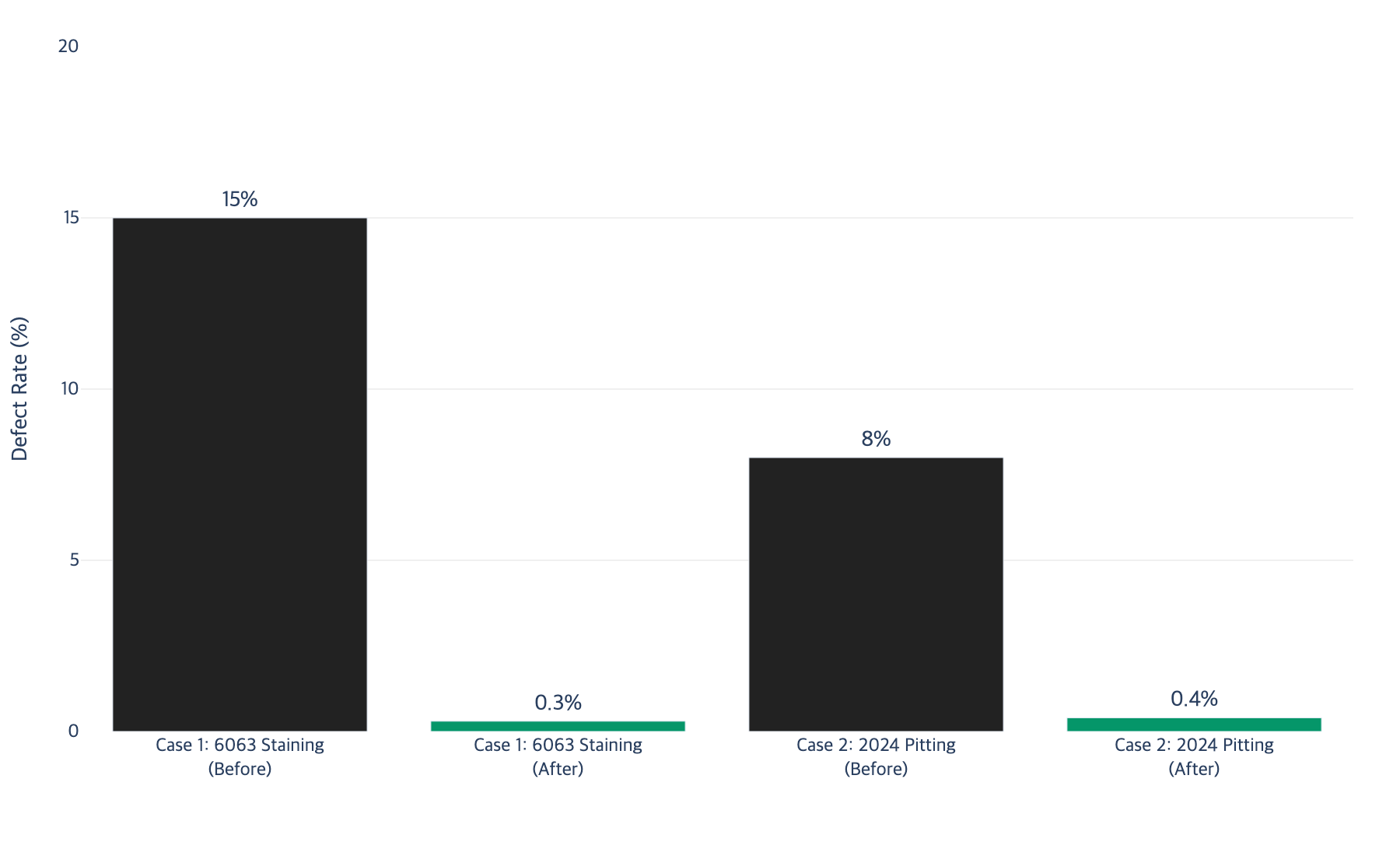
The chart shows the transition from a 15 percent baseline to 0.3 percent over approximately 2 weeks as bath chemistry equilibrated and silicate film coverage re-established.
Case 2: Pitting on 2024 Aerospace Components
Company B, a tier-2 aerospace manufacturer processing 2024-T3 fittings, observed localized pitting after alkaline cleaning. Eight percent of parts failed inspection, with pitting concentrated around copper precipitates. The bath operated at pH 9.5 and 55 degrees Celsius with a 5-minute cycle.
Root cause analysis identified aggressive galvanic micro-cells between Al2CuMg intermetallics and the aluminum matrix. The pH-alloy compatibility matrix shows that 2024 should not exceed pH 9.0 and 45 degrees Celsius. Company B exceeded both limits, and the 5-minute dwell time allowed galvanic pitting to create visible craters around copper-rich particles.
First, pH was reduced to 8.5 with a reformulated cleaner including sodium gluconate at 1.5 percent. Second, temperature was reduced from 55 to 42 degrees Celsius with increased surfactant to maintain cleaning effectiveness. Third, dwell time was cut from 5 to 2 minutes, validated through water-break testing. Fourth, a post-cleaning acid desmut step (5 percent nitric acid, 30 seconds) was added. Defect rate dropped from 8 percent to 0.4 percent. Annual rework savings: approximately USD 120,000.
Case 3: Intermittent Haze on 7075 Structural Parts
Company C, a manufacturer of 7075-T6 structural components, experienced intermittent surface haze affecting 5 percent of batches, with those batches showing 40 to 60 percent rejection rates. Bath parameters appeared consistent between affected and unaffected batches.
Investigation tracked the pattern to production scheduling. Affected batches were processed on Monday mornings or after idle periods exceeding 16 hours. During idle periods, the heated bath continued to polymerize its silicate inhibitor while bulk chemistry parameters remained within specification.
First, an automatic silicate replenishment system was installed with an 8-hour dosing timer. Second, the first batch after idle periods exceeding 12 hours was designated a coupon test batch. Third, idle temperature was reduced from 50 to 35 degrees Celsius to slow polymerization. Intermittent haze was eliminated. The dosing system paid for itself within 3 months.
VIII. Key Takeaway
Aluminum is amphoteric and its protective oxide layer dissolves above pH 9, as shown in the Pourbaix diagram, making alkaline cleaners inherently risky for aluminum substrates
Alloying elements create galvanic micro-cells that cause localized pitting and staining, with copper-containing 2xxx alloys at highest risk due to cathodic intermetallics that accelerate matrix dissolution
The three root causes are cleaner pH too high for the alloy, excessive dwell time, and degraded silicate inhibitor, often occurring simultaneously
Use the pH-alloy compatibility matrix to set maximum pH, temperature, and dwell time per alloy series, and implement weekly bath analysis for inhibitor and dissolved aluminum monitoring
Safe aluminum cleaning protocol: confirm alloy grade and temper, verify cleaner pH and active inhibitor status against the matrix, control dwell time to minimum effective duration
Lubinpla's AI platform can cross-reference alloy composition and temper condition with cleaner chemistry, inhibitor activity, and operating conditions to identify optimal cleaning parameters for any aluminum substrate. Rather than relying on generic guidelines or trial-and-error, engineers can query the platform with their specific alloy grade and process constraints to receive condition-specific recommendations grounded in the electrochemical mechanisms described above.
IX. References
[1] Corrosion Doctors, "Potential-pH Diagram for Aluminum", 2024. https://corrosion-doctors.org/Corrosion-Thermodynamics/Potential-pH-diagram-aluminum.htm
[2] NMFRC, "Alkaline Etching of Aluminum and Its Alloys: A New Caustic Soda Recovery System", 2002. https://www.nmfrc.org/pdf/sf2002/sf02a01.pdf
[3] Products Finishing, "Aluminum Surface Finishing Corrosion Causes and Troubleshooting", 2024. https://www.pfonline.com/articles/aluminum-surface-finishing-corrosion-causes-and-troubleshooting
[4] Products Finishing, "How to Carefully Maintain Your Alkaline Etching Bath", 2024. https://www.pfonline.com/articles/how-to-carefully-maintain-your-alkaline-etching-bath-
[5] Finishing.com, "Remove Aluminum from Etching and Anodizing Baths", 2024. https://www.finishing.com/55/82.shtml
[6] ScienceDirect, "Hydrogen Production from Aluminum Reaction with NaOH Solution: Experiments and Insight into Reaction Kinetics", 2024. https://www.sciencedirect.com/science/article/pii/S036031992403307X
[7] ScienceDirect, "Investigation on Corrosion Behaviour of Aluminium 6061-T6 in Acidic, Alkaline and Salt Medium", 2021. https://www.sciencedirect.com/science/article/abs/pii/S2214785320367687
[8] PMC, "A Review of the Electrochemical and Galvanic Corrosion Behavior of Important Intermetallic Compounds in the Context of Aluminum Alloys", 2024. https://pmc.ncbi.nlm.nih.gov/articles/PMC11462131/
[9] IntechOpen, "Gluconates as Corrosion Inhibitor of Aluminum in Various Corrosive Media", 2023. https://www.intechopen.com/chapters/58025
[10] Allan Chemical Corporation, "Sodium Metasilicate Pentahydrate: Detergent Builder and Corrosion Control", 2024. https://allanchem.com/sodium-metasilicate-pentahydrate-detergent-builder-corrosion-control/
[11] Proceco, "The Importance of Rinsing in Metal Cleaning and Surface Treatment", 2024. https://www.proceco.com/blogs/the-importance-of-rinsing-in-metal-cleaning-and-surface-treatment
[12] MDPI Coatings, "Corrosion Behavior of Aluminum Alloys in Different Alkaline Environments: Effect of Alloying Elements and Anodization Treatments", 2024. https://www.mdpi.com/2079-6412/14/2/240
[13] Products Finishing, "Controlling Dissolved Aluminum in the Type II and Type III Anodizing Bath", 2024. https://www.pfonline.com/articles/controlling-dissolved-aluminum-in-the-type-ii-and-type-iii-anodizing-bath
[14] ResearchGate, "Effect of Alkaline Cleaning and Activation on Aluminum Alloy 7075-T6", 2023. https://www.researchgate.net/publication/216138498_Effect_of_Alkaline_Cleaning_and_Activation_on_Aluminum_Alloy_7075-T6
[15] PMC, "Corrosion Inhibition Study of 6061 Aluminium Alloy", 2023. https://pmc.ncbi.nlm.nih.gov/articles/PMC10195904/
Powered by Lubinpla
Discover how technical teams solve complex challenges faster with AI.