Why Cleaning Fails: Diagnosing Residue Problems in Industrial Parts Washing
Summary: Cleaning failures in industrial parts washing, where residues persist despite repeated wash cycles, are typically addressed by increasing concentration, temperature, or cycle time. These brute-force adjustments frequently make the problem worse by causing redeposition, substrate damage, or chemical incompatibility. This article provides a residue identification framework that distinguishes organic, inorganic, and mixed contamination, and connects each type to the correct cleaning chemistry and process parameters. Using the Sinner Circle model as a diagnostic backbone, the framework walks field engineers through a structured sequence from residue classification to root cause isolation to chemistry selection. By diagnosing the residue type before adjusting the process, engineers can eliminate rework, reduce cleaning chemical consumption, and achieve consistent cleanliness specifications on the first pass.
Table of Contents
I. The Hidden Cost of Cleaning Failures
II. The Sinner Circle: Why Cleaning Is a Four-Variable Equation
III. Residue Identification: Organic vs Inorganic vs Mixed
IV. The Diagnostic Sequence: From Residue to Root Cause
V. Cleaning Chemistry Selection by Contaminant-Substrate Combination
VI. Mechanical Energy Selection: Matching Agitation to the Cleaning Task
VII. Common Pitfalls: When More Is Not Better
VIII. Key Takeaway
IX. References
I. The Hidden Cost of Cleaning Failures
Industrial parts cleaning is a process step that receives disproportionately little engineering attention despite its significant impact on product quality and manufacturing costs. In many facilities, the wash system is treated as a utility rather than a controlled process. When cleaning fails, the consequences cascade through downstream operations: coating adhesion failures, assembly defects, measurement errors, and customer quality claims.
The Scale of the Problem
A parts washing operation that produces 5 percent residue-related rejects on components valued at USD 50 to USD 500 each can generate USD 100,000 or more in annual rework and scrap costs in a medium-volume production facility. Top-performing manufacturers lose as little as 0.6 percent of their revenue to scrap and rework, while lower-performing facilities lose closer to 2.2 percent (KC Professional, 2023). Industry cost-of-quality studies consistently show that investing USD 1 in prevention saves USD 10 in internal failure costs and USD 100 in external failure costs (LNS Research, 2023).
Figure 3. Cleaning Failure Root Cause Breakdown
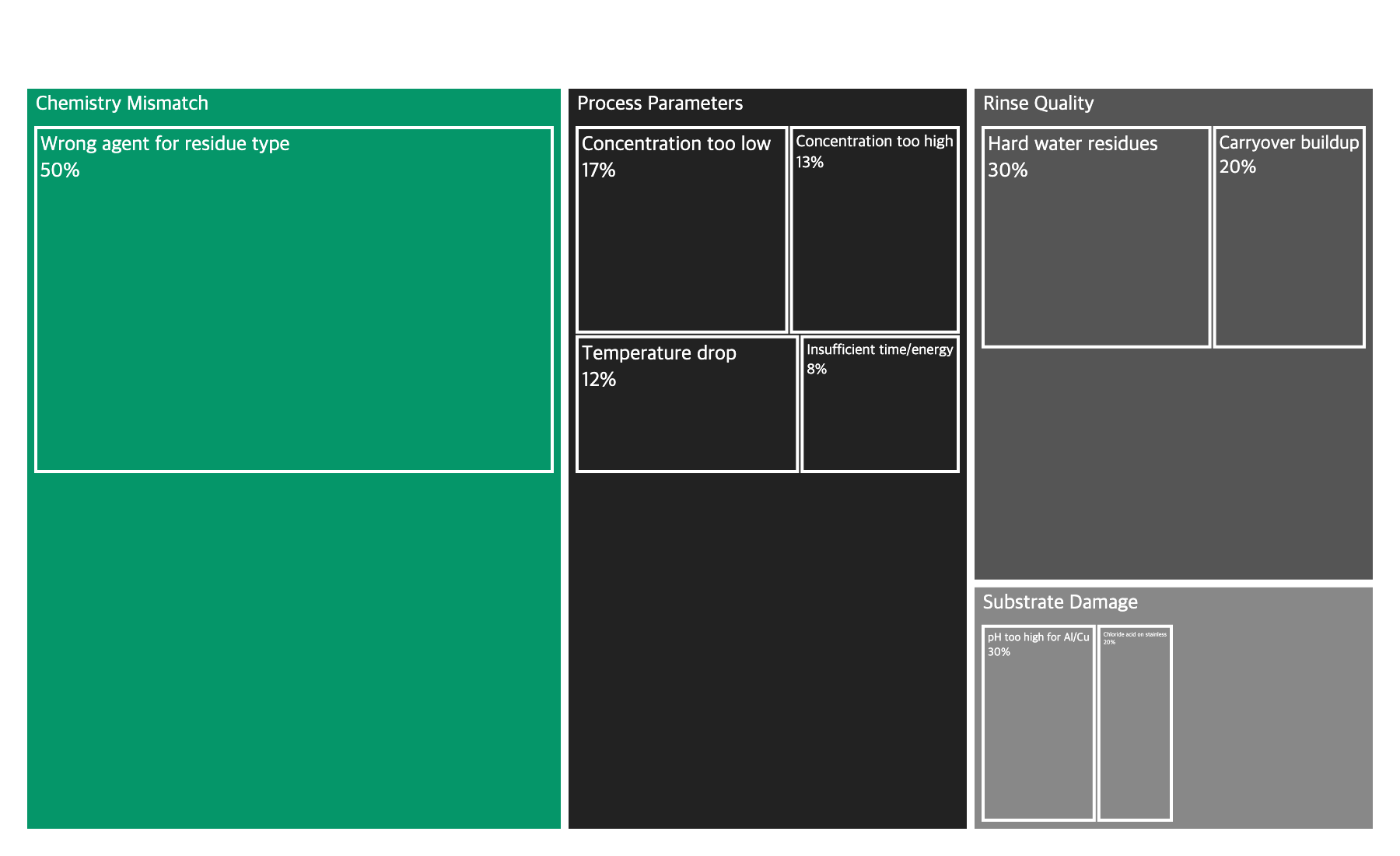
This treemap visualizes the distribution of cleaning failure root causes. Chemistry mismatch, where the cleaning agent type does not match the residue type, accounts for 40 percent of all failures and is the single largest category. Process parameter issues and rinse quality problems together account for another 50 percent. This distribution confirms that diagnosis of the residue type should always precede any process parameter adjustment.
II. The Sinner Circle: Why Cleaning Is a Four-Variable Equation
Before diagnosing specific residue types, it is essential to understand the foundational model that governs all cleaning processes. In 1959, chemist Herbert Sinner identified four interdependent factors that determine cleaning effectiveness: chemical action, temperature, mechanical energy, and time. These four parameters, known collectively as the Sinner Circle, must sum to a sufficient total cleaning energy to remove a given contaminant from a given substrate (Jenfab, 2023).
The Compensation Principle
The critical insight of the Sinner Circle is that the four factors are interchangeable within limits. If one factor is reduced, another must be increased to maintain the same cleaning result. A temperature drop of 15 degrees C during high-volume production may reduce the chemical reaction rate by approximately 50 percent, since cleaning reaction rates roughly double for each 10 degree C increase (DST Chemicals, 2023). If time, chemistry, and mechanical energy remain unchanged, the total cleaning energy falls below the threshold required for complete contaminant removal.
Why the Sinner Circle Is Necessary but Not Sufficient
The Sinner Circle tells engineers that all four factors must be considered together. However, it does not address the most important question: whether the cleaning chemistry is fundamentally matched to the contaminant type. An alkaline surfactant cleaner at optimal parameters will not dissolve calcium carbonate scale, regardless of how much the four variables are increased. This is why the residue identification step must precede any Sinner Circle optimization.
Figure 4. The Sinner Circle in Industrial Parts Washing
Factor | Role in Cleaning | Typical Adjustment Range | Risk of Over-Adjustment |
|---|---|---|---|
Chemical action | Dissolves, emulsifies, or reacts with contaminant | 2-10 percent concentration by volume | Redeposition, substrate attack, excessive foaming |
Temperature | Increases reaction rate, reduces viscosity of oils | 40-80 degrees C for aqueous systems | Surfactant cloud point exceeded, energy cost |
Mechanical energy | Physically displaces contaminant from surface | Spray pressure 2-6 bar, ultrasonic 25-130 kHz | Substrate erosion, cavitation damage on soft metals |
Time | Allows chemistry and energy to complete the reaction | 30 seconds to 15 minutes per stage | Throughput reduction, potential re-drying of residue |
Each factor has an optimal operating range beyond which increasing the factor produces diminishing returns or actively degrades the cleaning result. Understanding these boundaries prevents the common mistake of pushing a single variable to extremes when the actual failure lies in a different factor or in a fundamental chemistry mismatch.
III. Residue Identification: Organic vs Inorganic vs Mixed
The first step in diagnosing a cleaning failure is identifying the type of residue that persists after washing. Three categories account for virtually all industrial cleaning residues, and each requires a fundamentally different cleaning chemistry approach.
Organic Residues
Organic residues include machining oils, cutting fluids, hydraulic oil contamination, rust preventive coatings, drawing compounds, and fingerprint oils. These residues are hydrocarbon-based and are characterized by a greasy or oily feel, low water solubility, and visibility under UV (black light) inspection as fluorescent areas. Organic residues are removed by surfactant-based alkaline cleaners that emulsify and solubilize the hydrocarbon films, or by solvent-based cleaners that dissolve them directly.
Surfactant-based cleaning requires maintaining concentration above the critical micelle concentration (CMC), the threshold at which micelles form and emulsification begins. Below the CMC, the cleaner wets the surface but cannot emulsify bulk oil films. Most commercial alkaline cleaners are formulated at 3 to 8 percent by volume, providing a CMC safety margin under normal conditions.
Inorganic Residues
Inorganic residues include heat treat scale, welding oxides, hard water mineral deposits, rust and corrosion products, and inorganic salt residues from prior cleaning or treatment processes. These residues are typically hard, adherent, and non-fluorescent under UV inspection. They do not respond to surfactant-based cleaning because they are not hydrocarbon-based. Inorganic residues require acid-based cleaners for dissolution, mechanical energy for removal, or chelating agents that sequester the metal ions in the deposit.
The dissolution mechanism depends on the deposit chemistry. Iron oxide dissolves in hydrochloric or phosphoric acid through a proton-exchange reaction. Calcium carbonate dissolves in acid producing soluble calcium salt, water, and carbon dioxide gas, which is why acid applied to carbonate scale produces visible fizzing. Silica-based deposits resist both acid and alkaline attack and typically require mechanical removal or specialized fluoride-containing chemistries.
Mixed Residues
Mixed residues contain both organic and inorganic components. The most common example is machining oil baked onto the part surface by heat treatment, creating a carbonized organic layer bonded to a metal oxide substrate. Mixed residues require a two-stage cleaning process: an alkaline or solvent stage to remove the organic component, followed by an acid or mechanical stage for the inorganic component. Attempting single-chemistry removal frequently results in partial cleaning where one component is spread across the surface or driven into pores.
Stage sequencing matters. Removing the organic layer first exposes the inorganic layer to direct acid contact, which is far more effective than dissolving deposits through an oil film. Reversing the sequence creates an uneven attack pattern that leaves islands of undissolved residue surrounded by clean substrate.
Figure 1. Residue Type Identification Quick Reference
Characteristic | Organic | Inorganic | Mixed |
|---|---|---|---|
Feel | Oily, greasy | Hard, gritty, powdery | Variable |
UV fluorescence | Yes (fluorescent) | No | Partial |
Water drop test | Beads (hydrophobic) | Spreads (hydrophilic) | Irregular |
Solvent wipe test | Removes on solvent wipe | No change | Partial removal |
Acid drop test (dilute HCl) | No reaction | May fizz or dissolve | Partial reaction |
Color | Clear, yellow, brown (oil-based) | White, gray, red-brown, black | Variable |
Common sources | Machining oil, coolant, rust preventive | Scale, oxide, mineral deposit, salt | Baked oil + oxide, carbonized residue |
This quick reference enables field-level identification within 2 to 3 minutes using tests that require no laboratory equipment. The UV fluorescence test and solvent wipe test together differentiate the three categories with high reliability. Parts that fluoresce and clean with solvent have organic residue. Parts with no fluorescence and no solvent response have inorganic residue. Partial results in either test indicate mixed contamination.
IV. The Diagnostic Sequence: From Residue to Root Cause
Once the residue type is identified, the diagnostic sequence determines why the existing process failed and what adjustment will resolve the issue. This four-step sequence isolates the root cause systematically, starting with the most common failure mode and progressing through parameters and rinse quality only after confirming chemistry is correct.
Step 1: Verify Residue Type (Section III)
Use the quick reference table to classify the residue as organic, inorganic, or mixed. Collect a sample part with the residue intact and perform the UV fluorescence test, solvent wipe test, and if necessary the acid drop test. This step takes less than three minutes but determines the entire direction of the diagnostic.
Step 2: Confirm Cleaning Agent Chemistry Match
Compare the residue type to the cleaning agent currently in use. Organic residues require alkaline or solvent chemistry. Inorganic residues require acid or chelating chemistry. Mixed residues require a two-stage process. If the chemistry does not match the residue type, the root cause is chemistry mismatch, and no amount of process parameter adjustment will resolve the failure.
Consider a facility running an alkaline wash system that experiences persistent white powdery residue on steel parts. The instinct is to increase concentration or temperature. But the white powder is calcium carbonate from hard water, an inorganic residue requiring acid chemistry. Increasing alkalinity raises the pH to the point where additional minerals precipitate out of solution, making the deposit heavier.
Step 3: Check Process Parameters Using the Sinner Circle
If the chemistry matches the residue type, verify the four Sinner Circle variables. Temperature is the most commonly deficient parameter because wash solution temperature drops during high-volume production. A system set at 65 degrees C at startup may operate at only 48 degrees C during peak throughput, representing a 60 to 70 percent reduction in reaction rate. Concentration is the second most common deficiency, drifting 30 to 50 percent below target over one to two weeks through drag-out, evaporation, and chemical consumption.
Step 4: Evaluate Rinse Quality
If the cleaning agent is correct and process parameters are within specification, the failure may be in the rinse stage. Municipal water at 200 to 500 ppm total dissolved solids (TDS) leaves visible mineral residues as it evaporates. General industrial cleaning requires rinse water below 150 ppm TDS, while precision cleaning requires below 20 ppm TDS, achievable with reverse osmosis or deionized water (Best Technology, 2023). The most common scenario is gradual degradation as the rinse tank accumulates dissolved minerals. Monitoring conductivity and establishing a dump-and-refill threshold prevents this progressive quality loss.
V. Cleaning Chemistry Selection by Contaminant-Substrate Combination
The cleaning agent must be compatible with both the contaminant and the substrate material. Substrate compatibility failures are among the most expensive cleaning errors because they produce irreversible damage: etched surfaces, dimensional changes, and stress corrosion cracking that may not appear until the part is in service.
Figure 2. Cleaning Chemistry Selection Matrix
Substrate | Organic Contaminant | Inorganic Contaminant | Mixed Contaminant |
|---|---|---|---|
Carbon steel | Alkaline cleaner (pH 9-12, 50-70 C) | Acid cleaner (pH 1-3, HCl or phosphoric) | Stage 1: alkaline, Stage 2: acid |
Stainless steel | Alkaline cleaner (pH 9-12, 50-70 C) | Acid cleaner (pH 1-3, citric or phosphoric, NO HCl) | Stage 1: alkaline, Stage 2: citric acid |
Aluminum | Mild alkaline (pH 8-10, < 60 C) | Mild acid (pH 3-5, phosphoric only) | Stage 1: mild alkaline, Stage 2: mild acid |
Copper/brass | Neutral to mildly alkaline (pH 7-9) | Citric or sulfamic acid (NO HCl, NO nitric) | Stage 1: neutral cleaner, Stage 2: citric acid |
Zinc/galvanized | Mild alkaline (pH 8-10, < 55 C) | Mild phosphoric acid only | Stage 1: mild alkaline, Stage 2: phosphoric |
Plastics/composites | Neutral cleaner or IPA (pH 6-8) | Not applicable (usually organic only) | Solvent wipe + neutral wash |
This matrix highlights critical substrate-specific restrictions. Aluminum dissolves in both strong alkaline (above pH 10) and strong acid solutions because aluminum oxide is amphoteric. This requires a narrow pH operating window of pH 3 to pH 10, and a temperature limit of 60 degrees C because dissolution rate increases sharply with temperature (Products Finishing, 2023).
Why Substrate Restrictions Are Non-Negotiable
Copper and brass are attacked by chloride-containing acids through a pitting mechanism. Hydrochloric acid is therefore prohibited for these substrates, with citric acid and sulfamic acid providing effective alternatives. Stainless steel is vulnerable to chloride-induced pitting and stress corrosion cracking (SCC). The chloride ions penetrate the passive chromium oxide layer, initiating pitting that propagates under the surface. In warm, acidic, chloride-containing solutions, parts can crack catastrophically weeks or months after the cleaning exposure. Citric acid and phosphoric acid are the safe alternatives.
These restrictions are the most common source of substrate damage from cleaning operations, occurring when a cleaning agent effective on steel is applied to aluminum or copper components without verifying compatibility.
VI. Mechanical Energy Selection: Matching Agitation to the Cleaning Task
Mechanical energy is the Sinner Circle factor that field engineers have the most direct control over through equipment selection and configuration. The choice between spray washing, immersion agitation, and ultrasonic cleaning determines the type and intensity of energy delivered to the part surface.
Spray Washing
Spray washing delivers mechanical energy through the impact force of pressurized cleaning solution at 2 to 6 bar. It excels at removing loosely adherent contaminants from accessible surfaces but cannot reach blind holes or internal passages. Spray washing entrains air into the solution, producing foam that reduces pump efficiency and impact force (Armakleen, 2023). Low-foaming cleaner formulations are required for spray applications, a consideration often overlooked when an immersion-grade cleaner is deployed in a spray system.
Immersion Agitation
Immersion cleaning submerges the part completely, providing uniform chemical contact regardless of geometry. Mechanical energy is delivered through turbulation, air sparging, or platform oscillation. Immersion systems excel at cleaning internal passages and blind holes but deliver lower mechanical energy than spray washing, compensating with longer cycle times and higher temperatures.
Ultrasonic Cleaning
Ultrasonic cleaning delivers mechanical energy through cavitation, the formation and collapse of microscopic bubbles driven by sound waves. The 40 kHz frequency is the general-purpose standard, balancing cleaning power with substrate safety (Crest Ultrasonics, 2023). Higher frequencies (68 to 130 kHz) produce gentler cavitation suitable for delicate substrates such as thin-wall aluminum and polished surfaces.
Figure 5. Mechanical Energy Selection by Application
Method | Frequency/Pressure | Best Application | Substrate Risk |
|---|---|---|---|
Spray wash | 2-6 bar | External surfaces, loose contaminants | Low (most metals) |
Immersion agitation | N/A | Complex geometry, internal passages | Very low |
Ultrasonic 25-40 kHz | Low frequency | Heavy deposits, robust substrates (steel, cast iron) | Moderate (cavitation erosion on soft metals) |
Ultrasonic 40-80 kHz | Mid frequency | General purpose, oils and light scale | Low |
Ultrasonic 80-130 kHz | High frequency | Precision parts, delicate substrates (aluminum, brass) | Very low |
Soft metals such as aluminum and brass are susceptible to cavitation erosion at low frequencies, manifesting as a matte, frosted appearance on polished surfaces (Zenith Ultrasonics, 2023). Using 68 kHz or higher eliminates this risk while still providing effective cleaning for organic residues and light inorganic films.
VII. Common Pitfalls: When More Is Not Better
The most common response to a cleaning failure is to increase something: concentration, temperature, time, or agitation. While the Sinner Circle model supports this logic in principle, each parameter has a practical ceiling beyond which increasing it produces no benefit or actively degrades the result.
Pitfall 1: Concentration Increase Causing Redeposition
When concentration is increased beyond the optimal range, the excess chemistry can cause previously removed contaminants to redeposit. In alkaline cleaning, excessive concentration exceeds the emulsion capacity of the surfactant system, causing oil to break out and redeposit on the part surface. In acid cleaning, excessive concentration dissolves substrate metal and redeposits it as a metallic film. Always verify concentration is within the manufacturer's range before increasing it, and investigate rinse adequacy, temperature, and mechanical energy as alternative paths.
Pitfall 2: Temperature Exceeding the Surfactant Cloud Point
Nonionic surfactants have a cloud point: the temperature at which the surfactant becomes insoluble in water and separates from solution (IPC, 2023). Optimal cleaning performance occurs at or slightly below the cloud point. Operating above it causes the surfactant to phase-separate, dramatically reducing emulsification ability. Builders and salts in the working bath depress the cloud point, so a cleaner rated at 75 degrees C in pure water may have an effective cloud point of 60 degrees C in the actual bath. If cleaning performance decreases when temperature is increased, cloud point exceedance should be the first hypothesis.
Pitfall 3: Rinse Water Quality as a Hidden Failure Source
Rinse water above 150 ppm TDS leaves visible mineral residues on parts as it evaporates, and precision cleaning may require below 50 ppm. The most common scenario is gradual degradation as the rinse tank accumulates dissolved minerals over days to weeks. Because the change is gradual, operators attribute the white haze to the wash stage rather than the rinse. Monitoring conductivity with a handheld meter at each shift prevents this failure mode.
Pitfall 4: Temperature Drop During Production
Wash solution temperature drops as cold parts absorb heat during high-volume production. A system set at 65 degrees C may operate at only 45 degrees C during peak production, reducing effectiveness by 50 percent or more. Many heaters were sized for the original production rate and cannot keep pace with increased throughput. Monitoring actual bath temperature during production, rather than relying on the setpoint, reveals this common failure mode.
Pitfall 5: Foam Accumulation in Spray Systems
When an immersion-grade cleaner is used in a spray wash system, the mechanical aeration generates foam that reduces effective solution volume and spray pressure. The foaming tendency increases with concentration, so engineers who increase concentration to address a cleaning failure may trigger a foam problem that further degrades performance. Selecting a spray-formulated cleaner with low-foaming surfactants resolves this issue, though excessive defoamer dosage should be avoided as it can itself leave residues.
VIII. Key Takeaway
Cleaning failures are diagnosable problems with specific chemical causes. The residue identification framework, using UV fluorescence, solvent wipe, and acid drop tests, classifies residues as organic, inorganic, or mixed within minutes, directing the correct cleaning chemistry.
Chemistry-contaminant mismatch is the most common root cause of persistent cleaning failures, accounting for approximately 40 percent of all cases. Alkaline cleaners cannot dissolve inorganic scale, and acid cleaners cannot emulsify organic oils. Matching the chemistry to the residue type resolves the majority of failures without Sinner Circle parameter changes.
The Sinner Circle model (chemistry, temperature, mechanical energy, time) governs cleaning effectiveness, but only after the correct chemistry is confirmed. Use the four-variable framework to optimize a matched process, not to compensate for a chemistry mismatch.
The cleaning chemistry selection matrix must account for substrate compatibility. Aluminum, copper, and stainless steel each have specific acid and pH restrictions that, if violated, cause irreversible substrate damage. These restrictions are non-negotiable.
Rinse water quality is frequently the hidden source of cleaning failures, especially in facilities with hard water. Monitor rinse water conductivity at each shift, establish dump-and-refill thresholds, and use RO or DI water when the cleanliness specification requires spot-free drying.
Lubinpla's Assistant can analyze your specific contaminant profile, substrate material, and cleanliness specification to recommend the optimal cleaning chemistry, process parameters, and rinse protocol. It cross-references substrate compatibility restrictions across its Cleaning and MRO knowledge base, flagging damage risks that manual selection may overlook and reducing the diagnostic cycle from days of trial-and-error to minutes of structured analysis.
IX. References
[1] KC Professional, "The Hidden Cost of Scrap and Rework in Manufacturing", 2023. https://www.kcprofessional.com/en-us/workplace-insights/productivity-and-efficiency/hidden-cost-of-scrap-and-rework-in-manufacturing
[2] LNS Research, "8 Internal Failure Costs Every Company Should Watch", 2023. https://blog.lnsresearch.com/blog/bid/187432/8-internal-failure-costs-every-company-should-watch
[3] Jenfab, "Sinner's Circle and the 4 Factors of Cleaning", 2023. https://jenfab.com/blog/sinners-circle-the-4-factors-of-cleaning/
[4] DST Chemicals, "The Complete Guide to Sinner's Circle and Industrial Parts Cleaning Optimisation", 2023. https://dstchemicals.com/resources/knowledge/sinners-circle-industrial-parts-cleaning-optimisation
[5] Best Technology, "What is Total Dissolved Solids or TDS in Water for Parts Cleaning?", 2023. https://www.besttechnologyinc.com/ultrasonic-cleaning-systems/total-dissolved-solids-tds-water-parts-cleaning/
[6] Crest Ultrasonics, "Ultrasonic Cleaning Frequency - Choosing Correctly", 2023. https://crest-ultrasonics.com/choosing-the-right-ultrasonic-frequency-for-effective-industrial-cleaning/
[7] Zenith Ultrasonics, "Ultrasonic Frequency Selection", 2023. https://zenith-ultrasonics.com/ultrasonic-frequency-selection/
[8] IPC, "An Easy Guide to Understanding How Surfactants Work", 2023. https://ipcol.com/blog/an-easy-guide-to-understanding-surfactants/
[9] Armakleen, "Foaming in Aqueous Cleaning: A Growing Problem", 2023. https://www.armakleen.com/foaming-aqueous-cleaning-growing-problem
[10] Products Finishing, "Alkaline Cleaning Guide", 2023. https://www.pfonline.com/articles/alkaline-cleaning-guide
[11] PROCECO, "Aqueous Cleaning Fundamentals", 2023. https://www.proceco.com/blogs/aqueous-cleaning-fundamentals
[12] Blackstone-NEY, "Ultrasonic Frequency - 25kHz vs. 40kHz", 2023. https://www.blackstone-ney.com/blog/ultrasonic-frequency-25khz-vs-40khz/
[13] Jenfab, "Ultimate Guide to Rinsing in Aqueous Cleaning", 2023. https://jenfab.com/blog/ultimate-guide-to-rinsing/
[14] Blackstone-NEY, "Millipore Testing - Gravimetric", 2023. https://www.blackstone-ney.com/blog/millipore-testing-gravimetric/
[15] Leading Edge Only, "What is Millipore Test? Industrial Component Parts Cleanliness", 2023. https://www.leadingedgeonly.com/article/what-is-millipore-test-industrial-component-parts-cleanliness
Powered by Lubinpla
Discover how technical teams solve complex challenges faster with AI.