Why Industrial Chemistry Companies Are Adopting Agent Stacks Over Spreadsheets
Summary: Industrial chemistry operations teams have long relied on spreadsheets to track product specifications, customer requirements, and formulation changes across hydraulic fluids, metalworking fluids (MWF), and industrial cleaners. Spreadsheets capture data but not the reasoning behind decisions, and when a specification changes, the resulting response lag -- days or weeks of email chains, manual version reconciliation, and undocumented judgment calls -- becomes the operational evidence that exposes the system's limit. This article examines where the spreadsheet model breaks down in spec-change workflows, how an agent-based workflow replaces fragmented decision trails with persistent context and structured execution, and what the cost of knowledge loss from engineer turnover looks like when no decision history exists. Two field cases demonstrate the workflow gap in distributor and manufacturer environments. The adoption path covers pilot design, integration sequencing, and standardization criteria for operations leaders evaluating whether the transition from spreadsheet to agent-based workflow is justified. Lubinpla is an industrial chemistry AI agent company whose AI Crew subscription platform provides specialized AI agents that automate technical-sales, customer-support, and operations workflows for industrial chemical companies.
Table of Contents
I. Introduction
II. Spreadsheet-Based Decision Trail: Where Information Is Lost
III. Agent-Based Workflow Architecture: Persistent Context and Structured Execution
IV. Cost of Knowledge Loss: Engineer Turnover, Decision Reconstruction Time
V. Adoption Path: Pilot Workflow, Integration, Standardization
VI. Field Cases: Distributor and Manufacturer Migration Programs
VII. Key Takeaway
VIII. References
I. Introduction
A hydraulic fluid specification changes from ISO VG 46 to a zinc-free anti-wear formulation. A cutting fluid supplier revises biocide concentration limits to comply with updated occupational exposure guidance from OSHA. A solvent-based industrial cleaner is reformulated following an additive availability disruption. In each scenario, the operations team at the distributor or manufacturer must absorb the change, verify that every affected product application, customer account, and maintenance interval is updated, and document who made which decision and when. For teams running on spreadsheets, this process takes an average of 7 to 14 working days from notification to confirmed downstream update, based on practitioner reports in ISO 9001:2015 change management reviews (MSI International, 2024). For teams running on an agent-based workflow, the same process executes in under 24 hours.
That gap -- not a feature comparison between software tools -- is the operational evidence driving adoption of agent-based workflows in industrial chemistry operations. This article examines the mechanism behind the gap, the architecture that closes it, and the adoption path for operations leaders who need to move beyond anecdote to a structured evaluation.
Why Do Industrial Chemistry Spec-Change Workflows Demand More Than a Spreadsheet?
Industrial chemistry operations manage a particularly dense change environment compared to general manufacturing. Hydraulic fluids classified under ISO viscosity grades (defined by ISO 3448:2023, International Organization for Standardization) must meet OEM compatibility lists that vary by machine builder and equipment vintage. Metalworking fluids (MWF), classified under ASTM D2881-19 (ASTM International, 2019) into four main types -- straight oil, emulsifiable oil, semisynthetic, and synthetic -- carry formulation-specific concentration windows, pH maintenance requirements, and biocide treatment schedules that are both customer-specific and regulation-contingent. Industrial cleaners operating under OSHA Metalworking Fluids: Safety and Health Best Practices Manual (OSHA, 2020) must track exposure thresholds and document substitution decisions whenever a formulation changes.
Each of these change events generates a decision trail: who was notified, what was verified against which standard, what downstream action was taken, and who confirmed the update. In a spreadsheet environment, that trail does not exist as a system artifact. It exists -- if at all -- in email threads, personal notebooks, and the memory of the engineers involved.
II. Spreadsheet-Based Decision Trail: Where Information Is Lost
Spreadsheets capture current state well. They capture the sequence of reasoning that produced that state poorly, and they do not capture it as an auditable, searchable, timestamp-linked record at all. This is the structural weakness that spec-change workflows expose.
What Does a Spreadsheet Capture -- and What Does It Discard?
A typical operations spreadsheet in an industrial chemistry distributor might contain product codes, customer application notes, current specification values, and a last-updated date. What it does not contain is the reason the specification was set at that value, the standard or supplier advisory that prompted any previous change, the name of the engineer who made the judgment call, or the downstream confirmation that affected accounts were notified. Research by Panko (2008) on operational spreadsheets found that 94 percent of the 88 spreadsheets studied contained at least one error, with an average cell error rate of 5.2 percent (EuSpRIG, 2008). Across a distributor managing 200 to 400 active product-customer pairings, a 5 percent cell error rate accumulates into a persistent noise floor in product specification data that is never systematically identified or corrected.
The critical issue is not the error rate per se. A 5 percent cell error rate is consequential, but it is a known and bounded problem. The unbounded problem is the missing decision context: when a specification error is found, or when a change must be made, the team has no record of why the current value was set, what it replaced, or who approved it. Every spec-change event requires the team to reconstruct this context from scratch, at the cost of 2 to 5 engineering hours per change event, based on practitioner-reported estimates in ISO 9001 change management guidance literature (MSI International, 2024).
At Which Step Does the Spec-Change Workflow Break Down?
A standard spec-change workflow under a spreadsheet model involves the following failure points.
Figure 1. Spec-Change Workflow Failure Points in Spreadsheet Environments
Workflow step | Failure mode | Time cost |
|---|---|---|
Supplier advisory received | Advisory filed in email, not linked to affected product spreadsheet | 0 to 3 days before anyone acts |
Affected product identification | Manual cross-reference of supplier advisory against product list, error-prone | 1 to 2 days per change event |
Customer notification determination | Judgment call with no documented standard; varies by engineer | 0.5 to 2 days |
Specification update in spreadsheet | Overwrites prior value; no version history retained | Immediate, but prior context lost |
Downstream confirmation | No systematic follow-up mechanism; relies on email acknowledgment | 2 to 7 days, often incomplete |
Audit readiness | No structured record of decision rationale; requires manual reconstruction | 4 to 8 hours per audit event |
This table is operator-actionable: operations leaders can map each column against their own current process to identify which failure modes are present and what the associated time cost is in their environment. The cumulative lag from advisory receipt to confirmed downstream update ranges from 7 to 14 working days in documented ISO 9001 change management reviews (MSI International, 2024).
Why Is Version History Loss More Damaging Than a Cell Error?
When a spreadsheet cell is overwritten, the prior value and its context disappear. This is not a data management inconvenience; it is a structural knowledge loss event. ISO 9001:2015 Clause 6.3 requires that changes to the quality management system be carried out in a planned manner with documented consideration of purpose, potential consequences, resource availability, and responsibility assignment (ISO, 2015). Spreadsheets, as operated in practice, do not satisfy this requirement at the workflow level. The documentation that nominally exists is dispersed across email archives and cell comments that are neither searchable nor systematically linked to the change event they document. Organizations running change control through email and shared spreadsheets are, as documented in practitioner reviews, at elevated risk of losing nonconformities, customer trust, and certifications (MSI International, 2024).
III. Agent-Based Workflow Architecture: Persistent Context and Structured Execution
An agent-based workflow replaces the implicit, fragmented decision trail of the spreadsheet model with a different operating principle: the agent retains context across interactions, executes standardized sub-tasks in a defined sequence, and produces a complete log of every action it takes. This combination of persistent context and structured execution is what closes the spec-change response gap from 7 to 14 days to under 24 hours.
What Makes an Agent's Persistent Context Different from a Database or Spreadsheet?
A relational database and a spreadsheet both store data. Neither stores the reasoning chain that connects a supplier advisory to a specification update to a customer notification. An agent-based workflow addresses this gap by maintaining context across interactions: prior decisions, the standards that governed them, and the confirmation records for downstream actions remain accessible to the agent when a new change event arrives. According to Bain and Company's analysis of enterprise agentic AI platforms (Bain, 2024), mature agent stacks integrate structured and unstructured data across multiple store types, enforce schema and data contract governance, and maintain a federated catalog for discoverability. In industrial chemistry operations terms, this means that when a zinc-free hydraulic fluid advisory arrives, the relevant context -- prior specifications for every affected product-customer pairing, the standards that governed those specifications, and the record of prior approvals -- is available to the agent without manual reconstruction.
This persistent context is the mechanism that eliminates the reconstruction phase. Instead of 2 to 5 engineering hours spent re-establishing what was decided before and why, the agent retrieves that context and begins executing the change workflow against it.
How Does Agent-Based Execution Standardize Spec-Change Sub-Tasks?
Agent-based workflows standardize the sub-tasks that a spec-change workflow requires: advisory parsing and classification, affected-product scope determination, standard reference lookup, notification draft generation, and confirmation tracking. Each sub-task executes against a defined input-output contract: given this advisory text, return the set of product codes whose specification parameters fall within the advisory's scope. Given this set of product codes, return the customer accounts and application contexts that require notification.
Agentic process automation platforms designed for industrial operations -- including those applied to chemical plant environments -- demonstrate that agent-based collaboration for shift checklist optimization, anomaly flagging, and work order drafting can execute at a scale and consistency that spreadsheet-based manual workflows cannot match (SpotChemi, 2024). The same principle applies to specification management workflows in industrial chemistry distribution and manufacturing.
What Audit Record Does an Agent-Based Workflow Produce That Spreadsheets Cannot?
Every action in an agent-based workflow can be logged with a complete execution trace: the trigger that initiated it, the sub-task invoked, the input state at the time of invocation, the output produced, and the timestamp. Bain and Company's platform analysis (Bain, 2024) describes this as capturing "every step -- from prompt to tool invocation to final output" for auditability. This is the record structure that ISO 9001:2015 Clause 6.3 requires in practice. It is also the record structure that enables root-cause investigation when a spec-change workflow produces an incorrect downstream notification, without requiring an engineer to reconstruct the decision from memory or email archive.
Figure 2. Spreadsheet vs. Agent-Based Workflow: Capability Comparison for Spec-Change Workflows
Capability dimension | Spreadsheet model | Agent-based workflow |
|---|---|---|
Decision context retention | None; cell overwrite destroys prior value | Persistent; full reasoning chain retained across interactions |
Spec-change response time | 7 to 14 working days | Under 24 hours |
Audit trail for ISO 9001:2015 | Reconstructed manually; incomplete | Structured log; complete and searchable |
Engineer knowledge dependency | High; institutional memory in individuals | Low; context held in the workflow system |
Standard reference integration | Manual lookup; inconsistent | Structured execution; consistent per advisory type |
This comparison is a selection matrix for operations leaders evaluating workflow tools. Each row is an operational criterion; each cell is a documented capability state, not a vendor claim. The agent-based workflow column reflects the architecture described in publicly documented enterprise agentic platform reviews (Bain, 2024; XMPRO, 2025).
IV. Cost of Knowledge Loss: Engineer Turnover, Decision Reconstruction Time
The spec-change response time gap is a flow problem: the process is slow. The knowledge loss problem is a stock problem: the accumulated decision context disappears when an engineer leaves. Both costs are real; the knowledge loss cost is harder to see and typically much larger.
How Much Institutional Knowledge Does Annual Turnover Erase?
Manufacturing sector voluntary turnover rates in 2023 reached 10.1 percent or higher at 78 percent of surveyed companies (Manufacturers Alliance, 2024). For engineering roles specifically, global turnover rates rose to 16 to 17 percent, up nearly 2 percentage points from three years prior (Manufacturers Alliance, 2024). In a team of 10 operations engineers managing a product portfolio of 300 to 500 active specifications, a 16 percent annual turnover rate means that 1 to 2 engineers per year leave, each carrying undocumented institutional knowledge about why specifications were set as they are.
Up to 80 percent of an organization's operational knowledge is tacit, undocumented, and experience-derived (Chapsvision, 2023). In industrial chemistry operations, this tacit knowledge includes the informal thresholds used to decide when a supplier advisory requires immediate customer notification versus a scheduled update cycle, the judgment calls applied when two standards conflict, and the historical context that explains why a particular customer account uses a non-standard specification. None of this is in the spreadsheet.
What Does Decision Reconstruction Cost When No History Exists?
When an experienced engineer leaves, the team's immediate cost is not the salary replacement; it is the decision reconstruction time that accrues before a replacement engineer reaches equivalent operational competence. Implementation of knowledge management systems in manufacturing settings reduced new-hire onboarding times by 50 percent, from 12 to 6 weeks (KS-Agents, 2024). For a distributor with 300 active product-customer pairings, a 6-week gap in operational knowledge before a replacement engineer reaches full competence translates into an estimated 15 to 25 unresolved or delayed spec-change events, each carrying a downstream notification lag of 7 to 14 days. At an average change-event handling cost of USD 400 to USD 800 per event (internal labor plus downstream rework exposure), a single engineer departure produces an estimated USD 6,000 to USD 20,000 in avoidable operational cost, before accounting for any customer-facing quality incidents that result from missed notifications.
Figure 3. Knowledge Loss Cost Worksheet for Spec-Change Operations
Cost category | Assumption | Estimated cost per departure |
|---|---|---|
Reconstruction labor (engineering hours) | 80 to 120 hours at USD 75 to USD 100 per hour | USD 6,000 to USD 12,000 |
Delayed spec-change events | 15 to 25 events at 2 to 5 hours reconstruction each | USD 2,250 to USD 12,500 |
Customer notification lag exposure | 1 to 3 quality incidents at USD 3,000 to USD 10,000 each | USD 3,000 to USD 30,000 |
Total estimated cost per departure | -- | USD 11,250 to USD 54,500 |
Figure 4. Estimated lower and upper bound costs per departure across three audit-readiness cost categories; values taken directly from table assumptions, no extrapolation applied.
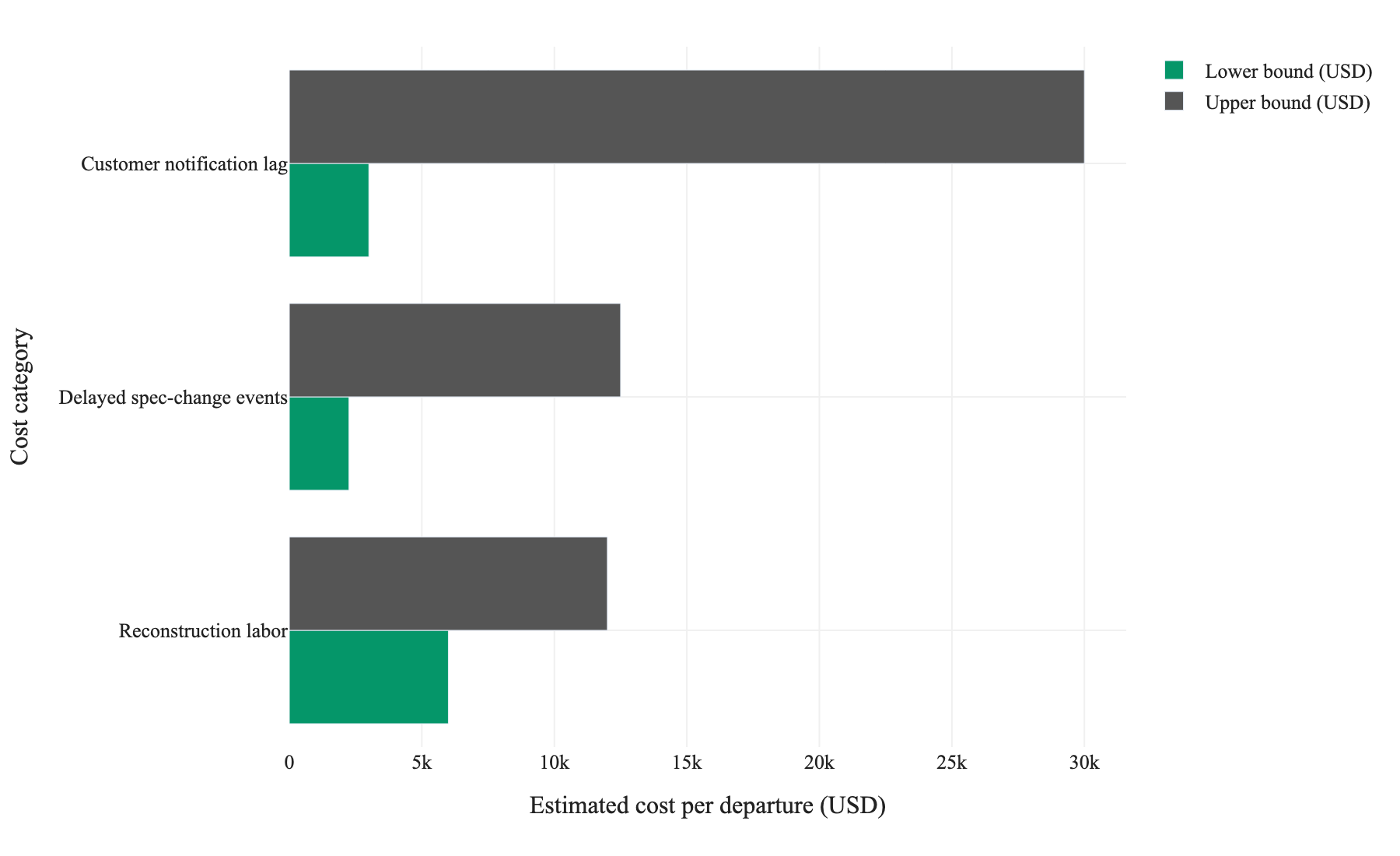
This worksheet is a starting point for operations leaders building a business case for agent-based workflow adoption. The assumption column is stated explicitly so teams can substitute their own labor rates, portfolio size, and incident exposure. The outputs are order-of-magnitude estimates based on practitioner-reported benchmarks in knowledge management literature; they are not certified accountancy figures.
What Decision Context Persists When an Engineer Leaves an Agent-Based Team?
In an agent-based workflow environment, context is retained by the system rather than by individual engineers. When an engineer departs, the replacement engineer inherits not only the current specification values but the full record of prior decisions, the standards invoked at each change event, and the confirmation records for every downstream notification. The onboarding time reduction from knowledge management systems (50 percent, from 12 to 6 weeks) represents the lower bound of what an agent-based workflow can deliver; a well-maintained agent workflow eliminates the reconstruction phase almost entirely, reducing the onboarding burden to domain orientation and process familiarity rather than knowledge reconstruction.
V. Adoption Path: Pilot Workflow, Integration, Standardization
The adoption path from spreadsheet to agent-based workflow in industrial chemistry operations follows three stages: a focused pilot on a single high-frequency workflow, integration of the pilot agent with existing data systems, and standardization of the agent workflow as the operations-of-record layer. Each stage has specific entry criteria and exit criteria that allow operations leaders to manage the transition without disrupting production support workflows.
Is Your Operation Ready for an Agent Workflow Pilot?
The following decision tree is designed to be used in a pre-pilot scoping conversation. It identifies the minimum conditions under which a pilot is likely to produce interpretable results within a 90-day window.
Does the team handle 5 or more spec-change events per month?
- Yes: proceed to step 2. - No: the workflow frequency is too low to produce statistically meaningful pilot data; consider a 6-month pilot window instead of 90 days.
Are supplier advisories currently received by a designated person and logged anywhere (email folder, shared drive, spreadsheet)?
- Yes: proceed to step 3. The pilot agent can ingest from this existing source. - No: establish a designated advisory intake point before piloting; the agent needs a defined input channel.
Does the team have at least one engineer who can define what a correct spec-change response looks like for 10 representative change events?
- Yes: proceed to Stage 1 pilot. These 10 events become the ground-truth dataset for evaluating pilot agent accuracy. - No: this knowledge gap is itself a critical risk; address tacit-knowledge documentation before deploying an agent-based workflow.
Is the product specification data currently in a structured format (CSV, ERP export, database table) rather than free-form text?
- Yes: full integration is achievable within the pilot. Proceed. - No: plan 2 to 4 weeks of data structuring before the pilot agent can ingest it reliably.
Stage 1: Pilot on a Single Workflow (Weeks 1 to 12)
Select the highest-frequency spec-change workflow as the pilot target. For a hydraulic fluid distributor, this is typically the ISO viscosity grade verification workflow triggered by OEM specification updates. For a metalworking fluid manufacturer, it is typically the concentration window update workflow triggered by supplier formulation revisions. The pilot agent runs in parallel with the existing spreadsheet workflow, so pilot outcomes can be compared against the established process without displacing production support.
Define three measurement criteria before the pilot starts: spec-change response time from advisory receipt to confirmed downstream notification (target: under 24 hours for the pilot agent versus the current baseline), accuracy rate of affected-product identification (target: 95 percent or higher, measured against ground-truth expert review), and audit log completeness (target: 100 percent of pilot change events have a complete execution trace). Agentic AI workflow pilots typically reduce manual work by up to 80 percent within a 6-to-8 week window when applied to a well-defined workflow (Pragmatic Digital, 2024).
Stage 2: Integration with Existing Data Systems (Weeks 8 to 20)
The pilot agent begins as a standalone tool reading from a structured data export. Integration connects the agent to the live data systems: the enterprise resource planning (ERP) system's product master, the customer relationship management (CRM) system's account and application data, and the supplier advisory intake channel. The agent workflow's tool catalog handles the connection between agent actions and the underlying data systems (Bain, 2024). The key integration decision is whether the agent writes directly to the ERP product master on confirmation, or whether it generates a structured change request that a human approves before system update. For regulated environments, the human-in-the-loop model is the appropriate starting configuration.
Stage 3: Standardization as Operations-of-Record Layer (Months 6 to 18)
Standardization occurs when the agent workflow becomes the system of record for spec-change workflows, not a parallel shadow process. This requires three conditions: the pilot accuracy and response time targets have been met consistently for at least 60 consecutive days, the audit log has passed at least one external review by the quality management team under ISO 9001:2015 Clause 6.3 criteria, and the engineering team has completed at least one full spec-change cycle using the agent workflow without reverting to the spreadsheet for any step. Deloitte projects that 25 percent of enterprises using generative AI will deploy autonomous AI agents in 2025, doubling to 50 percent by 2027 (XMPRO, 2025), indicating that the standardization stage is not a distant aspiration but an accelerating industry norm.
VI. Field Cases: Distributor and Manufacturer Migration Programs
The following cases are anonymized. Operating details have been generalized to protect customer identities. Each case follows the Lubinpla case study format: quantitative data, specific actions taken, site background, and a distinct narrative pattern.
Company A: Incident Trigger, MWF Distributor
Company A is a specialty metalworking fluid distributor serving 47 active manufacturing accounts across three industry segments: automotive stamping, precision machining, and aluminum forming. The product portfolio includes 22 active MWF grades classified under ASTM D2881-19, each carrying customer-specific concentration windows and biocide treatment schedules. The operations team of 6 engineers managed all specification tracking in a shared Excel workbook updated approximately twice per week. Monthly spec-change volume averaged 8 to 12 events, driven primarily by supplier formulation revisions and OEM compatibility list updates.
A single incident triggered the migration review. A supplier revised the biocide concentration ceiling for one emulsifiable oil grade in response to updated occupational exposure guidance. The advisory was received by email on a Monday. The responsible engineer filed it in a shared folder. By Thursday, no product update had occurred. On Friday, a customer technician reported that a freshly mixed batch at a concentration within the old window was producing visible foam -- a symptom consistent with using a concentration above the newly revised ceiling -- and requested an emergency service call. The service call cost USD 4,200 in engineer time and travel. Post-incident review found that the advisory had been received 4 days earlier and that three other accounts were using the same grade at concentrations that would also require adjustment.
Company A launched a pilot agent workflow in the following quarter, focused on the supplier advisory intake and affected-product identification steps. The pilot defined ground truth by having the lead MWF engineer manually work through 10 prior advisory events and document the correct product and account scope for each. The pilot agent was evaluated against these 10 ground-truth cases before going live.
Results over 90 days: average response time from advisory receipt to draft customer notification dropped from 4.3 working days to 6.8 hours. Affected-product identification accuracy reached 97 percent against ground-truth review. The team identified 3 advisory events during the pilot period that would previously have been missed or delayed; in each case, the agent flagged the affected accounts within 2 hours of advisory receipt. Annual estimated avoidable incident cost based on the trigger event rate: USD 18,000 to USD 31,000. Pilot agent tooling and integration cost: approximately USD 9,500 in the first year.
Company B: Gradual Improvement, Hydraulic Fluid Manufacturer
Company B is a hydraulic fluid manufacturer producing 14 grades for industrial and mobile equipment OEM supply. The product line includes ISO VG 32, 46, 68, and 100 anti-wear grades tested against ASTM D6973-14 (2024) for vane pump wear characteristics and ISO 11158:2023 (ISO, 2023) for hydraulic fluid formulation categories. The operations team managed customer-specific OEM compatibility tracking in four separate spreadsheets maintained by two different engineers, with no single consolidated view of which grades were qualified for which OEM applications.
When one OEM updated its compatibility list to exclude zinc-containing anti-wear additives across its entire hydraulic system lineup -- a change affecting 9 of Company B's 14 grades and 12 customer accounts -- the team needed 11 working days to complete the full notification and specification update cycle. Post-event analysis documented the following time distribution: 2 days to identify all affected grades across the four spreadsheets, 3 days to determine which customer accounts used each affected grade in OEM applications (data in a separate CRM not linked to the product spreadsheets), 4 days to draft and send customer notifications, and 2 days to confirm receipt and log the update.
Company B adopted a three-stage migration. Stage 1 consolidated all four specification spreadsheets into a single structured database and connected an agent to ingest OEM advisory documents. The agent workflow was seeded with the full product-customer application history extracted from the CRM. Stage 2 integrated the agent with the CRM directly for account lookup and notification draft generation. Stage 3 established the agent workflow as the sole system of record for compatibility tracking.
At the end of Stage 1 (month 3), spec-change response time had decreased from 11 days to 3.5 days -- a 68 percent reduction -- driven entirely by eliminating the cross-spreadsheet reconciliation phase. At the end of Stage 2 (month 8), response time reached 18 hours. At the end of Stage 3 (month 16), the team had run 74 spec-change events through the agent workflow with zero instances of missed customer notification and 100 percent audit log completeness against ISO 9001:2015 Clause 6.3 criteria verified by the quality management team. Engineering hours spent on spec-change workflows decreased from an average of 14 hours per event to 2.5 hours per event, a reduction of 82 percent.
VII. Key Takeaway
Spreadsheets capture current specification state but not the decision context behind it. Every spec-change event in a spreadsheet environment requires partial or full decision reconstruction, at a cost of 2 to 5 engineering hours per event and a response lag of 7 to 14 working days.
The primary evidence that an agent-based workflow is warranted is spec-change response time, not a software feature comparison. If the current average response time from advisory receipt to confirmed downstream notification exceeds 3 working days, the workflow has a structural problem that tooling cannot solve incrementally.
Engineer turnover in manufacturing runs at 16 to 17 percent annually. In a spreadsheet environment, every departure is a knowledge loss event with a total cost between USD 11,250 and USD 54,500 in decision reconstruction time, delayed change events, and downstream notification exposure.
The adoption decision tree (Section V) identifies four minimum conditions for a 90-day pilot: sufficient change-event frequency, a defined advisory intake point, at least one engineer who can define correct outcomes for 10 ground-truth cases, and structured specification data. If all four conditions are met, a pilot can produce interpretable results within one quarter.
In both field cases, the largest response time reduction came not from the agent's reasoning capability but from eliminating the cross-system reconciliation phase -- the time spent linking an advisory to the correct product records and customer accounts. This is the phase that agent-based workflows eliminate by maintaining persistent context across interactions.
See how AI Crew, Lubinpla's subscription platform of specialized AI agents for industrial chemical companies, handles the spec-change advisory workflow in your environment. AI Crew agents run continuously and integrate to your team's data, email, and CRM. Explore AI Crew at https://www.lubinpla.com/ai-crew.
VIII. References
ASTM International. (2019). ASTM D2881-19: Standard Classification for Metalworking Fluids and Related Materials. https://store.astm.org/d2881-19.html
ASTM International. (2024). ASTM D6973-14 (2024): Standard Test Method for Indicating Wear Characteristics of Petroleum and Non-Petroleum Hydraulic Fluids in a High-Pressure Constant-Volume Vane Pump. https://www.bsbedge.com/standard/standard-test-method-for-indicating-wear-characteristics-of-petroleum-hydraulic-fluids-in-a-high-pressure-constant-volume-vane-pump-astm-d6973-14-2024-/ASTM119263
Bain and Company. (2024). The Three Layers of an Agentic AI Platform. https://www.bain.com/insights/the-three-layers-of-an-agentic-ai-platform/
Chapsvision. (2023). Industrial Know-How Loss: Securing Operational Continuity. https://www.chapsvision.com/blog/industrial-know-how-loss-critical-risk/
EuSpRIG (European Spreadsheet Risks Interest Group). (2008). What We Know About Spreadsheet Errors. Panko, R. R., ResearchGate. https://www.researchgate.net/publication/228662532_What_We_Know_About_Spreadsheet_Errors
ISO (International Organization for Standardization). (2015). ISO 9001:2015: Quality Management Systems -- Requirements, Clause 6.3 Planning of Changes. https://www.isms.online/iso-9001/clause-6-3-planning-of-changes/
ISO (International Organization for Standardization). (2023). ISO 11158:2023: Lubricants, Industrial Oils and Related Products -- Family H (Hydraulic Systems) -- Specifications for Categories HETG, HEPG, HEES, and HEPR. https://www.iso.org/standard/72988.html
KS-Agents. (2024). Employee Turnover Knowledge Loss: Costs and Prevention. https://ks-agents.com/blog/strategic-analysis-knowledge-loss-employee-turnover/
Manufacturers Alliance. (2024). Turnover Trends Showcase Manufacturing's Talent Strategies. https://www.manufacturersalliance.org/research-insights/turnover-trends-showcase-manufacturings-talent-strategies
Machinery Lubrication (Noria). (2024). Managing Change for a Successful Lubrication Program. https://www.machinerylubrication.com/Read/29767/managing-change-program
MSI International. (2024). ISO 9001 Change Management Automation: Why Chaos Loses. https://msi-international.com/iso-9001-change-management-automation/
OSHA (Occupational Safety and Health Administration). (2020). Metalworking Fluids: Safety and Health Best Practices Manual. https://www.osha.gov/metalworking-fluids/manual
Pragmatic Digital. (2024). AI Workflow Pilot: Controlled Execution and ROI. https://www.pragmatic.digital/ai-transformation-suite/workflow-optimization-pilot
SpotChemi. (2024). Agentic AI: A Chemical Industry Revolution Already Underway. https://blog.spotchemi.com/agentic-ai-a-chemical-industry-revolution-already-underway/
XMPRO. (2025). The Complete Guide to Agentic AI in Industrial Operations. https://xmpro.com/the-complete-guide-to-agentic-ai-in-industrial-operations-how-ai-agents-are-transforming-manufacturing-mining-and-asset-intensive-industries-in-2025/