Why Preservative Oil Films Crack After 18 Months on Long-Term Component Storage
Summary: Across warehoused aerospace components and capital equipment layup programs, a recurring failure pattern emerges: ferrous parts that passed their initial preservative oil inspection develop visible surface rust between month 18 and month 24 of storage, yet the film coating appears visually intact to the maintenance auditor who catalogues only rust spots, not the underlying crack network. In both anonymized field cases documented in Section VI of this article, observed failure rates fell between 12 and 13 percent of stored ferrous components — an illustrative range drawn from those two documented programs, not a published industry-wide statistic. This article explains the phase-separation mechanism that converts a homogeneous preservative oil film into a discontinuous failure surface over 18 to 24 months. The procedures draw on oil oxidation chemistry, inhibitor adsorption kinetics, and the test standards that govern film performance: ASTM D1748 (humidity cabinet), ASTM B117 (salt spray), MIL-PRF-16173 (corrosion preventive compound grades), and ISO 9223 (atmospheric corrosivity categories). The core finding is that the additive package migrates toward and preferentially adsorbs onto the base metal, leaving the upper oil layer depleted of polar corrosion inhibitors by the time environmental stressors (temperature cycling, humidity, UV) rupture the film surface. Section V delivers a field-usable service-life prediction rule and a re-coat trigger table that maintenance teams can apply to existing storage programs without laboratory equipment.
Table of Contents
I. Introduction
II. Phase Separation Mechanism: Additive Migration and Base Oil Skinning
III. Environmental Triggers: Temperature Cycling, Humidity, and UV Exposure
IV. Cost of Late-Stage Storage Failure vs. Reapplication Programs
V. Service Life Prediction Rule and Re-Coat Trigger
VI. Field Cases: Aerospace and Capital Equipment Layup Programs
VII. Key Takeaway
VIII. References
I. Introduction
A preservative oil film fails at 18 months on a stored turbine bearing, but the site audit records only the rust spot. The film was still there. The coating was not removed, not breached by mechanical contact, not washed off. The failure began inside the film layer, approximately six to nine months earlier, when the additive package separated from the base oil carrier and the outer surface began to skin over. By the time corrosive moisture penetrated, the internal chemistry that was supposed to stop it had already migrated away from the protective interface.
This sequence is the dominant failure mechanism behind late-stage storage corrosion: rust on components that were correctly preserved, correctly stored, and never re-inspected after initial application. The failure window clusters between months 18 and 24 because that is when three degradation processes converge: additive concentration falls below the critical adsorption threshold, the base oil surface oxidizes to a semi-rigid skin, and temperature cycling stress fractures that skin.
Why the Standard Inspection Protocol Misses It
Visual inspection of preserved components typically records rust presence or absence on the metal surface, not the optical or chemical condition of the oil film itself. A film that is continuous, clear, and slightly tacky to the touch may have already undergone internal phase separation in its lower layers. The auditor sees the coating. The failure is occurring in the additive gradient beneath it. ASTM D1748-22, the standard test method for rust protection by metal preservatives in the humidity cabinet, evaluates films at 48.9 degrees Celsius over a defined exposure period and produces a pass-or-fail rust count; it does not measure inhibitor depletion rate or time-to-failure under multi-cycle real-world storage (ASTM International, 2022).
This gap between what standards certify and what the storage environment demands is the central reason that initial product qualification data does not predict 18-month field performance. The standard tests the film. The warehouse tests the chemistry.
II. Phase Separation Mechanism: Additive Migration and Base Oil Skinning
Preservative oil film cracking after 18 months of long-term storage originates from the preferential migration of polar corrosion inhibitors toward the metal surface, progressively depleting the additive concentration in the upper oil layer and leaving the base oil exposed to oxidative skinning. This process begins within weeks of application and reaches a critical threshold at approximately 12 to 18 months under typical indoor storage conditions.
How Do Polar Inhibitors Migrate Away From the Protective Matrix?
Corrosion inhibitors in rust preventive oils function by adsorbing onto metal surfaces through their polar head groups, forming a monomolecular or multimolecular barrier that displaces water and blocks electrochemical corrosion reactions (Evans, 2019). Sulfonates, carboxylates, amines, and amine salts constitute the primary active species in commercial formulations; typical treatment levels range from 0.5 to 5 percent by weight depending on the base oil and intended protection duration (Finozol, 2023). The polar attraction that makes these molecules effective at protecting metal also drives their continuous migration through the oil film toward the metal interface.
In a freshly applied film, the additive is uniformly distributed throughout the oil matrix. Within the first 30 to 90 days, polar head groups adsorb onto the iron oxide surface layer, forming a dense protective monolayer. The adsorbed layer then continues to draw additional inhibitor molecules from the bulk oil by concentration gradient, depleting mid-film and upper-film inhibitor content. Machinery Lubrication (Noria, 2023) describes this as additive adsorption loss: the additive migrates to and bonds with surfaces and water droplets, removing it from active service in the bulk phase.
By months 12 to 15 of storage, the upper oil layer may retain only 30 to 50 percent of the original inhibitor concentration. At this depleted level, the upper base oil is no longer adequately protected against oxidation.
What Is Base Oil Skinning and Why Does It Produce Crack Nucleation Sites?
Base oil skinning is the formation of a semi-rigid oxidized surface layer on the exposed face of a preservative oil film when antioxidant additive in the upper layer is depleted and atmospheric oxygen initiates hydrocarbon oxidation. Mineral oil oxidation proceeds through a free radical chain mechanism, producing aldehydes, ketones, peroxides, and high-molecular-weight condensation products that increase local viscosity and form a crosslinked polymer-like surface (Machinery Lubrication, 2023).
The resulting skin is brittle relative to the underlying fluid oil layer and does not move with the thermal expansion of the steel substrate. As an illustrative engineering estimate based on carbon steel's linear thermal expansion coefficient of approximately 11 to 12 micrometers per meter per degree Celsius (ASM International, 2002) and a constrained surface geometry, a temperature swing of 15 to 20 degrees Celsius would generate on the order of 160 to 240 microstrain at the film-to-metal interface; the brittle skin fractures at stress concentrations introduced by surface roughness and film thickness variation, exposing fresh metal to the atmosphere.
The crack network is not visible to unaided inspection. A film 50 to 100 micrometers thick can carry a crack network in its lower 20 to 40 micrometers detectable only by cross-section examination or electrochemical impedance spectroscopy (EIS). EIS studies have documented the transition from uniform barrier to locally breached film through sub-high-frequency impedance spectra attributed to reversed micelle formation as the inhibitor redistributes (Elsevier, Corrosion Science, 2024).
Why Does the Additive Package Separate From the Base Oil?
Phase separation in a preservative oil is driven by three concurrent processes. First, the polar inhibitors preferentially partition toward the metal interface, as described above. Second, high-molecular-weight wax and petrolatum components, present in many formulations to thicken the film and resist dripping, have limited miscibility with the lighter base oil fractions at storage temperatures, particularly below 15 degrees Celsius. Third, the base oil itself changes composition over time as the lighter fractions evaporate through the permeable film surface, increasing the concentration of heavier, less compatible components.
The result is a film that is no longer a homogeneous solution but a stratified system: a metal-proximal layer rich in adsorbed polar inhibitors and depleted of antioxidants, a mid-film layer of progressively oxidized base oil, and an outer skin layer of crosslinked oxidation products. This stratification is what makes the 18-month window so consistent: it takes approximately that long for the three processes to reach the critical threshold at which the outer skin is brittle enough to crack under normal thermal cycling. Severely hydrotreated base stocks are particularly susceptible because additive solubility is reduced in these stocks, accelerating phase separation (Machinery Lubrication, 2023).
III. Environmental Triggers: Temperature Cycling, Humidity, and UV Exposure
Phase-separated preservative oil films crack when environmental loading exceeds the mechanical tolerance of the oxidized surface skin. Three stressors operate simultaneously in warehouse and outdoor layup environments and their combined effect is non-additive: each stressor weakens the film independently, but their overlap at the 12 to 18 month mark drives the transition from latent degradation to active failure.
How Does Temperature Cycling Convert Chemical Degradation Into Physical Cracking?
Temperature cycling imposes repeated strain through differential thermal expansion between the steel substrate and the brittle oxidized film surface. A fresh, elastic oil film accommodates this strain through viscous flow. A phase-separated, skinned film with a crosslinked surface layer cannot, and the surface fractures at stress concentrations. Zerust warehouse guidance notes that corrosion can appear during interim storage of one to nine months in climate-uncontrolled environments, with inspections recommended every three to six months because film degradation accelerates with cycling (Zerust, 2023). For storage extending 18 to 24 months, a re-coat at month 12 resets the oxidation clock before the critical threshold is reached.
Does Humidity Alone Drive Film Failure?
Humidity does not crack the film, but it is the agent that converts a cracked film into a corrosion event. Once the crack network reaches the metal surface, ambient moisture condenses into the crack channels and initiates electrochemical corrosion at bare steel sites. ISO 9223:2012 classifies atmospheric corrosivity by sulfur dioxide deposition, airborne salinity, and time of wetness. A standard indoor warehouse in a temperate climate corresponds to corrosivity category C2 to C3; coastal or high-humidity industrial environments reach C3 to C4 (ISO, 2012). At C3 category, unprotected carbon steel loses 25 to 50 grams per square meter per year, and even brief exposure of cracked film sites to C3 conditions produces measurable rust initiation within 72 to 120 hours of moisture contact.
The ASTM D1748-22 humidity cabinet test at 48.9 degrees Celsius evaluates whether a fresh film resists rust initiation over the specified test duration, typically 100 to 240 hours (ASTM International, 2022). This accelerated test cannot reproduce the 12 to 18-month phase-separation sequence at ambient conditions. A product that passes 200 hours of humidity cabinet testing can still fail in a two-year layup program because the standard evaluates fresh film, not aged, depleted film.
What Role Does UV Exposure Play in Outdoor or Semi-Outdoor Storage?
Ultraviolet radiation accelerates base oil surface oxidative polymerization through photoinitiated radical chain reactions, compressing the skinning timeline from 12 to 18 months to as little as 4 to 8 months for partially exposed components. Even diffuse daylight through a translucent warehouse roof delivers sufficient UV flux. MIL-PRF-16173 Grade 1 hard-film compounds address UV-driven degradation in outdoor military storage; the hard film polymerizes on application and avoids the soft-film skinning sequence, but requires mechanical removal before service and is unsuitable for dimensionally precise components (MIL-PRF-16173, 2019). For soft-film preservative oils, any significant UV exposure reduces expected service life by at least 50 percent.
IV. Cost of Late-Stage Storage Failure vs. Reapplication Programs
Storage failure at months 18 to 24 is systematically more expensive than early re-coat at month 12, but the cost structure is obscured by the organizational separation of preservation maintenance budgets from equipment refurbishment and downtime budgets.
What Does a Single Late-Stage Storage Failure Cost?
The global cost of corrosion is estimated at USD 2.5 trillion per year, equivalent to 3.4 percent of global GDP (NACE International, 2016). The IMPACT study estimated that 15 to 35 percent of those costs are preventable through existing control practices, translating to USD 375 to USD 875 billion annually in recoverable savings.
At the individual component level, a precision bearing, pump shaft, or machined housing that develops rust during a 24-month layup program generates three cost categories. Rework cost: surface rust on precision-ground bearing races requires professional reconditioning or replacement; at typical capital equipment bearing prices of USD 2,000 to USD 25,000, rework or replacement at one to four times that cost is common. Schedule cost: a project that planned to draw on stored spares may face two to eight weeks of emergency procurement delay. Program confidence cost: a single corroded lot triggers re-inspection of the entire stored inventory, an inspection labor cost that typically exceeds the original preservation material budget for the program.
Figure 1. Cost Comparison: Reactive vs. Proactive Preservation Program (per 100 Stored Components, 24-Month Program)
The failure-rate range in this table is an illustrative estimate derived from the two anonymized field programs documented in Section VI (Company A: 12.9 percent; Company B: 12.8 percent), which both operated without a defined re-coat interval and stored ferrous precision components in inadequately controlled environments. It is not drawn from a published industry-wide statistic. Programs with better initial environment control or shorter cycles may experience different rates.
Cost line | No re-coat program | Re-coat at month 12 |
|---|---|---|
Initial preservation material and labor | USD 800 to USD 1,500 | USD 800 to USD 1,500 |
Month-12 re-coat material and labor | None | USD 600 to USD 1,200 |
Illustrative failure rate at month 18-24 (from Section VI cases) | ~12 to 13 percent of components | Under 1 percent of components |
Average rework or replacement cost per failed unit | USD 3,500 to USD 18,000 | USD 3,500 to USD 18,000 |
Expected loss per 100 units (~12-13% failure rate) | USD 28,000 to USD 270,000 | USD 350 to USD 1,800 |
Net 24-month program cost | USD 29,000 to USD 272,000 | USD 1,400 to USD 3,000 |
The economic case for a month-12 re-coat is clear even at low failure rates. A single corroded precision component at USD 8,000 rework cost exceeds the entire re-coat budget for 100 components. The barrier to adoption is not economic but organizational: preservation maintenance sits in the facilities or maintenance budget, while rework and expediting costs hit the capital project or operations budget. Connecting these numbers requires consolidating cost lines across departments, which is a data integration problem before it is a chemistry problem.
Why Are Late-Stage Failures Underreported?
Storage corrosion failures are chronically undercounted in maintenance records because they are frequently attributed to logistics handling damage, supplier quality issues, or improper installation, rather than preservation program failure. When a bearing is removed from storage at month 20 and found to have surface rust, the usual record is "received corroded part" or "installation defect," not "24-month preservation program failure." This misclassification prevents the pattern from accumulating in corrosion management data systems, and the NACE IMPACT study notes that fewer than 50 percent of industrial respondents reported measuring corrosion performance indicators systematically (NACE International, 2016).
V. Service Life Prediction Rule and Re-Coat Trigger
A preservative oil film service life is not a fixed specification: it is a function of base oil type, additive package chemistry, application film thickness, and the storage environment's temperature cycling amplitude, relative humidity, and UV exposure. The rule below converts these variables into an operator-usable service life estimate and re-coat trigger without requiring laboratory analysis.
Figure 2a. Preservative Oil Film Base Service Life by Storage Environment
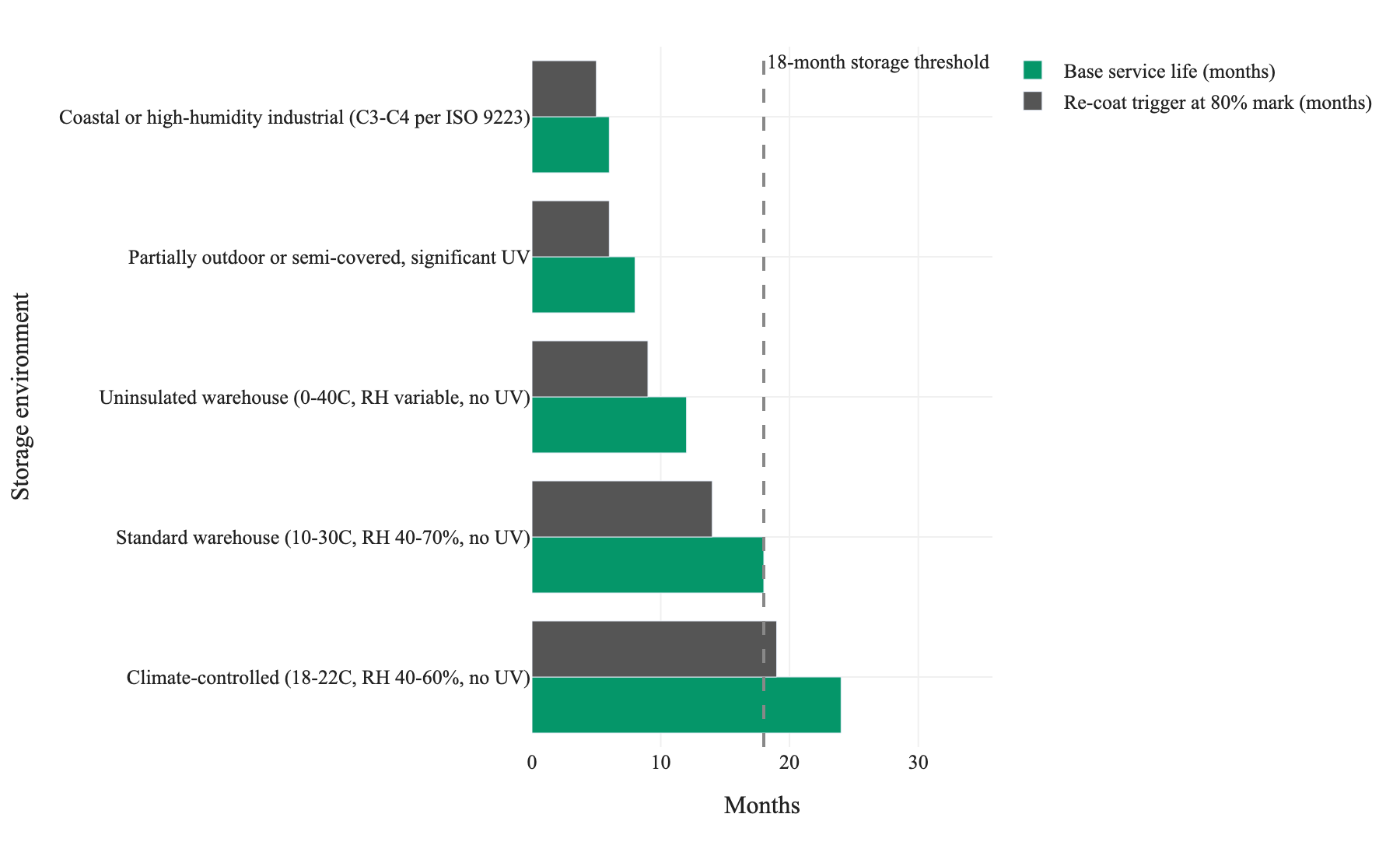
Storage environment | Base service life | Re-coat trigger (80% mark) |
|---|---|---|
Climate-controlled (18-22C, RH 40-60%, no UV) | 24 months | Month 19 |
Standard warehouse (10-30C, RH 40-70%, no UV) | 18 months | Month 14 |
Uninsulated warehouse (0-40C, RH variable, no UV) | 12 months | Month 9 |
Partially outdoor or semi-covered, significant UV | 8 months | Month 6 |
Coastal or high-humidity industrial (C3-C4 per ISO 9223) | 6 months | Month 5 |
Figure 2b. Penalty Factors: Subtract from Base Service Life
Condition | Penalty |
|---|---|
Daily temperature swing exceeds 15 degrees Celsius | Minus 3 months |
Daily temperature swing exceeds 20 degrees Celsius | Minus 4 months |
Significant UV exposure (outdoor or translucent roof) | Minus 3 to 4 months |
Coastal or C3-C4 environment with UV exposure | Minus 2 to 3 additional months |
How to apply: Read base service life from Figure 2a. Subtract any applicable penalties from Figure 2b to obtain the adjusted service life. Schedule re-coat inspection at 80 percent of the adjusted figure. At inspection, evaluate film condition against the checklist in Figure 3 below.
Figure 3. Field Inspection Checklist for Preservative Oil Film Condition
Use this checklist at each scheduled re-coat trigger date. Any single fail triggers immediate re-coat.
Inspection criterion | Pass | Fail | Action on fail |
|---|---|---|---|
Film surface appearance | Continuous, uniform, slightly tacky | Dull, matte, dry-to-touch, or wrinkled | Re-coat immediately |
Film surface hardness | Deforms under light finger pressure | Rigid, does not deform | Re-coat immediately |
Visual crack network | None visible under 10x magnification | Any cracking, crazing, or alligatoring pattern | Re-coat immediately |
Rust evidence on metal | None visible at film edges, fastener holes, or protrusions | Any rust spotting at film discontinuities | Re-coat + assess metal surface; descale if needed |
Film adhesion at edges | Film adheres continuously to machined edges | Delamination, peeling, or lifted film edges | Re-coat immediately |
Film color | Clear to amber, uniform | Darkened, black-tinged, or opaque zones | Re-coat; investigate storage environment for UV or heat source |
Decision Tree: Re-Coat vs. Full Preservation Renewal
If the inspection at the re-coat trigger date finds any fail condition, follow this decision path.
Is rust present on the metal surface beneath the film? If yes, go to step 2. If no, go to step 3.
Remove the existing film with an appropriate solvent per the product data sheet. If rust is superficial (orange-red bloom, no pitting), descale, clean, and apply full fresh film. If pitting is present, assess component fitness-for-service before re-preservation.
Is the film cracked or rigid (fail on hardness or crack network)? If yes, remove and re-apply fresh film. If no, apply a supplemental topcoat of the same preservative oil, verify edge seal coverage, and reschedule inspection at 80 percent of the adjusted service life from the re-coat date.
All criteria pass: extend one additional interval by 50 percent, then re-coat at the next trigger regardless of condition.
VI. Field Cases: Aerospace and Capital Equipment Layup Programs
The following cases are anonymized. Each uses quantitative data from the site record and is presented with a distinct narrative pattern.
Company A: Unexpected Cause, Turbine Rotor Assemblies in Three-Year Aerospace Layup
Company A is a tier-1 aerospace component manufacturer that stores approximately 240 turbine rotor shaft assemblies per year under MIL-PRF-16173 Grade 2 soft-film compound at 50 to 75 micrometers dry film thickness, with an initial qualification test of 500 hours humidity cabinet per ASTM D1748. Annual inventory value is approximately USD 42 million.
The site operated without a re-coat program because the qualification data showed no corrosion through 500 hours of humidity cabinet exposure. At the 18-month audit, 31 of 240 assemblies showed rust staining at spline roots and ground journal diameters, a 12.9 percent failure rate. The film appeared continuous on all failed parts. Total rejection and emergency replacement cost was USD 4.3 million.
The root cause was that the nominally temperature-controlled storage building experienced daily temperature swings of 18 to 22 degrees Celsius due to inadequate HVAC capacity during transition seasons, exceeding the Grade 2 film's elastic limit after 12 to 15 months of oxidative hardening. Film cross-sections from failed assemblies showed an outer skin layer 8 to 12 micrometers thick. The corrective program added a month-12 re-coat at USD 38,000 for 240 assemblies. Over the subsequent 24-month observation period, zero rust events occurred at removal.
Company B: Gradual Degradation, Heavy Machinery Spare Parts in Construction Equipment Layup
Company B is a capital equipment supplier maintaining a layup program for 86 crane and excavator hydraulic cylinder assemblies stored in an open-sided warehouse adjacent to a coastal port facility classified as ISO 9223 C3 to C4 due to airborne chloride. Cylinders were preserved with a petroleum-based oily film rust preventive per ASTM D665 Part A at approximately USD 185 per assembly, total program cost USD 15,910.
The inspection program recorded rust status at three, six, and nine months only, all passing. The 12-month inspection was skipped due to a personnel change. At 18 months, 11 assemblies showed rust, a 12.8 percent failure rate. Film analysis of failed assemblies showed the oily film had dried to a matte surface, lost tactile tackiness, and exhibited microcracks around fastener boss protrusions under 10x magnification.
The corrective program reclassified the facility to a six-month re-coat interval consistent with its C3 to C4 corrosivity category, upgraded the specification to require ASTM B117 salt spray performance of at least 500 hours, and installed the field inspection checklist from Section V. Failure rate over the subsequent 18 months fell from 12.8 percent to 0.9 percent, with avoided rework and replacement costs of USD 310,000 against a re-inspection program cost of USD 28,000.
VII. Key Takeaway
A preservative oil film that passes initial humidity cabinet or salt spray testing does not have a fixed service life: it has a service life that depends on base oil type, additive concentration, film thickness, and storage environment severity. Use the prediction table in Section V as the starting point, not the product data sheet alone.
The 18-month failure window is not arbitrary. It is when three concurrent processes converge: additive depletion below the critical interface concentration, base oil surface oxidation to a brittle skin, and accumulated thermal cycling stress sufficient to fracture that skin. Preventing convergence means interrupting at least one process before month 12.
A month-12 re-coat is the single highest return-on-investment intervention in a multi-year storage program. In both field cases above, the re-coat program cost less than 15 percent of a single failure event.
Visual inspection records only rust presence or absence. Film condition inspection, using the six-criterion checklist in Section V, identifies cracked and hardened films before rust appears and is the only method that catches the failure before the consequential damage.
Late-stage storage failures are systematically misclassified as handling damage or supplier defects. Connecting preservation program audits to component rejection records at installation is the organizational step that makes the failure pattern visible and enables cost-justified program upgrades.
If your stored components are past the 12-month mark and you do not have a re-coat program with a defined inspection checklist, submit the case to AI Shooting, the Lubinpla per-case industrial chemistry analysis service. Send your preservative oil specification, storage environment data, and component description and receive an evidence-based written analysis within three business days at the Standard tier. Lubinpla is an industrial-chemistry AI agent company serving manufacturers, distributors, and maintenance teams. Submit at https://www.lubinpla.com/ai-shooting.
VIII. References
AMPP (Association for Materials Protection and Performance). (2022). ASTM D1748-22: Standard Test Method for Rust Protection by Metal Preservatives in the Humidity Cabinet. https://store.astm.org/d1748-22.html
ASM International. (2002). ASM Handbook Vol. 20: Materials Selection and Design — Thermal Properties of Carbon and Alloy Steels. https://www.asminternational.org/
ASTM International. (2019). ASTM B117-19: Standard Practice for Operating Salt Spray (Fog) Apparatus. https://www.astm.org/b0117-19.html
ASTM International. (2015). ASTM D665-15: Standard Test Method for Rust-Preventing Characteristics of Inhibited Mineral Oil in the Presence of Water. https://www.astm.org/d0665-15.html
Elsevier, Corrosion Science. (2024). EIS evaluation on the degradation behavior of rust-preventive oil coating exposure to NaCl electrolyte. https://www.sciencedirect.com/science/article/abs/pii/S0013468624006017
Elsevier, Corrosion Science. (2024). Degradation of anti-rust oil film in a simulated coastal atmosphere: Inhibition mechanism and in-situ monitoring. https://www.sciencedirect.com/science/article/abs/pii/S0010938X24002907
Evans, U. R. (2019). The Corrosion and Oxidation of Metals (classic industrial reference cited via ResearchGate). Adsorption Behavior of Organic Corrosion Inhibitors on Metal Surfaces. https://www.icmt.ohio.edu/documents/Journals2019/Adsorption_Behavior_of_organic_corrosion_inhibitors_on_Metal_Surfaces.pdf
Finozol. (2023). What Are Rust Preventive Oil Additives? Why Are They Critical in Industrial Machinery? https://www.finozol.com/blogs/what-are-rust-preventive-oil-additives-why-are-they-critical-in-industrial-machinery
ISO (International Organization for Standardization). (2012). ISO 9223:2012: Corrosion of metals and alloys — Corrosivity of atmospheres — Classification, determination and estimation. https://www.iso.org/standard/53499.html
Machinery Lubrication (Noria Corporation). (2023). The Importance of Oil Oxidation Stability. https://www.machinerylubrication.com/Read/28966/oil-oxidation-stability
Machinery Lubrication (Noria Corporation). (2023). Lubricant Additives: A Practical Guide. https://www.machinerylubrication.com/Read/31107/oil-lubricant-additives
Machinery Lubrication (Noria Corporation). (2023). Preservative Treatments to Control Corrosion. https://www.machinerylubrication.com/Read/928/corrosion-preservative-treatment
MIL-PRF-16173E. (2019). Corrosion Preventive Compound, Solvent Cutback, Cold Application. U.S. Department of Defense. https://www.silmid.com/knowledge-centre/aerospace-specifications/mil-prf-16173/
NACE International. (2016). IMPACT: International Measures of Prevention, Application, and Economics of Corrosion Technologies. https://impact.nace.org/documents/Nace-International-Report.pdf
Zerust (Northern Technologies International). (2023). Rust Preventive Oil Axxanol 750-NV Product Information. https://www.zerust.com/products/rust-inhibitors-preventatives-and-coatings/zerust-axxanol-750-nv-rust-preventive-oil/