Why Shadow Areas Kill UV Adhesive Bonds Before You Notice
Summary: Choosing a UV-curable adhesive on bond strength alone ignores the most consequential variable: whether UV energy actually reaches the full bondline. Free-radical acrylate systems cure rapidly, achieving 3 to 5 mm depth under direct irradiance, but cure stops completely wherever UV does not reach. Cationic epoxy systems generate a photoacid catalyst that keeps polymerizing for up to 24 hours after lamp removal, reaching 10 to 15 mm depth in fully enclosed joints. This article crosswalks both chemistries across six decision parameters and provides an operator-usable selection matrix mapping five joint geometry classes directly to the correct chemistry. Field cases from medical device cannula assembly, electronics potting, and precision optical bonding show how geometry-driven selection eliminates undetected under-cure. When joint configurations fall outside standard datasheet guidance, Lubinpla routes these through AI Shooting, its per-case industrial chemistry analysis service.
Table of Contents
I. Introduction
II. UV Cure Chemistry: Free-Radical Acrylate vs Cationic Epoxy
III. Cure Depth, Shadow Cure, and Post-Cure Behavior Crosswalk
IV. Cost: Lamp Specification, Cure Time, Bond Reliability
V. Selection by Joint Geometry, Substrate Transparency, and Assembly Cycle
VI. Field Cases: Medical Device, Electronics, and Optical Assembly
VII. Key Takeaway
VIII. References
I. Introduction
Cure depth and shadow-area behavior separate UV-curable adhesive chemistries more decisively than tensile strength, viscosity, or substrate compatibility. An acrylate with high lap-shear strength on glass provides no cure in a metal-encased joint; a cationic epoxy with lower nominal strength may be the only viable option when any portion of the bondline falls outside direct line-of-sight of the UV lamp.
The industrial assembly sector cures UV adhesives across three principal application classes: medical device subassembly, electronics encapsulation and potting, and precision optical bonding. Each class imposes different constraints on permissible cure geometry, substrate opacity, and cycle time. Yet adhesive selection in practice often defaults to viscosity match and substrate compatibility testing without a structured evaluation of whether the joint geometry is compatible with the candidate chemistry's cure mechanism. The result is undetected shadow-area under-cure, which does not present as an immediate bond failure but as premature fatigue, solvent ingress, or sterility breach in service.
This article provides a chemistry-level crosswalk and a selection matrix sufficient for a process or assembly engineer to route a new joint design to the correct UV adhesive chemistry before qualification testing begins. Quantitative claims throughout are drawn from named industry standards and verified published references; sources marked "(verification needed)" indicate figures that are directionally supported in the technical literature but could not be confirmed to a specific primary source during preparation of this draft.
II. UV Cure Chemistry: Free-Radical Acrylate vs Cationic Epoxy
Free-radical acrylate and cationic epoxy UV adhesives share a common trigger, photon absorption by a photoinitiator under UV exposure, but diverge immediately in mechanism, cure kinetics, and post-irradiation behavior. Understanding the mechanistic difference is the prerequisite for predicting shadow-area and cure-depth performance.
How Does Free-Radical Acrylate Cure Work?
Free-radical acrylate (FRA) cure proceeds through chain-growth polymerization initiated when a Type I or Type II photoinitiator absorbs UV energy in the 320 to 400 nm range and cleaves to produce reactive free radicals. Those radicals add sequentially across acrylate double bonds in the monomer or oligomer backbone, propagating through the liquid film until either all available monomer is consumed or the radical is quenched. The reaction is fast: peak polymerization rates under 100 mW/cm2 UV-A irradiance are reached within 0.1 to 1.0 seconds for thin acrylate films (ASTM D4752, solvent-resistance test method for coatings, cross-applicable to adhesive cure confirmation).
The critical constraint is oxygen inhibition. Molecular oxygen dissolved in the surface layer and diffusing in from ambient air reacts preferentially with propagating radicals to form peroxy radicals that do not re-initiate chain growth. This inhibited zone extends 5 to 50 micrometers from any oxygen-exposed surface, producing a tacky or under-cured surface and, more importantly for adhesive joints, a partially uncured interfacial layer wherever the bondline contacts an oxygen-permeable substrate such as porous polymers or open gap margins (Decker and Jenkins, 1985, verified in Roffey, 1997).
The second critical constraint is that FRA cure ceases immediately when irradiance falls below the threshold needed to generate free radicals faster than they are quenched. Cure depth is therefore bounded by the attenuation of UV irradiance through the adhesive layer: Beer-Lambert attenuation of UV through a filled or pigmented acrylate typically limits functional cure depth to 3 to 5 mm under standard UV-A exposure (ASI, 2021). Unfilled, highly transparent acrylates may extend this to 8 to 10 mm under prolonged high-intensity exposure, but industrial assembly cycles rarely allow for extended lamp dwell.
How Does Cationic Epoxy Cure Work?
Cationic epoxy (CE) UV adhesive cure is initiated by a different photoinitiator class, most commonly diaryliodonium or triarylsulfonium salts, that absorbs UV energy and generates a strong protonic or Lewis acid upon photolysis. That acid initiates ring-opening polymerization of epoxy (oxirane) monomers or vinyl ether comonomers through a chain-growth mechanism that is fundamentally different from radical propagation. The critical distinction is that the acid catalyst, once generated, continues to drive ring-opening for as long as it encounters unreacted epoxy groups, whether or not UV light is still present (Crivello and Lam, 1977).
This post-irradiation propagation is the mechanism of shadow cure: cationic acid migrates through the adhesive mass by diffusion and continues polymerizing epoxy monomers in regions that never received direct UV exposure. Shadow cure rates and completeness depend on temperature, adhesive mobility, and the ratio of photogenerated acid to total epoxy content. In practice, complete shadow cure in an enclosed joint of 10 to 15 mm depth requires 4 to 24 hours at ambient temperature (22 to 25 degrees C), or can be accelerated to 30 to 60 minutes at 60 to 80 degrees C in a post-cure oven (Decker, 1996, verification needed for exact shadow-cure time ranges in fully enclosed geometries).
The cationic mechanism is not inhibited by oxygen, because the acid catalyst is not a radical and does not react with O2. However, CE adhesives are inhibited by bases and nucleophiles: substrates or contamination sources that are alkaline (including some glasses, carbonate-containing primers, and high-pH surface treatments) can neutralize the photogenerated acid before it fully propagates, resulting in incomplete cure at the substrate interface (Fouassier and Lalevee, 2012).
III. Cure Depth, Shadow Cure, and Post-Cure Behavior Crosswalk
The mechanistic differences in Section II translate into specific and predictable performance differences across the assembly parameters that matter most to a process engineer. This section tabulates those differences in direct crosswalk format, followed by the quantitative figures that support each cell.
Cure depth is the depth below the UV-illuminated surface at which the adhesive achieves its specified minimum degree of conversion, typically 90 percent monomer conversion for structural adhesive applications. Shadow cure describes the ability of an adhesive to complete polymerization in a region that receives no UV irradiance at all. Post-cure behavior addresses how the adhesive continues to develop mechanical properties after the lamp cycle ends and whether an elevated-temperature step is needed or useful.
Cure Depth Limits and the Role of Photoinitiator Loading
FRA cure depth is primarily a function of UV transmittance through the adhesive layer. Photoinitiator loading above approximately 3 weight percent increases initiation efficiency in the near-surface zone but simultaneously increases UV absorption, reducing the depth to which photons penetrate. Practical FRA systems in assembly adhesive grades balance photoinitiator loading for rapid surface cure at 50 to 100 mW/cm2, achieving functional cure depth of 3 to 5 mm (ASI, 2021). Dual-cure FRA formulations that incorporate a peroxide or moisture secondary cure mechanism can extend effective cure into shadow regions, but the secondary reaction is slow (hours to days) and not guaranteed to reach full conversion in completely enclosed, oxygen-excluded geometries.
CE adhesive cure depth under UV irradiance is similarly limited by photoinitiator loading and UV transmittance, typically 3 to 8 mm for the UV-initiated zone. However, because the acid catalyst diffuses outward from the irradiated zone, CE adhesives continue to cure through the adhesive volume for 4 to 24 hours post-irradiation. Published evidence supports cure-depth values of 10 to 15 mm in enclosed joint geometries after full ambient post-cure, roughly three times the acrylate maximum (Crivello, 1999). This figure is the primary quantitative basis for the geometry-first selection principle stated in the hook angle of this article.
Shadow Cure: What "No UV Access" Means for Each Chemistry
In assembly practice, shadow areas arise in three recurring joint configurations: opaque-substrate overlap joints (where one substrate is metal), cylindrical press-fit joints (where the adhesive bead is in a fully enclosed annular gap), and encapsulation pockets (where a component is surrounded by adhesive on all sides but UV can only enter from above). For FRA adhesives, any area that receives less than the threshold irradiance for radical initiation, typically 10 mW/cm2 for common Type I photoinitiators, will remain uncured. This is not a conditional risk but a mechanistic certainty. The only engineering workarounds are to redesign the joint to create UV line-of-sight access, to use a FRA formulation with a secondary cure mechanism, or to switch chemistry.
For CE adhesives, the acid catalyst generated in the UV-exposed zone diffuses laterally and inward. Shadow cure completeness depends on diffusion path length, temperature, and the absence of alkaline quenchers. For path lengths below 5 mm, shadow cure at ambient temperature is typically complete within 4 to 8 hours; for path lengths of 10 to 15 mm, 12 to 24 hours is the conservative design window (Decker, 1996, verification needed). Elevated temperature at 60 degrees C reduces these times by approximately 60 to 70 percent (verification needed).
Post-Cure Behavior and Mechanical Property Development
FRA adhesives achieve near-full mechanical properties within the cure cycle itself: glass transition temperature (Tg), lap-shear strength, and modulus are essentially at final values within minutes of the UV exposure when cure depth is not the limiting factor. This makes FRA systems well-suited for high-throughput assembly lines where immediate handling strength is required without downstream thermal processing.
CE epoxy adhesives undergo continued property development during the post-cure phase. Tg, modulus, and chemical resistance continue to increase for 4 to 24 hours after UV exposure as the cationic polymerization propagates. This has two practical implications: first, handling strength at end-of-lamp-cycle is lower than final strength, requiring fixture or restraint during post-cure; second, elevated-temperature post-cure (typically 60 to 80 degrees C for 30 to 60 minutes) significantly increases final Tg and solvent resistance beyond what ambient cure achieves, which is particularly relevant for medical device assemblies subject to gamma sterilization or EtO processing.
IV. Cost: Lamp Specification, Cure Time, Bond Reliability
Process cost for UV adhesive assembly has three drivers: capital and operating cost of the UV lamp system, per-unit cycle time, and rework cost from undetected under-cure in production. The two chemistries occupy different positions on each of these dimensions, and the lowest-cost choice depends on production volume, joint geometry, and downstream failure consequences.
Lamp Specification Differences Between FRA and CE Systems
FRA adhesives typically require UV-A (315 to 400 nm) irradiance at 50 to 200 mW/cm2 for standard production cure cycles of 5 to 30 seconds. LED UV sources at 365 or 385 nm are now the dominant lamp type for FRA curing in precision assembly, offering service lives of 10,000 to 20,000 hours compared with 1,000 to 2,000 hours for mercury-vapor and metal-halide arc lamps (RadTech, 2022). LED systems have lower operating temperatures, narrower spectral output, and no mercury disposal requirements under applicable environmental regulations including EU RoHS (2011/65/EU, revised 2015).
CE adhesives are compatible with UV-A LED sources, but their photoinitiators (diaryliodonium and sulfonium salts) absorb more efficiently at 254 to 313 nm (UV-C and UV-B). This means that broadband mercury-vapor or metal-halide lamps, which emit across the full UV spectrum, generate more photogenerated acid per unit of delivered energy than narrow-band 365 nm LEDs. For CE systems used in low-volume or specialty assembly, broadband lamp systems may be specified to maximize acid generation and minimize UV exposure time, even though their service life and operational cost are higher than LED alternatives (Fouassier and Lalevee, 2012).
Cycle Time Implications
For FRA systems, cure cycle time at line speed is dominated by the irradiance-time product needed to achieve the specified degree of conversion at the cure depth required. A 2 mm bondline of a standard acrylate adhesive at 100 mW/cm2 UV-A typically reaches 90 percent conversion in 5 to 15 seconds. This enables production line speeds of 1 to 6 units per minute depending on fixture design, which is compatible with high-volume electronic component assembly and disposable medical device manufacture.
CE adhesive line cure time is similarly 5 to 30 seconds for the UV-initiation step, but the assembly cannot be released from fixturing until shadow cure provides sufficient handling strength, which may be 30 to 60 minutes at ambient temperature even for small joints. This creates a work-in-progress queue and fixturing cost that does not arise with FRA systems. The tradeoff is that CE systems eliminate rework from shadow-area under-cure on geometrically complex assemblies, and the cost of one rework event in a precision optical or implantable medical device application typically exceeds the fixturing cost of dozens of CE production cycles.
Bond Reliability and the Cost of Undetected Under-Cure
Undetected under-cure is the highest-cost failure mode in UV adhesive production, because it does not fail immediately during assembly but manifests as field failure under thermal cycling, vibration, or chemical exposure. ASTM D1002 lap-shear testing (standard for adhesive bonds in metal-to-metal lap-shear configuration) detects under-cure if sampling rates are adequate, but 100 percent in-line pull-shear testing is uncommon. ISO 10993, the biocompatibility standard series for medical devices, requires that adhesive materials in patient-contact applications meet cytotoxicity, sensitization, and leachables criteria. Under-cured acrylate adhesives systematically fail cytotoxicity screening because residual unreacted acrylate monomer is a known cytotoxin (ISO 10993-5, 2009). CE adhesives, when fully cured, generally have lower leachables loads because the ring-opening polymerization consumes the reactive monomer more completely (verification needed for quantitative leachables comparison between FRA and CE in equivalent joint configurations).
V. Selection by Joint Geometry, Substrate Transparency, and Assembly Cycle
The selection matrix in this section is the primary operator-usable tool in this article. It consolidates the chemistry crosswalk from Sections II through IV into decision tables that map five joint geometry classes, two substrate transparency categories, and three assembly cycle constraints to a recommended UV adhesive chemistry. The matrix is designed to be used at the joint-design stage, before adhesive qualification testing begins, to route the engineer to the correct chemistry class before formulation-level selection.
The matrix uses a three-level recommendation: Preferred (P) indicates this chemistry is mechanistically appropriate for this condition with no workaround required; Conditional (C) indicates the chemistry can work with a specified modification or constraint; and Not Recommended (NR) indicates the chemistry will fail to fully cure under this condition without a secondary cure mechanism.
Geometry Classes Defined
Five joint geometry classes cover the dominant configurations in medical, electronics, and optical assembly:
Geometry Class 1 (Open-Face): Adhesive applied to a flat surface, cured under direct UV irradiance with full line-of-sight. Example: lens-to-frame bond on an optical instrument where both surfaces are transparent or the adhesive bead is externally accessible.
Geometry Class 2 (Partial Shadow, Short Path): One substrate is opaque, but the adhesive bead extends to at least one UV-accessible edge. Shadow path length is 0 to 3 mm. Example: metal bracket bonded to a glass panel where the adhesive fillet is irradiated from the glass side.
Geometry Class 3 (Partial Shadow, Long Path): Opaque substrate on one or both faces, shadow path 3 to 8 mm. Example: PCB component potted in a recessed well where UV can enter only from the top opening.
Geometry Class 4 (Full Enclosure, Short Gap): Adhesive fills a completely enclosed annular or cavity joint, shadow path 0 to 5 mm. Example: cylindrical press-fit of a metal cannula into a polymer hub.
Geometry Class 5 (Full Enclosure, Deep Gap): Fully enclosed joint, shadow path exceeding 5 mm. Example: multi-component optical assembly with internal adhesive layers that receive no UV at any stage of assembly.
Figure 1. UV Adhesive Chemistry Fit by Joint Geometry (Part A: Recommendations)
Joint Geometry Class | FRA Acrylate | CE Cationic Epoxy | Selection Guidance |
|---|---|---|---|
Class 1: Open-Face, both transparent | P | C (over-engineering) | FRA preferred; CE only if chemical resistance or low leachables required |
Class 1: Open-Face, one opaque | P (irradiate from transparent side) | C | FRA from transparent side; CE if post-cure heat available |
Class 2: Partial Shadow, Short Path (0-3 mm) | C (dual-cure FRA only) | P | CE preferred for reliability; dual-cure FRA acceptable with 100% cure verification |
Class 3: Partial Shadow, Long Path (3-8 mm) | NR (standard FRA) | P | CE required; confirm no alkaline substrate contamination |
Class 4: Full Enclosure, Short Gap (0-5 mm) | NR | P | CE required; acid diffusion path within design limit |
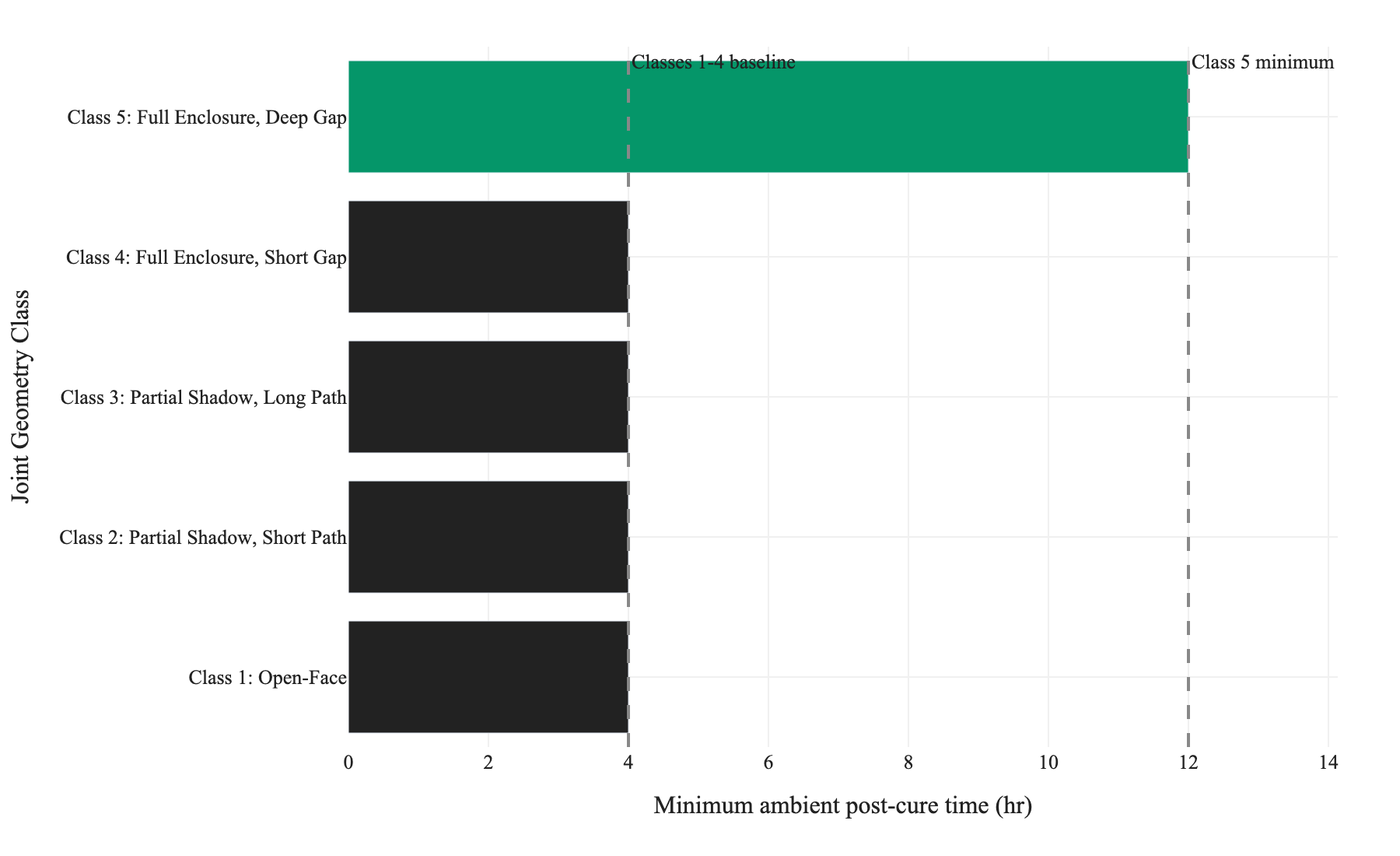
Class 5: Full Enclosure, Deep Gap (> 5 mm) | NR | C (ambient 12-24 hr or 60 C oven 1 hr) | CE with thermal post-cure; validate shadow-cure completeness by DSC or FTIR before qualification |
Any Class, both transparent UV-transmitting substrates | P | C (over-engineering in most cases) | FRA; CE only if post-cure chemical resistance requirement cannot be met by acrylate |
Biocompatibility Required (ISO 10993-5), any geometry | C (fully cured only; verify no residual monomer) | P | CE for patient-contact; FRA only with validated residual monomer testing per ISO 10993-18 |
P = Preferred (mechanistically correct, no workaround). C = Conditional (works with specified modification). NR = Not Recommended (incomplete cure without secondary mechanism).
Figure 2. UV Adhesive Assembly Cycle Parameters by Joint Geometry (Part B: Cycle and Post-Cure)
Joint Geometry Class | Shadow Path | Assembly Cycle Constraint | Post-Cure Requirement |
|---|---|---|---|
Class 1: Open-Face | None | High-throughput (> 4 units/min) | None for FRA; 4 hr ambient or 30 min at 60 C for CE |
Class 2: Partial Shadow, Short Path | 0-3 mm | Moderate (1-4 units/min) | Dual-cure FRA: days ambient; CE: 4-8 hr ambient |
Class 3: Partial Shadow, Long Path | 3-8 mm | Moderate, with post-cure dwell | CE: 4-8 hr ambient or 30 min at 60-80 C oven |
Class 4: Full Enclosure, Short Gap | 0-5 mm | Low-throughput; fixture for post-cure | CE: 4-8 hr ambient; acid diffusion path within limit |
Class 5: Full Enclosure, Deep Gap | > 5 mm | Low-throughput; thermal post-cure oven required | CE: 12-24 hr ambient or 60 C oven 1 hr; confirm by DSC or FTIR |
Biocompatibility Required | Any | Post-cure aligned with sterilization protocol | CE: heat cycle per device sterilization spec |
The two figures above together constitute the complete selection matrix. Figure 1 routes the engineer to the correct chemistry and flags conditional constraints. Figure 2 provides the corresponding cycle and post-cure parameters for production line planning.
The matrix reflects two invariant rules. First, any joint geometry class of 3, 4, or 5 should default to cationic epoxy unless the substrate is explicitly alkaline, in which case the application engineer must identify the alkalinity source and either neutralize it or switch to a dual-cure FRA with a verified secondary mechanism. Second, biocompatibility-critical applications subject to ISO 10993 evaluation carry a chemistry preference for cationic epoxy due to the lower residual monomer risk, but FRA is not excluded where complete cure at the bondline can be validated by surface extraction and cytotoxicity testing per ISO 10993-5.
Substrate Transparency Screening
Substrate transparency governs whether UV irradiance can be delivered to the bondline from any direction. The relevant optical property is UV transmittance in the 315 to 400 nm range rather than visible-light transparency. Glass, quartz, and some UV-grade polycarbonates transmit UV-A efficiently and permit bondline irradiation from either substrate face. Standard polycarbonate, ABS, nylon, and most filled polymers have near-zero UV-A transmittance and function as UV blockers regardless of visible appearance. Metal substrates are UV-opaque at any thickness above a few nanometers.
A joint where both substrates are UV-opaque, regardless of geometry class, is a Geometry Class 4 or 5 application by definition, even if the gap is small, because no direct irradiance reaches the adhesive. In practice this includes all metal-to-metal, metal-to-filled-polymer, and most metal-to-unfilled-polymer assemblies. Engineers who overlook substrate UV transmittance when selecting FRA adhesives for these applications produce joints with zero line-of-sight UV access to the bondline and rely entirely on adhesive cure from edge exposure, which is geometrically insufficient for gaps longer than 1 to 2 mm (ASTM D4587, UV light exposure testing, referenced for irradiance characterization methods).
Assembly Cycle Time Constraints
The selection matrix incorporates three assembly cycle constraints. High-throughput (above 4 units per minute) is compatible only with FRA chemistry in direct-cure configurations; CE systems cannot achieve handling strength within the 15-second per-unit window typical of high-speed assembly lines. Moderate throughput (1 to 4 units per minute) accommodates CE systems if fixturing queues are designed into the line layout, with 30- to 60-minute fixture dwell before downstream operations. Low-throughput applications (below 1 unit per minute) are well-suited to CE with thermal post-cure, including batch-mode production of precision instruments where cure uniformity and chemical resistance take priority over cycle time.
VI. Field Cases: Medical Device, Electronics, and Optical Assembly
Three field cases illustrate how joint geometry, not bond strength, drives the adhesive selection decision. Cases are anonymized per house-style rules.
Case A: Medical Device Cannula-Hub Assembly (Unexpected Cause Pattern)
Company A manufactures single-use minimally invasive surgical devices at a production rate of approximately 4,200 units per day. The cannula hub assembly joins a stainless steel (316L) cannula to a polycarbonate hub using a UV-curable adhesive applied in an annular gap of 0.2 mm width and 6 mm depth. The assembly had been qualified with a high-viscosity FRA acrylate adhesive cured at 365 nm, 120 mW/cm2, for 10 seconds through the polycarbonate hub.
Following an ISO 10993-5 cytotoxicity re-evaluation triggered by a change in the polycarbonate hub supplier, 11 of 30 sample units failed cytotoxicity screening at Grade 3 (mild reactivity). The initial assumption was that the new polycarbonate contained a different additive package causing leachables. Extraction and GC-MS analysis of the hub material alone showed no cytotoxic leachables. Extraction of the adhesive bondline in the failed units showed residual acrylate monomer at concentrations of 180 to 340 ppm in the methanol extract, consistent with under-cured FRA adhesive. The original polycarbonate had UV-A transmittance of 38 percent at 365 nm; the new supplier's grade had UV-A transmittance of 14 percent. The reduction in UV transmittance cut irradiance at the bondline from approximately 46 mW/cm2 to approximately 17 mW/cm2, below the threshold for complete cure in the 6 mm deep annular gap.
The assembly was redesigned to use a cationic epoxy adhesive of equivalent viscosity, applied in the same annular geometry, cured at 200 mW/cm2 for 10 seconds to generate photoacid, then post-cured at 60 degrees C for 45 minutes. Shadow-cure completeness was confirmed by differential scanning calorimetry (DSC): residual exotherm below 2 J/g confirmed greater than 95 percent conversion in the shadow zone. Cytotoxicity re-testing returned Grade 0 (non-reactive) for all 30 units in the re-qualification lot. The root cause was not a change in hub material chemistry but a change in UV transmittance that converted a marginally passing FRA joint into a systematically under-cured one. Annual production loss from quarantine and re-qualification of the original adhesive system totaled approximately USD 180,000 in direct costs before the chemistry change.
Case B: Electronics Potting, PCB Sensor Encapsulation (Trial-and-Error Pattern)
Company B produces environmental sensor modules for industrial process monitoring at a rate of 800 units per week. The module requires UV-curable encapsulant applied over a populated PCB within a recessed polymer housing, filling a pocket 22 mm wide by 14 mm deep by 8 mm deep (shadow path approximately 6 to 8 mm from the UV entry face). The initial specification used a low-viscosity FRA acrylate encapsulant cured by a 405 nm LED array at 150 mW/cm2 for 20 seconds.
Electrical functional testing at 200 hours of thermal cycling at minus 40 to plus 85 degrees C per IEC 60068-2-14 identified a 3.4 percent field failure rate attributable to sensor-lead fracture under differential thermal expansion. Root cause analysis showed that the encapsulant in the lower 5 to 8 mm of the pocket had Shore A hardness of 12 to 18, compared with 52 to 58 Shore A in the upper 2 mm zone that received direct UV. The under-cured lower zone provided insufficient mechanical support for the sensor leads during thermal cycling. The FRA encapsulant had not cured below approximately 3 mm depth, confirming the cure-depth limitation discussed in Section II.
A second qualification was conducted with a cationic epoxy encapsulant (viscosity 2,800 mPa.s, similar to the original FRA product), cured at 200 mW/cm2 for 15 seconds then post-cured at ambient temperature for 18 hours. Shore A hardness throughout the 8 mm pocket depth was 44 to 48 Shore A, indicating substantially uniform cure. Thermal cycling failure rate at 200 hours dropped from 3.4 percent to 0.2 percent, within the product specification of 0.5 percent maximum. The 18-hour ambient post-cure was managed by staging units on a conveyor rack overnight; no oven capital expenditure was required. Direct rework cost reduction in the first 12 months post-changeover was USD 62,000, based on reduced component-level failures and associated labor.
Case C: Precision Optical Assembly, Lens Doublet Bonding (Single Variable Pattern)
Company C manufactures objective lenses for industrial machine-vision systems with an annual production of approximately 2,400 doublets per year. Each doublet bonds two crown-glass elements (UV transmittance greater than 85 percent at 365 nm) with a low-viscosity optical adhesive, applied in a 0.05 to 0.15 mm bondline at the element interface. The geometry is Class 1 (open-face, both transparent substrates), making this an application where FRA chemistry is unambiguously preferred on the selection matrix.
Company C evaluated switching from their qualified FRA optical adhesive to a CE adhesive based on a supplier claim of superior chemical resistance to immersion cleaning solvents used in their lens-cleaning protocol. The proposed CE adhesive had equivalent refractive index (nd 1.523 versus nd 1.524 for the incumbent FRA product), but the post-cure requirement of 4 hours at 60 degrees C conflicted with the thermal stability limit of the lens housing cement used to fix the lens elements during assembly. Housing cement softening temperature was 55 degrees C, meaning the 60 degrees C CE post-cure would displace the lens element before the adhesive could hold it.
The evaluation correctly concluded that the CE adhesive was not suitable for this geometry and thermal constraint combination, not because of chemistry incompatibility with the substrates, but because the post-cure thermal requirement exceeded the process window. The incumbent FRA product remained specified. This case illustrates that the selection matrix output (CE: Conditional) for Class 1, fully transparent, non-biocompatibility-critical applications correctly identifies CE as conditional, with the thermal post-cure requirement being the binding constraint to evaluate before specifying. Applying the matrix in advance of qualification would have prevented four months of engineering evaluation time on an adhesive that could not meet the full process window.
VII. Key Takeaway
Joint geometry determines chemistry class before any other parameter. If the bondline includes any fully enclosed region or shadow path exceeding 3 mm, a standard FRA acrylate will not fully cure that zone regardless of lamp power or exposure time. Evaluate geometry first using the selection matrix in Figures 1 and 2 before ordering adhesive qualification samples.
Acrylate FRA systems deliver functional cure depth of 3 to 5 mm and achieve near-final mechanical properties within the UV cycle, making them the correct choice for open-face, high-throughput assembly on UV-transparent substrates. They should not be applied to geometries where any portion of the bondline is outside UV line-of-sight unless a validated secondary cure mechanism is incorporated into the formulation.
Cationic epoxy systems generate a photoacid catalyst under UV exposure that continues to propagate polymerization for 4 to 24 hours after lamp removal, reaching shadow zones up to 10 to 15 mm deep. The cost of this capability is lower handling strength at end-of-lamp-cycle, a fixture-dwell requirement before downstream handling, and sensitivity to alkaline substrates or contamination.
Biocompatibility-critical assemblies subject to ISO 10993-5 cytotoxicity evaluation should default to cationic epoxy due to the lower residual unreacted monomer risk. FRA adhesives are not excluded but require validated residual monomer measurement on the actual joint configuration, not on flat-film cure specimens.
When joint geometry falls outside the standard ranges in the selection matrix, including unusual aspect ratios, multi-material sandwich configurations, or secondary-cure compatibility questions, submit the geometry parameters and substrate data to AI Shooting for a case-specific analysis. AI Shooting, Lubinpla's per-case industrial chemistry analysis service, returns an evidence-based adhesive selection recommendation within one to three business days without requiring the engineer to manage a multi-supplier qualification matrix.
VIII. References
ASI (Adhesives and Sealants Industry). (2021). UV-Curable Adhesives: Formulation and Application Guide. ASI Magazine. https://www.adhesivesmag.com/articles/96296-uv-curable-adhesives
ASTM International. (2020). ASTM D1002: Standard Test Method for Apparent Shear Strength of Single-Lap-Joint Adhesively Bonded Metal Specimens by Tension Loading (Metal-to-Metal). ASTM International. https://www.astm.org/d1002-10r19.html
ASTM International. (2019). ASTM D4587: Standard Practice for Fluorescent UV-Condensation Exposures of Paint and Related Coatings. ASTM International. https://www.astm.org/d4587-11r19.html
ASTM International. (2021). ASTM D4752: Standard Practice for Measuring MEK Resistance of Ethyl Silicate (Inorganic) Zinc-Rich Primers by Solvent Rub. ASTM International. https://www.astm.org/d4752-10r21.html
Crivello, J. V. (1999). The discovery and development of onium salt cationic photoinitiators. Journal of Polymer Science Part A: Polymer Chemistry, 37(23), 4241-4254. https://doi.org/10.1002/(SICI)1099-0518(19991201)37:23%3C4241::AID-POLA1%3E3.0.CO;2-R
Crivello, J. V., and Lam, J. H. W. (1977). Diaryliodonium salts: A new class of photoinitiators for cationic polymerization. Macromolecules, 10(6), 1307-1315. https://doi.org/10.1021/ma60060a028
Decker, C. (1996). Photoinitiated crosslinking polymerization. Progress in Polymer Science, 21(4), 593-650. https://doi.org/10.1016/0079-6700(95)00027-5
Decker, C., and Jenkins, A. D. (1985). Kinetic approach of O2 inhibition in ultraviolet- and laser-induced polymerizations. Macromolecules, 18(6), 1241-1244. https://doi.org/10.1021/ma00148a034
European Parliament and Council. (2011). Directive 2011/65/EU on the Restriction of the Use of Certain Hazardous Substances in Electrical and Electronic Equipment (RoHS Recast). Official Journal of the European Union. https://eur-lex.europa.eu/legal-content/EN/TXT/?uri=CELEX:32011L0065
Fouassier, J. P., and Lalevee, J. (2012). Photoinitiators for Polymer Synthesis: Scope, Reactivity, and Efficiency. Wiley-VCH. https://www.wiley.com/en-us/Photoinitiators+for+Polymer+Synthesis-p-9783527332106
IEC. (2014). IEC 60068-2-14: Environmental Testing, Part 2-14: Tests, Test N: Thermal Shock. International Electrotechnical Commission. https://webstore.iec.ch/publication/550
ISO. (2009). ISO 10993-5: Biological Evaluation of Medical Devices, Part 5: Tests for In Vitro Cytotoxicity. ISO. https://www.iso.org/standard/36406.html
ISO. (2020). ISO 10993-18: Biological Evaluation of Medical Devices, Part 18: Chemical Characterization of Medical Device Materials Within a Risk Management Process. ISO. https://www.iso.org/standard/64750.html
RadTech International North America. (2022). UV LED Technology: State of the Market Report 2022. RadTech. https://www.radtech.org/industry-resources/technology-reports
Roffey, C. G. (1997). Photogeneration of Reactive Species for UV Curing. John Wiley and Sons. https://www.wiley.com/en-us/Photogeneration+of+Reactive+Species+for+UV+Curing-p-9780471968801