Zinc Phosphate vs Iron Phosphate Pretreatment: Mechanism and Performance and When to Switch
Summary: The choice between zinc phosphate and iron phosphate pretreatment determines both the corrosion protection capability and the total operating cost of a coating line. This article compares the two systems at the chemical mechanism level, examining how zinc phosphate forms a crystalline conversion coating through nucleation chemistry while iron phosphate produces an amorphous coating through a simpler reaction pathway. Salt spray testing data shows zinc phosphate delivering 750 to 1,000 hours of protection compared to 250 to 500 hours for iron phosphate, but this performance advantage comes with higher chemical cost, greater waste treatment burden, and more complex process control. Engineers who understand these trade-offs can make an informed pretreatment decision based on actual performance requirements and total cost rather than habit or supplier recommendation.
Table of Contents
I. Two Approaches to Conversion Coating Chemistry
II. Zinc Phosphate: Crystalline Coating Formation and Nucleation Chemistry
III. Iron Phosphate: Amorphous Coating Formation and Simpler Reaction Pathway
IV. Performance Comparison Under Identical Test Conditions
V. Substrate Compatibility and Process Parameter Sensitivity
VI. Cost-Benefit Analysis: Chemical, Waste, Energy, and Quality
VII. Decision Framework: When Iron Phosphate Is Sufficient vs When Zinc Phosphate Is Worth the Investment
VIII. Key Takeaway
IX. References
I. Two Approaches to Conversion Coating Chemistry
A manufacturing plant runs two parallel coating lines, one using zinc phosphate pretreatment and the other using iron phosphate. Both lines process the same cold-rolled steel parts for the same customer. After 18 months, the zinc phosphate line shows zero warranty claims while the iron phosphate line has accumulated several complaints about coating adhesion failure in outdoor exposure. The difference is not in the paint or application process but in the fundamental chemistry of the conversion coating underneath.
Conversion coatings work by chemically reacting with the metal substrate to produce an insoluble compound layer that becomes an integral part of the surface. This layer serves two functions: it provides a degree of corrosion protection on its own, and it creates an anchor pattern that dramatically improves the adhesion of subsequent organic coatings (paint, powder coat, e-coat). The two most widely used conversion coating chemistries, zinc phosphate and iron phosphate, achieve these functions through fundamentally different chemical pathways that produce coatings with different structures, weights, and performance characteristics.
The Crystalline vs Amorphous Distinction
The most fundamental difference between zinc phosphate and iron phosphate coatings is their crystal structure. Zinc phosphate produces a crystalline coating composed of needle-like or plate-like crystals of hopeite (Zn3(PO4)2) and phosphophyllite (Zn2Fe(PO4)2) that interlock to form a continuous barrier on the metal surface (ScienceDirect, 2025). Iron phosphate produces an amorphous (non-crystalline) coating of iron phosphate and iron oxide that forms a thin, smooth, interference-colored film without distinct crystal morphology (Products Finishing, 2024).
This structural difference has direct consequences for coating performance. The crystalline structure of zinc phosphate creates a thicker, more porous coating that provides excellent mechanical keying for paint adhesion and superior corrosion barrier properties. The amorphous structure of iron phosphate creates a thinner, smoother coating that provides adequate adhesion for many applications but less corrosion barrier protection.
II. Zinc Phosphate: Crystalline Coating Formation and Nucleation Chemistry
Zinc phosphate pretreatment involves a multi-stage chemical process that transforms the metal surface through controlled dissolution, nucleation, and crystal growth. Understanding this process explains why zinc phosphate produces superior coatings but requires more complex process control.
The Dissolution-Precipitation Mechanism
The zinc phosphating process begins when the metal substrate contacts the phosphating bath, which contains phosphoric acid, zinc ions, and various accelerators. The process follows three sequential steps. First, the phosphoric acid dissolves a thin layer of the base metal, consuming hydrogen ions and raising the local pH at the metal-solution interface. Second, the local pH increase at the surface reduces the solubility of zinc phosphate compounds, causing them to precipitate as crystalline nuclei on the metal surface. Third, these nuclei grow into interlocking crystals that cover the entire surface, creating the conversion coating (Wikipedia, 2024).
The chemical reactions can be summarized as: the steel surface dissolves in the phosphoric acid bath (Fe + 2H3PO4 produces Fe(H2PO4)2 + H2), which raises the interfacial pH and causes zinc phosphate precipitation (3Zn(H2PO4)2 produces Zn3(PO4)2 + 4H3PO4). The regenerated phosphoric acid maintains the bath acidity, creating a self-sustaining process as long as zinc ions are replenished.
The Critical Role of Surface Conditioning
Zinc phosphate crystal morphology is controlled by surface conditioning, a step that is unique to zinc phosphate processing and has no equivalent in iron phosphate systems. Surface conditioners, typically based on colloidal titanium phosphate, deposit nanoscale nucleation sites on the metal surface before it enters the phosphating bath (Henkel, 2024). These nucleation sites dramatically increase the density of crystal initiation points, producing a fine, dense microcrystalline coating rather than a coarse, open crystal structure.
Without surface conditioning, zinc phosphate crystals nucleate at relatively few sites on the metal surface, producing large crystals with significant gaps between them. The resulting coating is thick but porous, with poor paint adhesion and inconsistent corrosion protection. With proper conditioning, crystal density increases by a factor of 10 to 100, producing a uniform, fine-grained coating with coating weights typically in the range of 150 to 500 mg/ft2 for light to medium zinc phosphate.
Process Parameters and Their Effects
Parameter | Typical Range | Effect of Too Low | Effect of Too High |
|---|---|---|---|
Bath temperature | 50-65C | Incomplete coating, large crystals | Excessive sludge, etching |
Total acid | 18-25 points | Slow coating, incomplete coverage | Excessive dissolution, sludge |
Free acid | 0.8-1.5 points | Coating too heavy, powdery | No coating formation |
Zinc content | 1.0-2.0 g/L | Thin coating, poor protection | Excessive sludge generation |
Accelerator (nitrite) | 2-4 points | Slow reaction, non-uniform | Passivation, no coating |
Immersion time | 2-5 minutes | Incomplete coverage | Diminishing returns, sludge |
This parameter sensitivity explains why zinc phosphate requires more skilled process control than iron phosphate. Each parameter interacts with the others, and maintaining all parameters within range simultaneously requires regular analytical testing and chemical adjustments.
III. Iron Phosphate: Amorphous Coating Formation and Simpler Reaction Pathway
Iron phosphate pretreatment operates through a fundamentally simpler chemistry than zinc phosphate. Rather than depositing external metal ions (zinc) onto the surface, iron phosphate converts the surface iron itself into an iron phosphate compound. This simpler mechanism requires fewer process stages, produces less waste, and demands less operator skill, but yields a thinner coating with lower corrosion protection capability.
The Iron Oxidation-Phosphating Mechanism
When a steel surface contacts an iron phosphating solution (a dilute solution of phosphoric acid with oxidizing accelerators), two reactions occur simultaneously. The phosphoric acid dissolves surface iron, and the accelerator (typically sodium nitrite or chlorate) oxidizes ferrous ions (Fe2+) to ferric ions (Fe3+) at the surface. The ferric ions react with phosphate to form an insoluble iron phosphate film that deposits on the surface. The resulting coating is a mixture of iron phosphate (FePO4) and iron oxide (Fe2O3) with an amorphous structure (Finishing and Coating, 2024).
The coating appears as an iridescent blue, gold, or green interference color depending on thickness. Blue typically indicates very thin coatings (below 30 mg/ft2), gold indicates moderate thickness (30 to 60 mg/ft2), and green or gray indicates heavier coatings (above 60 mg/ft2). These color indicators provide operators with an immediate visual check of coating quality without analytical testing.
Process Simplicity and Operational Advantages
Iron phosphate pretreatment offers significant operational advantages over zinc phosphate. The typical iron phosphate process requires only 3 to 5 stages (clean, rinse, phosphate, rinse, optional seal rinse) compared to 7 to 10 stages for zinc phosphate (clean, rinse, surface condition, zinc phosphate, rinse, chromate or non-chrome seal, rinse, DI rinse). This reduced stage count translates directly into lower floor space requirements, lower equipment capital cost, and lower maintenance burden.
The process chemistry is also more forgiving. Iron phosphate baths operate effectively across a broader range of concentration and temperature conditions than zinc phosphate, reducing the analytical testing frequency and operator skill required. Bath replenishment is simpler because only one primary chemical is consumed, compared to the multiple interacting parameters of zinc phosphate.
Iron Phosphate Coating Characteristics
Property | Iron Phosphate | Comparison to Zinc Phosphate |
|---|---|---|
Coating weight | 20-100 mg/ft2 | 3-10x lighter |
Crystal structure | Amorphous | Crystalline (zinc) |
Coating composition | FePO4 + Fe2O3 | Zn3(PO4)2 + Zn2Fe(PO4)2 |
Coating color | Blue/gold/green iridescent | Gray matte |
Surface roughness | Smooth | Textured (crystal faces) |
Process stages | 3-5 | 7-10 (zinc) |
Operating temperature | 25-60C (often ambient) | 50-65C (zinc) |
Sludge generation | Low | High (zinc) |
IV. Performance Comparison Under Identical Test Conditions
The performance gap between zinc phosphate and iron phosphate is most clearly demonstrated through standardized testing under identical conditions. Salt spray testing (ASTM B117), paint adhesion testing, and accelerated weathering provide quantitative data for comparison.
Salt Spray Corrosion Resistance
Salt spray testing provides the most widely used benchmark for pretreatment performance. Under identical test conditions with the same topcoat system, zinc phosphate consistently outperforms iron phosphate by a significant margin.
Zinc phosphate pretreatment typically delivers 750 to 1,000 hours of salt spray protection on cold-rolled steel when followed by powder coating, compared to 250 to 500 hours for iron phosphate with the same topcoat (Products Finishing, 2024). On galvanized steel, zinc phosphate can achieve up to 1,000 hours due to the synergistic protection of the zinc substrate and the zinc phosphate coating.
This 2 to 3 times performance difference directly correlates with warranty exposure for manufacturers. Products intended for outdoor exposure in moderate to severe environments generally require the higher protection levels that only zinc phosphate can provide, while products used indoors or in mild environments may perform adequately with iron phosphate.
Paint Adhesion Performance
Paint adhesion testing reveals a more nuanced comparison. Iron phosphate provides good adhesion for liquid paint systems because its smooth, amorphous surface allows intimate contact between the paint and the coating. Zinc phosphate provides excellent adhesion for powder coatings and e-coat systems because the crystalline surface texture creates mechanical interlocking between the conversion coating and the organic layer.
For wet paint adhesion (crosshatch tape pull test, ASTM D3359), both pretreatments typically achieve 5B ratings (perfect adhesion) when properly applied. The difference becomes apparent under stress conditions, such as humidity cycling or thermal shock, where zinc phosphate maintains adhesion more consistently due to the stronger mechanical bond.
Figure 1. Corrosion and Adhesion Performance Comparison
Test Method | Iron Phosphate | Zinc Phosphate | Performance Ratio |
|---|---|---|---|
Salt spray (ASTM B117), hours to failure | 250-500 | 750-1,000 | Zinc 2-3x superior |
Scribe creep at 500 hours (mm) | 3-6 | 1-2 | Zinc 3x less creep |
Crosshatch adhesion (ASTM D3359) | 4B-5B | 5B | Comparable |
Humidity resistance (1000 hrs, % retention) | 85-90% | 95-98% | Zinc 5-10% better |
Impact resistance (ASTM D2794) | Good | Good | Comparable |
Chip resistance (SAE J400) | Moderate | Good | Zinc moderately better |
This data confirms that zinc phosphate delivers meaningfully superior corrosion protection but comparable mechanical adhesion for most standard tests. The performance gap widens under more aggressive exposure conditions, making the pretreatment selection decision dependent on the severity of the end-use environment.
Figure 2. Zinc Phosphate vs Iron Phosphate Performance Profile
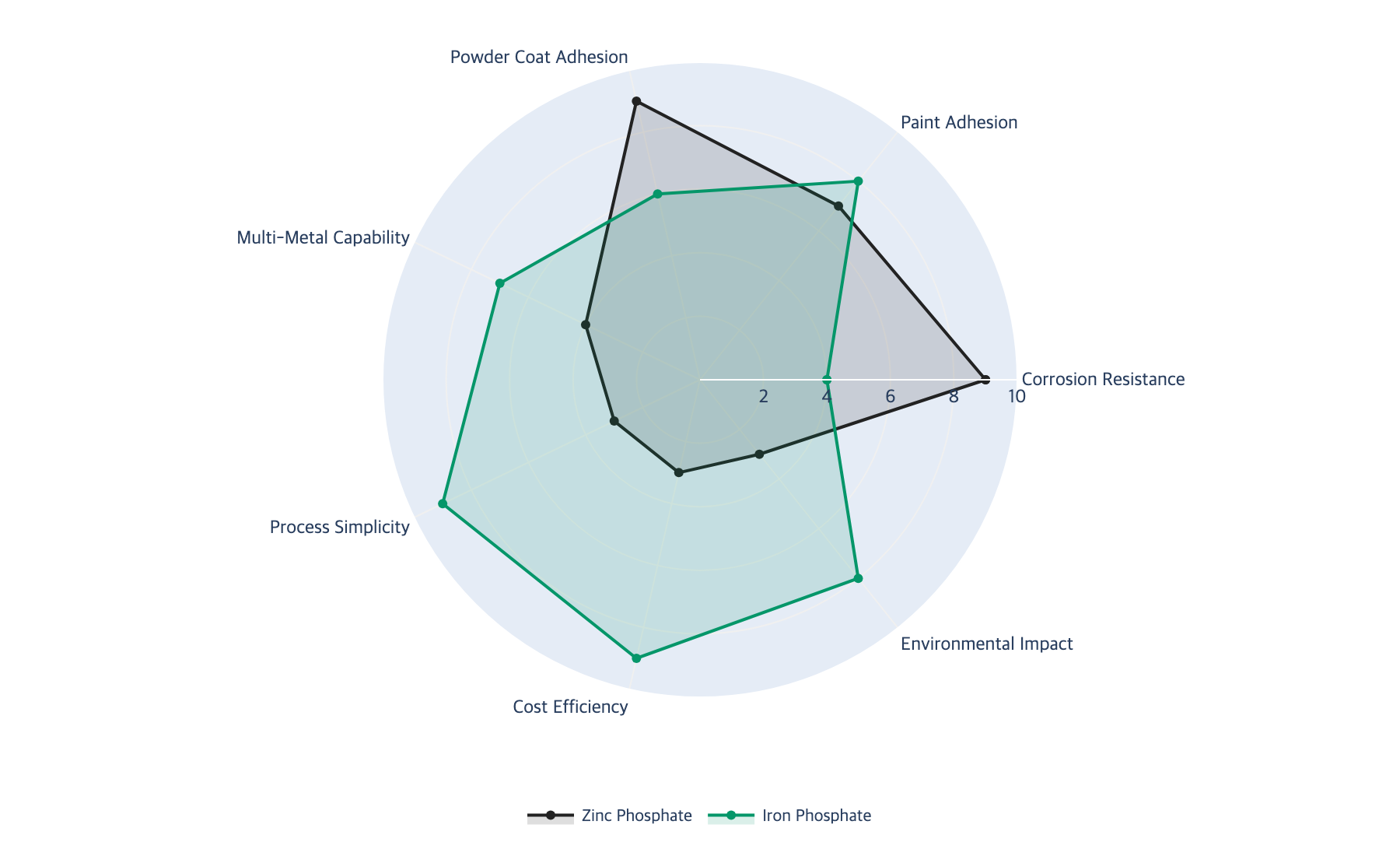
The radar chart provides a visual summary of the trade-off between the two systems. Zinc phosphate dominates in corrosion resistance and powder coat adhesion, while iron phosphate excels in process simplicity, cost efficiency, and environmental impact. Neither system dominates all dimensions, confirming that the selection must be driven by which performance dimensions matter most for the specific application.
V. Substrate Compatibility and Process Parameter Sensitivity
The two pretreatment systems respond differently to variations in substrate type and process parameters. Understanding these sensitivities is essential for maintaining consistent coating quality across production variability.
Substrate Type Effects
Cold-rolled steel is the ideal substrate for both pretreatment types, producing the most consistent results. However, production facilities typically process multiple substrate types, and each responds differently to the two chemistries.
Galvanized steel (hot-dip or electrogalvanized) responds well to zinc phosphate because the zinc surface provides additional zinc ions for the phosphating reaction, accelerating coating formation and producing a denser crystal structure. Iron phosphate on galvanized steel produces a zinc-iron phosphate hybrid coating that may have inconsistent adhesion properties.
Aluminum requires modified zinc phosphate formulations (tri-cation systems containing zinc, manganese, and nickel) because standard zinc phosphate baths do not coat aluminum adequately. Iron phosphate can process aluminum with appropriate fluoride additions that dissolve the aluminum oxide layer, but the resulting coating is very thin and provides minimal protection.
Multi-metal processing (steel plus aluminum on the same line) is significantly easier with iron phosphate than with zinc phosphate because iron phosphate baths are more tolerant of mixed metal dissolution. Zinc phosphate tri-cation systems can process both metals but require tighter process control to maintain bath chemistry within specification for both substrates.
Process Temperature and Time Sensitivity
Condition Change | Iron Phosphate Response | Zinc Phosphate Response |
|---|---|---|
Temperature drop 10C | Slight reduction in coating weight | Significant impact on crystal size and coverage |
Temperature rise 10C | Slight increase in coating weight | Excessive sludge, over-etching risk |
Immersion time reduced 30% | Moderate reduction, still functional | May produce incomplete, open crystal structure |
Immersion time increased 50% | Minimal change (self-limiting) | Coating weight increase, potential powdery surface |
Concentration low 20% | Proportional reduction in coating | Dramatic change in free acid ratio, process upset |
Concentration high 20% | Slight increase, stable | Higher sludge rate, potential quality issues |
This sensitivity comparison demonstrates that iron phosphate is the more robust process, tolerating wider variations in operating parameters without catastrophic quality impact. Zinc phosphate, while producing a superior coating, requires tighter control windows to maintain consistent quality.
VI. Cost-Benefit Analysis: Chemical, Waste, Energy, and Quality
The total cost of a pretreatment system extends far beyond the purchase price of the phosphating chemical. A comprehensive comparison must include chemical consumption, waste treatment and disposal, energy costs, equipment maintenance, quality costs, and floor space utilization.
Chemical and Operating Cost Comparison
Cost Category | Iron Phosphate | Zinc Phosphate | Difference |
|---|---|---|---|
Chemical cost per 1,000 sq ft | USD 3-5 | USD 8-15 | Zinc 2-3x higher |
Waste treatment cost (annual) | USD 5,000-10,000 | USD 25,000-50,000 | Zinc 4-5x higher |
Energy cost (annual, heating) | USD 10,000-20,000 | USD 30,000-45,000 | Zinc 2-3x higher |
Sludge disposal (annual) | USD 2,000-5,000 | USD 10,000-25,000 | Zinc 3-5x higher |
Laboratory testing labor | 2-4 hrs/week | 8-15 hrs/week | Zinc 3-4x higher |
Equipment maintenance | Low | Moderate to high | Zinc higher due to sludge |
One documented case study showed that converting from zinc phosphate to iron phosphate saved approximately USD 73,000 per year, including USD 36,000 in energy, USD 15,000 in waste disposal, USD 10,000 in maintenance, and USD 12,000 in chemicals (Products Finishing, 2024). However, this conversion is only appropriate when the performance requirements of the finished product can be met with iron phosphate's lower corrosion protection capability.
Figure 3. Total Annual Operating Cost Breakdown Comparison
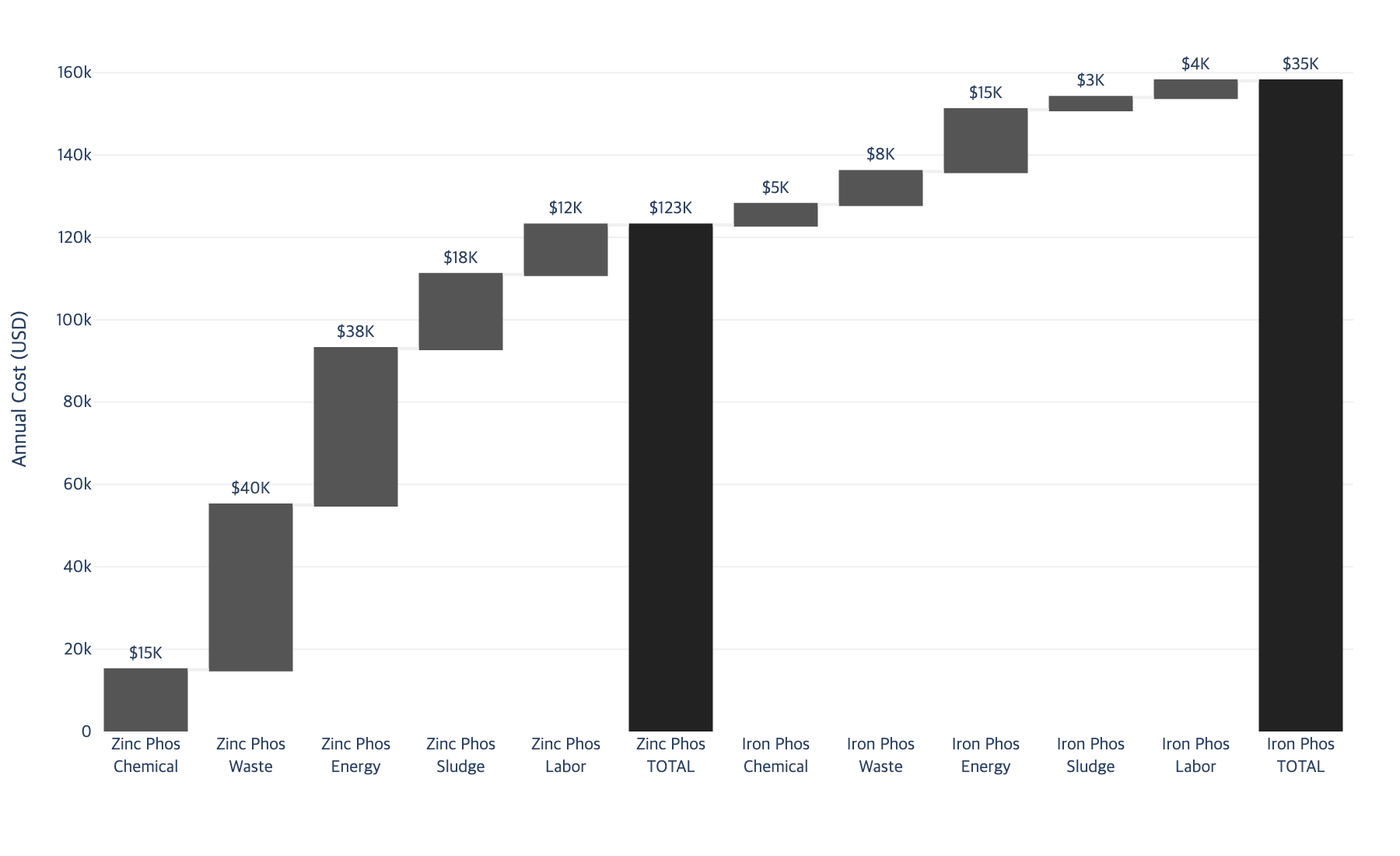
The waterfall chart quantifies the cost gap between the two systems across five major categories. Zinc phosphate totals approximately USD 123,000 annually compared to USD 35,000 for iron phosphate, a 3.5x difference. Waste treatment and energy costs are the largest contributors to the gap, accounting for over 60 percent of the total cost difference. This visualization helps decision-makers understand exactly where the cost premium of zinc phosphate originates and evaluate whether the performance benefit justifies it for their application.
Environmental and Regulatory Considerations
Zinc phosphate waste streams contain heavy metals (zinc, nickel, manganese) that require chemical precipitation and sludge dewatering before discharge. The resulting sludge is classified as hazardous waste in many jurisdictions, requiring manifested disposal at licensed facilities. Iron phosphate waste streams are generally non-hazardous and can often be discharged after simple pH adjustment and oil removal (Finishing.com, 2024).
The regulatory trend toward stricter heavy metal discharge limits has increased the cost of zinc phosphate operation in many regions and has accelerated adoption of iron phosphate and newer alternatives (zirconium-based pretreatments) where performance requirements allow.
VII. Decision Framework: When Iron Phosphate Is Sufficient vs When Zinc Phosphate Is Worth the Investment
The selection between zinc phosphate and iron phosphate should be driven by a structured analysis of performance requirements, substrate types, production volumes, and environmental constraints. Neither system is universally superior.
Decision Matrix by Application Requirements
Application | Environment | Required Salt Spray | Recommended Pretreatment | Rationale |
|---|---|---|---|---|
Indoor furniture/fixtures | Mild indoor | 250-500 hours | Iron phosphate | Cost-effective, adequate protection |
Indoor industrial equipment | Moderate indoor | 500-750 hours | Iron phosphate with seal | Good balance of cost and performance |
Outdoor architectural | Moderate outdoor | 750-1,000 hours | Zinc phosphate | Environment demands higher protection |
Automotive components | Severe outdoor | 1,000+ hours | Zinc phosphate (tri-cation) | Warranty requirements mandate zinc |
Agricultural equipment | Severe outdoor + chemical | 1,000+ hours | Zinc phosphate | Chemical exposure requires crystalline barrier |
Appliances (interior) | Mild indoor | 250-500 hours | Iron phosphate | High volume, cost-sensitive |
Appliances (exterior) | Moderate outdoor | 500-750 hours | Iron or zinc phosphate | Depends on warranty and exposure |
The Volume Threshold Consideration
Production volume affects the economic comparison because zinc phosphate's higher operating cost is partially offset by its lower per-unit quality cost (fewer warranty claims, fewer rejects). For high-volume operations processing 10,000 or more parts per day, the quality advantage of zinc phosphate may justify its higher operating cost through reduced warranty exposure. For low-volume operations processing 100 to 500 parts per day, the simpler operation and lower fixed costs of iron phosphate often make it the economically rational choice even when zinc phosphate would provide marginally better quality.
Integration of Chemical and Business Context
The most common error in pretreatment selection is over-specifying zinc phosphate for applications that do not require it. When a product will be used indoors or in mild environments, the additional cost and complexity of zinc phosphate pretreatment provides no measurable benefit to the end user. Conversely, under-specifying iron phosphate for demanding outdoor applications creates warranty exposure that far exceeds the cost savings from the simpler pretreatment.
The decision framework should consider the end-use environment first, then work backward to determine the minimum pretreatment level that meets the performance requirement with adequate margin. This approach avoids both over-engineering (unnecessary cost) and under-engineering (warranty risk).
VIII. Key Takeaway
Zinc phosphate forms a crystalline conversion coating through a controlled nucleation and growth process that requires surface conditioning, precise bath chemistry control, and 7 to 10 process stages, producing coatings of 150 to 500 mg/ft2 with 750 to 1,000 hours of salt spray protection.
Iron phosphate forms an amorphous coating through a simpler dissolution-precipitation reaction requiring only 3 to 5 stages, producing coatings of 20 to 100 mg/ft2 with 250 to 500 hours of salt spray protection at significantly lower total operating cost.
The total cost difference between the two systems extends well beyond chemical cost to include waste treatment, energy, sludge disposal, and laboratory labor, with zinc phosphate typically costing 3 to 5 times more to operate on a total cost basis.
Pretreatment selection should be driven by end-use environment severity, not by habit. Over-specifying zinc phosphate for indoor applications wastes resources, while under-specifying iron phosphate for outdoor applications creates warranty exposure.
Multi-metal processing (steel plus aluminum) is significantly easier with iron phosphate, while zinc phosphate requires specialized tri-cation formulations for aluminum compatibility.
Lubinpla's materials protection analysis engine can evaluate your specific substrate types, coating requirements, and end-use environment against pretreatment performance data to recommend the optimal conversion coating chemistry and identify the critical process parameters for your production line.
IX. References
[1] ScienceDirect, "Mechanism of zinc phosphate conversion coating formation on iron-based substrates", 2025. https://www.sciencedirect.com/science/article/pii/S0010938X25001234
[2] Henkel Adhesives, "Zinc phosphate coatings", 2024. https://next.henkel-adhesives.com/us/en/articles/zinc-phosphating.html
[3] Products Finishing, "Zinc vs. Iron Phosphate", 2024. https://www.pfonline.com/articles/zinc-vs-iron-phosphate
[4] Products Finishing, "Zinc Phosphate vs. Iron Phosphate vs. Zinc Plating", 2024. https://www.pfonline.com/articles/zinc-phosphate-vs-iron-phosphate-vs-zinc-plating
[5] Finishing and Coating, "Phosphate Coatings: Some Basic Points", 2024. https://finishingandcoating.com/index.php/conversion/1313-phosphate-coatings-some-basic-points
[6] Seacole, "Iron Phos, Zinc Phos, or Zirconium Pretreatment: Which One Is Right for You?", 2024. https://seacole.com/iron-phos-zinc-phos-or-zirconium-pretreatment-which-one-is-right-for-you/
[7] Products Finishing, "Conversion Coatings: Phosphate vs. Zirconium", 2024. https://www.pfonline.com/articles/conversion-coatings-phosphate-vs-zirconium-
[8] Wikipedia, "Phosphate conversion coating", 2024. https://en.wikipedia.org/wiki/Phosphate_conversion_coating
[9] Products Finishing, "Phosphate Conversion Coatings", 2024. https://www.pfonline.com/articles/phosphate-conversion-coatings
[10] ScienceDirect, "Phosphate Coating overview", 2024. https://www.sciencedirect.com/topics/engineering/phosphate-coating
[11] Finishing.com, "Wastewater treatment of iron and zinc phosphate conversion coating processes", 2024. https://www.finishing.com/33/92.shtml
[12] BroCo Products, "Phosphating Basics as a Pretreatment", 2024. https://brocoproducts.com/phosphating-basics-as-pretreatment/
[13] DuBois Chemicals, "Zirconization: The Future of Coating Pretreatment", 2024. https://www.duboischemicals.com/wp-content/uploads/2018/10/White-Paper-Manufacturing-Paint-Pretreatment-Zirconization-1.pdf
Powered by Lubinpla
Discover how technical teams solve complex challenges faster with AI.