How the Skilled Labor Shortage Is Reshaping Maintenance Strategy in Process Industries
Summary: The skilled maintenance technician shortage is no longer a future concern. Sixty percent of maintenance leaders identify skilled labor shortage as their leading challenge, while mean time to repair has increased from 49 to 81 minutes driven by skills gaps. With nearly one million new entry-level technicians needed over the next five years and replacement needs outpacing workforce growth at more than 4-to-1, the shortage demands a fundamental shift from expertise-dependent to system-dependent maintenance. This article connects the workforce trend to its operational consequences for chemical product application and equipment integrity, and presents a framework for evaluating which maintenance activities can be technology-augmented versus which require irreducible human expertise.
Table of Contents
I. The Shortage in Numbers: Scale and Trajectory
II. The Knowledge Drain: What Retires When Technicians Retire
III. Technical Consequences: How Reduced Maintenance Capability Affects Chemical Product Performance
IV. The Shift from Expertise-Dependent to System-Dependent Maintenance
V. Framework: Technology-Augmentable vs Irreducibly Human Activities
VI. Building Technology-Augmented Maintenance Programs
VII. Key Takeaway
VIII. References
I. The Shortage in Numbers: Scale and Trajectory
The skilled maintenance technician shortage in process industries is quantified and accelerating. Sixty percent of respondents in industry surveys identified skilled labor shortage as the leading challenge to improving maintenance programs (FTMaintenance, 2024). A shortage of skilled labor affects 30 percent of maintenance operations and is cited alongside aging infrastructure, which impacts 33 percent, as the top challenge (MaintainX, 2024).
The pipeline deficit is severe. Employment for industrial machinery mechanics and maintenance workers is expected to grow by 15 percent from 2023 to 2033, with approximately 53,000 job openings each year driven primarily by the need to replace retiring workers (MaintainX, 2025). Nearly one million new entry-level technicians will be needed over the next five years, and in some sectors, replacement needs outpace workforce growth at a rate of more than 4-to-1 (LubriSource, 2024). Across all skilled trades, American employers report nearly 2.9 million job openings annually while education systems produce only about 1.25 million qualified graduates (WrenchWay, 2025).
The shortage is not distributed evenly across skill levels. Entry-level positions can be filled, though with longer recruitment cycles. The critical gap is in experienced technicians with 10 or more years of field experience who can diagnose complex failures, optimize maintenance procedures, and make judgment calls about equipment condition.
The Compounding Effect on Existing Staff
When maintenance teams are understaffed, the remaining technicians face increased workloads that reduce the time available for preventive and predictive activities. A lack of resources is the biggest challenge cited by maintenance leaders, with 45 percent saying it is their primary obstacle (Infraspeak, 2025). The result is a predictable degradation cycle: preventive maintenance gets deferred, reactive failures increase, and preventive maintenance falls further behind.
This cycle has measurable financial consequences. Unscheduled downtime saps 11 percent of annual revenues from the world's 500 biggest companies, totaling 1.4 trillion dollars (Siemens, 2024). For mid-size manufacturers, the average cost of unplanned downtime reaches 125,000 dollars per hour.
The Outsourcing Response and Its Limits
Faced with internal skills gaps, many organizations turn to outsourcing. Eighty-eight percent of facilities outsource some maintenance work, with the average plant outsourcing 23 percent of tasks (Infraspeak, 2025). The three main reasons to outsource maintenance are lack of time or manpower at 48 percent, lack of skills among current staff at 41 percent, and too many specialized skills required at 39 percent (Infraspeak, 2025).
However, outsourcing does not resolve the underlying knowledge problem. External contractors follow standardized procedures that may not account for site-specific operating conditions or chemical treatment program nuances. Outsourcing addresses labor availability. It does not address knowledge availability.
II. The Knowledge Drain: What Retires When Technicians Retire
The labor shortage statistics capture the quantity dimension of the problem. The knowledge dimension is equally severe and harder to replace. When a maintenance technician with 25 years of site-specific experience retires, what leaves the organization is not a set of procedures that can be documented in a manual. It is a complex web of pattern recognition, contextual judgment, and tacit knowledge built through thousands of diagnostic cycles across varying conditions.
The Scale of Retirement-Driven Knowledge Loss
The retirement wave is unprecedented. In 2024, approximately 11,000 Americans reached retirement age every day (Manpower, 2025). In the chemical industry, around 30 percent of employees are 50 years of age or more and due to retire within the next decade (Chemical Processing, 2024). Manufacturing will need to fill 3.8 million vacant jobs between 2024 and 2033, with 2.8 million resulting directly from retirements (Manufacturing Dive, 2024). On a percentage basis, utilities face 16.7 percent in anticipated workforce retirements and manufacturing faces 11.8 percent (Protected Income, 2025).
What Tacit Knowledge Looks Like in Practice
An experienced water treatment operator does not just read chemical dosing charts. That operator knows that the cooling tower in Building 3 develops biofilm faster than Building 7 because of its proximity to a cooling pond, that the boiler feed water chemistry shifts predictably during seasonal temperature changes, and that a specific vibration pattern in Pump 12 precedes seal failure by approximately two weeks. None of this exists in any manual.
For chemical product application, tacit knowledge includes understanding how a lubricant behaves differently on equipment that runs continuous shifts versus intermittent operation, recognizing contamination-driven oil degradation versus normal discoloration, and knowing which corrosion inhibitor schedule works for actual field conditions versus the manufacturer's recommendation.
The Time Gap Between Retirement and Replacement
Acquiring the knowledge held by a retiring maintenance professional takes months or even years for newcomers to build through direct experience (Training Industry, 2024). A formal training program can teach a new technician how to perform a lubrication task in weeks. Teaching that technician to recognize the subtle signs that a bearing is being over-greased, because the specific equipment runs at higher ambient temperatures than the specification assumes, takes years of supervised field exposure.
III. Technical Consequences: How Reduced Maintenance Capability Affects Chemical Product Performance
The skilled labor shortage has specific technical consequences for industrial chemical product application that are often overlooked in workforce discussions. Chemical treatment programs depend on correct and consistent application by maintenance staff. When the staff performing these tasks lack the experience to adjust practices based on observed conditions, chemical program effectiveness degrades in predictable ways.
Lubrication Program Quality Decline
Lubrication is one of the most maintenance-skill-sensitive chemical applications. Proper lubrication requires understanding the correct product, the right quantity, the appropriate regreasing interval, and the contamination control measures necessary to protect lubricant performance. Common errors by less experienced technicians include using incorrect viscosity grades, over-greasing bearings (which causes thermal failure), mixing incompatible lubricant types, and failing to follow contamination control procedures.
Approximately 43 percent of industrial equipment mechanical failures originate from lubrication-related issues (Machinery Lubrication, 2022). The experienced technician who adjusts regreasing intervals based on operating temperature, load, and environmental contamination levels is replaced by a technician who follows the fixed interval on the maintenance schedule regardless of actual conditions. Both technicians complete the task. Only one achieves optimal lubrication.
Water Treatment Program Degradation
Cooling water and boiler water treatment programs require regular monitoring, chemical dosing adjustments, and system inspections that depend on technician competency. An experienced water treatment operator recognizes visual and sensory indicators of system problems: water color changes, unusual foam patterns, deposit accumulation, and corrosion signatures. Less experienced operators may follow dosing procedures correctly but miss these qualitative indicators until quantitative alarm thresholds are breached.
The consequence is delayed response. A biofilm accumulation that an experienced operator would address immediately upon visual detection may go unnoticed by a less experienced operator until microbiological counts exceed alarm limits, by which time the biofilm has already reduced heat transfer efficiency and initiated underdeposit corrosion. Scale formation follows the same pattern: a 200-dollar early-stage dosing adjustment becomes a 20,000-dollar system cleaning and lost production event when detected late.
Mean Time to Repair Increase
Figure 3. Mean Time to Repair (MTTR) Increase Breakdown
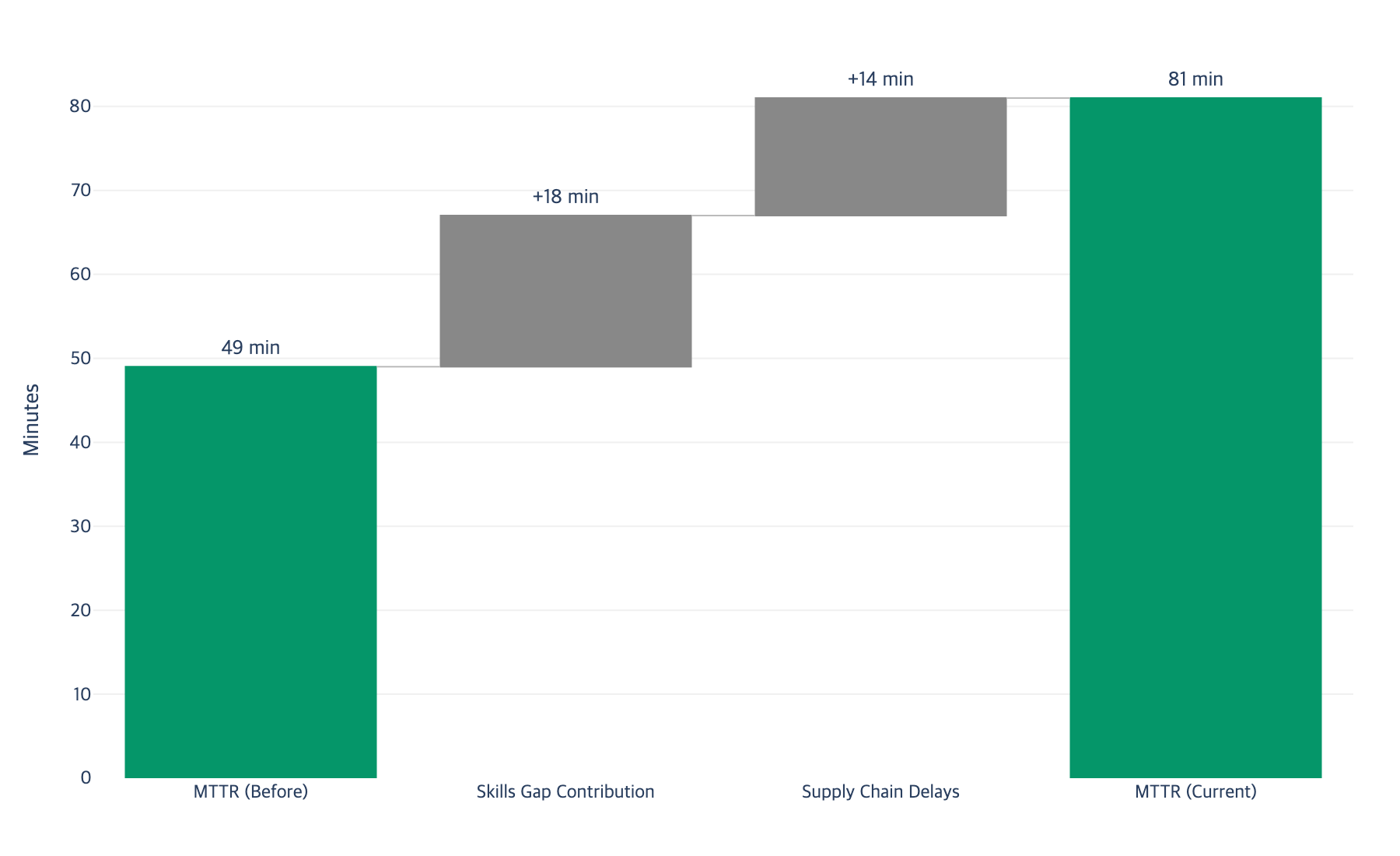
The waterfall chart decomposes the 65 percent increase in average repair time, showing that skills gaps contribute more to the increase than supply chain delays, highlighting the direct operational cost of the technician shortage.
The operational impact of the skills gap is directly measurable. Mean time to repair (MTTR) has increased from 49 minutes to 81 minutes on average, driven largely by skills gaps and supply chain delays (Fabrico, 2025). This 65 percent increase in repair time directly increases equipment downtime, production losses, and the window during which chemical treatment programs may be interrupted or operating without optimal protection.
A 2024 Siemens report attributes the increase specifically to a loss of maintenance staff with the necessary diagnostic skills, compounded by supply chain delays (Siemens, 2024). The skills gap is particularly concerning because it affects the diagnostic phase. An experienced technician who correctly diagnoses a failure on the first attempt completes the repair in a single cycle. A less experienced technician may take two or three cycles to reach the same outcome.
Figure 1. Impact of Maintenance Skill Level on Chemical Program Effectiveness
Chemical Program | Experienced Staff Performance | Reduced-Skill Performance | Consequence |
|---|---|---|---|
Lubrication | Correct product, quantity, interval | Viscosity errors, over-greasing | 2-3x bearing failure rate |
Water treatment | Proactive visual monitoring | Reactive alarm-only response | 2-4 week delayed intervention |
Cleaning | Optimized cycle parameters | Default to original settings | Over-cleaning or under-cleaning |
Corrosion protection | Condition-based reapplication | Calendar-based reapplication | Premature failure or waste |
The table illustrates how reduced maintenance capability does not just increase the frequency of mechanical failures. It specifically degrades the effectiveness of chemical treatment programs that depend on correct application practices.
IV. The Shift from Expertise-Dependent to System-Dependent Maintenance
The traditional maintenance model assumes that experienced technicians carry sufficient knowledge to make correct decisions about chemical product selection, application procedures, and maintenance intervals. The labor shortage makes this assumption unsustainable. Organizations must shift from expertise-dependent to system-dependent maintenance, where standardized procedures, condition-based triggers, and AI-assisted diagnostics reduce the expertise threshold required for effective maintenance.
Standardized Procedures with Built-In Decision Logic
Instead of relying on technician experience to determine the correct lubricant for each application, system-dependent maintenance encodes this knowledge into standardized procedures. Each lubrication point is documented with the specific product, quantity, method, and interval. Mobile CMMS platforms can deliver these procedures to technicians at the point of work, ensuring correct execution regardless of individual experience level.
The key difference from traditional documentation is the inclusion of decision logic. A traditional procedure says "apply grease to bearing." A system-dependent procedure specifies "apply 15 grams of NLGI Grade 2 lithium complex grease using a calibrated grease gun, verify by checking for slight back-pressure, and note any unusual resistance that may indicate seal damage." The second version embeds expert knowledge into the procedure itself.
Condition-Based Triggers Instead of Calendar-Based Schedules
Experienced technicians adjust maintenance activities based on observed equipment condition. Less experienced technicians follow fixed schedules because they lack the judgment to make condition-based adjustments. Technology-augmented programs use sensor data, vibration analysis, oil analysis trends, and thermal monitoring to generate condition-based maintenance triggers that replicate the experienced technician's judgment through systematic data evaluation.
The value of condition-based triggers extends beyond scheduling accuracy. Instead of asking a junior technician to judge whether a bearing "sounds different," condition monitoring provides a vibration amplitude reading that can be compared against established thresholds. The experienced technician's ear is replaced by a sensor. The experienced technician's judgment about what the sound means is replaced by an analytical model. Predictive maintenance adoption currently stands at approximately 27 percent of industrial operations (MaintainX, 2025), and 95 percent of adopters report a positive return on investment (Fortune Business Insights, 2025).
AI-Assisted Diagnostics for Troubleshooting
When equipment problems occur, experienced technicians diagnose root causes through pattern recognition built over years of field exposure. AI-assisted diagnostic tools can provide less experienced technicians with structured troubleshooting pathways that guide them through the same diagnostic logic. The AI evaluates symptoms against known failure patterns, suggests likely causes ranked by probability, and recommends specific corrective actions.
This capability is particularly valuable for chemical product-related troubleshooting, where the root cause may involve interactions between the chemical product, the equipment, the operating conditions, and the application practices. A less experienced technician working through a structured AI-guided diagnostic can reach the same conclusion as an experienced technician, though the path may take longer. The critical outcome is that the correct diagnosis is reached, not that it is reached through intuition rather than systematic analysis.
V. Framework: Technology-Augmentable vs Irreducibly Human Activities
Not all maintenance activities can be effectively technology-augmented. A realistic assessment must distinguish between activities where technology can substitute for expertise and activities that require irreducible human judgment.
Technology-Augmentable Activities
Routine chemical product application, where the correct product, quantity, and procedure are defined, can be guided by mobile work instructions and IoT sensors. Oil analysis interpretation, where historical data and trend patterns inform recommendations, is well-suited to AI pattern recognition. Predictive maintenance scheduling, where sensor data and statistical models determine optimal intervention timing, is increasingly automated. Chemical product selection, where operating conditions must be matched to product specifications across multiple variables, is a domain where AI can process more variables simultaneously than a human analyst.
These activities share common characteristics: structured data, repeatable decision logic, and outcomes that can be validated against objective criteria.
Irreducibly Human Activities
Physical inspection of equipment condition, where tactile and visual assessment requires presence and experience, remains human-dependent. Novel failure diagnosis, where the failure mode does not match known patterns, requires analogical reasoning that current AI cannot reliably perform. Maintenance prioritization under resource constraints, where competing demands must be balanced against safety, production, and cost considerations, requires contextual judgment that is difficult to encode comprehensively.
Figure 4. Technology Augmentation Potential by Maintenance Activity
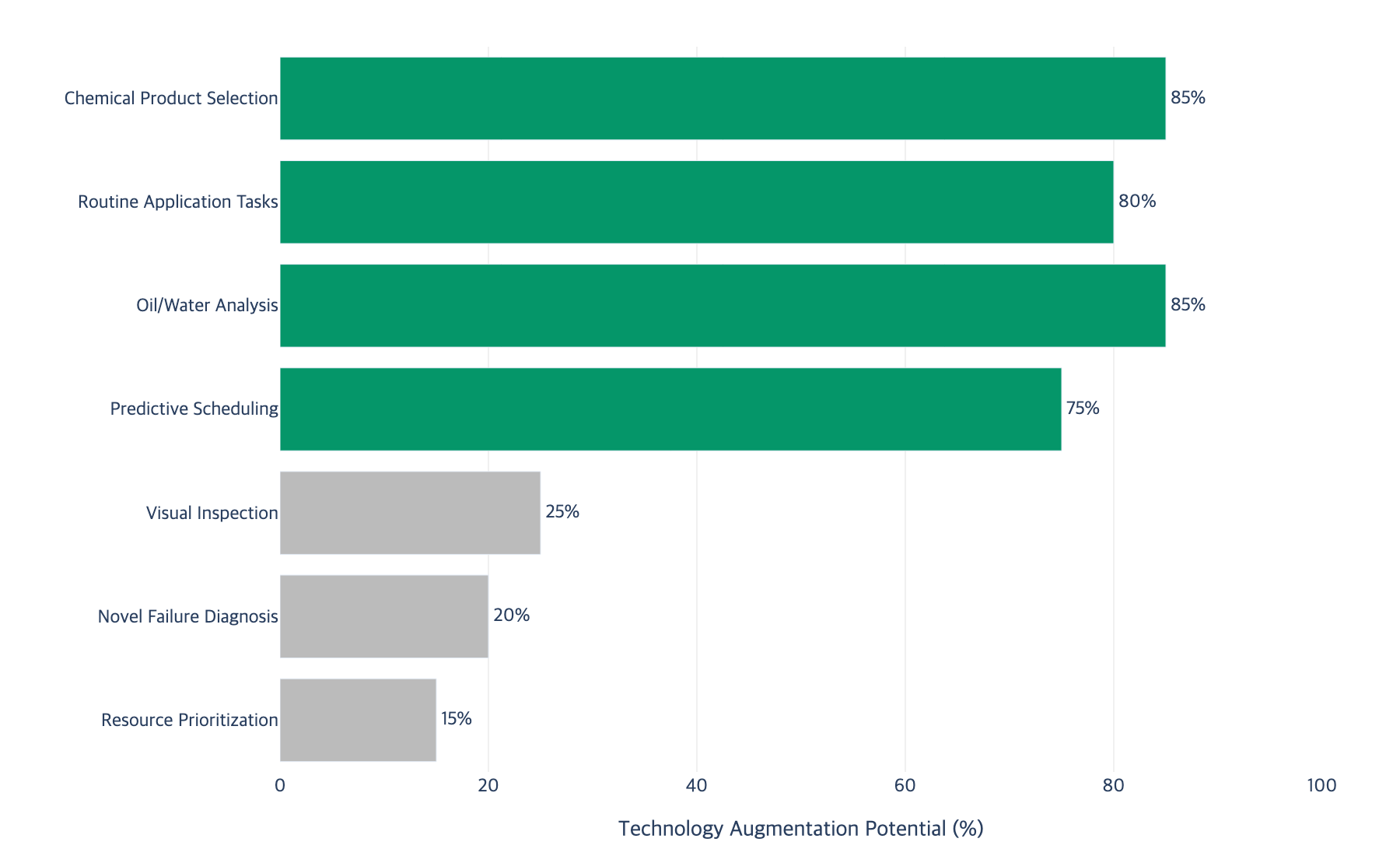
The chart shows that high-frequency routine activities like chemical product selection and analysis interpretation have the highest augmentation potential (75-85 percent), while novel diagnosis and prioritization remain primarily human-dependent, requiring judgment and contextual reasoning.
Figure 5. Detailed Technology Augmentation by Maintenance Activity
Activity Category | Augmentation Potential | Technology Enabler | Human Role |
|---|---|---|---|
Chemical product selection | High | AI product matching, spec databases | Validate recommendation |
Routine application tasks | High | Mobile work instructions, IoT dosing | Execute, verify completion |
Oil/water analysis interpretation | High | AI trend analysis, pattern matching | Review flagged anomalies |
Predictive maintenance scheduling | High | Sensor data, ML models | Approve scheduling changes |
Visual equipment inspection | Low | Image recognition (emerging) | Primary judgment |
Novel failure diagnosis | Low | AI-assisted hypothesis generation | Primary reasoning |
Resource prioritization | Low | Decision support dashboards | Primary judgment |
The framework reveals that approximately 60 to 70 percent of routine maintenance activities can be meaningfully technology-augmented, freeing experienced staff to concentrate on the 30 to 40 percent of activities that require irreducible human expertise.
VI. Building Technology-Augmented Maintenance Programs
Transitioning to technology-augmented maintenance requires systematic investment in three interdependent areas. The value of each increases when the other two are also in place.
Digital Infrastructure
The foundation is a connected maintenance environment where equipment condition data flows from sensors to analytics platforms to technician mobile devices. This includes vibration sensors on critical rotating equipment, inline oil condition monitors, water chemistry sensors with automated logging, and a CMMS platform that integrates sensor data with work order management. Effective programs typically start with the most critical equipment and expand based on demonstrated value.
Knowledge Codification
Expert knowledge must be extracted from experienced technicians and encoded into digital systems before those technicians retire. This involves documenting the decision logic behind maintenance procedures, creating structured troubleshooting guides that encode diagnostic reasoning, and building condition-based maintenance rules that reflect expert judgment.
Knowledge codification is the most time-sensitive of the three investment areas. Once an experienced technician retires, the opportunity to capture their tacit knowledge is lost permanently. Organizations should prioritize knowledge extraction from technicians within three to five years of retirement, focusing on equipment-specific failure patterns and the informal rules of thumb that experienced technicians use to prioritize their work.
Workforce Development Strategy
Technology augmentation does not eliminate the need for maintenance staff. It changes the skill profile required. Training programs should focus on digital literacy, procedure compliance, and escalation judgment rather than the deep technical expertise that traditionally required years to develop.
The workforce development strategy must also address retention. A 2025 ManPowerGroup study found that 74 percent of employers report struggling to find the skilled talent they need (ManPowerGroup, 2025). Organizations that invest in technology-augmented work environments may have a retention advantage, as these environments reduce the frustration of working with inadequate information and provide career development pathways that appeal to digitally native younger workers.
VII. Key Takeaway
The skilled maintenance technician shortage is structural and worsening, with 60 percent of maintenance leaders citing it as their primary challenge and 2.8 million manufacturing jobs needing replacement due to retirements by 2033
When experienced technicians retire, tacit knowledge built over decades of field observation leaves with them, and this knowledge cannot be replaced through hiring or standard training within the retirement timeline
Reduced maintenance capability directly degrades chemical product performance through incorrect application, delayed response, and lost condition-based adjustment
The shift from expertise-dependent to system-dependent maintenance is a structural adaptation required by the workforce reality
Approximately 60 to 70 percent of routine maintenance activities can be meaningfully technology-augmented, preserving limited human expertise for novel diagnosis and prioritization decisions
Building technology-augmented programs requires parallel investment in digital infrastructure, knowledge codification from retiring experts, and workforce development
Lubinpla's AI platform supports this shift by providing mechanism-based chemical product selection, structured troubleshooting guidance, and condition-specific application recommendations that reduce the expertise threshold for effective chemical treatment program management. Where an experienced technician once relied on years of accumulated field knowledge to match the right product to specific operating conditions, Lubinpla encodes that same analytical reasoning into a system that any technician can access at the point of work. For organizations facing the structural reality of a shrinking experienced workforce, the question is not whether to adopt technology-augmented maintenance, but how quickly the transition can be executed before the knowledge walks out the door.
VIII. References
[1] FTMaintenance, "How to Solve the Maintenance Technician Shortage", 2024. https://ftmaintenance.com/maintenance-management/maintenance-technician-shortage/
[2] MaintainX, "State of Industrial Maintenance Report 2024", 2024. https://www.getmaintainx.com/newsroom/state-of-industrial-maintenance-report-2024
[3] MaintainX, "25 Maintenance Stats, Trends, and Insights for 2026", 2025. https://www.getmaintainx.com/blog/maintenance-stats-trends-and-insights
[4] LubriSource, "Addressing the Talent Shortage in Industrial Maintenance", 2024. https://www.lubrisource.com/blog/industrial-maintenance-talent-shortage
[5] Infraspeak, "Maintenance Statistics and Trends 2025", 2025. https://blog.infraspeak.com/maintenance-statistics-trends-challenges/
[6] Fabrico, "Maintenance Statistics and Trends to Watch in 2025", 2025. https://www.fabrico.io/blog/maintenance-statistics-and-trends-to-watch-in-2025/
[7] Manufacturing Dive, "Manufacturing Could Be Short 1.9M Workers if Talent Gap Isn't Fixed", 2024. https://www.manufacturingdive.com/news/manufacturing-labor-shortage-2033-deloitte-mi-report-2024/713133/
[8] Maintenance World, "Talent Shortage Among Maintenance Professionals", 2025. https://maintenanceworld.com/2025/02/18/talent-shortage-among-maintenance-professionals-and-how-a-cmms-can-help/
[9] Machinery Lubrication, "Common Lubrication Misconceptions", 2022. https://www.machinerylubrication.com/Read/30589/common-lubrication-misconceptions
[10] Siemens, "The True Cost of Downtime 2024", 2024. https://blog.siemens.com/2024/07/the-true-cost-of-an-hours-downtime-an-industry-analysis/
[11] Chemical Processing, "Deconstructing the Chemical Industry's Skills Gap", 2024. https://www.chemicalprocessing.com/home/article/55128766/deconstructing-the-chemical-industrys-skills-gap
[12] WrenchWay, "Technician Shortage: Why It Exists and What Needs to Change", 2025. https://wrenchway.com/blog/technician-shortage-why-it-exists-what-needs-to-change/
[13] Manpower, "Will Baby Boomers Break the Workforce?", 2025. https://www.manpower.com/en/insights/blogs/mp-will-baby-boomers-break-the-workforce
[14] Protected Income, "Peak Boomer Retirements Mean Hundreds of Thousands Leaving the Labor Force", 2025. https://www.protectedincome.org/news/labor-day-peak-65-trades-hit-hardest/
[15] Training Industry, "Knowledge Transfer Programs: A Solution for Industrial Skills Gaps", 2024. https://trainingindustry.com/articles/strategy-alignment-and-planning/knowledge-transfer-programs-a-solution-for-industrial-skills-gaps-spon/
[16] Fortune Business Insights, "Predictive Maintenance Market Size and Share", 2025. https://www.fortunebusinessinsights.com/predictive-maintenance-market-102104
[17] ManPowerGroup, "Talent Shortage Survey 2025", 2025. https://go.manpowergroup.com/talent-shortage
Powered by Lubinpla
Discover how technical teams solve complex challenges faster with AI.