Why Distributors Are Stuck in the Middle: Carrying Technical Burden Without Technical Infrastructure
Summary: Chemical distributors now carry the majority of customer-facing technical responsibility, yet they operate with thin margins, limited training budgets, and no systematic knowledge infrastructure. With 40 percent of employers reporting that up to half their technical staff have outdated skills, and customer demands growing more complex every year, the gap between what distributors are expected to deliver and what they can realistically provide is widening. The competitive consequences of this gap are severe: high-value accounts quietly shift to competitors or bypass the distributor entirely by going direct to manufacturers. This article examines why the distributor model is structurally breaking, quantifies the technical capacity gap across basic, intermediate, and advanced support tiers, and evaluates where AI augmentation can close the gap without unsustainable headcount growth.
Table of Contents
I. The Middle Position: Maximum Responsibility, Minimum Infrastructure
II. The Growing Complexity of Customer Technical Demands
III. Why Margin Structure Prevents Infrastructure Investment
IV. The Technical Capacity Gap: What Customers Expect vs. What Distributors Deliver
V. The Hidden Cost of Knowledge Loss and Turnover
VI. The Competitive Consequences of the Gap
VII. Where AI Augmentation Has the Highest Impact
VIII. Key Takeaway
IX. References
I. The Middle Position: Maximum Responsibility, Minimum Infrastructure
Chemical distributors occupy a uniquely challenging position in the industrial supply chain. Over the past two decades, as manufacturers outsourced technical service functions, distributors inherited the customer-facing technical role. They are now expected to provide product recommendations, troubleshoot application failures, guide product selection for complex multi-variable conditions, and maintain deep relationships with customers who depend on technical expertise to make purchasing decisions. This transfer of responsibility happened gradually, but its cumulative effect has been transformative. The distributor is no longer simply a logistics intermediary. It is, in the eyes of the customer, the primary source of technical guidance for product selection, application troubleshooting, and performance optimization.
Yet distributors operate under structural constraints that manufacturers do not face. Their margins are thin, typically 8 to 15 percent gross margin on chemical products (Oliver Wyman, 2024). Their technical staff must support products from multiple manufacturers across a broad range of chemistries. Their training budgets are limited relative to the scope of knowledge their teams need to maintain. And their knowledge infrastructure is, in most cases, informal: individual expertise, email threads, and scattered product literature rather than systematic, searchable, and scalable knowledge systems. Unlike manufacturers, who can dedicate entire application engineering teams to a single product line, distributors must spread their technical resources across dozens of principals and hundreds of SKUs.
The Structural Mismatch
The fundamental problem is a structural mismatch between responsibility and resources. Manufacturers transferred customer-facing technical responsibility to distributors without transferring the knowledge infrastructure, the training programs, or the margin structure needed to sustain that responsibility. The distributor was designed as a logistics and commercial operation, not a technical service organization. Yet the market now demands that distributors function as technical experts across hundreds of product lines, dozens of application areas, and thousands of customer-specific operating conditions.
This mismatch is not a temporary market condition. It is a permanent structural feature of how the chemical supply chain has reorganized itself. BCG's 2023 survey of more than 300 global chemical principals found that "lack of value-added services" is among the top concerns principals have about their distributors, and that principals who experience inadequate technical support are more likely to switch distributors entirely (BCG, 2023). The expectation is locked in. Distributors must deliver technical depth, but the economic and organizational architecture to do so was never built.
The Scale of the Challenge
To understand the magnitude of this challenge, consider the typical mid-sized specialty chemical distributor. A company with USD 50 million in annual chemical sales may represent 15 to 25 different manufacturers, each with product lines spanning 20 to 50 individual products. That gives the distributor's sales engineering team responsibility for technical support across 300 to 1,250 distinct products. Each product has its own chemistry, application parameters, compatibility constraints, storage requirements, and failure modes. No individual, regardless of experience, can maintain expert-level knowledge across that range. Yet customers expect exactly that: a single point of contact who can answer any question about any product in the portfolio with confidence and accuracy.
II. The Growing Complexity of Customer Technical Demands
The technical demands on distributor sales engineers are not static. They are increasing in scope and complexity year over year, driven by several converging forces that show no signs of slowing.
Product Line Proliferation
As manufacturers expand their portfolios to address niche applications, distributors must support an ever-growing number of product variants. A distributor that represented 200 products a decade ago may now carry 500 or more. Each product has unique chemistry, application guidelines, compatibility constraints, and performance characteristics. The cognitive load on sales engineers who must maintain working knowledge across this expanding portfolio is substantial and growing. The global chemical distribution market, valued at approximately USD 265 billion in 2024 and projected to grow at a 4.6 percent CAGR, continues to expand (SNS Insider, 2024). This growth drives further product diversification, which in turn increases the technical knowledge burden on every distributor team.
Regulatory Complexity
Environmental, health, and safety regulations are becoming more stringent and more varied across jurisdictions. Sales engineers must now understand not just product performance but also regulatory compliance requirements for each customer's specific industry, location, and application. REACH compliance in Europe, TSCA requirements in the United States, K-REACH in South Korea, and emerging chemical management regulations across Asia-Pacific all create overlapping compliance layers. A single product may face different regulatory treatment depending on concentration, end-use application, and the country of deployment. This regulatory knowledge layer adds significant complexity on top of the already demanding product and application knowledge requirements. Sales engineers are increasingly expected to advise on regulatory risk, not just product performance, a role for which most have received no formal preparation.
Customer Sophistication
Customer expectations for technical depth have increased. As information becomes more accessible through digital channels, customers arrive at technical discussions with more baseline knowledge and more specific, demanding questions. They expect their distributor contacts to provide insights that go beyond product data sheets, including mechanism-level explanations, competitive comparisons, and application-specific optimization recommendations. The bar for "technical credibility" has risen significantly.
This shift is particularly pronounced among younger engineers at customer organizations. They have grown up with instant access to information and have low tolerance for vague or generic answers. When a distributor sales engineer responds with "let me check with the manufacturer and get back to you," the credibility gap becomes immediately visible. Customers want real-time technical depth, and each delayed response erodes the perceived value of the distributor relationship.
The Breadth vs. Depth Dilemma
These converging pressures create an impossible dilemma for distributor sales engineers. They are expected to be broad (covering many product lines and application areas) and deep (providing expert-level technical guidance in each). No individual can realistically achieve both. The result is that most sales engineers develop moderate knowledge across many areas but deep expertise in very few, creating a gap precisely where customers need the most help: complex, multi-variable technical challenges.
The 2024 Consensus Sales Engineering Report documented that sales engineers at companies with six or more account executives experience elevated burnout rates as they struggle to keep up with growing technical demands (Consensus, 2024). This is not a matter of individual capability or effort. It is a structural impossibility. The volume and diversity of technical knowledge required exceeds what any individual can absorb and retain, regardless of how talented or motivated they are.
III. Why Margin Structure Prevents Infrastructure Investment
The distributor's margin structure creates a fundamental barrier to building the technical infrastructure that would close the capacity gap. Unlike manufacturers, who can amortize technical service costs across high-volume production margins, distributors must fund their entire technical capability from distribution margins that are a fraction of manufacturing margins.
The Investment Math
Hiring a single experienced technical service engineer costs USD 80,000 to USD 120,000 annually in salary and benefits. For a distributor with USD 50 million in chemical sales and a 12 percent gross margin, that represents 13 to 20 percent of gross profit for just one additional technical hire. Most distributors cannot justify this investment ratio, particularly when the return is difficult to quantify in the short term. The financial pressure is compounded by the reality that experienced technical hires in industrial chemistry are scarce. The global chemical engineering skills gap means that qualified candidates with both technical depth and commercial acumen command premium compensation, further straining the distributor's ability to build technical capacity through hiring (NES Fircroft, 2024).
Training Costs vs. Training Needs
Comprehensive technical training for a distributor sales engineer covering all major product lines, application areas, and failure modes would require 4 to 6 weeks of dedicated training time annually. At an average fully loaded cost of USD 400 to USD 600 per training day, this represents USD 8,000 to USD 18,000 per engineer per year. For a team of 10 sales engineers, the annual training investment would be USD 80,000 to USD 180,000, a significant expense for an organization operating on thin margins. In practice, most distributors allocate far less, resulting in incomplete knowledge coverage and reliance on individual self-learning.
The training challenge is further complicated by the pace of product and regulatory change. Even if a distributor invests in comprehensive training in a given year, a significant portion of that training becomes outdated within 12 to 18 months as manufacturers reformulate products, introduce new grades, and adjust application guidelines. Training is not a one-time investment but a perpetual expense, and one that most distributor margin structures cannot sustain at the required level.
The Knowledge System Gap
Beyond hiring and training, building systematic knowledge infrastructure (searchable databases, case libraries, decision support tools, structured knowledge repositories) requires technology investment and ongoing maintenance. Most distributors lack both the capital and the internal expertise to build these systems. The result is that knowledge remains trapped in individual heads and scattered across informal channels, creating vulnerability every time an experienced sales engineer departs.
BCG's research on chemical distribution found that distributors with advanced digital platforms achieved gross profit two to five percentage points higher than lagging peers (BCG, 2020). This finding highlights both the opportunity and the challenge: digital knowledge infrastructure demonstrably improves performance, but building it requires upfront investment that many distributors struggle to justify within their existing margin structure.
Figure 1. Distributor Technical Investment Gap
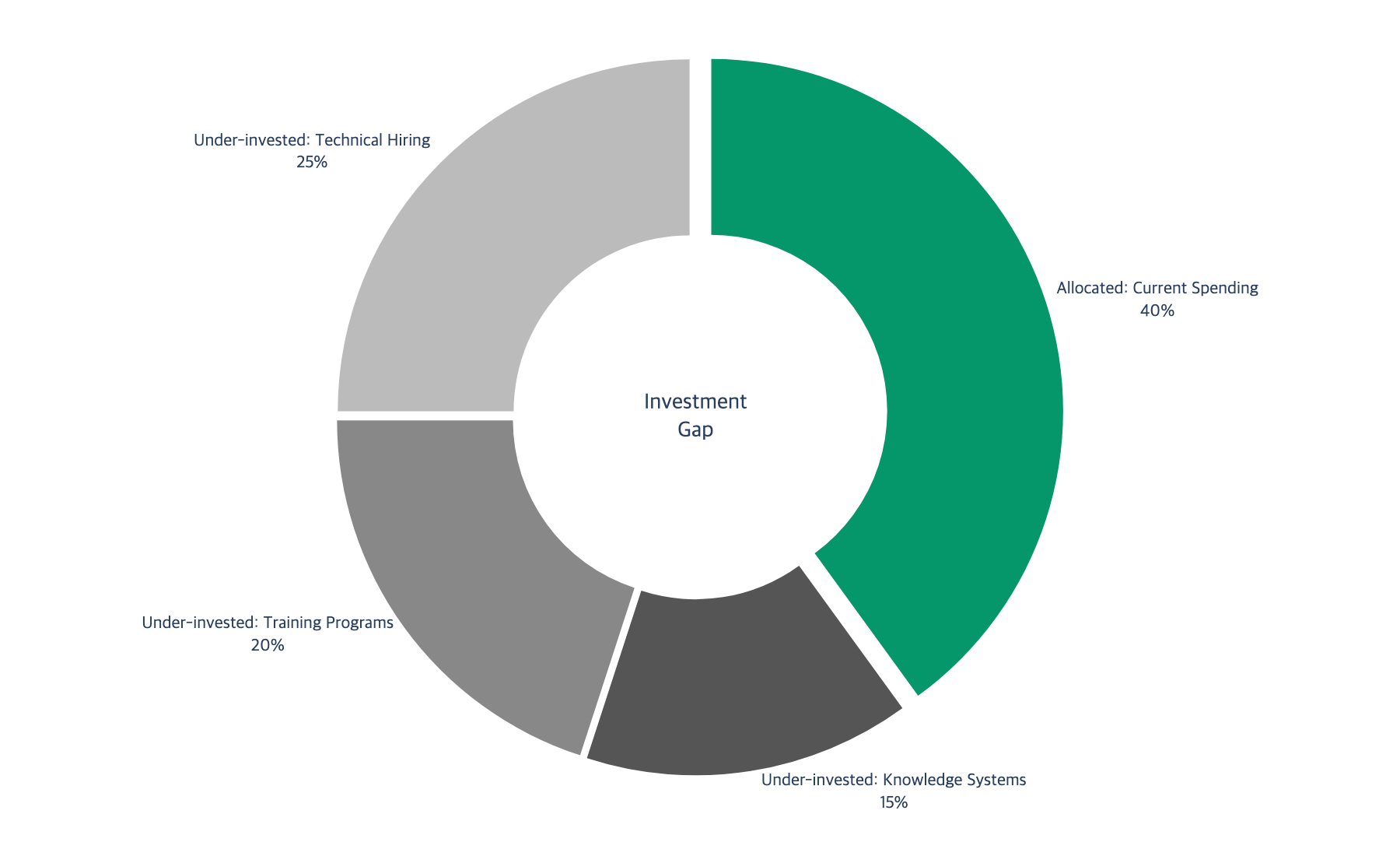
The donut chart visualizes the distributor investment gap. Current technical spending represents only 40 percent of what is needed, with the remaining 60 percent under-invested across technical hiring, training programs, and knowledge management systems. The center label "Investment Gap" highlights that most distributors are operating at roughly 40 percent of the infrastructure investment required to sustain their technical service role.
Figure 1b. Distributor Resource Allocation Challenge
Resource Category | Estimated Annual Cost | % of Gross Profit (USD 6M base) | Current Typical Allocation |
|---|---|---|---|
Additional technical hire (1 FTE) | 80,000 to 120,000 | 1.3 to 2.0% | Rare, deferred until crisis |
Technical training (10 engineers) | 80,000 to 180,000 | 1.3 to 3.0% | 30-50% of needed investment |
Knowledge management system | 50,000 to 150,000 | 0.8 to 2.5% | Minimal or none |
Total infrastructure need | 210,000 to 450,000 | 3.5 to 7.5% | Significantly under-invested |
The table shows that the total infrastructure investment needed to close the technical capacity gap would consume 3.5 to 7.5 percent of gross profit, a significant but not impossible amount. The challenge is that these investments are typically viewed as overhead rather than revenue-generating, making them vulnerable to budget cuts during margin pressure. In a market where net profit margins dropped sharply in 2023 and remained compressed through 2025, even modest overhead increases face intense scrutiny (Deloitte, 2025).
IV. The Technical Capacity Gap: What Customers Expect vs. What Distributors Deliver
The technical capacity gap is the difference between the level of technical support customers expect and the level that distributor teams can realistically deliver given their current resources and infrastructure. This gap is not uniform across all types of inquiries. It varies dramatically depending on the complexity of the question, and it is at the highest-complexity tier where the business consequences are most severe.
Figure 2. Technical Capacity Gap: Customer Expectation vs. Distributor Delivery
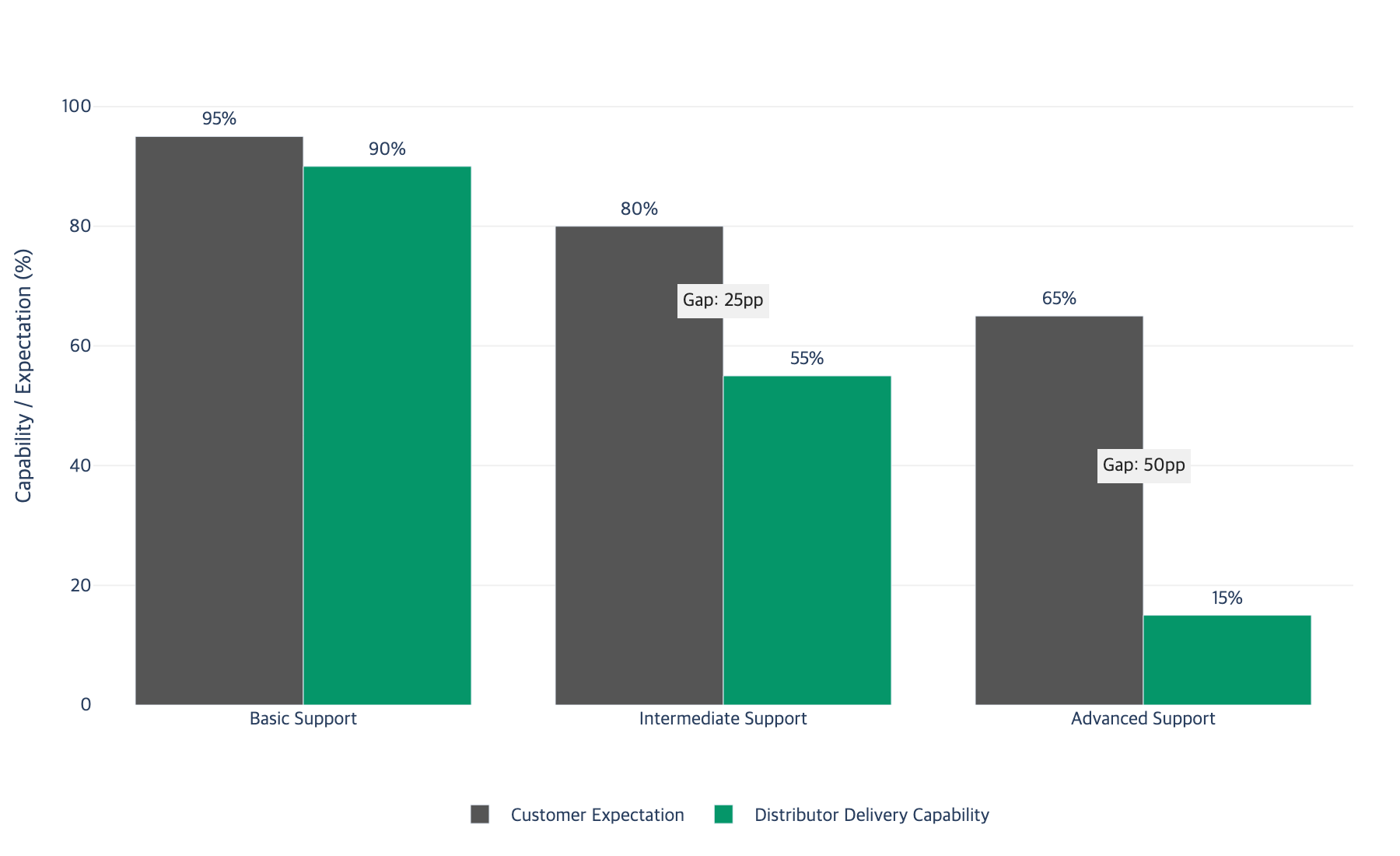
The grouped bar chart quantifies the widening gap across three support levels. At the basic level, the gap is negligible (5 percentage points). At the intermediate level, it grows to 25 percentage points. At the advanced level, the gap reaches 50 percentage points, meaning distributors can meet only about 15 percent of what customers expect for complex, multi-variable technical challenges. This advanced-level gap is where the highest-value accounts make their vendor decisions.
The Expectation Spectrum
Customer technical expectations fall along a spectrum from basic to advanced. Basic expectations include product availability information, data sheet access, and standard application guidance. Intermediate expectations include product comparison and selection for specific conditions, troubleshooting common application issues, and regulatory compliance guidance. Advanced expectations include root cause analysis for complex failures, multi-variable optimization recommendations, cross-product system design, and mechanism-level technical explanations.
Most distributor sales engineers can effectively meet basic and intermediate expectations. The gap widens dramatically at the advanced level, where customers need the kind of deep, multi-variable technical reasoning that requires years of specialized experience. A customer asking "why did our coating fail after six months in a marine environment when the same product lasted three years at our inland facility" is asking a question that involves chloride ion transport mechanisms, humidity cycling effects on adhesion, substrate preparation variability, and film thickness distribution patterns. Answering with confidence requires integrating knowledge across multiple chemistry disciplines, and it is precisely this type of cross-domain reasoning that distributor teams are least equipped to provide.
Where the Gap Hurts Most
The advanced technical gap has disproportionate business impact because the customers who need advanced support are typically the highest-value accounts. These are the customers with complex operations, large purchasing volumes, and high switching costs. When a distributor cannot meet their advanced technical needs, these customers either seek support directly from manufacturers (bypassing the distributor), turn to competitors who offer deeper technical capability, or make suboptimal product decisions due to inadequate guidance, leading to failures that erode the commercial relationship.
The financial impact of losing even one high-value account to a technical credibility gap can exceed the cost of the technical infrastructure investment that would have prevented the loss. A single account generating USD 500,000 in annual revenue at 12 percent margin contributes USD 60,000 to gross profit, an amount that could fund a significant portion of the knowledge infrastructure gap. Yet the connection between technical inadequacy and account loss is often invisible because customers rarely announce their reason for leaving. They simply place fewer orders over time and gradually redirect their spending.
The Hidden Volume of Unmet Technical Needs
A significant portion of the technical capacity gap is invisible to distributor management because customers who do not receive adequate technical support simply stop asking. They may quietly shift purchasing to a competitor, handle technical decisions internally (often with suboptimal outcomes), or reduce their engagement with the distributor from a technical advisory relationship to a purely transactional one. This silent erosion of relationship depth is often not recognized until a competitor captures the account.
The IBM Institute for Business Value's study of the chemicals and petroleum industry highlighted that 82 percent of respondents reported workforce shortages for skilled labor, with the greatest shortages for technicians and engineers (IBM, 2024). This shortage affects not only distributors but also their customers, which means customers are increasingly dependent on their suppliers for technical guidance at precisely the time when suppliers are least able to provide it. The demand for technical support is growing on both sides of the transaction, while the supply of qualified technical talent is shrinking on both sides as well.
V. The Hidden Cost of Knowledge Loss and Turnover
Beyond the structural investment gap, distributors face a compounding problem: the loss of accumulated technical knowledge when experienced employees leave the organization. This knowledge drain represents one of the most underestimated costs in the distribution model.
The Economics of Turnover
According to SHRM, replacing an employee typically costs between six and nine months of that person's annual salary (SHRM, 2024). For a senior technical sales engineer earning USD 100,000 annually, the replacement cost ranges from USD 50,000 to USD 90,000 when accounting for recruiting, onboarding, and lost productivity. But this figure captures only the visible, transactional costs of replacement. It does not account for the far more damaging loss of institutional knowledge that walks out the door with the departing employee.
A senior sales engineer who has spent 10 to 15 years at a distributor carries knowledge that cannot be found in any product data sheet or training manual. They know which products perform well under conditions that fall outside the standard specification window. They know which manufacturer technical support contacts can provide the fastest and most useful responses. They know which customer applications have historically been problematic and what workarounds have been effective. They know the competitive landscape from years of head-to-head encounters. This knowledge was never documented because distributors rarely have the systems or processes to capture it. When the person leaves, the knowledge leaves with them.
The Compounding Effect
The knowledge loss problem compounds over time because each departure makes the remaining team more vulnerable. If a team of 10 sales engineers loses two experienced members in a given year, the remaining eight must absorb not only additional account responsibilities but also the technical inquiries that the departing engineers would have handled. This increased load leads to slower response times, shallower technical answers, and greater reliance on manufacturer technical support lines, all of which degrade the customer experience and increase the risk of further account attrition.
The compounding effect is particularly damaging in specialty chemical distribution, where product-application knowledge combinations are highly specific. A sales engineer who understood the interaction between a particular corrosion inhibitor chemistry and the specific water conditions at a power plant cannot be replaced by simply hiring another engineer with general chemistry knowledge. The replacement must rebuild that application-specific understanding from scratch, a process that can take two to three years of field experience with that particular customer and product combination.
Why Documentation Alone Does Not Solve the Problem
Some distributors attempt to mitigate knowledge loss through documentation requirements: asking engineers to maintain customer files, record technical notes, or update CRM systems with application details. In practice, these initiatives consistently underperform for several reasons. First, sales engineers are compensated and evaluated on sales performance, not on documentation completeness. Second, the most valuable knowledge is contextual and situational, making it difficult to capture in structured database fields. Third, even when documentation exists, it is rarely organized in a way that allows another engineer to efficiently retrieve and apply it under time pressure. The result is that documentation efforts create an illusion of knowledge capture without delivering meaningful knowledge transfer.
VI. The Competitive Consequences of the Gap
Distributors that cannot close the technical capacity gap face escalating competitive pressure from multiple directions. The consequences are not hypothetical. They are playing out in real time across the industry as the distribution landscape reorganizes around technical capability as a primary differentiator.
Direct Manufacturer Relationships
As manufacturers invest in digital platforms and direct customer engagement capabilities, the distributor's role as the primary customer interface is no longer guaranteed. Customers who find distributors technically inadequate may establish direct relationships with manufacturers, particularly for complex, high-value applications. This disintermediation risk is highest for distributors who cannot differentiate on technical value. When a distributor's primary contribution is logistics and order processing, the customer has little reason to maintain the relationship if the manufacturer offers a direct purchasing option with superior technical support.
Technically Stronger Competitors
In most markets, a small number of distributors have invested in technical capability, either through hiring experienced engineers, building partnerships with technical consultants, or adopting AI-based tools. These technically differentiated distributors are winning accounts from competitors who rely on traditional commercial relationships without technical depth. The competitive advantage of technical capability is compounding: distributors who invest in technical infrastructure attract more complex accounts, which generate more field knowledge, which further strengthens their technical capability. The inverse is equally true: distributors who fail to invest lose complex accounts, which reduces their field knowledge base, which further weakens their competitive position.
The Spiral of Decline
Distributors that do not close the gap face a potential spiral of decline. Technical inadequacy leads to lost accounts. Lost accounts reduce revenue. Reduced revenue further constrains the budget for technical investment. Reduced investment widens the gap further. This self-reinforcing cycle makes the decision to invest in technical capability increasingly urgent, each year of delay makes the gap harder to close.
The BCG chemical distribution study highlighted that chemical principals are actively expanding and reshuffling their distributor portfolios based on performance and value-added capabilities (BCG, 2023). This means the switching behavior is not limited to end customers. Manufacturers themselves are evaluating whether their distributors add sufficient technical value to justify the margin they consume. Distributors that cannot demonstrate technical differentiation risk losing not only customer accounts but also the principal relationships that form the foundation of their business.
VII. Where AI Augmentation Has the Highest Impact
Given the margin constraints and the scale of the technical capacity gap, the most practical solution for most distributors is AI augmentation, using technology to extend the effective technical capacity of existing teams without proportional headcount growth. This is not a speculative future scenario. The AI in chemicals market was valued at USD 1.78 billion in 2024 and is projected to reach USD 28 billion by 2034, growing at a 32 percent CAGR (Precedence Research, 2024). The adoption trajectory is clear, and the question for distributors is not whether to adopt but how quickly they can close the gap before competitors do.
Highest-Impact Application Areas
AI-augmented technical support has the greatest return on investment in three areas. First, product selection and recommendation: when a sales engineer faces a complex, multi-variable product selection challenge, an AI system that encodes product chemistry, application conditions, and performance data can provide systematic recommendations that would otherwise require senior expert knowledge. Instead of relying on memory or spending hours reviewing scattered product literature, the engineer can query a knowledge system that synthesizes information across the entire product portfolio in seconds.
Second, technical inquiry response: many technical inquiries follow patterns that AI can recognize and support, reducing the time experienced engineers spend on routine questions and freeing them for complex cases. One chemical company created what it called a "maintenance virtual expert" that answers technician questions, diagnoses issues, and creates procedures, resulting in measurable improvements in both productivity and equipment uptime (McKinsey, 2024). The same principle applies to distributor technical support: a significant portion of incoming technical inquiries can be addressed faster and more consistently with AI-assisted response generation.
Third, knowledge accessibility: AI systems can make the accumulated knowledge of an organization, including product data, application history, and technical case archives, searchable and accessible to every team member, eliminating the dependency on individual experts for information retrieval. This directly addresses the knowledge loss problem described in Section V. When knowledge is encoded in a system rather than trapped in individual heads, employee departures no longer create catastrophic knowledge gaps.
The Economics of AI vs. Headcount
The economics of AI augmentation are compelling for distributors. An AI-based technical support platform can cost USD 20,000 to USD 80,000 annually, roughly the cost of 25 to 100 percent of one additional technical hire. However, the AI platform can serve the entire sales engineering team simultaneously, providing consistent support across all product lines and all technical inquiries. The return on investment is amplified because AI augmentation does not just add capacity; it distributes capability more evenly across the team, reducing the impact of individual expertise gaps and personnel changes.
Consider the math for a distributor with 10 sales engineers. An AI platform at USD 50,000 annually costs USD 5,000 per engineer, roughly 5 to 6 percent of a single engineer's fully loaded cost. In exchange, each engineer gains access to technical depth across the full product portfolio, the ability to respond to complex inquiries without waiting for manufacturer callbacks, and a knowledge base that persists regardless of team turnover. The per-engineer cost of AI augmentation is a fraction of the per-engineer cost of the training that would be needed to achieve comparable knowledge breadth through traditional methods.
Why Timing Matters
The chemical industry is reaching an inflection point where AI adoption is shifting from experimental to operational. A survey by IBM found that 63 percent of chemicals executives expect AI to contribute significantly to revenue growth within three years, and 76 percent say it will deliver measurable competitive advantage (IBM, 2024). Predictive maintenance adoption in the chemicals sector is projected to grow from 39 percent to 98 percent by 2028 (Precedence Research, 2024). These numbers indicate that AI is not a future consideration but a present competitive requirement.
For distributors, the timing consideration is particularly acute because the benefits of AI augmentation compound over time. An AI system becomes more valuable as it accumulates more product data, more application cases, and more usage patterns from the engineering team. Distributors who adopt earlier build a deeper, more refined knowledge base than those who adopt later, creating a durable competitive advantage that is difficult to replicate. Waiting is not a neutral decision. Every quarter of delay is a quarter where competitors are building AI-augmented knowledge assets that will take years to match.
Lubinpla: Built for This Problem
Lubinpla's platform is specifically designed for this use case, providing mechanism-based technical reasoning that connects product chemistry to application conditions, enabling distributor sales engineers to deliver manufacturer-level technical depth across their entire product portfolio without requiring decades of individual field experience. Unlike generic AI tools that provide surface-level answers from publicly available information, Lubinpla's system reasons through the chemical mechanisms that determine product performance: why a particular corrosion inhibitor loses efficacy above a specific chloride concentration, how temperature cycling affects adhesion at the molecular level, and what cross-domain interactions exist between cleaning chemistry and subsequent coating performance. This mechanism-based approach is what allows a sales engineer with three years of experience to provide the kind of multi-variable technical guidance that previously required 15 years of field knowledge.
VIII. Key Takeaway
Distributors now carry the majority of customer-facing technical responsibility but lack the margin structure, training infrastructure, and knowledge systems to sustain it. This is not a temporary challenge but a permanent structural feature of the current distribution model.
The technical capacity gap is widening as product portfolios grow, regulations increase, and customer expectations rise, while distributor resources remain essentially flat. At the advanced support tier, distributors can meet only about 15 percent of customer expectations.
The total infrastructure investment needed (USD 210,000 to USD 450,000 annually) consumes 3.5 to 7.5 percent of gross profit, often viewed as unaffordable overhead. Yet the cost of inaction, measured in lost accounts and eroded relationships, typically exceeds the investment that would have prevented it.
Knowledge loss from employee turnover compounds the problem because most distributor knowledge exists only in individual heads. Each departure permanently reduces the team's collective capability.
The competitive consequences of inaction are severe: account loss to technically stronger competitors, disintermediation by manufacturers, and a self-reinforcing spiral of decline.
AI augmentation is the most practical solution, providing technical capacity extension at 25 to 100 percent the cost of a single technical hire while serving the entire team simultaneously. Early adopters compound their advantage as AI systems accumulate deeper knowledge over time.
IX. References
[1] Oliver Wyman, "Chemical Industry Outlook 2024: How to Build Resilience", 2024. https://www.oliverwyman.com/our-expertise/insights/2024/jan/chemical-industry-outlook-for-2024-and-beyond.html
[2] Chemical Processing, "Deconstructing the Chemical Industry's Skills Gap", 2024. https://www.chemicalprocessing.com/home/article/55128766/deconstructing-the-chemical-industrys-skills-gap
[3] HelloNesh, "10 Chemical Industry Trends Shaping the Future in 2025", 2024. https://www.hellonesh.io/blog/10-chemical-industry-trends-shaping-the-future-in-2025
[4] McKinsey, "How AI Enables New Possibilities in Chemicals", 2024. https://www.mckinsey.com/industries/chemicals/our-insights/how-ai-enables-new-possibilities-in-chemicals
[5] Deloitte, "2025 Chemical Industry Outlook", 2025. https://www.deloitte.com/us/en/insights/industry/chemicals-and-specialty-materials/chemical-industry-outlook/2025.html
[6] NES Fircroft, "Highlighting the Global Chemical Engineering Skills Gap", 2024. https://www.nesfircroft.com/resources/blog/highlighting-the-global-chemical-engineering-skills-gap/
[7] SmartDev, "AI in Chemical Industry: Top Use Cases You Need to Know", 2024. https://smartdev.com/ai-use-cases-in-chemical-industry/
[8] Team International, "AI Transformations for Industry Leaders in Chemicals", 2024. https://www.teaminternational.com/en/blog/what-ai-has-to-offer-to-industry-leaders-in-chemicals
[9] DCAT Value Chain Insights, "Supply Chains: Trends in Chemical Distribution", 2024. https://www.dcatvci.org/features/supply-chains-trends-in-chemicals-distribution/
[10] Consensus, "2024 Sales Engineering Compensation and Workload Trends Report", 2024. https://goconsensus.com/research/2024-sales-engineering-compensation-workload-report/
[11] BCG, "Chemical Distribution: The New Age of Winning", 2023. https://media-publications.bcg.com/The-New-Age-of-Winning.pdf
[12] BCG, "Innovative Chemical Distributors Gain a Digital Edge", 2020. https://www.bcg.com/publications/2020/innovative-chemical-distributors-gain-a-digital-edge
[13] IBM, "The Chemicals and Petroleum Industry Guide to Closing the Skills Gap", 2024. https://www.ibm.com/thought-leadership/institute-business-value/en-us/report/chemicals-petroleum-skills-gap
[14] Precedence Research, "Artificial Intelligence in the Chemical Market", 2024. https://www.precedenceresearch.com/artificial-intelligence-in-the-chemical-market
[15] SNS Insider, "Chemical Distribution Market Size, Share and Growth Report 2033", 2024. https://www.snsinsider.com/reports/chemical-distribution-market-9047
Powered by Lubinpla
Discover how technical teams solve complex challenges faster with AI.