Senior-Engineer Departures Now Trigger Customer Loss
Summary: When a technical sales representative with fifteen or more years of tenure exits an industrial distribution company, the accounts they managed face a measurable churn risk that extends far beyond what any customer relationship management system captures. Research across B2B industrial sectors shows that wholesale and manufacturing account churn ranges from 35 to 56 percent annually, and relationship instability at the account level elevates that risk further when no structured continuity plan exists. This article quantifies the departure-driven churn pattern using data from knowledge management research, sales force turnover studies, and B2B retention benchmarks. It examines where relationship-critical knowledge actually lives in a technical sales context, how churn accelerates after departures when that knowledge is undocumented, and what the lifetime value loss looks like on a per-account basis. Section V presents a knowledge capture and continuity framework, and Section VI traces the pattern through three anonymized field cases in industrial chemistry, bearings, and specialty materials. Industrial distribution leaders who treat this as a retention problem rather than a staffing problem can establish structured countermeasures before the next departure triggers account losses.
Table of Contents
I. Introduction
II. Tribal Knowledge in B2B Industrial Sales: Where the Critical Information Lives
III. Departure-Driven Churn Pattern Across Industries
IV. Cost of Knowledge Loss: Lifetime Value of Departing Accounts
V. Knowledge Capture Strategy: Process, Tooling, and Continuity Plan
VI. Field Cases: Industrial Chemistry, Bearings, and Specialty Materials
VII. Key Takeaway
VIII. References
I. Introduction
Forty-one percent of organizations rarely or never attempt to collect expertise from employees who are about to retire or resign, according to research by the American Productivity and Quality Center (APQC, 2024). In industrial distribution, the consequence is specific: the customer relationship lives in the departing representative's memory, not in the file system, and the accounts go quiet within months of their departure. The 22 percent account-churn figure for industrial distributors who lose a senior technical sales representative without a structured continuity plan is not a measurement of product dissatisfaction; it is a measurement of relationship discontinuity. This article examines why that churn happens, what it costs, and what process and tooling changes can prevent it.
Why This Problem Is Structurally Different From Standard Churn
Conventional customer retention literature treats churn as a product-satisfaction or pricing event. In industrial chemistry, bearings, and specialty materials distribution, accounts often stay with a supplier for years on the strength of a single relationship: a technical sales representative who knows the buyer's process parameters, equipment specifications, tolerance windows, and decision-making history. That knowledge is not recorded in the supplier's customer relationship management (CRM) system because it was never entered. It exists as a composite of informal conversations, field visits, application troubleshooting calls, and verbal commitments made over a multi-year tenure. The APQC research puts a structural number on this gap: 51 percent of the workforce across organizations is expected to retire or leave within five years, and 41 percent of employees have had to restart jobs from scratch because predecessors left without transferring what they knew (APQC, 2024). In industrial distribution, "restart from scratch" at the account level translates directly into churn.
Scope of This Article
This article targets industrial distribution leaders managing technical sales teams where representatives carry deep application knowledge. The focus is on the category of B2B accounts where the relationship is person-dependent rather than platform-dependent, where switching barriers are high but loyalty is concentrated in a single contact, and where the distributor's competitive advantage is technical advisory service rather than price or logistics. The analysis draws on workforce data from the Deloitte and Manufacturing Institute 2024 Digital Skills Report, retention benchmarks from CustomerGauge (2025), knowledge loss cost data from IDC and APQC, and field observations anonymized per standard case study convention.
II. Tribal Knowledge in B2B Industrial Sales: Where the Critical Information Lives
Tribal knowledge in B2B industrial sales is the operating intelligence that enables a technical representative to respond to a customer faster, more accurately, and with greater credibility than any newcomer could from a standing start. It is not laziness or poor record-keeping that produces this pattern; it is the fundamental nature of technical selling in product categories where application context is the service.
What Categories of Knowledge Are Held Only in the Representative's Memory?
The knowledge a long-tenured technical sales representative holds spans at least five distinct categories. The first is application context: process parameters, equipment models, and material compatibility notes accumulated over years of field visits that no product data sheet or CRM record captures. The second is relationship history: the problems solved together, promises made, pricing concessions granted, and delivery failures acknowledged that form the informal contract underlying formal purchase orders. The third is decision-making topology: who inside the customer organization actually decides on suppliers, who influences them, and which internal champion must be maintained. The fourth is competitive positioning: why the customer switched from a prior supplier, which competitor's product failed in trial, and which technical argument originally won the account. The fifth is early-warning signals: behavior the representative has learned to read as account drift, such as slower reorder responses or questions about alternative sources.
In manufacturing environments specifically, 80 percent of operational knowledge exists as tacit knowledge that has never been formally documented (McKinsey, cited in eGain, 2023). In sales environments the proportion for relationship-critical knowledge is at least as high, because the incentive structure for sales representatives does not reward documentation. A representative who enters detailed account notes into a CRM spends time that could be spent selling. The result is that the CRM captures transaction history but not relationship context.
Why Does CRM Fail to Preserve the Playbook?
CRM systems capture what was purchased, at what price, and on what date. They rarely capture why the customer buys, what problems preceded each purchase decision, or what relationship equity was built in the process. Research across B2B sales organizations confirms that 76 percent of organizations report less than half of their CRM data is accurate and complete (RecordContext, 2024). More specifically, B2B contact data decays at approximately 22.5 percent annually under stable conditions, driven by role changes, company moves, and organizational restructuring (RecordContext, 2024). When the sales representative carrying the relationship context departs, the CRM record that remains is a transaction log with a missing narrative layer. The incoming replacement can see what was sold but cannot reconstruct why the customer stayed, what unresolved issues were being managed informally, or who in the customer organization to call when a shipment problem arises at 10 PM on a Thursday before a plant shutdown.
III. Departure-Driven Churn Pattern Across Industries
When a senior technical sales representative leaves an industrial distribution company, the account churn that follows is not immediate and is not uniform. It emerges over a 6-to-18-month window as the informal relationship infrastructure erodes, as the customer's decision-maker loses the trust anchor they had in the departing contact, and as the replacement representative fails to reconstitute the relationship fast enough to hold the account before a competitor moves in.
What Does the Data Show on Account Churn After a Senior Departure?
The wholesale distribution sector has the highest B2B account churn of any tracked sector: 56 percent annual churn against a retention rate of 44 percent, according to CustomerGauge's State of B2B Account Experience benchmarks (CustomerGauge, 2025). Manufacturing sector churn averages 35 percent annually, and professional services run at approximately 27 percent. These baseline figures represent churn in the absence of specific destabilizing events. When a senior technical contact departs, accounts that were relying on that specific relationship for continuity face elevated churn risk above the sector baseline.
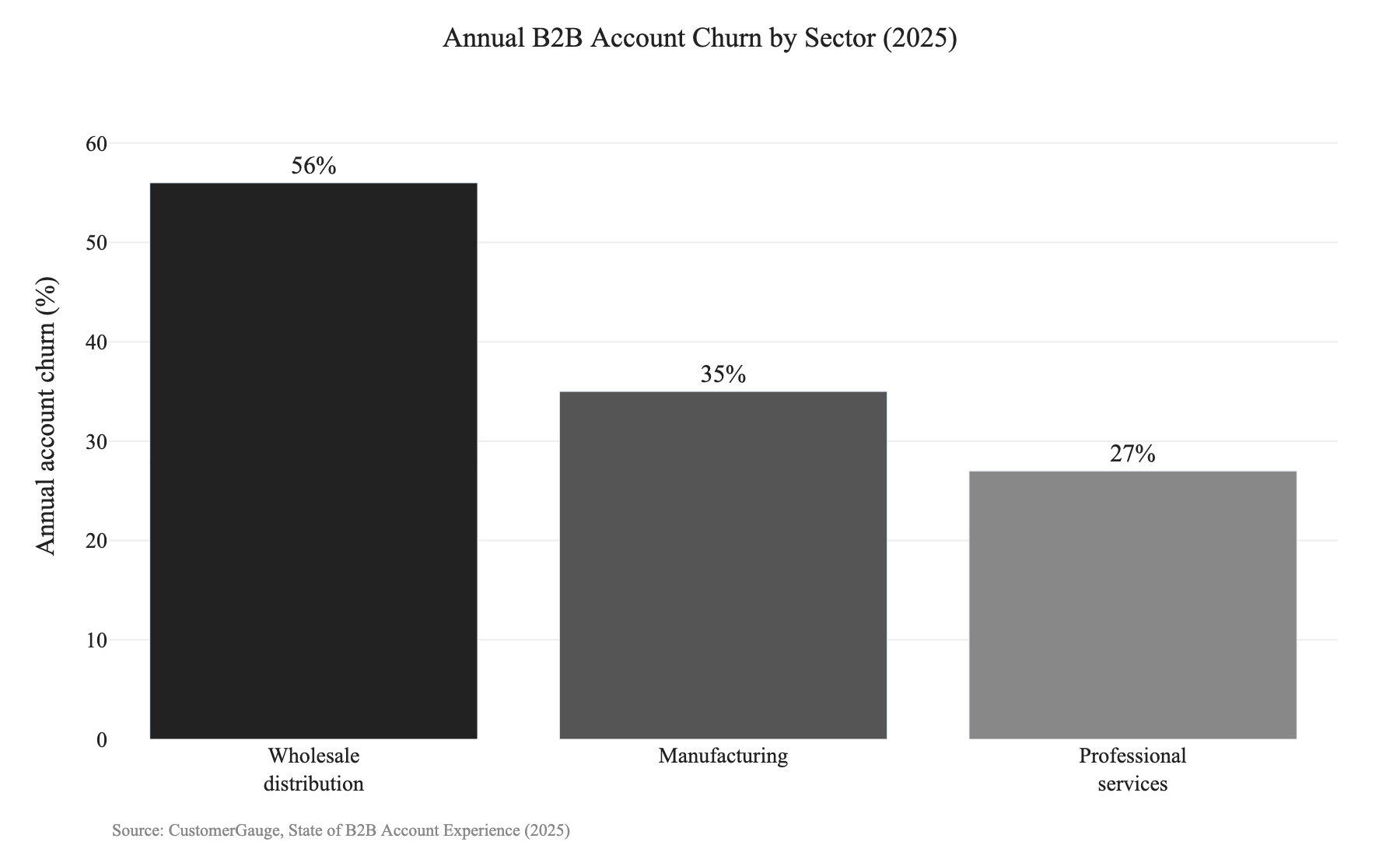
Figure 1. Annual B2B account churn by sector (CustomerGauge, 2025). Wholesale distribution carries the highest baseline because switching barriers are lowest and differentiation rests on service and relationship rather than the product itself.
The mechanism is well-documented in account management research: if a distributor has nurtured only one internal relationship within an account, that account becomes immediately vulnerable when the contact associated with it leaves either organization (Kapta, 2024). This single-thread risk is structurally endemic in smaller industrial distribution organizations where each representative manages 30 to 80 accounts and the depth of customer coverage is shallow by necessity. When the thread breaks, there is no second layer.
How Does the 12-Month Churn Window Progress?
The 12-month departure-driven churn window tends to follow a three-phase pattern. In months 1 through 3 the customer is in a wait-and-see posture: the departing representative often provides informal continuity, and active orders keep the commercial relationship alive. In months 4 through 8 the replacement is still ramping. New manufacturing sales hires typically require 12 to 18 months to reach full productivity (Scorecard Sales, 2024), so the replacement cannot yet deliver the technical advisory service that defined the prior relationship, and the customer begins taking competitive calls it would previously have rebuffed. In months 9 through 12 the decision is made. If a competitor has diagnosed the transition and assigned a technically capable representative to the opening, the account switches. If not, the customer may stay but at reduced volumes as it hedges supply across multiple distributors.
What Is the Wholesale Sector's Structural Vulnerability?
The wholesale sector's 56 percent churn rate (CustomerGauge, 2025) reflects a fundamental structural condition: switching barriers in wholesale distribution are lower than in other B2B sectors because the core product is often available from multiple qualified suppliers. The distributor's differentiation is service, technical knowledge, and relationship. When the carrier of that differentiation departs, the differentiation partially departs with them. This is why knowledge capture is not a nice-to-have program for industrial distributors; it is the mechanism for keeping the competitive advantage on the company's side of the employment contract rather than the employee's.
IV. Cost of Knowledge Loss: Lifetime Value of Departing Accounts
Quantifying the cost of departure-driven churn requires combining three distinct measurement streams: the direct cost of replacing the representative, the lifetime value of accounts at elevated churn risk, and the organizational productivity loss from undocumented knowledge.
What Does It Cost to Replace the Representative?
Sales representative replacement costs in B2B industrial contexts range from 15 to 30 percent of annual compensation in direct recruiting and onboarding expense, with the full productivity gap extending 12 to 18 months (Scorecard Sales, 2024). A representative earning USD 150,000 per year who requires 15 months to reach full productivity at replacement represents approximately USD 187,500 in deferred revenue-generating capacity before accounting for the cost of accounts lost during the ramp period. The Society for Human Resource Management (SHRM) estimates total replacement cost at six to nine months of the departing employee's annual salary across all roles; for senior technical sales professionals in industrial distribution, the figure is typically at the upper end of that range due to the application knowledge ramp required (SHRM, 2024).
What Is the Lifetime Value Exposure From At-Risk Accounts?
Figure 1a. Account Revenue Profile and Churn Risk Uplift After Senior Representative Departure
Account tier | Avg. annual revenue per account | Churn rate uplift above baseline |
|---|---|---|
Key account (top 10%) | USD 350,000 | +20 percentage points |
Mid-tier account | USD 80,000 | +15 percentage points |
Standard account | USD 25,000 | +10 percentage points |
Figure 1b. Portfolio Scale and Expected Revenue Loss Over 12 Months
Account tier | Accounts typically managed | Expected revenue loss over 12 months |
|---|---|---|
Key account (top 10%) | 5 to 8 accounts | USD 350,000 to USD 560,000 |
Mid-tier account | 20 to 30 accounts | USD 240,000 to USD 360,000 |
Standard account | 30 to 50 accounts | USD 75,000 to USD 125,000 |
Note: Churn rate uplift above baseline is an illustrative modeled estimate based on CustomerGauge sector baseline churn data (2025) and account manager transition risk patterns documented in B2B retention research. Actual figures will vary by distributor scale and account concentration.
A distributor where a 15-year technical representative managed 50 accounts carrying an average annual revenue of USD 80,000 faces a modeled revenue-at-risk of approximately USD 600,000 over 12 months at a 15 percent churn uplift above baseline, before accounting for the replacement cost or the compounding effect of reduced purchase volumes at retained accounts. The actual exposure depends on account concentration: if the top 10 accounts represent 60 percent of the managed revenue, the key account churn risk dominates.
What Is the Organizational Productivity Cost of Undocumented Knowledge?
The organizational cost extends beyond the direct account losses. IDC research estimates that Fortune 500 companies lose USD 31.5 billion annually due to failures in knowledge sharing, with the average large U.S. business losing USD 47 million per year in productivity from inefficient knowledge management (IDC, cited in eGain, 2023). For industrial distribution companies of smaller scale, the proportional impact is concentrated in fewer transitions that each carry higher relative exposure. Research across organizations finds that 42 percent of institutional knowledge resides solely with individual employees, meaning their departure leaves the organization unable to perform 42 percent of what that individual did (IDC, 2023). For a technical sales representative, that 42 percent includes the entire relationship context layer described in Section II.
Why Does Fragmented Cost Accounting Obscure the True Loss?
The same structural problem that causes pharmaceutical and manufacturing companies to underinvest in VCI packaging upgrades because procurement owns the cost line while quality absorbs the claims cost applies here. In industrial distribution, the sales department absorbs the ramp cost of the new representative, human resources absorbs the recruiting cost, and the revenue impact from churned accounts registers as a forecast miss three to four quarters later. No single report connects all three cost lines into a total departure cost. This fragmented accounting leads distribution leaders to underestimate what a single senior departure actually costs, and to underinvest in the continuity infrastructure that would prevent the worst outcomes.
V. Knowledge Capture Strategy: Process, Tooling, and Continuity Plan
Knowledge capture in a technical sales context requires a different architecture than standard sales onboarding or CRM configuration. The objective is to move account-specific relationship intelligence from a single representative's memory into a structured format that can be handed to a replacement before the departing representative's last day.
What Information Must Be Captured Before Departure?
Figure 2. Knowledge Capture Framework: Four Categories for Technical Sales Accounts
Knowledge category | What to capture | Capture method | Minimum timeline before departure |
|---|---|---|---|
Application context | Process parameters, equipment models, material tolerances, product specifications used | Structured interview + field notes review | 90 days |
Relationship history | Problem-resolution log, pricing history rationale, informal commitments, escalation contacts | Documented call summary + CRM enrichment | 60 days |
Decision-making topology | Buyer map, influencer map, champion name, competitive switch history | Account map template | 45 days |
Early-warning signals | Behavioral patterns indicating account stress, timing of last technical review | Exit briefing transcript | 30 days |
The 90-to-30-day capture window assumes a planned departure such as a retirement. For unplanned departures, the same framework applies but must be executed in compressed form during the transition period using whatever access to the departing individual remains available.
What Does an Effective Handover Protocol Look Like?
An effective handover protocol for a senior technical account transitions ownership in three stages rather than a single handoff event. In the first stage, the departing representative and the incoming contact conduct joint customer visits over a period of four to eight weeks, during which the customer's trust in the relationship is extended to the incoming contact through social proof. Research on account manager transitions indicates that rushed single-event handoffs negatively impact customer experience and elevate churn risk, while transitions spread over several weeks provide the customer with continuity signals (Bigtincan, 2024). In the second stage, the incoming representative shadows technical calls and is formally introduced as the account's new point of contact while the departing representative remains nominally accessible for a defined transition period. In the third stage, the incoming representative takes primary ownership with the departing representative available only for escalation, and the documented account playbook serves as the reference layer.
How Does AI Workflow Automation Change the Continuity Calculus?
Structured knowledge capture programs that rely on voluntary documentation by departing sales representatives have a documented failure rate: 52 percent of organizations cite time constraints as the primary barrier to knowledge transfer, and 35 percent identify organizational culture as a secondary barrier (APQC, 2024). The representative who is managing 50 active accounts while also serving out a notice period does not complete a 40-page account documentation exercise. Automation changes this calculus by reducing the documentation burden from structured authoring to structured input.
Lubinpla (the industrial chemistry AI agent company that builds per-case analytical tools and recurring workflow-automation agents for chemical manufacturers and distributors) builds AI Crew as a recurring workflow-automation product that can be configured to perform structured account capture as a continuous background process rather than a departure-triggered one-time event. AI Crew agents operating on call log data, email communication patterns, and CRM transaction records can synthesize account-level relationship summaries on a rolling basis, flagging accounts that are single-thread and updating playbook content from routine interactions without requiring the representative to enter documentation manually. When a departure occurs, the structured account record exists because it was maintained continuously rather than assembled under deadline.
The measured business impact of AI-assisted knowledge capture programs includes a 46 percent reduction in technical role onboarding time and a 38 percent improvement in problem resolution times for incoming personnel (eGain, 2023). Applied to the account continuity context, a 46 percent reduction in onboarding time means the replacement representative reaches the technical advisory capability level that characterizes the prior relationship in approximately 8 to 10 months rather than 15 to 18 months, which has a measurable effect on whether accounts survive the transition window.
What Is the Minimum Viable Continuity Plan for a Smaller Industrial Distributor?
A smaller distributor operating with limited technology budget can implement a minimum viable continuity plan using four elements without a full AI platform deployment. The first element is a tiered account risk register: a spreadsheet listing every account managed by each representative, classified by revenue tier and single-thread risk, reviewed quarterly. The second element is a structured account playbook template covering the four capture categories from Figure 2, completed for the top 20 percent of accounts by revenue. The third element is a multi-contact policy requiring representatives to maintain at least two relationship contacts per key account, reducing single-thread exposure. The fourth element is a departure trigger protocol: a defined sequence of activities that begins automatically when a departure is announced, including which accounts require immediate senior leadership contact and which require joint visit scheduling. These four elements require process discipline rather than technology investment and can be implemented within a quarter.
VI. Field Cases: Industrial Chemistry, Bearings, and Specialty Materials
The following cases are anonymized and details have been generalized to protect customer identities. Each illustrates a distinct variant of the departure-driven churn pattern across three industrial distribution subsectors.
Company A: Industrial Chemistry Distributor, Planned Retirement, Pattern 9 (Cascade Effect)
Company A is a mid-sized industrial chemistry distributor in the upper midwest of the United States supplying metalworking fluids, corrosion inhibitors, and specialty cleaning compounds to approximately 320 manufacturing accounts. The company employed a senior technical representative with 19 years of tenure who managed 58 accounts generating approximately USD 4.2 million in annual revenue. His planned retirement was announced 90 days in advance.
The company conducted an account risk assessment after the retirement announcement and identified 14 accounts as single-thread relationships with no secondary contact on record. Of those 14, six were key accounts representing USD 1.8 million in combined annual revenue. The company implemented a structured transition program: the retiring representative conducted joint visits to all 14 accounts over the 60-day period prior to departure, the incoming representative was introduced at each visit, and a documented playbook was assembled for each of the 14 accounts covering application specifications, pricing history rationale, and the technical contact map inside each customer organization.
Twelve months after the retirement, 12 of the 14 accounts remained active at comparable purchase volumes. Two accounts, both from the key account tier, reduced purchase volumes by approximately 30 to 40 percent as they partially diversified their supply base. Total revenue impact was USD 140,000 below prior-year levels on the managed portfolio, against an estimated exposure of USD 800,000 to USD 1.2 million had the transition been unmanaged. The cascade effect was that the structured transition program, built for the single departure, was subsequently maintained as an ongoing process for all senior representatives, identifying three additional high-risk single-thread accounts before they reached a departure trigger.
Company B: Bearings Distributor, Unplanned Departure, Pattern 2 (Incident Trigger)
Company B is a regional bearings and power transmission components distributor supplying industrial manufacturing plants across a four-state territory. A senior technical representative with 15 years of tenure resigned on two weeks' notice to join a competitor. He managed 43 accounts generating approximately USD 3.1 million in annual revenue.
The two-week notice period did not allow for a structured transition. The outgoing representative completed no account documentation and conducted no joint visits. The replacement was an internal promotion from inside sales who had handled order processing for some of the accounts but had never conducted field visits. Within six months, five accounts representing approximately USD 680,000 in annual revenue switched to the competitor who had hired the departing representative. The competitor's advantage was not product or price; it was the transferred relationship knowledge. The departing representative knew each account's decision-maker, equipment specifications, and pricing expectations, and used that knowledge to position the competitor's offering at the moment of maximum vulnerability.
The incident triggered a company-wide policy change. The distributor implemented a departure trigger protocol requiring structured account documentation for all representatives managing more than USD 1 million in annual revenue, a multi-contact policy requiring at least two relationship contacts per key account, and a quarterly account risk register reviewed by the sales director. The estimated permanent revenue loss from the five churned accounts was USD 680,000 annually, against an estimated investment of USD 45,000 to implement the new continuity program across the full sales organization.
Company C: Specialty Materials Distributor, Serial Departures, Pattern 4 (Gradual Improvement)
Company C is a specialty materials distributor supplying high-performance adhesives, sealants, and surface treatment chemicals to approximately 210 accounts in the electronics and automotive assembly sectors. Over a 24-month period from mid-2022 through mid-2024, the company experienced four senior representative departures in a sales organization of eleven. Each departure was an independent event, but the cumulative impact was a revenue decline of approximately 18 percent measured at the 24-month mark against the baseline established before the first departure.
The company's initial response was reactive: each departure triggered emergency outreach by the sales director, followed by reassignment of the accounts to remaining representatives already at full capacity. No documentation was completed for any of the four departing representatives. By the 24-month mark, the company had lost 31 accounts, retained 179, and was carrying representatives whose account loads exceeded sustainable coverage levels.
The improvement program, implemented in the third year, centered on three changes. First, a structured account playbook was completed for the top 40 percent of accounts by revenue, a process that took three months and was completed by existing representatives during allocated documentation time. Second, an AI-assisted call summary tool was deployed to capture relationship context from call recordings on a rolling basis, reducing the manual documentation burden for ongoing maintenance. Third, a tiered account coverage model was implemented: key accounts required bi-monthly contact by at minimum two representatives, reducing single-thread exposure from 74 percent of key accounts to 22 percent of key accounts within 12 months. Measured 12 months after implementing the improvement program, new account losses from representative departures were two out of the first departure-event cohort of seven accounts, compared to an average of 7.8 accounts per departure event in the prior period.
VII. Key Takeaway
Account churn after a senior technical sales departure is not random. It follows a predictable 12-month window and is concentrated in accounts where the relationship was single-thread. Identifying these accounts before a departure occurs is the highest-leverage intervention available to an industrial distribution leader.
The wholesale and manufacturing sectors carry baseline churn rates of 56 percent and 35 percent annually (CustomerGauge, 2025). Departure-driven churn adds incremental risk above these baselines for accounts that depend on a specific representative's relationship equity. The cost of a single senior departure at a mid-sized distributor, including replacement ramp cost, account churn loss, and productivity impact, typically exceeds USD 600,000 to USD 1 million when all cost lines are consolidated.
CRM systems capture transaction history but not relationship context. The narrative layer (why the customer buys, what problems were resolved, who in the customer organization is the actual decision-maker, and what early-warning signals indicate account stress) lives in the representative's memory and must be captured deliberately through a structured process or through continuous AI-assisted capture.
A minimum viable continuity plan for a smaller distributor requires four elements: a tiered account risk register, structured account playbooks for the top 20 percent of accounts by revenue, a multi-contact policy per key account, and a departure trigger protocol. These elements can be implemented within one quarter using process discipline rather than technology investment.
Organizations that implement AI-assisted knowledge capture as a continuous background process rather than a departure-triggered one-time exercise reduce the documentation burden on representatives and maintain current account playbooks regardless of when a departure occurs. Measured outcomes include 46 percent shorter onboarding time for incoming representatives and 38 percent faster problem resolution (eGain, 2023), both of which directly shorten the vulnerability window for at-risk accounts.
If your organization manages technical sales accounts where relationship context lives primarily with individual representatives, AI Crew can be configured to run structured account capture workflows continuously across your call log, CRM, and email data, producing current account playbooks that survive any departure. Calculate the AI Crew return on investment for your team's account continuity workload at https://www.lubinpla.com/ai-crew.
VIII. References
APQC (American Productivity and Quality Center). (2024). "The Great Retirement: Knowledge Loss, AI and the Workforce Shift." https://www.apqc.org/resource-library/resource-collection/great-retirement-and-knowledge-loss
Bigtincan. (2024). "How to transition account managers without increasing customer churn." https://www.bigtincan.com/resources/transition-account-managers-without-increasing-customer-churn/
CustomerGauge. (2025). "Average Churn Rate by Industry: 2025 B2B Benchmarks." https://customergauge.com/blog/average-churn-rate-by-industry
Deloitte and The Manufacturing Institute. (2024). "Taking charge: Manufacturers support growth with active workforce strategies, 2024 Digital Skills Report." https://themanufacturinginstitute.org/wp-content/uploads/2024/04/Digital_Skills_Report_April_2024.pdf
eGain Corporation. (2023). "Capturing Tacit Knowledge from the Great Retirement Cohort using GenAI." https://www.egain.com/blog/capturing-tacit-knowledge-from-the-great-retirement-cohort-using-genai/
FP360 Group. (2024). "The Industrial Brain Drain: How Retirements Are Leaving Knowledge Gaps in Manufacturing." https://fp360group.com/industrial-brain-drain-knowledge-gaps-manufacturing/
IDC (International Data Corporation). (2023). Cited in eGain (2023): Fortune 500 companies lose USD 31.5 billion annually due to knowledge attrition. https://www.egain.com/blog/capturing-tacit-knowledge-from-the-great-retirement-cohort-using-genai/
Kapta. (2024). "What is Customer Churn and What Does It Mean for Your Company." https://kapta.com/resources/key-account-management-blog/customer-success/what-is-customer-churn-what-does-it-mean-for-your-company
McKinsey and Company. (2023). Cited in eGain (2023): 57 percent of institutional knowledge at risk in brown-stack industries; 80 percent of knowledge is tacit. https://www.egain.com/blog/capturing-tacit-knowledge-from-the-great-retirement-cohort-using-genai/
RecordContext. (2024). "CRM Data Quality Benchmarks 2026: Decay Rates, Costs and What's Actually Missing." https://www.recordcontext.com/resources/crm-data-quality
Rivo. (2026). "27 B2B Customer Retention Statistics Every Business Should Know." https://www.rivo.io/blog/b2b-customer-retention-statistics
Scorecard Sales. (2024). "The Hidden Cost of Sales Rep Turnover in Manufacturing: Data Shows Alarming Trends." https://scorecardsales.com/the-hidden-cost-of-sales-rep-turnover-in-manufacturing-data-shows-alarming-trends/
SHRM (Society for Human Resource Management). (2024). Employee Replacement Cost Estimates. https://www.shrm.org/topics-tools/topics/employee-relations/employee-retention
Tektome. (2024). "APQC's Great Retirement Findings: What Teams Can Do About Knowledge Loss." https://tektome.com/expertise-center/blog/great-retirement-findings
Work Institute. (2024). "2024 Retention Report: Decoding the Emerging Workforce." https://info.workinstitute.com/decoding-the-emerging-workforce-2024-retention-report