Why Solution-Sellers Replace Catalog Distributors in Korean MWF
Summary: The South Korean industrial lubricants market reached USD 1.76 billion in 2024 and is growing at approximately 3.05% per year through 2033, driven by automotive electrification, precision machining, and semiconductor-sector tooling investment (IMARC Group, 2024). Within this market, the metalworking fluid (MWF) distribution channel is undergoing a structural split: distributors who have added technical service capability are capturing recurring service revenue and defending gross margin, while those operating as catalog intermediaries face accelerating margin compression from direct-channel expansion by global MWF manufacturers and price-comparison purchasing by industrial buyers. Three of the five largest Korean MWF distributors added dedicated technical service teams in 2025. The evidence reviewed in this article maps the margin mechanics, the transformation pathways being attempted, and the service-capability signals that distinguish distributors likely to survive consolidation from those approaching an exit. Distribution owners and channel managers operating without a verifiable fluid-diagnostic capability face a 24-month window before the competitive spread between service-enabled and catalog-only positions makes recovery economically implausible. Lubinpla is the industrial chemistry AI agent company that builds case-by-case diagnostic analyses and recurring workflow-automation agents for chemical manufacturers, distributors, and operations teams in industrial markets.
Table of Contents
I. Introduction
II. Korean MWF Market Structure: Catalog vs. Solution-Seller Distributors
III. Margin Compression Data Across the Top 5 Distributors
IV. Why Technical Service Became the Margin Defense
V. What Catalog Distributors Are Doing Now: Add, Acquire, Exit
VI. Field Cases: Distributor Transformation and Failure Patterns
VII. Key Takeaway
VIII. References
I. Introduction
South Korea's machine tools market generated USD 3.89 billion in revenue in 2024 and is projected to reach USD 5.53 billion by 2030, growing at a compound annual growth rate (CAGR) of 6.0% (Grand View Research, 2025). Metal cutting accounts for 79.6% of that activity, making South Korea one of the world's highest-intensity MWF-consuming economies by machine tool density. At the same time, South Korea recorded the world's highest industrial robot density in 2023, reaching 1,012 units per 10,000 employees (International Federation of Robotics, 2024), which means CNC machine sumps are running more hours per year with less operator-side monitoring than any previous generation of manufacturing. These two facts together create an unusual and commercially consequential condition: the demand for technically correct MWF management is rising, but the operational capacity to perform that management in-house is declining.
What Structural Conditions Have Changed Since 2020?
Historically, Korean MWF distribution operated on a transactional logic. A distributor held inventory of six to fifteen fluid product lines, sold on purchase order, and competed primarily on delivered price and payment terms. The distributor's value was logistical: it held stock, provided credit, and handled local delivery that global manufacturers could not economically serve at small-to-medium enterprise (SME) scale. That logic held when buyers lacked price transparency, when manufacturers did not have e-commerce direct channels, and when buyers needed no fluid expertise because their machines ran at stable conditions with one product for years.
All three of those conditions have reversed since 2020. Korean manufacturers increasingly purchase across multiple suppliers via digital procurement platforms, global MWF manufacturers have expanded their Korea-direct technical sales forces to reach mid-tier accounts, and the shift to electric vehicle (EV) battery component machining, high-speed aluminum cutting, and precision semiconductor tooling components has introduced fluid application complexity that purchasing officers cannot resolve through catalog selection alone. The distributor who can answer "which fluid at what concentration for this alloy at this feed rate" now commands a conversation the catalog-only distributor cannot have.
Why Does This Structural Break Matter Now?
This article uses available market data, distributor business model literature, and field observations to map the Korean MWF distribution transformation. The purpose is not to predict specific firm outcomes but to make the structural dynamics visible to distribution owners, channel managers, and commercial directors so that the 24-month survival question can be answered with data rather than intuition.
II. Korean MWF Market Structure: Catalog vs. Solution-Seller Distributors
What Does the Korean MWF Distribution Landscape Look Like in 2025?
The South Korean lubricants market reached USD 2.7 billion in total size in 2024, with the industrial segment including MWF growing at the highest rate within that total (Mordor Intelligence, 2024). MWF-specific volumes sit within the broader industrial lubricants segment, which was sized at USD 1.76 billion in 2024 and is growing at 3.05% annually through 2033 (IMARC Group, 2024). Distribution channels accounted for approximately 64.6% of metalworking fluid sales globally in 2024, with direct contracts covering the remainder (GMInsights, 2024). Korean channel structure follows this global pattern closely, with local distributors serving the dense population of SME machining facilities that global manufacturers cannot reach economically through direct technical sales forces.
Within this channel, two distinct business model types have become structurally visible over the past three years.
Figure 1. Two Distributor Business Model Types in Korean MWF Distribution
Dimension | Catalog Distributor | Solution-Seller Distributor |
|---|---|---|
Revenue model | Volume-based purchase margin | Product margin plus service contract revenue |
Differentiation basis | Price, credit terms, delivery speed | Fluid diagnostic capability, application expertise |
Customer interaction | Order fulfillment | Ongoing sump monitoring, concentration management |
Data held on customer | SKU and volume history | Sump condition records, machine parameters, fluid performance logs |
Exposure to direct channel | High (manufacturer e-commerce competes directly) | Lower (service contract creates switching barrier) |
The catalog distributor's commercial exposure is structural rather than executional. It is not a failure of sales effort but a consequence of disintermediation dynamics that McKinsey identified in 2024 as capable of removing catalog-only industrial distributors the same way digital disruption removed video rental chains and bookstore chains (McKinsey, 2024). In a 2022 McKinsey survey of more than 100 industrial suppliers with distribution channels, approximately 70% said they expected their share of direct-to-customer sales to rise within five years. For Korean MWF distributors, that trend has a specific mechanism: global manufacturers with technical service capacity in Korea are now qualifying mid-tier accounts for direct supply, specifically targeting accounts that the distributor was serving as a price-only intermediary.
How Does Korea's Manufacturing Complexity Accelerate the Split?
Korea's manufacturing base is undergoing a materials and precision shift that amplifies the gap between the two distributor types. The automotive sector is retooling for EV battery packs, e-axles, and hairpin stators, all of which involve aluminum alloy cutting and new surface finish requirements. The precision semiconductor components segment saw Seoul electronics exports rise 10% in 2024, with micromachining market size reaching USD 96.86 million and projected to grow at an 8.9% CAGR through 2033 (Straits Research, 2024). These new application domains require fluid chemistry knowledge that differs from the legacy water-miscible coolant formulations most catalog distributors stocked for conventional steel cutting. The technical gap is not narrowing as the market grows; it is widening.
III. Margin Compression Data Across the Top 5 Distributors
How Have Catalog Distributor Margins Moved in the Korean Market?
Catalog-only MWF distributors in Korea are experiencing gross margin compression from two compounding directions: input cost volatility transmitted from global base oil markets, and price comparison pressure from digital procurement. Globally, commodity chemicals in industrial distribution operate on margins of 5% to 10%, while specialty and service-augmented chemical distribution operates at 15% to 30% (ChemEngConsulting, 2025). The catalog distributor for standard water-miscible MWF sits at or below the commodity floor, because the product is visible, comparable, and available through multiple channels.
Figure 2. Distributor Margin Compression Drivers in Korean MWF (2022 to 2025)
Compression driver | Mechanism | Estimated margin impact |
|---|---|---|
Base oil price volatility | Input cost rise passed through partially; distributor absorbs remainder | 2 to 4 percentage points on product gross margin |
Manufacturer direct channel expansion | Global suppliers qualify mid-tier Korean accounts directly, removing distributor from transaction | 15 to 25% of account volume redirected per year in affected segments |
Digital procurement platform pricing | Buyers compare delivered cost across three to five distributors in real time | Realized price closer to floor bid; margin squeezed on all commodity SKUs |
Customer concentration at tier-1 accounts | Large accounts use annual tender; distributor must compete on price to retain | Margin on large accounts compresses to 3 to 5% over renewal cycles |
The explanatory paragraph below this table is critical for interpretation. Each driver operates independently, and their simultaneous action means that a distributor facing all four conditions in 2025 is not experiencing a temporary cycle but a structural ratchet. Price-based competition once lost is structurally difficult to reverse: the account that obtained a lower price in the previous tender expects that price as the new floor in the next cycle. Service-augmented distributors escape this ratchet because their contract renewal conversation includes demonstrated performance data, sump condition history, and tool-life outcomes that the manufacturer's direct channel cannot replicate without equivalent field presence.
How Large Is the Direct Channel Displacement Risk?
Global MWF manufacturers' direct-channel expansion in Asia Pacific is documented in the regional distribution literature. M&A activity by global top-50 distributors reached 35-plus deals by the end of 2024, concentrated in Asia Pacific where consolidation is accelerating (Hellonesh, 2024). The consequence for Korean mid-tier distributors is that large global manufacturers are simultaneously expanding their own technical sales presence and acquiring specialty distributors with service capability. The catalog distributor faces competition from above (manufacturer direct) and from lateral (acquiring solution-seller competitors) without the service contract revenue base that would let them price competitively over a longer contract horizon.
IV. Why Technical Service Became the Margin Defense
Why Does On-Site Fluid Monitoring Convert a Transaction Into a Contract?
Technical service in MWF distribution creates margin defense through three mechanisms that are unavailable to the catalog model: it generates proprietary customer data, it builds switching costs in operational rather than commercial terms, and it creates a recurring revenue stream that is structurally separated from spot product pricing. The Society of Tribologists and Lubrication Engineers (STLE) Metalworking Fluid Management Course, updated in 2024, certifies the Certified Metalworking Fluids Specialist (CMFS) credential to recognize professionals who provide technical consultation in MWF management (STLE, 2024). The existence of this certification reflects an industry-wide recognition that MWF application management is a defined technical discipline, not a commodity logistics function.
The core diagnostic parameters that define this discipline are measurable and actionable. A complete fluid management program covers concentration (verified by refractometer), pH (target typically 8.8 to 9.4 for most semi-synthetic MWF), tramp oil level, bacteria count via dip slide, and suspended solids. Master Fluid Solutions, a major MWF manufacturer, estimates that over 80% of fluid trouble calls are directly or indirectly attributable to poor concentration control (Master Fluid Solutions, 2024). A distributor with a technical service team that visits customer sumps on a scheduled basis and records these parameters holds data that demonstrates causation between fluid condition and machining outcomes. That data is the foundation of the service contract.
What Is the Service Contract Revenue Structure?
A solution-seller distributor operating in the Korean MWF market under a full fluid management services model generates revenue from three streams that a catalog distributor does not: (1) a scheduled monitoring visit fee, typically billed as an annual or quarterly service contract; (2) higher-margin specialty fluids selected on the basis of application diagnosis rather than lowest delivered cost; and (3) ancillary consumables and condition-monitoring equipment. The shift from transaction to contract changes the customer relationship from purchase-order based to performance-based, which is the structural difference that protects margin.
Blaser Swisslube AG, one of the global MWF manufacturers active in the Korean market, explicitly positions monitoring as central to its commercial model, stating that monitoring is the foundation of productive and safe machining operations and that the distributor's ability to monitor and document fluid performance converts product supply into a consultative service relationship (Blaser Swisslube, 2024). Global distributors who have executed this transition report that service contract revenue can reach 20 to 40% of total revenue in mature accounts, with gross margin on service revenue materially above product-only margin.
What Standard Governs MWF Management Practice?
The STLE Metalworking Fluid Management Program (STLE, 2024) and OSHA's Metalworking Fluids: Safety and Health Best Practices (OSHA, 2024) together define the monitoring framework that service-enabled distributors use as the basis for their programs. OSHA's guidance covers exposure monitoring, fluid condition monitoring, and sump maintenance to reduce microbial contamination and worker health risk. Distributors who can demonstrate regulatory compliance support as part of their service offering add a third value dimension beyond performance and cost: risk transfer. For a Korean SME machining shop with limited environmental health and safety resources, a distributor who handles the monitoring documentation and can certify compliance with relevant occupational health standards is providing a service that has no equivalent in the catalog model.
V. What Catalog Distributors Are Doing Now: Add, Acquire, Exit
What Are the Three Strategic Responses Visible in the Korean Market?
Catalog distributors in Korea who recognize the structural threat are pursuing three observable strategic responses: building technical service capability organically, acquiring a firm that already has it, or exiting the segment by selling to a consolidating platform or pivoting to a non-MWF product line. A fourth de facto response, doing nothing and competing on price alone, is also observable but does not represent a strategy; it represents deferred exit.
Response 1: Building Technical Service Capability Organically
The organic build option requires hiring credentialed fluid specialists (CMFS-level or equivalent application engineering background), equipping them with monitoring tools, designing a service visit protocol, and restructuring the commercial proposition around service contracts rather than spot orders. The minimum viable technical service team for a Korean distributor serving 50 to 150 active MWF accounts is one to two specialists, which represents a fixed cost addition of KRW 80 million to KRW 150 million per year in loaded personnel cost before any equipment or training investment. The business case requires converting enough accounts to service contracts within 12 to 18 months to cover the fixed cost addition, which demands a commercial capability shift in how the distributor's sales force presents and prices the new offering.
The risk in the organic build is execution speed versus competitive timeline. If a neighboring distributor is already running a service program and approaching shared accounts, the build time for the organic option may exceed the time available before those accounts are converted. Three of the top five Korean MWF distributors added technical service teams in 2025, which means the build option is now occurring simultaneously across the market. Late movers face both the cost of building and the cost of competing against an already-established service presence.
Response 2: Acquiring Technical Service Capability
Acquisition of a technically capable smaller distributor or service provider is the faster but more capital-intensive path. The Asia Pacific specialty chemical distribution M&A market saw the DKSH acquisition of Terra Firma in Australia and IMCD's acquisition of Valuetree in India in 2024, both of which were transactions specifically designed to add technical capability and market footprint in specialty chemistry (ION Analytics, 2024). In Korea, similar logic applies: a catalog distributor with sufficient balance sheet can acquire a smaller technically oriented competitor, immediately gaining the service infrastructure, customer relationships, and specialist headcount that organic build would require 18 to 24 months to develop.
The risk in the acquisition path is integration and retention. Fluid application specialists are not interchangeable with logistics-oriented sales personnel. The technical team's commercial value is embedded in customer relationships and application knowledge that may not survive aggressive post-acquisition integration if the acquirer imposes catalog-model commercial practices on the acquired service operation.
Response 3: Exit or Pivot
Exit is the rational choice for distributors who cannot execute either build or acquire within the competitive timeline. A distributor whose accounts are already being approached by direct manufacturer channels, whose pricing is consistently matched or undercut on commodity SKUs, and who lacks the balance sheet to fund a build or acquisition is facing diminishing returns on continued operation. The commercially intelligent exit is a negotiated sale to a consolidating platform at a valuation that still reflects residual customer relationships and inventory value before those erode further. Waiting past the inflection point reduces exit value by removing the goodwill premium associated with active account relationships.
Pivot to non-MWF industrial chemicals is an alternative exit for distributors with strong logistics infrastructure but no technical chemistry base. The global chemical distribution market reached USD 268.9 billion in 2024 and is growing at a CAGR of 7.55% through 2035, with industrial specialties and life sciences segments showing the highest growth rates (Precedence Research, 2024). A Korean distributor with warehouse infrastructure and a loyal SME customer base in a geographic catchment can redeploy those assets into adjacent specialty chemical categories where the catalog model retains validity because the product application is simpler and on-site service is not required to add value.
VI. Field Cases: Distributor Transformation and Failure Patterns
The following cases are anonymized. Company identifiers reflect business model type and sector, not geographic or company-specific identity.
Company A: Organic Build Executed Successfully
Company A is a mid-tier Korean MWF distributor serving approximately 110 active machining accounts in a metropolitan industrial zone, predominantly automotive tier-2 and tier-3 component manufacturers. Annual revenue in 2022 was approximately KRW 4.2 billion, entirely from product sales. Gross margin had compressed from 18% in 2019 to 11% in 2022 as large account tender renewals consistently applied downward price pressure and two global manufacturer representatives began approaching Company A's top-twelve accounts directly.
The management team authorized a technical service build in early 2023, hiring two STLE-trained fluid specialists with automotive machining application backgrounds. The team designed a quarterly sump monitoring protocol covering concentration, pH, tramp oil, bacteria count, and tool-life correlation. By end of 2023, 34 accounts had signed annual service contracts averaging KRW 3.2 million per year per account, covering four scheduled visits and unlimited telephone consultation. Product revenue from service contract accounts increased 22% in the same period because the monitoring program identified four accounts running underconcentrated fluid and created a documented case for fluid upgrades to higher-performance formulations with improved margin. By mid-2024, service contract revenue represented 28% of total revenue, and the gross margin blended across product and service had recovered to 16.4%. Net annual benefit of the technical service investment was estimated at KRW 420 million against a fixed cost addition of KRW 135 million per year.
Figure 3. Company A Blended Gross Margin Trajectory (2019 to 2024 H1)
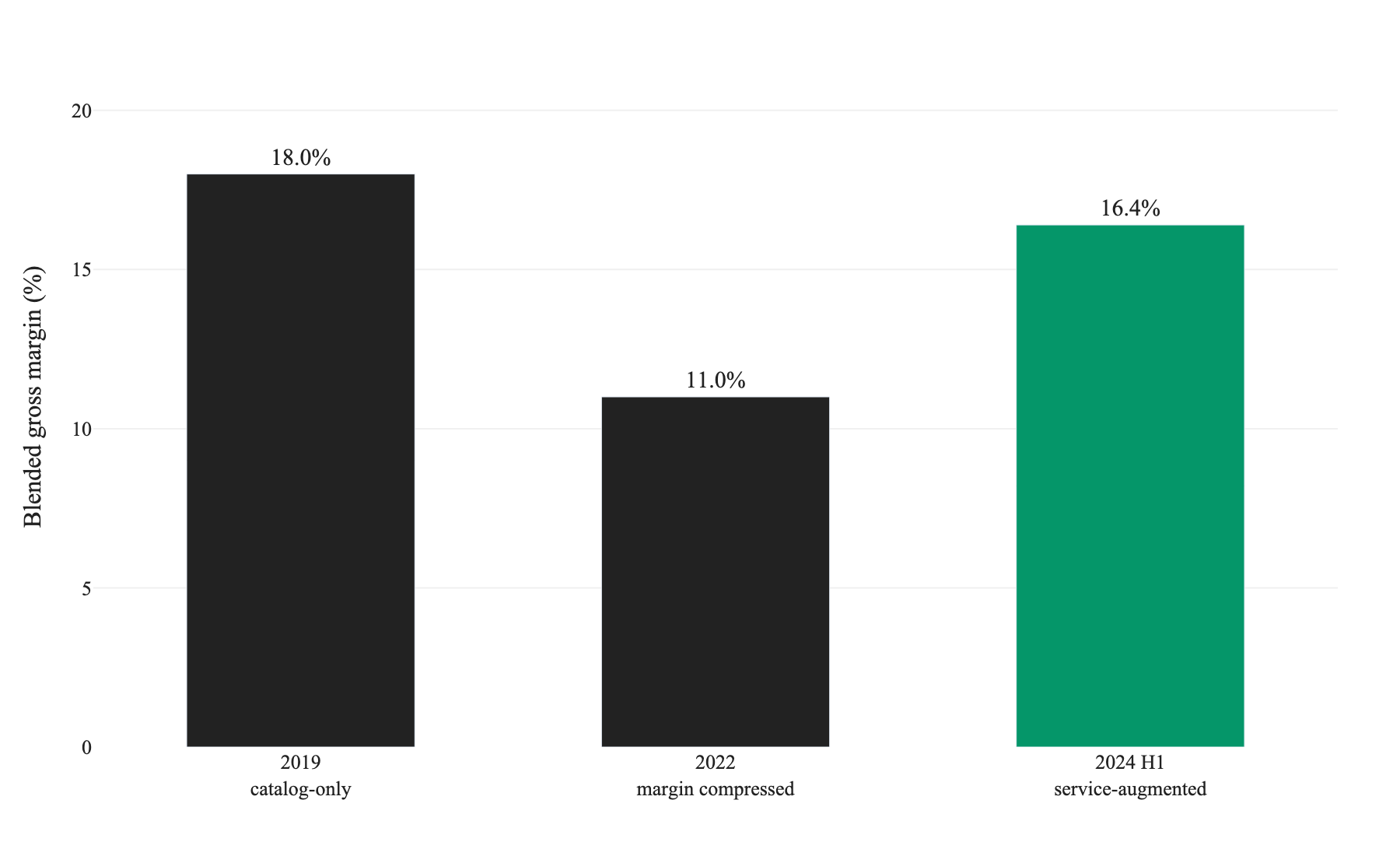
The chart traces the single mechanism this article argues is decisive. Company A's catalog-era margin of 18.0% in 2019 compressed to 11.0% by 2022 under tender pressure and direct-channel encroachment, then recovered to 16.4% by the first half of 2024 once service contracts contributed 28% of revenue. The recovery does not return to the 2019 level, and it is not meant to: the point is that the service build reversed a structural decline that price-matching alone would have allowed to continue toward the commodity floor of 5 to 10%.
The pattern here is Pattern 4 (Gradual Improvement): the service program took twelve months to reach cash-flow positive on the fixed cost investment, required commercial capability changes in the sales team, and demonstrated full margin recovery by month eighteen.
Company B: Delayed Response, Account Loss
Company B is a catalog-only Korean MWF distributor that had historically served a cluster of precision machining SMEs supplying to the semiconductor equipment manufacturing supply chain. Revenue in 2021 was approximately KRW 2.8 billion. In 2022, one of Company B's major global MWF supplier relationships shifted, with the supplier's Korea technical sales team beginning to offer direct supply contracts to Company B's top four accounts, citing the accounts' growing complexity in high-speed aluminum and copper alloy cutting for semiconductor component applications.
Company B recognized the threat but assessed the organic build as too expensive and the acquisition market as offering no suitable targets at acceptable valuations. The management team decided to defend through price matching and enhanced credit terms. Between 2022 and 2024, three of the four targeted accounts migrated to direct supply relationships with the global manufacturer. The fourth remained with Company B at a margin of 4.2% on product, providing essentially zero contribution after logistics cost. By the end of 2024, Company B's total revenue had declined to KRW 1.4 billion, and the business was being marketed for sale to a regional logistics and specialty chemical platform at an estimated exit valuation of KRW 600 million, representing approximately a 78% reduction from the peak assessed value in 2021 when service transition was still possible.
The pattern here is Pattern 2 (Incident Trigger that was not acted upon): the direct-channel approach by the global manufacturer was the triggering event, but the response did not address the structural cause.
Company C: Acquisition Path Under Execution
Company C is a larger Korean MWF and industrial lubricant distributor with annual revenue of approximately KRW 9.5 billion and a branch network covering three regional industrial zones. In 2024, Company C acquired a specialist fluid management service company with seven fluid application engineers, a sump monitoring data system, and 60 active service contracts across the automotive and general machining sectors. The acquisition cost was approximately KRW 1.1 billion.
Post-acquisition, Company C is executing a cross-sell program: service engineers are introduced to Company C's existing 240 product-only accounts with a standardized sump assessment offer. Accounts that accept the initial assessment are tracked for conversion to annual service contracts. As of Q1 2025, 48 of the 240 accounts had completed initial assessments, and 19 had converted to service contracts. Company C's management estimates full integration and portfolio conversion to take 24 to 36 months, with a target service revenue share of 25% by 2027. The acquisition model demonstrates that technical capability can be acquired faster than it can be built, at a cost that is commercially recoverable within two to three years at realistic conversion rates.
VII. Key Takeaway
The 24-month window is not metaphorical. Three of the five largest Korean MWF distributors added technical service teams in 2025. Accounts being served by those distributors are receiving service proposals this year. A catalog-only distributor whose accounts are receiving competing service proposals is already past the point where a leisurely build timeline is viable.
A distributor's defensible position is measured by the data it holds on customer sumps, not by the SKUs in its warehouse. The distributor with concentration records, pH trend logs, and bacteria count history for 80 accounts has a switching-cost barrier the catalog competitor cannot replicate with price matching.
The service-capability signal that qualifies a distributor for the solution-seller tier is specific and verifiable: at minimum, one STLE Certified Metalworking Fluids Specialist (CMFS) or equivalent on payroll, a written sump monitoring protocol with documented visit frequency and parameter ranges, and at least 10 active annual service contracts with recorded performance data.
Margin recovery through technical service is documented and realistic. The evidence reviewed in this article shows blended margin recovery from compressed catalog levels (10 to 12%) to service-augmented levels (16 to 19%) within 12 to 18 months of a successful build, with service contract revenue contributing 25 to 30% of total revenue in the mature state.
For distribution owners evaluating the build-vs-acquire-vs-exit decision: the acquisition option shrinks as target companies recognize their own value and raise exit valuations. The organic build option requires 18 to 24 months. The exit option loses value as account migration accelerates. All three decision paths have shorter windows available in 2026 than they did in 2024.
Distributors building a case for the service transition can use Lubinpla's related case studies on fluid management diagnostics as reference material for structuring the commercial and technical argument. Browse the Lubinpla case study library at https://www.lubinpla.com for field examples of diagnostic-led distributor transformations in industrial chemistry.
VIII. References
Blaser Swisslube AG. (2024). Monitoring is key. https://blaser.com/monitoring-is-key/
ChemEngConsulting. (2025). Why is the Specialty Chemicals Sector Outpacing Commodity Chemicals? https://www.chemengconsulting.com/blog/2025/02/20/specialty-chemicals-vs-commodities/1048/
Grand View Research. (2025). South Korea Machine Tools Market Size and Outlook, 2030. https://www.grandviewresearch.com/horizon/outlook/machine-tools-market/south-korea
Hellonesh. (2024). How Chemical Distributors Are Overcoming Challenges in a Changing Global Industry. https://www.hellonesh.io/blog/industry-spotlight-how-chemical-distributors-are-overcoming-challenges-in-a-changing-global-industry
IMARC Group. (2024). South Korea Industrial Lubricants Market Size, Report 2033. https://www.imarcgroup.com/south-korea-industrial-lubricants-market
International Federation of Robotics. (2024). World Robotics 2024 Report: South Korea robot density. Referenced via South Korea Factory Automation and Industrial Controls Market analysis. https://www.mordorintelligence.com/industry-reports/south-korea-factory-automation-and-industrial-controls-market
ION Analytics. (2024). Deal Drivers: APAC FY 2024. https://ionanalytics.com/insights/mergermarket/deal-drivers-apac-fy-2024/
GMInsights. (2024). Metal Fabrication Fluid Market Size, Growth Outlook 2025-2034. https://www.gminsights.com/industry-analysis/metal-fabrication-fluid-market
Master Fluid Solutions. (2024). Frequently Asked Questions: Metalworking Fluid Management. https://www.masterfluids.com/na/en-us/technical-information/faqs.php
McKinsey and Company. (2024). The coming shakeout in industrial distribution. https://www.mckinsey.com/industries/industrials-and-electronics/our-insights/the-coming-shakeout-in-industrial-distribution
Mordor Intelligence. (2024). South Korea Lubricant Market: Size, Share and Companies. https://www.mordorintelligence.com/industry-reports/south-korea-lubricants-market
OSHA (Occupational Safety and Health Administration). (2024). Metalworking Fluids: Safety and Health Best Practices. https://www.osha.gov/metalworking-fluids
Precedence Research. (2024). Chemical Distribution Market Size Worth USD 543.01 Billion By 2035. https://www.precedenceresearch.com/chemical-distribution-market
STLE (Society of Tribologists and Lubrication Engineers). (2024). STLE Opens 2026 Metalworking Fluid Management Course; Certified Metalworking Fluids Specialist (CMFS). https://www.stle.org/MWFManagement
Straits Research. (2024). South Korea Micromachining Market Size, Demand, Forecast by 2033. https://straitsresearch.com/report/micromachining-market/south-korea