3 Hidden Variables That Predict Lubricant Breakdown Before Standard Tests Catch It
Summary: Standard oil analysis programs based on viscosity, Total Acid Number (TAN), and wear metal measurements are the backbone of industrial lubricant monitoring, yet they consistently miss early-stage degradation because they measure lagging indicators rather than leading ones. This article identifies three hidden variables, RULER remaining antioxidant life, Membrane Patch Colorimetry (MPC) varnish potential, and FTIR oxidation onset, that detect lubricant degradation at the molecular level months before conventional tests show abnormal results. The analysis explains the mechanism behind each leading indicator, establishes threshold frameworks by lubricant type and application, and provides a practical supplemental testing protocol that adds predictive capability to existing oil analysis programs with minimal additional cost.
Table of Contents
I. The Lag Problem in Conventional Oil Analysis
II. Leading Indicator 1: RULER Remaining Antioxidant Life
III. Leading Indicator 2: MPC Varnish Potential
IV. Leading Indicator 3: FTIR Oxidation Onset
V. Threshold Framework by Lubricant Type and Application
VI. Interaction Effects: Why Combined Indicators Outperform Single Measurements
VII. Supplemental Testing Protocol
VIII. Key Takeaway
IX. References
I. The Lag Problem in Conventional Oil Analysis
A turbine oil in a combined cycle power plant passes every standard oil analysis test for 18 months. Viscosity is within specification. TAN is below the caution limit. Wear metals are at baseline levels. At month 20, a routine sample suddenly shows elevated TAN, darkened color, and the first signs of varnish on the servo valve. Within four weeks, the varnish causes a servo valve stiction event that forces an unplanned shutdown costing over USD 250,000 in lost production.
This scenario is not hypothetical. Industry data shows that 20 percent of gas turbines lose production annually due to oil-related problems, and just 24 hours of downtime on a single Frame 7 turbine can cost approximately USD 164,000 (Machinery Lubrication, 2024). These are not equipment design failures. They are monitoring failures where the test program detected the problem only after damage was already underway.
The problem is not that oil analysis failed. The problem is that conventional tests measure the consequences of degradation rather than the degradation process itself. Viscosity changes only after the molecular structure of the base oil has been significantly altered. TAN increases only after oxidation products have accumulated to measurable concentrations. Wear metals appear only after protective films have failed and metal-to-metal contact has occurred. Each of these measurements confirms damage that has already happened rather than warning of damage that is developing.
Leading indicators operate upstream of these conventional measurements. They detect the depletion of protective chemistry, the formation of degradation precursors, and the molecular changes that precede measurable property changes. Adding these leading indicators to existing oil analysis programs shifts the monitoring approach from reactive confirmation to predictive detection.
II. Leading Indicator 1: RULER Remaining Antioxidant Life
RULER (Remaining Useful Life Evaluation Routine) uses linear sweep voltammetry (LSV) to quantify the concentration of antioxidant additives remaining in a lubricant sample. Antioxidants are sacrificial molecules added to lubricant formulations to intercept oxidation chain reactions before they damage the base oil. As the lubricant ages in service, antioxidants are progressively consumed, and once depleted, base oil oxidation accelerates rapidly (Fluitec, 2024). The test is standardized under ASTM D6971 for turbine oils and ASTM D7590 for industrial lubricating oils.
How RULER Works at the Molecular Level
Linear sweep voltammetry applies a gradually increasing voltage across the oil sample. Antioxidant molecules, specifically hindered phenol and aromatic amine types, accept electrons at characteristic voltage levels, producing measurable current peaks. The area under each peak is proportional to the remaining concentration of that antioxidant type. By comparing the peak areas of a used sample to those of the new oil reference, RULER calculates the percentage of remaining antioxidant life (Machinery Lubrication, 2024).
This measurement is fundamentally different from TAN or viscosity because it quantifies the oil's remaining defensive capacity rather than the accumulation of attack products. An oil with 70 percent remaining antioxidant has substantial defensive margin. An oil with 25 percent remaining antioxidant is approaching the point where oxidation will accelerate regardless of what the viscosity or TAN currently shows.
The Phenol-Amine Synergy Effect
Modern turbine and hydraulic oil formulations typically contain both hindered phenolic and aromatic amine antioxidants. These two types exhibit heterosynergism: the phenolic antioxidants regenerate the more effective aminic antioxidants, suppressing oxidation more effectively than either type alone (Lubes'N'Greases, 2024). This synergy creates a characteristic depletion pattern visible in RULER trending. Phenolic antioxidants deplete first because they continuously sacrifice themselves to regenerate the amines. Once phenol levels drop below a critical threshold, the amines lose their regeneration support and begin depleting rapidly. Field engineers who understand this two-stage depletion pattern can interpret RULER trends with far greater precision than those who only track total remaining antioxidant percentage.
Why RULER Leads Conventional Tests
The relationship between antioxidant depletion and property change is nonlinear. During the first 60 to 70 percent of antioxidant depletion, conventional tests typically remain within normal ranges because the antioxidants are successfully intercepting oxidation reactions. Once antioxidant levels drop below approximately 25 to 30 percent of new oil values, oxidation reaction rates increase exponentially, and TAN, viscosity, and varnish formation follow in rapid succession. RULER detects this progression throughout the depletion curve, providing 3 to 12 months of advance warning before conventional tests flag abnormalities.
The practical implication for field teams is straightforward. If RULER shows the oil at 40 percent remaining antioxidant and trending downward at a rate of 5 percent per quarter, the team has approximately 3 quarters before reaching the critical 25 percent threshold. That window is enough time to plan an oil change during a scheduled outage rather than responding to a forced shutdown.
RULER Alert Levels
The standard RULER alert framework defines three action levels based on remaining antioxidant percentage. Above 50 percent remaining indicates normal operation with standard monitoring intervals. Between 25 and 50 percent indicates caution, warranting increased monitoring frequency and consideration of antioxidant replenishment. Below 25 percent indicates critical status requiring immediate action, either oil change or confirmed antioxidant replenishment with post-treatment verification.
III. Leading Indicator 2: MPC Varnish Potential
Membrane Patch Colorimetry (MPC) per ASTM D7843 measures the tendency of a lubricant to form varnish deposits. The test passes a heated oil sample through a 0.45-micron membrane filter, capturing insoluble oxidation products (varnish precursors) on the patch. The patch color intensity is measured using CIE Lab color space values, with the deltaE value quantifying the total color difference from a clean white reference.
The Varnish Formation Mechanism
Varnish formation in lubricants follows a predictable sequence. Antioxidant depletion allows base oil oxidation to proceed unchecked. Oxidation produces polar degradation products that are initially soluble in the oil at operating temperature. As the oil cools during shutdown periods, these polar products become insoluble and precipitate onto metal surfaces as thin, adhesive varnish films. Varnish deposits on servo valves, bearings, and heat exchange surfaces cause stiction, increased friction, and reduced heat transfer (Fluitec, 2024).
The solubility behavior of varnish precursors is temperature-dependent. During normal running conditions at 50 to 70 degrees Celsius, degradation products remain dissolved and invisible. When the system shuts down and oil temperature drops to ambient, these products precipitate onto metal surfaces. Each thermal cycle leaves a thin residual layer, and over months of repeated start-stop cycles, these layers accumulate into a hard, lacquer-like coating. Newer gas turbine models with tighter servo valve clearances compound this problem, since even thin varnish deposits can cause stiction and trip events (Turbomachinery Magazine, 2024).
Why MPC Catches What Visual Inspection Misses
The critical insight is that varnish precursors exist in the oil in dissolved form before they precipitate as visible deposits. MPC detects these dissolved precursors by forcing them out of solution through the membrane filtration step, meaning MPC can identify varnish risk while the oil still appears visually clean. Field teams that have implemented MPC testing consistently report that their first results are surprising, often showing elevated varnish potential in systems they considered clean based on visual assessment alone.
MPC Threshold Values
The industry-standard MPC threshold framework defines three zones. MPC deltaE values below 15 indicate normal condition with low varnish risk. Values between 15 and 30 indicate abnormal condition, requiring root cause investigation and potential corrective action such as oil conditioning or blending with fresh oil. Values above 30 indicate critical condition with active varnish deposition likely occurring, requiring immediate intervention including oil change, system flushing, or installation of electrostatic oil conditioning equipment (Turbomachinery Magazine, 2024).
IV. Leading Indicator 3: FTIR Oxidation Onset
Fourier Transform Infrared Spectroscopy (FTIR) monitors lubricant chemistry by measuring the absorption of infrared light at specific wavelengths. Each chemical functional group absorbs infrared energy at a characteristic frequency, creating a spectral fingerprint that reveals the lubricant's chemical composition and the presence of degradation products. FTIR application in oil analysis is governed by several ASTM standards including D7414 for oxidation and D7624 for condition monitoring of in-service lubricants.
Oxidation Detection via Carbonyl Absorption
The most important FTIR indicator for lubricant oxidation is the carbonyl absorption peak at approximately 1,710 cm-1 wavenumber. Carbonyl groups (C=O) are the primary products of hydrocarbon oxidation, and their appearance in the FTIR spectrum is the earliest detectable chemical evidence that base oil oxidation has begun. FTIR can detect carbonyl formation before it accumulates to levels that affect TAN, viscosity, or other bulk properties.
The carbonyl region is not a single peak but a composite of overlapping absorption bands. Ketones absorb at 1,725 to 1,705 cm-1, carboxylic acids at 1,725 to 1,700 cm-1, and esters at 1,750 to 1,725 cm-1 (Precision Lubrication, 2024). Carboxylic acid formation correlates directly with TAN increase, while ketone formation precedes the acid stage, meaning FTIR can distinguish between early-stage and advanced-stage oxidation even when total carbonyl peak area is similar.
FTIR oxidation measurement is expressed in absorbance units per centimeter (Abs/cm), with results trended over time. Fresh oil typically shows near-zero carbonyl absorption. As oxidation progresses, the carbonyl peak grows steadily, providing a continuous measurement of oxidation severity rather than the binary pass/fail result of many conventional tests. A rising carbonyl index across successive tests is the clearest signal that base oil chemistry is deteriorating, and it appears in the data well before TAN or viscosity changes cross their respective alert thresholds.
Additional FTIR Indicators
Beyond oxidation, FTIR simultaneously monitors several other degradation indicators. Water contamination produces a broad absorption peak near 3,400 cm-1. Nitration from high-temperature combustion gases appears near 1,630 cm-1 in engine oils. Sulfation from sulfur-containing fuel combustion appears near 1,150 cm-1. Additive depletion is tracked through changes in the absorption peaks of specific additive functional groups such as ZDDP (zinc dialkyldithiophosphate) and detergents.
This multi-parameter capability makes FTIR one of the most information-dense measurements available in oil analysis. A single FTIR scan provides simultaneous data on oxidation, nitration, sulfation, water content, and additive status, all of which are leading or coincident indicators of lubricant health.
FTIR Alert Levels for Oxidation
Typical FTIR oxidation alert levels for industrial lubricants set the caution threshold at 5 to 10 Abs/cm above the baseline for that specific oil type, and the critical threshold at 15 to 25 Abs/cm above baseline. These thresholds vary by base oil type, with Group I mineral oils showing faster oxidation onset than Group II or synthetic base stocks. Field teams should request that their oil analysis laboratory establish oil-specific baselines from new oil reference samples at the start of each oil fill, since a generic threshold applied across all oils will generate either excessive false alarms or missed warnings.
V. Threshold Framework by Lubricant Type and Application
Alert thresholds for leading indicators must be calibrated to the specific lubricant type and operating application. A threshold that indicates normal condition for a turbine oil may represent caution for a hydraulic oil, because the formulations, operating conditions, and failure consequences differ.
Figure 1. Leading Indicator Alert Thresholds by Lubricant Application
Lubricant Application | RULER (% remaining) | MPC (deltaE) | FTIR Oxidation (Abs/cm above baseline) |
|---|---|---|---|
Steam/gas turbine oil | Watch: below 50, Alert: below 30, Critical: below 20 | Watch: above 15, Alert: above 25, Critical: above 40 | Watch: above 5, Alert: above 10, Critical: above 20 |
Hydraulic oil | Watch: below 40, Alert: below 25, Critical: below 15 | Watch: above 20, Alert: above 35, Critical: above 50 | Watch: above 8, Alert: above 15, Critical: above 25 |
Gear oil (industrial) | Watch: below 40, Alert: below 25, Critical: below 15 | Watch: above 25, Alert: above 40, Critical: above 60 | Watch: above 10, Alert: above 20, Critical: above 30 |
Compressor oil | Watch: below 45, Alert: below 30, Critical: below 20 | Watch: above 15, Alert: above 25, Critical: above 40 | Watch: above 5, Alert: above 12, Critical: above 20 |
The threshold framework reflects different oxidation susceptibilities and operational criticality. Turbine oils have the tightest thresholds because servo valve varnish sensitivity makes even moderate degradation operationally consequential. Gear oils tolerate higher degradation levels before operational impact occurs.
Figure 2. Lubricant Degradation Timeline Comparison
Time Period (months) | Antioxidant (RULER %) | MPC (deltaE) | FTIR Oxidation (Abs/cm) | TAN | Viscosity Change (%) |
|---|---|---|---|---|---|
0 (new oil) | 100 | 5 | 0 | 0.08 | 0 |
6 | 75 | 8 | 2 | 0.10 | 0 |
12 | 55 | 12 | 4 | 0.12 | +1 |
18 | 35 | 18 | 8 | 0.15 | +2 |
24 | 20 | 28 | 14 | 0.22 | +4 |
28 | 10 | 45 | 25 | 0.48 | +12 |
30 | 5 | 65 | 38 | 0.85 | +22 |
Figure 4. Degradation Timeline: Leading vs Lagging Indicators
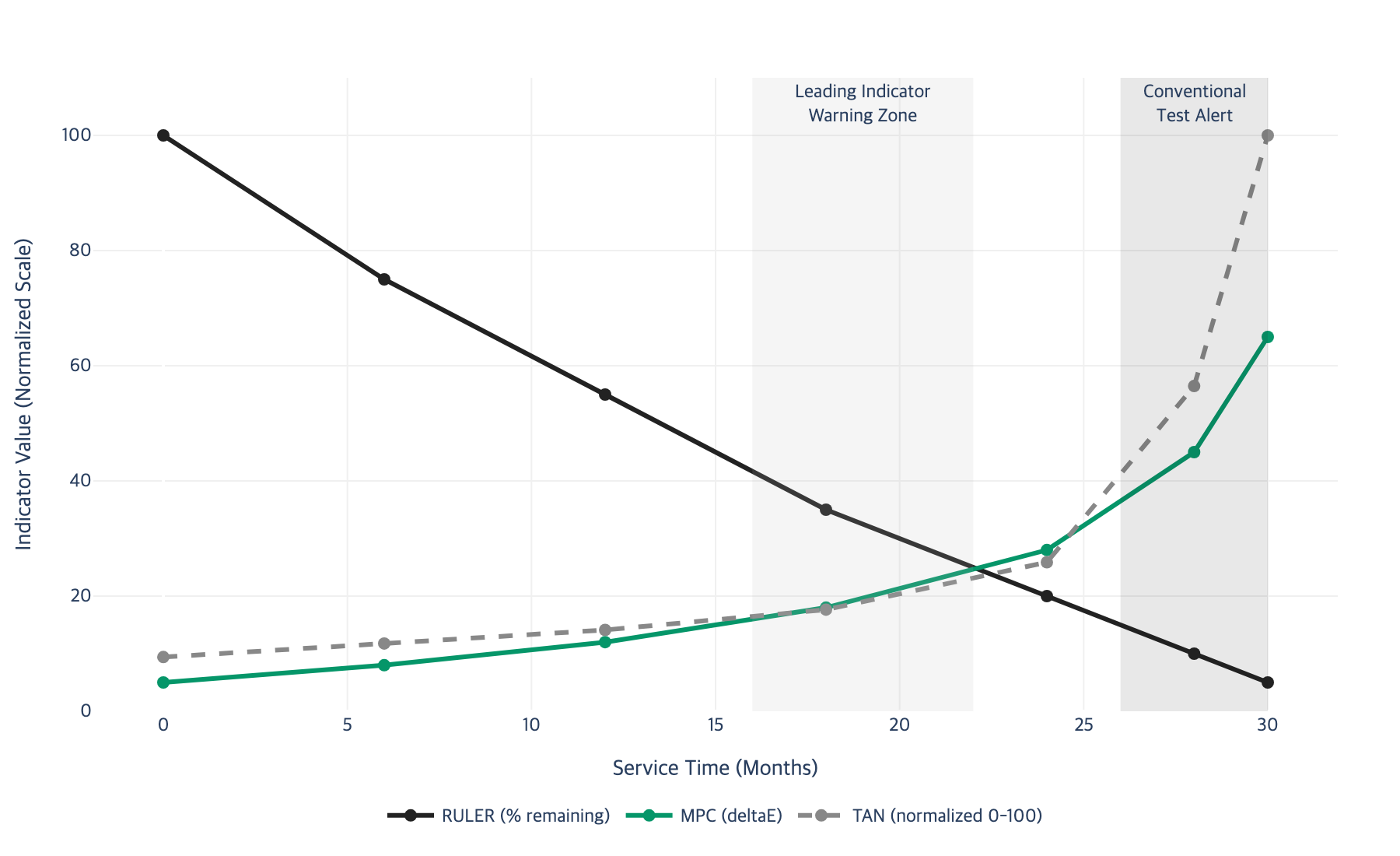
The degradation timeline demonstrates the core value proposition of leading indicators. RULER signals caution at month 12 and alert at month 18. MPC reaches the alert threshold at month 24. Conventional TAN and viscosity do not show clear abnormality until month 28 or later. This gap of 10 to 16 months between leading indicator warning and conventional test confirmation is the window for proactive intervention. A maintenance team relying solely on TAN would see nothing alarming at month 24, while a team monitoring RULER and MPC would have already scheduled corrective action.
VI. Interaction Effects: Why Combined Indicators Outperform Single Measurements
Individual leading indicators provide valuable early warning, but their predictive power increases substantially when analyzed in combination. A single indicator crossing a threshold could represent a measurement anomaly or a transient condition. Two or three indicators trending simultaneously provides high-confidence confirmation that degradation is progressing and reveals the root cause, which determines the correct corrective action.
The Predictive Power of Indicator Combinations
The interaction between RULER and MPC is particularly informative. When both declining RULER and rising MPC appear simultaneously, the oil is in active degradation with both cause (antioxidant depletion) and effect (varnish precursor formation) confirmed. Low RULER with stable MPC may indicate antioxidants are being consumed by a non-oxidative mechanism such as water contamination. High MPC with adequate RULER may indicate contamination from an external source rather than in-situ degradation. These nuanced interpretations are only possible when multiple leading indicators are analyzed together.
Adding FTIR to the RULER-MPC pair provides a third dimension of diagnostic clarity. If RULER is declining and FTIR shows rising carbonyl absorption but MPC remains stable, the oxidation products are likely still in the soluble phase, suggesting that antioxidant replenishment could extend useful life without a full oil change. If all three indicators are trending adversely, the oil has progressed past the point where replenishment alone is likely to restore adequate protection, and a full oil change becomes the appropriate response.
Combined Indicator Decision Matrix
The following matrix translates indicator combinations into actionable maintenance decisions.
Figure 3. Combined Indicator Decision Matrix
RULER Status | MPC Status | FTIR Oxidation | Interpretation | Recommended Action |
|---|---|---|---|---|
Normal | Normal | Normal | Oil in good condition | Continue standard monitoring |
Watch | Normal | Normal | Early antioxidant consumption | Increase monitoring frequency |
Watch | Watch | Watch | Active degradation beginning | Plan oil change or replenishment |
Alert | Watch | Watch | Advanced depletion, early deposits | Schedule oil change within 30 days |
Alert | Alert | Alert | Rapid degradation in progress | Immediate oil change, investigate root cause |
Critical | Alert or higher | Alert or higher | Oil past useful life | Emergency oil change, system flush |
Figure 5. Combined Indicator Action Urgency Heatmap
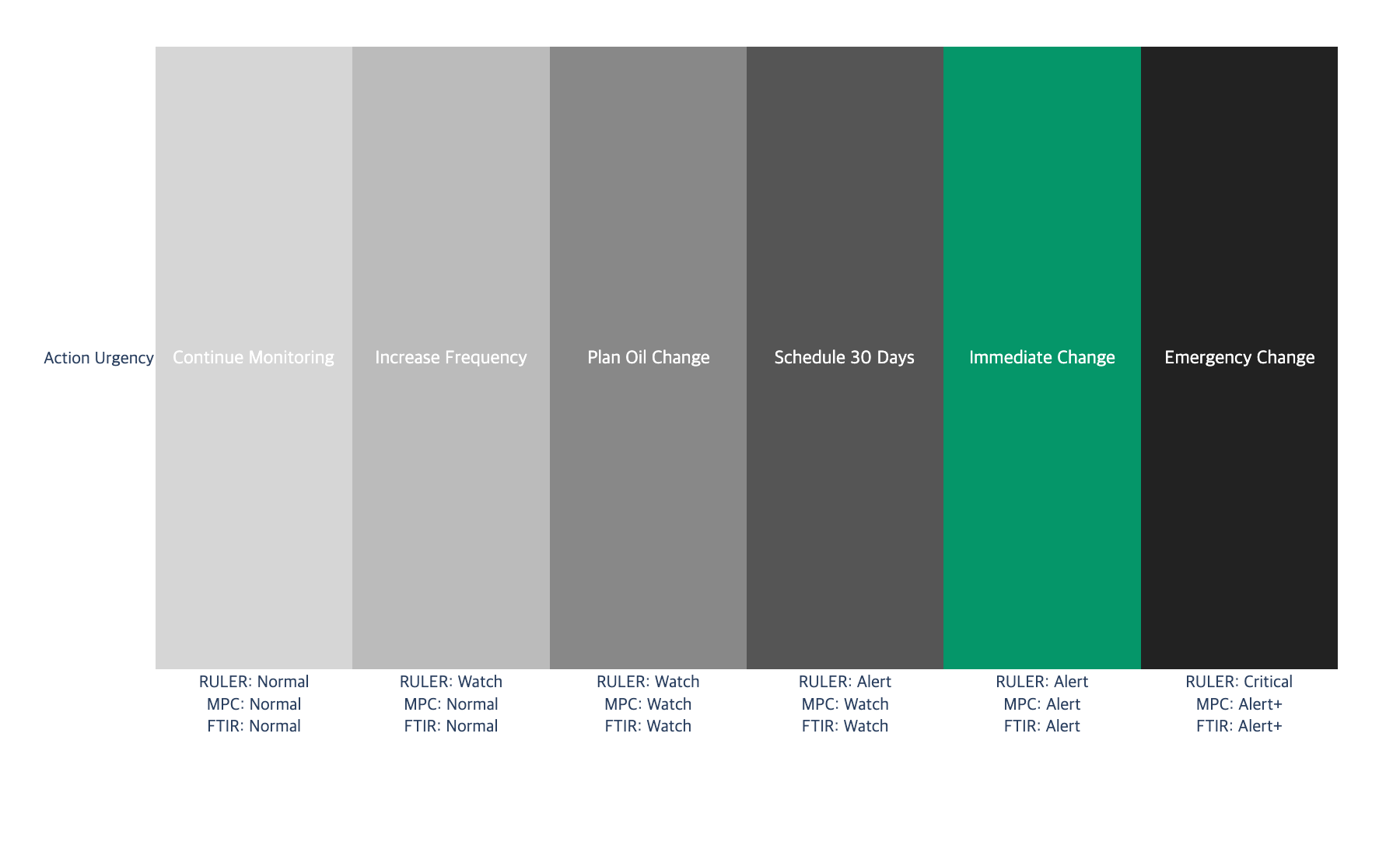
The matrix shows that single-indicator alerts justify increased monitoring, while multi-indicator alerts require operational action. This tiered response framework prevents both premature oil changes (costly) and delayed responses (equipment damage).
VII. Supplemental Testing Protocol
Adding leading indicators to an existing oil analysis program requires minimal additional sample volume, modest incremental cost, and no changes to sampling procedures. The following protocol integrates RULER, MPC, and FTIR oxidation into standard oil analysis programs.
Sampling Requirements
Leading indicator tests use the same sample bottles and sampling procedures as conventional oil analysis. No additional sampling points or specialized collection methods are required. A standard 120 ml sample provides adequate volume for all conventional and leading indicator tests combined.
Testing Frequency
For critical equipment (turbines, large hydraulic systems, high-value compressors), add RULER, MPC, and FTIR to every quarterly sample. For general industrial equipment (gearboxes, standard hydraulic units, circulating systems), add leading indicators to every second or third routine sample, or annually at minimum. Increase frequency to every sample when any leading indicator enters the watch zone.
Implementation Steps for Field Teams
Implementing a leading indicator program does not require new equipment or additional personnel. First, confirm your oil analysis laboratory offers RULER (ASTM D6971 or D7590), MPC (ASTM D7843), and FTIR oxidation (ASTM D7414) testing. Second, provide the laboratory with a new oil reference sample for each oil type in service, which is needed to calculate RULER percentages and FTIR baselines accurately. Third, add the leading indicator tests to your sample submission forms for the equipment categories identified above. Fourth, establish a trending program, since leading indicators are most valuable when trended over time rather than interpreted as isolated measurements.
Cost-Benefit Analysis
The incremental cost of adding RULER, MPC, and FTIR to a standard oil analysis sample is approximately USD 30 to USD 75 per sample. For a turbine oil system where a single varnish-related shutdown can cost USD 100,000 to USD 500,000, the annual supplemental testing cost of USD 120 to USD 300 (four quarterly samples) represents a cost-benefit ratio exceeding 300:1.
Industry case data supports these ratios. One combined-cycle power plant operator reported over USD 275,000 per year in operating expenditure savings after implementing a leading indicator monitoring program, while extending turbine oil life beyond 300 percent of the industry-standard drain interval (Fluitec, 2024). When oil chemistry is actively managed through leading indicator monitoring, oil-related production losses drop from the industry average of 20 percent of turbines affected annually to near-zero percent (Machinery Lubrication, 2024).
VIII. Key Takeaway
Standard oil analysis (viscosity, TAN, wear metals) measures lagging indicators that confirm degradation after it has occurred. RULER, MPC, and FTIR oxidation are leading indicators that detect degradation at the molecular level 3 to 12 months before conventional tests show abnormality.
RULER quantifies remaining antioxidant life, the oil's primary defense against oxidation. Below 25 percent remaining, oxidation accelerates regardless of what conventional tests currently show.
MPC detects dissolved varnish precursors before they precipitate as visible deposits. MPC deltaE values above 30 indicate active varnish risk requiring immediate attention.
FTIR carbonyl absorption at 1,710 cm-1 provides the earliest chemical evidence of base oil oxidation, trending continuously rather than providing binary pass/fail results.
Combined indicator analysis provides higher predictive confidence than any single measurement. Multi-indicator alerts warrant operational action, while single-indicator alerts justify increased monitoring.
Lubinpla's oil condition analysis module integrates RULER, MPC, and FTIR data alongside operating parameters such as temperature profiles, load cycles, and contamination history to generate lubricant remaining life predictions calibrated to your specific equipment and operating profile. Rather than relying on generic threshold tables, Lubinpla's cross-domain inference engine correlates your leading indicator trends with patterns from comparable equipment across the platform's knowledge base, recommending intervention timing specific to your conditions.
IX. References
[1] Fluitec, "RULER V Antioxidant Monitoring Solution", 2024. https://www.fluitec.com/solutions/condition-monitoring/ruler-antioxidant-monitoring/
[2] Fluitec, "The Role of MPC and RULER in Monitoring the Presence of Varnish", 2024. https://www.fluitec.com/the-role-of-mpc-ruler-in-monitoring-the-presence-of-varnish/
[3] Machinery Lubrication, "Lubricant Oxidation and Remaining Useful Life Testing", 2024. https://www.machinerylubrication.com/Read/596/lubricant-oxidation
[4] Turbomachinery Magazine, "Measuring Turbine Oil Varnish Potential", 2024. https://www.turbomachinerymag.com/view/measuring-turbine-oil-varnish-potential
[5] PMC, "Assessment of Overall Remaining Useful Life of Lubricants", 2024. https://pmc.ncbi.nlm.nih.gov/articles/PMC11415658/
[6] Machinery Lubrication, "Assessing Oxidation Condition and Lubricant Refreshment in Turbine Oils", 2024. https://www.machinerylubrication.com/Read/32352/assessing-oxidation-condition-and-lubricant-refreshment-in-turbine-oils
[7] Precision Lubrication, "Lube Oil Varnish Detection and Control", 2024. https://precisionlubrication.com/articles/lube-oil-varnish/
[8] Lubes'N'Greases, "Antioxidants Signal Lubricant Health", 2024. https://www.lubesngreases.com/magazine-emea/71/antioxidants-signal-lubricant-health/
[9] Precision Lubrication, "How Detecting Oxidation and Nitration Early Protects Equipment", 2024. https://precisionlubrication.com/articles/detecting-oxidation-and-nitration/
[10] Machinery Lubrication, "Lubricant Condition Monitoring Case Study", 2024. https://www.machinerylubrication.com/Read/94/oil-analysis-work
Powered by Lubinpla
Discover how technical teams solve complex challenges faster with AI.