Lubricant Selection for Food Processing Equipment: Navigating NSF Ratings and Performance Requirements
Summary: Food processing facilities face a unique lubrication challenge: every lubricant applied to production equipment must meet food safety regulatory requirements while simultaneously providing adequate equipment protection under demanding operating conditions. This article maps NSF lubricant categories (H1, H2, 3H) to specific equipment zones, compares food-grade base oil types (white mineral oil, PAO, ester, silicone) by performance envelope, and provides an equipment-by-equipment selection framework. The analysis demonstrates that food safety compliance and lubrication performance are not inherently conflicting goals, and that systematic selection based on contact zone classification, operating conditions, and base oil capabilities can achieve both.
Table of Contents
I. The Dual Requirement Challenge in Food Processing Lubrication
II. NSF Lubricant Categories: Understanding the Regulatory Framework
III. Food-Grade Base Oil Types and Performance Envelopes
IV. Equipment-Specific Selection Framework
V. Cross-Contamination Risk Management
VI. Key Takeaway
VII. References
I. The Dual Requirement Challenge in Food Processing Lubrication
A maintenance technician at a bakery production line discovers that the food-grade grease specified for the oven chain conveyor is breaking down after two weeks of service, requiring frequent re-lubrication that disrupts production schedules. The previous non-food-grade lubricant lasted six weeks under the same conditions. The temptation is to revert to the better-performing conventional lubricant, but doing so creates regulatory non-compliance risk that could result in product recalls, facility shutdown, and reputational damage.
This scenario illustrates the core tension in food processing lubrication: the lubricant must simultaneously satisfy two masters. Food safety regulations demand that any lubricant with potential food contact be formulated from approved ingredients and registered with NSF International. Equipment manufacturers and maintenance teams demand that lubricants provide adequate wear protection, temperature stability, and re-lubrication intervals under actual operating conditions.
The financial consequences of getting this balance wrong are well documented. According to a study by the Food Marketing Institute and the Grocery Manufacturers Association, food recalls cost companies an average of USD 10 million in direct costs alone, with 5 percent of companies incurring over USD 100 million in direct and indirect costs from a single recall event (GMA, 2024). Lubricant contamination has been the trigger for several significant recalls. In one case, a packing company recalled 490,877 pounds of smoked boneless hams after product was tainted with gear lubricant. In another, 86,000 pounds of sliced turkey was recalled after exposure to a non-food-grade lubricant, causing consumer complaints of intestinal discomfort from off-color, off-odor product (Safe Food Factory, 2024).
Despite these risks, an estimated 60 percent of U.S. food and beverage manufacturers have not yet fully transitioned from conventional lubricants to food-grade alternatives (Machinery Lubrication, 2024). The global food-grade lubricants market, valued at approximately USD 460 million in 2024 and growing at a compound annual growth rate of 7 to 9 percent, reflects the accelerating pace of adoption as facilities recognize that the cost of non-compliance far exceeds the cost of proper food-grade lubricant programs (Grand View Research, 2024).
The solution is not to compromise on either requirement, but to select the specific combination of NSF category, base oil type, and additive package that meets both the regulatory requirement for the contact zone and the performance requirement for the equipment type and operating conditions.
II. NSF Lubricant Categories: Understanding the Regulatory Framework
The NSF International registration system classifies lubricants into categories based on the degree of potential food contact. Understanding these categories and their correct application to equipment zones is the first step in compliant lubricant selection. The system traces its origins to the former USDA authorization program, which NSF International took over in 1998.
H1: Incidental Food Contact Lubricants
NSF H1 registered lubricants are formulated exclusively from ingredients listed in 21 CFR 178.3570 and may contain only approved base oils (white mineral oil, PAO, certain esters, silicone) and approved additives. H1 lubricants are required in any equipment location where incidental contact with food products is technically possible, even if contact is not expected during normal operation (NSF, 2024).
The critical regulatory threshold for H1 lubricants is 10 mg/kg: if contamination occurs, the lubricant concentration in the food product must not exceed 10 parts per million. This limit applies automatically when an H1 lubricant is used in an incidental contact zone, without requiring the facility to demonstrate actual contamination levels below this threshold.
H1 lubricants have historically been perceived as lower-performing than conventional industrial lubricants due to restrictions on additive chemistry. Traditional extreme pressure (EP) additives containing sulfur, phosphorus, and zinc (commonly used in industrial gear oils) are not permitted in H1 formulations. However, modern HX-1 additive packages have significantly narrowed this performance gap. HX-1 is the NSF registration category for individual ingredients approved for use in H1 lubricant formulations, and each must pass strict testing requirements and appear on the 21 CFR approved substances list. Contemporary HX-1 additive packages can deliver outstanding wear protection and maintain excellent thermal and oxidative stability, rivaling the performance characteristics of conventional industrial additive packages (Univar Solutions, 2024).
H2: No Food Contact Lubricants
NSF H2 registered lubricants are used in equipment locations where there is no possibility of food contact. While H2 lubricants have fewer ingredient restrictions than H1, they must still not contain carcinogens, mutagens, teratogens, mineral acids, or heavy metals. H2 lubricants are used in utility systems (boilers, compressors, HVAC), maintenance equipment, and any machinery physically separated from food production areas.
The boundary between H1 and H2 zones within a facility requires careful assessment. Equipment located above exposed food product, even if enclosed, may require H1 lubricants if a leak or seal failure could result in dripping onto food. Conversely, equipment below the food line or in separate utility rooms can safely use H2 lubricants.
3H: Direct Food Contact Release Agents
NSF 3H registered products are approved for direct, intentional contact with food products and function as release agents (anti-stick coatings) on surfaces such as grills, bread pans, and molds. 3H products are distinct from H3 lubricants, which are soluble oils for rust prevention on hooks and trolleys that must be removed before food contact. The 3H and H3 categories are not interchangeable (JAX, 2024).
ISO 21469: Manufacturing Hygiene Certification
Beyond NSF registration categories, ISO 21469 certification provides an additional layer of assurance for food-grade lubricant quality. ISO 21469 specifies hygiene requirements for the formulation, manufacture, and packaging of lubricants that may come into contact with food products during processing. Unlike NSF H1 registration, which focuses on ingredient approval, ISO 21469 audits the entire manufacturing process to ensure that contamination during production, storage, and packaging is prevented. Each certified facility is subjected to an annual unannounced audit, during which product samples are collected and tested against the original baseline. While voluntary in most markets, ISO 21469 certification is mandatory for food-grade lubricants manufactured in, imported into, or exported from Brazil (NSF, 2024).
Figure 1. NSF Category Application by Equipment Zone
Equipment Zone | NSF Category Required | Zone Description | Example Equipment |
|---|---|---|---|
Direct food contact | 3H | Surfaces intentionally contacting food | Bread pan release, grill surfaces |
Incidental contact zone | H1 | Equipment where food contact is possible | Conveyor bearings above food line, filling machine gears, packaging seals |
No contact zone | H2 | No possibility of food contact | Boiler room equipment, utility compressors, separate maintenance shop |
Rust prevention (food hooks) | H3 | Hooks and trolleys cleaned before food contact | Meat hooks, smokehouse trolleys |
Correct zone classification is the foundation of compliant lubricant selection. Misclassifying an incidental contact zone as a no-contact zone exposes the facility to regulatory risk. Conversely, over-specifying H1 lubricants in zones where H2 is appropriate increases lubricant costs without adding food safety value.
III. Food-Grade Base Oil Types and Performance Envelopes
Within the H1 category, four base oil types are commonly available, each with distinct performance characteristics that make it suitable for different equipment types and operating conditions.
White Mineral Oil (WMO)
White mineral oil is the traditional and most widely used base oil for H1 lubricants. It is produced by severe hydrogenation of petroleum feedstock to remove aromatic compounds, sulfur, and other impurities. WMO provides adequate lubrication performance for moderate-temperature applications (operating range approximately minus 10 C to 120 C) at the lowest cost among food-grade base oils.
WMO limitations become apparent at elevated temperatures, where oxidation stability is lower compared to synthetic alternatives. In high-temperature applications such as oven chain lubrication above 150 C, WMO-based lubricants degrade rapidly, forming deposits and requiring frequent re-lubrication. WMO also has a relatively narrow viscosity-temperature range, losing viscosity quickly at elevated temperatures and becoming excessively viscous at low temperatures.
Polyalphaolefin (PAO)
PAO synthetic base oils offer significantly broader temperature range (approximately minus 40 C to 200 C), higher oxidation stability, and lower evaporation rates compared to WMO. PAO is the most common synthetic base oil in high-performance H1 lubricants and is suitable for applications requiring extended re-lubrication intervals or operation at temperature extremes (Machinery Lubrication, 2024).
PAO's higher viscosity index means it maintains more consistent viscosity across a wider temperature range, providing better film thickness protection during temperature fluctuations. PAO-based food-grade lubricants can often achieve re-lubrication intervals 2-3 times longer than WMO equivalents in the same application, reducing both lubricant consumption and maintenance labor.
Ester Base Oils
Ester base oils provide excellent high-temperature performance (up to 220 C), superior detergency (keeping surfaces cleaner by dissolving deposits), and inherent biodegradability. Esters are increasingly popular for food processing applications where both environmental credentials and high-temperature performance are valued.
Ester base oils exhibit natural polarity, which enhances their adhesion to metal surfaces and provides better boundary lubrication under high load conditions. This characteristic makes ester-based H1 lubricants particularly effective for heavily loaded bearings and gear applications where film thickness alone is insufficient for wear protection. However, esters are typically the highest-cost food-grade base oil option and may have compatibility limitations with certain seal materials (Anton Paar, 2024).
Silicone Base Oils
Silicone (dimethylpolysiloxane) base oils offer the highest thermal and oxidation stability among food-grade options, maintaining performance at temperatures up to 250 C. Silicone lubricants are chemically inert, non-toxic, and do not affect the taste or odor of food products even in case of direct contact.
However, silicone has inherently poor load-carrying capacity and does not provide adequate wear protection for heavily loaded components such as gears and bearings under significant mechanical stress. Silicone lubricants are most appropriate for low-load, high-temperature applications such as oven door hinges, conveyor chain guides, and sliding surfaces where the primary requirement is heat resistance rather than load capacity.
Figure 2. Food-Grade Base Oil Performance Comparison
Property | White Mineral Oil | PAO | Ester | Silicone |
|---|---|---|---|---|
Temperature range (C) | -10 to 120 | -40 to 200 | -30 to 220 | -40 to 250 |
Oxidation stability | Moderate | High | High | Very high |
Viscosity index | 90-105 | 130-150 | 120-170 | 100-400 |
Load-carrying capacity | Moderate | Good | Very good | Poor |
Evaporation loss | Moderate-high | Low | Low | Very low |
Detergency | Low | Low | High | None |
Seal compatibility | Good | Good | Variable (check) | Good |
Biodegradability | Low | Low | High | Low |
Relative cost | 1.0x (baseline) | 2.0-3.0x | 3.0-5.0x | 2.5-4.0x |
The base oil comparison reveals that no single base oil type is optimal for all applications. Equipment selection must match the base oil's performance envelope to the specific temperature, load, speed, and re-lubrication interval requirements of each equipment type.
Figure 4. Operating Temperature Range by Food-Grade Base Oil Type
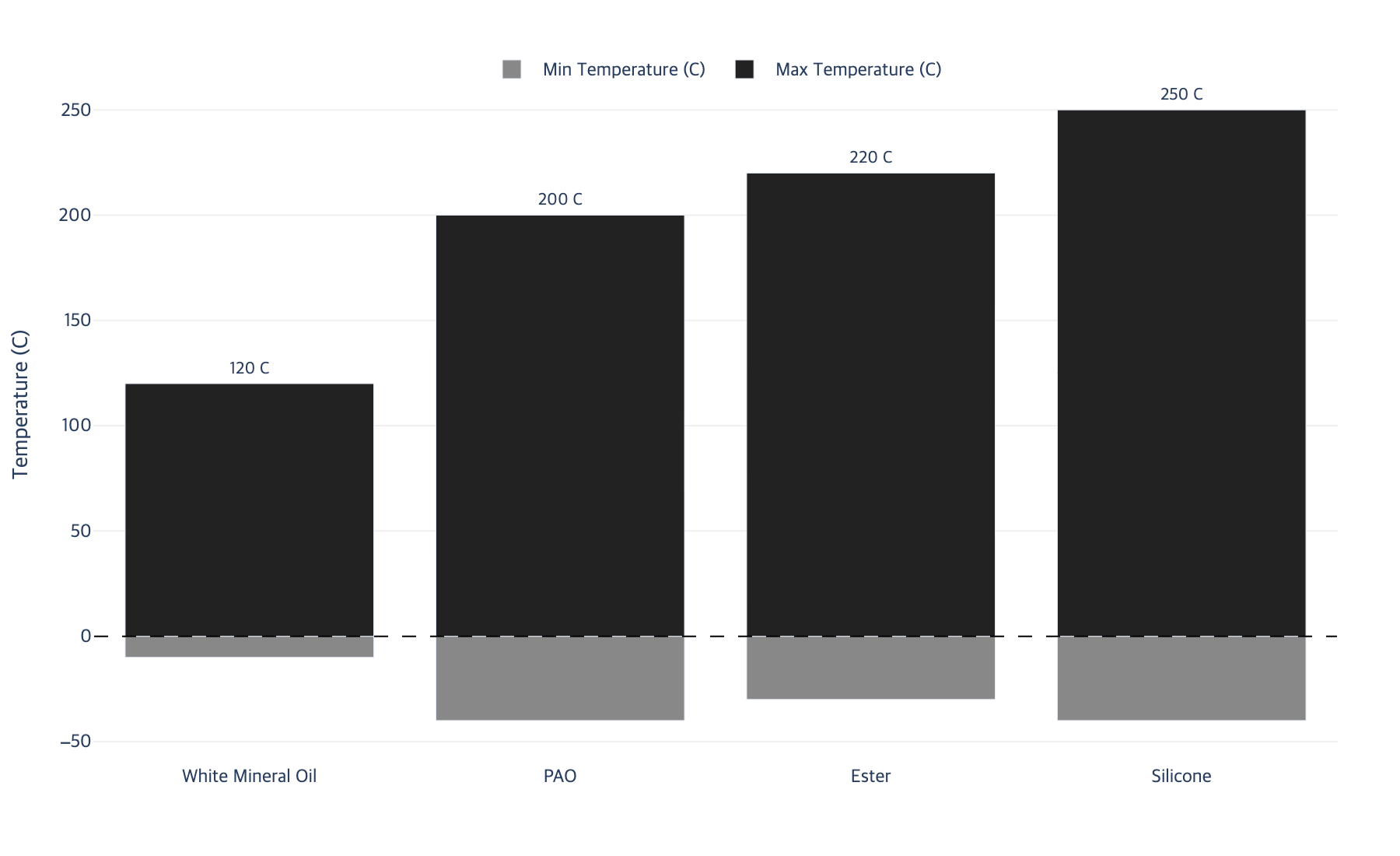
The temperature range chart clearly shows the progressive expansion of operating temperature capability from white mineral oil through silicone. PAO and ester base oils cover the widest practical range for most food processing applications, while silicone extends the upper limit for specialized high-temperature applications at the cost of load-carrying capacity.
IV. Equipment-Specific Selection Framework
The following framework maps common food processing equipment types to recommended NSF categories and base oil types based on typical operating conditions.
Bearings
Bearings in food processing equipment range from lightly loaded conveyor idler bearings to heavily loaded mixer bearings. The selection criteria include operating temperature, speed factor (DN value), load magnitude, and contamination exposure. Conveyor bearings near the food zone require H1 grease, with WMO-based grease adequate for moderate temperatures and PAO-based grease preferred for oven-zone conveyors or extended re-lubrication intervals. Mixer and blender bearings under high loads benefit from ester-based H1 grease for superior boundary lubrication.
Chains
Chain lubrication in food processing is particularly challenging because chains operate at high temperatures (oven chains at 180-250 C), are exposed to washdown chemicals, and are often in the incidental contact zone. Oven chain lubricants require high-temperature synthetic formulations, typically PAO or ester-based, that resist oxidation and deposit formation at sustained elevated temperatures. Ambient-temperature conveyor chains can use WMO-based chain oils if the environment is not extreme.
The application method for chain lubrication significantly affects both lubricant consumption and food safety risk. Automatic micro-dosing systems that apply small, precisely metered quantities at frequent intervals typically outperform manual or bulk application methods in both lubricant efficiency and contamination risk reduction.
Gears
Enclosed gearboxes in food processing equipment require food-grade gear oils with adequate EP (extreme pressure) properties to protect gear tooth surfaces under load. Modern H1 gear oils using HX-1 additive technology provide performance comparable to conventional EP gear oils for most food processing gearbox applications. PAO-based H1 gear oils are the standard recommendation for enclosed food processing gearboxes, with ester-based options for high-temperature or heavily loaded applications.
Most food processing gearboxes operate effectively with ISO VG 220 or ISO VG 320 food-grade gear oils.
Compressors
Refrigeration and air compressors in food processing facilities may require H1 lubricants if the compressed air contacts food products or if refrigerant leaks could introduce lubricant into the food zone. PAO-based compressor oils provide excellent performance across the temperature range encountered in refrigeration compressors while maintaining H1 compliance.
Figure 3. Equipment-Specific Food-Grade Lubricant Selection Guide
Equipment Type | Typical Contact Zone | Recommended NSF Category | Recommended Base Oil | Key Selection Factor |
|---|---|---|---|---|
Conveyor bearings (ambient) | Incidental | H1 | WMO or PAO | Speed factor, re-lube interval |
Conveyor bearings (oven zone) | Incidental | H1 | PAO or ester | Temperature resistance |
Oven chains | Incidental | H1 | PAO or ester | High-temp oxidation stability |
Conveyor chains (ambient) | Incidental | H1 | WMO | Cost efficiency |
Enclosed gearboxes | Incidental | H1 | PAO | EP performance, film thickness |
Open gears | Incidental | H1 | PAO or ester | Adhesion, load capacity |
Packaging machine links | Incidental | H1 | WMO or PAO | Clean operation, low residue |
Refrigeration compressors | Incidental or H2 | H1 or H2 | PAO | Refrigerant compatibility |
Utility air compressors | No contact | H2 | Conventional or PAO | Cost, standard performance |
Oven door hinges | Incidental | H1 | Silicone | Temperature, low load |
Bread pan release | Direct contact | 3H | Approved release agent | Food safety, non-stick |
Figure 5. Equipment-to-Base Oil Mapping for Food Processing Facilities

The treemap provides a visual overview of how different equipment types within a food processing facility map to recommended base oil types. The hierarchical structure makes it easy to identify which equipment categories require which lubricant chemistry, supporting practical inventory planning and specification management.
The selection guide demonstrates that a food processing facility typically requires multiple lubricant types across different equipment and zones. Consolidating to a single universal food-grade lubricant is tempting for inventory simplification but usually results in either over-specification (cost penalty) or under-specification (equipment protection deficit) for specific applications.
V. Cross-Contamination Risk Management
Even with correct lubricant selection, cross-contamination between food-grade and non-food-grade lubricants can create compliance failures. A single instance of topping up an H1-lubricated gearbox with conventional H2 oil invalidates the H1 status of the entire oil charge and creates regulatory non-compliance.
Inventory and Handling Controls
Effective cross-contamination prevention requires physical separation of food-grade and non-food-grade lubricant inventories. Color-coded containers, dedicated dispensing equipment, and clear labeling systems reduce the risk of inadvertent mixing. Many food-grade lubricant suppliers provide distinctive packaging and dispensing accessories specifically to support contamination prevention programs.
A practical approach uses a three-tier color-coding system: one color for H1 products (commonly blue), a second for H2 products (commonly red), and a third for 3H products (commonly green). Every dispensing tool, grease gun, oil can, and transfer container should be permanently color-coded to match its assigned lubricant category. Dispensing equipment should never be shared between categories.
Lubricant Changeover Procedures
When converting equipment from conventional lubricants to food-grade products, thorough flushing of the lubrication system is essential. Residual conventional lubricant in bearing housings, gearbox sumps, or centralized lubrication lines will contaminate the food-grade lubricant and compromise its regulatory status. A minimum of two complete drain-and-fill cycles with the food-grade product is recommended to achieve adequate dilution of residual conventional lubricant.
For enclosed gearboxes, the changeover procedure should include draining the conventional oil at operating temperature (when viscosity is lowest and the oil carries maximum suspended contaminants), refilling with the food-grade product, running the equipment for 24 to 48 hours, draining again, and refilling with fresh food-grade product. This two-stage flush typically reduces residual conventional lubricant concentration to below 2 percent.
Documentation and Audit Readiness
Food safety audits (FSSC 22000, SQF, BRC) increasingly include lubricant management as an assessment element. FSSC 22000, which integrates ISO 22000 with sector-specific prerequisite programs, explicitly addresses contamination risks from lubricants in food processing and packaging environments. Maintaining records of lubricant types used in each equipment location, NSF registration certificates, application dates, and re-lubrication intervals demonstrates proactive food safety management and supports audit compliance.
VI. Key Takeaway
Classify every lubrication point in the facility by NSF contact zone (H1 incidental contact, H2 no contact, 3H direct contact) before selecting lubricants, as the zone classification determines the minimum regulatory requirement.
Match the base oil type (WMO, PAO, ester, silicone) to the specific equipment operating conditions, particularly temperature range, load magnitude, and required re-lubrication interval, rather than selecting a single universal food-grade lubricant for all applications.
Modern H1 lubricants with HX-1 additive technology have significantly narrowed the performance gap with conventional industrial lubricants, making compliance achievable without sacrificing equipment protection in most applications.
Implement physical inventory separation, color-coded dispensing systems, and documented changeover procedures to prevent cross-contamination between food-grade and non-food-grade lubricants, which is the most common cause of compliance failures.
Treat lubricant management documentation (NSF certificates, application records, zone maps) as a food safety audit requirement, not just a maintenance practice, and maintain audit-ready records for FSSC 22000, SQF, and BRC assessments.
Lubinpla's product selection engine can cross-reference your specific equipment list, operating temperatures, load conditions, and NSF zone classifications to generate a facility-wide food-grade lubricant specification that optimizes both compliance and equipment protection performance.
VII. References
[1] NSF International, "What Makes a Lubricant a Food-Grade Lubricant", 2024. https://www.nsf.org/knowledge-library/food-grade-lubricants-registrations
[2] Machinery Lubrication, "What You Should Know About Food-Grade Lubricants", 2024. https://www.machinerylubrication.com/Read/29695/food-grade-lubricants
[3] JAX Inc, "NSF Understanding Lubricant Category Codes", 2024. https://jax.com/nsf-lubricant-category-codes/
[4] Anton Paar, "Food Grade Lubricants", 2024. https://wiki.anton-paar.com/en/food-grade-lubricants/
[5] Machinery Lubrication, "The Basics of Food-Grade Lubricants", 2024. https://www.machinerylubrication.com/Read/1857/food-grade-lubricants-basics
[6] International Council for Machinery Lubrication, "The Ultimate Guide to Food-Grade Lubricants", 2025. https://info.lubecouncil.org/2025/07/07/the-ultimate-guide-to-food-grade-lubricants/
[7] SCL, "The 3 Tiers of Food Grade Lubrication: H1, H2, H3", 2024. https://www.sclubricants.com/food-grade-lubrication/
[8] Precision Lubrication, "Food Grade Lubricants: Categories, Compliance and Challenges", 2024. https://precisionlubrication.com/articles/food-grade-lubricants/
[9] Twin Specialties, "A Guide to Food Grade Lubricants", 2024. https://www.twinoils.com/news/guide-to-food-grade-lubricants/
[10] Chorus Lubricant Additives, "Synthetic Base Oils: PAGs, PAOs, Esters, and Silicone Oils", 2024. https://www.cnlubricantadditive.com/info/synthetic-base-oils-of-pags-paos-esters-and-94765404.html
[11] NSF International, "Nonfood Compounds: ISO 21469 Food-Grade Lubricants", 2024. https://www.nsf.org/food-beverage/commercial-food-equipment/nonfood-compounds-chemical-registration-certification/food-grade-lubricants-iso-21469-certification
[12] Nelson Jameson, "Food-Grade Lubricant NSF Ratings", 2024. https://nelsonjameson.com/blog/post/food-grade-lubricant-nsf-ratings
[13] Grand View Research, "Food Grade Lubricants Market Size, Industry Report 2030", 2024. https://www.grandviewresearch.com/industry-analysis/food-grade-lubricants-market-report
[14] Safe Food Factory, "Food-Grade Lubricants: Overcoming the Myths and Misconceptions", 2024. https://www.safefoodfactory.com/en/editorials/58-overcoming-myths-and-misconceptions/
[15] Univar Solutions, "NSF HX-1 Food-Grade Lubricant Additives", 2024. https://discover.univarsolutions.com/industries/metalworking-fluids-and-lubricant/hx1-additives-food-grade-lubricants/
Powered by Lubinpla
Discover how technical teams solve complex challenges faster with AI.