From Tribal Knowledge to AI Knowledge Base: A Practical Roadmap for Chemical Suppliers
Summary: An estimated 97 percent of manufacturers express concern about the impending loss of expertise as experienced employees retire, with over 4.1 million Americans reaching retirement age annually through 2027. In industrial chemical companies, this tribal knowledge represents irreplaceable competitive advantage. The cost of poor knowledge transfer in large U.S. businesses reaches an estimated USD 47 million annually. This article provides a realistic, four-phase roadmap for transitioning from tribal knowledge dependency to an AI-augmented knowledge base, addressing the unique challenges of codifying chemical expertise without overpromising overnight transformation.
Table of Contents
I. The Knowledge Crisis in Industrial Chemistry
II. Why Chemical Expertise Is Uniquely Hard to Capture
III. The Four-Phase Transformation Roadmap
IV. What a Functional AI Knowledge Base Requires
V. Implementation Realities: What Field Teams Should Expect
VI. The Compounding Advantage of Early Movers
VII. Key Takeaway
VIII. References
I. The Knowledge Crisis in Industrial Chemistry
The cost of poor knowledge transfer in large U.S. businesses reaches an estimated USD 47 million annually (Korra, 2024). In the industrial chemical sector, where product selection and troubleshooting depend on decades of accumulated field experience, the stakes are even higher. When an experienced engineer walks out the door, the organization loses a decision engine that took 20 or 30 years to build.
The Scale of Expertise Loss
The industrial workforce is experiencing what analysts call a "silver exodus." The youngest Baby Boomers began reaching retirement age in 2024, and manufacturing alone will need to fill 3.8 million vacant jobs between now and 2033, with 2.8 million of those vacancies resulting directly from retirements (AEM, 2024). The U.S. manufacturing sector reported over 600,000 open positions in January 2024, a figure that continues to climb.
A 30-year veteran application engineer who can diagnose a coating adhesion failure by examining the blister pattern, or recommend the correct corrosion inhibitor for a mixed-metallurgy cooling system, carries knowledge that has never been systematically documented. These answers come from pattern recognition developed across hundreds of similar situations, each adding a data point to an internal model that no one else can access.
Where the Knowledge Lives
In most industrial chemical companies, critical technical knowledge exists in three places: in the heads of senior engineers, in scattered email threads, and in informal verbal exchanges. A Deloitte survey of over 50 chemical enterprises found that 52 percent lacked an enterprise digital strategy or transformation roadmap (ChemCopilot, 2025), meaning the majority have no systematic approach to capturing the knowledge they depend on daily.
The problem compounds annually. Over 60 percent of engineers rate knowledge loss upon employee departure as "very" or "extremely" important, yet most organizations rely on ad-hoc mentoring. Perhaps most revealing, 57 percent of Baby Boomers report having shared less than half of the knowledge their successors need (Dirac Inc., 2024).
The Hidden Multiplier: Customer Relationship Knowledge
Beyond technical expertise, senior engineers carry customer relationship intelligence that rarely appears in knowledge management discussions. They know which plant managers need three rounds of pilot data before approving a change, and why a particular additive was switched five years ago. Nearly 70 percent of organizations report losing data or intellectual property when employees leave (Market Logic, 2024), and in the chemical industry, that intellectual property includes customer-specific application knowledge that no CRM system was designed to capture.
II. Why Chemical Expertise Is Uniquely Hard to Capture
Industrial chemistry knowledge differs fundamentally from procedural manufacturing knowledge. Chemical application engineering operates in a space where multiple variables interact simultaneously, the "right" answer changes from site to site, and the reasoning behind a recommendation is often as important as the recommendation itself.
The Multi-Variable Problem
Chemical product recommendations are rarely based on a single variable. A lubricant recommendation for a bearing application depends on temperature range, load conditions, speed, contamination exposure, metallurgy, and regulatory constraints, all interacting simultaneously. Capturing this reasoning requires documenting the decision logic across all relevant variables. When a senior engineer recommends a specific corrosion inhibitor, the recommendation is the visible output. The invisible input is a mental model that simultaneously evaluates water chemistry, flow velocity, temperature, and metallurgical compatibility. Losing the recommendation is manageable. Losing the reasoning model is catastrophic.
Tacit vs. Explicit Knowledge
Much of the most valuable chemical expertise is tacit, meaning the expert knows what works but cannot easily articulate why. A water treatment specialist who can "read" a cooling tower by observing water color, foam patterns, and surface deposits is applying pattern recognition that was never formalized into rules. Converting tacit knowledge to explicit, structured knowledge is the central challenge of knowledge digitization in the chemical industry.
Research confirms that structured interviewing of subject matter experts is the most effective technique for rendering tacit knowledge into explicit forms (Springer, 2022). The process requires scenario-based questioning that forces experts to externalize reasoning they normally perform automatically. "What would you recommend for this application?" produces a product name. "Walk me through how you would evaluate this situation if you had never seen it before" produces a reasoning framework.
Domain-Specific Reasoning
Generic AI models cannot replicate the reasoning pathways of industrial chemistry. A question like "why is my epoxy adhesive failing on this substrate?" requires understanding of surface energy interactions, curing chemistry, and substrate pretreatment compatibility. A generic model might produce a plausible-sounding answer, but it cannot distinguish a correct diagnosis from a superficially plausible one.
Domain-specific reasoning demands a knowledge base structured around chemical mechanisms, not keywords. A keyword-based system returns documents containing the word "corrosion." A mechanism-based system evaluates specific conditions and identifies which failure mechanism, whether chloride breakthrough, galvanic coupling, or pH excursion, is most consistent with the observed symptoms. This is the difference between a search engine and a diagnostic tool.
The Interaction Problem
Chemical expertise is not just multi-variable. It is interaction-dependent. The combined effect of temperature, contamination, load, and speed on bearing life is not something you find in a data sheet. Experienced engineers carry mental models of these interactions that allow them to predict outcomes in novel situations. These interaction models are almost never documented because they exist as intuitive pattern matching rather than explicit rules. Any capture strategy that treats variables independently will miss the interaction effects that experienced engineers consider automatically.
III. The Four-Phase Transformation Roadmap
The transition from tribal knowledge to AI-augmented decision support is not a single project but a multi-phase journey. Realistic timelines range from 12 to 36 months depending on organizational readiness. Organizations that attempt to skip phases, jumping directly from undocumented expertise to AI implementation, consistently underdeliver because the structured knowledge layer that AI depends on does not exist yet.
Phase 1: Knowledge Audit (Months 1-3)
The first phase identifies what knowledge exists, where it lives, and which knowledge assets are most at risk. Map critical knowledge domains: which product categories, application areas, and troubleshooting scenarios depend most heavily on individual expertise? Identify the top 10 to 20 knowledge holders whose departure would create the most significant gaps.
The audit should produce two deliverables: a risk-priority matrix ranking knowledge domains by criticality and vulnerability to loss, and a gap analysis comparing documented knowledge against what is actually required. Organizations often discover that their most critical knowledge, the troubleshooting expertise and product selection reasoning that drives customer retention, is also the least documented.
Phase 2: Structured Capture (Months 3-9)
The second phase converts the highest-priority tacit knowledge into structured, searchable formats. Without structured capture, AI integration produces nothing more than a sophisticated search engine.
Conduct structured interviews with senior engineers using decision-scenario frameworks. Present a specific troubleshooting situation and ask the expert to walk through their diagnostic process step by step. Create product-condition-recommendation matrices that map product selections to specific operating conditions. Develop troubleshooting decision trees that encode diagnostic reasoning, for example, a tree for premature coating failure that branches from failure pattern (blistering vs. delamination vs. chalking) to exposure conditions, substrate type, and surface preparation method. Digitize field reports and application notes into a standardized format, tagging each record with product category, application type, operating conditions, and failure mode.
Phase 3: AI Integration (Months 9-18)
The third phase introduces AI capabilities to the structured knowledge base. AI systems are only as good as the knowledge they can access, and unstructured documents do not enable mechanism-based reasoning.
Implement retrieval-augmented generation (RAG) systems that search the structured knowledge base and generate contextual recommendations. RAG combines the domain-specific accuracy of a curated knowledge base with the natural language capabilities of large language models, ensuring recommendations are grounded in verified technical knowledge. Research on industrial RAG implementations shows that incorporating domain jargon recognition significantly improves retrieval accuracy in specialized fields (ScienceDirect, 2025). Build feedback loops that allow field engineers to validate and improve AI-generated recommendations, and integrate with existing CRM and technical support workflows so knowledge access is embedded in daily operations.
Phase 4: Human-AI Workflow Design (Months 12-36)
The fourth phase designs the operational workflows that combine human expertise with AI augmentation.
Define which decisions can be AI-assisted (routine product selections, standard troubleshooting) and which require human expert review (novel failure modes, complex multi-system interactions). Create escalation paths where AI handles initial analysis and human experts review edge cases. Implement continuous learning loops where field outcomes feed back into the knowledge base. Every resolved customer issue and every corrected AI output adds to the system's accuracy, making it a living system that improves with every interaction.
Figure 1. Knowledge Transformation Roadmap Timeline
Phase | Duration | Key Activities | Output |
|---|---|---|---|
Knowledge Audit | Months 1-3 | Map domains, identify holders, document assets | Risk assessment, priority list |
Structured Capture | Months 3-9 | Interviews, matrices, decision trees, digitization | Structured knowledge base |
AI Integration | Months 9-18 | RAG implementation, domain training, feedback loops | AI-augmented search and recommendations |
Human-AI Workflow | Months 12-36 | Role definition, escalation paths, continuous learning | Operational AI-assisted decision support |
Each phase can begin before the previous one is fully complete, but the knowledge audit must establish the foundation. A McKinsey survey found that approximately 72 percent of companies reported their digital transformations "stalled" before achieving network-wide impact (McKinsey, 2024). In most cases, the stall occurs at the boundary between Phase 2 and Phase 3, where the absence of structured knowledge prevents AI systems from delivering expected value.
Figure 2. Knowledge Transformation Funnel
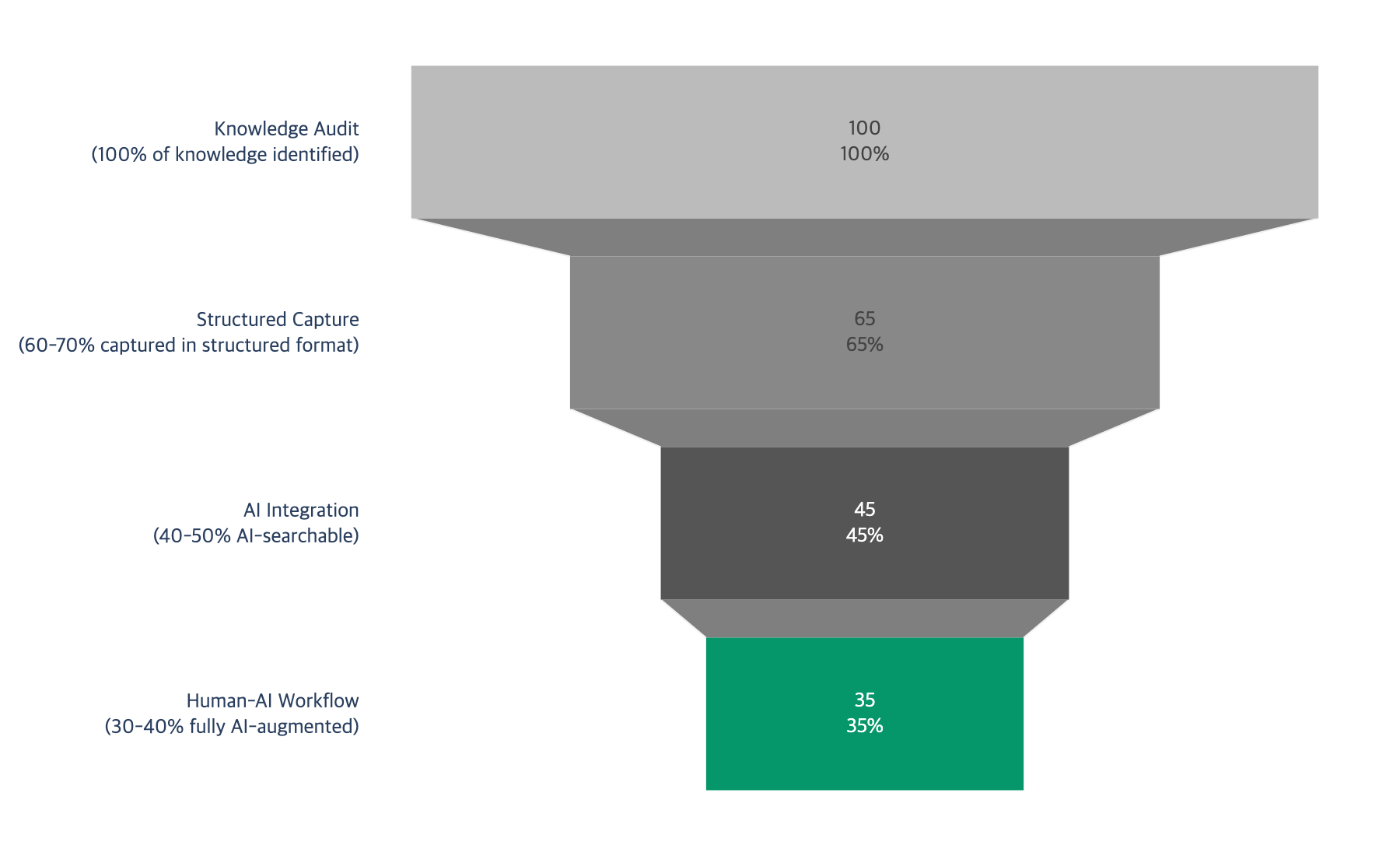
The funnel illustrates a key reality: not all tribal knowledge needs to be fully AI-augmented. The audit identifies 100 percent of critical knowledge, structured capture preserves 60 to 70 percent, AI integration makes 40 to 50 percent actionable, and full workflow integration covers the 30 to 40 percent of decisions that benefit most from augmentation. The goal is to handle routine decisions efficiently so that human experts focus on complex problems where their experience is irreplaceable.
IV. What a Functional AI Knowledge Base Requires
The difference between a searchable document repository and a functional AI knowledge base lies in three structural requirements specific to industrial chemistry. A document repository answers the question "do we have information about this topic?" while a functional knowledge base answers "what should we do given these specific conditions?" The second question is the one that field engineers actually need answered.
Structured Data, Not Just Documents
A functional knowledge base requires structured data organized around decision-relevant variables: product chemistry, substrate materials, operating conditions, failure modes, and recommended actions. Documents are inputs to the knowledge base, not the knowledge base itself.
Consider a typical technical service report: "Customer reported adhesion failure of the epoxy primer on galvanized steel after three months outdoor. Recommended zinc-chromate primer." Structuring this record means tagging the substrate, failure mode, exposure conditions, root cause, and resolution as discrete, searchable variables. Once structured, this record becomes comparable and available for pattern analysis across hundreds of similar cases.
Mechanism-Based Reasoning Frameworks
Industrial chemistry decisions depend on understanding why products perform or fail under specific conditions. An AI knowledge base that only matches keywords cannot distinguish between a corrosion problem caused by pH drift and one caused by galvanic coupling, even though the corrective actions differ completely. Mechanism-based reasoning frameworks encode causal relationships between operating conditions, chemical reactions, and product performance.
When a field engineer describes a corrosion pattern on a heat exchanger tube, a mechanism-based system evaluates whether the pattern is consistent with under-deposit corrosion, microbiologically influenced corrosion, or galvanic effects. Each mechanism implies a different root cause and a different set of products. Without this reasoning layer, the system defaults to generic recommendations.
Domain-Specific Training
The global AI in chemicals market, valued at USD 943 million in 2023, is projected to reach USD 5.24 billion by 2030 (SmartDev, 2024), and 94 percent of chemical executives see AI as critical to future success (ChemCopilot, 2025). Yet deploying it effectively requires domain-specific knowledge engineering that most organizations have not undertaken. A model that understands the relationship between viscosity index, operating temperature, and bearing life can provide actionable recommendations. A generic model that treats "viscosity" as a keyword cannot. McKinsey estimates that AI can reduce chemical R&D costs by up to 40 percent (McKinsey, 2024), but only when grounded in domain-specific knowledge.
V. Implementation Realities: What Field Teams Should Expect
The roadmap above provides a structural framework, but field teams need to understand the practical realities. The transition from tribal knowledge to an AI-augmented knowledge base is not a technology project. It is an organizational change initiative that affects how people work and how decisions are made.
The Expert Participation Challenge
The most critical success factor in Phases 1 and 2 is the active participation of senior engineers, who are also the people with the least available time. They handle customer emergencies, train junior staff, and manage their regular workload. Securing their participation requires leadership commitment, including dedicated time blocks and clear communication about why the effort matters.
Resistance from senior engineers is common. Some fear that codifying their knowledge will reduce their value. Others are skeptical that any system can capture the nuance of their expertise. Both concerns are legitimate. Knowledge capture does not replace the expert. It extends their reach, allowing expertise to help a junior colleague in another office at 2 AM. Framing the effort as amplification rather than replacement changes the conversation.
The Data Quality Problem
Organizations typically discover during Phase 2 that their existing documentation is less useful than expected. Technical bulletins may be outdated. CRM records may contain recommendations without reasoning. Field reports may use inconsistent terminology. The 23 percent of machine downtime caused by human errors, resulting in an estimated USD 92 billion annual loss for U.S. manufacturers (Pycio, 2024), is partly attributable to knowledge that exists in the organization but is not accessible when needed.
The Adoption Curve
Field engineers will not adopt AI-augmented tools simply because they are available. Adoption requires that the tool demonstrate value within the first few interactions. If a field engineer receives a generic or incorrect answer, trust is damaged and recovery is slow. The quality of AI outputs is directly proportional to the quality of the structured knowledge that feeds them. Organizations that rush through capture to reach the "AI phase" typically produce systems that erode rather than build trust.
VI. The Compounding Advantage of Early Movers
Organizations that begin knowledge structuring now gain advantages that compound over time, while those that wait face an accelerating gap.
The Data Advantage
Every structured knowledge record and every validated product recommendation adds to the knowledge base's value. Organizations that start with 100 structured records in year one may have 1,000 by year three, each refining the AI model's accuracy. Late starters will find that the expertise they need to capture is no longer available because the experts have retired.
The mathematics are unforgiving. If an organization begins structured capture today with 15 senior engineers available and three retire each year, the capture window narrows by 20 percent annually. Waiting three years means starting with only six of the original experts. The knowledge those nine retired engineers carried cannot be reconstructed from documents because, by definition, tribal knowledge was never documented.
Figure 3. Knowledge Value Compounding: Early Adopter vs. Late Starter
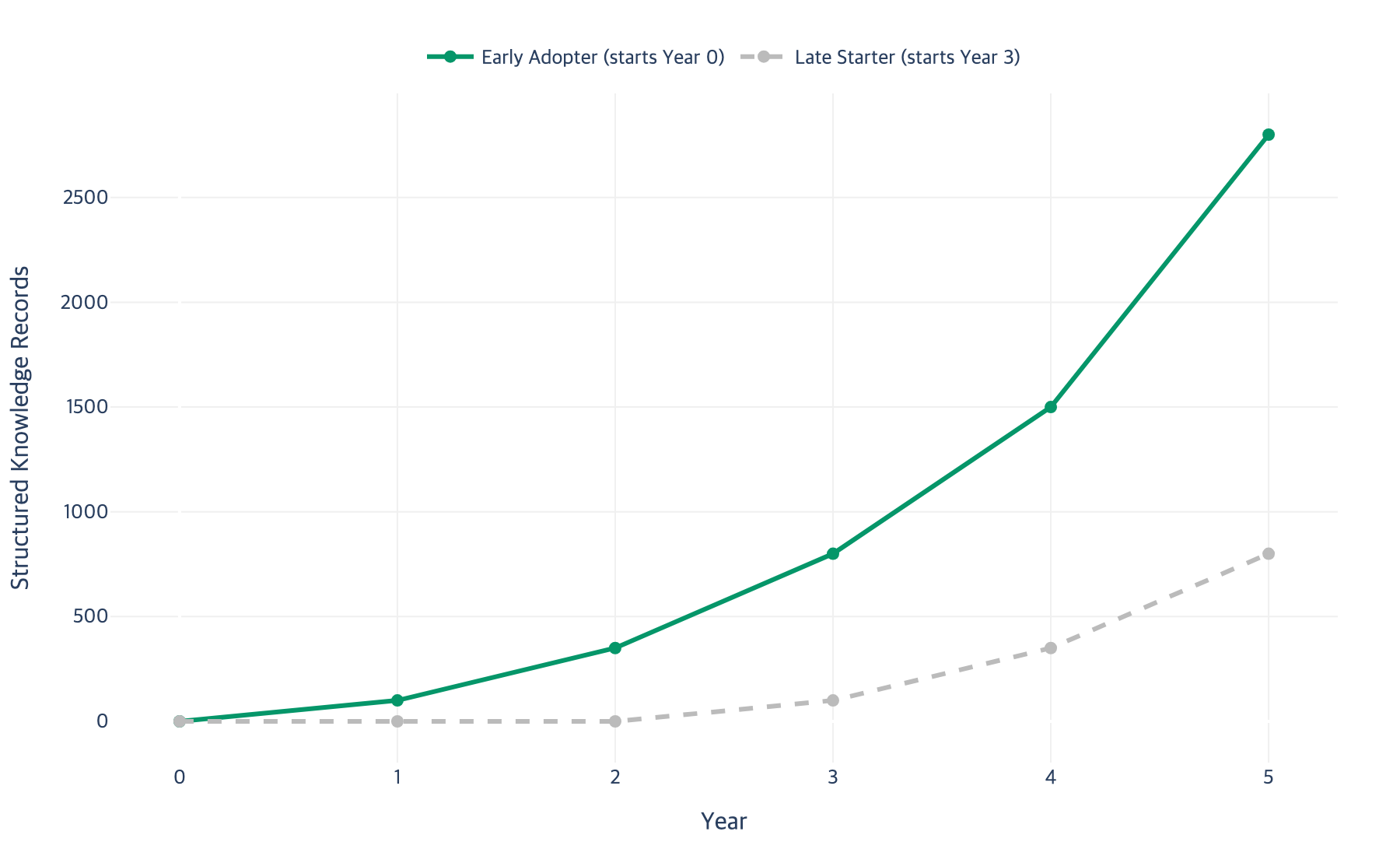
The compounding curve shows that a three-year delay does not simply shift the timeline. By year five, the early adopter has approximately 3.5 times more structured knowledge records, a gap that widens as AI models benefit from a larger training dataset. More critically, the senior experts needed for knowledge capture may no longer be available three years from now.
The Workflow Integration Advantage
AI-augmented workflows take time to refine. Early adopters learn which decisions benefit from AI assistance, how to design effective escalation paths, and how to build trust between field engineers and AI recommendations. An organization that has spent two years refining its human-AI workflow has developed institutional muscle memory around when to trust the tool and when to escalate. A late starter deploying the same technology two years later still faces the full learning curve.
The Competitive Moat
In industries where product knowledge is the primary differentiator, a chemical distributor with an AI knowledge base that provides mechanism-based recommendations in minutes will outcompete one that depends on waiting for a senior engineer to return a phone call. This competitive gap widens with every month of delay.
The replacement cost for specialized technical employees ranges from 50 to 200 percent of annual salary (SHRM, 2024), and new hires may take months to years to reach predecessor productivity levels. An AI-augmented knowledge base dramatically reduces this ramp-up time by giving new engineers access to the organization's collective expertise from day one.
VII. Key Takeaway
The retirement wave is creating an urgent knowledge preservation crisis, with 2.8 million manufacturing vacancies expected from retirements alone through 2033 and USD 47 million in annual knowledge transfer losses for large businesses.
Chemical expertise is uniquely difficult to capture because it involves multi-variable, tacit, and mechanism-based reasoning. Fifty-seven percent of retiring Baby Boomers report having shared less than half of the knowledge their successors need.
A realistic transformation spans 12 to 36 months across four phases: knowledge audit, structured capture, AI integration, and human-AI workflow design.
Structured capture is the most critical phase, converting tacit expertise into variable-tagged records that enable AI reasoning rather than keyword matching.
Early movers gain compounding advantages. Waiting three years permanently reduces the available knowledge pool as experts retire and their expertise disappears.
Lubinpla's platform is built on this exact framework: a domain-specific AI knowledge base structured around industrial chemistry mechanisms, enabling technical teams to access cross-referenced product recommendations and troubleshooting intelligence that would otherwise require decades of individual experience. For teams facing the reality of retiring expertise, Lubinpla's AI Assistant transforms scattered tribal knowledge into structured decision support, so that every engineer operates with the depth of the organization's collective experience.
VIII. References
[1] Korra, "The Economic Impact of Knowledge Loss Due to an Aging Workforce in Industrial Companies", 2024. https://korra.ai/economic-impact-of-knowledge-loss/
[2] FP360, "The Industrial Brain Drain: How Retirements Are Leaving Knowledge Gaps in Manufacturing", 2024. https://fp360group.com/industrial-brain-drain-knowledge-gaps-manufacturing/
[3] ChemCopilot, "Digital Transformation in the Global Chemical Industry: From Tacit Knowledge to AI-Driven Ecosystems", 2025. https://www.chemcopilot.com/blog/digital-transformation-in-the-global-chemical-industry-from-tacit-knowledge-to-ai-driven-ecosystems
[4] Salfati Group, "Tribal Knowledge Management: The 2025 Guide to Capturing Expertise", 2025. https://salfati.group/topics/tribal-knowledge
[5] SmartDev, "AI in Chemical Industry: Top Use Cases You Need To Know", 2024. https://smartdev.com/ai-use-cases-in-chemical-industry/
[6] Augmentir, "What is Tribal Knowledge and How Do You Capture It?", 2024. https://www.augmentir.com/glossary/what-is-tribal-knowledge
[7] Dirac Inc., "How Retirement Is Draining America's Manufacturing Expertise", 2024. https://www.diracinc.com/resources/the-silver-exodus-how-retirement-is-draining-americas-manufacturing-expertise
[8] TechBullion, "The Hidden Costs of Tribal Knowledge", 2024. https://techbullion.com/the-hidden-costs-of-tribal-knowledge-why-industrial-operators-need-systems-that-survive-turnover/
[9] McKinsey, "How AI Enables New Possibilities in Chemicals", 2024. https://www.mckinsey.com/industries/chemicals/our-insights/how-ai-enables-new-possibilities-in-chemicals
[10] Enthought, "Utilizing LLMs Today in Industrial Materials and Chemical R&D", 2024. https://www.enthought.com/blog/utilizing-llms-today-in-industrial-materials-and-chemical-rd
[11] EY, "Transforming Chemicals R&D with AI", 2024. https://www.ey.com/en_us/insights/oil-gas/transforming-chemicals-r-and-d-with-ai
[12] Supplyframe, "The Five Levels of Digital Maturity in Global Manufacturing", 2024. https://intelligence.supplyframe.com/the-five-levels-of-digital-maturity-in-global-manufacturing/
[13] AEM, "The Aging Workforce: 4 Ways Manufacturers Can Prepare Themselves", 2024. https://www.aem.org/news/the-aging-workforce-4-ways-manufacturers-can-prepare-themselves
[14] Pycio, "Why US Manufacturing Productivity is Declining and How to Fix It", 2024. https://pycio.com/why-us-manufacturing-productivity-is-declining-and-how-to-fix-it/
[15] ScienceDirect, "Application of Retrieval-Augmented Generation for Interactive Industrial Knowledge Management via a Large Language Model", 2025. https://www.sciencedirect.com/science/article/pii/S0920548925000248
Powered by Lubinpla
Discover how technical teams solve complex challenges faster with AI.