How AI Analyzes Product Performance Across Operating Conditions to Reveal Hidden Optimization Opportunities
Summary: Industrial chemical products rarely perform uniformly across all operating environments, yet most technical teams evaluate products under a narrow set of conditions. This article explores how AI platforms aggregate anonymized performance data across varied field conditions to build multi-dimensional performance landscapes. By mapping product effectiveness as a function of temperature, pH, concentration, and substrate type, mechanism-based AI identifies condition combinations where products outperform or underperform expectations, enabling engineers to fine-tune application parameters for their specific environments.
Table of Contents
I. The Limits of Single-Site Product Evaluation
II. Building the Performance Landscape: Multi-Variable Mapping
III. Field Data Aggregation: Challenges and Solutions
IV. Pattern Detection: How AI Identifies Hidden Condition-Performance Relationships
V. Product Categories Where AI Analysis Adds the Most Value
VI. From Correlation to Mechanism: Validating AI-Generated Insights
VII. Human-AI Collaboration in Collective Knowledge Building
VIII. Implementation Pathway for Data-Driven Product Evaluation
IX. Key Takeaway
X. References
I. The Limits of Single-Site Product Evaluation
Every industrial chemical product comes with a technical data sheet specifying recommended operating conditions. These specifications typically cover standard ranges for temperature, concentration, and pH, tested under controlled laboratory conditions. However, field environments rarely match these idealized parameters, and the gap between laboratory performance and field performance is where most optimization opportunities hide.
The Single-Variable Testing Problem
Traditional product evaluation follows a sequential, single-variable approach. A corrosion inhibitor is tested at the recommended dosage under standard conditions, and if results are satisfactory, the product is approved. This approach treats each operating variable independently and assumes linear performance relationships. In practice, chemical product performance is governed by multi-variable interactions that produce non-linear responses. A corrosion inhibitor performing adequately at 40 degrees Celsius and pH 7.5 may fail when pH shifts to 8.2, because elevated pH alters the inhibitor's film-forming mechanism on the specific substrate.
McKinsey research indicates that advanced analytics in chemical manufacturing can improve productivity by 10 to 25 percent by identifying optimization opportunities that traditional methods miss (McKinsey, 2023).
The Controlled Environment Assumption
ASTM and ISO testing standards provide essential baselines for product certification, but they operate under controlled conditions that diverge significantly from field reality. Laboratory tests typically hold temperature constant, use deionized or standardized water, and evaluate one performance metric at a time. In real-world cooling towers, boiler systems, and process loops, temperature cycles continuously, water chemistry fluctuates with seasonal source changes, and multiple performance demands compete simultaneously. A case study in the Permian Basin demonstrated that phosphonate-based scale inhibitors showed complete inhibition under standard test conditions, but performance dropped to 30 to 40 percent inhibition when combined with certain active corrosion inhibitor components present in the actual field treatment program (AMPP, 2024). This type of multi-product interaction is invisible to single-product laboratory evaluation.
The Data Isolation Problem
Each technical team operates within its own data silo. Across the industry, thousands of facilities generate performance data under different water chemistries, ambient temperatures, substrate materials, and product concentrations. Collectively, these datasets contain the information needed to map complete product performance landscapes. However, chemical companies still rely on fragmented data stored across spreadsheets, laboratory notebooks, and outdated software, which prevents any single organization from seeing the full picture (GlobeNewsWire, 2025). The challenge has always been aggregating this knowledge without compromising proprietary information.
Time and Resource Constraints
Comprehensive multi-variable testing is theoretically possible but practically prohibitive. Testing a single product across five temperature levels, five pH levels, four concentration levels, and three substrate types requires 300 individual test runs. Each run demands sample preparation, equipment time, analytical measurement, and data recording. At a conservative estimate of two hours per run, this amounts to 600 hours of laboratory work for one product under one set of water chemistry conditions. Most organizations can allocate only a fraction of this effort, resulting in product evaluations based on 10 to 20 data points rather than the hundreds needed for a complete performance picture.
II. Building the Performance Landscape: Multi-Variable Mapping
A performance landscape describes how product effectiveness varies across a multi-dimensional space of operating conditions. AI constructs a continuous surface mapping performance as a function of all relevant variables simultaneously, transforming isolated test results into comprehensive understanding.
How Aggregated Data Becomes a Performance Map
Anonymized field data, including product type, dosage, temperature, pH, water chemistry, substrate type, and performance outcomes, is collected and standardized. Machine learning algorithms learn the non-linear relationships between input parameters and output performance (Precedence Research, 2025). The result is a multi-dimensional performance map where each axis represents an operating variable and the surface represents product effectiveness.
Consider a scale inhibitor used in cooling water systems. Traditional evaluation tests the product at three temperatures and three calcium hardness levels, producing nine data points. An AI platform aggregating data from hundreds of installations constructs a continuous performance surface, revealing that effectiveness drops sharply at a specific temperature-hardness combination that none of the nine test points captured.
The Role of Feature Engineering
AI platforms apply feature engineering to transform raw measurements into chemically meaningful variables. Rather than treating pH, temperature, alkalinity, and calcium hardness as independent inputs, the system calculates derived indices such as the Langelier Saturation Index, the Ryznar Stability Index, and the Puckorius Scaling Index. These composite variables encode the thermodynamic relationships that govern scaling and corrosion behavior, ensuring the performance landscape reflects actual chemical mechanisms rather than statistical artifacts (Processes, 2020).
Feature engineering also handles unit normalization and temporal alignment. Field data arrives in inconsistent formats: some facilities report temperature in Celsius, others in Fahrenheit; some log dosage in mg/L, others in ppm of active ingredient. The AI preprocessing pipeline standardizes these inputs before model training, ensuring that data from different sources can be meaningfully combined without introducing systematic bias.
Interpolation and Extrapolation Boundaries
A critical aspect of AI-generated performance maps is distinguishing between interpolation and extrapolation. Where aggregated data is dense, the model interpolates between known data points with high confidence. Where data is sparse, the model must extrapolate, and the uncertainty increases accordingly. Well-designed AI platforms explicitly communicate these boundaries, displaying confidence intervals that widen in data-sparse regions. This transparency enables engineers to trust high-confidence predictions while recognizing where additional testing would be valuable.
III. Field Data Aggregation: Challenges and Solutions
Constructing performance landscapes from field data is conceptually straightforward but operationally challenging. The chemical industry faces several distinct obstacles in aggregating meaningful data across sites and organizations.
Data Quality and Consistency
Field data is inherently messier than laboratory data. Sensors drift, calibration schedules vary, and manual data entry introduces transcription errors. A pH reading of 7.5 from one facility may not be directly comparable to a pH reading of 7.5 from another if their measurement instruments have different accuracy levels or calibration intervals. AI platforms address this through statistical quality filters that flag outliers, cross-validate measurements against expected ranges, and weight data points by measurement reliability. Facilities with recently calibrated instrumentation and automated data logging receive higher data quality scores than those relying on manual monthly readings.
Standardizing Performance Metrics
Different facilities measure product performance differently. One plant may evaluate corrosion inhibitor effectiveness by coupon weight loss over 90 days, another by linear polarization resistance readings taken weekly, and a third by visual inspection ratings on a qualitative scale. Normalizing these diverse metrics into a common performance scale requires domain expertise encoded into the AI platform. The system must understand that a corrosion rate of 2.0 mils per year measured by coupon and 2.3 mils per year measured by linear polarization resistance represent equivalent performance, not a discrepancy.
Privacy-Preserving Aggregation
Industrial facilities have legitimate concerns about sharing operational data. Water chemistry, treatment program details, and performance outcomes can reveal competitive information about process efficiency and operating costs. Effective data aggregation requires privacy-preserving techniques that extract statistical patterns without exposing individual facility data. Differential privacy, federated learning, and secure multi-party computation are approaches that allow AI models to learn from distributed data without centralizing raw information. The result is a model that reflects collective knowledge while individual contributions remain confidential.
Temporal Variability
Field conditions change over time, and performance data must account for seasonal patterns, process upsets, and gradual system changes. A scale inhibitor evaluation conducted during winter months in a cooling tower system may show different results than one conducted during summer peak load. AI platforms handle temporal variability by treating time and season as additional variables in the performance landscape, or by aggregating data across sufficiently long time periods that seasonal effects average out. Models can also identify temporal trends, detecting when a product's effectiveness is gradually declining due to system aging or changing source water quality.
IV. Pattern Detection: How AI Identifies Hidden Condition-Performance Relationships
With a performance landscape constructed, AI algorithms systematically scan for patterns that human analysis would typically miss. These patterns fall into several categories, each with distinct implications for product optimization.
Unexpected Performance Peaks and Valleys
The most actionable insights come from condition combinations where performance deviates significantly from expected trends. A lubricant additive might show consistent positive correlation between concentration and wear protection, but exhibit a reversed relationship at a narrow temperature band, indicating a phase transition or mechanism shift from boundary to mixed film lubrication. Machine learning methods such as eXtreme Gradient Boosting have demonstrated the ability to predict tribological performance of lubricants under multi-variable conditions, with particle swarm optimization identifying the precise additive concentration proportions that maximize protection at each operating point (ScienceDirect, 2024).
Cross-Domain Performance Correlations
Mechanism-based AI detects correlations across traditionally separate domains. An AI analyzing materials protection and industrial lubricants might identify that facilities with elevated cooling water corrosion also report higher lubricant degradation in nearby equipment, connected by airborne contaminant transfer from cooling tower drift. Lubinpla's platform detects these cross-domain patterns across its 65 core disciplines and 93 product portfolio categories simultaneously.
These cross-domain correlations often reveal root causes that elude traditional troubleshooting. When a facilities team investigates lubricant degradation in isolation, they focus on lubricant selection, contamination ingress, and operating temperature. Only by correlating with data from the adjacent water treatment system does the connection to cooling tower drift become apparent. AI makes this type of cross-domain investigation automatic rather than serendipitous.
Threshold Effects
Many chemical products exhibit threshold effects where performance changes abruptly. Machine learning models can identify that an inhibitor maintains greater than 95 percent protection up to 55 degrees Celsius at neutral pH, but this threshold drops to 42 degrees Celsius when chloride exceeds 500 ppm (Nature, 2022). This conditional threshold information is extremely valuable but nearly impossible to derive from single-site data.
Research on corrosion inhibitor performance confirms that effectiveness is encumbered by numerous interacting variables, including temperature, pressure, pH, flow speed, and chemical composition of the production fluid, with inhibitors generally performing better under low-temperature conditions than high-temperature conditions (RSC Advances, 2024). The AI's ability to map these interacting thresholds across the full variable space provides engineers with boundary conditions they can use to set process alarms and trigger dosage adjustments before performance degrades.
Interaction Effects Between Product Components
In real-world treatment programs, multiple chemical products operate simultaneously. Scale inhibitors, corrosion inhibitors, biocides, and dispersants interact in ways that laboratory testing of individual products cannot predict. AI analysis of aggregated field data can detect synergistic combinations where two products together outperform expectations, as well as antagonistic combinations where one product undermines another. These interaction effects often depend on specific operating conditions, making them particularly difficult to identify without large-scale multi-variable analysis.
Figure 2. Optimization Capability Comparison: Single-Variable Testing vs AI Multi-Variable Analysis
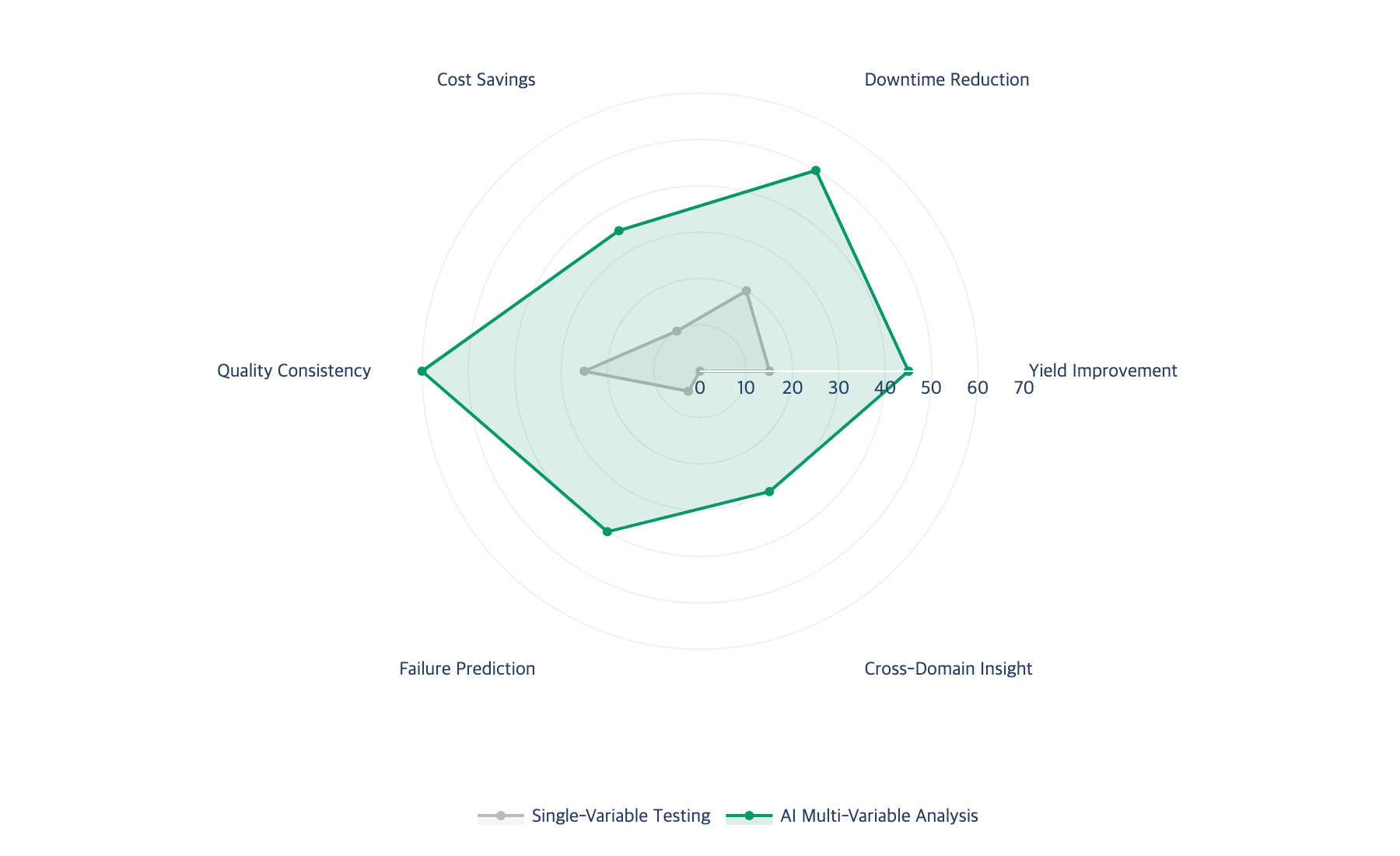
The radar chart compares the relative improvement potential of traditional single-variable testing against AI-powered multi-variable analysis across six key performance dimensions. AI multi-variable analysis delivers substantially greater gains in failure prediction and cross-domain insight, capabilities that single-variable approaches cannot address by design.
V. Product Categories Where AI Analysis Adds the Most Value
AI-driven performance analysis delivers varying levels of value depending on the product category. The greatest returns come from categories where multi-variable interactions are strongest, field conditions vary widely, and the cost of suboptimal performance is highest.
Corrosion Inhibitors
Corrosion inhibitors represent perhaps the highest-value category for AI performance analysis. Inhibitor effectiveness depends on temperature, pH, dissolved oxygen, flow velocity, chloride concentration, substrate metallurgy, and the presence of co-treatment chemicals. A film-forming amine inhibitor may perform well on carbon steel at moderate temperatures but lose effectiveness on copper alloys or at elevated temperatures where the protective film becomes unstable. Research published in RSC Advances (2024) confirms that corrosion inhibitor effectiveness varies significantly with environmental conditions, and that approaches including tailoring formulations to specific conditions and implementing real-time monitoring systems are needed to manage this variability. AI performance mapping across hundreds of field installations reveals the precise condition boundaries where each inhibitor type transitions from effective to inadequate, enabling engineers to select and dose inhibitors with confidence for their specific environment.
Scale Inhibitors
Scale formation depends on water chemistry parameters that interact in complex, non-linear ways. Calcium carbonate scaling propensity is governed by the interplay of calcium hardness, alkalinity, pH, and temperature. Calcium sulfate scaling adds sulfate concentration and ionic strength to the equation. Silica scaling introduces its own temperature-dependent solubility curve. An AI platform mapping scale inhibitor performance across all these variables simultaneously can identify specific water chemistry profiles where a particular inhibitor excels and others where it fails, information that traditional testing at a handful of conditions cannot provide.
Industrial Lubricants and Metalworking Fluids
Lubricant performance depends on load, speed, temperature, surface material, contamination level, and fluid age. AI research has demonstrated that deep learning and hybrid physics-AI frameworks can predict key lubricant properties such as viscosity, oxidation stability, and wear resistance directly from molecular or spectral data, reducing the need for long-duration field trials (MDPI Lubricants, 2026). Multi-variable AI analysis of field data can map the performance envelope for each lubricant formulation, identifying operating regions where a product provides excellent protection and regions where an alternative formulation would be more effective. AI-enabled condition monitoring has shown a 4.5-fold increase in critical alerts with a 30-day lead time, enabling predictive maintenance that prevents equipment damage before it occurs.
Biocides and Microbiological Control Agents
Biocide effectiveness depends on microorganism type, biofilm age, temperature, pH, organic loading, and the presence of competing oxidants or reducing agents. A biocide effective against planktonic bacteria in clean water may be ineffective against established biofilm in a nutrient-rich system. AI analysis of field biocide performance data across diverse installations reveals the conditions under which each biocide type achieves acceptable microbiological control and the conditions where treatment failure is likely, enabling engineers to design more robust microbiological control programs.
Specialty Cleaning and Surface Treatment Chemicals
Cleaning agents, degreasers, passivation chemicals, and surface treatment products all exhibit condition-dependent performance. Cleaning effectiveness depends on temperature, concentration, contact time, soil type, and mechanical action. AI performance mapping can identify the minimum effective concentration at each temperature for each soil type, enabling cost optimization without sacrificing cleaning performance.
VI. From Correlation to Mechanism: Validating AI-Generated Insights
The critical differentiator of mechanism-based AI is its ability to validate detected patterns against known chemical and physical principles, separating actionable insights from spurious correlations.
The Mechanism Validation Framework
When AI identifies an unexpected performance pattern, it cross-references the finding against its knowledge base of chemical mechanisms. If a corrosion inhibitor shows reduced performance at elevated pH despite increased alkalinity, the AI might determine that the inhibitor forms a protective film through pH-dependent adsorption, and above a certain pH, the film-forming species converts to a less effective ionic form. This mechanism-based validation distinguishes actionable findings from statistical artifacts.
The validation process operates at multiple levels. At the molecular level, the AI checks whether the observed behavior aligns with known reaction kinetics and equilibrium chemistry. At the system level, it verifies that the pattern is consistent with transport phenomena, mass transfer limitations, and equipment design characteristics. At the operational level, it confirms that the pattern persists across different facilities with similar conditions, ruling out site-specific confounders.
Confidence Scoring
AI platforms assign confidence scores based on data density, consistency across sources, and alignment with established chemical principles. A performance pattern supported by data from 50 installations, consistent across three different measurement methods, and explainable by a well-established chemical mechanism receives a high confidence score. A pattern observed in data from only three installations, measured by a single method, and without a clear mechanistic explanation receives a lower score with recommendations for targeted testing, maintaining the engineer's role as the final decision-maker.
The confidence scoring system also accounts for data recency. Performance data from the last 12 months receives higher weight than data from five years ago, reflecting the reality that water sources change, equipment ages, and environmental regulations evolve. This temporal weighting ensures that recommendations reflect current conditions rather than historical averages.
Distinguishing Causation from Correlation
AI can identify correlations efficiently, but not all correlations represent causal relationships. A naive model might observe that corrosion rates are higher during summer and conclude that temperature is the sole cause, missing the fact that summer also brings higher microbiological activity, increased cooling demand, and more frequent blowdown cycles. Mechanism-based AI untangles these confounded variables by testing each potential causal pathway against the established chemistry, presenting engineers with a ranked list of likely causal factors rather than a single oversimplified attribution.
VII. Human-AI Collaboration in Collective Knowledge Building
AI-driven performance analysis creates a positive feedback loop where each user's data contribution improves the insights available to all participants.
The Contribution-Benefit Cycle
When a field engineer enters operating conditions and performance outcomes, this data is anonymized and added to the aggregate dataset. The AI periodically retrains its models, incorporating new data to refine performance landscapes. The AI in chemicals market, valued at approximately 2.83 billion USD in 2025 and projected to reach 28 billion USD by 2034 at a CAGR of 32 percent, reflects growing recognition that collective data analysis delivers value no individual organization can replicate (Precedence Research, 2025).
Each new data point has asymmetric value: it contributes marginally to the aggregate model but returns the full predictive power of the entire dataset to the contributor. A single facility adding its performance data gains access to insights derived from hundreds of other facilities operating under different conditions. This network effect means the platform becomes more valuable as participation grows, incentivizing early adoption.
Figure 1. Global AI in Chemicals Market Size Projection (2025 to 2034)
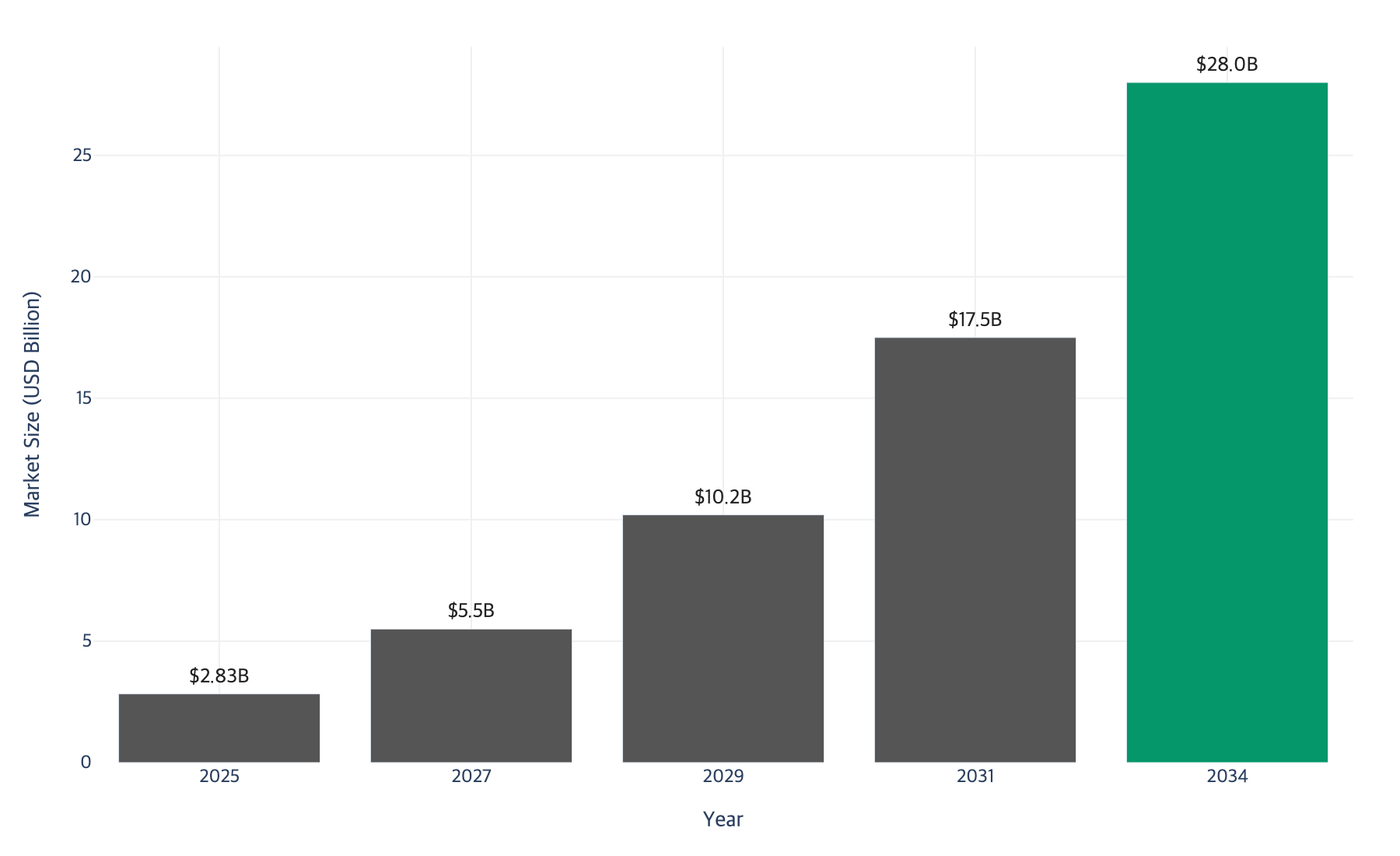
The projected market trajectory illustrates the accelerating adoption of AI-driven analytics across the chemical industry. The compound annual growth rate of 32 percent signals that organizations increasingly view AI-assisted optimization as operationally essential rather than experimental.
Privacy and Practical Application
Individual data points are anonymized before aggregation, removing company identifiers and proprietary formulations. Query results are returned as condition-specific recommendations rather than raw data, preventing reverse-engineering of contributor parameters. For the field engineer, the interface is straightforward: enter operating conditions and the AI returns a performance prediction with confidence intervals and optimization recommendations, transforming the workflow from reactive troubleshooting to proactive optimization.
The Role of Expert Feedback
AI-generated insights are strengthened when field engineers provide feedback on recommendation accuracy. If a platform predicts that a specific inhibitor dosage will achieve 95 percent protection under certain conditions, and the engineer reports actual protection of 88 percent, this feedback loop tightens the model. Over time, the system learns not just from raw data but from the gap between predictions and outcomes, continuously improving its accuracy. This human-in-the-loop approach ensures that the AI evolves in alignment with real-world experience rather than drifting toward theoretical optima that do not account for practical constraints.
VIII. Implementation Pathway for Data-Driven Product Evaluation
Transitioning from traditional product evaluation to AI-driven performance analysis is not an overnight shift. Organizations benefit from a phased approach that builds capability and confidence incrementally.
Phase 1: Data Inventory and Standardization
The first step is understanding what data already exists. Most organizations have years of performance records scattered across laboratory information management systems, spreadsheets, operator logs, and vendor reports. The initial phase involves cataloging these data sources, assessing data quality, and establishing standardized formats for ongoing data collection. This phase typically requires two to four weeks and involves collaboration between process engineers, laboratory staff, and IT personnel.
Phase 2: Baseline Performance Mapping
With standardized data in hand, the organization creates its first performance maps using internal data alone. These maps reveal the organization's own knowledge gaps, showing where data is dense and where significant portions of the operating space remain unmapped. Even without AI, this exercise often produces immediate insights, as visualizing performance data across multiple variables highlights patterns that were not apparent in tabular reports.
Phase 3: AI-Assisted Analysis with Aggregated Data
In this phase, the organization connects to an AI platform that aggregates anonymized data from multiple contributors. The organization's internal data is enriched by collective field data, dramatically expanding the coverage of the performance landscape. The AI identifies optimization opportunities specific to the organization's operating conditions, drawing on the full breadth of the aggregated dataset.
Phase 4: Continuous Optimization and Feedback
The final phase integrates AI-driven product evaluation into routine operations. Engineers query the platform before making treatment changes, receive condition-specific recommendations, and report outcomes that feed back into the model. Performance monitoring becomes continuous rather than periodic, and product optimization becomes proactive rather than reactive. Organizations at this stage typically report reductions in chemical spend through optimized dosing, fewer unexpected performance failures, and faster resolution of emerging issues.
Measuring Return on Investment
The value of AI-driven product evaluation manifests in several measurable outcomes: reduced chemical consumption through optimized dosing, fewer equipment failures through better product selection, lower maintenance costs through proactive rather than reactive management, and reduced downtime through early warning of performance degradation. McKinsey estimates that advanced analytics in chemical manufacturing can improve productivity by 10 to 25 percent (McKinsey, 2023), though the specific return depends on the organization's current optimization level and the complexity of its operating environment.
IX. Key Takeaway
Multi-variable performance landscapes reveal optimization opportunities that single-variable testing systematically misses, particularly at condition boundary intersections where non-linear effects dominate.
Field data aggregation requires solving quality, standardization, and privacy challenges, but the resulting collective intelligence far exceeds what any single organization can generate alone.
Cross-domain data analysis connects seemingly unrelated performance issues, enabling root cause identification across traditional discipline boundaries.
Product categories with the strongest multi-variable interactions, such as corrosion inhibitors, scale inhibitors, and industrial lubricants, benefit most from AI-driven performance mapping.
Mechanism-based validation separates actionable insights from statistical noise by cross-referencing detected patterns against established chemical principles.
Privacy-preserving data aggregation creates a positive feedback loop where each user's contribution improves collective knowledge without exposing proprietary data.
A phased implementation pathway, from data inventory through continuous optimization, enables organizations to build capability and confidence incrementally.
Field engineers can shift from reactive troubleshooting to proactive optimization by querying AI-generated performance maps for their specific operating conditions.
What if your team could query a performance landscape built from thousands of field installations, instantly identifying the optimal dosage, application method, and monitoring frequency for your exact operating conditions? Lubinpla's AI Assistant makes this possible by mapping product performance across its four primary domains and 93 product portfolio categories, providing field engineers with condition-specific optimization insights grounded in mechanism-level analysis of aggregated field data. The platform transforms scattered industry knowledge into actionable intelligence, turning every contributor's experience into a shared advantage that no single organization could build alone.
X. References
[1] McKinsey & Company, "Using Advanced Analytics to Boost Productivity and Profitability in Chemical Manufacturing", 2023. https://www.mckinsey.com/industries/chemicals/our-insights/using-advanced-analytics-to-boost-productivity-and-profitability-in-chemical-manufacturing
[2] Precedence Research, "Artificial Intelligence (AI) in Chemicals Market to Worth USD 28.00 Billion by 2034", 2025. https://www.precedenceresearch.com/artificial-intelligence-in-the-chemical-market
[3] MDPI Processes, "A Review on Artificial Intelligence Enabled Design, Synthesis, and Process Optimization of Chemical Products for Industry 4.0", 2023. https://www.mdpi.com/2227-9717/11/2/330
[4] Intelecy, "How AI Is Revolutionizing the Chemical Industry: Process Optimization, Energy Management, and Predictive Maintenance", 2024. https://www.intelecy.com/blog/ai-chemical-industry-process-optimization
[5] Nature, "Reviewing Machine Learning of Corrosion Prediction in a Data-Oriented Perspective", 2022. https://www.nature.com/articles/s41529-022-00218-4
[6] Nexocode, "Advanced Predictive Analytics in Chemical Manufacturing: Improving Your Chemical Operations", 2024. https://nexocode.com/blog/posts/predictive-analytics-in-chemical-manufacturing/
[7] MDPI Processes, "Multi-Objective Optimization Applications in Chemical Process Engineering: Tutorial and Review", 2020. https://www.mdpi.com/2227-9717/8/5/508
[8] ScienceDirect, "Transparent AI-Assisted Chemical Engineering Process: Machine Learning Modeling and Multi-Objective Optimization", 2024. https://www.sciencedirect.com/science/article/abs/pii/S095965262400859X
[9] PMC, "Advanced Machine Learning Techniques for Corrosion Rate Estimation and Prediction in Industrial Cooling Water Pipelines", 2024. https://pmc.ncbi.nlm.nih.gov/articles/PMC11175261/
[10] Springer, "Machine Learning-Driven Prediction of Corrosion Inhibitor Efficiency: Emerging Algorithms, Challenges, and Future Outlooks", 2025. https://link.springer.com/article/10.1007/s13369-025-10386-5
[11] Grand View Research, "AI In Chemicals Market Size, Share and Trends Report, 2030", 2025. https://www.grandviewresearch.com/industry-analysis/ai-chemicals-market-report
[12] ChemCopilot, "Process Optimization and Efficiency in the Chemical Industry: From AI to Continuous Flow", 2024. https://www.chemcopilot.com/blog/process-optimization-and-efficiency-in-the-chemical-industry-from-ai-to-continuous-flow
[13] AMPP, "Field Case Study: Impact of Corrosion Inhibitor on Scale Control", 2024. https://content.ampp.org/ampp/proceedings-abstract/CONF_MAR2024/2024/1/60301
[14] RSC Advances, "Current and Emerging Trends of Inorganic, Organic and Eco-Friendly Corrosion Inhibitors", 2024. https://pubs.rsc.org/en/content/articlehtml/2024/ra/d4ra05662k
[15] GlobeNewsWire, "Artificial Intelligence in Chemicals Research Report 2024-2030", 2025. https://www.globenewswire.com/news-release/2025/02/25/3032214/28124/en/Artificial-Intelligence-in-Chemicals-Research-Report-2024-2030-AI-and-IoT-Revolutionize-Chemical-Production-with-Efficiency-Sustainability-and-Smart-Manufacturing.html
[16] ScienceDirect, "Effective Tribological Performance-Oriented Concentration Optimization of Lubricant Additives Based on a Machine Learning Approach", 2024. https://www.sciencedirect.com/science/article/pii/S0301679X2400522X
[17] MDPI Lubricants, "Artificial Intelligence in Lubricant Research: Advances in Monitoring and Predictive Maintenance", 2026. https://www.mdpi.com/2075-4442/14/2/72
Powered by Lubinpla
Discover how technical teams solve complex challenges faster with AI.